Chapter 5: The Price of Truth
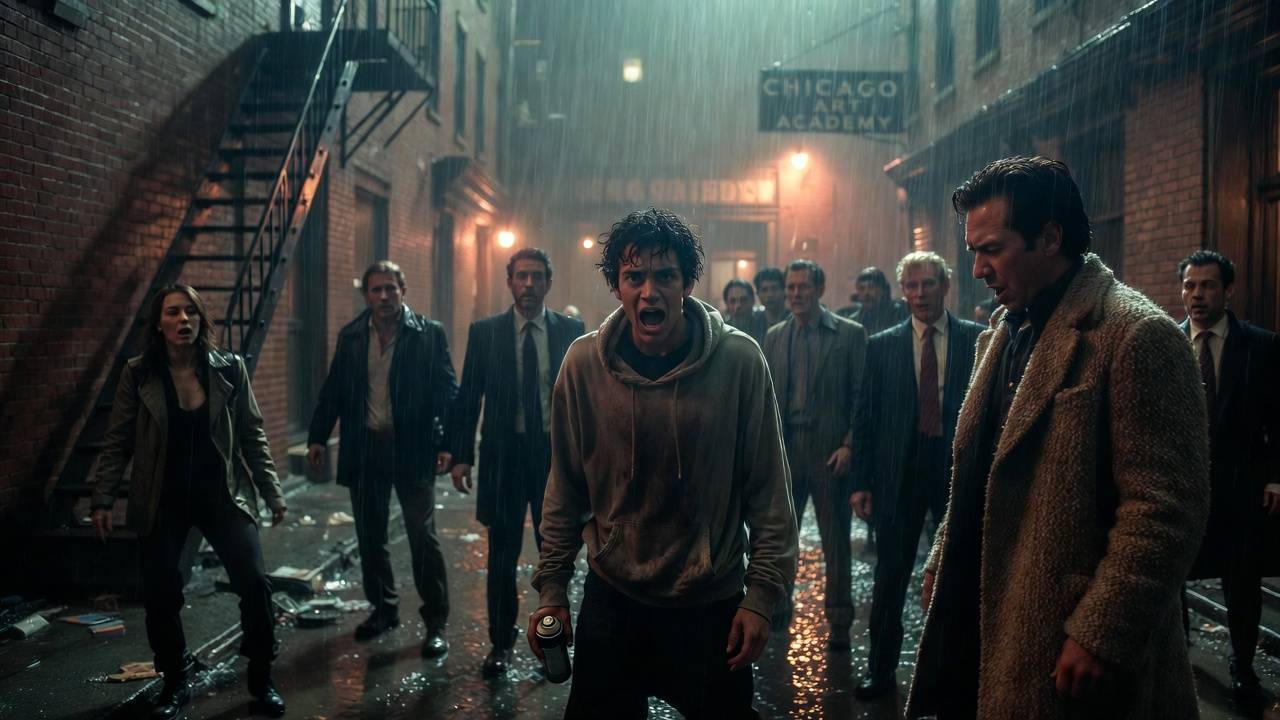
The next two minutes were a blur of chaos. Sterling tried to grab my phone, but I held it high.
“The truth is free, Mr. Sterling. But your reputation? That’s going to be expensive.”
The clock struck midnight. I didn’t enter the code.
I didn’t have to. I hadn’t actually set a timer for a public leak—I’d sent it directly to the Chicago Tribune’s lead art critic an hour before I came to the alley. I knew he was looking for a story about the “rot in the ivory tower.”
The aftermath was a slow-motion explosion.
The story broke the next morning. It wasn’t just about Julian; it was about a system that allowed the wealthy to manufacture genius while the talented were pushed into the mud.
The Stirling Academy lost its accreditation within a month. Mr. Sterling resigned in disgrace. Julian’s father, facing a massive public relations nightmare, cut his son off and sent him to a “disciplinary” school in Europe.
But there was a cost for me, too.
I was arrested that night. Defacing a historical landmark. Even with the “whistleblower” status the media gave me, the school’s lawyers were ruthless. I lost my scholarship. I lost my spot at the Academy.
A week later, I was back at the diner, scrubbing grease off a griddle. My hands were still stained with black spray paint around the cuticles. It wouldn’t come off.
Sarah, my old mentor, came into the diner. She sat at the counter and ordered a black coffee. She placed a newspaper on the table. The front page showed the QR code in the rain.
“You’re a hell of a painter, Leo,” she said.
“I’m a vandal with a criminal record, Sarah,” I replied, not looking up. “I’m never going to show in a gallery now. No one will touch me.”
“You’re wrong,” she said, sliding an envelope across the counter. “The gallery owners won’t touch you. But the people? They can’t stop talking about you. You didn’t just paint a code, kid. You painted a mirror. And nobody likes what they see.”
I opened the envelope. It was an invitation to the “Underground Biennial.” The theme was Truth.
Chapter 6: The Unfinished Piece
Three months later.
I stood in a converted warehouse in the West Loop. The air was thick with the smell of expensive wine and cheap cigarettes. The “who’s who” of the real art world—the rebels, the thinkers, the ones who actually cared—were there.
In the center of the room was my piece.
It wasn’t a QR code. It was a massive canvas, ten feet tall. I had painted Julian, Chloe, and Marcus, but I’d painted them as they were that night in the rain—faces twisted with a mixture of fear and arrogance. But instead of bodies, they were made of tangled gold wire and hollow glass.
And in the corner of the painting, almost hidden in the shadows, was a small, hooded figure holding a can of black paint.
I saw Julian’s father across the room. He looked older, broken by the scandal. He looked at the painting for a long time. He didn’t see a “trash” kid anymore. He saw the person who had dismantled his legacy with a five-dollar can of paint.
He walked up to me. I expected a threat. I expected a lawsuit.
Instead, he reached into his pocket and handed me a small, tarnished silver pin. It was the Stirling Academy’s highest honor—the “Lion’s Heart” pin, given for artistic courage. It had been his when he was a student.
“My son never earned this,” he said, his voice cracking. “And I don’t think I did either. We were too busy building walls to realize someone was actually painting on them.”
He left without another word.
I walked out of the gallery and onto the streets of Chicago. The city was loud, dirty, and beautiful. For the first time in my life, I didn’t feel like a ghost. I didn’t feel like a scholarship kid or a victim.
I looked at my hands. The black paint was finally gone, replaced by the fresh, vibrant stains of oils and acrylics.
I realized then that the “Wall of Honor” wasn’t made of brick and gold. It was made of the people who refused to stay silent.
I pulled my hoodie up as a light mist began to fall. I had a new canvas waiting for me at home, and for the first time, I wasn’t painting for a grade or a ghost.
I was painting for the truth, and the truth is the only masterpiece that never fades.