CHAPTER 5: THE RECKONING
By 8:00 AM the next morning, “Julian Sterling” was the top trending topic on X.
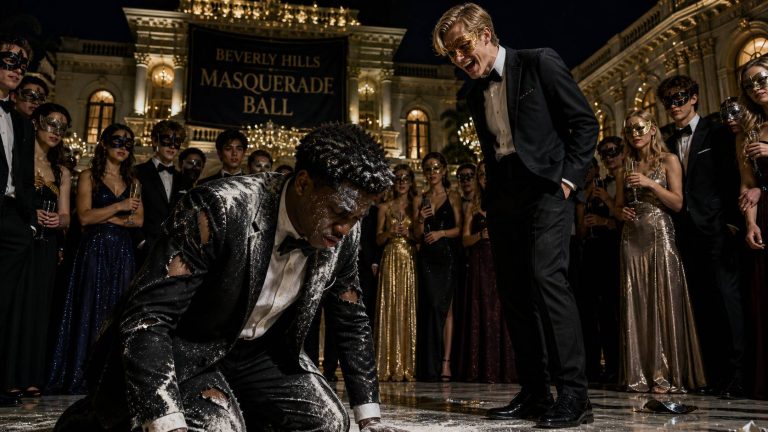
The video Marcus’s virus had attached—the “Beggar Bot” POV—was everywhere. It was cinematic, brutal, and undeniable. You could see Julian’s face in 4K resolution, his laughter echoing as he humiliated a boy whose only crime was being better than him.
The “Founders Club” arrived at school to find the gates swarming with news vans.
Julian stepped out of his Tesla, his usual swagger replaced by a confused frown. “What is this? Is there an award ceremony?”
A reporter shoved a microphone in his face. “Mr. Sterling, do you have a comment on the ‘DNA’ remark you made to Marcus Thorne? Or the fact that Stanford has already formally withdrawn your application and issued a lifetime ban?”
Julian froze. His face went gray. “What? That’s… that’s a mistake. I didn’t—”
“The video is online, Julian,” a voice called out.
It was Sarah. She was standing at the top of the stairs, her eyes red from crying. She held up her phone. “Everyone’s seen it. The real you. The version of you that doesn’t have a PR team.”
Julian’s father, the billionaire, arrived twenty minutes later. Not to comfort his son, but to scream at him in the hallway. “Do you have any idea what this does to the IPO? You idiot! You put it in writing? You put it on video?”
The “Founders Club” crumbled. Leo and Caleb were escorted out by campus security as the school board scrambled to distance themselves from the scandal.
In the middle of the chaos, Marcus walked through the front doors.
The hallway, usually a gauntlet of whispers and sneers, went silent. Students parted like the Red Sea. They didn’t look at Marcus with pity anymore. They looked at him with a profound, terrifying respect.
He walked straight to Julian, who was sitting on a bench, his head in his hands.
“You said that robot suited my genes, Julian,” Marcus said quietly.
Julian looked up, his eyes hollow. “You ruined my life. You hacked me. That’s a felony, Marcus. My dad will sue you into the dirt.”
“Actually,” Marcus leaned in, “the virus didn’t ‘hack’ anything. It just organized your own files. You submitted them yourself. You signed the ethics agreement. You told the truth for the first time in your life. That’s not a crime. That’s just… efficient programming.”
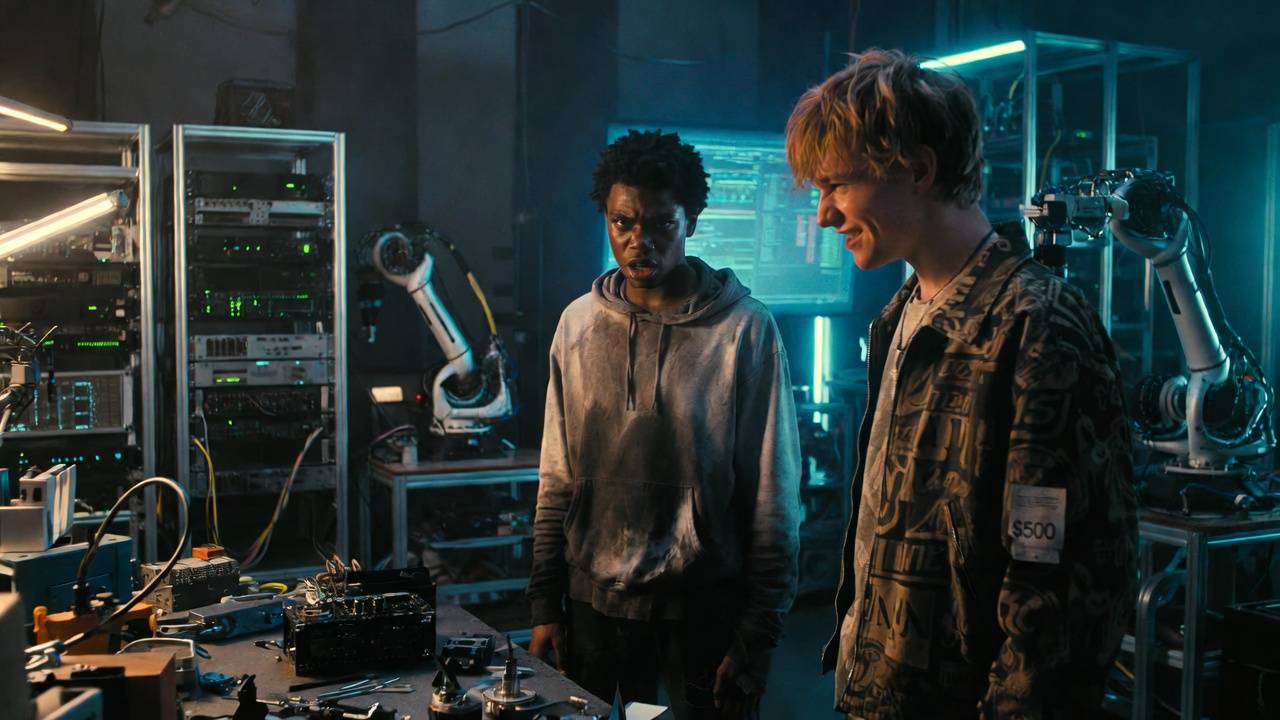
Marcus turned and walked away. He had a meeting with a representative from MIT who had seen his original designs for Aegis—the ones Marcus had uploaded to an open-source forum months ago.
The genius wasn’t in the revenge. It was in the work Julian had tried to destroy.
CHAPTER 6: NEW ARCHITECTURE
Six months later.
The dust in Silicon Valley never truly settles, but the landscape had shifted. Julian’s father had stepped down. The “Founders Club” were now names mentioned in ethics textbooks as a cautionary tale of “Toxic Tech Culture.”
Marcus stood on the stage at a national robotics gala. He wasn’t wearing a grease-stained hoodie anymore, but a sharp suit. Behind him sat the rebuilt Aegis. It wasn’t a beggar. It was a sophisticated medical assistant bot designed to help nurses in underfunded clinics—a tribute to his mother.
He looked out into the crowd. He saw Coach Miller, who had been promoted to Head of the Technology Department. He saw Sarah, who was now running a non-profit for girls in STEM.
And in the very back, he saw his mother. She wasn’t wearing scrubs. She was wearing a dress the color of a sunrise, crying tears of pure, unadulterated pride.
Marcus didn’t talk about Julian in his speech. He didn’t talk about the “Beggar Bot” or the scandal. He talked about the architecture of the soul.
“We spend so much time teaching machines how to think,” Marcus told the hushed audience, “that we forget to teach ourselves how to feel. We build firewalls to keep people out, but we forget that the most dangerous viruses are the ones we grow inside ourselves: arrogance, hate, and the belief that someone else is ‘less than’ because of where they come from.”
After the ceremony, he walked out into the cool night air. His phone buzzed. A message from an unknown number. It was a photo of a rusted tin cup sitting in a trash can outside a local community center.
Marcus didn’t reply. He deleted the message.
He walked to his mother, who was waiting by the car. They didn’t need words. He had proven that you could break a machine, and you could even break a heart, but you can never delete the truth once it’s been written into the world.
As they drove away from the glittering lights of the valley toward a future he had built with his own two hands, Marcus realized that he wasn’t a servant or a king.
He was the architect of his own destiny, and his code was finally, beautifully clean.
True power isn’t found in the machines we build, but in the humanity we refuse to let them break.