The chain-link fence at the corner of 4th and Atlantic didn’t just keep the basketballs in; it kept the world out. Or so we thought.
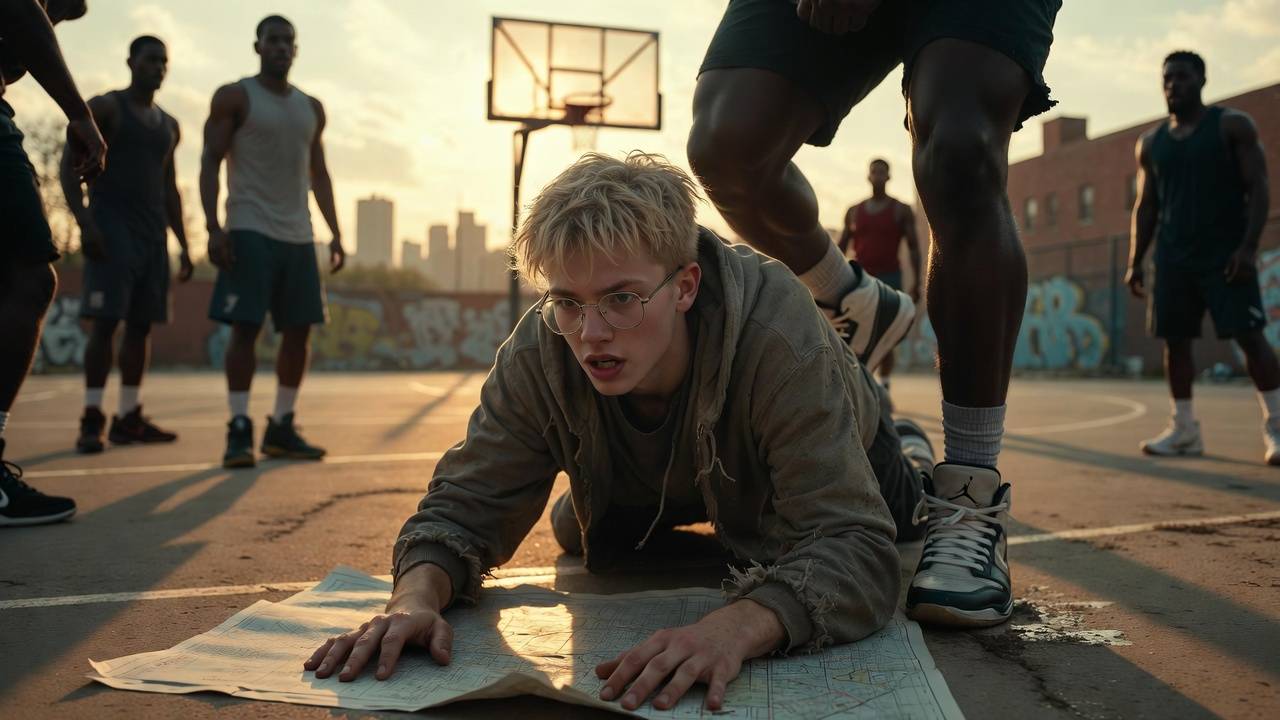
I was on my knees, the heat of the Brooklyn asphalt seeping through my jeans. The air smelled like exhaust, cheap cologne, and the looming threat of rain.
Jax stood over me, his shadow swallowing me whole. He was the king of these courts—a 6’4″ blur of muscle and resentment. To him, I was just “The Ghost,” the skinny white kid who sat on the bleachers with a sketchbook and a backpack full of “useless” dreams.
“You’re lost, Ghost,” Jax sneered, his voice vibrating in his chest. “This isn’t for people who use books to hide from reality. This is for us. People who actually live.”
He kicked a clump of mud toward my bag. Then he pointed at his sneakers—custom Jordans that cost more than my dad’s first car.
“Clean ’em. Use one of those fancy papers you’re always scribbling on.”
The guys behind him laughed, but it was a hollow sound. They were hungry. They were tired. And they were looking for someone to blame for the fact that the neighborhood was disappearing.
I didn’t argue. I didn’t fight back. My heart was a drum in my ears, but my hands were steady. I reached into my tube and pulled out the heavy, vellum sheet I’d been carrying for weeks.
It wasn’t a sketch. It wasn’t a poem.
I knelt there, in the middle of the “paints,” and began to wipe the grime off his left shoe with the corner of the paper. I could feel the blue ink smearing against the white leather.
“That’s it,” Jax mocked, though his eyes looked uncertain. “Know your place.”
I looked up at him, my glasses fogging from the humidity. I didn’t feel small. For the first time in my life, I felt like the most powerful person on that court.
“You’re right, Jax,” I said, my voice barely a whisper. “I am using books to hide from reality. But you should probably look at what’s on this paper before you decide whose reality we’re living in.”
I stood up and flattened the paper against his chest.
The laughter stopped.
Jax looked down. His eyes scanned the bold, black lines, the stamps of the City Planning Commission, and the name at the bottom: Vance Holdings.
He saw the red perimeter drawn around the very spot we were standing on. He saw the words “PROPOSED DEMOLITION” and “PRIVATE LUXURY RESIDENCES.”
And then he saw my handwriting in the margins, redesigning the entire structure to include a community center and a library—the only version of the plan that kept this court alive.
“My dad bought this lot yesterday,” I told him, as the silence turned deafening. “And I’m the only person in his ear telling him why he shouldn’t tear it down.”
Read the full story in the comments.
If you don’t see the new chapter, tap ‘All comments’.
FULL STORY
CHAPTER 2: THE BLOOD BENEATH THE BLUEPRINTS
The walk home from the courts was always the longest part of my day. In Brooklyn, neighborhoods change block by block, like a quilt stitched together by people who don’t speak the same language. By the time I hit the brownstones of Park Slope, the smell of street-cart souvlaki had been replaced by the scent of expensive lavender and artisanal coffee.
I entered my house—a four-story masterpiece of glass and original molding—and felt the immediate chill of the central air. It felt like a tomb.
“Leo? Is that you?”
My mother, Sarah, appeared in the doorway of the kitchen, a glass of Chardonnay in one hand and her phone in the other. She was a partner at one of the city’s top law firms. To her, “The City” was a series of chess moves. To me, it was a living, breathing thing that was being suffocated.
“You’re late,” she said, her eyes drifting to the smudge of dirt on my forehead. “And you’ve been at that park again. We’ve talked about this. That area is… transitioning. It’s not safe for you to be hanging around there.”
“Transitioning is a nice word for ‘being erased,’ Mom,” I muttered, heading for the stairs.
“Don’t be dramatic. Your father is doing great things for this city. He’s creating jobs. He’s modernizing.”
I stopped on the third step. “He’s buying memories and turning them into square footage. There’s a difference.”
I locked myself in my room, a space filled with architectural models and maps. On my desk lay the original master plan for the “Atlantic Commons Project.” My father, Arthur Vance, was a man who measured success in vertical feet. He wasn’t a villain in his own mind; he was a visionary. But his vision didn’t have room for a basketball court where kids like Jax felt like kings.
I remembered my grandfather taking me to that court when I was six. He’d grown up in a tenement three blocks away. “This is the heartbeat, Leo,” he’d say, pointing to the players. “As long as the ball is bouncing, the neighborhood is alive.”
My grandfather died three years ago. Two weeks later, my father sold his old house to a developer.
I pulled out my laptop and opened the CAD files I’d been working on in secret. I had spent months trying to find a compromise—a way to satisfy my father’s greed while saving the “heartbeat.” I had designed a multi-use complex that integrated the library my father wanted to donate for a tax break with the existing basketball courts.
It was a beautiful design. It was efficient. It was also, according to my father, “a waste of prime real estate.”
A knock on the door interrupted my thoughts. It wasn’t the soft tap of my mother. It was the heavy, rhythmic thud of a man who owned the ground he walked on.
“Leo. Open up.”
I opened the door. My father stood there, still in his charcoal suit, looking like he’d just stepped off a private jet.
“I got a call from the site supervisor,” he said, his voice flat. “He said someone saw a kid matching your description talking to the locals on the 4th Street lot. And he said you were carrying a set of the revised schematics.”
He stepped into the room, his presence making the walls feel closer.
“Those are proprietary documents, Leo. They aren’t toys for you to show off to your ‘friends’ in the street.”
“They aren’t my friends, Dad,” I said, my voice shaking. “They’re people who live there. People who have nowhere else to go.”
“They’ll go where everyone else goes. Somewhere cheaper. That’s the way of the world.” He pointed to the map on my desk. “I’m building a legacy. A library with my name on it. That’s worth more than a cracked piece of asphalt.”
“Is it? Or is it just about making sure everyone forgets what was there before you?”
My father leaned in, his eyes cold. “You’re young. You think the world runs on sentiment. It doesn’t. It runs on contracts. And that court? The contract is signed. The bulldozers move in on Monday.”
He turned to leave, but stopped at the door. “And stay away from there. If I hear you’ve been back, I’m taking the car, the tuition, and that computer you use to play ‘architect.’ Grow up, Leo.”
The door clicked shut. I looked at the map. I looked at the dirt Jax’s shoes had left on my sleeve.
I didn’t feel like growing up. I felt like starting a war.
FULL STORY
CHAPTER 3: THE UNLIKELY ALLY
The next morning, the air in Brooklyn felt heavy, like it was holding its breath. I didn’t go to school. Instead, I took the subway three stops back to 4th and Atlantic.
The court was empty, except for one person. Manny.
Manny was a fixture. He was seventy if he was a day, with skin like old leather and eyes that had seen every trend, every riot, and every championship the borough had to offer. He sat on the same milk crate every morning, a whistle around his neck that he hadn’t blown in a decade.
“You’re back,” Manny said, not looking up from the newspaper. “Thought after yesterday, you’d be hiding under your bed.”
“I have something to show you,” I said, sitting on the bleachers.
“I saw what you showed Jax. Bold move, Ghost. Stupid, but bold. You realize you gave ’em a reason to hate you more, right? Now you’re the face of the enemy.”
“I’m not the enemy. I’m trying to stop it.”
Manny finally looked at me. “How? Your old man is the one holding the pen. In this city, the man with the pen always beats the man with the ball.”
“Not if the man with the pen realizes the ball is the only thing keeping the city from burning down.” I pulled out my laptop—the one my father threatened to take away—and showed Manny the designs. “I’ve integrated the court into the library. It’s a sunken court, protected by the building’s architecture. It saves the space and gives my dad the ‘monument’ he wants.”
Manny squinted at the screen. “It’s fancy. Looks like something out of a movie. But your daddy don’t want ‘those kids’ in his library. He wants people who buy ten-dollar lattes.”
“If we can get the community to back this—not just protest, but demand this specific plan—the city council won’t approve his permits. They’re already under pressure for the lack of green space in the new developments.”
Manny sighed, a long, weary sound. “You need Jax. You need the neighborhood to show up. And right now, Jax wants to put your head through a hoop.”
“Then help me talk to him.”
Manny looked at the court. He looked at the “Vance Holdings” sign that had been bolted to the fence overnight.
“Jax’s brother, Deon… he’s a good kid. Smart. Likes to draw, just like you. But he hides it because in this neighborhood, you either play ball or you’re a target. Jax protects him. That’s Jax’s weakness. He’s not fighting for himself. He’s fighting so Deon has a place to be someone.”
Manny stood up, his knees cracking. “Come on. He’ll be at the bodega on 5th. But if this goes south, I’m telling everyone I never met you.”
We found Jax sitting on the hood of an old Chevy, drinking a blue Gatorade. When he saw me, his entire body tensed. He looked like a coiled spring.
“You got five seconds before I forget Manny is standing there,” Jax said, his voice a low growl.
“The bulldozers are coming Monday,” I said, skipping the pleasantries. “I have a way to stop them. But I need you to lead the neighborhood.”
Jax laughed, a bitter, jagged sound. “Lead them where? To your daddy’s office? He’d have us arrested before we hit the lobby.”
“No. To the court. Sunday night. We’re going to draw the new lines ourselves. We’re going to show them that this isn’t just a lot. It’s an anchor.”
I handed him a copy of my design. Not the technical blueprint, but a rendered image of what the court could look like—vibrant, modern, and still theirs.
Jax looked at the image. I saw his eyes flicker. He saw himself in that picture. He saw Deon.
“Why you doing this, Ghost?” Jax asked, his gaze finally meeting mine. “You’re rich. You could live anywhere. Why do you care about this dump?”
“Because my grandfather’s name is etched into the concrete under those bleachers,” I said. “And because I’m tired of my father thinking he can buy the soul of a place just because he has the deed.”
Jax stayed silent for a long time. He looked at the paper, then at the street.
“Sunday night,” he said finally. “Bring your ‘books,’ Ghost. We’re gonna need a lot of chalk.”
FULL STORY
CHAPTER 4: THE CALM BEFORE THE CRACKS
Saturday was a blur of nervous energy. I spent the day buying every stick of industrial sidewalk chalk I could find. I also spent it lying to my parents.
“I’m staying at a friend’s house to study for the finals,” I told my mother. She barely looked up from her iPad.
“Fine. Just be back for brunch on Sunday. Your father wants to discuss your summer internship at the firm.”
I nodded, feeling a pang of guilt that was quickly swallowed by a sense of purpose. I wasn’t just Leo Vance anymore. I was a double agent in the war for Brooklyn’s heart.
Sunday evening arrived with a bruise-colored sky. I met Jax, Deon, and about fifty others at the court. The atmosphere was electric, a mix of hope and pure, unadulterated fear. These people had seen their shops closed, their rents doubled, and their friends evicted. They were used to losing.
“Listen up!” Jax yelled, standing on the bleachers. The crowd went silent. “This kid… the Ghost… he says there’s a way to keep this place. He says if we make enough noise, the city won’t let his old man tear it down. I don’t know if he’s lying. I don’t know if this is just some rich-kid game.”
He looked at me, then back at the crowd.
“But I know that on Monday, we lose everything. So tonight, we give ’em a reason to remember who we are.”
We started at 9 PM.
Using my blueprints as a guide, we began to mark out the new dimensions of the proposed community center. We didn’t just draw lines; we drew dreams.
Deon and a group of kids started coloring in a massive mural in the center of the court—a phoenix made of basketballs and books. I worked alongside Jax, measuring out the perimeter of the new library wing.
“You’re not bad with a chalk line,” Jax muttered, his forehead dripping with sweat.
“I’ve spent my whole life measuring things,” I replied. “It’s the first time I’ve felt like the measurements actually mattered.”
As the night wore on, the neighborhood began to wake up. People brought out speakers. Someone started a grill. It wasn’t a protest yet; it was a block party on the edge of an abyss.
But then, the headlights appeared.
A black SUV pulled up to the fence. The engine idled, a low, predatory growl. My heart dropped into my stomach.
The door opened, and my father stepped out.
He didn’t look angry. He looked disappointed, which was far worse. He walked through the gate, his polished shoes stepping over the vibrant chalk drawings. He looked at the mural, then at the crowd, and finally at me.
“Leo,” he said, his voice amplified by the sudden silence of the crowd. “Get in the car.”
“No,” I said, standing my ground. Jax stepped up beside me, followed by Manny and Deon.
“You’re embarrassing yourself,” my father said, ignoring the fifty people surrounding him. “You think a little chalk is going to stop a multi-million dollar development? This land belongs to me. These people are trespassing.”
“They aren’t trespassing on a lot, Dad. You’re trespassing on a community.” I stepped forward, holding my laptop. “Look at the plans. I sent them to the City Council’s planning board an hour ago. I also sent them to the local news. They’re on their way, Dad. They love a story about a ‘Visionary Developer’ who refuses to save the only park in the neighborhood.”
My father’s eyes narrowed. “You did what?”
“I gave them a choice. They can back your original plan and face a public relations nightmare, or they can back the ‘Vance Community Library’—the one that keeps the court. Your name is still on it. You still get the tax break. But we get to keep our home.”
“You’ve betrayed your family, Leo,” he hissed.
“No,” I said, looking at Jax and the others. “I finally found one.”
The sound of news vans pulling up echoed down the street. The cameras were coming. The secret was out. But as my father turned to face the lights, I realized that winning the battle was only the beginning of the cost.