CHAPTER 1
The silence in Dublin, Ohio, doesn’t sound like peace. It sounds like a held breath. It’s the kind of silence that only exists in neighborhoods where the lawns are mowed to the millimeter and the secrets are buried under three layers of mulch.
I pulled my Audi into the driveway at 9:00 PM, the engine purring like a well-fed cat. I was exhausted. My back ached from twelve hours of litigating a merger that didn’t matter, and my mind was a chaotic Rolodex of billable hours.
I just wanted a glass of Chardonnay and the comfort of knowing my daughter, Maya, was safe in her room.
But when I walked through the door, the house felt cold. Not the “AC is on” cold, but the kind of cold that settles in your marrow when something is fundamentally wrong.
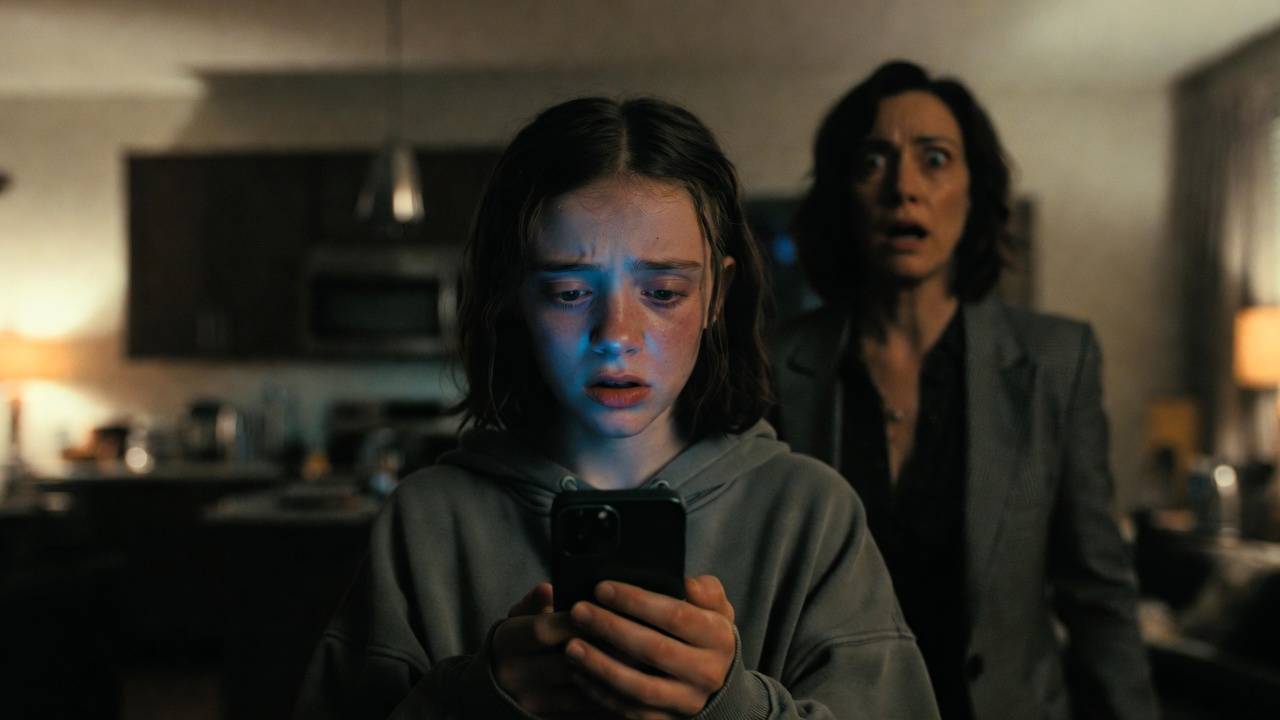
I found her in the living room. No lights on. Just the flickering, ghostly blue glow of her iPhone illuminating a face I barely recognized. Maya used to have these bright, inquisitive eyes—eyes that looked at the world like it was a gift. Now, they were sunken, rimmed with red, staring into the digital abyss.
“Maya?” I whispered, dropping my briefcase.
She didn’t move. A notification chimed. Then another. Ding. Ding. Ding. A rapid-fire execution of her spirit.
I walked over and snatched the phone. I know, I know—privacy, boundaries, “Gen Z” rights. But I’m a mother first and a lawyer second. What I saw on that screen turned my blood to slush.
It was a group chat titled “THE ASH HEAP.” Two hundred members. All of them kids from her high school. And at the center of it was a photo of Maya—a candid, cruel shot of her eating lunch alone.
The caption read: “The local ghost. Why is she still breathing our air?”
Then, a new message popped up from an account called ‘V0id’: “Everyone wishes you’d disappear from their feed, permanently. Do us a favor and log off for good.”
My heart didn’t just break; it shattered into a million jagged pieces. My little girl was being hunted in the one place I couldn’t protect her: the palm of her hand.
I looked at Maya. She wasn’t crying anymore. She was just… gone.
“I’ll fix this,” I hissed, the protective rage rising in my throat. “I’ll find out who they are. I’ll sue their parents. I’ll burn this school down if I have to.”
Maya finally looked at me. Her voice was a dry rasp. “You can’t fix the internet, Mom. You can only ignore it. Like you ignore me.”
She stood up and walked away, leaving me standing in the dark with a vibrating phone that felt like a ticking bomb. I didn’t know then that the explosion had already happened. I didn’t know that the monster I was looking for wasn’t hiding in a locker room or a suburban basement.
The monster was much closer to home.
Read the full story in the comments.
If you don’t see the new chapter, tap ‘All comments’.
FULL STORY
CHAPTER 2
The next morning, I didn’t go to the office. I called my senior partner and told him a lie about a burst pipe. In reality, the pipe that had burst was the one holding back my sanity.
I spent four hours at Maya’s school, Liberty High. It’s one of those “Blue Ribbon” schools where the halls smell like floor wax and privilege. I sat in the office of Mr. Henderson, the counselor. He was a man who looked like he’d spent twenty years trying to extinguish forest fires with a squirt bottle. He wore mismatched socks—one navy, one black—a detail that made me want to scream.
“Mrs. Sullivan,” he said, sighing. “We’re aware of the ‘Ash Heap’ chat. We’ve sent out three emails about digital citizenship this month.”
“Emails?” I slammed the screenshots onto his desk. “These kids are telling my daughter to end her life. This isn’t a lack of citizenship. This is a crime.”
“We can’t track the accounts,” Henderson said, his voice flat. “They use VPNs. They use burner apps. The ‘V0id’ account? It’s a ghost. It deletes itself every forty-eight hours and reappears with a new IP.”
I left his office feeling smaller than I had in years. I went to the grocery store to buy things I knew Maya liked—the expensive organic berries, the white cheddar popcorn. I was trying to buy her back.
When I got home, I found Maya’s room locked. I knocked, but there was no answer. I stood there, forehead against the wood, listening. I expected to hear crying. I expected the sound of a teenager in despair.
Instead, I heard typing.
Rapid, frantic clicking. The sound of someone building something.
I went to the laundry room to clear my head, grabbing Maya’s hamper. As I dumped her oversized hoodies into the washer, something heavy hit the floor with a metallic clack.
I reached into the pile of clothes. My fingers brushed against something cold and plastic. I pulled it out.
It wasn’t Maya’s iPhone. It was an old, cracked Samsung—a burner phone I’d never seen before. No case, no stickers, just a scarred screen.
My breath hitched. I pressed the home button. It wasn’t locked.
The screen flickered to life, and the last app opened was Instagram. It was logged into an account I recognized instantly.
V0id.
I felt a wave of nausea so violent I had to steady myself against the dryer. I scrolled through the sent messages.
“Why are you still breathing our air?”
“Everyone wishes you’d disappear.”
They were all there. Every hateful word, every jagged insult that had been hurled at my daughter over the last three months.
And they were all sent from this phone.
My daughter wasn’t the victim of a digital quarantine. She was the architect of it.
CHAPTER 3
I sat on the floor of the laundry room for what felt like hours, the burner phone vibrating in my hand. Each vibration felt like a tiny electric shock. My mind, trained for logic and evidence, was trying to find an alternative theory. Maybe she found it? Maybe someone planted it in her laundry?
But the “Micro-actions” of her behavior over the last month began to click into place like the tumblers of a safe. The way she would check her phone and then look at me to see if I noticed her distress. The way she only “received” the worst messages when I was in the room.
I was being played.
I felt a flicker of anger, but it was quickly smothered by a terrifying realization: How much pain must a child be in to become her own bully?
I needed help. I couldn’t confront her yet; I’d just drive her deeper into the shadows. I called Leo, my nephew. He was a twenty-two-year-old tech genius who had been “asked to leave” MIT for hacking the campus server. If anyone could trace the emotional digital footprint, it was him.
“Aunt Elena?” Leo’s voice was groggy.
“I need you at the house, Leo. Now. I’ll pay your rent for six months. Just get here.”
Two hours later, Leo was sitting at my kitchen island, surrounded by three monitors he’d hauled from his car. He looked at the burner phone, then at Maya’s actual iPhone, which I’d managed to “borrow” while she was in the shower.
“This is dark, Aunt El,” Leo whispered, his fingers flying across the keys. “She’s not just sending messages. She’s created an entire ecosystem. She has ten different accounts. They argue with each other. Some defend her, some attack her. It’s a scripted play.”
“Why?” I asked, my voice breaking.
Leo stopped typing and looked at me with pity. “Look at the timestamps, El. She sends the most ‘urgent’ threats exactly ten minutes after you log onto your work VPN. And she stops the moment you log off.”
The room tilted. My work. My “billable hours.”
“She’s not trying to disappear from the world,” Leo said softly. “She’s trying to appear to you.”
CHAPTER 4
The “Digital Quarantine” was working, but not in the way I thought. Maya had successfully isolated herself from her peers by making herself “toxic” to be around. Who wants to be friends with the girl who is constantly surrounded by online drama?
She had cleared the field so that I was the only person left in her stadium.
I decided to test the theory. That evening, I told Maya I had to go back to the office for an “emergency” filing. I watched her through the Ring camera as I sat in my car at the end of the driveway.
The moment my car lights disappeared around the corner, Maya’s window lit up.
Five minutes later, my phone buzzed. It was a text from her: “Mom, they’re posting my address. I’m scared. Please come back.”
I felt a sob rise in my chest. I wasn’t just a workaholic; I was a catalyst. I had taught her that the only way to get my attention was through a crisis. I had ignored the quiet girl, so she became a screaming victim.
I walked back into the house. I didn’t announce myself. I walked straight up the stairs, my heart drumming against my ribs. I didn’t knock. I pushed the door open.
Maya was sitting on her bed, the burner phone in one hand, her iPhone in the other. She was mid-type, her face focused, almost professional.
She looked up. The blood drained from her face. She didn’t try to hide it. She just sat there, frozen, caught in the blue light of her own making.
“I found the phone in the laundry, Maya,” I said, my voice surprisingly steady.
She didn’t cry. She didn’t apologize. She just looked at the cracked screen of the burner phone and whispered, “It was the only way to make you stay.”