Chapter 5: The Weight of the Crown
The weeks following the tournament were a whirlwind of transition. I moved from my cramped foster room into a suite in Arthur’s Manhattan penthouse that was larger than the entire community center where I’d learned to play.
But wealth wasn’t what changed me. It was the absence of fear.
For the first time, I didn’t wake up wondering if I’d have to pack my trash bags and move to a new house. I didn’t have to worry about whether there was enough milk in the fridge. That mental energy, which had been consumed by survival for seventeen years, was suddenly free.
I poured it into everything. I started working with Arthur’s engineers on a new algorithm for deep-learning neural networks. I realized that the way I saw the chess board—the patterns, the branching paths of causality—was exactly how complex systems worked in the real world.
Meanwhile, the Vane family was collapsing in slow motion.
The news of Arthur pulling out of the merger had hit the financial wires like a grenade. Vane Holdings’ stock plummeted. Creditors started calling. Within a month, Robert Vane had been forced to sell their estate in Greenwich and move into a three-bedroom condo.
Julian dropped out of the next three tournaments. He couldn’t handle the whispers. Everywhere he went, people didn’t see the Grandmaster anymore; they saw the kid who threw a tantrum and lost his family’s fortune.
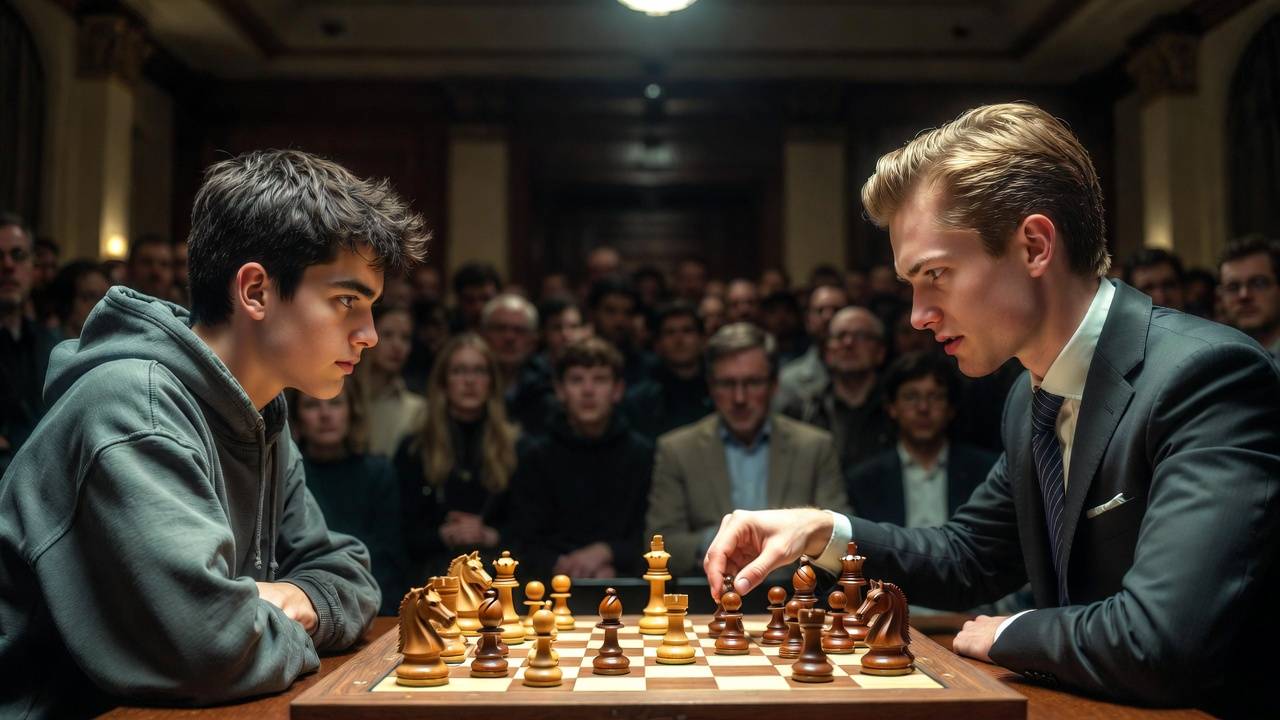
One afternoon, I was sitting in a small park in Chelsea, playing a casual game against an old man who had no idea who I was. It was the only way I could clear my head.
“You’re good, kid,” the old man said, scratching his chin. “You play like you’ve got nothing to lose, but everything to protect.”
“Something like that,” I replied, moving my Knight.
“Leo?”
I looked up. Standing on the path was Julian.
He wasn’t wearing a suit. He was wearing a plain t-shirt and jeans. He looked tired. The arrogance was gone, replaced by a hollowed-out kind of exhaustion.
“Can we talk?” he asked.
I nodded to the old man, who shrugged and wandered off to find another game. Julian sat down across from me. He looked at the board, then at me.
“My dad hates you,” Julian said bluntly. “He spends every night talking about how he’s going to sue Sterling, how he’s going to ‘get back what’s ours.'”
“And you?” I asked. “Do you hate me?”
Julian was silent for a long time. He reached out and touched a pawn, then pulled his hand back.
“I hated you because you made it look easy,” Julian said. “I’ve had a coach since I was four. I’ve had my life mapped out since before I could read. And you… you just showed up and took it. I thought if I took the board away, I could take the reality away.”
He looked me in the eye. “I was wrong. About the money. About everything. My dad… he’s not a good man, Leo. I’m starting to realize that the only reason I was ‘Golden’ was because he was paying for the gold.”
I felt a strange pang of empathy. Julian had been a villain in my story, but he was also a victim of his own privilege. He had been raised to believe that his worth was tied to a bank account, and when the account went dry, he had no idea who he was.
“What are you going to do?” I asked.
“I’m going to college,” Julian said. “A state school. My dad can’t afford the private ones anymore. And I’m quitting professional chess. I don’t love the game, Leo. I only loved winning for him.”
He stood up to leave, then paused. “That move you made… the Bishop to F4. I’ve replayed it a thousand times in my head. I still don’t know how you saw it coming ten moves back.”
I smiled. It wasn’t a smirk. It was a genuine smile. “I didn’t see it ten moves back, Julian. I saw it the moment you walked into the room. I knew you’d leave that corner open because you never think anyone can reach you there.”
Julian nodded slowly. “Checkmate,” he whispered.
He turned and walked away, disappearing into the crowd of New Yorkers. He wasn’t a prince anymore, and he wasn’t a footnote. He was just a kid trying to find a move that wasn’t dictated by his father.
Chapter 6: The Final Move
Six months later, I stood on the stage of the Lincoln Center. This wasn’t a chess tournament. This was the launch of the Sterling-Vance Foundation.
Arthur stood beside me as we announced a fifty-million-dollar endowment to provide chess programs, coding camps, and mental health resources to foster children across the country.
“We’re not just looking for the next Grandmasters,” I told the crowd, the lights blinding me for a moment. “We’re looking for the kids who think they’re invisible. We’re looking for the ones who have been told that their lives are already decided by the zip code they were born in.”
I looked out into the audience. I saw Miller, my old instructor from Akron, sitting in the front row, wearing a brand-new suit and crying openly. I saw dozens of kids in hoodies, their eyes wide with the realization that someone was finally looking at them.
After the speech, Arthur and I walked out onto the balcony overlooking the city. The Empire State Building was lit up in blue and white—the colors of our foundation.
“Your mother would have been so proud, Leo,” Arthur said softly.
“I hope so,” I replied.
I looked at the city, at the millions of people living their lives, making their moves, winning and losing. I realized that Julian had been wrong about one thing. Money doesn’t deliver the checkmate. It just changes the size of the board.
The real checkmate is when you can look at your life and realize you don’t need to win a game to be worthy. You don’t need a golden trophy to prove you exist.
I reached into my pocket and felt the smooth surface of the black Queen. I’d kept it as a reminder. Not of the win, but of the moment I realized I didn’t have to play by their rules anymore.
I took the piece and set it on the stone railing of the balcony. I left it there for the next person to find—a small piece of a larger story.
“Ready to go, Dad?” I asked.
Arthur smiled, the word ‘Dad’ still bringing a glint to his eyes. “Ready, Leo. What’s the next move?”
I looked at the horizon, where the sun was just beginning to dip below the skyline, painting the world in shades of gold and fire.
“Something bold,” I said. “Something they’ll never see coming.”
Because the best thing about being a ghost is that you can appear anywhere. And the best thing about having a soul is that you finally know what to do with the win.
No matter how many kings they knock down, the heart always knows where it belongs.