Chapter 5: The Aftermath of Light
The photo didn’t go on a cereal box.
It went on the cover of the September issue of Vogue. Then it was projected onto the side of the Burj Khalifa. Then it was on every digital billboard in Times Square.
It was titled The Sun-Kissed Ghost.
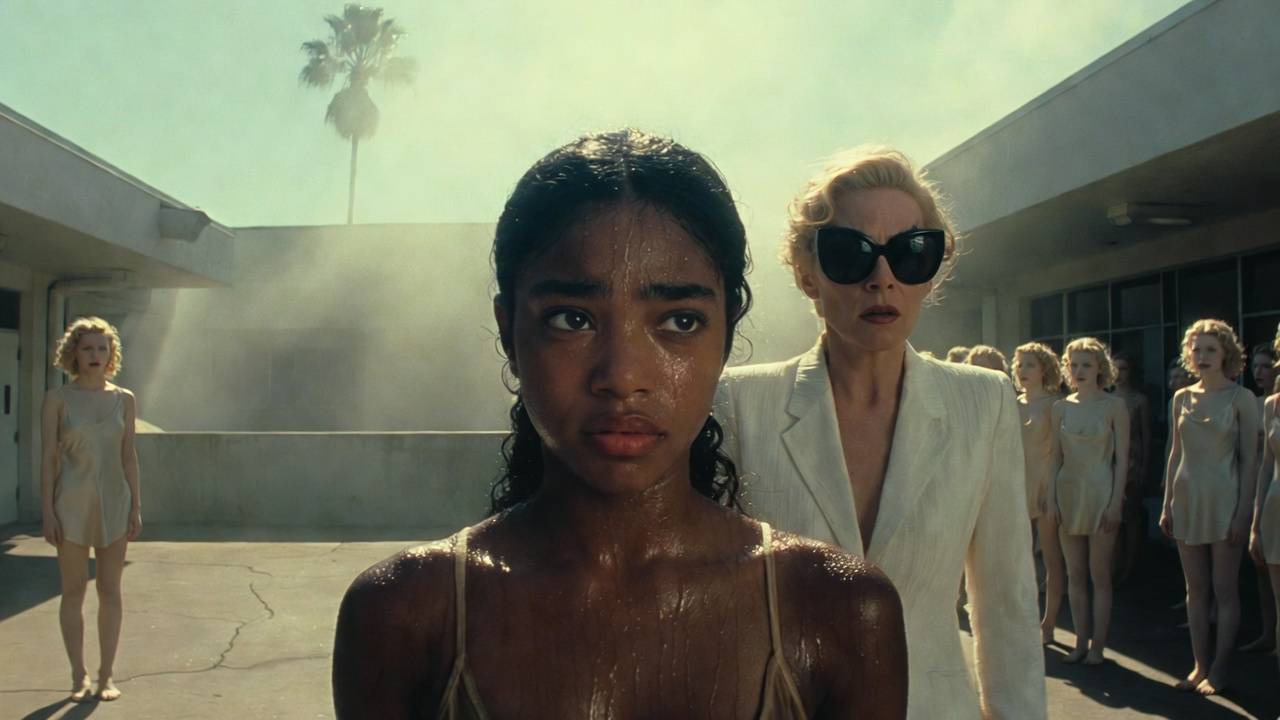
In the photo, the Porcelain Five are blurred, ghostly figures in the foreground, their expensive silk looking like cheap plastic. But in the center, I am blazing. Every bead of sweat looks like a diamond. My eyes aren’t “exotic”—they are ancient. I look like a queen standing amidst the ruins of a dollhouse.
The Vanguard Academy didn’t survive the month.
When the photo went viral, so did the story of “Compositional Endurance.” The world saw the cruelty behind the “Perfection.” Parents pulled their children. Donors fled. Madame Valeska was last seen boarding a flight to Switzerland, her reputation in tatters.
I went back to the academy one last time to get my things. The courtyard was empty. The plinth was still there, but someone had spray-painted “TRUTH” across the concrete.
I saw Chloe in the parking lot. She looked different. She was wearing jeans and a hoodie. Her blonde curls were gone, chopped into a messy bob.
“He was right, you know,” she said, her voice small.
I stopped. “About what?”
“We were plastic,” she whispered. “I spent three years trying to be a statue, and I almost forgot how to be a person. I hated you because you were real, and I was just a reflection of what someone else wanted.”
She looked at me, and for the first time, the “Rule of the Crowd” was dead. There was no one watching. No donors, no instructors. Just two girls.
“I’m sorry, Nia,” she said.
“I know,” I said.
I walked away. I didn’t need her apology, but I took it anyway. It was a heavy thing to carry, but not as heavy as the sun.
Chapter 6: The Definition of Art
Six months later.
I am standing in Times Square. My mother is next to me. She’s wearing a coat that costs more than her old car, and her hands are soft. We’ve spent the last month in Paris, Milan, and London.
She’s looking up at the fifty-foot version of my face.
“You look so strong, Nia,” she says, her eyes welling up. “Like you could carry the whole world.”
“I was just trying to stay standing, Ma,” I say, hugging her.
A group of teenagers passes by. They stop and look at the billboard. They don’t know I’m standing right there.
“Look at her skin,” one girl says, her voice full of awe. “She looks like she’s made of light. Not like those filtered-out models. She looks… human.”
I smile.
Julian Thorne once told me that the world is full of people who want to turn you into a backdrop for their own “perfection.” They want you to be quiet, to be still, to be the shadow that makes them look brighter.
But shadows have a secret. They are the only thing that proves the light is real.
I am no longer the wooden statue. I am the fire that burnt the academy down. And as I look at my mother’s smiling face, I realize that the most beautiful thing about perfection is that it doesn’t exist—but resilience does.
They tried to hide me in the background, but the sun found me anyway.
The most beautiful thing about a heart that’s been burnt is how brightly it glows.