CHAPTER 5: THE CONFRONTATION IN THE RAIN
I walked into the clearing like a specter. The rain was so thick it was like walking through a waterfall, but I knew every inch of this mud.
Miller saw me first. He scrambled back, his heels digging into the muck. He thought I was coming for revenge. He thought I had a knife, or a club, or that I was going to push him back into the cage.
“Get away!” he shrieked, his teeth chattering so hard I could hear the clicking. “Stay away from me!”
I didn’t say a word. I walked up to the mess hall porch and dropped the bundle of dry wood at his feet. I threw the emergency blanket—the crinkly, silver kind—over his shaking shoulders.
He stared at me, his eyes wide and bloodshot. The arrogance was gone. The “Master of the Universe” was just a wet, terrified boy who didn’t know how to make fire.
“Wrap it tight,” I said, my voice calm and steady against the roar of the storm. “Tuck your feet in. If you don’t stop shivering in ten minutes, your heart is going to skip. Understand?”
Caleb crawled over, clutching a corner of the blanket. He looked at me with an expression that was somewhere between worship and terror.
“You… you did this,” Miller rasped, his voice cracking. “You broke the tents.”
“The wind broke the tents, Miller,” I said. “I just reminded you that they could break.”
I knelt down and began to assemble a fire on the porch, shielded from the direct rain. My movements were slow and deliberate. I used the flint, the sparks flying bright and defiant in the dark. Within minutes, a small, stubborn flame was eating through the dry cedar.
The warmth began to radiate. The “Crowd” started to emerge from the darkness—the other shivering kids who had been hiding. They gathered around the fire I had built.
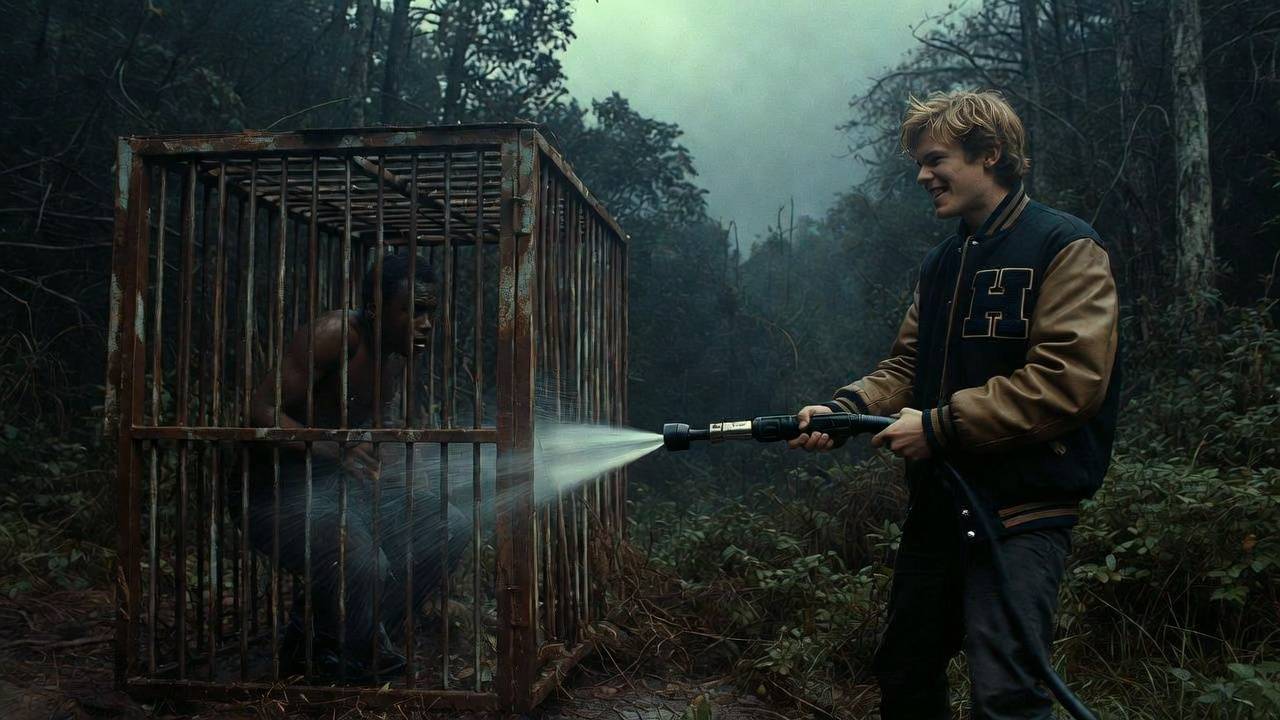
They didn’t look at me. They couldn’t. The shame was a physical weight in the air, heavier than the rain. They had watched me be sprayed like an animal, and now they were warming their hands by my fire.
Sarah, the counselor, finally appeared, her face pale. She started to bark orders, trying to regain control, but nobody listened to her. The hierarchy was dead.
Miller looked at the fire, then at the cage sitting empty in the middle of the clearing. He looked at the silver blanket wrapped around his chest.
“Why?” he whispered.
I stood up, the heat of the fire at my back.
“Because I know what it’s like to be cold,” I said. “And I wouldn’t wish it on anyone. Even you.”
CHAPTER 6: THE LESSON OF THE AFTERMATH
The sun rose over the Oregon woods with a cruel, mocking brightness. The storm had passed, leaving behind a graveyard of downed branches and shredded nylon.
The buses arrived early. The camp had been officially shut down due to “extreme weather conditions.”
I stood by the trailhead, my small pack slung over my shoulder. I had my own fire-starting kit, my own compass, and a heart that felt lighter than it had in years.
The other kids moved past me in a somber line. They weren’t the same people who had arrived three weeks ago. They looked tired. They looked humbled.
Caleb stopped in front of me. He didn’t say anything, but he reached out and touched my shoulder—a brief, hesitant gesture of acknowledgment. Then he climbed onto the bus.
Miller was the last one. He was wearing a borrowed sweatshirt, his expensive jacket lost to the mud. He walked up to me, his hands shoved deep into his pockets.
He looked at the kennel one last time. During the night, the wind had knocked a massive pine limb onto it, crushing the iron bars into a tangled mess of metal. If I had still been in there, I would have been dead.
He knew it. I knew it.
“I’m not going to say sorry,” Miller said, his voice low. “I don’t think a word like that covers it.”
“It doesn’t,” I agreed.
“My dad… he’s going to try to sue the camp. He’s going to try to make this all go away.” Miller looked at me, and for the first time, I saw a spark of something real in his eyes. Something that wasn’t an act. “But I told him I’m not testifying. I told him I’m telling the truth about what happened. All of it.”
It was a small choice. A difficult moral choice. But it was the first honest thing he’d ever done.
“Good luck, Miller,” I said.
He nodded once, then turned and boarded the bus.
Marcus was sitting in the back row. He waved at me through the glass—a sad, small wave. He was going back to his life, back to being a part of the crowd. But I hoped that the next time he saw someone in a cage, he’d remember the smell of the rain and the sound of the flint.
As the buses pulled away, leaving me alone in the quiet of the woods, I looked up at the Douglas firs. They were still there. They didn’t care about our drama, our cruelty, or our small redemptions. They just endured.
I started my walk toward the main road. I didn’t need a bus. I knew the way home.
In the end, we all have a cage we’re trying to escape—sometimes it’s made of iron, and sometimes it’s made of our own silence.
True strength isn’t found in how much power you have over others, but in how much warmth you can keep in your heart when the world turns cold.