CHAPTER 1
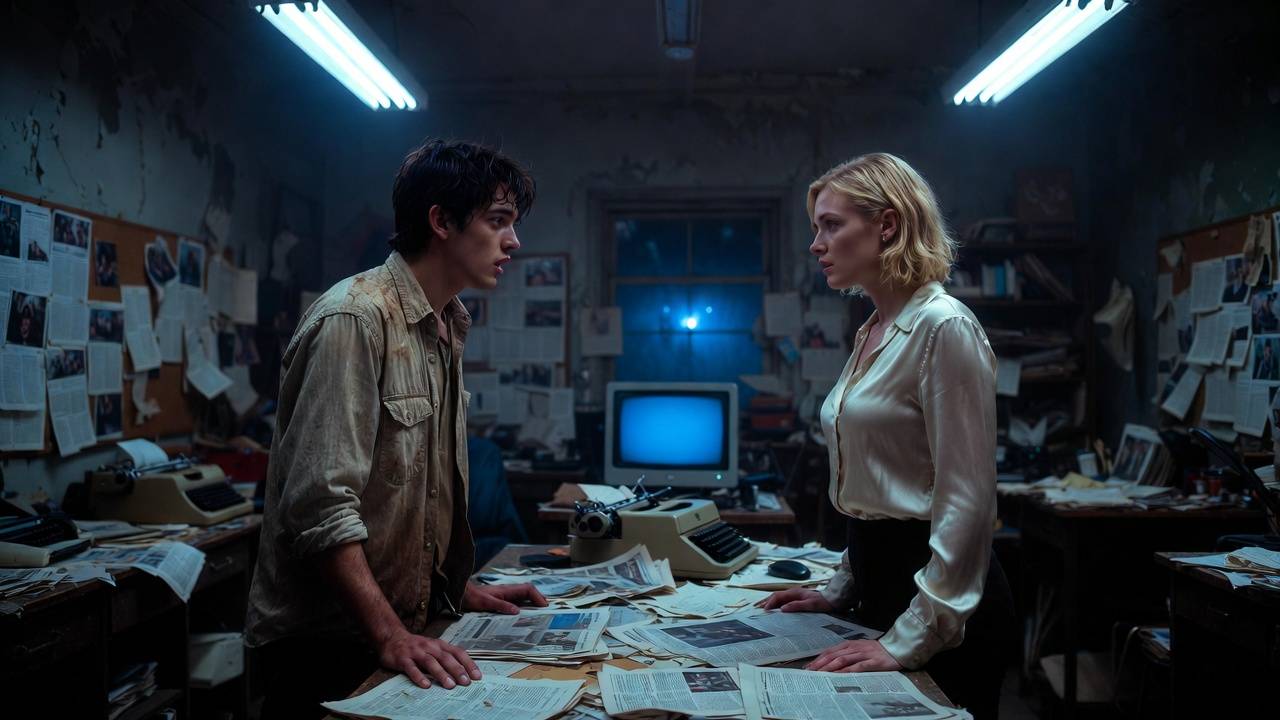
The sound of a mechanical keyboard in a silent room is usually rhythmic, almost like a heartbeat. But when Sarah hit the ‘Delete’ key, it sounded like a gunshot.
I stood there, my boots clicking on the linoleum of the Oakridge High Gazette office, watching four months of my life vanish into a digital void. The blue light of the monitor reflected off Sarah’s perfectly manicured face. She didn’t even look up at me. She just leaned back in her ergonomic chair—the one her father, a “Platinum Donor,” had bought for the newsroom—and exhaled a long, tired sigh.
“It’s gone, Leo,” she said. Her voice was like silk over a razor blade. “And it’s staying gone.”
“That story is the only reason the kids in the West End are even coming to school, Sarah,” I said, my voice cracking in a way that made me hate myself. “Coach Miller is benching every starter who isn’t ‘Oakridge Royalty.’ It’s discrimination, plain and simple. I have the emails. I have the recorded interviews with the parents.”
Sarah finally looked at me. Her eyes were cold, beautiful, and entirely empty. “What you have is a mess. You have a collection of complaints from people who are looking for excuses because their sons aren’t talented enough for D1 scholarships. You’re trying to start a fire in a town that loves its fireplace.”
She stood up, smoothing out her silk blouse. She looked like she belonged in a boardroom in Manhattan, not a dusty basement office in suburban Pennsylvania.
“The school board wants harmony, Leo. Principal Miller wants a championship. And I? I want a peaceful senior year before I head to Columbia. Your ‘truth’ isn’t worth this school’s peace. It’s inflammatory. It’s biased. And frankly, it’s boring.”
She walked toward the door, pausing just long enough to pat me on the shoulder. The smell of her expensive perfume—something floral and clinical—choked me.
“Go write about the new therapy dogs in the guidance office,” she whispered. “Write about pets. People love pets. They hate being told they’re the bad guys.”
She left, the heavy door swinging shut with a click that felt like a coffin closing.
I sat down in the swivel chair I’d spent a hundred nights in, the one with the torn stuffing and the squeaky wheel. My chest felt hollow. I looked at the blank screen where my 4,000-word exposé on the systemic sidelining of minority students had been just seconds ago.
Sarah thought she had won. She thought because she was the Editor-in-Chief, because her last name was on the wing of the local hospital, she could decide what was real and what wasn’t.
But Sarah had made one mistake. She thought I was just a “social justice warrior” with a laptop. She didn’t realize that when you grow up in the West End, you learn how to hunt. And I hadn’t just been hunting Coach Miller.
I reached into my bag and pulled out a second flash drive. The one I hadn’t plugged into the school’s network.
“You want a story about pets, Sarah?” I muttered to the empty room. “Let’s talk about how you’ve been the Principal’s favorite little lapdog.”
I opened a file titled THE LEDGER.
For weeks, I’d been watching Sarah. I’d seen her meeting with Principal Miller in his car after hours. I’d seen the way her family’s “donations” coincided perfectly with certain disciplinary files disappearing. I’d seen the wire transfers.
The discrimination story was the heart of the school. But the corruption story? That was the spine. And I was about to snap it.
Read the full story in the comments.
If you don’t see the new chapter, tap ‘All comments’.
CHAPTER 2
The West End of Oakridge wasn’t the ghetto, but to the people on the Hill, it might as well have been the moon. We had cracked sidewalks, two-bedroom houses that smelled like damp earth, and a high school football culture that treated 17-year-olds like Roman gladiators.
I grew up in one of those damp houses. My mom worked double shifts at the laundry, and my dad was a ghost who sent a check twice a year if we were lucky. I knew what it felt like to be invisible. That’s why I became a reporter. If I couldn’t be powerful, I could at least be the person who pointed a camera at the people who were.
The discrimination story started with Marcus.
Marcus was the best wide receiver Oakridge had seen in twenty years. He was fast, he had hands like glue, and he was a straight-A student. But mid-season, he was benched. No explanation. No dip in performance. Just… gone. In his place was Tyler Vance, whose dad owned the largest Ford dealership in the county.
“It’s not just me, Leo,” Marcus told me three months ago, sitting on the bleachers under a bruised November sky. He looked defeated. “It’s Javier. It’s Darnell. Anyone who doesn’t live in a gated community is getting ‘evaluated’ out of the rotation.”
I spent sixty days living in the shadows of the locker room. I talked to Coach Higgins, the aging assistant coach who was too close to retirement to lie anymore.
“It’s a directive, kid,” Higgins had told me, his voice a gravelly whisper. “Miller wants a specific ‘image’ for the team. Says it helps with the boosters. It’s sick, but I’ve got a mortgage. Don’t tell ’em we talked.”
I had it all. I had the smoking gun. And Sarah had deleted it with the casual indifference of someone swatting a fly.
But as I sat in the dark newsroom after she left, I thought about the “why.” Why would Sarah—who prided herself on being a “progressive leader”—kill a story that would obviously win us a Regional Press Award?
The answer was in the “Platinum Donor” list.
I started digging into the school’s financial records—the ones they didn’t post on the website. I’d spent my lunch hours for weeks befriending Mrs. Gable, the school’s administrative assistant. She was sixty-four, cynical as hell, and loved the lemon bars I bought from the bakery across town.
“You’re a nosy one, aren’t you?” she’d say, letting me ‘help’ her file papers in the back room.
One day, she ‘accidentally’ left a drawer open. Inside was a folder marked Development & Discretionary.
There were names. Dates. Amounts. And one name kept appearing next to “Scholarship Fund Adjustments”: Sarah Sterling.
Sarah wasn’t just the EIC. She was the middleman. Her father’s construction company was getting the contracts for the new stadium renovations, and in exchange, Sarah was making sure the student body stayed quiet. The “bribes” weren’t just cash; they were influence. They were “Preferred Admission” letters to Ivy League schools signed by the Principal himself, regardless of merit.
But it went deeper. Principal Miller was skimming. The “Stadium Fund” was missing nearly two hundred thousand dollars. And Sarah knew. She wasn’t just ignoring it; she was helping him hide it by bury any investigation that got too close to the school’s finances.
She thought she was protecting her future. She didn’t realize she was building a house of cards on a windy day.
I stayed in that office until 2:00 AM. I printed three hard copies of everything. The bank statements I’d managed to photograph. The emails between Sarah and Miller discussing “problematic” students. The ledger of missing funds.
My hands were shaking. This wasn’t a school story anymore. This was a felony.
I walked home in the biting Pennsylvania cold, the manila envelopes tucked tight against my chest. I felt like I was carrying a bomb. As I passed the dark silhouette of the high school, I didn’t feel like a student anymore. I felt like an executioner.
CHAPTER 3
The next morning, the school felt different. It felt like a movie set where the actors didn’t know the script had been changed.
I saw Sarah in the hallway. She was wearing a cream-colored wool coat, laughing with the cheer captains. She caught my eye and gave me a condescending little wave. She thought she’d broken me. She thought I was going to go write my “therapy dog” story and slink back to the West End.
I walked straight to the newspaper office.
Inside, Marcus was waiting for me. He was the only person I trusted. He’d been taking photos for me—not just of football games, but of the cars Sarah drove, the meetings in the parking lot, the “shredding” parties Miller held on Saturday mornings.
“Did she kill it?” Marcus asked, his voice low.
“She killed the football story,” I said, laying the envelopes on the table. “But she just gave us a better one.”
I showed him the ledger. Marcus, usually the most stoic guy I knew, let out a slow whistle. “Leo… this is the Principal. This is the Sterling family. They’ll bury you before this hits the printer.”
“They can’t bury me if I’m already in the dirt,” I said. “I’m not putting this in the Gazette. I’m going over their heads.”
“The Board?”
“No. The Philadelphia Inquirer. I sent the digital files to their lead investigative reporter last night. He called me at 6:00 AM. He’s driving down here today.”
Marcus looked at me with a mix of awe and terror. “You’re really doing this. You’re ending it.”
“I’m finishing it,” I corrected him.
But the “peace” Sarah wanted was about to be defended.
At 10:00 AM, I was called to Principal Miller’s office.
Miller was a man who looked like he was made of granite. He played college ball at Penn State and never let anyone forget it. He sat behind a desk that cost more than my mom’s car, surrounded by trophies and photos of himself shaking hands with politicians.
Sarah was already there, sitting in a leather chair, looking concerned.
“Leo,” Miller said, his voice deep and fatherly. “Sarah tells me you’re having some trouble staying on track with your assignments. She says you’re becoming… obsessive. Harassing staff? Looking into private files?”
I didn’t sit down. I stood in the center of the room, feeling the weight of the air.
“I’m a reporter, Principal Miller. I look where people tell me not to look. That’s the job.”
Miller’s eyes hardened. The “fatherly” act dropped instantly. “No, son. Your job is to represent this school. To build its reputation. Not to tear it down because you have a chip on your shoulder about your neighborhood.”
He leaned forward. “I’ve talked to your mother. I told her how disappointed I’d be if your behavior cost you your graduation. It would be a shame for her to work those double shifts for nothing, wouldn’t it?”
It was a threat. A direct, ugly threat against my family.
I looked at Sarah. She was looking at her nails, completely unbothered. She was a collaborator. She had traded the truth for a scholarship and a clean record.
“I understand,” I said quietly.
“Good,” Miller said, leaning back. “Sarah has a list of approved topics for the final issue. Pick one. And Leo? Stay out of the administrative wing. If I see you near Mrs. Gable’s office again, you’re expelled. No discussion.”
I walked out of the office. My heart was pounding so hard I could hear it in my ears. They thought they had intimidated me. They thought they had used my mother’s hard work as a cage to keep me in.
They didn’t realize that for people like me, the only thing we have is our name. And I wasn’t going to let them own mine.
CHAPTER 4
The rest of the day was a blur of adrenaline and paranoia. I felt like everyone was watching me. Every teacher, every hall monitor, every security camera seemed to be an extension of Miller’s reach.
I met Marcus behind the gym during the last period.
“The reporter from the Inquirer is at the diner down the street,” Marcus whispered. “He wants the hard copies. He wants the original photos of the wire transfers.”
“I have them,” I said. “But Sarah took my key to the newsroom. My locker is being watched. I had to hide the envelopes in the one place they’d never look.”
“Where?”
“The archives. The basement of the library. It’s covered in dust and hasn’t been touched since the 90s.”
As we walked toward the library, I saw Sarah. She was standing by her car—a brand new Audi, likely a “gift” for her silence. She was talking to Coach Miller. They looked like a team. They looked like the winners.
I realized then that this wasn’t just about a story. It was about the fact that people like Sarah and Miller believed the world was their playground, and people like Marcus and me were just the equipment.
We slipped into the library. Mrs. Gable was there, returning some books. She looked at me, and for a second, I saw a flash of something in her eyes. Not pity. Recognition.
“Be careful, Leo,” she whispered as she passed. “The shredder is running hot today.”
I ran to the basement. I pulled the envelopes from behind a stack of 1984 yearbooks. I felt a surge of triumph. We were going to make it. We were going to get out.
But as I turned to the stairs, the door clicked shut.
Sarah was standing there. She wasn’t smiling anymore. She looked frantic.
“Give them to me, Leo,” she said. Her voice was trembling. “I know what you have. I saw you with Mrs. Gable. I know you have the ledger.”
“Why do you care, Sarah?” I asked, stepping back into the shadows of the shelves. “You’re going to Columbia. You’re set for life. Why cover for a man who’s stealing from your own classmates?”
“Because if he goes down, I go down!” she screamed. The sound echoed off the concrete walls. “My father’s company… they didn’t just get the contract. They overcharged the school by half a million dollars. They used that money to pay for my tuition, for this car, for everything! If Miller is audited, my father goes to prison. Do you understand? You’re not just ‘uncovering the truth.’ You’re destroying my family.”
“Your family destroyed Marcus’s future,” I countered. “Your family stole from every kid who doesn’t have a ‘Platinum’ dad. You built your life on the backs of people who can’t afford to fight back.”
“I’m warning you,” she said, reaching into her bag. She pulled out her phone. “I’ll tell them you assaulted me. I’ll tell them you stole the files. Who are they going to believe? The Editor-in-Chief with the 4.8 GPA, or the kid from the West End with a history of ‘disciplinary issues’?”
She was desperate. And a desperate Sarah Sterling was the most dangerous thing in Oakridge.
She started to dial.
“Go ahead,” I said, holding the envelope up. “Call them. But you should know… Marcus is standing right behind you with his camera. And he’s been recording this entire conversation.”
Sarah froze. She turned around. Marcus was there, his DSLR raised, the red light of the ‘Record’ function blinking like a tiny, vengeful eye.
The look on Sarah’s face wasn’t just fear. It was the look of someone who finally realized that the people she thought were “invisible” were the ones who had been watching her all along.