CHAPTER 5: THE CLIMAX – THE TRUTH BENEATH THE FLOORBOARDS
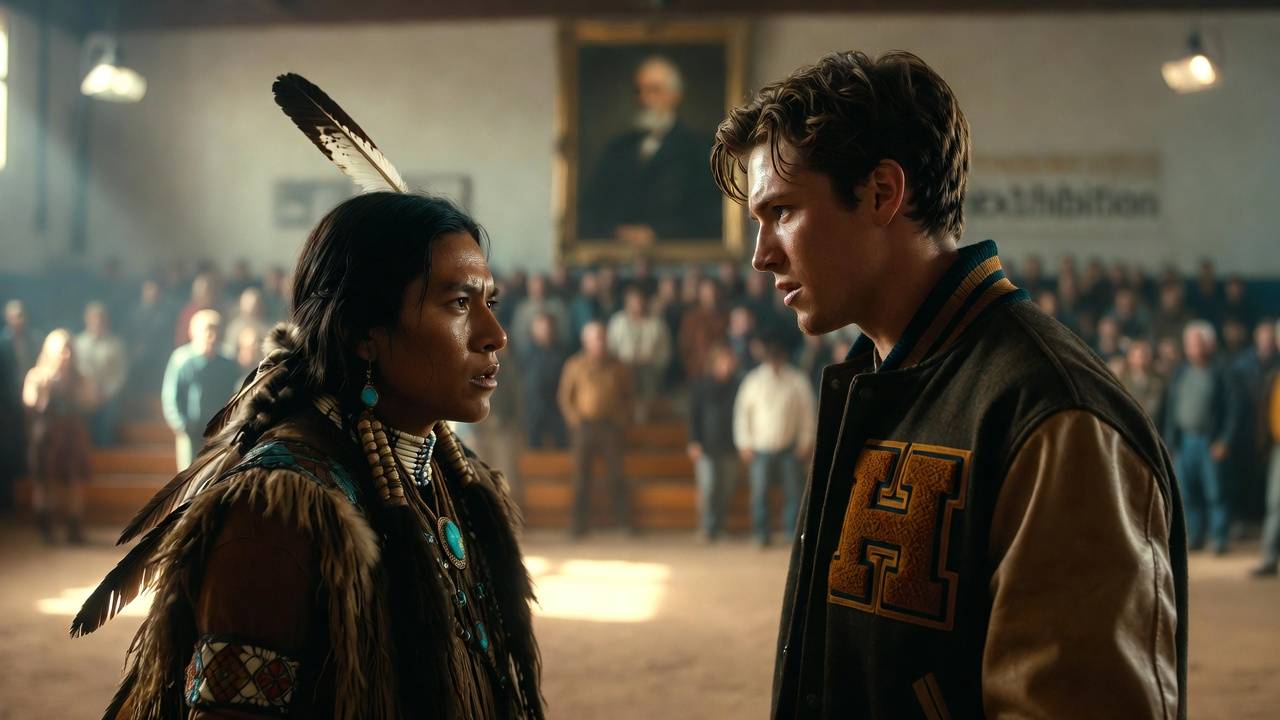
The key sat on the waxed wood floor, reflecting the gym’s lights. It was old, with a heavy, ornate bow shaped like an eagle.
Mayor Sterling’s eyes locked onto the key, and for the first time, Elan saw something other than arrogance in the man’s face. He saw fear. Pure, cold, ancestral fear.
“That… that’s just a piece of junk,” the Mayor said, his voice cracking. “Bryce, pick that up and give it to me.”
“Don’t touch it, Bryce,” Sarah said, stepping forward with her camera. She had been filming the entire exchange. “That key has the same crest as the one on the old vault in the basement of the Town Hall. The ‘Sterling Vault’ that nobody’s been allowed to open since 1920.”
The crowd was buzzing now. The “old secret” of Oakhaven wasn’t just a rumor anymore. It was lying on the floor.
“This key doesn’t belong to the Sterlings,” Elan said, picking it up. He felt a surge of adrenaline, a clarity he had never known. “It belongs to the trustees of the valley. According to the deed in this book, the central records of the town were to be kept in a dual-locked chest. One key for the Sterlings, and one for the Begays. My family kept our key. But your family… you changed the locks.”
“This is ridiculous!” the Mayor shouted. “I’m calling the police. This is harassment!”
“Call them,” Elan said. “Let them escort us all down to the Town Hall. Let’s see if this key fits the lock on the ‘Founding Records’ chest. If I’m wrong, I’ll leave this town and never come back. I’ll give you the land, the ring, everything.”
He looked Bryce dead in the eye.
“But if I’m right, Bryce… if I’m right, then every time you walk through this town, you’re walking on a lie. Your house, your cars, your ‘heritage’—it’s all built on a bill that’s 180 years overdue.”
Bryce looked at his father. He was looking for a denial, for a laugh, for the usual Sterling bravado. But Mayor Sterling was looking at the exit. He looked like a man who was watching his empire crumble in real-time.
“Dad?” Bryce whispered. “Tell him he’s crazy. Tell him the ring is just a coincidence.”
The Mayor didn’t say a word. He turned and walked out of the gym, his footsteps echoing like a funeral march.
The silence that followed was the heaviest thing Elan had ever felt. The “Climax” wasn’t a shout or a fight. It was the sound of a thousand people realizing they were living in a fiction.
Mrs. Crabtree, the historian, stepped forward. Her hand was trembling as she reached for the ledger. “May I?”
Elan nodded.
She turned the pages, her eyes scanning the meticulous records. She looked at the deed, the signatures, and the bloodstain. She looked at the key in Elan’s hand.
“In all my years of researching this town,” she said, her voice barely a whisper, “I always wondered why the 1842 records were so… sparse. Why the founding story felt like it started in the middle of a sentence.”
She looked up at Elan, and for the first time, a person of authority in Oakhaven looked at him with respect.
“You aren’t a footnote, Elan Begay. You’re the missing chapter.”
CHAPTER 6: THE SUNRISE ON A NEW LEGACY
The weeks that followed the exhibition were a whirlwind of legal battles, historical reappraisals, and a slow, painful reckoning for the town of Oakhaven.
The key fit.
Behind the heavy iron door of the Sterling Vault, they found the original, unedited records of the town’s founding. They found the letters Silas Sterling had written to his brother in the East, admitting his fear that the “owners of the land” would one day come to collect. They found the maps that showed the true boundaries of the gift—boundaries that included almost the entire downtown district.
The Sterling family didn’t lose everything—the law is a slow and complicated thing—but their “ownership” of the town’s history was over. The Mayor resigned. Bryce and his family moved away two months later, unable to bear the weight of the town’s new gaze.
But for Elan, the victory wasn’t about the land or the money.
It was a Tuesday evening, six months after the exhibition. The heat of the day was beginning to fade, and the sky was turning a bruised purple. Elan was standing on the edge of the mesa, looking down at the valley.
Beside him stood Sarah. She had her camera, as always, but she wasn’t taking pictures. She was just watching the light.
“They’re renaming the school,” Sarah said. “Did you hear?”
“Yeah,” Elan said. “Oakhaven-Begay High. It’s a start.”
“And the museum?”
“They’re giving back the baskets. And the ledger. It’s going to be the centerpiece of the new wing. They asked me to write the plaque.”
Elan looked down at his turquoise ring. It didn’t feel heavy anymore. It felt like a part of his skin, a part of his soul. He thought about Hastiin. He thought about the man who had sat on a groaning porch swing, holding the weight of a hidden world in his heart so his grandson wouldn’t have to.
“I used to hate this town,” Elan admitted. “I used to feel like I was invisible here.”
“And now?” Sarah asked.
Elan took a deep breath, the scent of sage and rain-damp earth filling his lungs. He looked at the red rocks, the ancient sentinels that had seen the starving strangers and the healers, the liars and the truth-tellers.
“Now,” Elan said, a small, genuine smile touching his lips. “Now, I feel like I’m finally home.”
He realized then that heritage isn’t something you inherit from the dead. It’s something you carry for the living. It’s the courage to stand in a room full of people who want you to be a ghost and insist on being flesh and blood.
He turned to walk back down toward the town, toward his mother, toward the future he had finally earned a place in. The sun dipped below the horizon, casting a long, golden shadow that stretched across the valley—not a shadow of a ghost, but the shadow of a man who knew exactly where he stood.
We weren’t just surviving in this town; we were the reason the town had a heartbeat to begin with.