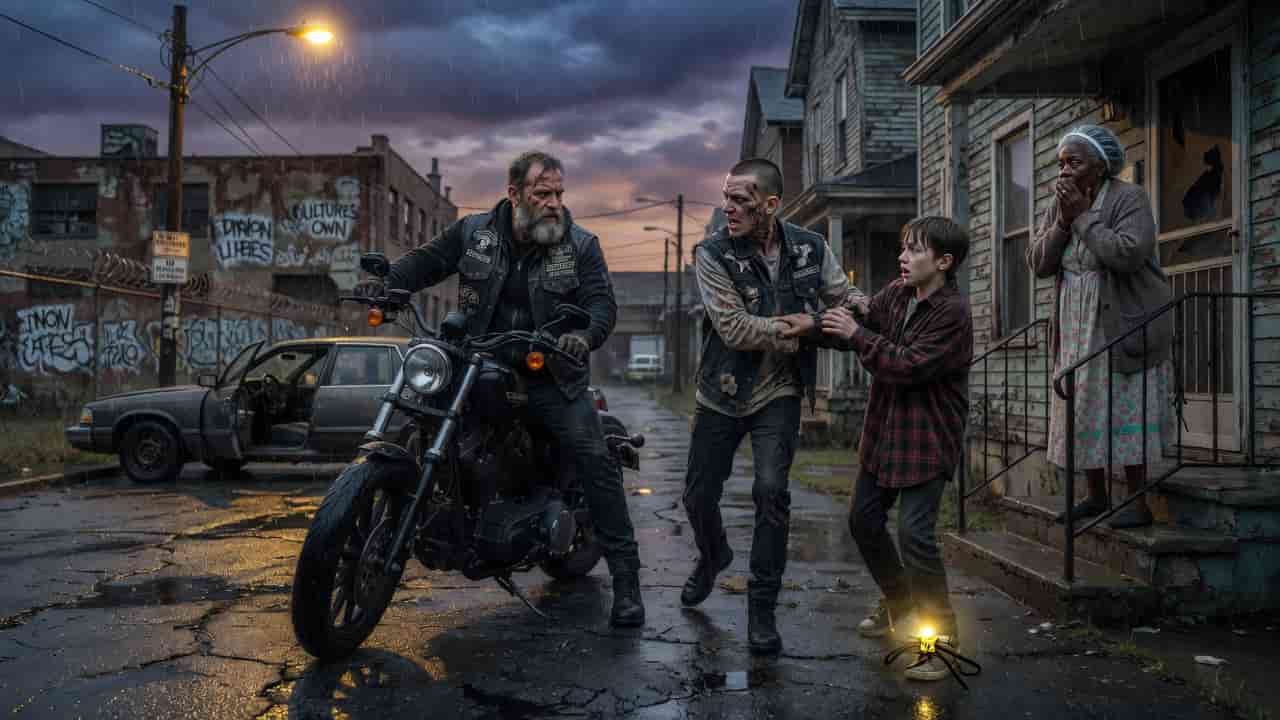
“He’s just street trash, Thorne. Move the bike before we move it for you.”
I didn’t move. I couldn’t. I was staring at the boy’s left shoe.
The Vultures were shoving the kid toward a rusted-out sedan, treating him like a bag of laundry they were about to dump in the river. The kid didn’t scream. He didn’t even make a sound. He just stood there, shaking, his eyes wide and hollow, while Crow laughed and gripped his arm hard enough to leave bruises.
But when the kid stumbled, the flickering streetlight hit his laces.
There it was. A thick gold band, tied into the knots of his dirty sneakers. It was missing the emerald I’d paid six months’ worth of rent for—the one I was told had melted into nothing the night the clubhouse went up in flames. The night my wife disappeared.
“Where did he get that ring, Crow?” my voice sounded like it was coming from the bottom of a well.
Crow didn’t even look down. He just gave the boy another shove, forcing him to his knees right there in the middle of the street while the neighbors watched from their porches. “I told you, Thorne. It’s garbage. Found him in a squat with a stray dog. Now get out of the way.”
Twelve years I’d lived with the lie. Twelve years I’d carried the weight of a casket that felt too light. And now, this silent boy was standing in the rain, wearing the only proof I had left that she might still be out there.
I didn’t just move the bike. I reached for the chrome pipe at my side.
Chapter 1: The Echo in the Asphalt
The rain in Detroit doesn’t wash anything away; it just makes the grime look more permanent. Jax Thorne sat on his Harley, the engine’s idle a low, rhythmic growl that vibrated through his thighs and up his spine. It was the only thing that felt solid in a world that had been dissolving for a long time.
He was parked at the mouth of an alley in the Brightmoor district, a place where the houses looked like teeth rotting out of a gumline. He wasn’t supposed to be here. The Iron Hides stayed south of the highway, and the Vultures—a pack of bottom-feeders who dealt in anything that bled or broke—claimed this particular stretch of industrial decay. But Jax had heard a rumor. A rumor about a boy, a dog, and a piece of jewelry that shouldn’t exist.
“You’re out of your lane, Jax,” a voice rasped.
Jax didn’t turn his head. He watched a group of three men emerge from the shadows of a collapsed garage fifty yards down the street. In the center was Crow, a man whose skin looked like it had been cured in nicotine and spite. He was dragging a small figure by the arm.
The boy was thin, his ribs likely visible under the oversized flannel shirt that hung off his frame. He moved with a limp, his head bowed, looking at the cracked sidewalk as if searching for a place to disappear. Following closely behind was a scruffy, three-legged dog that hopped along with a desperate, frantic loyalty.
Jax’s grip tightened on the handlebars. He’d seen plenty of ugliness in twenty years of club life, but there was something about the way Crow handled the kid—like he was a piece of scrap metal—that made Jax’s stomach turn.
“I’m just taking in the scenery, Crow,” Jax said, his voice deep and deceptively calm. “Didn’t realize the Vultures were in the daycare business.”
Crow laughed, a sharp, ugly sound. He gave the boy a shove, forcing him toward a rusted grey sedan idling at the curb. “This ain’t a kid. It’s a debt. One his mother couldn’t pay before she vanished. Now, he’s property.”
The boy stumbled. He didn’t cry out. He didn’t even gasp. He just caught himself on the door frame of the car, his thin shoulders trembling.
“The boy doesn’t speak?” Jax asked.
“Mute as a stone,” Crow sneered. “Makes him easier to manage. Doesn’t complain when he’s hungry. Doesn’t scream when he’s worked.”
Jax kicked the kickstand up. The Harley lurched forward, the front tire stopping inches from Crow’s mud-caked boots. The neighborhood was quiet, but Jax could feel the eyes. Old Ma was out on her porch two houses down, her hands clutched in her cardigan, her face a mask of practiced indifference that couldn’t quite hide the pity. This was how it worked here. People watched things happen, and then they forgot them so they could sleep at night.
“Let him go,” Jax said.
Crow’s eyes narrowed. The two men behind him reached for the waistbands of their jeans. “You’re gonna start a war over a stray? Your club’s been soft since the fire, Thorne. Everyone knows it. You’re just a king of a graveyard.”
Jax didn’t flinch at the mention of the fire. The memory of the flames—the roar of the gasoline, the way the clubhouse had folded like a burning bird—was always there, just behind his eyes. He’d spent twelve years trying to convince himself that he’d done the right thing by paying that doctor to sign the papers. He’d told himself Sarah was gone, and that by ending the search, he was protecting her memory from the men who would have dug her up just to hurt him again.
But then, the boy shifted.
The kid tried to pull his arm away from Crow’s grip, and in the movement, his left foot dragged across the wet asphalt. A flicker of gold caught the yellow glare of the streetlamp above.
Jax’s heart didn’t break; it stalled.
Tied into the filthy, knotted laces of the boy’s left sneaker was a heavy gold wedding band. It was scarred, the edges slightly flattened, and the central setting was a jagged, empty hole where a green stone should have been.
Jax knew that ring. He’d spent three months’ worth of bike-build money on the emerald that used to sit in that setting. He’d slipped it onto Sarah’s finger on a beach in Lake Huron while the wind whipped her hair into her eyes. He’d been told that ring had melted into a lump of unrecognizable slag in the heat of the clubhouse fire.
“Where did he get that ring?” Jax’s voice was a whisper now, thick with a sudden, suffocating pressure.
Crow looked down at the boy’s feet and laughed. He reached down and gave the boy’s foot a sharp kick, making the kid yelp—a soft, airless sound. “The ring? Kid says he found it in the dirt. I think he stole it. It’s trash, Thorne. Settings empty. Worth maybe fifty bucks in melt value.”
“I’ll give you five hundred for the boy and the ring,” Jax said.
Crow paused, his greed warring with his pride. He looked at the boy, then back at Jax. “Five hundred? For this piece of garbage? You really have gone soft.”
“Seven hundred,” Jax said, his hand moving toward the leather sheath on his thigh. “And I don’t ask again.”
The air between them grew heavy, the kind of tension that usually ended in the sound of breaking glass or clicking safeties. Crow looked at the Harley, then at the two men behind him. He knew Jax Thorne’s reputation. Jax wasn’t a man who fought for fun; he was a man who fought to finish things.
“Take him,” Crow spat, releasing the boy’s arm so abruptly the kid fell to the ground. “He’s more trouble than he’s worth anyway. Always staring. Always looking for his damn dog.”
The boy scrambled back, clutching the three-legged dog to his chest. He looked up at Jax, his eyes dark and unreadable. There was no gratitude in them. Only a deep, vibrating terror.
Jax reached into his vest, pulled out a roll of bills, and tossed them at Crow’s feet. He didn’t watch Crow pick them up. He just looked at the boy.
“Get on the bike,” Jax said.
The boy didn’t move. He looked at the dog, then at the massive machine, then back at the house where Ma was still watching.
“The dog comes too,” Jax added, his voice softening just enough for the boy to hear.
The boy stood up slowly, his movements jerky and uncertain. He climbed onto the back of the Harley, his small hands clutching the dog against his stomach, his knuckles white. He didn’t touch Jax. He just sat there, a silent weight on the back of a life that was about to be torn wide open.
Jax revved the engine, the sound echoing off the boarded-up houses like a warning. As they pulled away, he looked back in the rearview mirror. Crow was standing in the middle of the street, counting the money, his face twisted into a smirk that promised this wasn’t the end.
But Jax wasn’t thinking about Crow. He was thinking about the emerald that was missing from the ring. And he was thinking about the doctor he’d paid twelve years ago to lie about a body that might never have been there.
Chapter 2: The Weight of Gold
The Iron Hides’ clubhouse was a converted warehouse on the edge of the river, a fortress of corrugated metal and reinforced cinder blocks. Inside, the air smelled of stale beer, motor oil, and the kind of heavy, masculine silence that comes from men who have seen too much and said too little.
Jax pulled the Harley onto the shop floor, the engine echoing against the high rafters before he cut the ignition. The silence that followed was immediate and uncomfortable.
“Who’s the stray, Jax?”
Doc, the club’s medic, stepped out from the small infirmary area. He was an older man with a permanent squint and hands that were surprisingly steady for someone who’d spent thirty years stitching up bullet wounds and road rash.
Jax dismounted, his joints popping. He didn’t answer right away. He watched the boy slide off the back of the bike. The kid landed on his good leg, his eyes darting around the cavernous space, taking in the rows of bikes, the pool table, and the half-dozen men who were now staring at him. The three-legged dog hopped down beside him, its tail tucked between its legs.
“Found him in Brightmoor,” Jax said, his voice level. “The Vultures had him. I bought him out.”
A few of the younger recruits exchanged looks. One of them, a kid named Leo who’d joined six months ago, let out a low whistle. “You bought a kid? Is he a prospect or a pet?”
Jax turned his head, his gaze settling on Leo. It wasn’t an angry look, but it was enough to make the younger man take a step back and find something very interesting to look at on his boots.
“Go get some food, Leo,” Jax said. “And tell Cass to bring a bowl of water for the dog.”
As the room cleared, Jax turned back to the boy. The kid was standing near a stack of tires, his hand resting on the dog’s head. He looked smaller in the fluorescent light of the clubhouse, his skin pale and translucent, his hair a matted mess of brown curls.
“Kid,” Jax said.
The boy looked up.
“The ring. Let me see it.”
The boy hesitated, his hand going to his shoelace. He looked at Doc, then back at Jax. He didn’t move.
“I’m not going to take it,” Jax said, and the lie tasted like copper in his mouth. He was going to take it. He had to. But not yet. “I just want to look.”
Slowly, the boy sat down on the floor and began to untie his lace. His fingers were nimble despite the dirt under his nails. He looped the ring off the string and held it out in his palm. His hand was shaking.
Jax took the ring. It felt cold, despite having been against the boy’s foot. He held it up to the light. The gold was 14-karat, a custom design Jax had sketched on a napkin at a diner in 2012. He traced the inner band with his thumb, searching for the inscription.
S.T. – Always.
The breath left Jax’s lungs in a jagged rush. He lowered his hand, his fingers closing over the gold.
“Doc,” Jax said, his voice strained. “Take the boy to the back. Clean him up. See if he’s got any broken bones. Crow wasn’t gentle.”
Doc nodded, his expression shifting from curiosity to professional concern. “Come on, son. Let’s see what we’re dealing with.”
The boy didn’t move until Jax gave him a small, stiff nod. Then, he followed Doc toward the infirmary, the dog limping along behind them.
Jax stood alone in the center of the shop floor, the ring burning a hole in his palm. He walked over to his small office—a glass-walled cubicle in the corner—and sat down at the desk. He opened the bottom drawer and pulled out a battered metal lockbox.
Inside was a stack of yellowing papers, a few old photos, and a small, velvet-lined box. He opened the box. It was empty. It had been empty for twelve years, ever since he’d been told that Sarah’s jewelry had been destroyed in the fire.
He dropped the ring onto the desk. It clattered, a tiny, high-pitched sound that felt like a gunshot in the quiet room.
How?
He’d seen the fire. He’d seen the way the roof had collapsed over the living quarters. He’d seen the charred remains the recovery crew had pulled out. He’d paid Dr. Aris five thousand dollars to make sure the identification went through without a hitch, because the alternative—a prolonged investigation into the Iron Hides’ business—would have put every man in the club in a cage. He’d convinced himself he was being a leader. He’d convinced himself he was giving Sarah a quiet end.
But if the ring was here, the body wasn’t hers.
He reached for his phone and dialed a number he hadn’t called in a decade. It rang four times before a tired, cautious voice answered.
“Hello?”
“Aris,” Jax said. “It’s Jax Thorne.”
There was a long silence on the other end of the line. Jax could hear the sound of a television in the background, a canned laugh track that felt absurdly out of place.
“Jax,” Aris finally said, his voice trembling. “I told you never to call this number. I’m retired. I moved out of the city.”
“I found the ring, Aris,” Jax said, his voice dropping an octave. “The one that was supposed to be ash. It was tied to a kid’s shoelace in Brightmoor.”
The silence returned, longer this time. When Aris spoke again, he sounded like he was choking. “Jax… I did what you asked. I signed the papers. I didn’t look too close. You told me not to look too close.”
“Who was in that casket, Aris?” Jax roared, his hand slamming onto the desk.
“I don’t know!” Aris cried. “It was just… it was remains, Jax. It could have been anyone. There were three people missing after that fire, remember? Two of the prospects never showed up. I just… I did what was easy. I thought you wanted it to be her. You were so certain.”
Jax hung up. The phone slid from his hand, hitting the floor with a dull thud.
He leaned back in his chair, his head hitting the wall. He remembered the night of the fire. He’d been at a meeting across town. When he’d returned, the world was orange and black. He’d tried to run into the building, but his own men had held him back. He’d screamed her name until his throat felt like it was filled with broken glass.
And then, a week later, he’d made the choice. The pragmatic choice. The choice of a man who cared more about his empire than the truth.
He looked through the glass wall of the office. In the infirmary, he could see Doc sitting on a stool, talking quietly to the boy. The boy was sitting on the edge of the exam table, his shirt off. His back was a map of old scars—thin, white lines that spoke of a belt or a cord.
Jax felt a surge of nausea. If that boy was ten, and the fire was twelve years ago…
The math didn’t just hurt; it was an indictment.
Sarah had been three months pregnant when the clubhouse burned. He’d spent twelve years mourning a child he thought had never been born.
He stood up, his legs feeling like lead, and walked toward the infirmary. He stopped at the doorway. The boy was looking at a bowl of stew Cass had brought him. He was eating with a mechanical intensity, as if he expected someone to snatch it away at any moment.
“Doc,” Jax said.
Doc looked up, his face grim. He beckoned Jax into the hallway, away from the boy’s ears.
“He’s malnourished,” Doc whispered. “Dehydrated. And those scars on his back… those aren’t from the Vultures. Some of them are years old. But that’s not the thing, Jax.”
Doc reached into his pocket and pulled out a small plastic bag. Inside was a scrap of fabric, stained and torn.
“I found this tucked into his waistband,” Doc said. “It’s a piece of a hospital gown. From the old Mercy General. The one that closed down five years ago.”
Jax took the bag. Mercy General was three blocks away from where the old clubhouse had been.
“And Jax,” Doc added, his voice barely audible. “The boy’s eyes. They’re yours. Exactly yours.”
Jax looked through the door at the boy. The kid had finished the stew and was now staring at the three-legged dog, his hand resting on the animal’s scarred flank. He looked up, his gaze meeting Jax’s through the doorway.
For the first time, Jax didn’t see a stray. He saw a mirror. And in that mirror, he saw the coward he’d been for twelve long years.
Chapter 3: The Public Shame
The next morning, the sun was a pale, watery disc behind a curtain of grey smog. Jax took the boy to “The Greasy Spoon,” a diner that served as a neutral ground for the various factions of the city. It was a place where business was conducted over lukewarm coffee and cold toast, and where everyone knew everyone else’s business before the bill was paid.
Jax sat in a corner booth, the boy beside him. The kid was wearing a clean Iron Hides t-shirt that was far too big for him, and his hair had been washed, though it still stood up in wild, defiant tufts. The dog was tied to a hitching post outside, visible through the window.
Jax watched the room. He could feel the whispers. The Iron Hides’ president bringing a mute child into a public space was a signal. It was an announcement of ownership, of protection. But it was also a target.
The bell above the door jangled. Crow walked in, followed by four other Vultures. They didn’t look like they were here for breakfast. They looked like they were looking for a fight they could win.
The diner went quiet. The waitress, a woman named Sheila who’d seen enough stabbings to be unimpressed by leather vests, didn’t even stop pouring coffee.
Crow walked straight to Jax’s booth. He didn’t sit down. He leaned over the table, his breath smelling of stale beer and desperation.
“You got a lot of nerve, Thorne,” Crow said, his voice loud enough to carry to every booth in the room. “Taking my property into a public place like you own him.”
Jax didn’t look up from his coffee. “I paid the debt, Crow. He’s not your property.”
“The money was for the boy,” Crow sneered. “Not for the dog. And not for the disrespect. My boys think you made us look weak. Buying a kid like he’s a puppy. You trying to be a daddy, Jax? Is that what this is?”
Crow reached out and flicked the boy’s ear. It wasn’t a hard strike, but it was degrading. The boy flinched, pulling his head down into his shoulders.
“Don’t touch him,” Jax said, his voice a low vibration that made the silverware on the table rattle.
Crow laughed. He looked around the room, making eye contact with a couple of guys from a rival MC sitting at the counter. “Look at him! The big, bad Jax Thorne. Protecting a mute brat who can’t even say thank you. Hey, kid! Say something. Tell the man how much you love your new daddy.”
The boy stayed silent. His eyes were fixed on the salt shaker.
“What’s the matter?” Crow mocked, leaning closer to the boy’s face. “Cat got your tongue? Or maybe your mama just didn’t love you enough to teach you how to talk? Heard she was a real piece of work. A runner. Probably left you in that squat because she couldn’t stand the sight of you.”
The boy’s hands curled into fists on the table. His knuckles were white.
“That’s enough,” Jax said, standing up. He was a head taller than Crow and twice as wide. The movement was slow, deliberate, and terrifying.
“Oh, it’s enough when you say it is?” Crow spat. He reached down and grabbed the boy by the collar of his oversized shirt, yanking him out of the booth. The boy stumbled, his sneakers squeaking on the linoleum.
“Let him go,” Jax said, his hand going to the heavy brass knuckles he kept in his vest pocket.
“Why?” Crow asked, his face inches from the boy’s. “So you can take him home and play house? This kid is nothing. He’s a mistake. A ghost of a fire that should have finished the job.”
Crow shoved the boy backward. The kid hit a nearby table, sending a glass of orange juice shattering to the floor. The diners scrambled back, the sound of the breaking glass echoing in the sudden silence.
The boy sat on the floor, his flannel shirt soaked in juice, his face pale with humiliation. He looked around the room—at the men laughing, at the women looking away, at the witnesses who were already turning this moment into a story they could tell later.
Jax didn’t help the boy up. Not yet. He looked at Crow, and for the first time in years, the cold, calculating leader was gone. In his place was a man who had lost everything once and was realized he’d been complicit in his own ruin.
“You think this is about the kid, Crow?” Jax asked, his voice deathly quiet.
“I think you’re a joke, Thorne,” Crow said, stepping toward him. “And I think the Iron Hides are done.”
Jax didn’t wait for the next word. He moved with a speed that shouldn’t have been possible for a man his size. He grabbed Crow by the throat and slammed him back against the counter. The sound of Crow’s head hitting the Formica was a dull, sickening thud.
The other Vultures moved, but they were stopped by the sound of three heavy boots hitting the floor. Leo and two other Iron Hides had been sitting in the back booth, and they were now standing with their hands on their belts.
“This kid,” Jax said, his grip tightening on Crow’s throat until the man’s face turned a mottled purple. “Is my son.”
The room went absolutely still. Sheila stopped mid-motion with a coffee pot. The Vultures froze. Even the boy looked up, his eyes wide.
“His name is Toby Thorne,” Jax continued, his voice echoing in the diner. “And if any of you ever look at him, touch him, or speak his name without my permission, I will burn down whatever hovel you call home with you inside it. Do you understand?”
Crow couldn’t speak. He just managed a frantic, choking nod.
Jax threw him aside like a bag of trash. Crow slumped to the floor, coughing and gasping for air.
Jax walked over to Toby. He reached down and offered his hand. For a long second, the boy didn’t move. He looked at Jax’s hand—a hand covered in grease, scars, and the weight of a thousand bad decisions.
Then, slowly, the boy reached out and took it.
Jax pulled him up. He didn’t say anything else. He didn’t look at the crowd. He just walked Toby out of the diner, the boy’s hand small and cold in his.
As they stepped out into the rain, the three-legged dog began to bark, a frantic, joyful sound. Jax stopped by the bike and looked at Toby. The boy’s shirt was a mess, and his eyes were still wet with unshed tears of shame.
“I’m sorry,” Jax said. It was the first time he’d said those words in a decade.
The boy didn’t respond. He just climbed onto the back of the bike and pressed his face into the leather of Jax’s vest.
Jax started the engine. As they pulled away, he saw Ma standing on the corner, watching them. She didn’t look indifferent anymore. She looked like she was seeing a man who was finally, painfully, waking up.
Chapter 4: The Proof of the Lie
The medical records office of the old Mercy General was located in a basement that smelled of mildew and forgotten lives. Jax had spent four hours and three hundred dollars to get a clerk to let him into the archives.
He was looking for a name. Not Sarah’s. He knew her records would have been “lost” or altered. He was looking for the name of the woman who had brought a mute boy into the clinic ten years ago.
Toby sat on a crate in the corner, the dog asleep at his feet. The boy had been quiet since the diner, but the tension in his shoulders had eased. He watched Jax with a quiet, watchful intensity, as if he were trying to memorize the way Jax moved.
“Found it,” Jax whispered.
He pulled a dusty file from a shelf labeled UNINSURED/INDIGENT – 2015.
Inside was a single sheet of paper. A woman named “Maria Smith” had brought a two-year-old boy in for a respiratory infection. The address listed was a halfway house in the North End. But it was the note at the bottom of the page that made Jax’s hands shake.
Patient is non-verbal. Mother states he stopped speaking after a traumatic event involving fire. Mother has significant scarring on hands and forearms. Refused treatment for herself.
Jax closed his eyes.
Sarah.
She’d been there. She’d been alive. She’d been three blocks away from him, and she’d been terrified.
He remembered the fire again. It hadn’t been an accident. It had been a hit by the Vultures, a retaliation for a deal gone wrong. He’d told Sarah she was safe. He’d told her he’d handle it. And then, he’d let the building burn.
She hadn’t been running from the Vultures. She’d been running from the life he’d forced her into. She’d seen the men holding him back from the flames, and she’d realized that as long as she was Jax Thorne’s wife, she would always be a target.
He’d made it easy for her to stay dead. By paying Aris to fake the identification, he’d given her the exit she needed. But he’d also condemned her to a decade of hiding in the shadows, raising a son in squats and halfway houses, too afraid to reach out because she didn’t know if he was the man who would save her or the man who would destroy her.
“Jax!”
Leo’s voice echoed down the basement stairs. The young recruit burst into the room, his face flushed and sweating.
“The Vultures,” Leo panted. “They’re at the neighborhood. They’re surrounding Ma’s block. They heard what you said at the diner, Jax. They’re saying if you want the kid, you have to come get his mother too.”
Jax froze. “They have her?”
“They found the squat,” Leo said. “They’ve got the whole street blocked off. They’re calling you out, man. They’re saying you’re a liar and a thief.”
Jax looked at Toby. The boy had stood up, his face pale, his eyes wide with a new, sharper kind of terror.
“Is she there, Toby?” Jax asked, his voice cracking. “Is your mama there?”
The boy didn’t speak, but he nodded. He grabbed Jax’s sleeve, his grip desperate.
Jax felt the rage return, but this time it wasn’t cold. It was a white-hot roar that filled his ears. He’d spent twelve years being a “leader” who protected his interests. He’d been a man who chose the easy lie over the hard truth.
He reached down and picked up the boy, setting him on his feet.
“Leo,” Jax said, his voice like grinding stone. “Call the club. Every patch. Every recruit. Tell them we’re going to Brightmoor.”
“Jax, that’s Vulture territory,” Leo said, his eyes wide. “That’s a full-scale war.”
“I don’t care,” Jax said. He walked toward the stairs, his boots echoing in the hollow basement. “I’ve been living in a graveyard for twelve years, Leo. It’s time to see what’s left of the living.”
As they reached the street, the rain had turned into a torrential downpour. Jax climbed onto his bike, Toby behind him. He looked at the boy in the rearview mirror.
“We’re going to get her,” Jax said.
Toby didn’t nod. He didn’t make a sound. But for the first time, he reached forward and wrapped his small arms around Jax’s waist, holding on with everything he had.
Jax revved the engine and kicked the bike into gear. The Iron Hides were already pulling out of the warehouse district, a hundred engines roaring in unison, a wall of steel and leather moving toward the heart of the decay.
He didn’t know if Sarah would ever forgive him. He didn’t know if the boy would ever speak. He only knew that the gold ring was on his finger now, and the emerald was somewhere in the dark, waiting to be found.
The Vultures were waiting. The neighborhood was watching. And for Jax Thorne, the fire was finally, truly, beginning to burn.
Chapter 5: The Geography of Ruin
The roar of the Iron Hides was not a sound; it was a physical weight that flattened the rain and shook the glass out of the window frames of the derelict houses lining the route to Brightmoor. Jax Thorne rode at the head of the formation, a black-clad spear-tip followed by a hundred men who had, for twelve years, believed they were following a man who had lost his soul to a fire. They didn’t know the truth yet—not the whole of it—but they felt the shift in the atmosphere. The “King of the Graveyard” was gone. Something older and more dangerous had taken the handlebars.
Toby was a small, shivering pressure against Jax’s back. The boy’s hands were locked into the leather of Jax’s vest so tightly that Jax could feel the kid’s knuckles digging into his ribs. Every time the Harley hit a pothole or leaned into a turn, Toby’s grip tightened. He wasn’t just holding on for safety; he was holding on to the only thing that stood between him and the abyss of the Vultures.
“Eyes up,” Jax barked into his headset.
The column slowed as they hit the 1400 block of Winder Street. It was a cul-de-sac of misery, a row of Victorian houses that had been stripped of their dignity decades ago, their porches sagging like broken jaws. At the end of the street, three rusted sedans and a fleet of mismatched dirt bikes were parked in a jagged semi-circle, blocking the entrance to a particularly weathered two-story house.
Crow was standing on the roof of one of the cars. In his hand, he held a megaphone. At his side, two Vultures held a woman by the arms.
She was thin—painfully so—and her hair was a tangled nest of dark curls shot through with premature streaks of grey. Even from fifty yards away, through the grey curtain of the downpour, Jax recognized the tilt of her head. It was Sarah. But it wasn’t the Sarah of the beach at Lake Huron. This woman looked like she had been carved out of the very ash he’d spent a decade mourning. Her hands and forearms were encased in thick, tan compression sleeves—the kind used to protect fragile, grafted skin.
“Look who decided to join the party!” Crow’s voice crackled through the megaphone, distorted and mocking. “The great Jax Thorne! Bringing the whole circus to see the ghost!”
Jax cut his engine. One by one, the hundred bikes behind him went silent, leaving only the hiss of the rain and the rhythmic tink-tink-tink of cooling metal.
“Let her go, Crow,” Jax said. His voice wasn’t loud, but in the sudden vacuum of the silent street, it carried like a gunshot.
“Let her go?” Crow laughed, the sound echoing off the boarded-up windows. “Why would I do that? This woman’s been living in my territory for years. Squatting. Stealing. Hiding property. You know what we do to people who hide property, Jax?”
Crow stepped off the car and walked toward Sarah. He reached out and grabbed her by the chin, forcing her to look at the line of bikers. She didn’t struggle. She looked at Jax, and the expression in her eyes was so vacant, so utterly devoid of hope, that it hurt worse than any bullet Jax had ever taken.
“Is this her, Jax?” Crow shouted. “Is this the legendary Queen of the Hides? She looks a little burnt-out to me. Maybe she didn’t get enough of the fire the first time.”
Jax felt a hand on his shoulder. It was Doc. The older man had pulled his bike up beside him, his face a mask of grim fury. “Don’t let him bait you, Jax. He wants you to charge. Look at the windows.”
Jax shifted his gaze. In the darkened upper floors of the surrounding houses, he saw the glint of steel. Snipers. The Vultures had turned the cul-de-sac into a kill box.
“I’m not here to play games, Crow,” Jax said. He reached back and gently unhooked Toby’s hands from his waist. He slid off the bike and stood in the center of the street, unarmed, his hands open at his sides. “You want me? I’m right here. Leave the woman and the boy out of it.”
Toby scrambled off the bike, the three-legged dog hopping down beside him. The boy ran to Jax’s side, his eyes fixed on the woman held by the Vultures. He made a soft, whimpering sound—the first vocalization Jax had heard from him.
“Mama!” the boy mouthed. No sound came out, but the shape of the word hung in the cold air.
The woman’s vacant expression shattered. Her eyes flooded with tears, and she began to struggle, her boots slipping on the wet asphalt. “Toby!” she screamed. Her voice was raw, a sound that had been buried for too long.
Crow backhanded her.
The sound of the strike was sickeningly loud. Sarah’s head snapped to the side, and she collapsed to her knees.
The Iron Hides surged forward as one, a wall of leather and muscle ready to tear the street apart. Jax held up a hand, stopping them. His heart was hammering against his ribs like a trapped bird, but his mind was crystal clear. He knew how this went. If they charged, Sarah was dead. If they stayed, they were targets.
“You like to hit women, Crow?” Jax asked, his voice dropping into a register that made even his own men shiver. “You like to humiliate people who can’t fight back? That’s the Vulture way, isn’t it? Picking through the scraps of better men.”
Crow sneered, stepping over Sarah’s slumped form. “I’m the one holding the cards, Thorne. You’re the one who’s been living a lie for twelve years. You paid to bury a stranger so you could keep your club. You traded your wife for a patch. Tell them, Jax! Tell your boys what you did!”
The Iron Hides shifted. The silence grew heavy with a new kind of tension—distrust. Jax could feel the weight of a hundred sets of eyes on his back. They were loyal, but loyalty had limits, and a leader who faked a death was a leader who couldn’t be trusted with their lives.
“I did it,” Jax said, his voice ringing out. “I paid the doctor. I signed the papers. I chose the club over the search because I was a coward. I was afraid that if I kept looking, I’d find out that the Vultures had won. I wanted her to be dead so I didn’t have to live with the truth that I couldn’t protect her.”
He took a step forward, his boots splashing in a puddle.
“But I’m not that man anymore,” Jax said. “And I’m not leaving this street without her.”
“Then you’re dying on it!” Crow screamed.
He raised his hand, a signal to the snipers in the windows, but before he could drop it, a different sound erupted.
From the alleyways behind the Vultures, a second wave of engines roared. Not bikes. Trucks. Heavy, reinforced work trucks with “Thorne Construction” logos on the doors. They slammed into the Vultures’ barricade, the sound of crunching metal and shattering glass drowning out the rain.
Jax had made a call before they left. Not to the club, but to the men he’d worked with in the “civilian” world—the men who owed him for the jobs he’d given them when the city had turned its back.
In the chaos, the Iron Hides moved.
Jax didn’t reach for a gun. He lunged for Crow.
The two men collided in the middle of the street. Crow was younger and faster, but Jax had twelve years of repressed rage behind every punch. He slammed his forehead into Crow’s nose, feeling the cartilage give way. He grabbed Crow by the vest and swung him into the side of a rusted sedan, the metal denting under the impact.
“You… you’re… dead…” Crow wheezed, blood pouring from his face.
“Not today,” Jax whispered.
He looked over his shoulder. Doc had reached Sarah. He was shielding her with his body as the street erupted into a melee of leather, denim, and steel. Leo was holding Toby, keeping the boy low behind the Harley.
Jax turned back to Crow. He picked the man up by the throat and held him against the car. “Where is the emerald, Crow? The stone from the ring. I know you didn’t melt it.”
Crow grinned through a mouthful of blood. “Sold it. To a guy in Chicago. He’s probably got it on a mistress by now. You’re never getting it back, Thorne. Just like you’re never getting her back. Look at her! She’s broken. She’s a ghost.”
Jax looked at Sarah. She was standing now, supported by Doc. She was looking at Toby, her face a mask of raw, agonizing love. She wasn’t broken. She was just waiting for someone to remind her that she was allowed to exist.
Jax dropped Crow. The man slumped to the ground, unconscious or playing dead. Jax didn’t care which.
He walked toward Sarah. The fighting was still happening around them—the shouts, the sound of sirens in the distance, the crack of a stray shot—but the space between them felt like a sanctuary.
He stopped three feet away from her. The rain was streaming down his face, mixing with the sweat and the grime.
“Sarah,” he said.
She looked at him. Really looked at him. The vacancy was gone, replaced by a jagged, sharp-edged pain. She reached out with one of her scarred hands and touched his cheek. Her skin was rough, a map of the night the world had ended.
“You let me stay there, Jax,” she whispered. Her voice was like dry leaves. “You let me stay in the dark.”
“I know,” he said, his own voice breaking. “I’m sorry. I’m so sorry.”
She didn’t embrace him. She didn’t cry into his chest. She just looked at him with a weary, devastating clarity. “I didn’t stay dead for you, Jax. I stayed dead for him. I thought if they knew he existed, they’d do to him what they did to me.”
She looked at Toby, who was now running toward her, the dog at his heels.
The boy collided with her, his arms wrapping around her waist. Sarah collapsed to her knees, clutching her son, her sobs finally breaking through, a sound of pure, unadulterated relief that silenced the violence on the street.
Jax stood over them, his hand resting on Toby’s head. He looked up at the grey sky. The Vultures were scattering, the Iron Hides were rounding up the stragglers, and the sirens were getting closer.
He had his wife. He had his son. But as he looked at the scars on Sarah’s arms and the silence in Toby’s eyes, he knew that the war wasn’t over. The fighting was done, but the residue—the shame, the lies, and the twelve years of empty space—was just beginning to settle.
Chapter 6: The Residue of Truth
The “safe house” was a small cabin on the outskirts of the city, tucked away in a patch of woods that the developers had forgotten. It was owned by Doc’s sister, a woman who didn’t ask questions as long as the rent was paid in cash.
The rain had finally stopped, replaced by a heavy, humid mist that clung to the trees. Inside the cabin, a wood stove hummed, casting a warm, flickering light across the mismatched furniture.
Jax sat on the porch, a cup of black coffee in his hands. He was bruised, his knuckles were swollen, and his ribs ached with every breath, but the physical pain was a distraction from the pressure in his chest.
Behind him, inside the cabin, he could hear the quiet sounds of a life trying to reassemble itself. The clink of a spoon against a bowl. The soft whine of the three-legged dog. And the low, rhythmic murmur of Sarah’s voice as she talked to Toby.
She hadn’t stopped talking since they’d arrived. It was as if she were trying to make up for ten years of silence in a single night. She told Toby about the birds in the park, about the way the lake looked in the summer, about the stories she used to read to him when he was a baby in the halfway house.
Toby sat on the floor, his head resting against her knee, listening with an intensity that was almost painful to watch. He still didn’t speak, but he watched her lips move as if he were trying to catch the words and hold them.
The screen door creaked open. Sarah stepped out onto the porch. She was wearing an old sweatshirt of Jax’s, the sleeves pushed up to reveal the tan compression garments. She looked smaller than she had in the street, more fragile, but there was a steel in her eyes that hadn’t been there before.
She sat in the chair beside him. For a long time, neither of them spoke. The only sound was the drip of water from the eaves and the distant hum of the highway.
“He looks like you,” she finally said.
“He has your stubbornness,” Jax replied.
She let out a short, dry laugh. “He had to be stubborn to survive. We both did.”
Jax turned to look at her. The light from the window caught the side of her face, highlighting the faint lines of stress around her mouth. “Why didn’t you come to me, Sarah? Even after the fire subsided. Even after you knew I was still there.”
Sarah looked out into the dark woods. “I did come to you, Jax. Six months after the fire. I stood across the street from the clubhouse. I had Toby in a stroller. I saw you. You were sitting on your bike, laughing with a couple of prospects. You looked… settled. You looked like a man who had moved on.”
Jax felt a sharp, cold jab in his gut. “I was performing, Sarah. I was trying to keep the club together. I was dead inside.”
“Maybe,” she said. “But then I saw the Vultures watching you from the corner. And I realized that if I walked across that street, I wasn’t just bringing myself back. I was bringing a target back. You were the President of the Iron Hides, Jax. You were always going to be at war. And I couldn’t let my son be a casualty of your empire.”
“So you let me believe you were ash,” Jax whispered.
“You made it easy for me,” she said, her voice turning sharp. “You paid that doctor. You didn’t even ask for a DNA test. You wanted the closure more than you wanted the truth. It was cleaner that way, wasn’t it? A hero’s tragedy instead of a messy, dangerous reality.”
Jax set his coffee down. He couldn’t look at her. The truth of her words was a weight he couldn’t lift. He’d told himself he was protecting her memory, but she was right—he’d been protecting his own peace of mind. He’d traded the agonizing uncertainty of a search for the static, predictable grief of a grave.
“I’m leaving the club,” Jax said.
Sarah turned her head sharply. “What?”
“I turned the patch over to Doc tonight,” Jax said. “Temporarily. Leo will take over the day-to-day. I’m done, Sarah. I’ve spent twenty years building a fortress that ended up being a prison. I don’t want the throne anymore. I just want to be the man who gets to see his son grow up.”
Sarah was silent for a long time. She reached out and touched the gold ring on Jax’s finger—the one he’d taken back from Toby’s shoelace and cleaned. “The emerald is gone, Jax. The ring is broken.”
“I’ll find another stone,” he said. “Or we’ll leave it empty. Maybe it’s better that way. A reminder that things don’t go back to the way they were. They just become something else.”
She didn’t pull her hand away. “I don’t know if I can do this, Jax. I don’t know if I can be a wife again. I don’t know if I can trust that the world won’t catch fire the moment I look away.”
“I’m not asking for that,” Jax said. “Not yet. I’m just asking for a chance to be in the room. To help him find his voice.”
As if on cue, the screen door opened again. Toby stepped out, the dog trotting beside him. He walked over to Jax and held out a small, crumpled piece of paper.
Jax took it. It was a drawing. It was crude, done in crayon, but the image was clear. It was a man, a woman, a boy, and a three-legged dog, all standing in a circle. They were surrounded by a thick, black line—a wall. But inside the wall, Toby had drawn a sun.
Jax felt a lump form in his throat. He looked at Toby, then at Sarah.
The boy reached out and touched Jax’s hand, then Sarah’s. He pulled their hands together until they were overlapping on the arm of the chair.
“D-D…” Toby’s throat worked, his face twisting with the effort. A small, raspy sound escaped his lips. “D-Dad.”
The word was barely a whisper, a ghost of a sound, but it hit Jax harder than any blow he’d ever taken. He pulled Toby into his lap, burying his face in the boy’s hair. Sarah leaned over, her arm resting across Jax’s shoulders, her hand gripping Toby’s small one.
The three of them sat there in the quiet of the Detroit woods. The “King of the Graveyard” was gone, and the “Iron Hides” were a world away. There was no clean ending here. There were still Vultures in the city. There were still scars on Sarah’s arms. There were still years of silence to overcome.
But as the sun began to peek over the horizon, casting a pale, cold light through the mist, Jax Thorne realized that for the first time in twelve years, he wasn’t looking at the past.
He was looking at the woman beside him, the boy in his lap, and the empty setting of the ring on his finger—a space that didn’t feel like a loss anymore. It felt like a beginning.
He closed his eyes and breathed in the scent of rain and woodsmoke. The residue was there, and it would always be there, but for now, the fire was out. And the living were finally home.