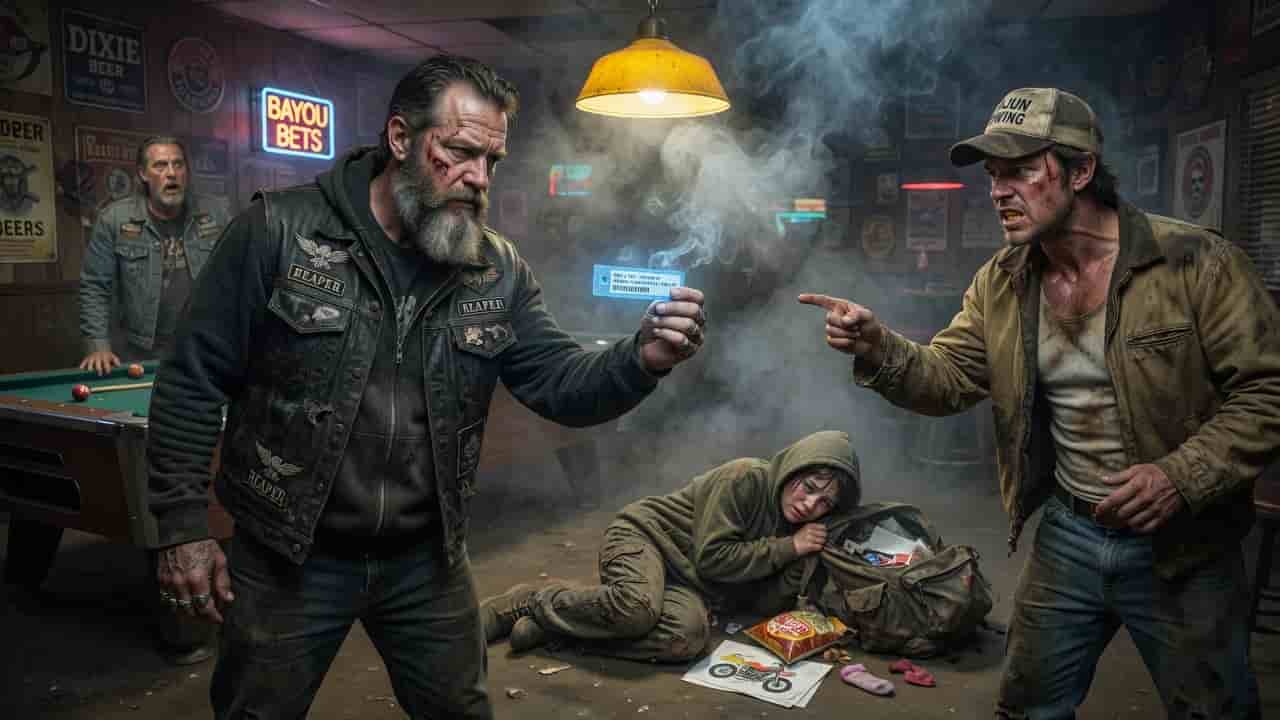
“Where did you get this?” Reaper’s voice was like gravel under a heavy boot. He didn’t look at the debt collector he’d just slammed against the wall. He was looking at the small, blue plastic bracelet in his hand. It was stained with years of grime, but the name was still clear: Elena Kane.
The bar went silent. Even the ceiling fans seemed to stop humoring the thick Louisiana heat. On the floor, the kid they called Joey—a girl in a boy’s oversized hoodie—shook like a leaf in a hurricane. She’d been the town’s punching bag for weeks, but Reaper had never stepped in. Not until that tag fell out of her ripped bag.
That bracelet had been on his wife’s wrist the night she was taken from him in a hit-and-run three years ago. The police said the driver vanished. The club said they’d look for him. Reaper had spent every night since then drinking himself into a stupor, blaming himself for not being the one behind the wheel that night.
“I found it,” the girl whispered, her eyes darting toward the back of the room where the older club members sat. “In the trash behind the clubhouse. Please, don’t hurt me.”
Reaper felt a coldness settle in his chest that had nothing to do with the air conditioning. He looked at the “Council” of bikers he’d called brothers for twenty years. They weren’t looking at the girl. They were looking at him, their hands inching toward their belts.
He realized then that the kid wasn’t just a witness. She was a target. And if he wanted the truth about what happened to Elena, he was going to have to burn down the only home he had left.
Chapter 1
The air in the Atchafalaya Basin didn’t just hang; it leaned on you. It was a thick, wet wool blanket that smelled of diesel, rotting cypress, and the kind of stale beer that only existed in places where hope went to die. Reaper sat on the porch of the clubhouse, a sprawling, sagging structure that had once been a fishing lodge before the Black Jackal MC claimed it in the late nineties. He was nursing a lukewarm bottle of Jax, his thumb tracing the jagged scar that ran from his temple down to his jawline.
He was forty-two, but his joints felt like they were filled with crushed glass. Every time the humidity spiked, the old injuries sang—the broken ribs from a spill in ’16, the gunshot wound in his thigh from a border run gone wrong, and the phantom ache in his chest that no amount of whiskey could touch.
“You’re brooding again, Reap,” a voice crackled.
Reaper didn’t turn. He knew the rhythm of those footsteps. Slim, the club’s resident tech-head and general nuisance, leaned against the railing. Slim was half Reaper’s size and twice as twitchy, a man who survived on nicotine and nervous energy.
“Thinking ain’t brooding,” Reaper said, his voice a low rumble.
“When you do it, it is. You got that look. The ‘I’m gonna kill someone or buy a tractor’ look.” Slim lit a cigarette, the flare of the lighter momentarily illuminating his hollow cheeks. “The Council’s meeting inside. Judge is asking for you.”
Reaper grunted. Judge was the oldest member of the Jackals, a man who remembered when the club rode Panheads and didn’t care about things like ‘territorial logistics’ or ‘diversified revenue streams.’ Judge was the closest thing Reaper had to a father, but lately, the old man’s wisdom felt like a leash.
“Tell him I’m finishing my beer,” Reaper said.
“He’s in a mood, Reap. Something about the New Orleans shipment being light.”
“Everything’s light these days, Slim. The world’s getting smaller. More people fighting over fewer crumbs.”
Reaper stood up, the porch boards groaning under his weight. He was a big man, built like a brick outhouse, with shoulders that seemed to take up most of the doorway. He made his way inside, the transition from the humid night to the air-conditioned interior hitting him like a physical blow. The clubhouse smelled of leather, floor wax, and the heavy, sweet scent of Judge’s pipe tobacco.
At the far end of the room, seated at a long table made of reclaimed oak, were the three men who ran the show. Judge sat in the center, his white hair pulled back in a ponytail, his eyes as sharp and cold as flint. To his left was Silas, a man who handled the money and looked more like a crooked accountant than a biker. To his right was Miller, a blunt instrument of a man who enjoyed the ‘enforcement’ side of the business a little too much.
“Reaper,” Judge said, nodding toward a chair. “Sit.”
“I’ll stand,” Reaper replied. He didn’t like sitting in meetings. It made him feel cornered.
“Suit yourself,” Judge said, leaning back. “We’ve got a problem in town. A little flea named Vance. He’s been shaking down the local businesses, claiming Jackal protection. Only problem is, we ain’t seen a dime of it.”
“Vance is a bottom-feeder,” Reaper said. “He collects debts for the payday loan sharks. He ain’t worth our time.”
“He’s using our name,” Silas interjected, his fingers tapping a rhythmic beat on the table. “That makes it our business. It makes us look weak, Reaper. And in this parish, weak is a death sentence.”
“He’s been hanging around the Rusty Anchor,” Miller added, a cruel smile touching his lips. “Got himself a little mascot, too. Some street kid he’s been using to run messages. It’s pathetic.”
Reaper felt a flick of irritation. He’d seen the kid. A small, scrawny thing in a hoodie that was three sizes too big, always lurking in the shadows of the alleyways. The town called him Joey. He looked like he hadn’t had a square meal since the Obama administration.
“I’ll talk to him,” Reaper said.
“Don’t just talk, Reap,” Judge said, his voice dropping an octave. “Remind him who owns the air he breathes. We’re losing grip on the locals. They need to see a Jackal back on the hunt.”
Reaper nodded, but his mind was elsewhere. It was the anniversary week. Three years since the rainy Tuesday night when Elena had stepped out to grab a gallon of milk and never came home. The hit-and-run had been clean—no skid marks, no witnesses, just a broken woman in a ditch and a husband who arrived ten minutes too late to say goodbye.
The police had called it an accident. The club had called it a tragedy. Reaper had called it his fault. He was supposed to be the one at the store. He was supposed to be the one protecting her. Instead, he was at the bar, celebrating a successful run that didn’t mean a damn thing now.
He walked out of the clubhouse without another word, his boots heavy on the gravel. He mounted his bike, a customized Harley that roared to life with a throatiness that vibrated in his teeth. He needed to move. He needed the wind to scour the thoughts from his head.
He rode through the outskirts of town, past the darkened storefronts and the flickering neon of the laundromat. He pulled up to the Rusty Anchor, a dive bar that sat on the edge of the swamp, its foundation slowly being reclaimed by the mud.
As he swung his leg over the saddle, he saw a flash of olive-green in the alleyway. The kid, Joey. He was sitting on a crate, his head buried in his hands. He looked small. Too small for a town this mean.
Reaper ignored him and pushed through the heavy wooden doors of the bar. The place was packed. The smell of fried catfish and cheap tobacco was thick enough to chew. At a corner table, surrounded by a couple of local toughs who thought they were harder than they were, sat Vance.
Vance was wearing a tan work jacket and a trucker hat, his face flushed with the kind of arrogance that came from having a little bit of power over people who had none. He was laughing, a shrill, grating sound that cut through the low hum of the room.
“And then I told her,” Vance shouted over the music, “if you don’t have the cash by Friday, I’m taking the car. I don’t care if you have to walk to the clinic!”
His cronies roared with laughter. Reaper didn’t move. He stood by the bar, watching, his presence slowly beginning to register with the people nearest to him. The laughter at Vance’s table died down one by one as they noticed the man in the leather vest standing like a shadow in the doorway.
Vance finally looked up, his smile faltering. He tried to puff out his chest, but his eyes gave him away. They were darting, looking for an exit that didn’t exist.
“Reaper,” Vance said, his voice cracking slightly. “Didn’t expect to see you here tonight. Buy you a drink?”
“I don’t drink with thieves,” Reaper said, his voice carrying through the quieted room.
“Thief? Now, hold on. I’m just doing my job, man. Collecting what’s owed.”
“You’re collecting under a name that don’t belong to you,” Reaper said, stepping forward. The crowd parted like the Red Sea. “The Jackals don’t know you, Vance. And the Jackals don’t like people using their reputation to scare single mothers.”
Vance’s face went from red to a sickly pale. “I… I was gonna bring a cut to the clubhouse. I swear. I was just getting the total together.”
“The total is zero,” Reaper said, now standing inches from Vance’s face. He could smell the sour beer on the man’s breath. “You’re done. You leave this town tonight, or the next time we talk, it won’t be in a bar.”
Vance looked around, desperate for support, but his ‘friends’ were suddenly very interested in the patterns of the wood grain on the table. He swallowed hard, his Adam’s apple bobbing.
“Yeah, okay. Sure, Reaper. No problem. I was leaving anyway.”
Vance stood up, his chair scraping loudly against the floor. He tried to walk past Reaper with some shred of dignity, but he tripped over his own feet. He scrambled toward the door, his cronies following close behind like whipped curs.
Reaper watched them go, but the victory felt hollow. It was too easy. Men like Vance didn’t just disappear; they crawled into different holes and waited for the light to fade.
He walked back out to his bike, the humidity pressing in again. The kid was still there, but he wasn’t on the crate anymore. He was standing by the edge of the alley, watching Reaper with wide, unblinking eyes.
“What are you looking at, kid?” Reaper growled.
The kid didn’t answer. He just pulled his hoodie tighter and vanished into the darkness of the swamp. Reaper stared at the spot where he’d been for a long moment, a strange, uneasy feeling settling in his gut. It was the feeling of a storm breaking, the kind that didn’t just wash the world clean, but tore it all down to the roots.
He kicked his bike into gear and headed back toward the clubhouse, the ghost of Elena sitting on the pillion behind him, her arms wrapped around his waist, her breath a cold wind against his neck. He had three more days until the anniversary. Three more days of pretending that he was still the man she’d loved, instead of the hollowed-out shell he’d become.
But as he rode, he couldn’t shake the image of the kid’s eyes. They weren’t the eyes of a street urchin. They were the eyes of someone who knew a secret. And in a town like this, secrets were the only things more dangerous than the men who kept them.
Chapter 2
The next evening, the heat had transitioned from oppressive to downright suffocating. The air felt like wet wool, sticking to the lungs and making every movement a chore. Reaper spent the afternoon in the garage, the familiar scent of oil and gasoline providing a thin layer of comfort. He was stripping down a carburetor, his hands moving with a precision that belied the turmoil in his head.
He didn’t want to think about the meeting. He didn’t want to think about Vance. And he most certainly didn’t want to think about the kid. But the kid was becoming a fixture, a ghost that refused to be exorcised.
“He’s back,” Slim said, leaning against the garage doorframe.
Reaper didn’t look up. “Who’s back?”
“Vance. He’s at the Anchor. He didn’t leave town, Reap. In fact, he’s acting like he owns the place. Heard he brought some muscle in from the parish over. Real nasty pieces of work.”
Reaper set the wrench down. The metal clattered against the concrete floor, the sound echoing in the quiet garage. “I told him to leave.”
“Well, he didn’t listen. And he’s got that kid with him again. Only it ain’t messages he’s running today. Vance is putting on a show.”
Reaper wiped his hands on a greasy rag, his knuckles white. He felt the familiar surge of adrenaline, the dark, cold tide that rose whenever he was pushed. He didn’t care about the Jackals’ reputation at that moment. He cared about the fact that a cockroach like Vance thought he could ignore a direct order.
“Get the bike,” Reaper said.
“You want me to call Miller? Or the Judge?”
“No,” Reaper said, his voice flat. “This is mine.”
The ride to the Rusty Anchor was short, but it felt like miles. The town felt different tonight—tense, like a bowstring pulled too tight. People were off the streets, the windows of the houses dark. Word had spread.
When Reaper pulled up, he saw the cars out front. Two black SUVs with tinted windows, parked haphazardly across the sidewalk. Muscle. Vance wasn’t just being stubborn; he was being protected.
He pushed open the doors to the bar, and the atmosphere hit him like a physical blow. It wasn’t the usual Friday night roar. It was a hushed, jagged silence, punctuated by a single, high-pitched laugh.
Vance was standing in the center of the room. He’d traded his work jacket for a cheap leather vest that looked ridiculous on his frame. Beside him stood two men—huge, thick-necked brutes with shaved heads and tribal tattoos crawling up their throats. They looked like professional violence, the kind you hired when you wanted a message delivered in broken bones.
And then there was the kid.
Joey was on his knees in the middle of a circle of empty tables. His oversized hoodie was torn at the shoulder, revealing a pale, bruised arm. He was staring at the floor, his small frame shaking.
“I told you, rat,” Vance was saying, his voice loud and performative for the crowd of regulars who were huddled by the bar. “If you lose the ledger, you pay the price. And since you don’t have any money, we’re gonna have to find another way for you to be useful.”
Vance held up a bowl of what looked like scraps from the kitchen—old hushpuppies and congealed gravy. He dropped it on the floor in front of the kid. The ceramic shattered, the mess spilling across the dirty floorboards.
“Eat,” Vance commanded.
The kid didn’t move.
“I said eat!” Vance stepped forward and shoved the kid’s head toward the mess. “Show everyone what a good little dog you are. Maybe then I won’t have to tell the Sheriff about that backpack you ‘found’ in the alley.”
A low murmur went through the crowd, but nobody stepped forward. These were hardworking people—loggers, fishermen, mechanics. They had families. They had lives. They couldn’t afford a war with the muscle in the SUVs, and they knew the Jackals weren’t their friends either.
Reaper felt the air in the room change. It wasn’t just anger anymore. It was a deep, visceral disgust that tasted like copper in the back of his throat. He’d seen a lot of things in twenty years with the club—shakedowns, brawls, things he wasn’t proud of—but he’d never seen a man humiliate a child for sport.
He stepped out of the shadows of the entryway.
“Vance,” Reaper said.
The name cut through the room like a blade. Vance froze, his hand still on the back of the kid’s neck. He looked up, his face a mask of false bravado.
“Reaper. Back for more? I told you, I got my own protection now. The Jackals don’t run this town anymore. We’re moving in, and we’re starting with the bottom-feeders.”
He shoved the kid again, his face inches from the gravy. “Go on, kid. Show the big bad biker how you eat.”
The two goons stepped forward, their shadows falling over Reaper. They were younger, faster, and probably better trained. But they didn’t have the weight of three years of grief and twenty years of rage behind them.
“The kid isn’t part of your business,” Reaper said, his voice dangerously quiet.
“The kid is my property,” Vance spat. “He owes me. And until he pays, I do whatever I want with him. Maybe I’ll sell him to the guys in New Orleans. I hear they like ’em small and quiet.”
The kid looked up then. For the first time, his eyes met Reaper’s. They weren’t just afraid. They were pleading. And in that moment, Reaper didn’t see a street kid named Joey. He saw the world that had failed Elena, the world that took the innocent and ground them into the dirt while the men who were supposed to protect them watched from the sidelines.
“Pick him up,” Reaper said.
“Make me,” Vance sneered.
Reaper didn’t wait. He moved.
The first goon lunged, a practiced left hook aimed at Reaper’s jaw. Reaper didn’t block; he slipped the punch and drove his elbow into the man’s throat. The sound of cartilage snapping was sickeningly clear in the quiet bar. The goon collapsed, clutching his neck, his face turning a dark, bruised purple.
The second goon was smarter. He drew a collapsible baton and swung it in a wide arc. The steel whistled through the air. Reaper took the hit on his shoulder—a searing flash of pain that would leave a bone-deep bruise—and used the momentum to close the gap. He grabbed the man’s wrist, twisted it until the bone popped, and slammed his head into the edge of the pool table. The goon went limp, sliding to the floor in a heap of meat and leather.
Reaper turned to Vance.
Vance had backed away, his hands shaking, his face a pale mask of terror. He’d dropped his vest, standing there in his dirty undershirt. He looked small. He looked like the coward he was.
“Wait… Reaper, wait! It was just a joke! We were just having some fun!”
Reaper stepped over the mess on the floor. He didn’t say a word. He grabbed Vance by the collar of his shirt and lifted him until his toes were barely touching the ground.
“You think this is fun?” Reaper asked, his voice a low, vibrating growl.
“No! No, I’m sorry! I’ll leave! I’ll leave right now!”
“You should have left when I told you the first time,” Reaper said.
He slammed Vance against the wooden pillar, the impact shaking the bottles on the back bar. He leaned in close, his breath hot against Vance’s ear.
“If I ever see you near this kid again, if I ever hear your voice in this town again, I won’t just break you. I’ll bury you so deep the crawfish won’t even find you. Do you understand?”
Vance nodded frantically, tears streaming down his face. Reaper threw him toward the door. Vance scrambled to his feet and ran, leaving his muscle unconscious on the floor and his dignity in the spilled gravy.
The bar was silent. The regulars were staring at Reaper with a mixture of awe and fear. He ignored them. He turned back to the kid.
Joey was still on the floor, his breath coming in ragged gasps. He was staring at the spot where Vance had been, his eyes wide and vacant.
“You okay, kid?” Reaper asked, his voice softening just a fraction.
The kid didn’t answer. He just reached out and started gathering the items that had spilled from his backpack—a few crumpled shirts, a half-eaten bag of chips, and a small, battered tin box.
Reaper knelt down to help him, his large hands clumsy in the small space. As he reached for a stray sock, his fingers brushed against something else. Something that shouldn’t have been there.
It was a plastic bracelet. Translucent blue. The kind they gave you in the emergency room.
Reaper froze. His heart hammered against his ribs like a trapped bird. He picked up the bracelet, his hands trembling. The ink was faded, but the name was still legible.
Elena Kane. Patient ID: 88421-B. The date on the bottom was the night of the accident.
The room seemed to tilt. The sounds of the bar faded into a dull roar, like the sound of the ocean in a seashell. He looked at the kid, really looked at him. The kid was staring at the bracelet in Reaper’s hand, his face pale, his lips trembling.
“Where did you get this?” Reaper whispered, the words barely audible.
The kid didn’t answer. He just reached out and tried to snatch the bracelet back, his movements frantic.
“Where did you get this!” Reaper roared, the sound echoing through the bar.
The kid flinched, pulling back into a tight ball. “I found it! In the alley! Behind the big house! Please, don’t take it! It’s mine!”
Reaper stared at the bracelet, then at the kid. The big house. The Jackal clubhouse.
His wife had died in a hit-and-run on the other side of town. Her belongings had been returned to him by the police—her purse, her ring, her clothes. But he’d never seen the hospital bracelet. He’d assumed it had been cut off and thrown away at the morgue.
But here it was. In the hands of a street kid who found it in the trash behind the place Reaper called home.
The coldness in his chest turned to fire. A white-hot, blinding rage that threatened to consume him. He looked up at the bar, at the people watching him, at the world that suddenly felt like a lie.
He grabbed the kid by the arm—not roughly, but with a grip that wouldn’t be denied—and pulled him toward the door.
“You’re coming with me,” Reaper said.
“No! Let me go!” the kid cried, struggling against his grip.
“I’m not gonna hurt you,” Reaper said, his voice thick with emotion. “But we’re gonna have a talk. And you’re gonna tell me everything you saw in that alley.”
He pushed through the doors of the Rusty Anchor, the blue hospital tag clutched in his fist like a weapon. The storm hadn’t just broken. It had arrived. And Reaper was right in the center of it.
Chapter 3
The safe house was a hunting cabin ten miles deep into the cypress swamp, accessible only by a single-lane dirt road that turned into a muddy soup after a heavy rain. It belonged to an old friend of Reaper’s, a man who had long ago traded the club life for a quiet existence of trapping and solitude. The air here was even heavier, the sound of bullfrogs and cicadas a constant, rhythmic thrumming that vibrated in the wood of the walls.
Reaper sat at the small kitchen table, the blue hospital bracelet lying between him and the kid. He’d forced a sandwich and a glass of milk on the boy—or girl, he still wasn’t entirely sure—but the kid hadn’t touched them. He was huddled in a chair, his oversized hoodie pulled up over his head like a turtle retreating into its shell.
“Talk to me, Joey,” Reaper said. His voice was tired, the adrenaline from the bar fight having evaporated, leaving behind a hollow, aching fatigue.
The kid didn’t look up. “My name isn’t Joey. It’s Mia.”
Reaper nodded slowly. “Okay, Mia. Why the boy clothes? Why the dirt?”
“It’s safer,” she whispered, her voice barely audible over the drone of the insects outside. “People don’t look at boys the same way. They leave you alone more.”
“Vance didn’t leave you alone.”
“Vance is a pig. He found me sleeping in the old cannery. He said he’d tell the cops I was a runaway if I didn’t work for him.” She finally looked up, her eyes dark and ancient in her small face. “I’m not a runaway. I’m an orphan. There’s a difference.”
Reaper felt a pang of something he hadn’t felt in a long time—pity. Real, unadulterated pity. He reached out and pushed the plate of sandwiches an inch closer to her.
“Eat, Mia. You’re safe here. Nobody’s gonna tell the cops anything.”
She hesitated, then reached out and took a half of a sandwich, biting into it with a desperation that made Reaper’s chest tighten. He waited until she’d finished the first half before he pointed to the bracelet.
“The tag, Mia. You said you found it behind the clubhouse. Tell me exactly where. Tell me what else was there.”
She swallowed hard, her eyes darting toward the door. “It was about a month ago. I was looking for scraps. The big bins behind the kitchen. I found a bag. A black trash bag, but it was heavy. It wasn’t food.”
“What was in it?”
“Clothes,” she said. “Old clothes. A leather jacket with the big dog on the back, but it was torn up. And there was a purse. A small, red one.”
Reaper’s breath hitched. Elena had a red purse. A small, vintage leather one she’d found at a flea market in Lafayette. The police had told him it was lost in the accident, likely thrown from the car and swallowed by the swamp.
“And the tag?”
“It was at the bottom of the bag. I thought it was pretty. The blue color. I kept it.” She looked at him, her eyes wide with fear. “I didn’t steal it, I swear! It was in the trash!”
“I believe you,” Reaper said, his voice thick. “Did you see who put the bag there?”
Mia shook her head. “No. But it was under a pile of fresh grease. Whoever did it wanted it hidden.”
Reaper stood up and walked to the window, staring out into the dark wall of the swamp. His mind was racing, connecting dots he’d spent three years trying to ignore.
The night of the accident, he’d been at the bar with Miller and Silas. Judge had been there too, holding court. When the call came in, they’d all been there to comfort him. They’d ridden with him to the hospital. They’d helped him arrange the funeral.
But the hit-and-run driver was never found. The police had said the car was likely a stolen sedan, something common that would blend in. But what if it wasn’t a car? What if it was a bike?
A bike with a rider who was wearing a Jackal vest.
He remembered the talk in the weeks following the accident. The way Miller had suddenly started riding a new bike, claiming his old one had been totaled in a ‘private accident’ he didn’t want to talk about. The way the Council had suddenly closed ranks, becoming even more secretive about the club’s business.
He’d been too blinded by grief to see it. He’d been the loyal soldier, the enforcer who didn’t ask questions because he believed in the brotherhood. He believed that they were his family.
But families didn’t murder each other’s wives and then throw their belongings in the trash like common refuse.
“Reaper?” Mia’s voice broke through his thoughts. “Are you gonna go back there?”
He turned to look at her. She was watching him with a terrifying clarity, as if she could see the war raging inside him.
“I have to,” he said.
“They’ll kill you,” she said, her voice matter-of-fact. “I saw them. The way they look at people. They aren’t like you.”
“How are they different, Mia?”
“You saved me,” she said simply. “They would have watched me eat the gravy.”
Reaper felt a lump in his throat. He walked over to her and put a hand on her shoulder. Her frame felt impossibly fragile under the heavy hoodie.
“You stay here. My friend, the man who owns this place, he’ll be back in the morning. He’ll take care of you. There’s enough food in the pantry for a week.”
“Where are you going?”
“I’m going to find a friend,” Reaper said. “Someone who still knows the difference between a brother and a murderer.”
He walked out of the cabin, the night air hitting him like a physical weight. He mounted his bike, but he didn’t start it. He sat there in the silence of the swamp, the blue hospital tag tucked into the pocket of his vest, right over his heart.
He needed to talk to Slim. Slim was the only one who wasn’t part of the Council, the only one who might have seen something on the digital side—repair logs, insurance claims, anything that would prove what his gut was telling him.
He kicked the Harley into life, the roar of the engine echoing through the cypress trees like a challenge. He wasn’t just the enforcer anymore. He was the judge, the jury, and if necessary, the executioner.
As he rode back toward town, the humidity seemed to lift, replaced by a cold, sharp clarity. He’d spent three years living in a ghost story. It was time to find out who had written the ending.
He pulled up to the small house Slim rented on the edge of the industrial district. The lights were on, the blue glow of a computer monitor visible through the front window. Reaper didn’t knock; he pushed through the door, his presence filling the small, cluttered room.
Slim jumped, nearly knocking over a stack of hard drives. “Reap! Damn, man. You trying to give me a heart attack?”
Reaper didn’t answer. He walked over to the desk and pulled the blue hospital tag from his pocket, dropping it onto the keyboard.
Slim looked at it, then up at Reaper. His expression went from confused to terrified in the span of a heartbeat.
“Where did you get that?” Slim whispered.
“You know what it is, Slim,” Reaper said, his voice a low, dangerous vibration. “I want to know why it was in the trash behind the clubhouse. And I want to know whose vest was in the bag with it.”
Slim swallowed hard, his hands shaking as he reached for a cigarette. “Reap… you don’t want to do this. You really, really don’t.”
“Tell me, Slim. Or I’ll find out from Miller. And I won’t be as nice as I’m being right now.”
Slim looked at the screen, then back at Reaper. He let out a long, shaky breath and started typing.
“I didn’t see the accident,” Slim said, his eyes fixed on the monitor. “But I saw the bike. Three years ago, the night of the rain. Miller brought his Hog in. The front end was smashed to hell. He said he hit a deer.”
“A deer?”
“That’s what he said. But there was no hair. No blood. Just… red paint. The same red as Elena’s car.”
Reaper felt the world go cold. “And the Council? Judge?”
“They knew, Reap. Judge told me to wipe the maintenance logs. He said it was a ‘club matter.’ He said you were too fragile, that it would break you if you knew a brother had been reckless.”
“Reckless?” Reaper spat the word like it was poison. “He killed her, Slim. He killed her and they hid it.”
“It wasn’t just Miller, Reap,” Slim said, his voice dropping to a whisper. “The black bag? The one the kid found? That wasn’t just Miller’s stuff. There was a ledger in there. A record of a payment from a developer in New Orleans. They wanted that intersection cleared for a new shopping center. Elena wasn’t an accident, Reap. She was a message. She was in the way.”
Reaper felt the air leave his lungs. It wasn’t just a hit-and-run. It was a hit. His wife, the woman who had been his light in the darkness, had been murdered because of a real estate deal. And the men he’d called brothers had taken the money and watched him mourn.
He stood up, the chair flying backward and crashing against the wall. He didn’t say a word. He didn’t have to. The look on his face told Slim everything he needed to know.
“Reap, wait!” Slim cried. “You can’t go there alone! They’re waiting for you! They knew you’d find out eventually!”
Reaper didn’t stop. He walked out the door, the blue hospital tag clutched in his hand. He had one more stop to make before the clubhouse. One more stop to prepare for the end of the world.
The anniversary was in two days. But for Reaper, the time for mourning was over. The time for reckoning had begun.
Chapter 4
Reaper sat on his bike in the shadows of the old sugar mill, a rusted skeleton of an industry that had long since abandoned the Bayou. The building loomed over him, a jagged silhouette against a sky that was beginning to bruise with the first hints of dawn. He was holding the blue hospital tag, the plastic cold against his palm.
He’d spent the last four hours in a state of hyper-focused clarity. The rage was still there, a molten core in the center of his chest, but it had been harnessed, directed. He’d gone to his own small apartment, a place he’d barely visited since the funeral, and retrieved the one thing he’d kept from his life before the Jackals.
It was a heavy, snub-nosed .45, a service weapon his father had carried in Korea. It was old, but it was well-maintained, and it carried a weight that felt more honest than the club-issued pieces he usually wore. He’d loaded it with a grim deliberateness, each click of the cylinder a sentence in a confession he was about to force.
He heard the low rumble of an engine. Not a bike. A truck.
A battered Ford F-150 pulled into the clearing, its headlights cutting through the mist. It stopped ten feet from Reaper, the engine idling with a rough, uneven cadence. The door opened, and a man stepped out.
It was Silas.
He looked older in the dim light, the lines on his face deeper, his posture less certain. He wasn’t wearing his colors. He was in a plain flannel shirt and work pants, looking like any other man trying to survive in a hard town.
“You’re a hard man to find, Reaper,” Silas said, his voice thin.
“I wasn’t hiding,” Reaper replied.
Silas walked closer, stopping just outside the circle of the Harley’s shadow. He looked at the gun tucked into Reaper’s belt, then at the blue tag in his hand. He sighed, a long, weary sound that seemed to carry the weight of years.
“Slim called me. Said you knew.”
“I know some of it,” Reaper said. “I want the rest. I want to know who gave the order.”
Silas looked away, staring into the dark line of the trees. “It wasn’t supposed to be her, Reap. You have to believe that. The developer, he just wanted the land. He wanted the locals to see that the Jackals couldn’t protect them anymore. He wanted chaos. Elena… she was just in the wrong place at the wrong time.”
“She was at the grocery store, Silas. In our neighborhood.”
“Miller was supposed to just scare her. Run her off the road, give her a fright. But he’d been drinking. He was always drinking back then. He hit her too hard. And once it happened… Judge said there was no going back. If we turned him in, the whole club would go down. The deal with the developer would fall apart, and we’d lose everything.”
“So you sold her for a shopping center,” Reaper said, his voice a flat, dead thing.
“We did what we had to do to survive! The club was dying, Reaper! We were broke, the feds were breathing down our necks, and the New Orleans crews were moving in. This deal… it was our way out.”
“And the black bag? The one with her purse and her tag?”
Silas closed his eyes. “That was Miller. He kept them. Like trophies. I told him he was sick, I told him to get rid of them, but he wouldn’t. He said he liked knowing he had a piece of you. That he was the one who really owned the Enforcer.”
Reaper felt a surge of nausea. The man he’d fought beside, the man he’d bled for, had kept his wife’s belongings as a way to feel superior. It wasn’t just a business deal. It was a betrayal so deep it felt like it had rewritten his entire history.
“Where is he now?” Reaper asked.
“He’s at the clubhouse. They all are. Judge knows you’re coming. He told Miller to finish it tonight. He said a broken dog is no use to the pack.”
Silas reached into his pocket and pulled out a small, leather-bound ledger. He held it out to Reaper.
“This is the record of the payments. Names, dates, bank accounts. Everything. It’s what Slim was looking for. I took it from Judge’s safe an hour ago.”
Reaper took the ledger, his fingers brushing against Silas’s. The man was trembling.
“Why are you giving me this, Silas? You’re part of it.”
“I’m tired, Reap. I’ve spent three years looking at you and seeing a ghost. I can’t do it anymore. I’m leaving. Taking my share and heading west. You do what you have to do.”
Silas turned and walked back to his truck. He stopped at the door and looked back.
“He’s waiting in the main hall, Reaper. Miller’s in the garage. Don’t go through the front. Use the service entrance behind the kitchen. It’s where the grease bins are.”
Reaper watched the truck pull away, the red taillights disappearing into the mist. He was alone again with the silence of the sugar mill and the weight of the truth.
He looked at the ledger, then at the blue hospital tag. He didn’t feel like a broken dog. He felt like a man who had finally found his purpose.
He mounted his bike and headed toward the clubhouse. He didn’t ride fast. He didn’t need to. The night was still young, and the reckoning would take as long as it needed.
As he approached the Jackal territory, he saw the flickering lights of the clubhouse through the trees. It looked like a fortress, a bastion of secrets and lies. He pulled off the road a mile away and walked the rest of the distance, his boots silent on the damp earth.
He moved through the woods with the skill of a hunter, his eyes adjusted to the dark. He reached the back of the building, the smell of stale grease and rotting food hitting him. The bins were there, the same ones Mia had scavenged.
He found the service entrance. It was unlocked, just as Silas had said. He stepped inside, the transition to the cool, stale air of the clubhouse making his skin prickle. He was in the kitchen. It was empty, the only sound the hum of the industrial refrigerator.
He moved through the hallway, past the closed doors of the bunkrooms. He could hear voices coming from the main hall—low, murmuring tones, punctuated by the clink of glasses.
He reached the heavy double doors of the hall. He took a deep breath, the scent of pipe tobacco and leather filling his lungs. He felt the .45 in his belt, the cold weight of it a comfort.
He pushed the doors open.
The room was exactly as it had been two nights ago. Judge sat at the head of the table, his white ponytail glowing in the lamplight. Miller sat to his right, a glass of whiskey in his hand, a smug, expectant look on his face.
They both looked up as Reaper entered.
“Reaper,” Judge said, his voice calm, almost welcoming. “We’ve been expecting you. Sit. Have a drink. It’s been a long night.”
Reaper didn’t sit. He walked to the center of the room and dropped the blue hospital tag onto the table. It slid across the polished wood, stopping right in front of Miller.
Miller looked at it, his expression not changing. He took a slow sip of his whiskey.
“Found your trash, Miller,” Reaper said, his voice a low, vibrating growl. “Found the trophies you kept from the woman you murdered.”
Miller laughed, a dry, rasping sound. “Murdered? That’s a strong word, Reap. It was an accident. Ask Judge. He’ll tell you. We were just doing business.”
“Business?” Reaper stepped closer, the light catching the scar on his face. “Business is shakedowns and smuggling. Business isn’t killing a man’s wife and then watching him mourn for three years while you take blood money from a developer.”
Judge leaned forward, his eyes cold and hard. “Enough, Reaper. We did what we had to do for the club. We protected the brotherhood. You were part of that brotherhood. You still are. If you can just put this aside, if you can accept that the world is a cruel place and we’re just survivors in it…”
“I’m not a survivor, Judge,” Reaper said, his hand moving toward his belt. “I’m the consequence.”
Miller moved faster than Reaper expected. He flipped the table, the heavy oak crashing into Reaper’s chest and pinning him against the wall. The whiskey glass shattered, shards of glass flying through the air.
Reaper struggled to get his breath, the weight of the table crushing his ribs. He saw Miller drawing a knife, a long, serrated blade that glinted in the dim light.
“I’ve wanted to do this for a long time, Reap,” Miller said, his face contorted in a mask of pure, unadulterated hate. “You were always the favorite. The ‘noble’ enforcer. But you’re just a dog. And tonight, I’m putting the dog down.”
He lunged, the knife aimed at Reaper’s throat.
Reaper twisted, the table shifting just enough for him to get a hand free. He grabbed Miller’s wrist, the two men locked in a desperate struggle for control. Miller was strong, fueled by adrenaline and years of resentment, but Reaper was fueled by something more.
He slammed his forehead into Miller’s nose, the sound of breaking bone echoing in the hall. Miller grunted, his grip loosening for a split second. Reaper used the opening to drive his knee into Miller’s groin and shove the table away.
They both fell to the floor, rolling among the shattered glass and spilled whiskey. Reaper managed to get on top, his fists raining down on Miller’s face. He didn’t feel the glass cutting into his knees. He didn’t feel the pain in his ribs. He only felt the need to destroy the man who had destroyed his life.
“Stop it!” Judge’s voice roared through the room.
Reaper looked up. Judge was standing at the end of the hall, a shotgun leveled at Reaper’s chest. His face was pale, his hands shaking.
“Get off him, Reaper. Now. Or I’ll blow you back into the swamp.”
Reaper didn’t move. He was staring at Judge, the man he’d looked up to, the man he’d trusted.
“Go ahead, Judge,” Reaper said, his voice thick with blood and rage. “Do it. Show everyone what the brotherhood really means. Show them how you protect your sons.”
Judge’s finger tightened on the trigger. The silence in the room was absolute, the only sound the ragged breathing of the three men.
And then, from the hallway behind Judge, a small, clear voice spoke.
“He’s telling the truth.”
Everyone turned. Standing in the doorway, her oversized hoodie stained with mud, her face pale but determined, was Mia.
She was holding a phone. Slim’s phone.
“I have the recordings,” she said, her voice trembling but steady. “Slim sent them to me. The logs, the insurance claims, the messages from the developer. Everyone in town is going to see them. Everyone in the parish.”
Judge’s face went from pale to a ghostly white. The shotgun wavered.
“Mia, get out of here,” Reaper said, his voice a frantic whisper.
“No,” she said, stepping into the room. “You saved me from Vance. I’m not letting them hurt you.”
Miller saw his opening. He lunged for the knife that had fallen near Reaper’s feet.
Reaper didn’t hesitate. He drew the .45 and fired.
The sound was deafening in the enclosed space. Miller was thrown backward, his chest exploding in a spray of red. He hit the floor and didn’t move.
Judge stared at Miller’s body, then at Reaper, then at the girl. The shotgun fell from his hands, clattering harmlessly onto the wood. He sank into a chair, his face buried in his hands.
“It’s over, Judge,” Reaper said, his voice weary. “The club, the deal, the lies. It’s all over.”
He walked over to Mia and took the phone from her hand. He looked at the screen. The files were all there. The truth, in black and white.
He looked back at Miller’s body, then at the blue hospital tag lying on the floor. He picked it up and tucked it back into his pocket.
“Come on, Mia,” Reaper said, reaching out a hand. “Let’s go.”
“Where?” she asked, her eyes wide.
“Away from here,” Reaper said. “As far as we can get.”
He led her out of the clubhouse, past the silent bunkrooms and the empty kitchen. They walked out into the cool, pre-dawn air, the sky turning a soft, pale gray.
He mounted his bike and helped Mia onto the back. She wrapped her small arms around his waist, her head resting against his back.
He kicked the Harley into life and rode away from the Jackal territory, the wind scouring the scent of the clubhouse from his clothes. He didn’t look back. He didn’t need to. The story of Reaper Kane was finished.
But as the sun began to rise over the Bayou, casting long, golden shadows across the water, he felt a strange, quiet peace. For the first time in three years, he wasn’t riding with a ghost. He was riding with a future.
And as they headed toward the horizon, the blue hospital tag sat in his pocket, a reminder of the cost of the truth, and the price of a second chance.
Chapter 5
The humidity didn’t stay behind at the clubhouse. It followed them down Highway 90, a thick, invisible passenger clinging to the leather of Reaper’s vest and the damp fabric of Mia’s hoodie. The roar of the Harley was the only thing filling the space between them, a mechanical scream that drowned out the sound of Reaper’s own heart hammering against his bruised ribs. He could feel Mia’s small hands gripped tight around his waist, her knuckles probably white under the grime. She hadn’t said a word since they’d crossed the parish line.
He didn’t blame her. She’d just watched a man get his chest opened up by a .45 in a room full of shadows. That kind of thing didn’t just leave a mark; it rewired the brain.
Reaper pulled into a derelict gas station three miles outside of Houma. The pumps were ancient, the glass cracked and clouded by years of salt air. He killed the engine, and the sudden silence was worse than the noise. It was heavy, expectant. He dismounted, his legs nearly giving out as his boots hit the gravel. The adrenaline was gone now, replaced by a cold, hollow ache that made every breath feel like inhaling broken glass.
“You okay?” he asked, his voice sounding like it had been dragged over a gravel pit.
Mia slid off the back of the bike. She stood there, swaying slightly, looking at him with eyes that seemed to have aged a decade in a single night. She didn’t answer. Instead, she looked down at her hands. They were stained with oil and a splash of something darker that had sprayed from Miller’s direction.
“I’m sorry you had to see that,” Reaper said. He walked to the side of the building, found a rusted spigot, and cranked it open. The water came out orange at first, then cleared to a tepid stream. He cupped his hands, splashed his face, and then gestured for her to do the same.
She approached the water hesitantly. She washed her hands with a frantic, obsessive energy, scrubbing until the skin was raw. When she finally looked up, her face was wet, her hair plastered to her forehead.
“Are they coming for us?” she asked.
“The club? Maybe. But they’re broken right now. Judge doesn’t have the stomach for a hunt, and Miller was the one who liked the blood.” Reaper leaned against the brick wall, his hand instinctively moving to the heavy weight of the pistol in his belt. “It’s the people with the money we have to worry about. The ones who paid for that intersection to be cleared. They have more to lose than a patch on a vest.”
He reached into his pocket and pulled out the ledger Silas had given him. The leather was soft, smelling of old tobacco and greed. He flipped through the pages. It wasn’t just names; it was a map of a decade’s worth of corruption. The developer, a man named Sterling Vance—no relation to the debt collector, just a shared name in a state full of coincidences—was a titan in New Orleans. He built luxury condos over the bones of working-class neighborhoods.
And Elena had been a line item in his budget.
“We can’t stay on the road,” Reaper muttered, more to himself than her. “They’ll have the plates. They’ll have the description.”
“We could hide in the swamp,” Mia suggested. “I know places. Places where the water is too shallow for the big boats.”
Reaper looked at her. She was ten years old, and her first instinct was to disappear into the mud. It broke something inside him that was already fractured. “No. No more hiding in the dirt, Mia. We’re going to a woman I know. Someone who lives outside the life. She’s… she’s Elena’s sister.”
The drive to Sarah’s house took another two hours. She lived in a small, neat cottage in Thibodaux, surrounded by ancient oaks draped in Spanish moss that looked like weeping ghosts. Reaper hadn’t spoken to her since the funeral. Sarah had looked at him then with a cold, unwavering hatred, blaming his life, his club, and his violence for the hole in their family. She wasn’t wrong.
He pulled the bike into the shadows of a neighboring grove and walked the rest of the way. Mia followed close behind, her footsteps silent. When he knocked on the door, the sound seemed to echo through the entire quiet neighborhood.
The porch light flicked on. A woman appeared behind the screen door, her face a mirror image of Elena’s, but hardened by a different kind of grief. She saw Reaper, and her hand went to her throat.
“Kane,” she whispered. “What did you do?”
“I found out the truth, Sarah,” Reaper said. He stepped into the light, letting her see the blood on his vest, the bruise darkening his jaw, and the trembling girl at his side. “I need you to take her. Just for a day. Maybe two.”
Sarah looked at Mia, her expression softening instantly. The maternal instinct that Elena had never gotten to use flared in her eyes. She pushed the screen door open. “Get inside. Both of you.”
The house smelled of lavender and lemon wax—a world so far removed from the grease and stale beer of the Jackal clubhouse that Reaper felt like he was trespassing. Sarah ushered Mia toward the kitchen, handing her a glass of juice and a warm blanket.
“Who is she?” Sarah asked, pulling Reaper into the hallway.
“A witness,” Reaper said. “And a victim. She found Elena’s things. The club… they’ve been lying to me for three years, Sarah. It wasn’t an accident. It was a contract.”
Sarah’s face went deathly pale. She slumped against the wall, her eyes filling with a sudden, sharp moisture. “I knew it. I told you those men were monsters. I told you they’d bring nothing but rot into her life.”
“You were right,” Reaper said, his voice cracking. “I’m going to New Orleans. I’m going to finish this.”
“You’re going to get yourself killed,” she snapped. “Look at you. You’re falling apart.”
“I’m already dead, Sarah. I died the night she did. I’ve just been walking around ever since.” He looked toward the kitchen, where Mia was sitting at the table, staring into her glass. “But that kid… she’s still alive. She deserves a chance to stay that way. Keep her here. Don’t let her out of your sight. If I’m not back by tomorrow night, take that ledger and the phone and go to the feds in Baton Rouge. Don’t go to the local cops. Half of them are on the payroll.”
He handed her the leather-bound book. Sarah took it as if it were made of live coals.
“Reaper,” she said as he turned toward the door.
He stopped, his hand on the frame.
“She loved you,” Sarah said, her voice small and pained. “In spite of everything. She used to say you were the only thing in that world that was still real.”
Reaper didn’t turn around. He couldn’t. If he saw the pity in her eyes, he’d lose the edge he needed to survive the next twelve hours. “She was wrong,” he said. “I’m the least real thing in this town.”
He walked out the door and back to the bike. The air was turning gray, the pre-dawn light revealing the skeletal branches of the oaks. He felt a strange sense of residue—not from the violence at the clubhouse, but from the quiet of Sarah’s house. It was the residue of the life he should have had. The birthdays, the holidays, the simple, boring routine of being a man who didn’t carry a gun.
He kicked the Harley to life. He had a hundred miles to cover, and a ghost to avenge.
As he hit the open road, the fatigue started to settle in earnest. His vision blurred at the edges, the white lines on the asphalt becoming a single, hypnotic streak. He thought about the blue hospital tag in his pocket. He reached down and touched it, the plastic sharp against his thumb.
He wasn’t riding for the club anymore. He wasn’t even riding for himself. He was riding for the girl in the olive-green hoodie, and for the woman who had died in a ditch because some man in a suit wanted to build a parking lot.
The city of New Orleans loomed ahead, a jagged skyline rising out of the mist. It was a place of music and light, but Reaper knew the darkness that lived in the alleys. He knew where the money hid.
He pulled into a 24-hour diner on the outskirts of the city, needing caffeine and a moment to think. The place was nearly empty, the only other customer an old man in a corner booth nursing a cup of black coffee. Reaper sat at the counter, his presence drawing a wary look from the waitress.
“Coffee,” he said. “Black. And a pack of Camels.”
He lit a cigarette, the first lungful of smoke steadying his nerves. He took out his phone—his own, not the one Mia had used—and dialed a number he’d kept in his contacts for years but never used.
“Vance?” he asked when a voice answered on the third ring. It wasn’t the debt collector. It was a man he’d known from his early days in the service, a man who worked private security for the elite.
“Who is this?” the voice asked, guarded.
“It’s Reaper. I need a location on Sterling Vance. His private residence. Not the office.”
There was a long silence on the other end. “Kane? You still riding with those bikers? Sterling Vance isn’t someone you want to mess with, man. He’s got friends in the governor’s office.”
“I don’t care about his friends,” Reaper said. “I have his ledger. The one that lists the payoffs to the Black Jackals. And the one that explains why Elena Kane died three years ago.”
The silence stretched even longer. Reaper could hear the sound of typing in the background.
“He’s at his estate in Garden District,” the voice finally said. “But listen to me, Reaper. He’s got a team there. Ex-Mossad, some local muscle. You go in there, you don’t come out. This isn’t a bar fight.”
“I know what it is,” Reaper said. He hung up and drained his coffee.
He walked back to the bike, the sun finally breaking over the horizon. The heat was already beginning to rise, the steam curling off the asphalt. He felt the weight of the .45 against his hip. He felt the cold, hard truth of the ledger in Sarah’s hands.
He had one shot. One chance to make the world make sense again.
He rode into the city, the noise of the traffic and the smell of the exhaust hitting him like a physical wall. He navigated the narrow streets of the Garden District, the opulent mansions with their wrought-iron fences and lush gardens looking like something out of a dream.
He found the estate. It was a massive Greek Revival structure, hidden behind a high brick wall and a gate that required a code. Reaper didn’t look for a code. He parked the bike a block away and found a spot where a massive magnolia tree overhung the wall.
He climbed with a grace that his heavy frame shouldn’t have possessed, his boots finding purchase in the rough bark. He dropped onto the manicured lawn, the sound of his landing muffled by the thick grass.
He was inside the fortress.
The residue of his past—the training, the violence, the years of being the man people feared—came flooding back. He wasn’t a biker now. He was a predator.
He moved through the shadows of the garden, his eyes scanning for cameras, for guards. He saw a man in a dark suit standing by the pool house, a cigarette dangling from his lip. The man was looking at his phone, his posture relaxed.
Reaper moved in. He didn’t use the gun. He used his hands, the silence of the garden his only witness. He caught the guard from behind, a quick, efficient chokehold that sent the man into unconsciousness before he could make a sound.
He stripped the guard of his radio and his earpiece.
“Target is secure,” a voice crackled in his ear. “All quiet on the east perimeter.”
Reaper didn’t answer. He moved toward the main house, his heart a steady, rhythmic drumbeat. He reached the French doors that led into the library. Through the glass, he could see a man sitting at a massive mahogany desk.
Sterling Vance.
He looked exactly like his photos—silver hair, tailored suit, the face of a man who had never known a day of hunger in his life. He was reading a report, a glass of expensive scotch at his elbow.
Reaper pushed the doors open.
Vance didn’t jump. He didn’t reach for a weapon. He simply looked up, his expression one of mild annoyance, as if a servant had entered without knocking.
“Can I help you?” Vance asked, his voice smooth and cultured.
“I’m Reaper Kane,” Reaper said, stepping into the room. He didn’t point the gun. He didn’t have to. The look in his eyes was enough.
Vance’s expression changed then. The annoyance vanished, replaced by a sharp, calculating interest. He set his pen down. “The biker. I heard you’d become a bit of a problem for Judge and his boys.”
“Judge is a coward,” Reaper said. “And Miller is dead. I’m here for the man who paid for the bullet.”
“I didn’t pay for a bullet, Mr. Kane. I paid for a relocation. What happened to your wife was a regrettable mistake by an incompetent drunk.” Vance leaned back, his fingers steepled. “But I suppose you’re here for a settlement? How much? Five hundred thousand? A million? Name your price, and we can end this tonight.”
Reaper felt a wave of cold fury. This man thought everything had a price. He thought the life of a woman who loved the smell of rain and the sound of old jazz could be settled with a check.
“I don’t want your money,” Reaper said. He reached into his pocket and pulled out the blue hospital tag, dropping it onto the mahogany desk.
Vance looked at it, then up at Reaper. “What is this?”
“It’s the only thing left of the woman you murdered,” Reaper said. “And it’s the thing that’s going to hang you.”
“You have no proof,” Vance said, his voice losing its smoothness. “A plastic tag and the word of a biker? No jury in this state will touch me.”
“I have the ledger,” Reaper said. “And I have the child who saw your men dumping the evidence. She’s safe, Vance. And she’s talking.”
Vance’s face went a sickly shade of gray. He reached for a button under his desk.
Reaper was faster. He pulled the .45 and leveled it at Vance’s forehead. “Don’t. I’ve already put down one dog tonight. I’ve got plenty of room for another.”
The room went silent. The only sound was the ticking of a grandfather clock in the corner.
“What do you want?” Vance whispered.
“I want you to pick up that phone,” Reaper said. “And I want you to call the District Attorney. You’re going to tell him everything. Every payoff, every contract, every life you’ve ruined to build your empire. And if you miss a single detail, I’m going to paint this library with your brains.”
Vance stared at the gun, then at the blue tag. He saw the truth in Reaper’s eyes—the truth of a man who had nothing left to lose.
He picked up the phone.
As Vance began to speak, his voice trembling as he confessed to the crimes that had built his world, Reaper stood by the window. He looked out at the Garden District, at the beauty and the wealth that had been bought with blood.
He felt the residue of the night finally beginning to settle. The anger was still there, but it was no longer a fire. It was a cold, hard stone.
He’d done it. He’d found the truth.
But as he looked at his hands, at the scars and the calluses and the faint trace of Miller’s blood under his fingernails, he knew he couldn’t go back. He couldn’t go back to Sarah’s house. He couldn’t go back to the club.
He was a man who belonged to the shadows. And the shadows were finally calling him home.
Chapter 6
The dawn over New Orleans was a bruised purple, the kind of light that made the city look like a theater set before the actors arrived. Reaper stood on the balcony of Sterling Vance’s library, the phone still clutched in the businessman’s shaking hand as the District Attorney’s office recorded every stuttered confession.
The police would be here in ten minutes. The sirens were already a faint, wailing ghost in the distance.
Reaper turned back to the room. Vance was slumped in his chair, his expensive suit looking suddenly too large for his shrinking frame. He looked like a man who had just watched his entire empire dissolve into a puddle of spilled scotch.
“I’m done,” Vance whispered, his eyes vacant. “Are you happy?”
“Happiness isn’t for people like us, Vance,” Reaper said. He picked up the blue hospital tag from the desk and tucked it back into his pocket. “It’s just about balance. And the scale finally leveled out.”
Reaper didn’t wait for the authorities. He moved back through the library, through the French doors, and into the lush, wet heat of the garden. He climbed the wall with a slow, deliberate effort, his body finally screaming in protest. Every muscle felt like it had been shredded, every bone ached with the weight of the last forty-eight hours.
He reached his bike and kicked it into gear. He didn’t head back to Thibodaux. He headed for the waterfront, a place where the city met the river in a tangle of rusted cranes and rotting piers.
He needed to see the water. He needed to feel the Mississippi moving, a relentless, muddy force that didn’t care about the sins of the men on its banks.
He pulled up to an abandoned wharf, the wood groaning under the weight of the Harley. He sat there for a long time, watching the tugboats push their barges through the mist. He took out his phone and dialed Sarah’s number.
“Is she okay?” he asked when she picked up.
“She’s sleeping,” Sarah said, her voice thick with relief. “Reaper… I saw the news. They’re saying a prominent developer has turned himself in. They’re saying there are warrants out for the entire Council of the Black Jackals.”
“The truth has a way of spreading once the dam breaks,” Reaper said. “Is Mia safe?”
“She’s safe. She’s going to stay with me for a while. We’re going to find her people, if there are any left. And if not… she has a home here.”
Reaper felt a knot in his throat loosen. It was the first time in three years he’d felt anything resembling peace. “Thank you, Sarah. For everything.”
“Where are you going, Reaper?”
“I don’t know. Somewhere the air doesn’t smell like grease and lies. Somewhere I can just be a ghost for a while.”
“You could come back,” she said, her voice soft. “Mia keeps asking for you. She says you’re the only one who didn’t look away.”
“Tell her… tell her I’m looking after things,” Reaper said. “Tell her she doesn’t have to wear the hoodie anymore.”
He hung up before he could change his mind. He couldn’t go back. He was a murderer now, twice over. Even if the law called it self-defense or justice, the weight of it was the same. He carried the residue of the clubhouse and the library in his marrow. He was the enforcer, and the enforcer didn’t get to sit at the kitchen table.
He walked to the edge of the pier and pulled the blue hospital tag from his pocket. He looked at Elena’s name one last time. He thought about the night she died, the rain on the windshield, the sound of the tires on the wet pavement. He thought about the man he’d been then—a man who thought loyalty was the highest virtue.
He was a different man now. A man who knew that loyalty was a lie if it wasn’t built on the truth.
He tossed the tag into the river. It flashed blue for a second before the muddy water swallowed it whole.
“Goodbye, Elena,” he whispered.
He walked back to the bike, but he didn’t get on. He saw a figure standing at the end of the wharf, partially obscured by the mist.
It was Slim.
The tech guy looked even more frazzled than usual, his denim jacket wrinkled, his hair a mess. He was holding a small duffel bag.
“Reap,” Slim said, his voice hesitant.
“What are you doing here, Slim?”
“The club’s gone, man. Judge is in custody, Silas vanished, and the rest of the boys are scattering like roaches. I didn’t have anywhere else to go.” Slim walked closer, his eyes darting toward the river. “I heard what you did. I heard about Vance.”
“You should have stayed out of it, Slim. You’re a tech guy. You don’t belong in the line of fire.”
“I was already in it, Reap. The moment I saw that bike three years ago, I was in it.” Slim handed him the duffel bag. “I cleaned out the club’s emergency fund before I left. It’s not much, but it’ll get you across the border. There’s a passport in there, too. A good one. Name’s John Miller. Irony, right?”
Reaper took the bag, the weight of the cash and the documents a final anchor to his old life. “Why, Slim?”
“Because you were the only one who ever treated me like a brother,” Slim said. He reached out and gripped Reaper’s shoulder, a brief, awkward gesture of affection. “Go on. Get out of here before the feds figure out you’re the one who did the heavy lifting.”
Reaper nodded. He mounted the bike and looked at Slim. “Take care of yourself, kid. Stay away from the bikes for a while.”
“I’m thinking of taking up gardening,” Slim joked, though his eyes remained sad.
Reaper kicked the Harley into life. He rode off the wharf and through the waking streets of New Orleans. He didn’t look at the mansions of the Garden District or the neon of Bourbon Street. He looked ahead, toward the long, flat stretch of the highway that led west.
He rode all day, through the rice fields of Acadiana and the pine forests of East Texas. He didn’t stop until he reached a small, nameless town on the edge of the desert. He found a cheap motel with a flickering sign and a room that smelled of stale cigarettes and industrial cleaner.
He sat on the edge of the bed, the silence of the room a physical weight. He opened the duffel bag and took out the passport. He looked at the face of John Miller—a man who didn’t exist, a man with no history, no scars, no dead wife.
He reached into his vest and pulled out his own wallet. He took out a small, faded photograph of Elena. It was the only thing he’d kept. He looked at her smile, the way her eyes crinkled at the corners.
He felt a sudden, sharp pain in his chest, a wave of grief that finally broke through the wall of adrenaline and rage. He put the photo face down on the nightstand and buried his face in his hands.
He cried then. Not for the club, or for the justice he’d found, or for the man he’d become. He cried for the man he’d lost—the man who had loved a woman and thought the world was a safe place.
When he finally stopped, the sun was setting over the desert, casting long, red shadows across the floor. He felt a strange sense of residue—not of blood, but of salt. The residue of tears.
He stood up and walked to the window. The world outside was vast and empty, a blank canvas of sand and sky. It was a place where a man could disappear. It was a place where a ghost could find a home.
He picked up the phone on the nightstand and dialed a number. Not Sarah’s. Not Slim’s.
A local sheriff’s office in a small town in Arizona.
“I’m calling about a job,” Reaper said, his voice steady. “I heard you were looking for a mechanic. Someone who knows his way around a heavy engine.”
The voice on the other end was gruff, suspicious. “We might be. What’s your name?”
Reaper looked at the passport on the bed. He looked at the empty space where the hospital tag had been.
“John,” he said. “John Miller.”
“Well, John, come on by in the morning. We’ll see what you’re made of.”
Reaper hung up. He walked to the bike and began to strip off the leather vest. He pulled the Jackal patch from the back, the stitches popping one by one. He held the piece of leather in his hand for a moment, the big dog staring back at him with its empty, embroidered eyes.
He dropped the patch into the trash can.
He was no longer a Jackal. He was no longer an enforcer. He was just a man with a bike and a name that didn’t belong to him.
As he lay down on the thin motel mattress, the sound of the desert wind rattling the windowpane, he thought about Mia. He thought about her sitting at Sarah’s table, the warm blanket around her shoulders, the glass of juice in her hand.
He’d saved her. He’d given her a chance.
And in the end, that was the only truth that mattered.
The next morning, Reaper woke before the sun. He dressed in a plain white t-shirt and jeans, his movements slow and deliberate. He packed his few belongings into the duffel bag and walked out to the bike.
The desert was cold, the air crisp and clean. He looked toward the horizon, where the first hint of light was beginning to touch the peaks of the mountains.
He didn’t feel like a ghost anymore. He felt like a man who was finally, painfully, alive.
He kicked the Harley into life and rode toward the town. He didn’t know what the future held, or if the past would ever truly let him go. But as the wind hit his face and the engine hummed between his legs, he felt a sense of purpose that he hadn’t known in years.
He was going to build something. Something that wasn’t built on blood. Something that wasn’t a lie.
He rode into the sunrise, the shadows of the Bayou finally, mercifully, behind him.