Dutch spent ten years trying not to become the monster he saw in the mirror every morning—the same one who wore his father’s face. As an enforcer for the Iron Brotherhood, his job was to break people, but his secret was the only thing keeping him human.
Every month, he sent half his take to a kid named Leo, the son of a man Dutch had been forced to “discipline” into a shallow grave years ago. It was penance, a quiet hope that money could wash the copper taste of blood out of his mouth.
But in the rain-soaked trucking yards of Tacoma, secrets have a way of rusting through. The Patch, the club’s cold-blooded auditor, is sniffing around the ledgers. And when Dutch is ordered to silence a witness, the wall he built between his two lives begins to crumble.
To save the kid and his own soul, Dutch has to do the one thing a biker never does: talk. But the Brotherhood doesn’t let go of its own, and Pete, the only man Dutch ever called a brother, is the one holding the leash.
FULL STORY
Chapter 1
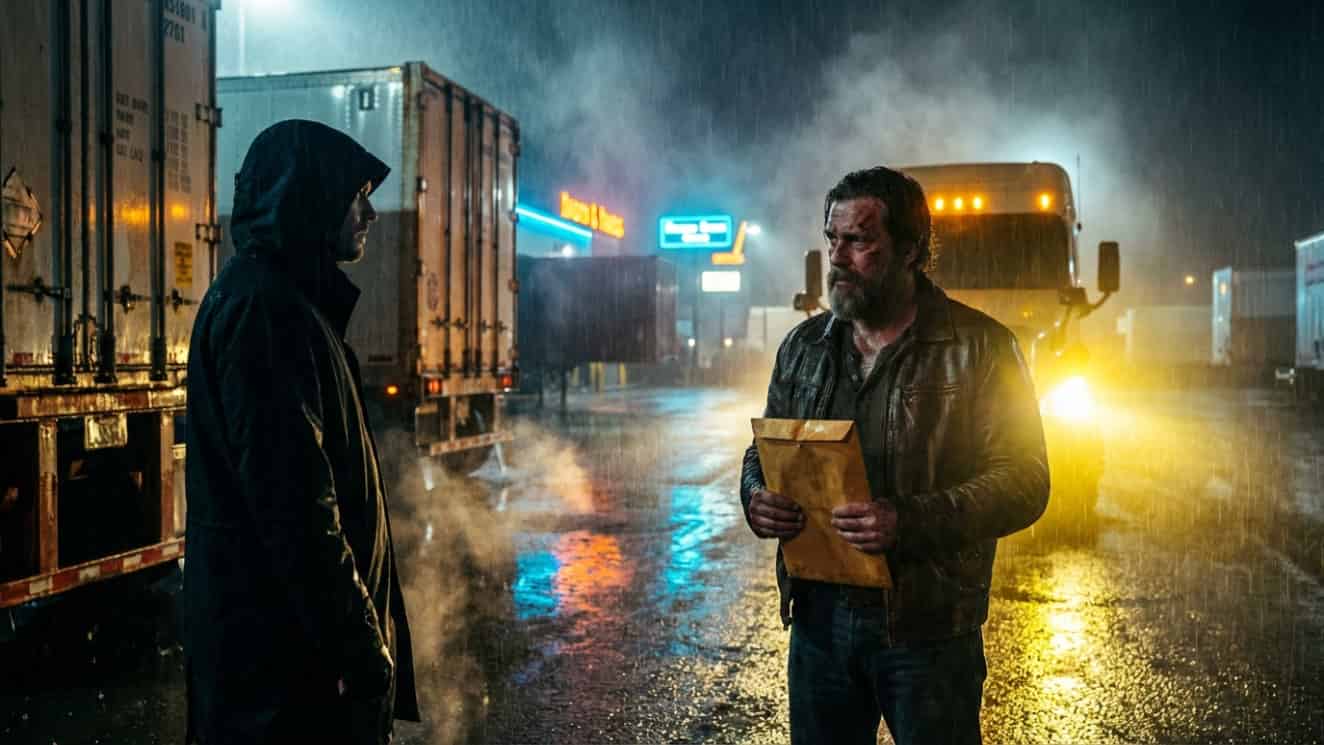
The rain in Tacoma didn’t fall; it just sort of hung there, a gray, heavy curtain that smelled like salt water and diesel exhaust. Dutch stood under the corrugated metal overhang of the main warehouse, watching the moisture bead on the black leather of his sleeves. His knuckles ached—a dull, rhythmic throb that reminded him he was thirty-two going on sixty. It was the kind of cold that got into your marrow and stayed there until July.
Behind him, the trucking yard was a labyrinth of rusted containers and idling Peterbilts. This was the headquarters of the Iron Brotherhood, a “legitimate” shipping company that specialized in moving things people didn’t want the DOT to see. Dutch had been the club’s primary enforcer for five years, a role he’d inherited because he was big, he was quiet, and he knew exactly how much pressure it took to break a radius bone without shattering it.
He hated it. Every second of it.
“You’re staring again, Dutch. People start thinking you’re looking for a way out when you stare at the gate that long.”
Dutch didn’t turn around. He knew the voice. Psycho Pete was leaning against a stack of pallets, tossing a folding knife into the air and catching it by the blade. Pete was his best friend, or as close as you could get to one in a world where loyalty was measured by how many years you were willing to pull in Walla Walla. Pete loved the life. He loved the noise, the smell of the primary chaincase, and the way people’s eyes went wide and wet when the bikes rolled into a parking lot.
“Just thinking about the oil leak on the Shovelhead,” Dutch said, his voice a low grate. “Gasket’s shot.”
“Gaskets can be fixed,” Pete said, stepping closer. He smelled like cheap cigarettes and chain lube. “It’s the hearts you gotta worry about. You been soft lately. The hit on the docks last week? You let that kid walk with both his thumbs. Patch noticed.”
“He got the message,” Dutch said. “He won’t be skimming from the containers again. You don’t need to cripple a guy to make him understand math.”
Pete laughed, a sharp, ugly sound. “Maybe you don’t. But the club does. It’s about the optics, brother. Your old man? He understood optics. I remember him taking a belt to that guy at the rally in ’98. Guy didn’t walk right for a year. That’s a legacy you’re carrying.”
Dutch felt the familiar heat rise in his chest, the one he spent every waking hour trying to douse. His father had been a legend in the Brotherhood, a man who treated violence like a spiritual calling. To the club, he was a hero. To Dutch’s mother, he was a nightmare who left blue-black fingerprints on her throat.
“My father is dead,” Dutch said. “Let him stay that way.”
A black SUV pulled into the yard, cutting through the puddles. It stopped ten feet from them, the wipers slapping back and forth with a rhythmic thwack-thwack. The passenger window rolled down an inch, revealing a pair of thin, wire-rimmed spectacles and a sliver of a pale forehead.
The Patch.
He wasn’t a biker in the traditional sense. He didn’t wear a vest or ride a custom bobber. He was an auditor, a man sent from the “Mother Chapter” to ensure the various branches weren’t rotting from the inside. He dealt in ledgers, drug routes, and “human resources.”
“Dutch,” the voice came from the car, thin and precise. “In.”
Dutch looked at Pete, who gave him a mock salute with the knife. He walked to the car, the wet gravel crunching under his boots. He climbed into the leather interior, which smelled of new car and peppermint. It was a jarring contrast to the grime outside.
“Your numbers are off,” The Patch said, not looking at him. He was scrolling through a tablet. “Not the club’s numbers. Yours.”
Dutch felt his pulse spike, but he kept his face a mask of bored indifference. “I spend what I make. Bikes aren’t cheap.”
“You haven’t bought a new part for that Shovelhead in six months,” The Patch said. “You haven’t been to the track. You haven’t bought a girl a drink since Christmas. And yet, every month, three thousand dollars vanishes from your account. It goes to a blind trust in Seattle. Care to explain why an enforcer for the Iron Brotherhood is participating in philanthropy?”
Dutch stared out the windshield. A seagull landed on a stack of tires, pecking at a piece of trash. “It’s a private matter. None of the club’s business.”
“Everything is the club’s business when you hold the rank you do,” The Patch said, finally looking up. His eyes were like two pieces of gray flint. “A man with a secret is a man with a lever. And I don’t like levers I don’t control. Who is Leo?”
The name hit Dutch like a physical blow. He didn’t flinch, but his grip tightened on the door handle.
“He’s a kid,” Dutch said. “A family friend.”
“A family friend whose father you killed three years ago,” The Patch corrected him. “In a warehouse much like this one. A ‘discipline’ that went too far, if I recall the report. You’ve been paying his tuition at UW. Engineering school. Very noble. Very… expensive.”
“It’s my money,” Dutch growled.
“It’s the club’s money,” The Patch snapped. “And right now, the club feels you’re paying a debt of conscience. A man with a conscience is a liability in this line of work. He hesitates. He doubts. He thinks about ‘right’ and ‘wrong’ instead of ‘us’ and ‘them.'”
The Patch leaned closer. “There’s a man named Sal. A driver. He saw something he shouldn’t have during the last border run. He’s talking to the Feds in a safe house in Olympia. You’re going to find him. You’re going to remind him why the Brotherhood is a lifetime commitment. And you’re going to do it without hesitation. No more half-measures, Dutch. No more ‘mercy.'”
“And if I don’t?”
The Patch smiled, a thin, bloodless line. “Then I’ll stop the payments to Leo. And then I’ll send Pete to explain to the boy exactly why his tuition was being paid in the first place. I imagine the truth would be quite a shock to a young man with such a bright future.”
Dutch looked at the man’s polished shoes. He thought about the three years of letters Leo had sent him—letters Leo thought he was sending to his father’s “old union buddy,” thanking him for looking out for the family.
“I’ll handle Sal,” Dutch said, his voice sounding like it belonged to someone else.
“I know you will,” The Patch said. “Pete is going with you. Just to make sure you don’t get lost on the way.”
Dutch stepped out of the car back into the rain. The gate at the end of the yard looked miles away. Pete was still by the pallets, grinning. He knew. He had always known Dutch was different, and he had been waiting for the moment the world finally forced him to be the man his father was.
Dutch walked toward his bike, the heavy boots feeling like lead. He had a debt to pay, but for the first time in his life, he didn’t know if he had enough blood left to cover the cost.
Chapter 2
The apartment Dutch shared with Maria was a third-floor walk-up in a brick building that had been decaying since the Eisenhower administration. It smelled of fried onions from the neighbor’s kitchen and the industrial soap Maria used to scrub the hospital floors where she worked the night shift.
Dutch came in late, his hair matted with rain and grease. Maria was at the small kitchen table, a textbook open in front of her. She was finishing her nursing degree, her brow furrowed in the way that usually made Dutch want to pull her into a hug. Tonight, it just made him feel like a trespasser in his own life.
“You’re late,” she said, not looking up. “I left some stew on the stove. It’s probably a brick by now.”
“I was at the yard,” Dutch said. He peeled off his leather jacket, the weight of it hitting the floor with a dull thud. He stood over the sink, scrubbing his hands with orange-scented pumice soap. He watched the black grime swirl down the drain, but the gray stain around his cuticles wouldn’t budge.
Maria stood up and walked over, wrapping her arms around his waist from behind. She pressed her face into his back, her warmth seeping through his damp T-shirt. “You smell like gas and rain. You’re vibrating, Dutch. What happened?”
“Nothing,” he lied. He turned around in her arms, looking down at her. Maria was the only thing in his world that didn’t feel like it was covered in rust. She knew he was a biker, knew he was an “enforcer,” but she chose to see the man who fixed her car without being asked and who woke up screaming from nightmares he wouldn’t name. “Just club business. The Patch is in town.”
Maria pulled back, her eyes narrowing. “The auditor? The one you said looks like a tax lawyer but acts like a ghost?”
“That’s the one.”
“He’s trouble, isn’t he? Every time he shows up, you come home looking like you’ve seen your own funeral.” She reached up, her thumb tracing the scar along his jawline. “Come with me to the bedroom. Let’s just… disappear for a few hours.”
Dutch wanted to. He wanted to drown in her and forget about the trucking yard, the tuition payments, and the man named Sal. But he could still feel The Patch’s gaze on the back of his neck.
“I have to go back out,” Dutch said. “Pete’s waiting. We have a run to Olympia.”
“At midnight?” Maria’s voice went flat. “In this weather?”
“Business doesn’t wait for the sun, Maria. You know that.”
She stepped away from him, her hands dropping to her sides. “I know that I’m tired of waiting for the phone call that tells me which morgue you’re in. I know that I see the way you look at your father’s old colors in the closet—like they’re a noose you’re waiting to put on.”
“It’s not like that,” Dutch said, though it was exactly like that.
“Isn’t it? You say you’re different than him. You say you don’t like the noise. But here you are, headed out into the dark with a man they call ‘Psycho’ to do God knows what to some poor soul.” She shook her head, a strand of dark hair falling across her face. “You’re thirty-two, Dutch. When is it enough?”
“When I say it is,” he snapped. The sharpness of his own voice surprised him. It sounded like his father’s. He saw the flicker of hurt in Maria’s eyes, and then the familiar wall of resignation.
“Fine,” she said, her voice quiet. “Go. Just… try to come back with the same soul you left with.”
Dutch didn’t answer. He couldn’t. He grabbed his jacket and walked out, the door clicking shut behind him with a finality that made his chest ache.
He met Pete at a 24-hour diner on the edge of the city. Pete’s bike, a raked-out chopper with chrome that looked like bone in the streetlights, was parked next to Dutch’s more sensible Dyna. Pete was inside, eating a plate of greasy hash browns and flirting with a waitress who looked like she’d been through three divorces and a house fire.
“Ready for the hunt?” Pete asked, sliding out of the booth. He was buzzing, his eyes wide and restless. He patted the heavy bulge under his denim vest. “I brought the ‘persuader.’ Just in case Sal doesn’t want to listen to reason.”
“We’re just supposed to talk to him, Pete,” Dutch said, sliding onto a stool. “The Patch said to remind him of his commitments. Not to turn him into a memory.”
Pete leaned in, his voice dropping to a low hiss. “The Patch told me something different. He told me that if you don’t have the stomach for it, I should do what needs to be done. To Sal… and to anyone else who isn’t pulling their weight.”
Pete’s hand rested on Dutch’s shoulder, a grip that was meant to be friendly but felt like a clamp. “I like you, Dutch. I really do. We’ve been through a lot. But don’t make me choose between you and the club. I’m not a smart man, but I know which one keeps the lights on.”
Dutch looked at his reflection in the chrome of a napkin dispenser. He looked tired. He looked like a man who was running out of places to hide.
“Let’s go,” Dutch said.
They rode south, the rain-slicked I-5 a ribbon of black glass beneath their wheels. The wind whipped at Dutch’s face, the cold air filling his lungs, but it didn’t feel like freedom. It felt like an escort to a gallows.
He thought about Leo. He thought about the man he’d killed—Leo’s father. He’d been a dockworker, a guy who’d stolen a shipment of electronics to pay for his wife’s cancer treatment. The club had sent Dutch to get the money back. It was supposed to be a simple beating, a warning. But the man had fought back, swinging a pipe, and Dutch had reacted. A single blow to the temple. The man had folded like a lawn chair, his eyes rolling back, and that was it. No last words. Just the sound of the rain on the warehouse roof.
Dutch had cleaned it up. The club had moved the body. But the guilt had stayed, a cold stone in his stomach that he tried to dissolve with monthly wire transfers. He’d found out the man had a son, a kid with a 4.0 GPA and no way to pay for college.
And now, because of that one moment of violence, Dutch was trapped in another.
They reached Olympia around 2:00 AM. The safe house was a non-descript rancher in a suburban neighborhood where the lawns were manicured and the porch lights were always on. It was the kind of place that felt safe because it was boring.
Pete killed his engine a block away and coasted into a dark spot under an oak tree. Dutch followed suit.
“He’s in there,” Pete whispered, checking the chamber of his .45. “Two Feds, probably. Young guys. They get lazy at this hour.”
“We’re not killing Feds, Pete,” Dutch warned. “That’s a death sentence for the whole chapter.”
“I’m not gonna kill ’em,” Pete said, grinning. “I’m just gonna make ’em sleep. You handle Sal. Make it count, Dutch. Show me you’ve still got the old man’s blood in you.”
Dutch watched Pete disappear into the shadows, moving with a predatory grace that was terrifying to behold. Dutch stayed by the bikes for a moment, his hand resting on the throttle. He could leave. He could just twist the grip and disappear into the night, leave Maria, leave the club, leave everything.
But then he thought of Leo. He thought of the letter he’d received last week: “I’m graduating in May. I wish my dad could see me. I wish you could be there too, Mr. Henderson. You’re the reason I have a future.”
Dutch pulled his mask up over his face and stepped into the dark.
Chapter 3
The inside of the house smelled like stale coffee and floor wax. Pete had moved through the back door like a ghost, and by the time Dutch entered the kitchen, one of the agents was slumped over the island, unconscious from a blow to the back of the head. The other was zip-tied to a radiator in the hallway, a gag in his mouth and terror in his eyes.
Pete pointed toward the back bedroom with the barrel of his gun. He was sweating, a manic gleam in his eyes. “He’s all yours, brother. I’ll watch the door. Don’t take all night.”
Dutch walked down the narrow hallway, his boots silent on the carpet. He pushed open the bedroom door.
Sal was sitting on the edge of the bed, a small, balding man in a threadbare undershirt. He looked up, and when he saw Dutch’s tall, hooded frame, he didn’t scream. He just let out a long, shuddering breath and closed his eyes.
“I knew you’d come,” Sal whispered. “I told them. I told the agents you wouldn’t just let me talk.”
Dutch stood in the doorway, the weight of the pistol in his waistband feeling like a thousand pounds. He looked at Sal—a man who had probably spent his whole life trying to be invisible, only to end up in the crosshairs of a machine that didn’t care about his existence.
“Why, Sal?” Dutch asked, his voice muffled by the mask. “You knew the rules. You knew what happens when you talk.”
“I have a daughter,” Sal said, his voice cracking. “She’s six. They told me if I testified, they’d put us in the program. Give her a chance to live somewhere where the air doesn’t smell like meth labs and burnt rubber. I just wanted her to be safe.”
Dutch looked at the man’s trembling hands. He saw the same desperation he’d seen in Leo’s father’s eyes three years ago. The same “why” that never had a good answer.
“Dutch!” Pete’s voice hissed from the hallway. “Movement outside! We gotta wrap this up!”
Dutch pulled the gun from his waistband. He saw Sal flinch, his shoulders hunched in anticipation of the end. Dutch looked at the man’s neck, the pulse thrumming there like a trapped bird.
Just pull the trigger, he told himself. Do it and the tuition keeps flowing. Do it and Maria stays safe. Do it and you’re the man the club wants you to be.
He raised the gun. He centered the sights on Sal’s chest.
“I’m sorry,” Dutch whispered.
He fired.
The sound was deafening in the small room. Sal spun back, hitting the headboard and sliding to the floor. Dutch didn’t look at the body. He turned and ran, his heart hammering against his ribs.
“Done?” Pete asked as Dutch burst back into the hallway.
“Done,” Dutch said, his voice cold.
They were back on the bikes and miles away before the first sirens echoed through the Olympia suburbs. Pete was laughing, the wind whipping his hair around his face. He kept giving Dutch the thumbs-up, a gesture of “brotherhood” that made Dutch want to vomit.
They parted ways at the city limits. Pete headed back to the trucking yard to report to The Patch, while Dutch headed toward the university district.
He parked his bike two blocks from a small, red-brick house where Leo lived with two other students. He sat on the curb, the rain finally stopping, replaced by a cold, biting mist. He pulled his phone out—his real phone, not the burner.
He scrolled through the photos Maria had sent him. Photos of them at the beach, photos of a future he knew he was burning down one bridge at a time.
Then he pulled up the bank app. He looked at the balance. He’d just killed a man to keep this account active. He’d just murdered a father so he could play-act at being a savior for another man’s son.
A shadow fell over him.
“You’re up late, Mr. Henderson.”
Dutch looked up. Leo was standing there, a backpack slung over one shoulder, a coffee cup in his hand. He looked tired but bright-eyed, the kind of look only people with a future get to have.
“Leo,” Dutch said, his voice cracking. He stood up, wiping his face. “Just… in the neighborhood. Had a late shift.”
Leo smiled, stepping closer. “You look like hell, man. Everything okay? You still coming to the graduation ceremony? I got you a seat right in the front row. Next to my mom.”
Dutch looked at the boy’s face. He saw the kindness there, the genuine affection for a man who didn’t exist. “I don’t know, Leo. Things are… complicated at the yard.”
“Hey,” Leo said, reaching out to pat Dutch’s arm. “You’ve done enough for us. If you can’t make it, I get it. But you’re family, Dutch. Don’t forget that.”
Family.
The word felt like a jagged piece of glass in Dutch’s throat. He watched Leo walk toward his house, whistling a tuneless song.
Dutch waited until the lights in the house went out. Then he walked back to his bike. He didn’t go home to Maria. He didn’t go back to the yard. He drove to a dark corner of the waterfront, pulled his pistol out, and looked at the barrel.
There was no blood on it. He’d used a silencer. He’d been professional.
He reached into his pocket and pulled out the small, lead-weighted bag he’d carried since the safe house. He opened it and poured the contents into his palm.
Two shell casings.
He hadn’t shot Sal. He’d fired twice into the mattress, inches from the man’s head, then shoved him into the closet and told him to stay silent for ten minutes. He’d gambled everything on Pete being too distracted to check the body.
But he knew Pete. And he knew The Patch. They’d find out. The Feds would report that Sal was still alive, or Pete would go back to gloat and find an empty room.
Dutch looked out at the black water of the Sound. He had maybe six hours before the world ended.
He picked up his phone and dialed a number he’d kept saved for three years. A number for a lawyer named Miller who specialized in “difficult transitions.”
“It’s Dutch,” he said when the man answered. “I’m ready to talk. But I need two people protected. And I need it done tonight.”
Chapter 4
The lawyer’s office was in a glass-and-steel building downtown that felt like a different planet from the trucking yard. Miller was a man who looked like he’d never had grease under his fingernails in his life. He sat across from Dutch, a recorder on the mahogany desk between them.
“You understand what this means, Dutch?” Miller asked, his voice calm. “Once you start this, there’s no going back. The Brotherhood has long arms and a very long memory.”
“I know,” Dutch said. He felt strangely light, like he’d already stepped off a cliff and was just waiting for the ground to find him. “I don’t want a deal for myself. I want Maria in witness protection. And I want the kid, Leo, and his mother moved. Different state. New names. Everything.”
Miller leaned back, tapping his pen against his chin. “And in exchange, you’re giving us the drug routes? The names? The Patch?”
“Everything,” Dutch said. “The trucking manifests, the bribe schedules, the names of the port authorities on the take. I’ve been keeping a ledger of my own for three years. It’s in a locker at the yard.”
“We need that ledger,” Miller said. “Without it, it’s just your word against a multi-state organization with very expensive lawyers.”
“I’ll get it,” Dutch said.
“Dutch, you can’t go back there,” Miller said, his eyes showing a flicker of genuine concern. “The minute the Feds realize Sal is alive, the club will know you flipped. You’ll be dead before you reach the gate.”
“I have to,” Dutch said. “If I don’t get that ledger, Maria and Leo are just targets. I’m the only one who knows where it is.”
He left the office as the sun began to bleed through the gray clouds, a pale, sickly yellow light. He drove back to the apartment, his mind racing. He had to get Maria out.
He burst through the door, finding Maria in the kitchen, already dressed for her shift. She looked up, her face tight with worry.
“Dutch? Where have you been? Pete was here.”
Dutch froze. “Pete? When?”
“An hour ago,” she said, her voice trembling. “He didn’t come in. He just sat in his truck outside, watching the windows. When I went out to ask him what he wanted, he just grinned and said he was ‘keeping an eye on the family.’ Dutch, what is going on?”
Dutch grabbed her by the shoulders, his fingers digging into her scrubs. “Listen to me. You need to pack a bag. Right now. Just the essentials. No phone, no laptop. Nothing they can track.”
“Dutch, you’re scaring me—”
“Maria, please!” he yelled. He immediately regretted the volume, seeing her flinch. He lowered his voice, his forehead resting against hers. “I’m trying to save us. I’ve talked to someone. They’re going to take you somewhere safe. You won’t see me for a while, but I’ll find you. I promise.”
“What did you do?” she whispered, tears welling in her eyes.
“I chose a side,” he said.
He helped her pack a small duffel bag, his movements frantic and clumsy. He drove her to a pre-arranged spot—a grocery store parking lot where a non-descript sedan was waiting. Two men in suits stood by the car.
“Go with them,” Dutch said, kissing her hard. He could taste the salt of her tears. “Don’t look back. Don’t call anyone. I love you.”
“Dutch, don’t go back to that place,” she begged, clutching his jacket. “Just come with us.”
“I can’t,” he said, gently uncoupling her hands. “I have to finish it.”
He watched the car pull away, feeling a piece of himself go with it. Then he turned his bike back toward the trucking yard.
The yard was quiet when he arrived, but it was the kind of quiet that felt like a held breath. The usual activity—the shouting of drivers, the clatter of forklifts—was absent.
He walked toward the warehouse, his hand never far from his waistband. He reached his locker and spun the dial. He pulled out the bike helmet, reaching inside the lining to retrieve the small, black ledger and the thumb drive taped to the interior.
“Looking for something, Dutch?”
He turned slowly. Psycho Pete was standing at the end of the aisle, leaning against a forklift. He wasn’t smiling anymore. He looked tired, and for the first time, he looked old.
“The Patch got a call,” Pete said, his voice flat. “From his friends in the PD. Seems Sal is very much alive. He’s currently telling a story about a big guy in a mask who took a couple of shots at a mattress and told him to run.”
Pete stepped into the light. He was holding his .45, the hammer cocked back.
“I wanted it to be true, Dutch,” Pete said. “I wanted you to be the guy I thought you were. I even lied for you. I told The Patch I saw the body. I staked my life on your word.”
“I’m sorry, Pete,” Dutch said, holding the ledger against his chest. “I couldn’t do it. I couldn’t be him.”
“Him? You mean your old man? He was a king in this club! He was a brother! You? You’re just a rat who likes to pretend he’s a saint because he pays a kid’s tuition.”
Pete’s hand was shaking. “The Patch wants you brought to the office. He wants to do it himself. He says it needs to be an example.”
“Is that what you want, Pete? To watch him do that? After everything?”
Pete looked away, his eyes scanning the rusted rafters of the warehouse. “Doesn’t matter what I want. The club is all I got, Dutch. Without this… I’m just a guy who likes to hurt people. I need the patch. I need the brothers.”
“You don’t need them,” Dutch said, taking a step forward. “You’re better than them, Pete.”
“Don’t lie to me!” Pete screamed, the sound echoing through the cavernous space. “I’m not better! I’m exactly what they made me! And so are you!”
A shadow moved in the doorway behind Pete. The Patch stepped into the warehouse, followed by four other club members. He was wearing his usual crisp suit, looking completely out of place among the grime.
“Enough sentiment, Peter,” The Patch said. “Bring him.”
Dutch looked at the men surrounding him. He looked at Pete, whose eyes were filled with a desperate, childish pain.
Dutch dropped the ledger. He didn’t reach for his gun. He just stood there, his arms at his sides.
“I’m not going to the office,” Dutch said.
The Patch nodded to the men. “Then break him here. Start with the hands. I want him to feel every bit of his betrayal before he dies.”
Chapter 5
The first blow came from a heavy-set biker named Tiny, a man Dutch had shared a dozen beers with. It was a lead pipe to the ribs, a sickening crunch that sent Dutch to his knees. He didn’t cry out. He just gasped, the air leaving his lungs in a ragged whistle.
“Hold him up,” The Patch commanded.
Two men grabbed Dutch’s arms, hauling him to his feet. His head lolled forward, blood dripping from a gash on his forehead onto his boots. He looked through the haze of pain at Pete, who was still standing by the forklift, his gun lowered, his face a mask of horror.
“Do it, Pete,” The Patch said, his voice as cold as the Tacoma rain. “You said you were a brother. Prove it. Take his fingers.”
Pete didn’t move. He looked at the heavy bolt cutters The Patch was holding out to him.
“Now, Peter,” The Patch said, his voice dropping an octave. “Or you can take his place.”
Dutch looked at Pete. Through the blood and the pain, he felt a strange sense of clarity. He saw the choice Pete was facing—the same choice Dutch’s father had made every day of his life. The choice to be a monster so he wouldn’t have to be a victim.
“It’s okay, Pete,” Dutch wheezed, the copper taste of blood thick in his mouth. “Do what you have to do.”
Pete stepped forward, his movements jerky, like a marionette. He took the bolt cutters. He looked at Dutch’s hand, the one that had fixed Pete’s bike a hundred times, the one that had pulled Pete out of a bar fight in Portland.
Pete’s eyes met Dutch’s.
“I’m sorry,” Pete whispered, his voice so low only Dutch could hear it.
Pete turned.
He didn’t swing at Dutch. He swung the heavy iron bolt cutters at Tiny, catching the man in the temple. Tiny went down like a felled oak. Before the other men could react, Pete pulled his .45 and fired three times.
The warehouse erupted into chaos. The Patch dove behind a stack of pallets, shouting orders. Dutch felt the hands holding him vanish as the bikers scrambled for cover. He slumped to the floor, his vision swimming.
“Dutch! Move!” Pete was over him, grabbing his jacket and dragging him toward the back of the warehouse.
Bullets whined off the concrete, kicking up dust and sparks. Pete returned fire, his movements practiced and calm, a stark contrast to his earlier hesitation. He shoved Dutch behind a heavy metal shipping container.
“Why?” Dutch coughed, clutching his side. Each breath felt like a knife in his lungs.
“Because you’re right,” Pete said, reloading his pistol. “I am a guy who likes to hurt people. But I’d rather hurt them than you. Now give me that damn ledger.”
Dutch handed him the black book. Pete tucked it into his vest.
“The back door is clear,” Pete said. “My truck is idling in the alley. Get to the lawyer. Tell him… tell him I’m the one who gave it to you.”
“Pete, come with me,” Dutch said, grabbing the man’s sleeve.
Pete smiled, a sad, broken-toothed grin. “Nah. Someone’s gotta hold the door. Besides, I don’t think they have a ‘witness protection’ for guys like me. I’m too loud for a new name.”
Pete stood up, his silhouette framed by the dim light of the warehouse. He looked at the men closing in from the other side of the yard.
“Go, Dutch! Go now!”
Dutch crawled toward the back door, the pain in his ribs a white-hot flame. He heard Pete shouting, heard the roar of the .45, followed by the chatter of a dozen other guns. He didn’t look back. He couldn’t.
He reached the alley and slumped into the cab of Pete’s beat-up Ford. The keys were in the ignition. He turned them, the engine roaring to life.
As he pulled away, he saw a flash of movement in his rearview mirror. The Patch was standing in the warehouse doorway, his spectacles glinting in the light. He wasn’t shooting. He was just watching, a vulture waiting for the inevitable.
Dutch drove. He drove through the industrial district, through the suburbs, through the city he’d spent his whole life trying to own, only to realize he was just another piece of its trash.
He reached Miller’s office just as the sun was hitting the tops of the buildings. He stumbled into the lobby, the ledger clutched in his hand, and collapsed onto the polished marble floor.
“I have it,” he whispered to the terrified receptionist. “Tell him… tell him the debt is paid.”
Chapter 6
The safe house was a small cottage on the edge of a lake in eastern Washington. It was quiet—so quiet that Dutch could hear the wind moving through the pines and the occasional lap of water against the shore. It was the kind of place he used to dream about, but now that he was here, the silence felt like a weight.
It had been six months since the night at the warehouse.
The Iron Brotherhood was gone, or at least the Tacoma chapter was. The ledger and the recordings had been enough. The Patch was in a federal holding cell, awaiting a trial that would likely keep him behind bars until he was a skeleton. A dozen others were scattered, some in prison, some in the wind.
Pete… Pete hadn’t made it. They found him in the warehouse, slumped against the same pallets where they used to drink beer. He’d taken four men with him.
Dutch sat on the small porch, his side still aching when the weather turned cold. He looked at the envelope in his lap. It was postmarked from a town in Montana he’d never heard of.
He opened it. There was a photo inside.
It was Leo, wearing a cap and gown, holding a diploma over his head. He was grinning, his face full of the bright, uncomplicated joy of a man who had no idea what his future had cost. On the back, in neat, hurried script: “I did it, Dutch. I’m an engineer. My mom and I moved—found a great spot out here. I hope you’re doing well. I owe you everything. See you soon, family.”
Dutch stared at the photo for a long time. He felt a lump in his throat that no amount of orange-scented soap could wash away.
A car pulled into the gravel driveway. Dutch stood up, his hand reflexively going to his waist, before he remembered he didn’t carry a gun anymore.
Maria stepped out of the car. She looked different. Her hair was shorter, and she looked tired in a way that sleep wouldn’t fix, but when she saw him, her face broke into a smile that made the last six months feel like a bad dream.
“Hey,” she said, walking up the steps. She smelled like pine needles and the same industrial soap.
“Hey,” Dutch said. He pulled her into his arms, holding her close. He felt her heart beating against his chest—a steady, living rhythm that replaced the roar of the bike engines.
“I talked to the lawyer,” she said, pulling back to look at him. “The trial is over. We’re… we’re done, Dutch. No more check-ins. No more shadows.”
Dutch looked out at the lake. The water was still, reflecting the vast, open sky. It was beautiful, but it felt fragile, like a piece of glass that could shatter at any moment.
“What do we do now?” he asked.
Maria took his hand, her fingers interlaced with his. She looked at his knuckles, the scars beginning to fade into the skin.
“We live,” she said. “We get jobs. We pay bills. We grow old and boring. We do all the things your father never could.”
Dutch looked at the photo of Leo sitting on the porch rail. He thought about the man he’d killed, the man he’d saved, and the man he’d left behind in a pile of rusted pallets. He thought about the blood in the tread of his life—how some of it would never wash out, no matter how far he ran.
But as he looked at Maria, he realized that for the first time in thirty-two years, he wasn’t afraid of the mirror.
“Okay,” Dutch said, his voice steady. “Let’s live.”
He picked up the photo of Leo and tucked it into his pocket. He followed Maria into the house, leaving the porch empty. The sun began to set over the mountains, casting long, peaceful shadows over the grass, and for a moment, the only sound was the wind in the trees, whispering about a debt that was finally, truly, settled.