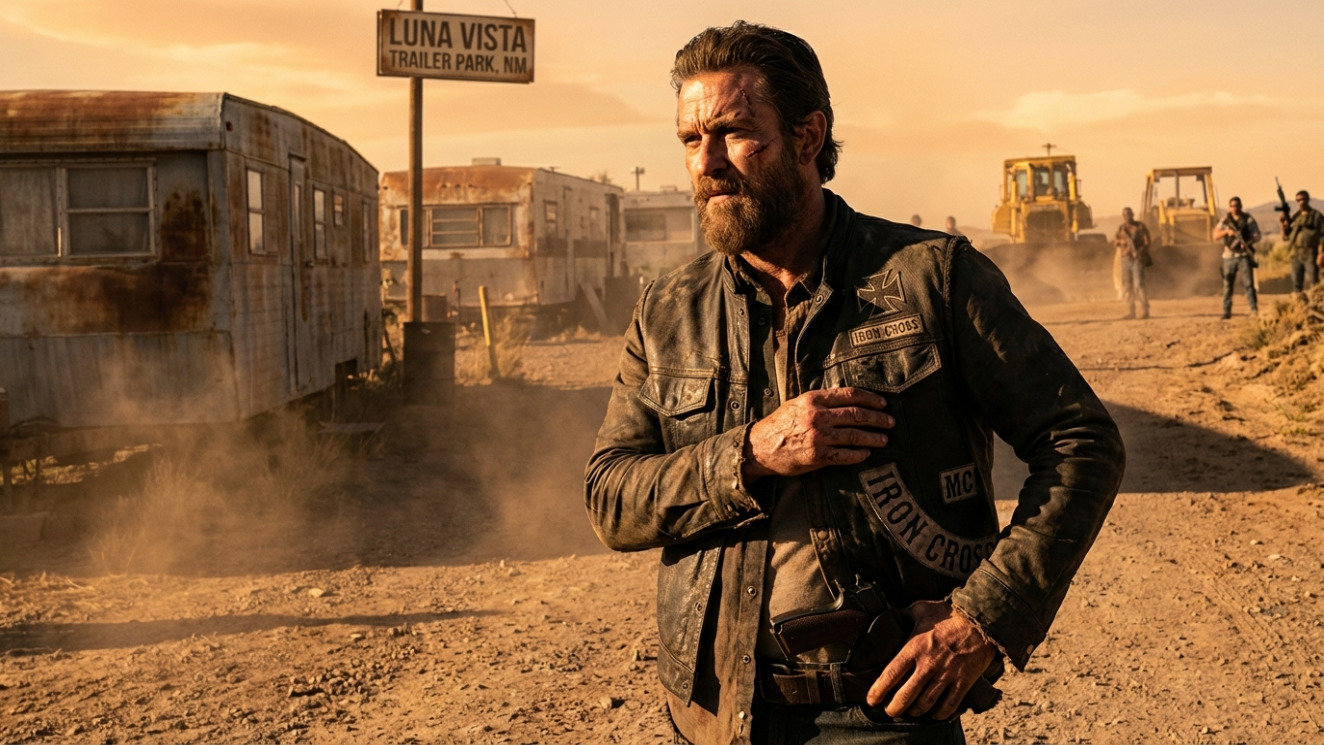
“Chapter 5: The High Desert Stand
The sun was a white-hot eye by 2:00 PM, staring down at the standoff with unblinking intensity. The media trucks had lined the highway, their satellite dishes aimed like weapons toward the entrance of Luna Vista. The sheriff’s department had arrived in force—ten cruisers, their lights flashing blue and red, parked in a semi-circle fifty yards from the biker line.
But they weren’t moving. The optics of a forced eviction of a dozen elderly residents and twenty single mothers, protected by seventy “”legendary”” outlaws, were a nightmare for a county sheriff in an election year.
Cane sat on his Shovelhead at the very front of the line. His hands were still bandaged, but he’d gripped the handlebars so tight the blood was beginning to seep through the cloth.
“”They’re waiting for Thorne to give the word,”” Preacher said, pulling his bike up next to Cane’s. “”The sheriff doesn’t want the heat, but Thorne’s the one who signs the campaign checks.””
“”He won’t wait much longer,”” Cane said. “”He’s losing money every hour those dozers sit idle.””
As if on cue, the line of sheriff’s cars parted. Three black Vanguard SUVs sped through the gap, followed by two massive yellow bulldozers, their blades reflecting the sun with a blinding glare.
The SUVs stopped twenty feet from the bikers. Miller stepped out, but he wasn’t wearing his tactical polo this time. He was in full riot gear—body armor, helmet, and a clear plastic shield. He carried a tear-gas launcher in the crook of his arm. Behind him, ten other Vanguard contractors stepped out, similarly equipped.
Miller didn’t speak. He simply raised his hand and pointed toward the park.
“”This is your final warning!”” a voice boomed over a megaphone from one of the SUVs. “”This is a lawful eviction. Anyone remaining on the property or obstructing the entrance will be arrested. You have five minutes to disperse.””
The bikers didn’t move. Tiny revved his engine, a thunderous growl that seemed to challenge the dozers.
Cane looked back at the park. Sarah and Elena were standing with the residents near the community center. They had formed their own line, holding hands. They looked small, fragile, and incredibly brave.
“”Tiny,”” Cane said. “”If this goes south, your job is to get the residents out the back fence. There’s an old service road that leads to the arroyo. Don’t let them get caught in the middle.””
“”I’m staying here with you, Cane,”” Tiny grunted.
“”That wasn’t a request, brother. The debt is about protection. Protect them.””
Tiny looked at Cane for a long beat, then nodded. He signaled to five of the younger riders, and they slowly backed their bikes away from the front line, heading toward the trailers.
The five minutes passed in a blur of heat and silence.
“”Time’s up!”” the megaphone barked.
The dozers began to move, the low, mechanical whine of their engines rising to a scream. They moved slowly, their blades lowered, the earth beneath them trembling.
“”Hold the line!”” Cane shouted.
The first canister of tear gas arched through the air, trailing a plume of white smoke. It landed ten feet in front of Cane’s bike, hissing like a snake. The wind caught the gas, blowing it back toward the Vanguard line, but another three canisters followed, landing right in the middle of the bikers.
The air turned into acid. Cane’s eyes burned, his throat seizing as he coughed, the world turning into a grey, stinging blur. He pulled a bandana over his face, his vision swimming.
Through the haze, he saw the dozers coming. They were ten feet away. Five feet.
One of the bikers, a young guy from the Tucson chapter, panicked. He kicked his bike into gear and tried to lunge at the lead dozer.
“”No!”” Cane screamed, but it was too late.
The biker didn’t hit the dozer. He was met by a volley of rubber bullets from the Vanguard line. He was knocked off his bike, the machine sliding into the dirt as he crumpled.
The sight broke the tension. The bikers, fueled by a decade of resentment toward authority and a fierce sense of loyalty, surged forward. It wasn’t a coordinated attack; it was a chaotic, violent explosion.
The next ten minutes were a blur of screaming metal and thudding impacts. The bikers used their bikes as shields, dodging the rubber bullets and the gas, trying to reach the contractors. It was a melee of leather and tactical gear, fought in a cloud of white smoke and red dust.
Cane saw Miller through the chaos. The Vanguard lead was systematically picking off bikers with his gas launcher, his movements cold and efficient.
Cane kicked his Shovelhead into gear. He didn’t head for the line; he headed for the lead dozer. He rode onto the embankment, the bike bouncing over the uneven ground, his bad leg jarring with every hit. He pulled up alongside the cab of the dozer and jumped.
He landed on the metal grating, his hands searing on the hot surface. The operator, a panicked-looking man in a hard hat, tried to push him off, but Cane was a man possessed. He reached into the cab, grabbed the operator by the collar, and hauled him out. They both tumbled into the dirt as the dozer, now unmanned, continued to crawl forward.
Cane scrambled to his feet, his limp heavy, and climbed back into the cab. He’d worked construction in his twenties, before the club took over his life. He slammed his foot on the brake and hauled back on the lever. The massive machine groaned and shuddered to a halt, the blade digging deep into the gravel just inches from the community center’s porch.
He looked out from the cab. The fight was shifting. The sheriff’s deputies, seeing the escalation, were finally moving in, but they weren’t attacking the bikers. They were moving to separate the two groups, their sirens wailing.
But then, a shot rang out.
It wasn’t the dull thud of a rubber bullet or the pop of a gas canister. It was the sharp, unmistakable crack of a high-caliber rifle.
The world seemed to stop.
Cane looked toward the Vanguard SUVs. Aris Thorne was standing near the rear of the lead vehicle. He wasn’t holding a gun. But Miller was. He had a long-range rifle braced against the roof of the SUV, his eye pressed to the scope.
He wasn’t aiming at the bikers.
He was aiming at the community center.
Cane’s heart stopped. He saw Elena standing on the porch, her back to the SUVs as she helped an elderly woman into the building.
“”Elena! Down!”” Cane roared, but his voice was lost in the chaos.
Miller fired again.
The bullet struck the wooden railing inches from Elena’s hand. She spun around, her eyes wide with shock.
Cane didn’t think. He jumped from the dozer cab, his leg buckling as he hit the ground. He ignored the pain, his only focus on the space between Miller’s rifle and the woman on the porch.
He ran. It was a slow, tortured gait, a man racing against a bullet with a body that had already failed him once.
Miller adjusted his aim. He was looking for a clear shot, a way to end the “”problem”” of Luna Vista once and for all.
Cane reached the porch just as Miller pulled the trigger for the third time.
He didn’t feel the impact at first. He just felt a sudden, massive weight in his chest, a blow that knocked the wind out of him and sent him stumbling backward. He hit the dirt, the world spinning, the blue New Mexico sky suddenly very far away.
“”Cane!””
It was Elena’s voice. She was kneeling over him, her hands pressing down on his chest. Her face was a blur of tears and dust.
“”I’m okay,”” Cane tried to say, but the words came out as a wet cough.
The sound of sirens was deafening now. He saw the sheriff’s deputies swarming the Vanguard SUVs, their guns drawn. He saw Thorne being slammed against the side of his Mercedes, his expensive suit being ruined by the dust. He saw Miller being wrestled to the ground.
But it all felt distant, like a movie playing in another room.
Tiny was there then, his massive shadow blocking the sun. He looked down at Cane, his hard face crumbling. “”You stupid, beautiful bastard,”” Tiny whispered.
“”The debt…”” Cane wheezed, his hand reaching out to grab Tiny’s vest. “”Is it… is it paid?””
Tiny took Cane’s hand in his own, his grip firm. “”Paid in full, Cassidy. Paid in full.””
Cane looked at Elena. She was holding the silver ring, her fingers tracing the blue stone. She leaned down and kissed his forehead, her tears warm against his skin.
“”You saved us,”” she whispered.
Cane closed his eyes. For the first time in ten years, the silence didn’t feel like a threat. It felt like peace.
Chapter 6: The Dust Settles
The recovery was slow, much like the desert itself after a flash flood.
Cane woke up in a hospital bed in Las Cruces three days later. The bullet had missed his heart by two inches, shattering a rib and collapsing a lung, but the doctors said he was too stubborn to die.
When he finally opened his eyes, the first thing he saw was Sarah. She was sitting in a plastic chair by the window, a stack of newspapers in her lap.
“”You’re trending,”” she said, her voice shaky but light.
She showed him the front page of the Albuquerque Journal. The headline read: STANDOFF AT LUNA VISTA: HERO BIKER SAVES COMMUNITY FROM PRIVATE MILITIA.
“”Thorne?”” Cane rasped, his throat feeling like it was full of sand.
“”In custody,”” Sarah said. “”The FBI got involved after the shooting. Turns out Vanguard’s contracts were riddled with kickbacks and fraud. And Elena… she gave them the footage from the shop. The old footage. It was enough to link Thorne to the Albuquerque heist and a dozen other racketeering charges. He won’t be seeing the sun from anything but a yard for a long time.””
Cane let out a long breath, his chest aching with the effort. “”And the park?””
“”The state issued a permanent injunction. A non-profit bought the land from the Thorne estate’s frozen assets. Luna Vista belongs to the residents now, Cane. We’re building a new community center. We’re calling it Cassidy Hall.””
Cane managed a weak smile. “”Don’t do that. It sounds like a funeral parlor.””
The door opened, and Tiny and Preacher walked in. They looked out of place in the sterile white room, their leather vests smelling of exhaust and road grime. Sarah took the hint and stepped out, giving them the room.
The two men stood at the foot of the bed. The silence was heavy, charged with the weight of everything that had been said—and everything that hadn’t.
“”The brothers are heading back,”” Tiny said. “”The story’s out, Cane. All of it. The three days, the wire, the choice you made.””
Cane looked at them, his heart sinking. “”And?””
“”And most of them don’t know what to think,”” Preacher said, his voice calm. “”The younger guys, they see the ‘informant’ label and they want blood. But the older guys… the ones who were there in ’13… they remember that they’re home with their families because you didn’t talk. They see the man who took a bullet for a waitress and a bunch of retirees. They see a brother who earned his colors back in the dirt.””
Tiny stepped forward, reaching into his pocket. He pulled out a patch—a new one, fresh embroidery on dark denim. It was the Iron Cross, but with a gold border.
“”The National President sent this,”” Tiny said, laying it on the bed next to Cane’s hand. “”He said a man who can change his mind and still hold the line is a man we want in the front. You’re a Nomad again, Cane. If you want to be.””
Cane looked at the patch. It was beautiful, in its own way. It represented the only family he’d ever known, the brotherhood he’d died a thousand times to protect.
He reached out and pushed the patch back toward Tiny.
“”No,”” Cane said, his voice steady. “”The debt is paid, Tiny. I’m tired of riding in circles.””
Tiny and Preacher shared a look. There was no anger, only a quiet, somber understanding.
“”Where will you go?”” Preacher asked.
“”I think I’ve done enough moving,”” Cane said. “”I think I’ll stay in the desert for a while. See if I can learn how to walk without a limp.””
The two men nodded, a final, silent salute, and walked out of the room. Their heavy boots echoed down the hallway until the sound faded into the hum of the hospital.
A week later, Cane was discharged. He didn’t have his bike—the Shovelhead was still in the impound lot at the sheriff’s office—so he took a bus back to Otero County.
He got off at the stop near The Dusty Spoon. The sun was setting, the sky a bruised purple, the air cooling as the stars began to poke through the haze.
He limped into the diner. It was empty, save for Elena, who was mopping the floor. She looked up when the bell chimed, and a small, genuine smile touched her lips.
“”You look terrible,”” she said.
“”I feel better than I look,”” Cane replied. He sat at the counter, the same spot he’d occupied two weeks ago.
She leaned the mop against the wall and walked over. She didn’t say anything; she just poured him a cup of coffee. This time, she didn’t stop mid-pour.
“”I have something for you,”” she said.
She reached under the counter and pulled out the silver ring. She didn’t hand it to him; she slid it across the Formica.
“”I want you to keep it,”” she said. “”My father would have wanted the man who saved his daughter to have it. He was a good man, Cane. He believed in second chances. Even for people who didn’t think they deserved them.””
Cane took the ring, the silver cool in his hand. He looked at the blue stone, then at the woman standing across from him. The ghost of Tommy, the ghost of her father, the ghost of the man he used to be—they were still there, but they weren’t screaming anymore.
“”I’m staying at the park,”” Cane said. “”Sarah offered me a job. Maintenance. It’s mostly fixing leaky faucets and painting fences, but it’s work.””
Elena nodded slowly. “”The park needs someone who knows how to fix things. And maybe… maybe you can come by here sometimes. The pie is still from Tuesday, but the coffee’s always fresh.””
“”I’d like that,”” Cane said.
He sat there for a long time, drinking the bitter coffee, watching the headlights of the cars on the highway. He was a man with a broken body, a dark past, and a future that didn’t go much further than the next trailer.
But as he looked at the ring on the counter, he realized that for the first time in his life, he wasn’t running from the horizon. He was just waiting for the sun to come up.
The desert was quiet. And for once, the silence was enough.”