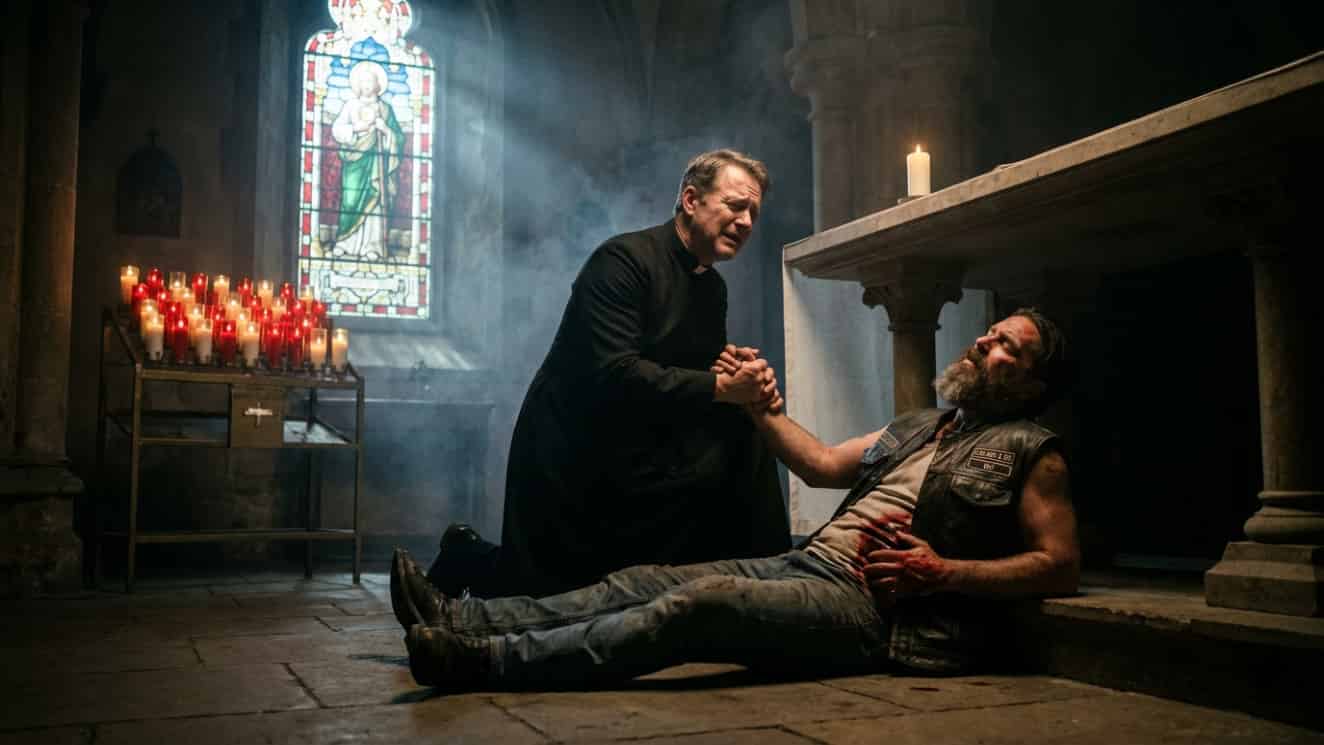
Father Thomas thought ten years of prayer could wash the oil and blood off his hands. He was wrong.
When his brother Elias shows up at St. Jude’s at midnight, dragging the weight of a dead civilian and a fractured brotherhood, the sanctuary walls start to feel like a cage. To save his brother, Thomas has to exhume the man he buried—the man they called Tank.
But the desert has a way of uncovering secrets. Like the fact that Thomas’s seminary tuition wasn’t paid for by grace, but by the very club he abandoned.
Now, with a cynical detective closing in and the MC demanding a blood debt, Thomas has to decide which vail is real: the collar or the leather. In a town where the heat melts everything down to the bone, some sins can’t be confessed. They have to be burned.
FULL STORY
Chapter 1
The heat in Ajo didn’t just sit on you; it pushed. It was a physical weight that felt like a hand pressed against the back of your neck, forcing you toward the dust. By ten o’clock at night, the air usually traded its white-hot edge for a dull, throbbing warmth, but tonight the wind was coming off the Sonora with a fever.
Father Thomas pushed the heavy iron bolt across the front doors of St. Jude’s. The metal was still warm. He wiped a bead of sweat from his temple with the back of a hand that bore a faded, puckered scar between the thumb and forefinger—a reminder of a jagged carburetor housing from a life that felt like it belonged to a different man.
The church was small, built of thick adobe that smelled of floor wax and old incense. It was the kind of place people came to when they had run out of other options. Thomas liked the silence of it. He liked that the shadows in the corners didn’t ask questions.
He walked toward the sacristy, his boots echoing on the Saltillo tile. He wasn’t a small man. Even in the black cassock, he had the shoulders of someone who had spent years horsing heavy machinery around. He’d lost the bulk of his youth, replaced by a lean, stringy strength that felt more permanent.
He was reaching for the light switch when the side door—the one leading to the small garden and the rectory—shook. It wasn’t a knock. It was the sound of a body hitting the wood.
Thomas froze. His hand didn’t go to a crucifix; it balled into a fist. That was the old instinct, the one he spent four hours a day praying to suppress. He took a breath, forced his fingers to unfurl, and moved to the door.
“We’re closed for the night,” he said, his voice low and gravelly. “If this is an emergency, the clinic is three blocks—”
“Tommy.”
The name hit him like a physical blow. Nobody in Ajo called him Tommy. To the town, he was Father Thomas. To the bishop, he was a reliable, if somewhat grim, servant of the diocese. To the world he’d left behind, he was Tank. But “Tommy” was a ghost’s word.
Thomas pulled the door open.
Elias slumped against the frame. He looked like a wreck. His leather vest—the “Iron Cross” top rocker visible even in the dim light—was coated in a layer of fine gray dust. One sleeve of his flannel shirt was soaked a dark, glistening crimson. He was breathing in shallow, jagged hitches, his eyes wide and unfocused.
“Elias,” Thomas whispered. He grabbed his brother’s shoulder, hauling him inside and kicking the door shut.
The smell hit him immediately: hot oil, exhaust, and the copper tang of fresh blood. It was the smell of every Saturday night Thomas had tried to forget for the last decade.
“I messed up, Tommy,” Elias rasped. He stumbled toward a wooden bench, leaving a smear of red on the white-washed wall. “I messed up real bad.”
Thomas didn’t ask what happened. He didn’t offer a blessing. He went to the supply closet and grabbed a first-aid kit and a basin of water. His movements were clinical, practiced. He’d patched up road rash and knife wounds in the back of garages long before he’d ever touched a prayer book.
He knelt in front of his brother. Elias was younger by six years, but tonight he looked ancient. His face was gaunt, his beard matted with sweat.
“Let me see it,” Thomas said.
He peeled back the flannel. It wasn’t a bullet wound. It was a long, jagged tear in the forearm, the kind you get when you come off a bike at sixty and hit a guardrail or a jagged piece of chrome. The skin was shredded, and Thomas could see the white flash of a tendon.
“You crashed,” Thomas said, soaking a cloth in the water.
“I didn’t crash,” Elias spat, flinching as the cool water hit the wound. “The other guy crashed. I just… I didn’t see him until I was on top of him.”
Thomas stopped scrubbing. He looked up, his eyes locking onto his brother’s. “The other guy?”
Elias looked away, his jaw working. “A sedan. Some kid, I think. He pulled out of the Chevron on 85. I didn’t have time to brake. I clipped his front end, sent him spinning into a concrete pylon.”
“Did you stop?”
The silence that followed was louder than the desert wind outside. Elias gripped the edge of the bench, his knuckles white.
“The club was right behind me, Tommy. We had a shipment. We couldn’t stop. Ratchet told me to keep riding. He said he’d handle it, but I saw the car. It was crumpled like a soda can. There was smoke. A lot of smoke.”
Thomas felt a cold stone settle in his stomach. This was the “cycle” he had told himself he’d escaped. The loyalty that required leaving a dying person in a ditch because of a “shipment.”
“You left them,” Thomas said, his voice flat.
“I had to! If the cops caught us with the crates—”
“You left a human being to die so you wouldn’t lose a load of whatever poison you’re running this week.” Thomas stood up, the basin of bloody water sloshing in his hands. “Get out.”
Elias looked up, shocked. “What?”
“Get out of my church, Elias. Go to the police. Or go to hell. But you don’t bring a hit-and-run into the house of God.”
“Your church?” Elias let out a sharp, ugly laugh that turned into a cough. “You think this place is yours? You think that collar makes you something else? You’re Tank, Tommy. You’re the guy who taught me how to lane-split. You’re the guy who taught me that the club is the only thing that stays.”
“I’m the man who walked away,” Thomas said.
“Yeah, you walked away. With forty grand of the club’s money in your bag.”
Thomas felt the air leave the room. He looked at the crucifix on the far wall. The secret he’d kept buried under layers of penance and service felt like it was clawing its way up his throat. He hadn’t just left; he’d stolen. He’d used the Iron Cross’s “emergency fund”—money meant for bail and burials—to pay his way through the seminary in Chicago. He’d told himself he was laundering the devil’s money for God’s work.
“I paid that back,” Thomas whispered.
“Not to the club, you didn’t,” Elias said, standing up unsteadily. He leaned into Thomas’s space, the smell of the road coming off him in waves. “Ratchet knows. He’s known for years. He let it go because he liked you. But Ratchet isn’t the one calling the shots tonight. The board wants their pound of flesh, and I’m the one they sent to collect.”
Elias grabbed Thomas’s arm, his bloody hand staining the black sleeve of the cassock.
“The kid in the car… he’s dead, Tommy. I heard it on the scanner before I ditched my bike in the scrub. The cops are looking for a black Road Glide with a bent fork. My bike. If they find it, I’m gone for twenty years. You’re going to help me.”
Thomas looked at the blood on his sleeve. It looked black in the dim light. He thought of the person in the car on Highway 85. Someone who had a family, a life, a reason to be at a Chevron at ten on a Tuesday.
“How can I help you?” Thomas asked, his voice sounding like it belonged to someone else.
“The church van,” Elias said. “The white one with the ‘St. Jude’s’ logo on the side. Nobody stops a priest. We’re going to get my bike out of the ditch, put it in the back of the van, and take it to the clubhouse in Gila Bend. Once it’s there, it’s gone. It’ll be parts by morning.”
“I can’t do that,” Thomas said. “That’s… that’s a crime, Elias. It’s an obstruction. It’s a sin.”
Elias leaned in closer, his voice a lethal whisper. “You abandoned me once, Tommy. Ten years ago, when the feds raided the warehouse in Mesa. You jumped the fence and never looked up. I did three years in Perryville because of you. I didn’t say a word. I kept your name out of every mouth.”
Elias stepped back, clutching his arm. “Now, I’m asking for the debt to be paid. One night. One drive. Then I’m out of your life forever. You can go back to your bread and wine and your quiet little lies. But if you don’t? I’ll make sure the Bishop knows exactly how Father Thomas bought his way into the light.”
Thomas looked around his sanctuary. The statues of the saints felt like witnesses. He could hear the ticking of the clock in the hallway. He had built a life here. He had helped people. He had found a version of peace that didn’t involve checking his mirrors every ten seconds.
But the foundation was rotten. He’d always known it. He’d just hoped the building would hold until he died.
“The keys are in the rectory,” Thomas said.
He didn’t look at his brother. He walked toward the door, his heart hammering against his ribs like a trapped bird. He wasn’t Father Thomas anymore. The weight of the world was back on his shoulders, and it felt exactly like the leather vest he’d tried so hard to burn.
Chapter 2
The morning sun hit the adobe walls of the rectory like a physical strike. Thomas sat at his small kitchen table, a mug of black coffee between his hands. He hadn’t slept. The white church van was back in its spot, its interior smelling of degreaser and scorched rubber. They had spent three hours in the desert, hauling Elias’s mangled Harley into the back of the van while the coyotes howled in the distance.
The bike was gone now. Elias was gone. But the silence in the church felt different today. It felt brittle.
A sharp knock at the door made Thomas jump. He wiped his face, checked the mirror to ensure his collar was straight, and opened the door.
Detective Miller was leaning against the porch railing. He was a man who looked like he’d been carved out of dry wood—lined face, graying hair, and eyes that seemed to be looking for a reason to be disappointed. He’d been the lead detective in Ajo for five years, and he and Thomas had a cordial, if distant, relationship.
“Father,” Miller said, tipping his hat.
“Detective. You’re out early. Coffee?”
“I’d love some, but I’m on the clock. There was a mess out on 85 last night. Hit-and-run. Killed a twenty-year-old kid on his way home from his shift at the mine.”
Thomas felt his throat tighten. He walked to the counter to pour a cup he didn’t want, just to turn his back. “That’s terrible. I heard the sirens last night.”
“Yeah. Nasty business. Based on the debris, we’re looking for a motorcycle. High-end, heavy frame. Probably a Harley. We found some oil spots and a piece of a fairing about a mile into the scrub where someone tried to hide, but the bike is gone.”
Miller walked into the kitchen, his boots heavy on the linoleum. He didn’t sit. He wandered over to the window that looked out toward the church parking lot.
“Funny thing,” Miller said, his voice casual. “One of my deputies says he saw a white van out that way around two in the morning. A white van with a logo on the side. Looked a lot like yours, Father.”
Thomas felt the sweat break out under his collar. “I was out. A parishioner had an emergency. Old Mrs. Gable. She thought she was having a heart attack. It turned out to be indigestion, but I stayed until she calmed down.”
It was a good lie. Mrs. Gable had dementia; she wouldn’t remember if he’d been there or not, but she’d swear he was if asked.
Miller turned, his eyes narrowing. “You’re a good man, Thomas. Always helping the lost sheep. But I’ve been looking into that hit-and-run, and I started looking into the Iron Cross MC. They’ve been moving a lot of weight through here lately.”
Miller stepped closer, his voice dropping. “I grew up in Mesa, Father. I remember the raids back in the day. I remember a guy they called Tank. Fast on a bike, faster with his fists. disappeared right before the indictments came down.”
Thomas didn’t blink. He’d practiced this stillness in front of the tabernacle. “I don’t know who that is, Detective. My life before the seminary is a matter of public record. I was a mechanic in Phoenix. I had a rough start, sure. But that’s why I’m here. Redemption isn’t just a word to me.”
“Redemption is a fine thing,” Miller said, heading for the door. “But justice is what I get paid for. That kid’s mother is sitting in my lobby right now, waiting for me to tell her who killed her son. If I find out someone helped that bike disappear… well, the law doesn’t care much about what kind of shirt you’re wearing.”
Miller left, his cruiser kicking up a cloud of dust as he pulled away. Thomas watched him go, his hand trembling as he set the coffee mug down.
He needed to talk to someone. Not a detective, and not a brother who wanted to drown him.
He walked over to the church and went into the small office behind the altar. Sister Elena was there, silently polishing the silver chalices. She was nearly eighty, a woman who spoke perhaps ten words a week but seemed to hear everything the wind whispered.
“Sister,” Thomas said.
She didn’t look up. “The blood on the wall in the garden, Thomas. I scrubbed it this morning. It was very thick.”
Thomas felt his knees go weak. He sat in the wooden chair across from her. “It was my brother, Elena. He’s in trouble.”
“He was always in trouble,” she said, her voice like dry parchment. “Even when you were boys and you brought him here to hide from your father. You cannot hide a wolf in a sheepfold, Thomas. Eventually, the wolf gets hungry.”
“He’s my blood,” Thomas said.
“And what of the blood he spilled?” she asked, finally looking up. Her blue eyes were piercing. “You think you can balance the scales by being a good priest? You cannot build a cathedral on a foundation of corpses.”
Thomas looked away. He thought of the forty thousand dollars. He thought of the “Tank” vest hidden in a trunk beneath the floorboards of the sacristy—a trunk he hadn’t opened in ten years but could never bring himself to burn.
“I have to protect him,” Thomas said.
“No,” Elena said. “You have to save him. There is a difference.”
She went back to her polishing. Thomas left the office and walked into the sanctuary. He went to the confessional—a small, cramped wooden box that smelled of cedar and the heavy, humid breath of a thousand sinners.
He sat inside and closed his eyes. He wasn’t waiting for a parishioner. He was waiting for the world to collapse.
An hour later, the curtain on the other side of the screen slid back.
“Bless me, Father, for I have sinned,” a voice said.
It wasn’t a parishioner. It was Ratchet.
Thomas could smell the man through the screen—stale tobacco, cheap leather, and the grease of a thousand engines. Ratchet was the man who had raised Thomas after their father had drunk himself into a shallow grave. He was the one who had given Thomas his first bike and his first patch.
“Ratchet,” Thomas whispered.
“You look good in the box, Tank,” the old man said, his voice a low rumble. “Suit fits you. But we got a problem. Elias is running scared. He thinks the cops are on him, and when Elias gets scared, he starts talking.”
“Talking to who?”
“To anyone who will listen. He’s blaming the club for the hit-and-run. Says I told him to keep riding. Which I did, but that’s the code. Now the board is worried. They don’t like loose ends.”
“What are you telling me this for?” Thomas asked.
“Because I like you, kid. I always did. You had the brains to get out, even if you did steal the bail money to do it. But Elias? He doesn’t have your brains. He’s going to get himself killed, or worse, he’s going to take the whole club down with him.”
Ratchet leaned closer to the screen. “The board wants him gone. Not to jail, Tommy. Gone. They think if he’s dead, the investigation dies with him. No bike, no rider, no problem.”
“He’s your brother too, in the club,” Thomas said, his voice rising in anger.
“The club is a business, Tank. You know that. I can’t stop them. But you? You’re a man of God now. You got a van. You got a rectory. You could hide him. Get him across the border to that mission in Nogales you’re always sending clothes to. If he disappears there, the club will forget about him.”
“And the hit-and-run?”
“The kid is dead, Tommy. Nothing changes that. But Elias doesn’t have to be.”
Thomas leaned his forehead against the wooden screen. He could feel the trap closing. If he helped Elias escape, he was a fugitive. If he didn’t, his brother was a dead man. And through it all, the ghost of a twenty-year-old kid was standing in the shadows of the church, asking why his life was worth less than the survival of a biker gang.
“I’ll do it,” Thomas said. “But you tell the board he’s dead. Tell them I handled it. Tell them the priest took care of the sinner.”
“I knew I could count on you,” Ratchet said. “He’ll be here tonight. Midnight. Don’t be late, Father.”
The curtain slid shut. Thomas stayed in the box for a long time, the darkness pressing in on him. He was a priest who was about to smuggle a killer across a border. He wondered if God was still listening, or if He’d walked out of St. Jude’s the moment Elias hit the door.
Chapter 3
The midnight air was still and heavy as Thomas pulled the church van behind “The Rusty Bolt,” a roadside bar on the outskirts of town that served as the unofficial headquarters for the local Iron Cross chapter. The neon sign buzzed with a dying hum, casting a sickly red light over the row of bikes parked out front.
Thomas kept the engine running. He felt exposed in his black clerical shirt. He’d left the cassock at the church, feeling like it was too heavy for the work he was doing tonight.
Elias emerged from the shadows of the loading dock, carrying a single duffel bag. He looked worse than he had the night before. His arm was bandaged with a dirty rag, and his eyes were bloodshot and twitching.
“You got the money?” Elias asked as he slid into the passenger seat.
“I have five hundred dollars from the poor box and my own savings,” Thomas said, his voice tight. “It’s enough to get you to Nogales and keep you for a month at the mission.”
“Five hundred? That’s it? I’m supposed to start a new life on five hundred bucks?”
“You’re lucky to have a life at all,” Thomas snapped. He put the van in gear and pulled away, the gravel crunching under the tires. “Ratchet says the board wants you dead, Elias. They think you’re a liability.”
Elias went silent. He stared out the window at the passing cacti, their silhouettes like twisted limbs against the starlight. “I didn’t mean to hit him, Tommy. He just appeared. I saw his face for a second. He looked so young.”
“He was twenty,” Thomas said. “His name was Danny. He was a mechanic’s apprentice.”
“How do you know that?”
“Detective Miller told me. I had to look his mother in the eye this afternoon when she came to the church to light a candle. She didn’t know she was talking to the man who helped his killer hide the bike.”
The guilt in the van was thick enough to choke on. They drove in silence for twenty miles, heading south toward the border. The desert was a vast, indifferent ocean around them.
“Why did you do it?” Elias asked suddenly.
“Do what?”
“Take the money. To become a priest. You were the best rider we had. You could have been president of the chapter in five years. Why this?” He gestured to Thomas’s collar.
Thomas gripped the steering wheel. “Because I was tired of the noise, Elias. I was tired of the sirens and the screaming and the way my hands smelled of gasoline even after I scrubbed them for an hour. I wanted to believe there was something else. Something quiet.”
“And is there?”
“There was,” Thomas said. “Until you showed up.”
A pair of headlights appeared in the rearview mirror. They were far back, but they were moving fast. Thomas watched them, a familiar coldness creeping up his spine.
“Someone’s behind us,” Thomas said.
Elias twisted in his seat, looking out the back window. “Is it the cops?”
“No. Too wide for a cruiser. It’s a truck.”
The headlights surged forward, the engine roar becoming audible over the hum of the van. It was a black dually with a brush guard—the kind of truck the club used for hauling trailers.
“It’s the club,” Elias whispered, his voice trembling. “Ratchet lied. He didn’t tell them I was going to the mission. He told them where I’d be.”
The truck rammed the back of the van, a jarring metal-on-metal impact that sent them fishtailing. Thomas fought the wheel, his old muscle memory taking over. He steered into the slide, his heart rate spiking.
“Get down!” Thomas yelled.
The truck pulled alongside them. The passenger window rolled down, and Thomas saw the glint of a barrel.
Pop-pop-pop.
The side window of the van shattered, glass raining down on Elias. Thomas slammed on the brakes, hoping to drop behind the truck, but the driver was experienced. He stayed glued to their side, forcing them toward the soft shoulder of the road.
“They’re going to kill us both!” Elias screamed.
Thomas looked ahead. There was a narrow turn-off—an old mining road that led into the foothills. It was a treacherous path, full of washouts and loose shale.
“Hold on,” Thomas said.
He yanked the wheel to the right. The van bounced violently as it left the pavement, the suspension screaming in protest. The truck followed, but its wider wheel base struggled with the narrow track.
Thomas drove like a man possessed, navigating by the dim glow of his high beams. He knew these roads; he’d spent his youth racing dirt bikes through these canyons. He pushed the van harder than it was ever meant to go, the engine overheating, the smell of burning oil filling the cabin.
He found what he was looking for—a narrow gap between two boulders that opened into a dry wash. He killed the lights and steered the van into the darkness, cutting the engine just as the truck roared past on the main trail above them.
The silence that followed was heavy. Thomas and Elias sat in the dark, breathing hard, listening to the sound of the truck’s engine fading into the distance.
“They’re gone,” Elias whispered.
“For now,” Thomas said. He leaned his head against the steering wheel. He was shaking. Not from fear, but from the adrenaline—the old, addictive rush of the chase. He hated how good it felt. He hated that the “Tank” inside him was still alive, waiting for an excuse to breathe.
“We can’t go to Nogales,” Elias said. “They’ll be watching the mission.”
“I know,” Thomas said. “There’s a place about five miles from here. An old silver mine. My father used to take us there when the bills were due and he didn’t want to talk to the repo man. We’ll hide there until morning.”
They got out of the van. The vehicle was ruined—the rear axle was bent and the side was riddled with bullet holes. They began to walk, two shadows moving through the scrub.
As they climbed toward the mine, Thomas looked back at the road. He saw the faint glow of a fire in the distance—the Chevron station where Danny had died.
“Elias,” Thomas said.
“Yeah?”
“When we get to the mine, you’re going to tell me everything. No lies. No club code. I need to know exactly what happened on that road.”
“I told you—”
“You told me the version that keeps you out of jail,” Thomas said, stopping and turning to face his brother. “I want the truth. Because I just traded my life for yours, and I want to know if it was worth the price.”
Elias looked at him, his face pale in the moonlight. For the first time, the defiance was gone. He looked like a small boy again, lost in a world he didn’t understand.
“I didn’t just hit him, Tommy,” Elias whispered. “I saw him trying to get out of the car. He was reaching for his phone. And I… I was so scared. Ratchet told me to make sure he couldn’t talk. I didn’t stop him. I just watched while Ratchet… while he…”
Elias broke down, sobbing into his hands. Thomas felt the world tilt. It wasn’t just a hit-and-run. It was a murder. And he was the man who had helped the murderers walk away.
Chapter 4
The silver mine was a jagged hole in the side of a limestone cliff, smelling of damp earth and bat guano. They sat near the entrance, hidden by a screen of mesquite bushes. Thomas had built a tiny, smokeless fire, more for the comfort of the light than for warmth.
Elias was curled in a corner, his breathing heavy and rattling. He was feverish; the wound on his arm had turned an angry, pulsing purple. Thomas had cleaned it again, but without antibiotics, the infection was winning.
“You should have left me in the ditch,” Elias muttered.
“Probably,” Thomas said. He was staring at his hands. They were covered in dirt and dried blood. He thought of the altar at St. Jude’s, the pristine white cloth, the gold of the monstrance. It felt a million miles away.
“You really believe in it, don’t you?” Elias asked. “The heaven and hell stuff?”
“I believe in the weight of things,” Thomas said. “I believe that every choice we make adds a stone to a bag we have to carry. Eventually, the bag gets too heavy, and you either drop it or it crushes you.”
“I want to drop it,” Elias said. “I want to go back to when we were kids. Before the club. Before Dad died.”
“We can’t go back, Elias. We can only go through.”
A soft sound—the crunch of a boot on gravel—made Thomas reach for a heavy iron pry bar he’d found in the mine. He stood up, shielding Elias with his body.
“Who’s there?”
A girl stepped into the light of the fire. She couldn’t have been more than nineteen. She was wearing a torn denim jacket and carrying a backpack that looked like it had been dragged through the mud. Her face was smudged with dirt, and her eyes were wide with terror.
“Please,” she said. “I saw your van. I saw the logo.”
“Who are you?” Thomas asked, lowering the bar but not letting go.
“My name is Sarah. I… I was at the Chevron. On Tuesday night.”
The air in the cave seemed to freeze. Elias sat up, his eyes fixed on the girl.
“I saw what happened,” Sarah said, her voice trembling. “I was in the bathroom when I heard the crash. I ran out… I saw the bike. I saw him.” She pointed at Elias. “And the other one. The old man.”
“Why didn’t you go to the police?” Thomas asked.
“I tried! But the old man… he saw me. He chased me. I ran into the desert. I’ve been hiding for two days. I saw the truck tonight, the one that was shooting at you. I thought they were the police. I thought I was saved. But then I saw the patches.”
She looked at Thomas, her gaze landing on his collar. “Are you really a priest? Or is that a lie too?”
Thomas felt a wave of shame so intense he had to sit down. “I’m a priest, Sarah. But I’m also a man who has done a very bad thing.”
“They killed Danny,” she said, tears finally spilling over. “He was my boyfriend. He was taking me to the movies. He was so happy because he’d just gotten a raise.”
Elias let out a low, pained groan and turned his face to the wall.
“I have his phone,” Sarah said, reaching into her pocket. “He was recording a video for his mom when it happened. It’s all on there. The crash. The old man’s face. Everything.”
Thomas looked at the small, cracked screen in her hand. This was it. The evidence that would destroy the Iron Cross. The evidence that would send Elias to prison for the rest of his life. And the evidence that would reveal Thomas’s involvement in the cover-up.
“Give it to me,” Elias said, his voice a desperate rasp. “Give it to me, Sarah. I can make this right. I can get you money. I can get you out of here.”
“Shut up, Elias,” Thomas said.
He looked at Sarah. She was shaking, her life shattered by a moment of biker arrogance. He looked at his brother, a man he had loved and protected his entire life. And he looked at himself—a priest who had lied to a detective, stolen from his parish, and used his holy office to shield a killer.
“Detective Miller is a good man,” Thomas said. “He’ll protect you.”
“They’ll find me,” Sarah said. “The men in the truck. They’re still out there.”
“I won’t let them,” Thomas said. “I’m going to take you to him.”
“And what about me?” Elias yelled, struggling to his feet. “You’re going to turn me in? Your own brother?”
“I’m going to save you,” Thomas said, his voice cracking. “I’m going to give you the only thing you have left. A chance to be honest.”
“I’ll die in there! You know what they do to club members who talk!”
“You’re already dying out here, Elias. Look at your arm. Look at your soul.”
Thomas turned to Sarah. “Stay here. Stay deep in the mine. I’m going to go to the ridge and see if I can get a signal. I’m calling Miller.”
“No!” Elias lunged for the phone in Sarah’s hand. Thomas intercepted him, his old strength returning. He pinned Elias against the damp stone wall, his hand around his brother’s throat.
“Enough!” Thomas roared. “I have spent ten years trying to pay for your sins and mine! I have lied to God! I am done, Elias! I am done!”
Elias slumped, the fight leaving him. He began to cry, a high, thin sound that echoed through the mine.
Thomas stepped back, his chest heaving. He looked at Sarah. “Give me the phone. I’ll keep it safe.”
She hesitated, then handed it over. It was warm from her pocket. Thomas walked out of the mine and into the cool night air. He climbed to the top of the ridge, the desert stretching out below him like a map of his failures.
He pulled his own phone from his pocket. He had one bar of service. He scrolled through his contacts until he found Miller’s number.
But before he could press call, he saw a line of lights on the highway below. Not police lights. The steady, rhythmic pulse of motorcycle headlamps. The pack was coming. Ratchet wasn’t going to let a priest and a runaway finish what the truck had started.
Thomas looked at the phone in his hand. He looked at the matchbook in his pocket. He realized then that there was only one way to end the cycle. It wouldn’t involve a courtroom, and it wouldn’t involve a confession. It would involve gasoline and holy water.
Chapter 5
The bikes arrived at the base of the foothills ten minutes later. Thomas could hear the thunder of the engines—a sound he used to love, but now sounded like the heartbeat of a monster. He counted six of them. Six riders. Six men he used to call brothers.
He went back into the mine. Sarah was huddled in the back, her eyes wide with terror. Elias was drifting in and out of consciousness.
“They’re here,” Thomas said.
He went to the corner of the mine where he’d left his bag. He reached past the prayer books and the extra collar. He reached for the heavy, leather-bound bundle at the bottom.
He unwrapped it. The leather was stiff, but the smell of it was unmistakable. He pulled out the vest. The “Tank” patch was faded, the white thread turned gray by time. He pulled it on over his black shirt. It was tight across the chest, but it fit.
“What are you doing?” Sarah whispered.
“I’m going to talk to them,” Thomas said.
“They’ll kill you,” she said.
“Maybe. But they won’t expect to see Tank.”
Thomas looked at Elias. “If I don’t come back, take the girl through the back passage. It leads to a dry creek bed that comes out near the old refinery. Keep walking until you hit the lights of the town. Don’t stop for anything.”
“Tommy…” Elias whispered, his eyes fluttering open.
“I love you, Elias,” Thomas said. “But I can’t be your shield anymore. I have to be your penance.”
Thomas walked out of the mine. He didn’t hide. He walked down the center of the trail, his boots steady on the rocks. At the bottom of the slope, the six bikes were parked in a semi-circle, their engines idling.
Ratchet was in the center, sitting on his custom shovelhead. He looked older in the moonlight, his face a mask of disappointment.
“You should have stayed in Chicago, Tank,” Ratchet said, his voice carrying over the rumble.
“I missed the weather,” Thomas said, stopping ten feet from the front tire of Ratchet’s bike.
The other riders shifted, their hands going to their belts or their jackets. They were younger men, most of them, guys who had only heard stories of the man in the leather vest.
“Where’s the girl, Tommy? And where’s your brother?”
“The girl is gone. She’s halfway to the border by now. And Elias… Elias is dead, Ratchet. He didn’t make it through the night. The infection got him.”
It was a lie, but it was a holy one.
Ratchet narrowed his eyes. “I don’t believe you. You were always a good liar, but you got soft. The collar did that to you.”
“The collar didn’t do anything but give me a place to hide,” Thomas said. He stepped closer, his voice dropping into a register that made the younger riders flinch. “You killed that kid, Ratchet. You told Elias to ride, and then you finished the job with your own hands. You think the club can protect you from that? You think God is going to look the other way because you’re wearing a patch?”
“I don’t care what God thinks,” Ratchet spat. “I care about the board. And the board wants the phone. We know she has it. We tracked the GPS signal before she turned it off.”
“I have the phone,” Thomas said, pulling it from his pocket. He held it up, the screen glinting in the moonlight. “And I’ve already uploaded the video to a private server. If I don’t check in by morning, it goes to the FBI, the DEA, and every news station from here to Phoenix.”
Another lie. But it was the only leverage he had.
Ratchet laughed, a dry, hacking sound. “You’re bluffing. You don’t know how to use a server. You’re a grease monkey who found a Bible.”
“Try me,” Thomas said.
He took another step forward. He was inside the circle now. He could feel the heat coming off the engines.
“Let them go,” Thomas said. “Let Elias be buried in peace. Let the girl walk away. I’ll give you the phone, and I’ll take the fall for the hit-and-run. I’ll tell Miller I was the one on the bike. I’ll tell him I was Tank again for one night and I messed up. You get your clean slate, and I get my penance.”
The riders looked at each other. This was a deal they understood. A sacrifice. A trade.
“Why would you do that?” Ratchet asked.
“Because I’m the one who stole the money,” Thomas said. “I’m the one who started this. If I hadn’t left, Elias wouldn’t have been trying so hard to prove he was as good as I was. This is my debt, Ratchet. Let me pay it.”
Ratchet sat in silence for a long minute. The wind whistled through the spokes of the bikes. Finally, he nodded.
“Give me the phone.”
Thomas walked up to Ratchet. He handed over the device. Ratchet took it, checked the screen, and tucked it into his pocket.
“Get out of here, Tank,” Ratchet said. “Before I change my mind.”
The bikes roared to life, one by one. They turned and sped away, their taillights disappearing into the dust. Thomas stood alone in the dark, the weight of the vest feeling heavier than it ever had.
He turned and began the long walk back up to the mine. His heart was hollow. He had saved his brother’s life, but he had surrendered his own. He was no longer a priest, and he was no longer a biker. He was a man with no name, standing in the middle of a desert that didn’t care if he lived or died.
Chapter 6
Morning came to the desert in shades of bruised purple and gold. Thomas sat on the steps of St. Jude’s, watching the sun rise over the Ajo peaks. He was wearing his cassock again, though it was torn and stained with the dust of the silver mine.
He’d gotten Sarah to Miller’s house three hours ago. He’d left her on the porch with the phone—the real phone. He’d given Ratchet a decoy he’d found in the mine’s old office. By the time the club realized they’d been played, the evidence would already be in the system.
Elias was at the mission in Nogales. Sister Elena had driven him in the parish’s second, older car. He was weak, but he would live. Whether he would ever be whole again was a question Thomas couldn’t answer.
The sound of a car door slamming made Thomas look up. Detective Miller was walking across the plaza, his face set in a grim line.
“You look like hell, Father,” Miller said, stopping at the bottom of the steps.
“It was a long night, Detective.”
“Sarah told me everything. Or most of it. She said you saved her life. She said you stood down six armed men with nothing but a leather vest and a bluff.”
Miller sat on the step next to him. He took out a pack of cigarettes, offered one to Thomas, and then lit one for himself when Thomas declined.
“The Iron Cross clubhouse was raided an hour ago,” Miller said, blowing a plume of smoke into the clear air. “We got Ratchet. We got the phone. We even found the bike in a shredder in Gila Bend. It’s over.”
“And Elias?” Thomas asked.
Miller looked at him, his eyes unreadable. “Sarah says Elias wasn’t there. She says the old man was the one who did it. She says the rider on the bike… she couldn’t be sure who it was. She thinks it might have been someone who’s already dead.”
Thomas felt a lump form in his throat. Sarah had given him a gift—a lie to protect the man who had protected her.
“But we have a problem, Thomas,” Miller continued. “The money. The seminary. I’ve been talking to the Diocese. They’re… concerned. There’s going to be an inquiry. A lot of questions about where Father Thomas’s tuition came from.”
“I know,” Thomas said. “I’ve already written my resignation. It’s on the altar.”
“You don’t have to do that. I could bury the financial stuff. You’ve done a lot of good here.”
“No,” Thomas said. “The building is rotten, Detective. I can’t keep living in it.”
Thomas stood up. He felt lighter than he had in years. The secret was out. The debt was being called in.
“What are you going to do?” Miller asked.
“I’m going to go for a walk,” Thomas said. “And then I’m going to find a way to be a man who doesn’t need a collar or a patch to know who he is.”
He walked away from the church, leaving the heavy adobe walls and the cool shadows behind. He walked toward the edge of town, where the pavement ended and the desert began.
He thought of Danny. He thought of the mother lighting a candle in the dim light of the sanctuary. He knew he could never make it right. He could never bring that boy back. But as he looked out at the vast, sun-drenched horizon, he realized that for the first time in his life, he wasn’t running.
He reached into his pocket and found a small, wooden cross that Sister Elena had given him years ago. He pressed it into the sand by the side of the road—a marker for a life that was finished.
Then he kept walking, his shadow long and straight before him, disappearing into the heat of the Arizona morning.