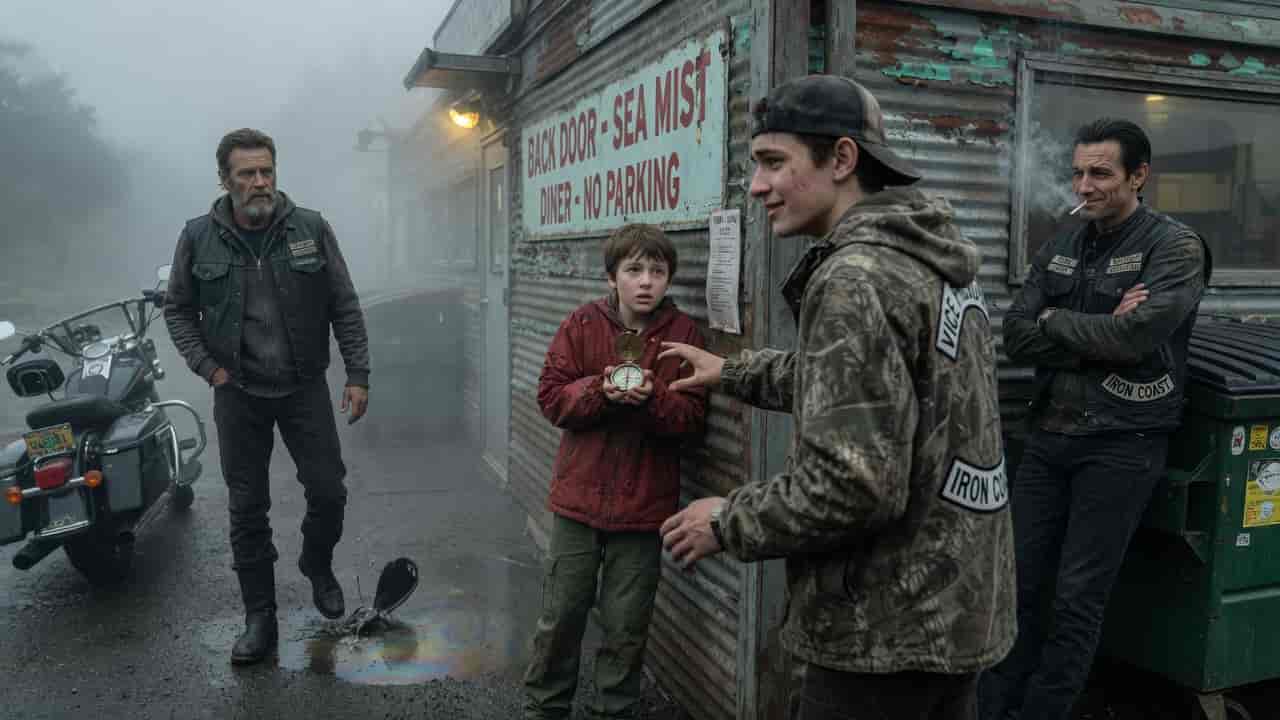
I watched from the seat of my Harley as the local boys cornered the kid behind the diner. He was small, maybe ten, clutching a piece of tarnished brass like it was the only thing keeping him on this earth.
I’m the President of the Black Sand MC. I’ve spent thirty years making sure people were afraid to even look me in the eye. I don’t do “charity.” I don’t break the club’s No Families rule. And I certainly don’t step into playground fights.
But when that compass hit the wet asphalt and the kid let out a sound like his soul was being ripped out, something in me snapped.
Maybe it was the way the light caught the engraving on the lid. Maybe it was the fact that my own vision was blurring at the edges, a terminal secret I hadn’t even told my Vice President.
Viper was watching from the shadows, a cigarette dangling from his smirk. He wanted to see if I’d finally gone soft. He wanted a reason to take my vest.
I stepped off the bike. My boots felt like lead, but my grip on that teenager’s wrist was iron.
“Put it down,” I said.
I didn’t do it for the kid. At least, that’s what I told myself. But then I picked up the compass and read the words I’d had engraved twenty years ago for a daughter I’d abandoned.
Always find your way back to me – M.
The room—the whole town—was about to find out exactly what I’d been hiding.
Chapter 1: The Weight of the Patch
The fog didn’t just roll off the Pacific in Coos Bay; it crawled. It had a way of sticking to the leather of Colt’s vest, turning the black hide into a damp, heavy second skin. It was 6:00 AM, and the vibration of the Shovelhead between his thighs was the only thing that felt solid. The rest of the world—the rusted hulls of the fishing fleet, the neon sign of the Pelican Diner, the grey stretch of Highway 101—was beginning to smudge.
Colt blinked, hard. A dark, jagged shape occupied the center of his vision, a blind spot that refused to be blinked away. Macular degeneration was a slow thief, but it was a thorough one. It started at the edges and worked its way in until all you had left was a peripheral memory of what the world used to look like.
He pulled into the gravel lot of the Black Sand MC clubhouse, a converted cannery that smelled eternally of salt, diesel, and old sins. He didn’t cut the engine immediately. He sat there, hands gripping the chrome bars, feeling the heat off the jugs. He needed a moment to map the walk to the door. Twenty paces to the ramp. Three steps up. Avoid the loose floorboard near the pool table.
“You’re late, Colt.”
The voice was sharp, cutting through the low rumble of the bike. Viper was leaning against the heavy oak doorframe, his “Vice President” patch catching the dim light of the porch bulb. Viper was forty, lean as a whip, and possessed the kind of ambition that made a man’s shadow look like a noose.
“I’m the President, Viper,” Colt said, his voice a gravelly rasp. “I arrive when the road says I’m here.”
He kicked the stand down with a heavy thud, praying his foot found the solid patch of dirt and not the slick mud. He dismounted with a stiffness he hated, his knees popping like dry kindling. He walked toward the door, keeping his gaze fixed slightly to the left of Viper’s face so the blind spot didn’t swallow the man whole.
“The run to Portland is Friday,” Viper said, falling in step behind him as they entered the dim, smoke-filled cavern of the bar. “The guys are asking about the route. Usually, you’ve got the maps laid out by now.”
“I’ve got the route in my head,” Colt lied. He couldn’t read a map anymore, not even with a magnifying glass. The lines blurred into a nest of spiders.
“Right. Your head,” Viper echoed. There was a thin layer of ice in his tone. He pulled out a chair at the long, scarred timber table in the center of the room—the Table. “You’ve been spending a lot of time at that clinic in Eugene, Colt. Some of the brothers are wondering if the ‘road’ is getting too long for you.”
Colt sat heavily at the head of the table. He could feel the eyes of the few members present—Rev, the club’s gray-bearded chaplain, and a couple of prospects mopping the floors. The Black Sand MC lived by a simple, brutal code: The Road is First. The Club is Family. No Blood Outside the Patch.
“My health is my business,” Colt said. “The business of this club is moving product and keeping the locals quiet. Is the shipment ready?”
“It’s ready. But the books are off,” Viper said, sliding a ledger toward Colt.
Colt didn’t look at it. He couldn’t. The white pages were just a glaring strobe in his vision. “Explain.”
“Three thousand missing from the last three months. Small bites. Not enough to starve us, but enough to notice. It looks like someone is funneling money into a private trust. A ‘M. Miller’ trust.” Viper leaned forward, his eyes narrowing. “You wouldn’t know anything about a ‘M. Miller,’ would you, Colt? Seeing as you don’t have any family left.”
Colt felt a cold prickle of sweat at the nape of his neck. M. Miller. Mariah. The daughter he hadn’t seen since she was six years old. The daughter who had died in a cheap motel in Reno three years ago, leaving behind a son he’d only discovered through a private investigator’s report.
“I’ll look into it,” Colt said, his voice flat.
“I’m sure you will,” Viper replied, standing up. “Just remember, the ‘No Families’ rule isn’t just a suggestion. It’s what keeps us from being vulnerable. If a man has something to lose outside these walls, he’s a liability. And liabilities get cut.”
Viper walked away, his spurs jingling with every step. Rev, who had been sitting quietly in the corner cleaning a glass, moved over to the table. He sat in Viper’s vacated chair and pushed a cup of black coffee toward Colt.
“He’s smelling blood, Colt,” Rev said softly. “And he’s not the only one. You’re missing the marks. You almost walked into the pool table twice yesterday.”
Colt gripped the coffee cup. “I’m fine, Rev.”
“You’re not fine. You’re a man trying to steer a ship through a hurricane while someone’s stealing the rudder.” Rev leaned in, his voice dropping to a whisper. “Did you find the boy?”
“I found him,” Colt admitted. “He’s staying with a foster family over on 4th. A woman named Mrs. Gable. She’s overwhelmed and the house is a wreck, but he’s safe for now.”
“You can’t keep funneling money to him, Colt. Viper will trace it back. He’s already halfway there.”
“He’s my grandson, Rev. My only blood. I left his mother to rot because of this vest. I’m not letting him end up in the system because I was too chicken to protect him.”
“Then you have to choose,” Rev said. “The vest or the boy. You can’t wear both into the grave.”
Colt didn’t answer. He looked toward the door, where the fog was pressing against the glass, thick and grey. In his mind, he saw the face of the boy from the photograph—Toby. He had Mariah’s eyes. And he had the compass Colt had sent her for her tenth birthday, the one she’d supposedly kept until the end.
“I’m going for a ride,” Colt said.
“It’s soupy out there,” Rev warned.
“I know the way,” Colt said, though as he stood up, he had to wait five seconds for the room to stop spinning. He walked out, his hand trailing along the back of the chairs, a blind man pretending he was just restless.
Chapter 2: The Alley Humiliation
The Pelican Diner sat on the edge of the docks, its grease-filmed windows overlooking the churning grey water of the bay. It was the kind of place where the coffee tasted like battery acid and the secrets were served on the side. Colt parked his Harley in the shadows of the cannery across the street, his heart hammering against his ribs.
He didn’t go inside. He waited.
Toby usually walked this way after school, taking the shortcut through the alley to reach the dilapidated Victorian where the Gables lived. Colt watched through the blur, his peripheral vision picking up the movement of a small figure in a red windbreaker.
Toby. The boy moved with a hesitant, watchful gait, his head down. He looked like a target. In a town like Coos Bay, smelling like poverty and foster care was a death sentence for a kid’s social standing.
Suddenly, three older boys stepped out from behind a stack of crab pots, blocking the alley. The leader was Jax, the sheriff’s nephew, a boy whose privilege was as thick as his neck. He was seventeen, built like a linebacker, and possessed the casual cruelty of someone who had never been told no.
Colt straightened, his hand dropping to the heavy chain on his belt.
“Where you going, Little Red?” Jax’s voice carried across the damp air, mocking and loud. He shoved Toby back against the rusted metal siding of the diner’s kitchen. “You lost? You need your little toy to find the way home?”
Toby didn’t fight back. He shrank against the wall, his small hands clutching something to his chest. “Leave me alone, Jax.”
“What’s that you got there? Let me see.” Jax grabbed Toby’s wrists, twisting them.
Toby let out a sharp cry of pain. “No! It’s mine! It was my mom’s!”
“Your mom? You mean the one who checked out in a Reno motel? I heard she was a real winner,” Jax sneered. He yanked the boy’s hands apart, and a small, tarnished brass object fell to the asphalt with a metallic clink.
Colt felt a surge of cold, white-hot rage. He’d seen a lot of things in his thirty years with the Black Sand—beatings, betrayals, the slow rot of men’s souls—but watching a teenager dismantle a child’s last shred of dignity felt like a personal insult to the universe.
In the shadows of the diner’s back door, another figure appeared. Viper. He was leaning against the doorframe, a cigarette in his hand, watching the scene with a bored, clinical interest. He saw Colt across the street. He didn’t move. He was waiting to see what the President would do.
Jax picked up the compass, holding it over his head. “Look at this piece of junk. It doesn’t even point North. Just like you, Toby. You’re just a broken little compass heading nowhere.”
The other two boys laughed, a harsh, jagged sound. Toby was shaking, tears carving tracks through the dirt on his face.
“Please,” Toby whispered. “Give it back.”
“Say it louder,” Jax commanded. “Say ‘Please, Jax, give me back my trash.'”
Colt didn’t think about the blind spot. He didn’t think about Viper. He didn’t think about the “No Families” rule. He kicked the Harley into gear and roared across the street, the bike’s engine a thunderous growl that silenced the alley. He swung the heavy machine around, the back tire kicking up a spray of gravel and oily water that pelted Jax’s camo jacket.
The boys froze. Even Jax, with all his sheriff-backed bravado, paled at the sight of the Black Sand colors.
Colt shut off the engine. The silence that followed was heavy, punctuated only by the ticking of the cooling metal and Toby’s ragged sobs. Colt dismounted, his boots hitting the wet asphalt with a finality that made the air feel thin.
“The boy asked for his property,” Colt said. His voice was low, vibrating with a menace that had nothing to do with volume.
Jax tried to find his swagger. “It’s just a joke, Mr. Miller. We’re just messing around.”
“I’m not laughing,” Colt said. He stepped forward, his eyes fixed on the compass in Jax’s hand. He could see the brass glinting, even through the smudge in his vision.
Viper stepped out of the shadows, his voice smooth and dangerous. “Careful, Colt. That’s the Sheriff’s nephew. We have an understanding with the Sheriff. You wouldn’t want to break a twenty-year peace over a foster kid’s trinket, would you?”
Colt didn’t look at Viper. He kept his eyes on Jax. “Put the compass down, Jax. Now.”
“And if I don’t?” Jax asked, his voice cracking.
Colt moved. It wasn’t the lightning-fast movement of a young man; it was the deliberate, unstoppable weight of an old one. He seized Jax’s wrist. The boy’s bones felt like dry twigs under Colt’s calloused palm. He squeezed, leaning into the boy’s space, his salt-and-pepper beard inches from Jax’s face.
“Then I’m going to tell your uncle that I caught you trying to rob a child,” Colt whispered. “And then I’m going to forget that I’m an old man who’s supposed to be civilized.”
Jax’s face crumpled. His fingers flew open, and the compass began to fall. Colt caught it mid-air, his thumb instinctively finding the familiar grooves of the engraving.
“Get out of here,” Colt said.
The boys didn’t wait. They scrambled toward the street, Jax stumbling in his haste.
Toby remained against the wall, his eyes wide and wet, staring at the man in the leather vest. Colt looked down at the compass. He didn’t need to see it clearly to know what it said. Always find your way back to me – M.
“You okay, kid?” Colt asked, his voice losing some of its edge.
Toby nodded slowly. He looked at the compass in Colt’s hand. “How did you… how did you catch it?”
“Spent a lot of years catching things I shouldn’t have,” Colt muttered. He held the compass out.
Toby took it, his small fingers brushing Colt’s. The contact felt like a static shock, a jolt of recognition that went straight to Colt’s heart.
“Thank you,” Toby whispered.
Colt looked up and saw Viper watching them. The Vice President’s eyes weren’t mocking anymore. They were analytical. Cold. He looked from the boy to the compass, and then back to Colt.
“Residue,” Viper said, his voice a ghost in the fog. “You just left a hell of a lot of residue, Colt. I hope that kid was worth the price of your vest.”
Viper turned and walked back into the diner. Colt stood in the alley, the fog closing in, feeling the weight of the compass—and the secret—crushing the air out of his lungs.
Chapter 3: The Toll of Truth
The inside of Penny’s Garage was a sanctuary of grease and organized chaos. Penny, a woman in her late fifties with hands permanently stained black by motor oil, didn’t look up from the engine of a ’68 Mustang when Colt led Toby inside.
“You’re late for the oil change, Colt,” she said, her voice a gravelly alto. Then she saw the boy. She stopped, her wrench poised in mid-air. “Who’s the stray?”
“This is Toby,” Colt said, ushering the boy toward a stool near the workbench. “He had a run-in with some of the local wildlife behind the Pelican.”
Penny wiped her hands on a rag, her sharp eyes scanning Toby’s red windbreaker and the way he clutched the brass compass. She looked at Colt, then back at the boy. Penny had been the club’s primary mechanic for two decades; she knew every secret the Black Sand tried to bury. She’d known Mariah.
“He’s got your chin, Colt,” she said quietly.
“He’s just a kid who needed a hand,” Colt snapped, his defensiveness sharp. “Can you look at the Shovelhead? The idle is rough.”
“The idle is fine. It’s the rider that’s vibrating,” Penny countered. She walked over to Toby and leaned down. “That’s a nice compass, kid. Mind if I see it?”
Toby hesitated, looking at Colt. Colt nodded. The boy handed it over. Penny turned it in her hands, her thumb tracing the lid. She didn’t open it. She didn’t have to.
“My mom said it was magic,” Toby said, his voice small but steady. “She said as long as I had it, I’d never be truly lost. Even when she… even when she had to go.”
“Your mom was right,” Penny said, handing it back. “You stay here and look at those old manuals on the shelf. I need to talk to this old goat.”
She grabbed Colt by the sleeve of his vest and pulled him into the small, cluttered office at the back of the garage. She slammed the door, the glass rattling in the frame.
“Are you out of your mind?” she hissed. “Viper saw you in that alley. I just got a call from Rev. The whole club is buzzing. They think you’re losing it, Colt. Or worse, that you’re breaking the rule.”
“I am breaking the rule, Penny,” Colt said, sinking into a worn vinyl chair. The blind spot was pulsing now, a dark heart at the center of his world. “I’ve been funneling the surplus from the Portland runs into a trust for him. I’ve been paying Mrs. Gable under the table to make sure he gets decent food. I’m his grandfather. What was I supposed to do? Let him rot in the system like Mariah did?”
“You didn’t let Mariah rot. She chose the road, just like you did.”
“She chose the road because I wasn’t there to show her anything else!” Colt slammed his fist onto the desk, sending a stack of invoices fluttering. “I’m dying, Penny. The doctor in Eugene says I’ve got six months, maybe less, before the vision goes completely and the heart decides it’s had enough. I can’t die leaving him with nothing but a tarnished compass and a memory of a grandfather who was too scared of a leather vest to claim him.”
Penny’s expression softened, the anger draining out of her. “Six months?”
“Maybe. If I’m lucky.”
“Viper knows, Colt. Maybe not about the kid, not for sure, but he knows about the money. He’s going to bring it to the Table. He’s going to call for a vote of no confidence. You know how the boys feel about the money. That’s their retirement, their bail fund.”
“I’ll pay it back,” Colt said. “I’ve got the old cabin in the woods. I’ll sell the land.”
“You can’t sell club-protected land without a vote. You’re trapped, Colt. You’ve built a cage out of your own rules.”
A soft knock on the door interrupted them. Toby was standing there, holding a heavy book about engine schematics.
“Mr. Miller?” Toby asked. “There’s a man outside. A man with a snake on his vest. He’s looking at your motorcycle.”
Colt stood up, his blood turning to ice. He walked to the window. Viper was standing in the garage bay, his hands tucked into his pockets, staring at Colt’s Harley. He wasn’t just looking; he was inspecting. He leaned down and touched the splash of mud on the fender—the mud from the alley.
Colt opened the office door and stepped out. “Looking for something, Viper?”
Viper turned, his smile thin and sharp as a razor. “Just admiring the machine, Colt. It’s a classic. But even classics need a rebuild eventually. The parts wear out. They become unreliable.”
He looked past Colt at Toby. The boy shrank back into the shadows of the office.
“The Sheriff called,” Viper said. “He’s not happy about his nephew’s wrist. He’s asking why the President of the Black Sand is playing bodyguard for a foster kid. He’s wondering if there’s a connection. If maybe the club is moving into… domestic interests.”
“The kid was being bullied. I stopped it. End of story,” Colt said.
“Is it? Because the books say otherwise. The books say the club is missing thirty thousand dollars over the last two years. And the M. Miller Trust is sitting on exactly that amount.” Viper stepped closer, his voice dropping so Toby couldn’t hear. “The Table meets tonight, Colt. Full assembly. Bring your vest. And maybe bring a better story than ‘I was just being a good neighbor.'”
Viper winked at the boy—a gesture that felt like a threat—and walked out into the fog.
Colt stood there, the smell of grease and salt air suddenly suffocating. He turned to Toby. The boy was clutching the compass so hard his knuckles were white.
“Am I in trouble?” Toby asked.
Colt knelt down, his knees screaming in protest. He looked at the boy—really looked at him, through the blur and the shadows. He saw the fear, but he also saw the resilience.
“No, Toby,” Colt said, his voice thick. “You’re not in trouble. I am. But I’m going to make sure you’re okay. I promise.”
“My mom said promises are the only thing you can’t lose,” Toby said.
Colt closed his eyes. He had broken every promise he’d ever made to Mariah. He couldn’t break this one. Not if it was the last thing he did.
“Penny,” Colt said, not looking back. “Keep him here. Don’t let him out of your sight. I have to go to the Table.”
“Colt,” Penny warned. “They’ll tear you apart.”
“Let them try,” Colt said. He walked out to his bike, the dark spot in his vision expanding, swallowing the world piece by piece.
Chapter 4: The Table
The basement of the cannery was a tomb. The air was thick with the smell of stale beer, old tobacco, and the heavy, metallic scent of tension. Twenty men in leather vests sat around the long timber table, their faces obscured by the dim, flickering light of the overhead industrial lamps.
At the head of the table, Colt sat in his high-backed chair. To his right was Viper. To his left was Rev. The rest of the brothers—men with names like Scar, Tank, and Dutch—sat in grim silence.
This was the Assembly. The heart of the Black Sand MC.
Viper stood up, his hands resting on the scarred wood. “Brothers. We are here because the road has become crooked. We are here because the leadership that has guided us for twenty years is no longer looking at the horizon. It’s looking at its own feet.”
A murmur of agreement rippled through the room.
“Colt Miller has been a great President,” Viper continued, his voice dripping with feigned respect. “But a man is only as strong as his loyalty to the patch. And lately, Colt’s loyalty has been… divided.”
Viper pulled a stack of papers from his vest and threw them onto the table. “The trust fund. Thirty thousand dollars of club money, diverted to a boy in the foster system. A boy Colt defended today in public, breaking our peace with the Sheriff and exposing us to unnecessary heat.”
“Is it true, Colt?” Dutch, a man with a face like a hatchet, asked. “Did you take the money?”
Colt looked at the men around the table. He saw the anger in some, the confusion in others. He saw Rev’s pained expression. He realized that the room was turning against him, not just because of the money, but because of the fear. If the President could break the rules, the whole structure of their lives—the only structure some of them had—was in danger of collapsing.
“I took the money,” Colt said. His voice was steady, echoing in the quiet room. “I took it because it was the only way to right a wrong I committed twenty years ago.”
“We don’t care about your wrongs, Colt!” Tank yelled, slamming a fist on the table. “That’s our money! That’s our security!”
“It was a drop in the bucket,” Colt countered. “I made this club millions. I built the Portland route. I kept the feds off our backs. I earned that money ten times over.”
“You earned it for the club!” Viper shouted. “Not for some brat who isn’t even wearing a patch! You broke the ‘No Families’ rule. You made yourself vulnerable. And in doing so, you made us vulnerable.”
Viper leaned over the table, his face inches from Colt’s. “Who is the boy, Colt? Tell the Table. Tell them why he’s so important that you’d risk everything we’ve built.”
Colt felt the pressure mounting. The secret was a stone in his throat. He looked at the blind spot in his vision, the darkness that was slowly erasing the men in front of him. He could lie. He could say the boy was a project, a long-term investment. But the compass… the engraving… it was only a matter of time before Viper found out the truth.
“He’s my grandson,” Colt said.
The silence that followed was absolute. Even the flickering lamps seemed to hold their breath.
“My daughter Mariah… she died,” Colt continued, his voice cracking for the first time. “She left him with nothing. I’m the only thing he has left. I’m dying, brothers. My sight is going. My heart is failing. I wanted to leave him something. I wanted him to have a chance.”
Viper laughed, a cold, sharp sound. “A chance? You’ve turned us into a charity case. You’ve put a target on our backs for a kid who doesn’t even know who you are.”
Viper turned to the room. “I call for a vote of no confidence. I call for the removal of Colt Miller as President. And I call for the reclamation of the funds—by whatever means necessary.”
“Whatever means necessary?” Rev asked, his voice low and dangerous. “He’s a ten-year-old boy, Viper.”
“He’s a liability,” Viper said. “And the club doesn’t keep liabilities. We’ll take the trust money back. And as for the boy… well, the Sheriff is already looking for a reason to move him out of the county. Maybe somewhere he won’t be such a distraction.”
Colt stood up, his chair scraping harshly against the concrete floor. “If you touch that boy, Viper, I will burn this clubhouse to the ground with everyone in it.”
“You and what army, Colt?” Viper sneered. “You can’t even see the end of the table. You’re a ghost wearing a vest.”
Viper looked around the room. “All those in favor of removal?”
One by one, hands began to rise. Dutch. Tank. Scar. Men Colt had bled with, men he had protected. They didn’t look at him. They looked at the table. They looked at the rules.
Finally, only Rev remained with his hand down.
“The vote is carried,” Viper said, his voice ringing with triumph. “Colt Miller, hand over your vest. You are stripped of your rank and your membership. You have until sunrise to leave the county. If we see you after that, you’ll be treated as an enemy of the club.”
Colt felt a numbness spreading through his limbs. He slowly unzipped the vest. The leather felt light now, as if the weight of the last thirty years had finally been lifted, leaving only a hollow space behind. He laid the vest on the table in front of Viper.
“The boy is at Penny’s,” Colt said, his voice a whisper.
Viper’s eyes widened. A predatory grin spread across his face. “Thanks for the tip, Colt.”
Viper turned to the prospects. “Go to the garage. Bring the kid here. We need to have a talk with Mrs. Gable about where that money really came from.”
“No!” Colt lunged across the table, his hands grasping for Viper’s throat.
But he was too slow. His vision betrayed him. He tripped over the leg of the table, crashing to the floor. The brothers stood back, watching him struggle. Nobody helped him up.
Viper stepped over him, his boots clicking on the concrete. “It’s over, Colt. Go find your way home. If you can still see the road.”
Colt lay on the cold floor, the darkness in his eyes merging with the darkness of the room. He could hear the roar of motorcycles outside—the prospects heading for Penny’s. He had lost his rank. He had lost his brothers. And now, he was about to lose the only thing that made his life worth living.
He reached into his pocket and felt the cold brass of the compass he’d taken back from Toby. He gripped it until the metal bit into his palm.
“Not yet,” he whispered to the empty air. “I’m not gone yet.”
Chapter 5: The Blind Man’s Run
The floor of the basement was colder than it had any right to be. Colt lay there, the rough concrete pressing against his cheek, and for a long, agonizing minute, he didn’t try to move. He just listened to the receding thunder of the motorcycles above. The prospects. The young, hungry ones who didn’t know the history of the patches they wore, only the weight of the violence they were expected to carry. They were going for Toby.
His vest—his colors—lay on the table six feet away. It looked smaller without him in it. It looked like what it actually was: a piece of a dead cow covered in embroidered lies.
“Get up, Colt.”
The voice was Rev’s. It was soft, but it carried the authority of a man who had buried more brothers than he had ever baptized. Colt felt a hand on his shoulder—a strong, calloused hand that didn’t care about votes or no-confidence motions.
Colt rolled onto his back, his breath hitching. The overhead light was a cruel, vibrating smear in his vision. The dark spot in the center was larger now, a jagged black inkblot that seemed to be pulsing in time with his heartbeat. He reached out, his hand shaking, and found Rev’s forearm.
“They’re going to the garage, Rev,” Colt rasped. “Viper… he’s going to use the boy to get to the money.”
“I know,” Rev said. He pulled Colt to his feet. Colt staggered, his balance shot, his head spinning. “The club is changing, Colt. It’s been changing for a long time. Viper just finally cut the anchor loose.”
“I need my bike.”
“You can’t see the end of your own arm, man. You’ll kill yourself before you hit the highway.”
Colt gripped Rev’s shirt, pulling the older man close. The smell of stale tobacco and old grease was a comfort, a reminder of the world he was losing. “I’ve ridden that stretch of road every day for thirty years. I know every pothole, every curve, every scent of the pine and the salt. I don’t need my eyes to find Penny’s. I need the engine.”
Rev looked at him for a long time. The silence in the basement was heavy, filled with the ghosts of the men who had sat at that table before them. Then, Rev reached into his pocket and pulled out a set of keys.
“I moved your bike behind the cannery so the prospects wouldn’t kick it over on their way out,” Rev said. “But Colt… if you do this, there’s no coming back. Viper will kill you. And if he doesn’t, the club will. You’re an outsider now. A ghost.”
“I was a ghost the day I left Mariah in Reno,” Colt said. “I’m just finally stopping the haunting.”
Rev helped him up the stairs and out the back door into the biting Oregon night. The fog had turned into a fine, freezing drizzle that coated everything in a slick, treacherous sheen. Colt’s Harley was waiting, a dark shadow against the rusted corrugated metal of the cannery.
Colt swung his leg over the seat. The familiar weight, the cold leather, the reach of the bars—it all snapped into place. He didn’t need to see. He felt the machine. He kicked the engine over, and the Shovelhead roared to life, a defiant scream against the quiet of the docks.
“Go,” Rev said, stepping back into the shadows. “I’ll try to slow the rest of them down at the clubhouse. But you’ve only got a few minutes.”
Colt didn’t wait. He twisted the throttle and shot out of the gravel lot.
The ride was a nightmare of intuition and terror. The world was a blurred tunnel of grey and black. He kept his head tilted, using the sliver of peripheral vision he had left to track the white line on the edge of the asphalt. Every time a car’s headlights approached from the opposite direction, the glare exploded in his eyes like a flashbang, leaving him completely blind for seconds at a time. He rode by the sound of the wind, the feel of the tires on the pavement, and the deep, instinctual map of Coos Bay burned into his brain.
He turned onto 4th Street, the engine echoing off the closed storefronts. He could see the faint, orange glow of Penny’s Garage ahead—a beacon in the gloom. Two other bikes were already there, parked haphazardly in the driveway. The prospects.
Colt didn’t slow down. He steered the Harley straight into the gravel, skidding to a halt just inches from the garage door. He didn’t bother with the kickstand; he let the bike drop onto its side, the heavy metal clattering against the stones.
He stumbled toward the side door, his hand finding the cold steel handle. Inside, the air was thick with the scent of burnt oil and the sharp, ozone tang of a welding torch.
“I told you to get the hell out of my shop!” Penny’s voice was a whip-crack.
Colt stepped into the light. He saw a blurred tableau: Penny standing in front of her office door, a heavy iron pry bar in her hand. Two prospects—younger guys, maybe twenty, both wearing “Black Sand” hoodies—were flanking her. One of them, a kid named Leo with a ratty ponytail, was holding a pair of heavy-duty bolt cutters.
“Colt?” Leo asked, his voice wavering. “What are you doing here? Viper said you were done.”
“I’m never done,” Colt said, his voice dropping into that low, dangerous register that had kept him in power for two decades. He walked toward them, his gait unsteady but his presence overwhelming. He looked at the shadows behind Penny. “Toby? You back there?”
“I’m here, Mr. Miller,” the boy’s voice came from the office, small and trembling.
“Stay there, kid,” Colt commanded. He turned his gaze—or what he could manage of it—back to the prospects. “Leo. Marcus. You both know me. I’m the one who vetted you. I’m the one who sat you down and told you what it meant to be a man in this club.”
“Viper says you’re a thief, Colt,” Marcus said, stepping forward. He was bigger than Leo, with a mean streak that Viper had been cultivating. “He says you stole from us. He says the kid is the evidence.”
“The kid is my blood,” Colt said. “And the money was mine. I didn’t steal a dime of yours. Now, you’re going to walk out that door, you’re going to get on your bikes, and you’re going to tell Viper that the garage was empty.”
“We can’t do that, Colt,” Leo whispered. “He’ll kill us.”
“And what do you think I’m going to do?” Colt asked. He reached into his pocket and pulled out a small, snub-nosed .38. He didn’t point it at them—not yet—but the weight of it in his hand changed the air in the room. “I’ve got nothing left to lose, boys. No vest. No rank. No future. That makes me the most dangerous man you’ve ever met.”
The prospects hesitated. They were bullies, not soldiers. They were used to intimidation, to the shared power of the group. Facing a man who had already been stripped of everything and was still standing was something they hadn’t been trained for.
“Colt, don’t,” Penny said, her voice low. “Don’t do this.”
“I have to,” Colt said.
Suddenly, the front garage door groaned, the heavy rollers screeching as it was yanked upward from the outside. The fog poured in, a white tide that swallowed the floor. A silhouette stood in the opening, framed by the headlights of a black SUV.
Viper.
He didn’t come in alone. Two more members were with him, their hands on their holsters. Viper walked into the shop, his boots clicking on the concrete, a slow, mocking applause coming from his hands.
“Look at this,” Viper said, his voice echoing in the rafters. “The great Colt Miller, reduced to hiding in a garage with a woman and a child. It’s pathetic, Colt. Truly.”
Viper stopped ten feet away. He looked at the prospects. “Leo, Marcus. Why is the kid still breathing? Why are you standing there like you’re waiting for a Sunday school lesson?”
“He’s got a gun, Viper,” Leo stammered.
Viper looked at Colt’s hand. He let out a short, sharp laugh. “A gun? Colt, you couldn’t hit the side of a barn if you were standing inside it. We all know about the Eugene clinic. We know your eyes are as dead as your career.”
Viper turned to the room, his voice rising. “Look at him! The man you all feared. The man who dictated our lives. He’s blind! He’s been leading us into the dark for a year because he was too proud to admit he’s broken.”
Viper stepped closer, right into Colt’s blind spot. Colt shifted his head, trying to find him, but Viper was quick. He circled like a shark.
“You think you’re protecting him?” Viper pointed a finger toward the office where Toby was hiding. “You’re just making it worse. Now the kid has to watch you die. He has to see his ‘hero’ get put down like an old dog.”
Viper reached out and shoved Colt’s shoulder. Colt stumbled, his balance failing him. He hit a workbench, a row of wrenches clattering to the floor.
“Stand up, President,” Viper mocked. “Show the boy how a Black Sand leader takes it.”
Viper shoved him again. This time, Colt went down to one knee. He could hear Toby’s muffled sob from the office. He could feel the cold concrete against his palm. He felt the weight of the .38 in his pocket, but he knew Viper was right—if he fired, he’d likely hit Penny or the boy.
“Stop it!” Penny screamed, stepping forward with the pry bar.
Viper’s hand was a blur. He backhanded her, a sickening crack echoing through the garage. Penny slumped against the Mustang, her hand going to her split lip.
“Stay out of grown-folks’ business, Penny,” Viper said. He looked back at Colt, his face twisted in a mask of pure, unadulterated contempt. “You see that, Colt? That’s on you. Every bit of pain in this room is your fault because you couldn’t just walk away. You couldn’t just die quiet.”
Viper leaned down, grabbing Colt by the collar of his hoodie and hauling him up. He slammed him against a steel pillar. “Where’s the rest of the money, Colt? The trust is only thirty. The books say forty. Where’s the other ten?”
Colt looked at him, his vision a swirling vortex of grey. He could smell the peppermint on Viper’s breath, the scent of a man who thought he had already won.
“I don’t… have it,” Colt wheezed.
“Liar,” Viper hissed. He signaled to the prospects. “Bring the kid out here. Let’s see if he knows where Grandpa hides his stash.”
“No!” Colt screamed, but Leo and Marcus were already moving toward the office.
Colt struggled, but Viper’s grip was iron. He was trapped, blind, and failing. The residue of his life—the violence, the secrets, the abandoned daughter—was finally catching up to him, and it was going to take the only good thing he had left with it.
“Look at me, Colt,” Viper whispered. “I want you to see this. I want it to be the last thing those clouded eyes ever register.”
The office door creaked open.
Chapter 6: The Way Home
The sound of the office door opening felt like the final click of a lock. Colt’s heart was a frantic bird in his chest, hammering against his ribs. He heard the heavy footsteps of the prospects, the scuffle of small sneakers on the concrete, and then the sharp intake of breath as Toby was dragged into the center of the garage.
“Let him go,” Colt said, his voice a low, vibrating growl. It wasn’t a plea. It was a warning from a man who had finally reached the end of his patience with the world.
“In a minute,” Viper said. He didn’t let go of Colt’s collar. He turned his head toward the boy. “Hey there, Toby. You remember me? I’m the one who told you to be careful. Turns out, you should have been more careful about who your friends are.”
Toby didn’t answer. Colt could feel the boy’s presence—the stillness of a child who had learned early on that movement only invited more pain.
“Leo,” Viper barked. “Check his pockets. Check that toy he’s always holding.”
“It’s not a toy,” Toby said, his voice surprisingly firm. “It’s a compass.”
“Whatever,” Viper sneered.
Colt felt Leo’s presence near the boy. He heard the fumbling of hands, the rustle of the red windbreaker. And then, the metallic snick of the compass being opened.
“Viper,” Leo said, his voice sounding strange. “Look at this.”
Viper shoved Colt one last time, sending him reeling back against the steel pillar, and stepped toward Leo. He snatched the compass away. Colt stood there, his hands out, feeling the cold air of the garage. He tilted his head, trying to catch the light.
” ‘Always find your way back to me – M.’ ” Viper read the inscription aloud, his voice dripping with mockery. “Very poetic, Colt. But there’s something else in here. A slip of paper tucked behind the glass.”
Colt felt his stomach drop. The slip of paper. He hadn’t known about that.
“It’s a receipt,” Viper said, his voice losing its mocking edge and turning into something sharper, more dangerous. “A receipt for a safety deposit box at the First National in Coos Bay. Date: two days ago. Depositor: Marcus Miller.”
Viper turned back to Colt, the compass glinting in his hand like a weapon. “The other ten thousand. It’s in the box, isn’t it? Along with the club’s ledger for the last five years. The real ledger.”
Colt didn’t say anything. He didn’t have to. The silence in the garage was the sound of a trap snapping shut—but not the one Viper had expected.
“You were going to flip,” Viper said, the realization dawning on him. “You weren’t just saving the kid. You were building a cage for all of us. You were going to hand the ledger to the feds in exchange for the boy’s protection.”
“I was going to hand it to them in exchange for his life,” Colt said, gesturing toward Toby. “Because I knew the moment I was gone, you’d come for him. You’re a scavenger, Viper. You don’t build anything. You just pick at the remains of what better men created.”
Viper’s face contorted with rage. He pulled his 9mm from his holster and pointed it directly at Colt’s chest. “Give me the key, Colt. Give me the key to that box, or I’ll end this right now.”
“I don’t have it,” Colt said. He smiled, a bloody, jagged grin. “It’s already in the mail. Addressed to the District Attorney’s office in Eugene. It’ll be there by tomorrow morning. Unless…”
“Unless what?” Viper screamed.
“Unless I call my contact and tell them it was a mistake. Unless I tell them the ledger is lost.”
Viper was shaking now. The power dynamic in the room had shifted. He was no longer the hunter; he was a man standing on a landmine, and Colt’s finger was on the trigger. The other members in the room—the ones Viper had brought as muscle—were looking at each other, their loyalty wavering. They weren’t interested in going to federal prison for a Vice President who couldn’t keep his own house in order.
“You’re lying,” Viper said, but the conviction was gone.
“Try me,” Colt said. “Kill me. See what happens when that box gets opened without my word.”
Suddenly, the roar of another motorcycle filled the driveway. Not one bike. Five. Ten. The sound was a tidal wave of chrome and thunder. The “Black Sand” assembly had arrived.
Rev led them in, his old Harley idling like a beast at the door. He didn’t look at Viper. He looked at the room—at the bleeding Penny, the terrified boy, and Colt standing broken against the pillar.
“Viper,” Rev said, his voice carrying through the garage like a tolling bell. “The Sheriff just called the clubhouse. He’s got deputies on the way. Someone reported a kidnapping.”
“It’s not a kidnapping!” Viper yelled. “It’s club business!”
“It stopped being club business when you put a gun to the head of the man who built this brotherhood,” Rev said. He looked at the other members. “Dutch. Tank. You really want to follow this man into a federal indictment? You want to spend the rest of your lives in a cage because Viper couldn’t wait six months for a dying man to pass the torch?”
Dutch, the man with the hatchet face, stepped forward. He looked at Colt, then at the compass in Viper’s hand. He walked over and snatched the brass object away, handing it back to Toby.
“The vote was for removal, Viper,” Dutch said, his voice cold. “Not for murder. And certainly not for the feds. You overplayed your hand.”
“He’s got a ledger!” Viper screamed. “He’s going to rat us all out!”
“He’s going to leave,” Rev said. He walked over to Colt and put an arm around his shoulders. “He’s going to take the boy, he’s going to take his money, and he’s going to disappear. And the ledger… well, the ledger is going to stay in that box until Colt draws his last breath. That’s the deal. Right, Colt?”
Colt looked into the darkness of the garage. He could feel Toby’s small hand slip into his. He felt the weight of the compass as the boy pressed it into his palm.
“That’s the deal,” Colt said. “I leave. The boy stays safe. The ledger stays buried as long as I’m left in peace.”
Viper looked around the room. He saw the faces of the men he thought he controlled. He saw the contempt in Dutch’s eyes, the disappointment in Rev’s. He was the President now, but he was a king of nothing. He had the vest, but he had lost the room.
“Fine,” Viper spat. He holstered his gun. “Get out. Get out of my sight. If I ever see you in this county again, I won’t wait for a vote.”
Viper turned and walked out into the fog, his prospects trailing behind him like beaten dogs. The rest of the club followed, their engines fading into the distance until the garage was silent, save for the ticking of the Mustang’s cooling engine.
Penny stood up, wiping the blood from her lip. She looked at Colt, then at Toby. “You okay, kid?”
“I’m okay,” Toby said. He looked up at Colt. “Are we going now?”
“Yeah, Toby,” Colt said, his voice thick with a sudden, overwhelming exhaustion. “We’re going.”
The coast was a jagged line of black rock and white foam. Colt sat on the tailgate of Penny’s old Ford truck, his feet dangling over the edge. The sun was just beginning to bleed through the grey horizon, a pale, watery light that did nothing to warm the air.
He couldn’t see the ocean anymore. He could only hear it—the rhythmic, crushing weight of the Pacific hitting the shore. It sounded like time.
Toby was sitting next to him, throwing small pebbles into the surf. The stray dog from the garage—a scruffy mutt that had followed them from Penny’s—was curled up at the boy’s feet, its head resting on his sneakers.
“Where are we going, Grandpa?” Toby asked.
It was the first time he’d used the word. Colt felt a sharp, sweet pain in his chest, a sensation more intense than any heart failure the doctors had described.
“South,” Colt said. “Down toward the Redwoods. I know a place where the trees are so big they swallow the sky. You can’t get lost there, Toby. The trees always know where the center of the world is.”
“And the compass?” Toby asked, holding the brass object up.
Colt took it. He didn’t open it. He just felt the warmth of the metal.
“The compass is for when the trees aren’t enough,” Colt said. “It’s for when you feel like the fog is never going to lift. You look at it, and you remember that someone, somewhere, always wanted you to find your way back.”
Colt felt the darkness in his vision closing in, the final shutters of his sight beginning to flicker. He knew he wouldn’t see the Redwoods. He wouldn’t see the boy grow into a man. He was a man who had lived his life in the roar of engines and the shadow of violence, and he was dying in the quiet of a cold beach with a child he barely knew.
But for the first time in sixty-two years, Colt Miller wasn’t afraid.
He reached out and found Toby’s shoulder. The boy leaned into him, a small, solid weight against the cold.
“Can you see the water, Toby?” Colt asked.
“Yeah,” the boy said. “It’s huge. It goes on forever.”
“Tell me what it looks like,” Colt whispered. “Start from the beginning.”
Toby began to speak, his voice a soft melody against the roar of the tide. He talked about the white caps, the grey gulls circling the kelp, and the way the light was finally breaking through the clouds.
Colt closed his eyes and listened. He didn’t need the road anymore. He didn’t need the vest. He had the voice of his grandson, the salt on his lips, and the weight of a promise kept.
He was finally home.