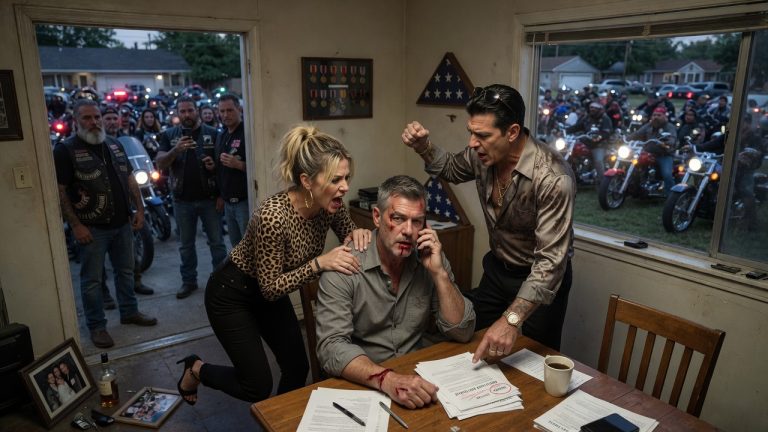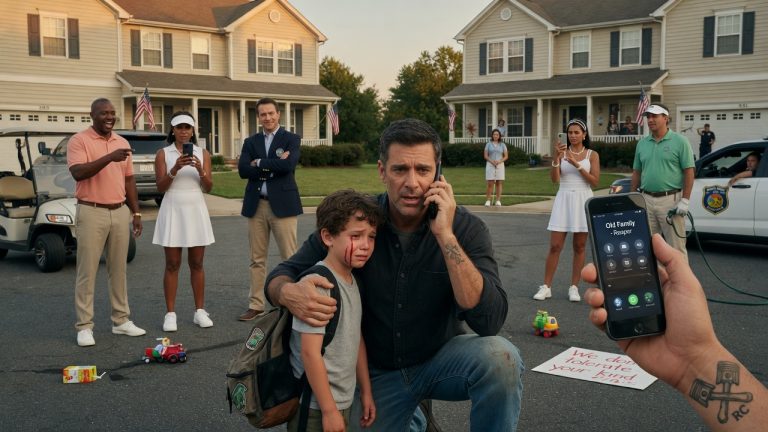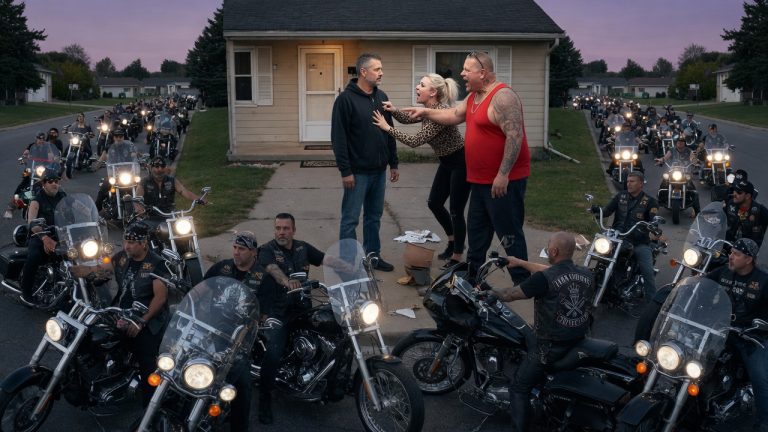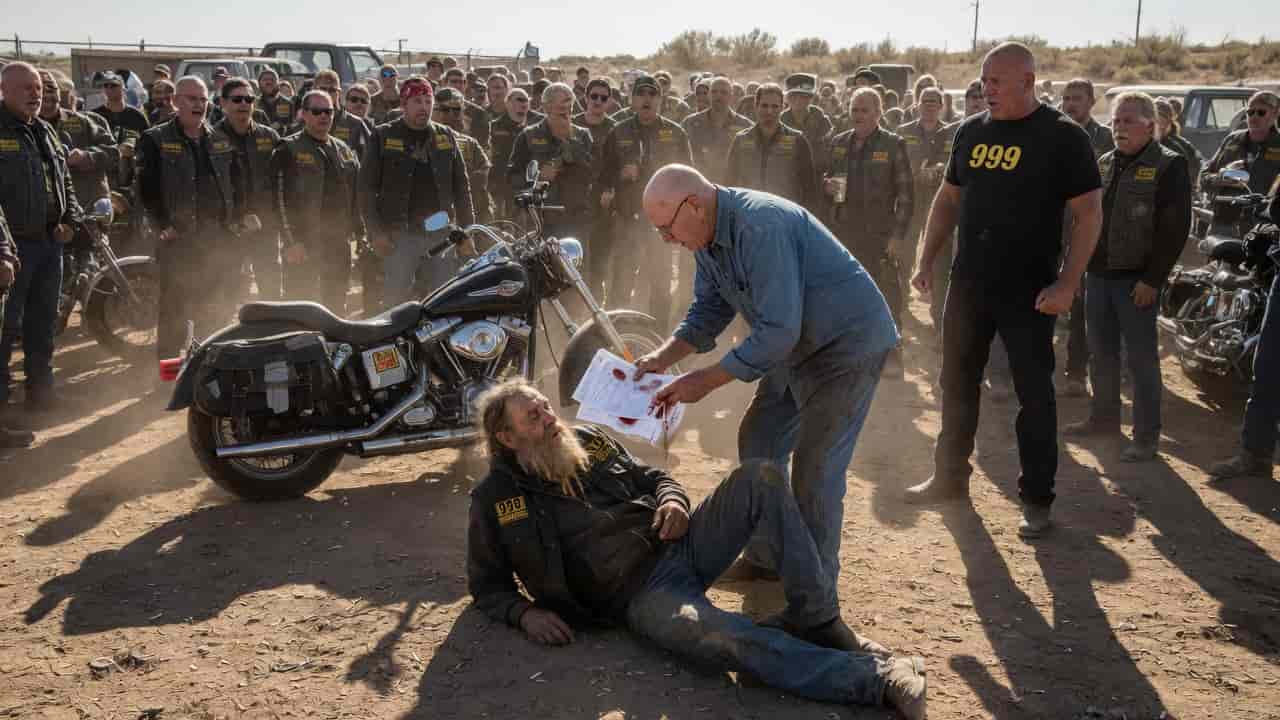
“Look at the date, Rusty. How long were you going to wait?”
Doc didn’t whisper it. He didn’t pull me into the back room or wait until the whiskey had softened the blow. He stood in the middle of the Pit, the New Mexico dust swirling around his boots, and held that blood-stained paper out like a flag of surrender.
I was on the ground, my lungs feeling like they’d been filled with wet sand, and 999 pairs of eyes were staring at me. These were men who had followed me through three decades of asphalt and fire. Men who believed I was made of iron and old oil.
“Give it back,” I wheezed, reaching for the only evidence of my fading time.
But Doc didn’t move. He looked at Anchor, my second-in-command, and then at the youngest recruits who had just traded their futures for a patch with my name on it.
“He sold the inventory, Anchor,” Doc said, his voice cracking the silence. “He sold the guns, the bikes, the deed to the lot. And he did it because he’s got three weeks left and he thinks money can buy his way out of the truth.”
The silence that followed wasn’t just quiet. It was the sound of a legacy turning to dust. I looked up and saw the pity in their eyes, and for the first time in seventy years, I realized that the man they loved was already gone.
I couldn’t tell them the money was for Sarah. I couldn’t tell them that the 999 wasn’t a club anymore—it was a funeral procession.
Chapter 1: The Rattle in the Case
The smell of 90-weight gear oil usually settled my nerves, but today it just made me nauseous. I sat on a low rolling stool in the back of the garage, the overhead fluorescent lights humming a flat, irritating B-flat that vibrated in my teeth. My hands—knotted with arthritis and scarred by fifty years of wrenching—were shaking. Not the kind of shake you get from too much coffee or a cold morning. This was a deep, rhythmic tremor that started in my marrow and ended in the fingertips of my right hand.
I was trying to shim a primary chain on a ’94 Softail, but the metal felt like it belonged to someone else. Every time I reached for the feeler gauge, a sharp, hot needle of pain poked at the inside of my ribcage, right under the left lung. I took a breath, shallow and careful. If I breathed too deep, the “rattle” started—a wet, clicking sound that reminded me of a loose valve tap in a dying engine.
“Rusty? You in there?”
I didn’t turn around. I knew that voice. Sarah. She was the only person allowed to walk into the garage without a formal invite from the gate guard. I wiped my hands on a rag that was more grease than fabric and waited for the pain to subside into its usual dull throb.
“Back here, kid,” I said. My voice sounded like gravel being kicked down a dry well.
Sarah walked into the light. She was six months along, her belly rounding out under a faded denim jacket. She looked so much like her grandmother it made my throat tight. The same sharp jawline, the same way of tucking a loose strand of dark hair behind her ear. She was the only thing I had left that wasn’t made of steel or regret.
“You look grey, Pop-pop,” she said, her eyes narrowing as she stepped over a disassembled transmission. She didn’t call me “President” or “Boss.” To her, the 999 Alliance was just a noisy hobby her grandfather had.
“It’s the lighting,” I lied. “Makes everyone look like a ghost.”
“You’re sweating. It’s sixty degrees in here.” She reached out and touched my forehead. Her hand was cool and soft. For a second, the rattle in my chest seemed to quiet down, intimidated by the sheer life coming off her. “You need to come over for dinner. I made pot roast. Real food, not that charred mystery meat Roadie cooks up at the clubhouse.”
“I got work, Sarah. The run to Mesa is in three days. Nine hundred and ninety-nine bikes on the I-40. It takes a lot of logistics to keep that many idiots from crashing into each other.”
“Let Anchor handle it. That’s what a VP is for, right?” She sat on the edge of a workbench, pushing aside a box of spark plugs. “I saw those guys today. The ones on the white bikes. The Vanguard.”
The name hit me like a low-side slide. The Vanguard. They were the new breed. They rode electric-assist sport-tourers that hummed like refrigerators and wore high-viz gear that looked like space suits. They didn’t care about the history of the 999 or the blood spilled to keep the New Mexico corridors open. They wanted the routes for their “automated logistics” contracts. They saw us as a bunch of oily relics in the way of progress.
“Where’d you see ‘em?” I asked, my grip tightening on the rag.
“At the diner. They were just sitting there, iPads out, looking at maps. One of them—the one with the blonde undercut—he looked at me. He didn’t smile, Rusty. He just stared. Like I was a data point he was trying to calculate.”
I felt a surge of heat that had nothing to do with the cancer. That was Jax. He was thirty years younger than me, and he had the kind of cold, analytical cruelty that comes from never having had to bleed for anything. He knew Sarah was mine. He knew she was my pressure point.
“Stay away from the diner for a while,” I said.
“I’m not afraid of them.”
“I am,” I muttered, though I didn’t mean it the way she thought. I wasn’t afraid of what they’d do to me. I was afraid of what I’d have to do to them if they touched her, and how little time I had left to finish it.
Sarah stood up, sensing the shift in my mood. “Dinner. Seven o’clock. If you’re not there, I’m coming back here with a tow truck and dragging you home.”
She kissed my cheek and walked out. I watched her go, the silhouette of her pregnancy a sharp reminder of the future I wouldn’t see. As soon as the door clicked shut, I doubled over. The rattle turned into a cough—a deep, tearing spasm that forced me to my knees. I grabbed a paper towel from the bench and pressed it to my mouth, gagging on the copper taste of blood.
When I pulled the towel away, there it was. A dark, jagged spray of red.
I stared at it for a long time. This was the reality. I was seventy years old, my wife had been buried in the high desert for twenty of those years, and my lungs were turning into necrotic mush. I had 999 men looking to me for leadership, and a granddaughter who needed a life that didn’t involve cleaning grease off a dead man’s tools.
I reached into the pocket of my leather vest and pulled out a crumpled envelope. Inside was a diagnostic report from a clinic in Albuquerque. Stage IV Small Cell. Inoperable. Prognosis: weeks.
I’d been carrying it for ten days. Ten days of watching my brothers talk about the “Next Big Run” and the “Five Year Plan.” Ten days of watching Anchor plan for a future that I’d already sabotaged.
I stood up, my legs feeling like brittle plastic. I walked over to the corner of the garage where an old upright tool chest stood. I unlocked the bottom drawer. It wasn’t full of wrenches. It was full of ledgers. Deeds to the clubhouse, titles for the fleet of support trucks, and the inventory lists for the “Security Cache”—the guns we kept in the floorboards of the clubhouse for when the Vanguard decided to stop being polite.
I’d already contacted a broker in El Paso. A man who didn’t ask questions as long as the serial numbers were scratched and the crates were heavy. He’d offered a half-million for the lot. It was enough to put Sarah through school, buy her a house in a neighborhood where nobody wore a patch, and set up a trust for the kid.
It was also enough to leave the 999 Alliance completely defenseless.
I looked at the blood on the paper towel. I looked at the ledger.
A leader is supposed to protect the pack. But a man is supposed to protect his blood. I was failing one of them, and as the rattle in my chest started up again, I realized I’d already made the choice. I just hadn’t told the pack that I was leading them to the slaughterhouse.
The hum of the lights seemed to get louder, a mocking sound that echoed the emptiness in my gut. I folded the blood-stained towel and tucked it into the envelope with the diagnosis. I didn’t want to forget what I was. A dying man with a secret that was going to burn everything I’d built to the ground.
Chapter 2: The Price of a Future
The “Iron Warehouse” sat on the edge of the mesa, a corrugated metal beast that swallowed the heat of the day and spat it out as a stifling, oily humidity at night. This was where the 999 stored their history. Not just the bikes, but the weight of three decades.
I pulled my truck up to the loading dock at 2:00 AM. The headlights cut through the swirling dust, illuminating Anchor’s silhouette. He was leaning against a stack of tires, his arms crossed over his massive chest. He looked like a statue carved out of granite and bad intentions.
“You’re late, Rusty,” he said. He didn’t move. He didn’t have to. He was my shadow, the man who handled the things I didn’t want to see.
“Traffic on the 25,” I lied. I climbed out of the truck, my knees popping like dry twigs. The air was thin up here, and every breath felt like I was sucking in shards of glass.
Anchor looked at the back of my truck, then at the warehouse doors. “The boys are asking questions, Boss. Roadie saw the crates being moved out of the floorboards yesterday. He thinks we’re prepping for a hit on the Vanguard. Everyone’s amped up. They want to know when the green light is.”
I felt a pang of guilt so sharp it nearly knocked me over. They wanted a war. They wanted to defend their turf, their honor, and their president. And I was selling the very steel they needed to do it.
“It’s not for a hit,” I said, walking past him toward the dock. “We’re rotating the stock. Getting some newer hardware. The old stuff is jamming.”
Anchor followed me, his footsteps heavy on the concrete. “We don’t rotate the whole cache at once, Rusty. We’re down to handguns and a few old shotguns in there. If Jax decides to roll on us tonight, we’re throwing rocks at ‘em.”
I stopped and turned. The moon was a sliver of bone in the sky, providing just enough light to see the suspicion in Anchor’s eyes. He’d been with me since he was nineteen. He knew the smell of a lie better than anyone.
“Trust me, Anchor. I’ve got a handle on it.”
“Do you? Because you haven’t eaten in three days, you’re coughing like a cold-start Shovelhead, and you’re dodging Sarah’s calls.” He stepped closer, his voice dropping an octave. “Is this about the Vanguard? Did they get something on you? If they’re blackmailing you, we don’t need the guns. We’ll just go over there with chains and end it.”
“Nobody is blackmailing me!” I snapped. The effort made me lightheaded. I leaned against the truck bed, trying to stabilize my vision. “I’m trying to ensure there’s a 999 left for you to lead when I’m done.”
“Then give us the tools to fight!”
“I’m giving you a way out!” I roared.
The silence that followed was heavy. Anchor stared at me, his mouth slightly open. I’d never yelled at him. Not once. We were the pillars. You don’t scream at the foundation of your own house.
I took a breath, letting the rattle in my chest settle. “The broker is coming at 3:00. He’s taking the crates. I’ve already got the wire transfer set up. It’s done, Anchor.”
“Where’s the money going?” Anchor asked. He wasn’t angry anymore. He sounded scared. “It’s not going into the club account. I checked. The treasury is bone dry. We can’t even pay the lease on the clubhouse next month.”
“I’m taking care of it.”
“Rusty, look at me.” He grabbed my shoulder. His grip was like a vise. “You’re my brother. You’re the reason I’m not in a pine box or a state cell. But if you’re selling out the club to line your own pockets, I can’t stop the boys from doing what they have to do. There’s a code.”
“The code is about survival,” I said, pulling away. “And I’m the only one here who knows what that actually looks like.”
I walked into the warehouse, the darkness swallowing me. I knew exactly where the crates were. I’d spent all afternoon moving them, my body screaming at every lift. Each crate represented a piece of the 999’s teeth. AR-15s, old M3 grease guns, crates of 5.56. All of it going to a man who would sell it to a cartel or a private militia, all so Sarah could have a nursery with a view of the mountains.
I sat down on one of the crates and pulled out my gas tank—the one from my personal bike that I’d brought into the garage for “repairs.” I unscrewed the cap. Inside, taped to the bottom of the tank above the fuel line, was a plastic bag. I fished it out.
Oxycodone. The high-dose stuff Doc had given me for the “bad days.”
I swallowed two without water. They tasted like chalk and bitterness. I leaned my head back against the cold metal of the warehouse wall and waited for the fog to roll in.
I thought about the night I lost Martha. The rain on the highway, the patch of black ice near Bernalillo. I’d been the one at the handlebars. I’d been the one who wanted to take the long way home. She’d died in the dirt, her blood mixing with the oil leaking from the bike. I’d spent twenty years trying to build something that would make up for that one moment of failure. I thought the 999 was my penance. I thought if I could protect a thousand men, maybe it would cancel out the one woman I couldn’t save.
But now, as the drugs began to dull the sharp edges of the cancer, I realized the club was just another bike I was about to crash.
The sound of a heavy diesel engine rumbled outside. The broker.
I stood up, my head swimming. I walked out to the dock and watched the white unmarked box truck back in. Two men in tactical vests jumped out. They didn’t look like bikers. They looked like professionals.
“You Miller?” one of them asked.
“Just load the crates,” I said.
Anchor stood by the truck, watching the transaction with a look of pure grief. He didn’t help. He just stood there like a ghost at his own funeral.
As the last crate was slid into the truck, the lead man handed me a tablet. “The transfer to the Sarah Miller Trust is complete. Verify the routing number.”
I looked at the screen. $500,000. It was there. The future. The life Martha would have wanted for our daughter’s daughter.
“We’re good,” I said.
The truck pulled away, disappearing into the desert night. I stood on the dock, the empty warehouse behind me, and felt lighter than I had in years. I was a man with nothing left to lose because I’d already given it all away.
“You’re a dead man, Rusty,” Anchor said from the shadows.
“I know,” I whispered. “But she isn’t.”
I turned to go, but my foot caught on a loose board. I stumbled, the world spinning in a nauseating tilt. I reached for my vest, my hand instinctively going to the pocket where the diagnosis was. I needed to make sure it was still there. I needed to feel the weight of my own ending.
But as I felt the empty pocket, a cold dread washed over me.
The envelope. The blood-stained paper.
It wasn’t there.
I looked back at the warehouse floor, then at the dirt lot. In the rush to move the crates, in the haze of the pills, I’d dropped it.
“Looking for something?” Anchor asked.
He wasn’t looking at me. He was looking at the ground near the tires where he’d been leaning. He didn’t pick anything up. But he didn’t have to.
“Go home, Anchor,” I said, my voice trembling.
“I’m going to the clubhouse,” he said, his voice cold and flat. “The boys are waiting for an update. I think it’s time I gave them one.”
He walked to his bike, the engine roaring to life with a sound that felt like a death knell. I watched his taillight disappear, and I knew.
The secret wasn’t mine anymore. And neither was the club.
Chapter 3: The Pit and the Pendulum
The “Pit” was a natural amphitheater of red rock and sand ten miles outside of town. It had been the 999’s gathering place for thirty years. Whenever the alliance needed to speak as one, we rode into the Pit.
Today, the sun was a white-hot hammer, beating down on the chrome of nine hundred and ninety-nine motorcycles. The noise was a physical thing—a low, rhythmic throb of idling engines that shook the very earth. I sat on my bike at the head of the formation, my hands clamped onto the grips to hide the tremor.
I could feel the shift in the air. It wasn’t the usual celebratory roar of a pre-run rally. It was a low, ugly vibration.
Anchor was standing on a flat rock twenty feet away, his back to me. He hadn’t spoken to me since the warehouse. He hadn’t even looked at me. Beside him was Doc, his medical bag slung over his shoulder, his face a mask of weary disappointment.
I climbed off my bike, my legs feeling like they were made of glass. Every step toward the center of the Pit was a battle. My chest felt like it was being squeezed by a giant’s fist. I reached the microphone stand—a piece of rebar welded to a brake rotor—and tapped it. The feedback shrieked through the canyon.
“Listen up!” I croaked.
The engines died. One by one, the roar faded into a silence so heavy it felt like it was suffocating me. Nearly a thousand men, all wearing the same patch, all looking at me.
“In two days, we ride to Mesa,” I began, my voice wavering. “We show the Vanguard that this territory belongs to the men who bled for it. We show them that history can’t be bought with an app and a clean shirt.”
Usually, this was where the cheers started. This was where the “999!” chant would begin, a wall of sound that could be heard in the next county.
But today, there was nothing. Just the wind whistling through the red rocks and the sound of someone’s heavy breathing.
“What’s the matter?” I asked, trying to find my old iron. “You guys forget how to yell? You get soft watching those electric bikes hum past?”
“We’re wondering about the steel, Rusty,” a voice called out from the back. It was Roadie. He stepped forward, his face flushed with anger. “We heard the cache is gone. We heard you sold our protection to a bunch of suit-and-tie gunrunners in El Paso.”
I looked at Anchor. He didn’t move.
“I’m modernizing the inventory,” I said, the lie tasting like ash. “I told Anchor. We’re getting new hardware.”
“Then show us the invoices!” Roadie yelled. “Show us the money! Because the treasury is empty, and the lease on the clubhouse is up, and I saw a wire transfer receipt on the warehouse floor this morning for a trust fund in your granddaughter’s name.”
The murmur started then. A low, dangerous growl that rippled through the crowd.
“That’s my business,” I said, my heart hammering against my ribs. “The club is my business. I built this! I gave you a name when you were nothing! I gave you a family!”
“And you’re selling that family to pay for a life we aren’t invited to!” Anchor finally turned around. His eyes were red-rimmed. He held up a hand, and the crowd went silent. “I didn’t want to believe it, Rusty. I told myself you were just tired. I told myself you had a plan.”
He looked at Doc.
“Show him,” Anchor said.
Doc stepped forward. He looked at me with a pity that hurt worse than any bullet. He reached into his denim shirt and pulled out the crumpled, blood-stained envelope.
“I found this at the warehouse,” Doc said, his voice amplified by the canyon walls. “Rusty didn’t drop it. He hid it. He’s been hiding it for weeks.”
“Doc, don’t,” I whispered.
But Doc wasn’t listening. He pulled the paper out. He held it up so the men in the front row could see the dark red smears.
“Look at the date!” Doc shouted. “Look at the diagnosis! It’s Stage IV. He’s dying, brothers. He’s been dying while he told us to prepare for a war. He sold the guns because he’s got three weeks left and he wanted to buy a future for his blood while he let us starve.”
The world began to tilt. The heat of the sun suddenly became unbearable, a weight that pressed down on my shoulders until I couldn’t breathe. I saw the faces of the men I’d led—men who had trusted me with their lives—and I saw the betrayal curdling into contempt.
I wasn’t a legend anymore. I was just a sick, old man who had stolen from his friends to pay for his ghost.
“I did it for Sarah!” I yelled, but my voice broke. A cough tore through me, a violent, hacking spasm that sent me to my knees.
I hit the dirt, the red sand filling my mouth. I tried to push myself up, but my arms gave out. I lay there, looking up at the sky, the “rattle” in my chest now a deafening roar.
Doc walked over to me. He didn’t help me up. He stood over me, the blood-stained paper in his hand, looking down like a judge.
“Ninety-nine men are following a man who’s already gone,” Doc said.
I looked past him and saw Anchor. My VP, my brother. He was taking off his vest. He dropped it in the dirt. Then Roadie did the same. Then another. The sound of leather hitting the sand was like a series of muffled gunshots.
The 999 was dissolving in front of my eyes.
I wanted to tell them I was sorry. I wanted to tell them that I was scared. That the thought of leaving Sarah alone in a world full of Vanguards and debt was more terrifying than the cancer.
But the words wouldn’t come. Only the blood.
I saw a movement at the edge of the Pit. A flash of white and silver.
Jax and the Vanguard. They were perched on the rim of the canyon, their silent electric bikes lined up like vultures on a fence. They were watching the 999 tear itself apart. They didn’t have to fire a single shot. They just had to wait for the old man to fall.
Jax raised a hand in a mocking wave.
I felt a surge of rage, but it was hollow. I’d given them the victory. I’d sold the guns. I’d broken the trust. I’d let the engine die.
As the darkness started to creep in at the edges of my vision, I felt a hand on my shoulder. It was Doc. He finally knelt down, his expression softening just a fraction.
“You shouldn’t have lied, Rusty,” he whispered. “We would have taken care of her. We’re bikers. We’re family. That’s what the patch means.”
“I didn’t… I didn’t want her to be a biker,” I wheezed.
“Well,” Doc said, looking at the piles of leather vests littering the Pit. “Looks like nobody’s a biker anymore.”
The last thing I saw before I blacked out was Anchor walking toward the canyon rim, his head down, his hands empty, leaving me alone in the dirt with my secret and my shame.
Chapter 4: The Residue of Iron
When I woke up, the smell was different. It wasn’t gear oil and sage; it was the sharp, antiseptic sting of the clubhouse infirmary. The lights were dim, the only sound the steady hiss-click of an oxygen concentrator tucked in the corner.
My chest felt heavy, like someone had laid a slab of granite across my ribs. I tried to sit up, but a plastic tube tugged at my nose.
“Stay down, Rusty. You’re running on fumes.”
Doc was sitting in a rickety folding chair by the door, cleaning a pair of surgical shears. He didn’t look up.
“Where is everyone?” I asked. My voice was a ghost of itself.
“Most of ‘em went home. Some went to the bars. A few… a few of the younger ones went to the Vanguard’s camp. They figure if the 999 is dead, they might as well ride with the winners.”
The words hurt worse than the needle in my arm. I looked at my hands. They were clean. Someone had washed the red dirt of the Pit off me.
“Anchor?”
“He’s outside the gate. He’s been sitting on his bike for six hours. Won’t talk to anyone. Just staring at the road.” Doc finally looked at me. His eyes were tired. “The wire transfer cleared, Rusty. I checked your tablet while you were out. Sarah’s trust is fully funded. She’s a millionaire on paper.”
“Then it was worth it,” I whispered.
“Was it? You think she’s going to be happy with that money when she finds out it was bought with the blood of the only family she had left? You think she wants a house paid for by the guns that were supposed to protect her grandfather?”
“She doesn’t have to know where it came from.”
“Secrets don’t stay buried in the desert, Rusty. The wind always blows the sand off the bones eventually.”
The door creaked open, and Roadie stepped in. He wasn’t wearing his cut. He looked smaller in just a plain t-shirt, like a man who had lost his skin.
“Vanguard’s at the gate,” Roadie said. His voice was flat. “Jax. He says he wants to talk to the ‘Late President.’ Those were his words.”
“Tell him to go to hell,” I said.
“He brought a gift,” Roadie added, looking at the floor. “He’s got Sarah, Rusty.”
The world didn’t just tilt then; it vanished. I ripped the oxygen tubes out of my nose and swung my legs off the bed. The room spun, a sickening carousel of grey and green. Doc tried to grab me, but I pushed him away with a strength I didn’t know I had left.
“Where?” I gasped.
“In the back of one of their tech-vans. He says he found her ‘wandering’ near the diner. Says it’s a dangerous neighborhood for a pregnant girl.”
I didn’t wait for my boots. I walked out of the infirmary in my socks, my chest screaming, my lungs rattling like a tin can full of rocks. I burst through the clubhouse doors and into the cool night air.
The gate to the 999 lot was wide open. The bikes—the few that were left—were lined up in a ragged semi-circle. At the center of the road stood Jax. He was wearing a white leather jacket that looked like it had never seen a speck of grease. Behind him was a sleek, silent van with blue LED lights humming along the base.
Anchor was standing ten feet from him, his hand on the grip of a tire iron, but he wasn’t moving. He looked at me as I approached, his face a mask of pure, helpless rage.
“Rusty!” Sarah’s voice came from the van. She sounded terrified.
Jax smiled. It was a clean, polished smile. “Evening, Rusty. You look… well, you look like a man who’s been dead for a week and just forgot to lie down.”
“Let her go, Jax,” I said. I had to stop every three words to catch my breath. “This is between us.”
“Is it? Because I thought the 999 was a brotherhood. But I see a lot of empty space on those vests. And I see a man who sold his brothers’ safety for a bank account.” Jax stepped forward, his boots clicking on the asphalt. “I’m a businessman, Rusty. I don’t want a war. I want efficiency. Your club is a liability. Your routes are a mess. But I’m willing to be generous.”
He gestured to the van.
“The money you put in that trust? The half-million? Transfer it to the Vanguard’s operating account. Consider it an ‘exit fee’ for the territory. You do that, and the girl goes home. You can spend your last few weeks in peace, watching the sunset.”
“I can’t,” I whispered. “The trust… it’s locked. I can’t touch it for eighteen years. That was the deal with the broker.”
Jax’s smile didn’t fade, but his eyes turned into chips of ice. “Then you really are a failure, aren’t you? You sold your soul for money you can’t even use to save the only thing you love.”
He turned back toward the van. “Take her to the mesa. We’ll see how she likes the view.”
“No!” I lunged forward, but my body betrayed me. I fell to my knees, coughing, blood spraying onto the blacktop.
The silence that followed was absolute. Jax looked down at me with genuine disgust. He raised a hand to signal his men.
But then, the sound started.
It wasn’t a roar. It was a low, rhythmic thumping. One bike. Then two. Then ten.
From the shadows of the side roads, from the darkened bars down the street, the 999 were coming back. They weren’t wearing their vests. They didn’t have their guns. But they had their bikes, and they had the one thing I thought I’d destroyed.
Anchor stepped forward, the tire iron white-knuckled in his hand. He looked at Jax, then he looked at me.
“He’s a liar, Jax,” Anchor said, his voice echoing in the night. “He’s a thief and a dying old fool.”
He stepped over me, his heavy boots inches from my head.
“But he’s our fool,” Anchor growled.
Behind him, Roadie and twenty other men stepped into the light. They were outnumbered. They were outgunned. They were standing in the wreckage of their own lives.
“You think you can stop us with iron and spit?” Jax laughed. “We have high-frequency deterrents. We have—”
“We have nothing to lose,” Anchor interrupted. “You ever fight a man who’s already lost everything? It’s a messy business, kid.”
The Vanguard bikers moved, their electric motors whining as they prepared to charge. The air turned electric, the tension a physical weight that made my skin crawl.
I looked up from the ground and saw Sarah’s face in the window of the van. She was crying, her hand pressed against the glass.
I realized then that the residue of my life wasn’t the money. It wasn’t the patch. It was the fact that even after I’d betrayed them, even after I’d humiliated myself in the dirt, these men couldn’t let me go.
I reached out and grabbed Anchor’s boot.
“Anchor,” I wheezed.
He didn’t look down. “Stay there, Rusty. You’ve done enough.”
He raised the tire iron, and as the first Vanguard bike lunged forward, the 999—the broken, vest-less remnants of my kingdom—screamed and ran into the fire.
I lay on the asphalt, the rattle in my chest turning into a steady, rhythmic thrum. I watched the shadows of men fighting for a ghost, and I knew that the engine was finally, truly dying. But it wasn’t going out quiet.
Chapter 5: Dead Man’s Poker
The sound of the first collision was unlike anything I’d ever heard in thirty years of road wars. It wasn’t the heavy, metallic crunch of steel on steel. It was the sharp, plastic snap of high-grade polymers shattering against the blunt force of a tire iron.
Anchor didn’t lead with a speech. He led with two hundred and forty pounds of muscle and a lifetime of resentment. He caught the lead Vanguard rider right in the chest as the electric bike whined forward. The rider went airborne, his sleek white helmet skipping across the asphalt like a stone on a pond. The bike, silent and eerie, hissed as it slid into the ditch, its blue LED strips flickering out.
Then the world turned into a blur of shadows and screaming motors.
I was still on my knees, my palms pressed into the grit of the parking lot. Every time I tried to draw a full breath, the “rattle” in my chest flared into a sharp, hot spike that threatened to black me out. I watched through a haze of pain as my brothers—the men I’d stripped of their dignity and their defenses—fought like cornered animals.
They didn’t have the AR-15s I’d sold. They didn’t have the tactical vests or the organized fire teams. They had chains, heavy-duty wrenches, and the sheer, desperate weight of their own bodies. Roadie was swinging a heavy master lock on the end of a length of tow-chain, his face twisted into a mask of pure, unadulterated rage. He took out the headlight of a Vanguard bike, then swung again, catching the rider in the shoulder.
But the Vanguard weren’t just tech-bros in fancy suits. They were organized. They moved in pairs, using their bikes as shields and their high-frequency “deterrents”—small, handheld devices that emitted a piercing, ultrasonic shriek—to disorient the 999. I saw two of my younger guys, kids who hadn’t been patched for more than a year, drop their weapons and clutch their ears, their faces contorting in agony as the sound waves scrambled their equilibrium.
“Get up, Rusty! Get up or get out of the way!”
It was Doc. He was standing over me, holding a heavy oxygen tank like a club. He didn’t look like a medic anymore. He looked like a man who had seen too much death to be afraid of a little more. He swung the tank, catching a Vanguard scout who tried to circle around toward the infirmary door.
I forced myself up. I used the bumper of an old Chevy truck as a hoist, my muscles screaming, my vision swimming with black spots. I didn’t look at the fight. I looked at the van.
Sarah was still in there. I could see her silhouette against the blue interior lights. Jax was standing near the sliding door, watching the carnage with a detached, clinical interest. He wasn’t fighting. He was managing. To him, this wasn’t a battle for honor; it was a hostile takeover that had encountered a slight logistical hiccup.
I started to move. It wasn’t a walk; it was a ragged, shuffling crawl on two feet. Every step felt like my ribs were grinding against a bag of broken glass.
“Jax!” I roared, but it came out as a wet, pathetic wheeze.
He didn’t hear me over the din of the brawl. Anchor was five yards away from him now, pinned down by two Vanguard riders who were using batons to keep him back. Anchor’s face was covered in blood, his black t-shirt ripped to shreds, but he was still snarling, still trying to bite his way through to the man in the white jacket.
I reached into my vest. My hand brushed against the empty pocket where the diagnosis had been, then moved lower, to the small, concealed holster at the small of my back. It was a derringer. A .22 caliber toy I’d kept as a last-resort backup for decades. It wasn’t part of the cache. It was a piece of junk I’d forgotten I even owned until I felt its cold weight against my spine.
I pulled it out. It looked ridiculous in my hand—a tiny, chrome-plated peanut against the high-tech weaponry of the Vanguard.
I kept moving. I reached the edge of the van’s shadow just as Jax turned. He saw me, and for the first time, his composure slipped. Not because he was afraid of the gun, but because he was offended by the sight of me. To him, I was a glitch in the system that refused to be deleted.
“Still breathing, Rusty? You really are a stubborn old dog,” Jax said. He reached into his jacket and pulled out a slim, matte-black pistol. It looked like something from a movie—no hammer, no slide, just a sleek, silent killing tool. “But even a dog knows when it’s time to go to sleep.”
He aimed the gun at my chest.
“Let her go,” I said. I had to lean against the side of the van to stay upright. The metal was cool against my shoulder. I could hear Sarah sobbing on the other side of the panel.
“And give up my leverage? I don’t think so. The money, Rusty. The wire transfer. I know you can’t touch it for eighteen years, but trusts can be reassigned with the right signatures. I have a digital notary in the van. We can fix your ‘legal’ problem in five minutes.”
“The money is gone,” I lied. The words felt heavy, like I was swallowing lead. “I cancelled the broker. The trust is empty.”
Jax’s eyes narrowed. “You’re lying. You don’t have the spine to leave her with nothing.”
“I have the spine to leave you with nothing,” I countered. I raised the derringer. My hand was shaking so badly I knew I couldn’t hit him from five feet away, let alone the ten feet between us. “You kill me, you get nothing. You kill her, the 999 will tear this desert apart until they find every single one of your ‘logistics’ hubs and burn them to the ground. You think they’re fighting hard now? Wait until they have a martyr.”
I saw the hesitation in his eyes. It was a brief flicker, a momentary calculation of risk versus reward. Jax lived in a world of data. He didn’t understand the “residue” of a life. He didn’t understand that these men weren’t fighting for me anymore—they were fighting for the memory of who I was supposed to be.
“You’re bluffing,” Jax said, but his voice lacked the previous chill.
“Try me,” I said. “I’m a dead man either way, Jax. Look at me. You think I’m afraid of that little black toy in your hand? I’ve got a killer inside me that’s doing a better job than you ever could.”
I took a deep, rattling breath and forced a smile. It was a terrifying sight, I’m sure—a bloody, dying old man grinning like a skull in the moonlight.
“Rusty, don’t!” Sarah’s voice screamed from inside.
The distraction was enough. From the side of the van, a shadow lunged. It was Anchor. He’d broken free from the two riders, leaving a trail of blood and teeth behind him. He didn’t go for Jax’s gun. He went for Jax’s throat.
The two of them hit the asphalt hard. Jax’s sleek pistol skittered across the ground, disappearing under the chassis of the van. Anchor was on top of him, his massive hands closing around Jax’s neck, his thumbs digging into the windpipe.
“Anchor, no!” I yelled.
But Anchor wasn’t listening. He was finishing the job. He was erasing the man who had threatened the only family we had left.
Vanguard riders began to swarm toward them, sensing their leader’s peril. I realized then that if Anchor killed him, the fight would turn into a massacre. The Vanguard would stop being “efficient” and start being vengeful.
I fired the derringer into the air.
The crack was small, almost pathetic, but in the sudden vacuum of the fight, it sounded like a cannon. Everyone froze. The riders, the 999, even Anchor.
“Enough!” I screamed. The effort caused a fresh wave of blood to spill from my mouth. I slumped against the van, the chrome derringer slipping from my fingers. “It’s over!”
I looked at Anchor. “Let him up. He’s not worth the soul you’ve got left.”
Anchor stared at Jax, whose face was turning a deep, bruised purple. Slowly, agonizingly, Anchor released his grip. He stood up, his chest heaving, his eyes fixed on me.
I looked at the Vanguard riders. “Take your boss. Take your bikes. Get off this lot. If I see a white jacket within ten miles of this mesa again, I’ll call the broker back. And I promise you, the men he sends won’t be as polite as we are.”
It was a hollow threat. The broker was gone, and I was empty. But they didn’t know that. They saw the 999 standing behind me—twenty-five battered, bloody men who looked like they were ready to die just for the chance to take someone with them.
The Vanguard riders hesitated, then moved. Two of them scooped Jax up. He was gasping for air, his polished white jacket ruined, his dignity a shattered thing in the dirt. They dragged him to a bike, and within seconds, the whine of the electric motors faded into the desert night.
The silence that followed was heavy. It was the sound of a vacuum being filled by the reality of what we’d done.
I slid down the side of the van until my rear hit the pavement. The world was dimming now, the edges of my vision turning into a soft, grey velvet.
“Rusty!”
The van door slid open. Sarah scrambled out, her hands shaking as she reached for me. She didn’t care about the fight or the money or the club. She just saw her grandfather dying in the dirt.
“I’m okay, kid,” I lied. “Just… just need a minute to catch my breath.”
She pulled my head into her lap, her tears hot against my forehead. I looked up and saw the 999 gathered around us. They weren’t cheering. They weren’t chanting my name. They were just watching the engine stop.
Anchor knelt down beside us. He reached out and touched the “999” patch on my vest. It was torn and stained with my own blood.
“We got her, Rusty,” Anchor said quietly.
“I know,” I whispered. “But the club… Anchor, the club is…”
“The club is whatever we say it is,” he said. He looked at the men standing behind him—the ones who had stayed, the ones who had fought for a man who had sold them out. “We don’t need the guns, Boss. We never did.”
I closed my eyes for a second, the rattle in my chest finally beginning to quiet. The residue of the night was thick in the air—the smell of ozone, burnt rubber, and iron. I had protected my blood, but I had broken my pack.
And as the darkness finally took me, I wondered if eighteen years was long enough for a child to forgive a man who had destroyed his legacy just to buy her a house.
Chapter 6: The Last Mile
The desert sun has a way of stripping everything down to the bone. By the time the horizon turned that bruised shade of purple and orange the next morning, the adrenaline had evaporated, leaving behind only the cold, hard reality of the aftermath.
I was back in the infirmary, though “infirmary” was a generous word for the back room of a clubhouse that was currently being packed into boxes. Doc had me on a morphine drip—the good stuff, the “end of the road” stuff. The rattle in my chest was still there, but it felt distant now, like a neighbor’s radio playing in a different house.
The clubhouse was quiet. Too quiet. For thirty years, this building had hummed with the sound of voices, the clinking of beer bottles, and the low-frequency vibration of idling engines. Now, it was just the sound of duct tape being pulled off a roll.
Anchor walked in, carrying a cardboard box. He looked like he’d been through a meat grinder. He had a row of black stitches across his forehead and a heavy bandage on his forearm where a Vanguard baton had caught him. He sat down in the chair Doc had vacated, the weight of his body making the plastic frame groan.
“They’re leaving, Rusty,” Anchor said.
“Who?”
“Everyone. Most of the guys are heading north. Some to Colorado, some to Arizona. Without the cache, without the clubhouse lease… there’s nothing to hold ‘em here. The 999 is down to about twelve of us.”
“I’m sorry, Anchor.”
“Don’t be. Most of those guys were here for the patch, not the people. The ones who stayed… they’re the ones who matter.” He looked at the box in his lap. It was my old leather vest. He’d cleaned it. The blood was gone, though the leather was stained a shade darker where the red had soaked in. “Sarah’s outside. She’s been sitting in your truck for three hours. She won’t come in.”
“She hates me,” I said. It wasn’t a question.
“She doesn’t hate you. She’s just realized that her grandfather is a human being instead of a hero. That’s a hard thing for a kid to swallow.” He stood up and set the vest on the foot of my bed. “The lease is up at noon. The Vanguard’s lawyers called. They bought the land from the county on an expedited tax-lien sale. We have to be off the property in four hours.”
“Where will you go?”
Anchor shrugged. “Roadie’s got a place in Las Cruces. A small shop. We’ll start there. Maybe just be a club of twelve for a while. No wars. Just riding.”
He looked at me, and for a second, the tough-guy facade cracked. I saw the nineteen-year-old kid I’d picked up off the side of the road twenty years ago. The kid who had looked at me like I was a god.
“You’re not coming with us, are you?” he asked.
“I think I’ve reached the end of my route, Anchor.”
He nodded, slowly. He didn’t say goodbye. Bikers don’t say goodbye. He just put a hand on my shoulder, squeezed once until the pain flared, and walked out.
A few minutes later, the door creaked again. Sarah.
She didn’t stay by the door. She walked right up to the bed and sat on the edge, the way she used to when she was five and had a scraped knee. Her eyes were red, her face pale, but her chin was set in that stubborn Miller line.
“Doc told me everything,” she said. “About the money. About why you sold the guns.”
“I wanted you to be safe, Sarah. I didn’t want you to have to worry about the light bill or the rent or… or men like Jax.”
“You think money makes me safe?” she asked, her voice trembling. “Rusty, you were the only thing that made me feel safe. And you spent the last month lying to me so you could replace yourself with a bank account.”
“I was dying anyway!” I snapped, the effort causing a sharp, wet cough. I wiped my mouth with a tissue, seeing the familiar red stain. “The cancer didn’t care about my plans. I had to do something.”
“You could have told me. We could have spent these weeks… I don’t know, fishing. Sitting on the porch. Instead, I spent them watching you turn into a stranger.” She looked down at her belly, her hand resting on the life growing inside her. “The trust… I’m not going to touch it. Not for me.”
“Sarah, don’t be foolish. It’s half a million dollars.”
“I’m going to use it to buy the clubhouse land back,” she said. “Not for the club. For the town. I’m going to turn it into a clinic. A real one. So the next guy who gets a ‘rattle’ in his chest doesn’t have to sell his soul to pay for a funeral.”
I stared at her. I wanted to be angry. I wanted to tell her she was throwing away her future. But as I looked at her, I realized she was doing exactly what I’d tried to do. She was protecting her blood. She was just doing it with more honor than I had.
“Your grandmother would have liked that,” I whispered.
“I know.” She leaned forward and kissed my forehead. “I’m going to wait in the truck. Anchor said he’d help me get you home.”
“No,” I said. I reached out and grabbed her hand. “Not home. To the garage. I want to sit in my chair for a while.”
She hesitated, then nodded.
The move was a blur of pain and morphine. They carried me out like a sack of grain, the remaining members of the 999 standing in a silent line as I was loaded into the back of my old Chevy. The sun was high now, the desert heat shimmering off the asphalt.
As we pulled out of the lot, I looked back. The “999 Alliance” sign was gone. The flag was down. The Iron Warehouse was empty. I had spent my life building a kingdom, and in the end, it fit into the back of a pickup truck.
We reached the garage an hour later. Sarah and Anchor carried me in and set me in my old rolling stool. The smell of oil and grease hit me like a familiar embrace. It was the only place in the world that made sense to me.
“Leave the door open,” I said.
Sarah looked at Anchor, then at me. She didn’t want to go. She wanted to stay and watch the light fade out of my eyes. But she knew me. She knew that a Miller doesn’t like an audience when he’s finishing a job.
“I’ll be on the porch,” she said. “I’m not going far, Rusty.”
“I know, kid. I know.”
They walked out, leaving me alone in the dim light of the garage. I looked at the primary chain I’d been working on three days ago. It was still there, the feeler gauge sitting on the bench where I’d left it.
I reached out and picked up a wrench. My hand was steady now—the morphine, or maybe just the finality of it all. I turned the wrench a quarter turn, feeling the metal give, the mechanical logic of it so much simpler than the lives of men.
I thought about the 999. I thought about the men heading north, their vests gone, their hearts heavy with the residue of my betrayal. I thought about Anchor, starting over with twelve men and a dream of just riding.
I had been a leader, and I had failed. I had been a husband, and I had failed. I had been a grandfather, and I had nearly failed again.
But as I looked through the open garage door at the New Mexico desert—the vast, unforgiving beauty of the land that had swallowed my wife and was about to swallow me—I felt a strange sense of peace. The money was Sarah’s. The clinic would be her legacy. And the 999… they would survive. They were like the desert; they changed shapes with the wind, but they never truly went away.
I leaned back in the stool, my head resting against the cold metal of the tool chest. The “rattle” in my chest was slowing down now. The engine was cooling. The fuel was gone.
I closed my eyes and pictured the I-40 at sunset. I pictured nine hundred and ninety-nine bikes, a ribbon of chrome and leather stretching out toward the horizon. I was at the front, the wind in my beard, Martha on the pillion seat behind me, her arms wrapped tight around my waist. No secrets. No blood. Just the road.
The wrench slipped from my hand, hitting the concrete floor with a final, metallic clink.
Outside, the wind picked up, blowing a swirl of red dust into the garage. It covered the bikes, the tools, and the old man in the leather vest, turning everything back into the earth from which it came.
The engine had stopped. But the road was still there, waiting for the next man brave enough to ride it.