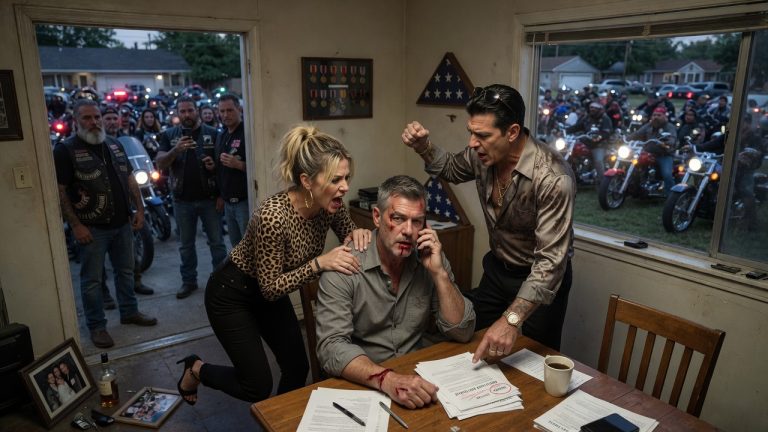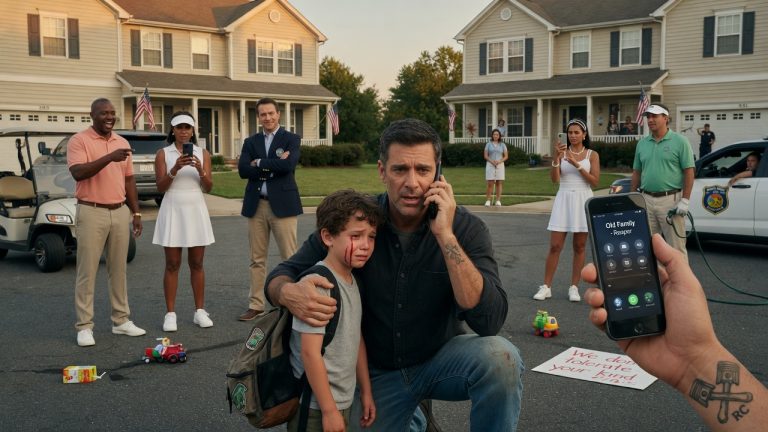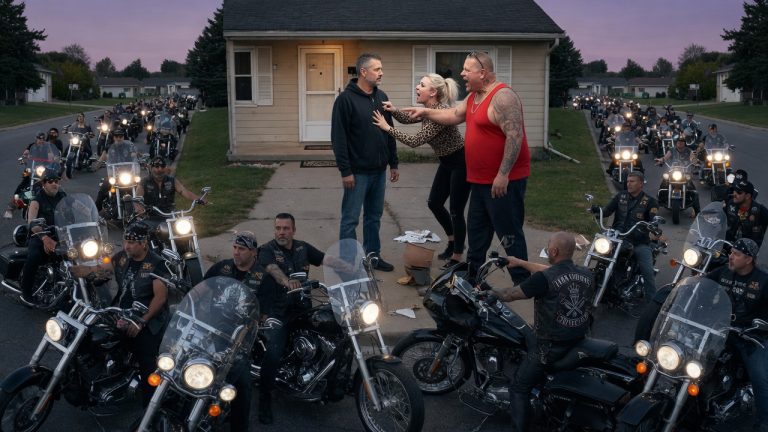
Detective Miller was the town’s golden boy. The man with the badge. The man everyone trusted.
But Marcus “Grave” Thorne knew better. He’d seen the way Nurse Sarah flinched when her husband walked into the ER. He saw the bruises she tried to hide under her blue scrubs—the ones she thought were invisible.
Grave is a man of silence and scars. He doesn’t talk much, and he doesn’t forgive easily. When he found what Miller was hiding on that burner phone, the “outlaw” realized he was the only one left who could actually enforce the law.
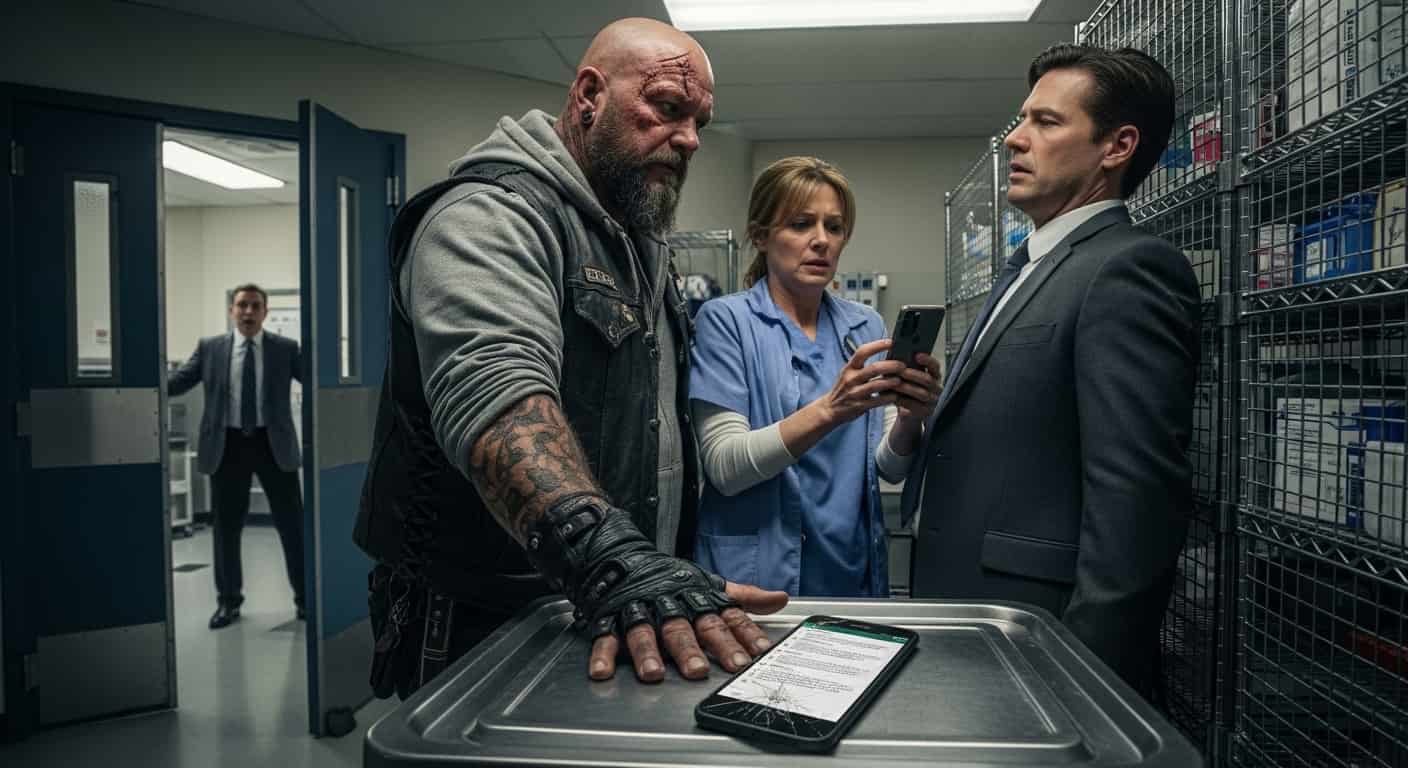
The moment Grave slammed that phone onto the tray, the lies didn’t just crack. They shattered.
Now, the hospital staff is watching. The secret is out. And Grave has a choice to make that will either save Sarah or burn his entire club to the ground.
FULL STORY: THE MERCY OF GRAVE MEN
Chapter 1: The Sound of Salt
The air in the Cook County ER always smelled like a mix of industrial floor wax and cheap coffee that had been burnt since 1994. Marcus Thorne, known to the Grim Reapers MC only as “Grave,” sat in the plastic chair of the waiting room. He was too big for the furniture. His knees pushed up against his chest, his leather vest creaking every time he took a breath.
He didn’t move. He hadn’t moved in four hours.
Across from him, a woman was crying into a crumpled tissue. A teenager with a split lip was staring at his shoes. Grave looked at none of them. He looked at the double doors. Behind those doors was the only thing that had ever made his life feel like more than a series of oil changes and bar fights: his daughter, Lily.
She was eight. She’d been crossing the street to get an ice cream when the black SUV hit her. The driver hadn’t even tapped the brakes.
A nurse stepped through the doors. She looked exhausted. Her name tag read Sarah, RN. She didn’t look at Grave like the cops did. She didn’t see the tattoos on his neck or the “1%” patch on his chest and assume he was the problem. She walked straight to him and sat down in the chair next to him.
“Mr. Thorne?” her voice was soft, but it cut through the hum of the vending machines.
Grave tried to speak. His throat felt like it was full of broken glass—the result of a piece of shrapnel from a bar fight years ago that had nicked his vocal cords. Only a raspy, dry hiss came out.
“Don’t try,” she said, placing a hand on his forearm. Her touch was professional but warm. “She’s in surgery. It’s going to be a long night. I brought you some water.”
She handed him a plastic cup. Grave took it, his hands—large enough to crush a man’s skull—trembling slightly.
“I stayed with her until they took her back,” Sarah whispered. “I held her hand. I told her her daddy was right here.”
Grave looked at her then. Sarah was thin, with dark circles under her eyes that spoke of double shifts and a life lived under pressure. But her eyes were steady. She was the only person in the city who didn’t treat him like a monster that night.
Lily died three hours later.
Sarah was the one who walked him to the exit at 4:00 AM. She was the one who handed him the small plastic bag containing Lily’s one remaining shoe and the photograph Grave kept in his wallet—the one Sarah had found in Lily’s pocket and taped back together after it had been torn in the impact.
“I’m so sorry, Marcus,” she had said.
That was three years ago. Grave had never forgotten the sound of her voice or the way she’d treated him like a human being when the rest of the world saw a criminal.
Now, Grave was back at Cook County. Not for a daughter, but for a brother. Eight-Ball had taken a slide on the I-90, his leg turned into a jigsaw puzzle of bone and denim.
Grave stood by the vending machine, his shadow long against the linoleum. He saw Sarah before she saw him. She was coming out of the breakroom, adjusting her stethoscope. She looked thinner. Paler.
And then he saw it.
As she reached up to tuck a stray hair behind her ear, the sleeve of her scrubs slid down. A dark, mottled purple bruise wrapped around her forearm like a bracelet. It wasn’t a “hit the corner of a table” bruise. It was the shape of four fingers and a thumb.
Grave’s heart, usually a cold, slow-moving engine, hitched in his chest. He didn’t move. He just watched.
A man in a sharp, grey suit walked up to her. He was handsome in a way that felt manufactured—perfect hair, a jawline that belonged on a campaign poster. He had a gold badge clipped to his belt.
“Sarah,” the man said. His voice was loud, booming with the confidence of a man who owned the room. “You’re late. I’ve been waiting in the car for ten minutes.”
“I had a patient code, Tom,” Sarah said, her voice small. “I couldn’t just leave.”
The man, Detective Tom Miller, smiled. It wasn’t a kind smile. It was the smile a predator gives a cornered rabbit before the bite. He reached out and grabbed her arm—the bruised arm—and squeezed.
“Don’t keep me waiting again,” Miller said, his voice dropping to a low, dangerous register. “It’s disrespectful. To me. To the office.”
Sarah didn’t pull away. She just stared at the floor, her shoulders hunching inward.
Grave felt the old fire rising in his gut. It was a familiar heat, the kind that preceded a lot of bad decisions. He stepped out from the shadow of the vending machine. The floorboards didn’t creak, but Miller felt the change in the air. He turned, his hand still on Sarah’s arm.
He looked Grave up and down—the leather, the scars, the silent, hulking presence.
“Can I help you, buddy?” Miller asked, his hand drifting toward his holster.
Grave didn’t speak. He couldn’t. He just stared at Miller’s hand on Sarah’s bruised skin. He looked at Sarah, who was looking at him with a mix of recognition and sheer, unadulterated terror.
Not for me, her eyes said. Don’t do it for me.
But Grave had already made his choice. He’d lost his daughter. He wasn’t going to let the only woman who’d ever shown him mercy lose her life.
Chapter 2: The Law and the Outlaw
The “Grim Reapers” clubhouse was a converted radiator shop on the South Side. It smelled of grease, stale beer, and the heavy, sweet scent of tobacco. Grave sat at the end of the long wooden table, cleaning a spark plug with a wire brush.
Eight-Ball was propped up on a sofa in the corner, his leg in a massive cast. “You’re vibrating, Grave,” Eight-Ball said, wincing as he shifted. “I can feel the heat off you from here. What happened at the hospital?”
Grave didn’t look up. He took a piece of paper and a pen from his vest pocket. He wrote one word: Miller.
Eight-Ball whistled low. “Detective Tom Miller? The ‘Golden Boy’ of the 12th District? He’s a nightmare, Grave. He’s got the DA in his pocket and a body count of ‘justified’ shootings that would make a hitman jealous. Why are we talking about him?”
Grave wrote: He’s hurting her.
Eight-Ball went quiet. He knew who ‘her’ was. Every man in the club knew about the nurse who’d stayed with Grave the night Lily died. Grave didn’t have many people, but the ones he had, he guarded with a ferocity that bordered on psychotic.
“You touch a cop, especially a high-profile one like Miller, and the city will burn this clubhouse to the ground,” Eight-Ball said seriously. “The Prez won’t back you on this. This isn’t club business.”
Grave stood up. He reached into his vest and pulled out a faded, taped-together photograph of an eight-year-old girl in a sundress. He laid it on the table.
“I know,” Grave’s voice came out as a haunting, airy rasp. It was the first time he’d spoken in days. “Not club business. My business.”
Grave spent the next three days as a ghost. He followed Miller. He didn’t use his bike; the roar of a Harley was too distinctive. He used an old, beat-up Honda Civic he’d taken in a trade and kept in the back of the shop.
He watched Miller leave the precinct. He watched him go to a high-end steakhouse with a woman who wasn’t Sarah. He watched Miller hand a thick envelope to a man in a dark alley behind a pharmacy.
But mostly, he watched the house.
A small, well-kept bungalow in a neighborhood where the lawns were manicured and the American flags were never frayed. From the street, it looked like the dream. From the shadows of the park across the way, Grave saw the reality.
He saw the lights go on in the kitchen. He saw the silhouettes through the blinds. He saw Miller pacing, gesturing wildly. He saw Sarah retreat. He saw the sudden, violent movement of a hand striking a face.
Grave’s grip on the steering wheel tightened until the plastic groaned. He wanted to go in. He wanted to wrap his hands around Miller’s neck and show him what real violence looked like.
But he knew better. If he just killed Miller, Sarah would go to jail as an accomplice, or the police would tear her life apart looking for a motive. He needed more. He needed to destroy Miller before he killed him.
On the fourth night, Grave saw Miller drop something.
Miller was stumbling out of a dive bar three miles from his precinct—a place where cops went to drink when they didn’t want to be seen. He was fumbling with his keys, cursing under his breath. As he pulled his hand out of his pocket, a small, black object fell into the gutter.
Miller didn’t notice. He got into his SUV and roared away, clipping the curb.
Grave waited five minutes. Then he stepped out of the shadows.
He reached into the oily water of the gutter and pulled out a burner phone. It was cheap, prepaid, and unlocked.
Grave sat in his car and scrolled. His eyes narrowed. It wasn’t just another woman. It was a series of messages coordinating the pickup of “medical supplies”—Fentanyl, Oxy, Morphine—stolen from the evidence locker and sold back to the streets. And there were photos. Photos Miller had taken of Sarah, bruised and bleeding, used as some kind of sick trophy or intimidation tactic sent to a number labeled “The Fixer.”
Grave felt a cold, hard clarity settle over him.
He didn’t go home. He drove straight to the hospital. He knew Sarah’s schedule. She was on the graveyard shift.
He walked into the ER, past the security guard who recognized him and gave a hesitant nod. He didn’t stop at the desk. He followed the familiar path toward the back, toward the supply rooms where the cameras didn’t reach and the air was thick with the smell of latex.
He found her in Supply Room 3. She was stocking shelves, her movements jerky and robotic.
“Sarah,” Grave rasped.
She jumped, a box of gauze falling from her hands. “Marcus? What are you doing here? You can’t be back here.”
“He’s coming,” Grave said. He could hear the heavy footfalls in the hallway. He knew the sound of those boots. Miller was coming to “check on his wife” again.
“Who? Tom? Marcus, you have to leave, please,” Sarah pleaded, her voice rising in panic. “If he sees you—”
“Let him see,” Grave said.
He stepped into the corner, vanishing into the shadows behind a stack of crates just as the door swung open.
Chapter 3: The Breaking Point
Detective Miller didn’t knock. He never did. He stepped into the supply room, the scent of expensive cologne and cheap whiskey following him.
“I called your cell, Sarah,” Miller said. His voice was flat, the kind of quiet that precedes a storm. “Three times.”
“The reception is bad back here, Tom,” Sarah said, her voice trembling. She tried to step past him, but Miller blocked the door.
“Don’t lie to me,” he said. He reached out and grabbed her chin, forcing her to look at him. “I don’t like liars. We’ve discussed this.”
“You’re hurting me,” she whispered.
“I’m teaching you,” Miller corrected. “There’s a difference.”
He raised his hand, his fingers curling into a fist. Sarah flinched, closing her eyes.
Clang.
The sound of metal hitting metal echoed through the small room.
Miller froze. He turned his head slowly.
Grave was standing there. He had stepped out of the shadows like a ghost conjured from the dark. He had just slammed a stainless steel medical cart into the wall, pinning Miller’s escape route.
And on that cart, glowing in the harsh fluorescent light, was the burner phone.
“What the hell is this?” Miller demanded, his hand dropping from Sarah’s face to his holster. “Thorne? You’re a dead man. Get out of here before I put a hole in you.”
Grave didn’t move. He didn’t even blink. He took a step forward, his massive frame dwarfing the detective.
“The phone,” Grave rasped. “The pictures. The ‘medical supplies.’ All of it.”
Miller’s face went from arrogant to pale in a heartbeat. He looked at the phone, then at Sarah, then back at Grave. “You think anyone is going to believe a patched-out thug over a decorated detective? I’ll have you in a cage before sunrise.”
“Look,” Grave said, pointing a scarred finger toward the door.
In the doorway stood Mrs. Higgins, the Hospital Administrator. She was a stern woman in her sixties who took no nonsense and feared no one. She had been walking by when she heard the cart hit the wall. She was staring at the phone, then at the bruises on Sarah’s neck that were now clearly visible under the bright lights, and finally at Miller.
“Detective,” she said, her voice like ice. “I think you should step away from my nurse.”
“This isn’t what it looks like, Martha,” Miller started, his voice cracking. “This biker, he’s—”
“I’ve seen enough,” she said. She pulled her cell phone from her blazer pocket. “I’m calling the Chief. And the DEA.”
Miller panicked. He reached for his gun.
He was fast, but Grave was faster.
Grave didn’t hit him. He grabbed Miller’s wrist with a grip that sounded like dry wood snapping. He twisted, sending the detective to his knees. Grave slammed Miller’s head against the metal shelving—not hard enough to kill him, but hard enough to make the world go dark for a moment.
Grave leaned down, his face inches from Miller’s ear.
“If you ever… touch her again,” Grave’s voice was a jagged, terrifying whisper, “I won’t use a phone. I’ll use my hands. And I don’t leave bruises. I leave graves.”
He let go. Miller slumped to the floor, sobbing and clutching his wrist.
Grave looked at Sarah. She was shaking, tears finally spilling over. She looked at Grave, and for the first time in three years, she didn’t see the grieving father. She saw the protector.
“Go,” Grave rasped.
“Marcus, wait,” she said.
But Grave was already moving. He walked past the Administrator, out of the supply room, and into the night. He had a debt to pay to his club, and a war with the 12th District was about to begin.
Chapter 4: The Debt of Brothers
The morning sun over the Chicago skyline was a dull, bruised orange. Grave sat on his bike outside the clubhouse, the engine idling with a low, guttural thrum.
The “War Council” was already gathered inside. He could hear the shouting.
Grave walked in, his boots heavy on the wooden floors. Every head turned. The President of the Grim Reapers, a man named “Iron” Pete, was standing at the head of the table. He looked like he hadn’t slept in a decade.
“You brought the heat, Grave,” Pete said, slamming a newspaper onto the table. The headline read: LOCAL DETECTIVE ARRESTED IN DRUG STING. “They picked up Miller an hour ago,” Pete continued. “But he’s talking. He’s telling them it was a setup. He’s telling them the Reapers are moving the weight. The feds are outside the gate, Marcus. They’re waiting for a reason to kick the door in.”
Grave stood in the center of the room. He felt the eyes of his brothers on him. Some were angry. Some were scared. Eight-Ball was the only one who looked at him with something like pride.
“I did it,” Grave rasped.
“We know you did it!” Pete roared. “But why? For a nurse? We’re a club, Marcus. We’re supposed to be a family. You just put the family on the chopping block for a woman who isn’t even a ‘property.'”
Grave looked at Pete. He thought about the night Sarah held Lily’s hand. He thought about the photograph she’d taped together.
“She was the only one,” Grave said, his voice stronger than it had been in years. “The only one who saw a man. Not a patch.”
He reached into his vest and pulled out a heavy brass key. It was the key to a locker at the Greyhound station.
“Everything is in there,” Grave said. “The ledger. The real names of the people Miller was working with. It’s not the club, Pete. It’s the Deputy Commissioner. Miller was his errand boy.”
The room went dead silent.
“If you give them that,” Eight-Ball whispered, “the feds go after the top. They leave us alone. They’ll be too busy cleaning their own house to worry about a few bikers.”
“But,” Pete said, his eyes narrowing, “who gives it to them? Whoever walks that into the federal building isn’t walking out. They’ll want a witness. They’ll want a name.”
Grave nodded. He knew. He’d known the moment he picked up that burner phone.
“I go,” Grave said.
“Marcus, you have a murder on your jacket from ten years ago,” Eight-Ball reminded him, his voice thick with emotion. “The one in Ohio. If you walk into a federal building, they’ll run your prints. They’ll find out you’re the one who killed that senator’s nephew to save that girl in the trailer park. You’ll never see the sun again.”
Grave looked at the photograph of Lily. He’d lived enough life. He’d seen enough blood.
“I’m already a ghost,” Grave rasped. “Ghosts don’t need the sun.”