Harrison Thorne didn’t just fire me; he handed me a one-way ticket to a cage and called it “”justice.””
I was twenty-four, an orphan who’d clawed his way through the foster system to land a job at Thorne Logistics. I thought I’d finally made it. I thought the $80,000 salary and the cubicle meant I was “”in.””
I was wrong. To men like Harrison Thorne, I wasn’t a success story. I was a “”disposable variable.””
“”The audit is clear, Jax,”” Thorne had said that morning, leaning back in his Italian leather chair, the smell of expensive cigars clinging to his skin. “”Two point four million is missing from the pension fund. And your digital signature is all over the transfers. I’m sorry, son. I really liked you.””
He wasn’t sorry. He was vibrating with the thrill of it. He’d stolen the money to cover his gambling debts in Macau, and he’d picked the kid with no parents, no high-priced lawyers, and a “”troubled”” childhood record to take the fall.
He thought I was a ghost. He thought that if I disappeared into a federal prison, no one would even ask where I went.
But as I stood there, watching the police walk toward my desk with handcuffs, I didn’t cry. I didn’t beg. I just looked at the photo on my desk—a grainy shot of me at ten years old, sitting on the gas tank of a 1982 Shovelhead, held steady by a man with hands like sandpaper and a heart of pure gold.
Thorne forgot that before I was an accountant, I was a “”nephew”” to the Iron Brotherhood.
He forgot that orphans don’t just lose families. Sometimes, we build better ones.
“FULL STORY
CHAPTER 1: The Disposable Boy
The air in the executive suite of Thorne Logistics felt like it was being pumped out of a vacuum. It was too clean, too quiet, and far too cold. Harrison Thorne stood by the floor-to-ceiling window, overlooking the gray, industrial sprawl of the city he felt he owned.
“”You know, Jax,”” Thorne said, his voice a smooth, practiced baritone. “”I always admired your grit. Most kids from your background end up on the street or behind a counter. You made it to the thirtieth floor.””
I sat in the guest chair, my hands folded in my lap. I could feel the sweat beginning to prickle at the back of my neck. I knew what was coming. I had seen the discrepancies in the ledger three weeks ago. I had brought them to my supervisor, who told me to “”mind my own business if I liked my paycheck.”” I had ignored the warning and dug deeper, finding the shell companies and the offshore routing numbers.
I thought I was being a hero. I thought I was protecting the company.
“”The police are in the lobby,”” Thorne continued, turning around. His eyes were like blue ice—pretty to look at, but they’d freeze you to death if you stayed too long. “”They have the warrants for your apartment. I’m sure they’ll find the ‘bonus’ money you’ve been stashing away. It’s a shame. Truly.””
“”I didn’t take a dime, Harrison,”” I said, my voice steadier than I felt. “”And you know it. Those transfers were authorized from your terminal.””
Thorne let out a short, dry laugh. “”My terminal? Jax, I’m a billionaire. I pay people to use terminals. And unfortunately for you, the IT logs show you logged in remotely at 3:00 AM last Tuesday. From your home IP.””
He’d spoofed it. Of course he had. He’d been setting this up for months. Every time he’d asked me to stay late, every time he’d given me his “”private”” login to “”help him with a project,”” he was just weaving the rope he was going to hang me with.
The door opened, and two officers from the Precinct 4 fraud unit stepped in. One was a veteran, Detective Miller, a man who looked like he’d seen too many lies and eaten too many donuts. The other was younger, eager to make an arrest.
“”Jax Miller?”” the younger one asked.
“”That’s me,”” I said, standing up.
As they pulled my arms behind my back, the cold steel of the cuffs biting into my wrists, I looked at Thorne. He was smiling. Not a big, villainous grin, but a small, satisfied smirk. The look of a man who had just successfully thrown out a piece of trash.
“”Don’t worry, Jax,”” Thorne called out as they led me toward the door. “”I’ll make sure your things from the office are sent to… well, wherever it is you’re going. I don’t suppose there’s any family I should contact?””
That was the jab. The final twist of the knife. He knew there was no one. My mother had died when I was six; my father was a name on a birth certificate that didn’t even have a signature.
I was led through the bullpen. My coworkers, people I’d grabbed coffee with for three years, looked away. Some whispered. Some looked disgusted. Sarah, the paralegal I’d been seeing for six months, was staring at her computer screen, her face pale, her hands trembling. She wouldn’t even look at me.
In the elevator, Miller looked at me. “”You got anything to say, kid? It’s a lot of money. You tell us where it is, maybe the DA goes easy.””
“”I don’t have it, Detective,”” I said. “”But I know who does.””
“”Yeah,”” Miller sighed. “”They all say that. Usually, it’s the invisible boogeyman.””
They put me in the back of the cruiser. As we pulled away from the curb, I saw Thorne standing under the golden canopy of the building, waving a hand at the press that had already gathered. He was playing the victim—the benevolent CEO betrayed by the charity-case orphan.
They took my phone. They took my belt. They put me in a holding cell that smelled of bleach and despair.
I sat on the thin, plastic-covered mattress and stared at the cinderblock wall. I had one phone call. In a world of normal people, I would have called a lawyer. I would have called a father. I would have called a brother.
But I didn’t have any of those.
I waited until the sun went down and the jail got quiet. Then, I walked to the payphone. I dialed a number I hadn’t called in five years—a number I’d kept memorized like a prayer.
It picked up on the third ring. The background noise was a roar of classic rock and the clinking of bottles.
“”Yeah?”” a voice growled. It was deep, gravelly, and sounded like a semi-truck idling.
“”Pop?”” I whispered. My voice broke. The “”grit”” Thorne had praised me for finally gave way.
There was a long silence on the other end. The music in the background seemed to dip.
“”Jax?”” the voice asked, suddenly sharp. “”That you, Little Bit?””
“”I’m in trouble, Pop. The bad kind.””
“”Where are you?””
“”County lockup. Thorne Logistics. He… he set me up. He’s taking everything.””
I heard a heavy thud, like a fist hitting a bar top. “”Listen to me, Jax. You keep your mouth shut. You don’t sign a damn thing. Do you hear me?””
“”I hear you.””
“”The family’s coming, son. We’re coming with the thunder.””
I hung up and walked back to my cell. For the first time since the handcuffs closed, I breathed. Harrison Thorne thought I was a man with no history. He was about to find out that my history had two wheels, a lot of leather, and a very long memory.
CHAPTER 2: The Weight of the Badge
Detective Miller wasn’t a bad man; he was just a tired one. He sat across from me in the interrogation room the next morning, a folder spread out between us. He’d spent the night looking through my life, and I could tell he didn’t like what he saw—not because it was criminal, but because it was empty.
“”Foster care from age six to eighteen,”” Miller read, flipping a page. “”Six different homes. Two incidents of ‘unauthorized use of a motor vehicle’ when you were sixteen. Then, suddenly, you turn it around. Scholarship, accounting degree, top of your class. You’re a success story, Jax. Why blow it for a couple million?””
“”I didn’t blow it, Detective,”” I said. I hadn’t slept. My eyes felt like they were full of sand. “”Look at the shell companies. Look at ‘Thorne-Macau Holdings.’ It’s a classic wash. He’s using the pension fund to cover debt.””
“”We looked,”” Miller said, rubbing his face. “”The accounts are encrypted. The signatures are yours. And we found twenty thousand dollars in cash in a shoebox under your bed this morning.””
My heart dropped. “”He planted it. He has a key to my place. He gave it to me when I moved in—it’s a company-owned apartment.””
Miller sighed. “”It’s a neat story, kid. But Thorne? He’s the city’s golden boy. He just donated five million to the Children’s Hospital. Why would he risk his empire for two million?””
“”Because he’s not a billionaire,”” I snapped. “”He’s a man in a very expensive suit standing on a collapsing sandcastle.””
The door opened, and a young lawyer in a suit that cost more than my car stepped in. He looked like he’d never seen the inside of a gym or a jail.
“”Mr. Miller? I’m Marcus Vane. I’ve been retained to represent you.””
I blinked. “”Who retained you? I don’t have any money.””
Vane smiled, a thin, nervous thing. “”A group of… concerned associates. They’ve already posted your bail. You’re free to go, pending the hearing in three days.””
Miller looked stunned. “”Bail was set at a hundred thousand. Who the hell paid that in cash?””
Vane cleared his throat. “”A collection of private citizens, Detective. If you’ll excuse us, my client has a lot of prep work to do.””
As I walked out of the precinct, I expected to see a limo or a taxi. Instead, I saw a single, battered Harley-Davidson Fat Boy idling at the curb. Sitting on it was Mitch.
Mitch was the closest thing I had to a brother. We’d spent three years in the same foster home under a man who used a belt more than his words. Mitch was three years older, twice as wide, and had “”Hate”” and “”Love”” tattooed on his knuckles in a way that didn’t look cliché—it looked like a warning.
“”Get on,”” Mitch said, tossing me a spare helmet.
“”Where are we going?””
“”The Clubhouse. Pop’s been calling in favors from Jersey to Cali. You look like hell, Jax.””
“”I feel like hell. They found money in my apartment, Mitch. He’s got me boxed in.””
Mitch kicked the bike into gear, the engine screaming. “”Thorne thinks he’s playing chess. He doesn’t realize we’re the kind of people who just kick the table over.””
We rode out of the city, away from the glass towers and into the industrial outskirts where the air smelled of diesel and woodsmoke. We pulled up to a nondescript warehouse with a heavy steel door and a sign that simply read S&S Restoration.
Inside, the air was thick with the sound of grinding metal and the smell of oil. And bikes. Rows and rows of them.
Silas—””Pop”” to me—was standing at a workbench, his hands covered in grease. He was the National President of the Iron Brotherhood, but to me, he was the man who had taught me how to balance a checkbook and a carburetor. He’d taken me in when I was eighteen and aging out of the system, giving me a job and a sense of gravity.
He didn’t say a word. He just walked over and pulled me into a bear hug that nearly cracked my ribs.
“”He tried to bury you, Little Bit,”” Silas rumbled into my ear.
“”He’s doing a good job of it, Pop,”” I said, pulling back. “”He’s got the evidence. He’s got the cops. He’s got the city.””
Silas picked up a rag and began wiping his hands. “”He’s got the ‘official’ version. But guys like Thorne… they always leave a trail in the dirt. They think the dirt is beneath them, so they don’t look down.””
He gestured to a back room where three men were sitting around a table covered in laptops. These weren’t bikers; they were younger, tech-heavy guys in Brotherhood hoodies.
“”Meet the ‘Ghost Crew,'”” Silas said. “”They’re the sons of members. They didn’t want to turn wrenches, so they learned how to turn code. They’ve been inside Thorne’s servers since you called last night.””
One of the guys, a kid named Leo, looked up. “”Jax, the guy is good. But he’s arrogant. He used a proprietary encryption that he bought from a firm in Switzerland. He thinks it’s unbreakable.””
“”Is it?”” I asked.
Leo grinned. “”Nothing’s unbreakable when you have the master key. And Thorne’s mistress? She’s been using his private cloud to store… well, let’s just say things she shouldn’t have. We found a backdoor through her account.””
“”What did you find?””
Leo’s face went serious. “”It’s not just embezzlement, Jax. He’s not just stealing. He’s moving money for a cartel out of Mexico. The missing pension funds? That was just his ‘fee’ for a botched shipment. He’s desperate.””
I felt a chill. This wasn’t just a corporate frame-up. This was life or death.
“”If we take this to the cops, Thorne will have them killed before they get to the courthouse,”” I said.
Silas stepped forward, his eyes burning. “”That’s why we aren’t going to the cops. Not yet. We’re going to the court of public opinion. And we’re going to bring the whole damn family to witness it.””
“”Pop, there are thousands of people who work for him. He’s powerful.””
“”And we have chapters in forty-eight states, Jax,”” Silas said. “”I put the word out. The Brotherhood protects its own. By Thursday, this city is going to hear a sound it’ll never forget.””
CHAPTER 3: The Ghost in the Machine
The next forty-eight hours were a blur of adrenaline and data. I lived in the back room of the warehouse, fueled by black coffee and the driving need to see Harrison Thorne’s world burn.
Leo and I went through the files. It was all there. The “”unauthorized”” transfers from my terminal had actually been executed from a satellite phone registered to Thorne’s private yacht, the Golden Mean, while it was anchored in the Bahamas. I had been at my desk in full view of three security cameras at the time.
“”Why didn’t the police see this?”” I asked, staring at the timestamps.
“”Because Thorne owns the firm that handles the police department’s digital forensics,”” Leo explained, his fingers flying across the keys. “”They didn’t look at the yacht logs because they were told the ‘source’ was already confirmed. It’s a closed loop, Jax. He’s got the whole system rigged.””
But the system had a flaw: Sarah.
Sarah wasn’t just the paralegal I’d been seeing; she was the one who handled Thorne’s private filings. I remembered her being nervous lately. I remembered her mentioning a “”special project”” that kept her up late.
“”I need to talk to her,”” I said.
“”It’s a risk,”” Silas warned, leaning against the doorframe. “”She could be in on it. Or she could be watched.””
“”She’s not in on it,”” I insisted. “”She’s scared. I saw her face when they took me away. She wasn’t disgusted; she was terrified.””
Mitch drove me into the city under the cover of a rainstorm. We waited outside Sarah’s apartment in a rusted-out van, a far cry from the bikes that would draw too much attention.
When she hopped out of her car, clutching her umbrella, I stepped out of the shadows.
“”Sarah!””
She screamed, dropping her keys. When she saw it was me, she didn’t run. She collapsed against the brick wall of her building, sobbing.
“”Jax, oh God, Jax. You shouldn’t be here. He… he said if I talked to anyone, he’d make sure my brother’s parole was revoked.””
My blood ran cold. Thorne really did his homework. Sarah’s brother had a drug conviction from years ago.
“”I know he’s framing me, Sarah. I have the digital logs. But I need the physical proof. The ledger he keeps in the floor safe in his study. The real one.””
Sarah looked up, her eyes wide. “”He never leaves that house, Jax. And he has armed security.””
“”He’s going to the ‘Man of the Year’ gala tomorrow night,”” I said. “”He’ll be out for four hours. Can you get me the code?””
“”I don’t know it,”” she whispered. Then, she paused. “”But I know where he keeps the backup. He’s paranoid. He has a physical keycard hidden in his office desk—the one at work. The one they haven’t searched because he’s the ‘victim.'””
“”Get it for me, Sarah. Please. If I go down, he’s just going to find someone else to use next time. Maybe it’ll be you.””
She looked at the ground for a long time. Then, she reached into her purse and pulled out a small, encrypted thumb drive.
“”I already made a copy of his private calendar and the security bypass codes for the office,”” she said, her voice trembling. “”I was going to go to the FBI, but I was too scared. Take it. Just… make sure he can’t hurt us anymore.””
As I walked back to the van, I felt a flicker of hope. But as we pulled away, I saw a black sedan pull out from the end of the block, its headlights off.
“”Mitch,”” I said. “”We’ve got company.””
Mitch didn’t panic. He just smiled. “”Good. I was getting bored.””
The chase through the rain-slicked streets of the suburbs was a cinematic nightmare. The sedan tried to ram us, but Mitch was a virtuoso with a heavy vehicle. He led them into a construction zone, weaving through concrete barriers with inches to spare.
“”Hold on!”” Mitch yelled as he slammed on the brakes, sending the van into a controlled slide.
The sedan, unable to react in time, plowed into a stack of industrial piping. It didn’t explode like in the movies, but the front end was crumpled, and the airbags deployed like white ghosts.
Mitch didn’t stop to check on them. “”Thorne’s playing for keeps now, Jax. No more games.””
We got back to the warehouse, and I handed the drive to Leo.
“”This is it,”” Leo said after a few minutes. “”The security bypass. We can get into his office tonight.””
Silas walked over, his heavy boots echoing on the concrete. “”No. Not tonight. We wait for the morning of the hearing. We want him to feel the most secure. We want him at the courthouse, ready to give his victory speech.””
“”Why wait?”” I asked.
Silas looked at his watch. “”Because the brothers from Oakland just crossed the state line. The Chicago chapter is three hours out. And the Texan boys? They’re bringing a convoy of five hundred bikes.””
He put a hand on my shoulder.
“”Tomorrow, Jax, we don’t just prove you’re innocent. We show them what happens when you touch a member of this family.””
CHAPTER 4: The Ghost of the Past
That night, I couldn’t sleep. I sat on a crate in the middle of the warehouse, surrounded by the sleeping forms of men who were willing to risk prison for a kid they barely knew.
I thought about my father. Not the man on the birth certificate, but the man who had sat in this very warehouse ten years ago.
His name was Thomas, but everyone called him ‘Slider.’ He wasn’t my biological father; he was the guy who had found me crying behind a dumpster when I was six, after my mother had overdosed. He’d stayed with me until the police came. And for the next twelve years, he’d been the only constant in my life. He’d visit me at every foster home, bringing me books and telling me that my brain was my greatest weapon.
“”They can take your clothes, Jax,”” he’d told me. “”They can take your name. But they can’t take what’s behind your eyes.””
Slider had died in a “”workplace accident”” at a factory owned by a subsidiary of Thorne Logistics. That was the secret I hadn’t told anyone—not even Silas. I hadn’t just applied for a job at Thorne because of the salary. I’d applied because I wanted to know why the safety railings on the third floor had been “”corroded”” when Slider fell.
I had found the answer in the files Leo and I had hacked. It wasn’t an accident. Thorne had cut the maintenance budget by 90% to funnel money into his Macau accounts. Slider hadn’t died of bad luck; he’d died of Harrison Thorne’s greed.
The weight of it almost crushed me. I wasn’t just fighting for my freedom. I was fighting for the man who had taught me how to be a man.
“”You okay, kid?””
It was Mitch. He was sitting on a bike nearby, cleaning a chrome exhaust pipe.
“”I’m just thinking about Slider,”” I said.
Mitch stopped rubbing. “”He’d be proud of you, Jax. You didn’t just survive. You became the one thing Thorne couldn’t control. An honest man who knows how to count.””
“”I don’t feel honest right now, Mitch. I feel like I want to tear his throat out.””
“”That’s not honesty,”” Mitch said, standing up. “”That’s justice. There’s a difference. Honesty is for the courtroom. Justice is for the street. Tomorrow, we’re going to give him a little bit of both.””
By 4:00 AM, the warehouse was vibrating. It wasn’t an earthquake; it was the arrival.
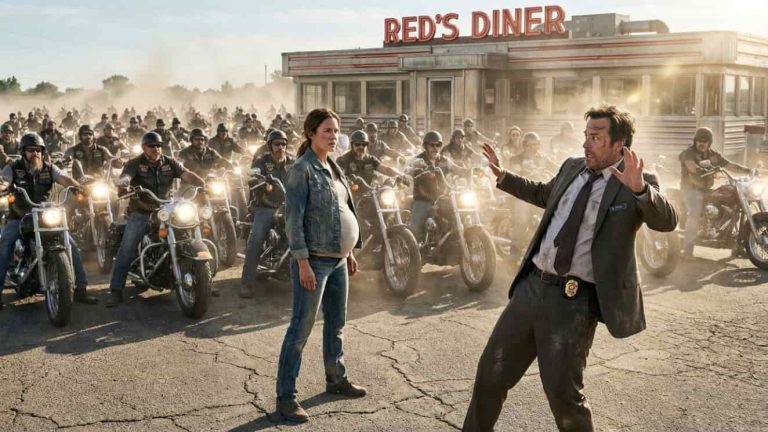
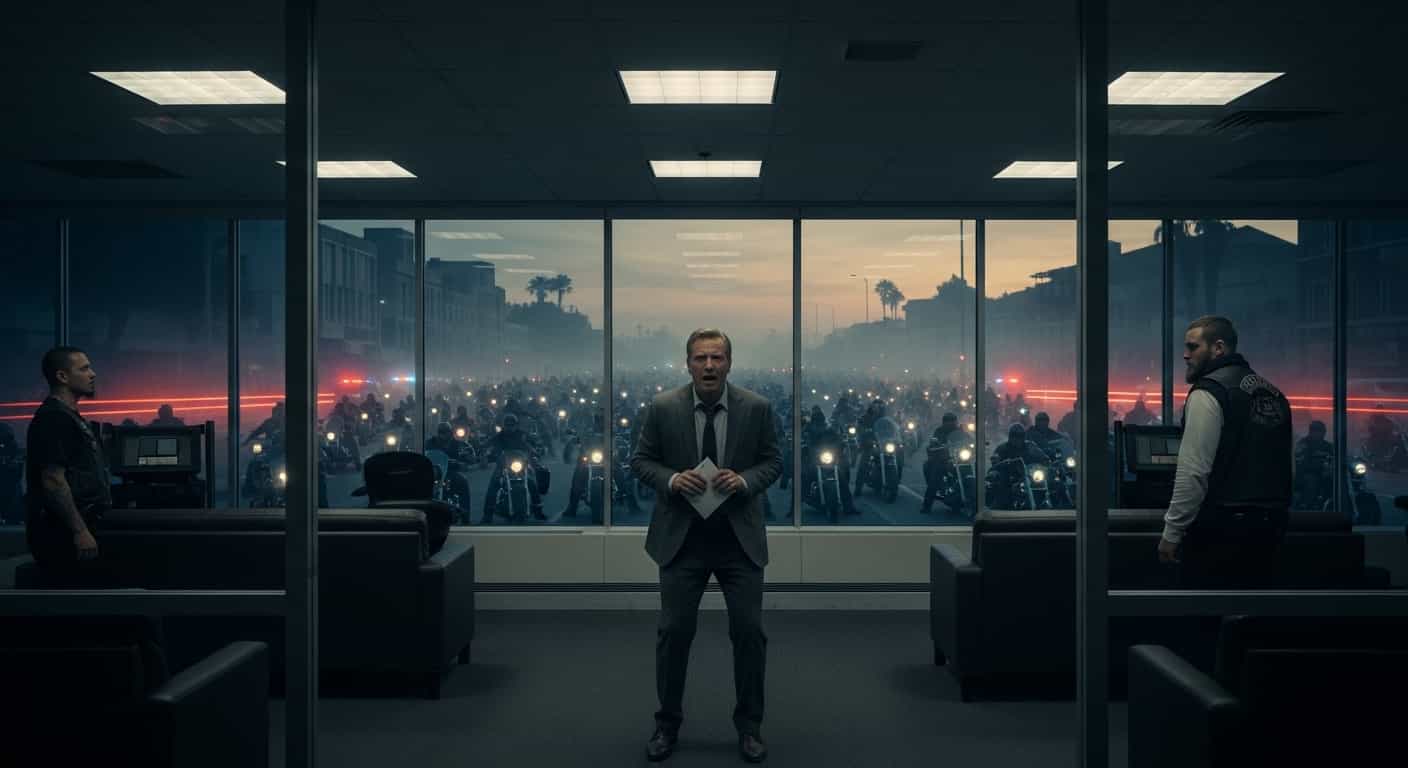
One by one, then ten by ten, then hundred by hundred, the motorcycles arrived. The sound was a low, visceral thrum that you felt in your teeth. Men and women in leather vests, covered in road dust and patches from every corner of the country, began to fill the lot.
They didn’t shout. They didn’t party. They parked their bikes in perfect, military rows. They shook hands with Silas. They looked at me with a nod of recognition—the “”Little Bit”” who had grown up to be an accountant, but was still one of them.
“”How many?”” I asked Silas.
“”Total? Around two thousand,”” Silas said, checking his phone. “”The local PD is panicking. They’ve called for back-up, but we’re not breaking any laws. We’re just… traveling. Together.””
He handed me a leather jacket. It was old, broken-in, and had the Iron Brotherhood patch on the back. It had been Slider’s.
“”Put it on,”” Silas said. “”It’s time to go to court.”””