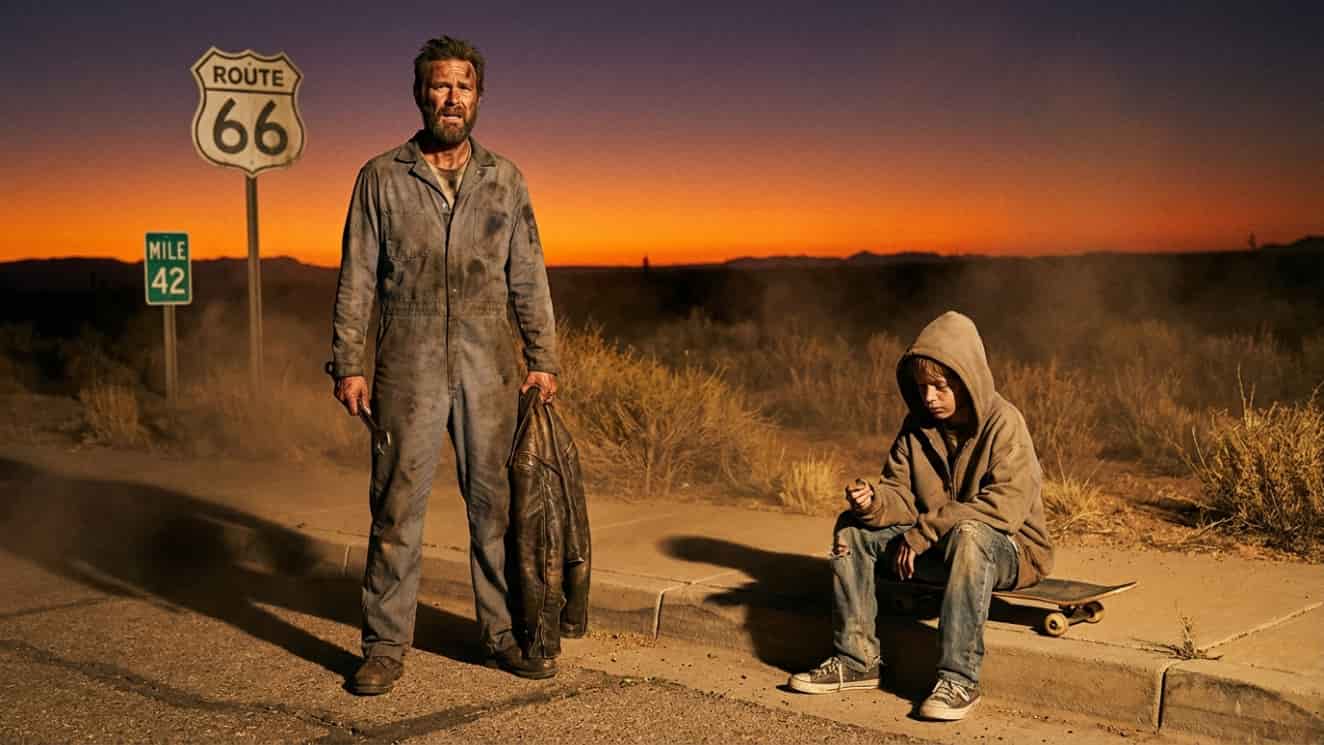
Chapter 1: The Ghost of Mile Marker 42
The heat in Arizona doesn’t just burn; it remembers. It clings to the back of your neck like a heavy, sweating hand, whispering about every mistake you ever made.
I stood at Mile Marker 42, the soles of my boots melting into the asphalt. It’s a nondescript stretch of Route 66, but to me, it was an altar. Twenty-five years ago, a rusted Chevy Nova pulled over right here. My father, a man whose face I can only remember as a series of sharp angles and the smell of stale Marlboros, looked at me.
“Stay right here, Dusty,” he’d said. “I’m gonna go grab us those strawberry milkshakes from the diner up the road. Don’t move. A man is only as good as his word, and my word is I’m coming back.”
I was seven. I waited until the sun went down. I waited until the coyotes started howling. I waited until a State Trooper found a shivering kid sitting on a suitcase, clutching a lucky quarter like it was a life raft.
He never came back.
Now, at thirty-two, I go by “Dusty” Rhodes—a name I gave myself because the one he left me with felt like a cursed heirloom. I’m a man of grease and gravel, a mechanic who spent a decade drifting until I found the “Roadside Refuge.”
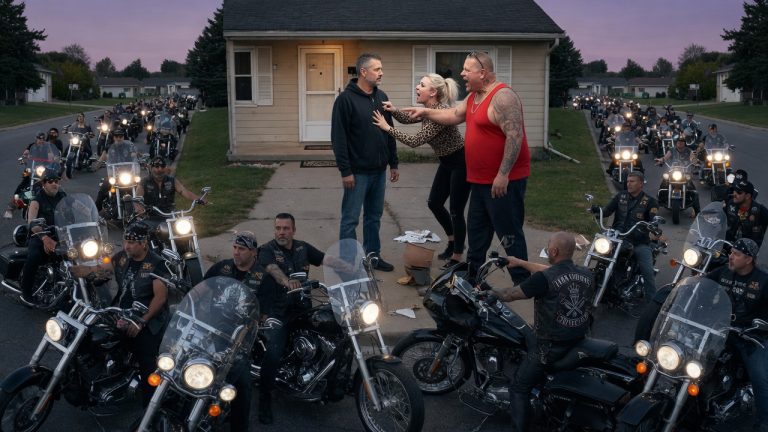
The Refuge isn’t just a biker bar or a truck stop. It’s a sanctuary for the abandoned. Sarah, the woman who runs it, took me in when I was twenty, starving and looking for work. She has flour on her apron, a permanent smudge of grease on her cheek, and eyes that look like tired embers—the kind that still have enough heat to keep you warm.
But today, the warmth was gone.
“He’s coming back, Dusty,” Sarah said, leaning against the weathered wooden bar. She was holding a final notice from the bank. “Marcus. He says the land is worth more as a lithium mine than a home for ‘strays’ like us.”
I looked at the peeling paint of the ceiling. This place saved me. When the world told me I was trash left on the side of the road, Sarah told me I was a master of the engine. She gave me a wrench and a reason to live.
“He can’t take it,” I said, my voice like grinding stones.
“Dusty, we’re two hundred thousand in the hole. The ‘Guardian Angel’ donations stopped six months ago.”
I felt a cold prickle in my chest. The “Guardian Angel” hadn’t stopped. I just had to be more careful about how I moved the money.
You see, nobody knows that the “drifter mechanic” who sleeps in the back shed is actually the one who has been paying the taxes on this place for five years. I’d stumbled into a bit of luck—a patent for a high-efficiency fuel injector I’d tinkered with in the dark hours. I had millions in a blind trust, and I spent every cent of the interest keeping the Refuge alive.
But Marcus, a man who smelled of expensive cologne and cheap intentions, was onto something. He didn’t just want the money. He wanted the dirt.
“I saw a kid today,” I told Sarah, changing the subject. “By the marker. He looked… lost.”
“Bring him in,” she sighed, wiping the counter. “We always have room for one more, even if we won’t have a roof by Tuesday.”
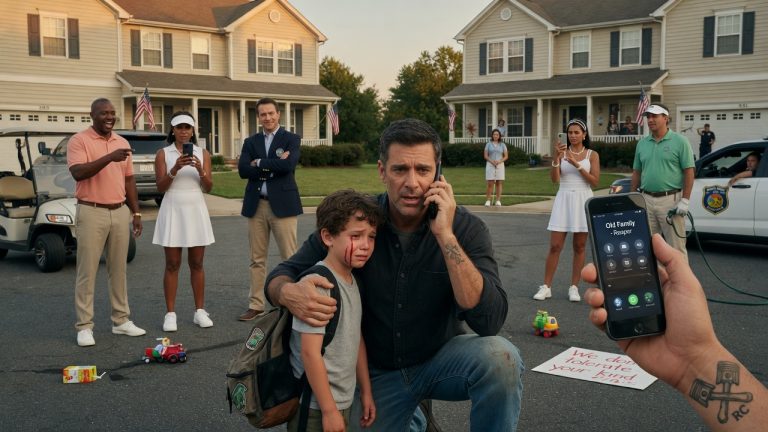
I walked out into the shimmering heat. A boy was sitting on the curb—maybe ten years old. He had a skateboard with chipped paint and a hoodie that was way too big for an Arizona summer. He was biting his lip so hard it was bleeding.
“Waiting for someone?” I asked.
The boy didn’t look up. “He’s coming back. He just went to get milkshakes.”
The world tilted. The ghost of Mile Marker 42 wasn’t just a memory anymore. He was sitting right in front of me.
FULL STORY
Chapter 2: The Vulture in a Three-Piece Suit
The boy’s name was Caleb. He didn’t want to talk, but he wanted a burger, and the Refuge provided. As I watched him tear into a basket of fries, I saw my own reflection in the way he kept glancing at the door every time the bells jingled. Every person who entered was a hope; every person who sat down was a disappointment.
“He’s not coming, kid,” I wanted to say. But the words felt like broken glass in my throat.
Sarah sat across from him, her presence maternal and fierce. “You’re safe here, Caleb. No one goes hungry at the Refuge.”
“My dad is just busy,” Caleb muttered, his voice cracking. “He’s a pilot. He had an emergency flight. He told me to wait at the station.”
I walked back to the garage, the familiar scent of oil and old tires failing to soothe me. I needed to move the money. If I didn’t pay off the balloon payment by Friday, Marcus would have the legal right to bulldoze the place.
But there was a catch. To pay off the debt in one lump sum, I had to reveal the source of the funds. The IRS and the bank required transparency for a transaction that large. If I did that, the legend of the “Guardian Angel”—the miracle that gave Sarah and the others hope that the universe actually cared—would die. They’d realize it was just me. Just Dusty. The guy who couldn’t even save himself from a gas station curb.
“Deep in thought, Rhodes?”
I didn’t need to turn around to know it was Marcus. I heard the click of his Italian leather shoes on the concrete floor of my shop.
“You’re trespassing,” I said, not looking up from the alternator I was stripping.
“Actually, I’m surveying,” Marcus chuckled. He was a man who grew up with silver spoons and used them to stir the blood of the working class. “This lot is the gateway to the valley. My investors want to put a hub here. You? You’re just a grease monkey clinging to a sinking ship.”
“The ship isn’t sinking. It just needs a tune-up.”
Marcus walked over and kicked my toolbox. The metal shrieked. “Friday, Dusty. At noon. I’m bringing the sheriff and the papers. Tell Sarah to start packing her flour. And that kid you brought in? He’ll be in the system by sunset. No more strays.”
I gripped the wrench so hard my knuckles turned white. “Get out.”
“Oh, I’m going. But think about it. You could walk away with a few grand if you convince Sarah to sign now. Why die for a diner?”
He left, the smell of his cologne lingering like a bad omen. I looked out the window and saw Caleb standing by the road again, staring into the distance where the heat distorted the horizon.
My old wound wasn’t just a scar; it was a map. And it was leading me right back to the choice I never wanted to make.
Chapter 3: The Weight of Silence
The next three days were a blur of tension. Sarah was quiet, her usual hum of activity replaced by a somber grace. She was cleaning everything—scrubbing the underside of tables, polishing the brass rails—as if she wanted to leave the place perfect for its funeral.
Caleb had started helping me in the shop. He was quick with his hands, a natural. He didn’t ask questions, and I didn’t offer answers. We worked in a silence that was more profound than any conversation.
“Dusty?” Caleb asked on Thursday evening, holding a spark plug.
“Yeah?”
“Why do you stay here? You’re good at this. You could go to the city. Work for a big dealership.”
I stopped. “Because nobody at a dealership would notice if I didn’t show up. Here… if I don’t show up, the lights don’t stay on. We look out for our own.”
“My dad says looking out for yourself is the only way to win,” Caleb whispered.
“Your dad is wrong, Caleb. Winning alone is just another way of being lost.”
That night, I sat in my shed, the laptop glowing in the dark. I had the transfer window open. Two hundred and fifty thousand dollars. One click, and the Refuge was safe. But the moment I hit ‘send,’ the bank would notify Sarah of the benefactor’s identity.
I thought about my father. He’d left me because I was a burden to his ‘win.’ He chose himself. If I kept my secret to protect my own anonymity—my own fear of being seen as anything other than a drifter—was I doing the same thing? Was my pride more important than the miracle Sarah believed in?
Sarah believed the money came from God, or fate, or the spirit of her late husband. It gave her a reason to keep the doors open for people like Caleb. If she knew it was just the mechanic, would the magic vanish? Would she feel like a charity case?
The dilemma gnawed at me. I was a man built on the foundation of being abandoned. If I revealed myself, I was finally “arriving.” I was no longer the boy at the gas station.
Suddenly, a knock at the door startled me. It was Old Man Miller, the local drunk who used to be a high-powered lawyer before the bottle claimed him. He was the only one who knew my secret because he’d helped me set up the trust years ago.
“Time’s running out, Dusty,” Miller rasped, leaning against the doorframe. “Marcus is at the hotel, celebrating. He’s already ordered the demolition crew for tomorrow.”
“I know,” I said.
“The girl… Sarah… she’s crying in the walk-in freezer. She thinks she failed everyone. Are you really going to let her believe that just to keep your ghost story alive?”
I looked at the ‘Submit’ button. The cursor blinked, a rhythmic heartbeat in the dark.
Chapter 4: The Ghost and the Machine
Friday morning arrived with a sky the color of a bruised plum. The air was thick, a storm brewing in the desert—the kind that brings flash floods and resets the earth.
At 10:00 AM, the Refuge was full. Not with customers, but with the people who lived there. The truckers who used it as a mailing address, the waitresses who lived in the trailers out back, and Caleb, who sat on his suitcase by the door.
Sarah stood behind the bar, her hands trembling as she poured coffee. “It’s been a good run,” she said, her voice cracking. “We gave ’em hell, didn’t we?”
A chorus of “Amen” and “You bet” echoed through the room, but it was hollow.
I was in the back, finishing a letter. It wasn’t a confession; it was a deed of gift.
“Dusty!” Sarah called out. “He’s here.”
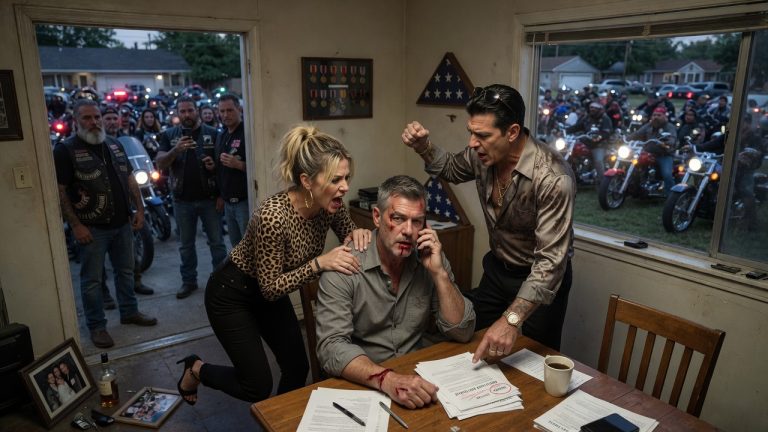
A black SUV pulled into the gravel lot, kicking up a cloud of dust that choked the air. Marcus stepped out, followed by a man in a sheriff’s uniform and two guys in hard hats. Marcus was holding a folder, a predatory glint in his eyes.
He walked into the Refuge like he owned the air we were breathing. “Noon,” he said, checking his gold watch. “The bank has officially transferred the title to my firm due to non-payment of the emergency lien.”
“We still have two hours,” I said, stepping forward. My shirt was stained with oil, my hands black with carbon.
“Two hours won’t find you a quarter-million dollars, Rhodes,” Marcus sneered. He turned to the Sheriff. “Can we begin the clearing process? I want the kitchen equipment inventoried.”
“Wait,” I said. My heart was thumping against my ribs like a trapped bird.
I looked at Sarah. She looked defeated. Her shoulders, which had carried the weight of a hundred broken souls, were finally slumped. Then I looked at Caleb. He was watching Marcus with a look of pure, unadulterated fear—the fear of a child who knows the sidewalk is coming.
I realized then that I wasn’t waiting for a milkshake. I was waiting for a man who would never come. And because he never came, I had to be the man who arrived.
“The debt is paid,” I said clearly.
The room went silent. The only sound was the hum of the refrigerator.
Marcus laughed—a sharp, ugly sound. “With what? Your collection of rusty wrenches? The bank records were checked an hour ago. No deposit.”
“Check again,” I said, pulling my phone from my pocket and turning the screen toward him.