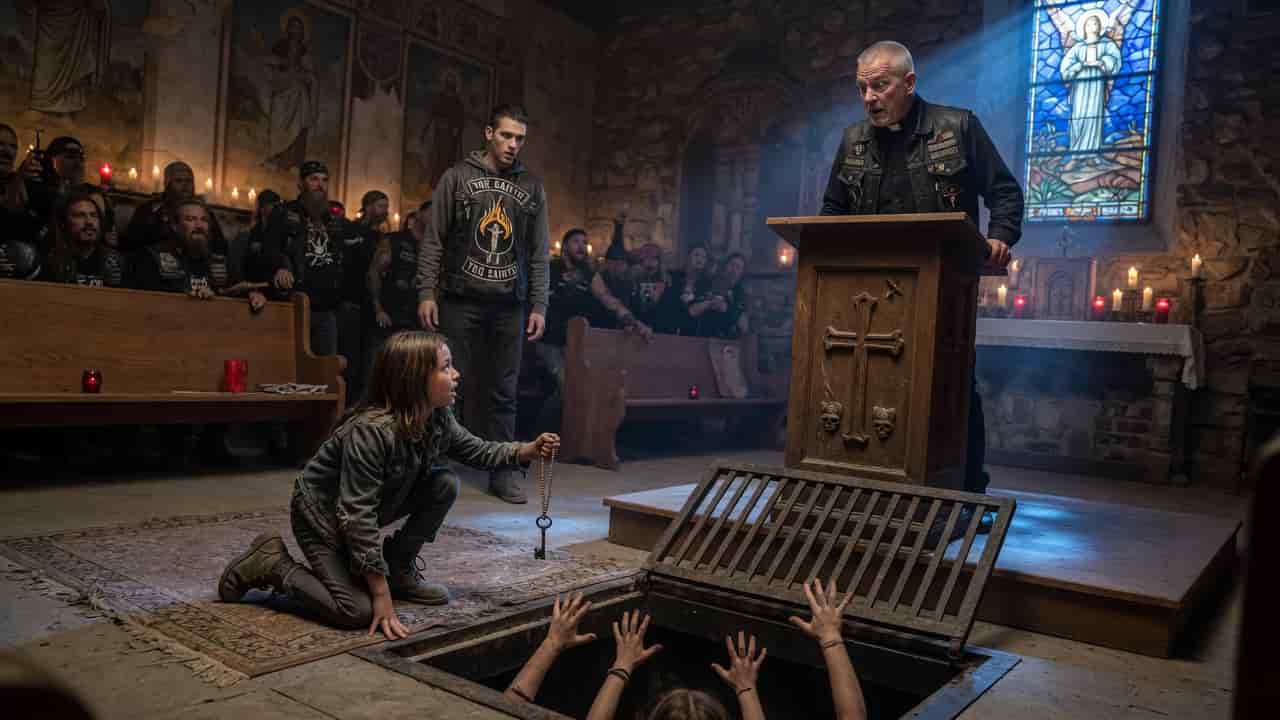
Deacon Saint didn’t shout. He didn’t have to. His voice had that low, vibrating authority that usually made grown men—hardened men with records and scars—drop their heads in shame. He stood behind his pulpit, the silver cross on his vest catching the candlelight, looking every bit like the savior he claimed to be.
But Mia didn’t move. Her small hands were locked onto the iron ring of the hidden grate, the gold key she’d swiped from Deacon’s neck glinting between her fingers.
“They’re down there, Deacon,” she whispered, her voice cracking the heavy silence of the monastery. “The ones you said went to a better place. They never left.”
The room went tomb-quiet. Caleb, the youngest of the Saints, stepped forward, his eyes darting between the girl and the man he’d called Father for three years. He saw the way Deacon’s hand was white-knuckling the edge of the oak pulpit. He saw the sweat on the “Saint’s” upper lip.
“Deacon?” Caleb’s voice was a plea for a lie he could still believe. “Tell her she’s wrong. Tell us all she’s wrong.”
Instead of answering, Deacon lunged. It wasn’t the movement of a man of God; it was the strike of a cornered predator. He reached for the girl, his face twisted into something unrecognizable, but the brotherhood he’d built on a lie was already beginning to fracture.
What happens when the man who saved your soul is the one selling others into the dark?
Chapter 1: The Aura of the Saint
The air inside the San Pedro Monastery didn’t smell like incense anymore; it smelled like primary drive oil, stale coffee, and the heavy, ozone scent of a desert storm rolling in from the Sangre de Cristo Mountains. It was a cavernous space, all vaulted stone and thick shadows, but the men sitting in the pews weren’t monks. They were “The Saints.” Fifty men in matching leather vests, their knuckles scarred, their eyes fixed on the man at the front of the room.
Deacon Saint didn’t look like a king, which was exactly why they worshipped him. He looked like a man who had walked through the fire and decided the heat was nothing to fear. He stood behind a pulpit he’d built himself from reclaimed cedar, wearing a clerical collar that looked stark and white against the rugged black leather of his MC vest. He was fifty-five, with a face that looked like it had been carved out of the New Mexico rimrock with a dull knife.
“Discipline is not a burden,” Deacon said, his voice a smooth, low-frequency rumble that seemed to vibrate the very floorboards. “Discipline is the fence that keeps the wolves from the fold. And in this world, brothers, you are either the shepherd, the sheep, or the wolf. We chose the staff. We chose the narrow road.”
In the third row, Caleb felt a familiar swell of pride in his chest. At twenty-four, he was the youngest full-patch member of the Saints. Three years ago, he’d been a shivering wreck in a county lockup, coming off a three-week meth bender that should have killed him. Deacon had appeared like a ghost in the visiting room—not to preach, but to offer a job. A job that came with a bed, a brotherhood, and a single, non-negotiable rule: absolute sobriety of body and mind.
Caleb looked at the man beside him, a giant of a man named “Cross” whose neck was a roadmap of faded prison ink. Cross was nodding, his eyes wet. This was the miracle of the Saints. Deacon took the men the world had discarded—the felons, the addicts, the broken soldiers—and gave them a monastery. He gave them a purpose that didn’t involve a needle or a Glock.
“Tonight, we prepare for the Charity Run,” Deacon continued, his hands resting lightly on the cedar. “Twelve trucks. Food, medical supplies, and hope for the mountain villages. They think the world has forgotten them. We will show them that the Saints remember.”
From the shadows of the side aisle, a small figure emerged. Mia, a ten-year-old girl with hair the color of parched earth, moved silently toward the dais. She was the “Anchor” of the monastery, the daughter of a member who had passed away two years ago. Deacon had taken her in, becoming the only father she knew. She usually sat at his feet during the sermons, a quiet reminder of what they were protecting.
But today, Mia didn’t sit. She stood at the edge of the dais, her eyes fixed on the heavy gold chain around Deacon’s neck. A single, ornate key hung from it, resting against his sternum. Caleb noticed she looked pale, her small shoulders bunched as if she were bracing for a blow.
“Deacon,” she whispered. It was a tiny sound, but in the hush of the monastery, it carried.
Deacon didn’t look down at her immediately. He finished his sentence, his eyes locked on the back of the room. “We leave at midnight. Check your bikes. Check your hearts.” Only then did he turn his gaze to the girl. His expression softened into a mask of paternal tenderness that made Caleb’s throat tighten.
“Not now, little one,” Deacon said softly, reaching out to pat her head. “The brothers are working.”
“The floor,” Mia said, her voice slightly louder. “It’s making the noise again.”
A flicker—something so fast Caleb almost missed it—passed over Deacon’s face. A tightening of the jaw, a microscopic hardening of the eyes. Then it was gone, replaced by a weary smile.
“The wind in the cellars, Mia. This place is old. It has many voices.” He looked back at the pews. “Dismissed.”
The room erupted into the sound of scraping boots and low murmurs. Caleb stood, stretching his lean frame, but his eyes stayed on Mia. She hadn’t moved. She was still staring at the floor, specifically the spot where a heavy, faded Persian rug covered the center of the stone aisle.
“Hey, kid,” Caleb said, walking over as the room emptied. He kept his voice light. “You look like you saw a ghost. You want to go check the bikes? I think the Indian is leaking a little oil.”
Mia didn’t look at him. “It’s not the wind, Caleb. The wind doesn’t beg.”
Caleb frowned, a chill that had nothing to do with the mountain air prickling his neck. “What are you talking about?”
“Mia!” Deacon’s voice barked from the sacristy door. It wasn’t the voice of a shepherd. It was sharp, cold, and carried a weight of command that made the girl flinch. “Go to your room. Now.”
Mia turned and bolted, her oversized boots clattering on the stone.
Deacon stepped back into the light, smoothing his vest. He looked at Caleb, his expression unreadable. “She has an overactive imagination, son. Too many old stories. Go help Cross with the crates. We have a long night ahead.”
Caleb nodded, the habit of obedience pulling him toward the exit. But as he walked away, he looked back. Deacon was standing perfectly still on the dais, staring down at the Persian rug. He reached up and gripped the gold key on his chest, his knuckles white, his lips moving in a silent prayer that looked more like a curse.
Outside, the New Mexico sun was dipping behind the peaks, turning the sky the color of a fresh bruise. A black SUV was parked a hundred yards down the dirt track that led to the monastery. Inside, a man named Vance sat with a long-lens camera, his breath fogging the window.
Vance was a private investigator, but that was just the title on his license. In his head, he was a debt collector. Ten years ago, a young pastor in a different state had convinced a congregation to invest their life savings into a “spiritual retreat” that never materialized. The pastor had vanished, along with the money and three young women from the choir.
Vance adjusted the focus on his lens. He caught a glimpse of a man in a clerical collar and a leather vest stepping out onto the monastery balcony.
“Found you, Saint,” Vance whispered to the empty car. He tapped a file on the passenger seat. It was filled with missing person reports, all from towns where the “Saints” had performed their charity runs.
He didn’t have proof yet. All he had was a pattern of disappearances and a man who looked exactly like a ghost from a decade ago. But he knew one thing about saints: they were usually just sinners who hadn’t been caught yet.
Inside the garage, the sound of wrenches on metal and the low hum of voices filled the air. Caleb was loading crates of “medical supplies” into the back of a refrigerated truck. The crates were heavy—unusually heavy for bandages and antibiotics.
“Easy with that one,” “Sin,” the club’s logistics man, said, stepping into the light. Sin was a wiry man with nervous eyes and a twitch in his left cheek. He never rode, but Deacon trusted him with the books. “The Deacon wants these handled with care.”
“What’s in here, Sin?” Caleb asked, wiping grease from his forehead. “Feels like lead.”
“The weight of salvation, kid,” Sin said, a jagged smile touching his lips. “Just do your job and don’t ask questions. You want to stay on the narrow road, don’t you?”
Caleb looked at the crate. A small, rhythmic thumping sounded from somewhere deep inside the truck. It was faint, like a heartbeat.
“You hear that?” Caleb asked.
Sin stepped closer, his presence suddenly suffocating. He smelled like peppermint and fear. “I don’t hear a damn thing, Caleb. And neither do you. Right?”
Caleb looked into Sin’s eyes and saw a bottomless, cold vacuum. The loyalty that had been his anchor for three years suddenly felt like a noose.
“Right,” Caleb said, his voice a hollow echo. “I don’t hear a thing.”
But as he walked back to the monastery to grab his gear, all he could think about was Mia’s face and the way she’d said the wind didn’t beg. The storm was coming, and for the first time in his life, Caleb wasn’t sure if the monastery walls were there to keep the world out, or to keep the monsters in.
Chapter 2: The Cracks in the Plaster
The “Nun” was what everyone called Elena, though she had never taken a vow in her life. She was forty, with sharp, intelligent eyes and a way of moving through the monastery like she owned the air. She handled the finances, the “donations,” and the delicate internal politics of the Saints. While Deacon provided the soul, Elena provided the iron.
She found Deacon in his private study, a room lined with leather-bound Bibles and architectural blueprints of the monastery’s sprawling subterranean levels. The room was cold, the only heat coming from a small electric heater that hummed in the corner.
“The shipment is loaded,” Elena said, leaning against the doorframe. She watched him as he stared at a ledger. “Sin says the boy is asking questions.”
Deacon didn’t look up. “Caleb? He’s a good boy. He’s just young. He thinks the world is a simple place because I’ve made it simple for him.”
“Simple people are dangerous, Deacon. They break when they find out things are complicated.” Elena walked over and placed a hand on his shoulder. “Vance is back. He’s in the black SUV by the trailhead. He’s been there for six hours.”
Deacon finally looked up. The “Saint” mask was off. His face looked older, more predatory. “Vance is a mosquito. He’s been chasing me for a long time. He thinks he’s an instrument of justice, but he’s just a man who can’t let go of the past.”
“He’s getting close to the mountain routes,” she warned. “If he follows the trucks tonight…”
“He won’t,” Deacon said, his voice dropping an octave. “Cross will handle the perimeter. We have a schedule to keep, Elena. The buyers are waiting in Juarez. If we’re late, the price drops. And we need the capital for the expansion.”
“And the girl?”
Deacon’s expression shifted, a flicker of genuine irritation crossing his features. “Mia is becoming a problem. She hears too much. She’s been spending too much time near the ventilation shafts in the cellar.”
“Maybe it’s time she joined her father,” Elena said, her voice as flat as a desert horizon.
Deacon stood abruptly, the chair scraping harshly against the stone. “No. She’s the only thing in this place that doesn’t feel like a transaction. I’ll talk to her. I’ll make her understand.”
“You can’t pray away a witness, Deacon,” Elena said, but he was already moving past her, the gold key swinging rhythmically against his chest.
Downstairs, in the communal kitchen, Caleb was sitting with a lukewarm cup of coffee, his mind a chaotic mess of gear ratios and muffled thumps. The monastery was supposed to be a sanctuary of truth, but the air felt thick with lies. He watched “Nun” Elena walk through the kitchen, her face a mask of cold efficiency. No one talked to her unless they had to.
He felt a small hand tug on his sleeve. It was Mia. She looked terrified, her eyes darting toward the security cameras mounted in the corners of the ceiling.
“Caleb,” she whispered, pulling him toward the pantry.
“Mia, I told you, I have to get the bike ready—”
“I saw them,” she hissed, her voice trembling. “Under the church. Not through the vents. I saw them through the crack in the door when Sin went down there.”
Caleb’s heart hammered against his ribs. “Saw what, Mia?”
“People. Women. They were sitting on the floor in the dark. They had tape on their mouths, Caleb. They looked like… like they were waiting to be thrown away.”
Caleb felt a wave of nausea. He thought of the “Charity Run.” The refrigerated trucks. The heavy crates. The mountain villages that supposedly needed “medical supplies.” The logic of the last three years began to unravel like a rotted shroud.
“Are you sure?” he asked, his voice barely audible.
“I have the key,” she said, opening her hand.
Caleb stared. It wasn’t the gold key from Deacon’s neck. It was a silver backup, an old skeletal thing she must have scavenged from the desk in the sacristy.
“Mia, give that to me,” Caleb said, his voice rising in panic. “If Deacon finds out you have that—”
“He’s coming!” Mia whispered, shoving the key into her pocket and darting back toward the kitchen table just as Deacon entered the room.
The atmosphere changed instantly. The other bikers who had been lounging in the kitchen stood up, a collective reflex of respect. Deacon walked to the center of the room, his eyes scanning the faces of his “sons.”
“Caleb,” Deacon said, his voice warm and paternal again. “A word.”
Caleb followed him out into the courtyard. The storm had arrived, a fine, stinging rain turning the dust into mud. Deacon stopped by a statue of St. Peter, the patron saint of the monastery.
“You’ve been quiet today, son,” Deacon said, looking up at the stone saint. “Something weighing on you?”
Caleb looked at the man who had saved him from the gutter. He wanted to ask about the crates. He wanted to ask about the women in the cellar. But he looked at the silver cross on Deacon’s vest and the steady, calm light in his eyes, and he felt the crushing weight of his own debt.
“Just the weather, Deacon. Worried about the mountain passes.”
Deacon nodded, placing a heavy hand on Caleb’s shoulder. “The road is always treacherous, Caleb. That’s why we ride together. But I need to know your heart is pure. Any doubts? Any shadows?”
The pressure of Deacon’s hand felt like a physical weight, a warning disguised as a blessing. Caleb realized then that the “discipline” Deacon preached wasn’t about saving them. It was about breaking them so they could be rebuilt into weapons.
“No shadows, Deacon,” Caleb lied.
“Good,” Deacon said. He leaned in closer, his breath warm against Caleb’s ear. “Because the Lord has no use for a lukewarm soul. If you see something you don’t understand, you come to me. Not to the brothers. Not to the girl. To me. Do you understand?”
“Yes, Deacon.”
“Go get your gear. We ride in an hour.”
As Caleb walked toward the garage, his boots splashing in the mud, he saw Cross standing by the main gate, a heavy wrench in his hand, watching the road where the black SUV was parked.
Caleb realized he was trapped. If he spoke up, he was a traitor to the only family he had left. If he stayed silent, he was an accomplice to something that made the “sins” of his past look like child’s play.
He reached into his pocket and felt the cold, hard shape of his cell phone. He thought of the PI, Vance. He thought of the women in the dark.
The residue of his conversation with Deacon felt like grease on his skin—something that wouldn’t wash off. He wasn’t a Saint anymore. He was just a man in a leather vest, waiting for the floor to give way.
Chapter 3: The Weight of the Key
The “Sobriety Vigil” was held once a month, a grueling four-hour session of prayer and public confession designed to keep the brothers “grounded.” Tonight, the atmosphere was particularly jagged. The Charity Run was only hours away, and the pressure of the impending “mission” had everyone on edge.
Deacon stood at the pulpit, the gold key glinting in the candlelight. He looked tired, but his voice was as sharp as a razor.
“We have a brother among us who has stumbled,” Deacon announced, his eyes moving like searchlights across the pews.
The room went cold. Caleb felt his stomach drop. He looked at “Greasy” Pete, a man in his fifties who had been with the club since the beginning. Pete was trembling, his head bowed so low his chin touched his chest.
“Pete,” Deacon said softly. “Stand up.”
Pete stood, his legs shaking. He looked like a man walking to the gallows.
“Tell the brothers what you brought into this sanctuary, Pete.”
“It was… it was just a pint, Deacon,” Pete whispered. “I had a bad night. My sister called, she’s sick, and I—”
“A pint of poison,” Deacon interrupted, his voice rising. “A pint of weakness. You brought the wolf into the fold, Pete. You told the brothers you were whole, but you were rot.”
Deacon stepped down from the dais and walked toward Pete. The silence in the monastery was absolute, save for the rhythmic drumming of the rain on the roof. Deacon reached into his vest and pulled out a small glass bottle. He held it up for everyone to see.
“This is what Pete values more than his brothers,” Deacon said. He handed the bottle to Pete. “Open it.”
Pete’s hands shook so hard the glass clinked against his wedding ring. He unscrewed the cap. The smell of cheap bourbon wafted through the front rows.
“Now,” Deacon said, his voice dropping back to a whisper. “Pour it out. On your boots. In front of your brothers. Show them what your ‘recovery’ looks like.”
Pete hesitated. For a second, a spark of defiance flickered in his eyes, but it was quickly snuffed out by the sheer weight of the collective gaze of fifty men. He tilted the bottle. The amber liquid splashed over his worn leather boots, soaking into the stone floor.
“I’m sorry,” Pete sobbed, the sound echoing off the high vaults. “I’m so sorry, Deacon.”
“Don’t apologize to me,” Deacon snapped. “Apologize to the man you were supposed to become.”
Deacon turned back to the pews, his face a mask of righteous fury. “This is why we need the fence! This is why we need the rules! Because without them, you are all just Greasy Pete, drowning in a pint of your own failure!”
Caleb felt a surge of hot, oily shame. Not for Pete, but for himself. He watched Deacon humiliate a man who had given him a decade of loyalty, all under the guise of “spiritual growth.” It was bullying, pure and simple, wrapped in the language of redemption.
As the vigil continued, Caleb felt a vibration in his pocket. A text message. He leaned back into the shadows of the pillar and checked his phone.
Vance: I know what’s in the trucks, Caleb. I know about the ‘Saints’ in Juarez. If you don’t help me, you’re going down with him. Meet me at the perimeter fence. Ten minutes.
Caleb looked up. Deacon was watching him. Or was he? The shadows made it hard to tell. Caleb stood up, moving quietly toward the back of the room. He slipped out the side door into the rain.
He found Vance crouched near a gap in the chain-link fence, a mile from the monastery buildings. The PI looked haggard, his face streaked with mud.
“You’re late,” Vance said, his voice a gravelly whisper.
“I shouldn’t be here,” Caleb said. “If they find me—”
“If they find you, you’ll be lucky if they just kill you,” Vance said, shoving a folder into Caleb’s hands. “Look at the photos.”
Caleb flipped through them by the light of his phone. Pictures of the mountain villages the Saints visited. But they weren’t pictures of charity. They were pictures of empty houses, grieving families, and women who looked like they’d been erased from the world.
“They aren’t delivering supplies, Caleb,” Vance said. “They’re picking up ‘cargo.’ The trucks go up empty and come back full. Then they go to the monastery, and then they disappear across the border.”
Caleb felt the world tilting. The thumping in the truck. The women Mia had seen.
“What do you want from me?” Caleb asked, his voice breaking.
“The key,” Vance said. “The gold one around his neck. It opens the subterranean access. I’ve tried the vents, but they’re barred from the inside. I need to get in there tonight, before the trucks leave. If I can get photos of the basement, the FBI will move in.”
“I can’t get that key,” Caleb said. “He never takes it off.”
“Then find another way. The girl, Mia—she knows something. She’s been watching you.”
“Leave her out of this,” Caleb snapped.
“She’s already in it, kid. Deacon isn’t her father. He’s her jailer. He’s waiting for her to get old enough to become ‘cargo’ too.”
The thought hit Caleb like a physical blow. He remembered the way Deacon had looked at Mia—the “tenderness” that now looked like appraisal.
“I’ll help you,” Caleb said, his voice hardening. “But I do it my way.”
As he walked back to the monastery, Caleb saw a figure standing on the balcony of the bell tower. It was Deacon, silhouetted against the stormy sky. He looked like a dark god overlooking his kingdom.
Caleb realized the “residue” of the night wasn’t just shame anymore. It was a cold, sharp clarity. The fence wasn’t there to keep the wolves out. It was there to make sure the sheep couldn’t escape.
He entered the monastery through the kitchen. Mia was there, sitting at the table, a piece of cold toast in front of her. She looked up, and for the first time, Caleb didn’t see an orphan. He saw a survivor.
“Caleb,” she whispered.
“I need that silver key, Mia,” Caleb said, his voice steady. “And I need you to show me exactly where you saw the door.”
Mia reached into her pocket and pulled out the old iron key. “I’ll show you. But we have to be fast. Deacon is starting the Final Blessing.”
The Final Blessing. The moment when every member of the Saints would be in the chapel, their heads bowed, their eyes closed. It was the only window they had.
Caleb took the key. It felt heavy, like it was made of the sins of fifty men.
“Stay behind me,” Caleb said. “And if anyone sees us… run. Run to the fence. There’s a man there named Vance. Tell him the Saint has fallen.”
Chapter 4: The Night of the Vigil
The atmosphere in the chapel was suffocating. The air was thick with the scent of unwashed bodies and cheap tallow candles. Fifty bikers sat in the pews, their leather vests creaking as they shifted. This was the Final Blessing, the last ritual before the Charity Run.
Deacon Saint stood at the pulpit, his arms outstretched. The gold key hung from his neck, reflecting the flickering orange light. He looked magnificent, a figure of absolute power and deceptive grace.
“Brothers,” Deacon began, his voice a low, melodic hum. “Tonight, we carry the light into the darkness. We go where others fear to tread. We are the hands of the Lord, reaching into the mire to pull up the lost.”
In the back of the room, Caleb stood near the door, his heart hammering a frantic rhythm against his ribs. He felt the silver key in his pocket, a cold, hard secret pressing against his thigh. He looked at Mia, who was tucked into the shadow of a stone pillar. She looked like a ghost, her pale face barely visible in the gloom.
“Close your eyes,” Deacon commanded. “Bow your heads. Feel the weight of the mission. Feel the presence of the Saint.”
Fifty heads bowed. Fifty pairs of eyes closed.
Caleb signaled to Mia. They slipped out of the chapel and into the darkened hallway that led to the sacristy. The monastery was a labyrinth of cold stone and heavy doors, but Mia moved with a frightening familiarity. She led him to a small, unassuming door behind the main altar.
“In here,” she whispered.
Caleb inserted the silver key. It turned with a heavy, grinding sound that seemed loud enough to wake the dead. They stepped into a narrow, winding staircase that smelled of damp earth and something sweet and sickly—like rotting fruit.
“The ventilation,” Mia whispered, pointing to a small iron grate near the floor. “That’s where the crying comes from.”
Caleb knelt and looked through the grate. Below them was a vast, dimly lit cavern. He saw shadows moving. He heard the low, rhythmic thumping he’d heard in the truck, but here it was louder, more human. It was the sound of dozens of people shifting on thin mattresses.
He saw a woman’s face pass under a single swinging bulb. She looked hollowed out, her eyes wide with a vacancy that made Caleb’s blood run cold.
“Oh, God,” Caleb breathed.
“They’re leaving tonight,” Mia said, her voice trembling. “In the refrigerated trucks. Deacon told Elena the ‘new batch’ was ready.”
Caleb pulled out his phone, his fingers shaking as he took photos through the grate. The images were grainy, but the truth was unmistakable. He saw the crates—the ones he’d loaded—being opened. They weren’t full of medical supplies. They were fitted with oxygen tanks and small, cramped benches.
Suddenly, the sound of the sermon upstairs stopped. The silence that followed was even more terrifying than the noise.
“The blessing is over,” Caleb hissed. “We have to get out of here.”
They turned to head back up the stairs, but the door at the top creaked open. A shaft of light spilled down the stairwell, illuminating the dust motes dancing in the air.
“Caleb?”
It was Cross. The giant’s silhouette filled the doorway, his heavy boots thumping on the stone landing.
“What are you doing down here, kid? The Deacon is looking for you.”
Caleb shoved the phone into his pocket, his mind racing. “Mia… Mia thought she heard something. I was just checking the vents.”
Cross stepped down into the stairwell, his presence filling the narrow space. He looked at Mia, then back at Caleb. His eyes were narrowed, suspicious.
“The Deacon says the wind in the cellars is none of your concern. He says curiosity is a form of pride, Caleb. And we know what happens to proud men in this house.”
Cross reached out and grabbed Caleb’s arm. His grip was like a steel vice. “Give me the phone, Caleb.”
“I don’t know what you’re talking about, Cross.”
Cross slammed Caleb against the stone wall, the impact knocking the breath out of him. “Don’t lie to me. I saw the flash. You’re recording the ‘charity,’ aren’t you?”
Mia screamed and lunged at Cross, biting his hand. The giant roared in pain and swiped at her, knocking her back against the stairs.
“Run, Mia!” Caleb shouted, struggling against Cross’s grip.
Mia scrambled up and bolted past Cross, disappearing into the chapel.
“You little brat!” Cross snarled, turning to follow her, but Caleb tackled him, the two men tumbling down the stairs and into the dark corridor below.
In the chapel, the congregation was just beginning to stir. Deacon was still at the pulpit, his eyes scanning the room for Caleb. He saw Mia burst through the sacristy door, her face streaked with tears and dust. She didn’t stop until she reached the center aisle, standing right on top of the Persian rug.
“Deacon!” she shrieked.
The room went silent. Deacon’s face hardened, the paternal mask finally cracking. “Mia, I told you to stay in your room.”
“I have the key!” she cried, holding up the silver skeleton key. “And I know what’s under the rug!”
Deacon’s eyes went wide. He looked at the brothers, who were starting to murmur in confusion. He saw the doubt beginning to flicker in their eyes—the same doubt that had destroyed the pastor a decade ago.
“The girl is sick,” Deacon said, his voice cold and commanding. “Elena, take her away.”
Elena stepped forward, her face a mask of iron, but she was stopped by the sound of a heavy metallic thud from beneath the floor.
The Persian rug shifted. A hand—pale, thin, and desperate—pushed up from beneath the iron grate.
The murmurs in the pews turned into a roar of shock. Caleb emerged from the sacristy, his face bruised and bleeding, holding his phone high.
“Look at the screens!” Caleb shouted, his voice cracking with emotion. “Look at what our ‘Saint’ is selling!”
He hit ‘send’ on a group message he’d prepared for the club’s internal server. Fifty phones chimed at once. Fifty men looked down and saw the photos of the cellar, the crates, and the hollowed-out faces of the women Deacon had promised to “save.”
Deacon stood at the pulpit, his kingdom collapsing around him in a matter of seconds. He reached for the gold key on his chest, but he wasn’t praying. He was looking for a way out.
“It’s a lie!” Deacon shouted, his voice cracking. “Caleb is a plant! He’s working with the police!”
But the brothers weren’t looking at Caleb anymore. They were looking at the iron grate, where the pale hands were still reaching upward.
Cross emerged from the sacristy, looking at Deacon with a mixture of betrayal and predatory hunger. The giant who had been Deacon’s most loyal hound was the first to realize that the shepherd was just a wolf in a collar.
“Deacon,” Cross said, his voice a low, dangerous rumble. “Open the floor. Let’s see what else is down there.”
Deacon backed into the pulpit, his face twisted into a snarl of pure, unadulterated rage. He looked at Mia, then at Caleb, his eyes burning with the realization that the silence was finally over.
The residue of the night was no longer shame or doubt. It was the cold, hard weight of a truth that could never be buried again. The San Pedro Monastery was no longer a sanctuary. It was a crime scene.
And the Saint was just a man, standing on a trapdoor that was finally beginning to open.
Chapter 5: The Shattered Altar
The sound that filled the San Pedro Monastery wasn’t a roar; it was a collective intake of breath, fifty men suddenly realizing the floor they stood on was built of bone and lies. Then came the chimes—a discordant, digital symphony of betrayal as Caleb’s photos hit fifty different screens. The images were jagged and poorly lit, but the truth didn’t need high resolution. It showed the steel cages, the zip-ties, and the terrified, sunken eyes of women who had been marketed as “lost souls” being found.
Deacon Saint stood behind his cedar pulpit, his hands still raised in a mock blessing that now looked like the reach of a drowning man. The flickering candlelight cast long, monstrous shadows against the stone walls, making him look less like a shepherd and more like a gargoyle.
“It’s a fabrication!” Deacon’s voice cracked, the smooth, melodic resonance replaced by a shrill, desperate edge. “Caleb has been compromised! He’s trying to destroy the brotherhood we’ve built! He’s working for the people who want to see you back in cages!”
It was a good play—the old play. He was trying to pivot the anger, to remind these men that the world outside hated them. For a heartbeat, it almost worked. A few of the younger patches looked toward Caleb with teeth bared, their hands drifting toward the knives at their belts.
But then there was Cross.
The giant biker didn’t look at his phone. He didn’t have to. He was staring at the iron grate where the small, pale hand was still gripped around a rusted bar. Cross had been Deacon’s shadow for ten years. He had broken bones for this man. He had believed that the “narrow road” was the only thing keeping him from the animal he used to be.
Cross walked toward the pulpit. His boots made a heavy, rhythmic thud on the stone that seemed to silence the room. He didn’t look angry; he looked hollowed out, as if someone had reached inside him and pulled out his spine.
“Deacon,” Cross said, his voice a low, vibrating growl. “Open the floor.”
“Cross, listen to me—”
“Open the floor, or I’ll open you,” Cross said. He wasn’t shouting. That was the terrifying part. He reached out and grabbed the edge of the cedar pulpit, his massive knuckles turning white. With a sudden, violent heave, he swiped the pulpit off the dais. It crashed into the front pew, splintering the wood and sending Bibles flying like startled birds.
Deacon backed away, his “Saint” vest fluttering. He looked small now, stripped of his wooden fortress. He reached for the gold key around his neck, his fingers fumbling with the chain.
“Elena!” Deacon screamed.
The “Nun” appeared from the sacristy, but she wasn’t coming to pray. She had a compact 9mm in her hand, the barrel leveled at the crowd. Her face was a mask of cold, professional indifference. She didn’t care about the theology or the brotherhood; she cared about the margins. And the margins were currently being erased.
“Back off!” Elena shouted. “Everyone back into the pews! Now!”
The room froze. The Saints were hard men, but they knew the sound of a safety being clicked off. Caleb felt the cold sweat stinging his eyes. He was standing near the side aisle, his arm protectively around Mia. The girl was shaking so hard he could feel her bones vibrating against his side.
“Caleb, get the girl out of here,” Cross commanded, never taking his eyes off Deacon.
“I’m not leaving the others,” Caleb said, his voice surprisingly steady. “They’re right under us, Cross. The trucks are idling in the yard. If we don’t stop this now, they’re gone.”
“Go,” Cross repeated. “I’ve got the Saint.”
Elena fired a warning shot into the vaulted ceiling. The crack of the gunshot was deafening in the stone chamber, sending a shower of plaster dust raining down like gray snow. In the confusion, Deacon bolted. He didn’t go for the front doors; he disappeared through the small door behind the altar, the one that led to his private study and the deeper tunnels.
“He’s going to the cellar!” Mia shrieked. “He’s going to lock them in!”
Caleb didn’t think. He pushed Mia toward a group of older bikers who looked more confused than hostile. “Keep her safe! If you ever believed in anything this club stood for, keep her safe!”
He turned and ran toward the altar. Elena pivoted to aim at him, but Sin, the twitchy logistics man, suddenly grabbed her arm. Sin wasn’t a hero—he was a rat who smelled a sinking ship. He knew that if the women were found, his only hope was to be the one who helped the “rescue.”
“Let him go, Elena!” Sin hissed. “It’s over! Look at them!”
The bikers were no longer sitting. They were surging forward, a wave of leather and rage that no single handgun could stop. Elena looked at the sea of scarred faces and saw the end of her empire. she lowered the gun, her expression shifting from defiance to a cold, calculating survivalism.
Caleb burst through the sacristy door. The air here was colder, smelling of the wet stone and the ozone of the storm. He could hear the frantic clatter of boots on the stairs below. He followed the sound, his breath coming in ragged gasps.
He reached the landing and saw Deacon at the bottom of the spiral staircase. The “Saint” was no longer graceful. He was frantic, his silver hair disheveled, his clerical collar torn open. He was shoving a heavy iron bolt into place on a reinforced steel door—the main entrance to the holding area.
“Deacon! Stop!” Caleb yelled, leaping from the last three steps.
He tackled the older man, the two of them crashing into the damp stone floor. The gold key on Deacon’s neck caught on Caleb’s vest, the chain snapping with a sharp clink. The key skittered across the floor, disappearing into the shadows.
Deacon fought with the desperation of a man who knew the gallows were waiting. He gouged at Caleb’s eyes, his fingernails drawing blood. “You ungrateful little addict!” Deacon hissed, his face inches from Caleb’s. “I gave you a life! I gave you a name! You were nothing before me!”
“I was a human being!” Caleb roared, slamming his forehead into Deacon’s nose.
The crunch of cartilage was sickeningly loud. Deacon slumped back, his nose erupting in a crimson spray. Caleb scrambled up, looking for the key, but the darkness of the cellar was absolute. The only light came from the single bulb hanging above the steel door.
Inside the room, the sounds of panic had turned into a terrifying silence. The women knew someone was outside. They knew the “Saint” was there. Caleb hammered on the door.
“It’s okay! I’m here to help! My name is Caleb!”
A muffled voice, thin and trembling, came from the other side. “He said… he said he was taking us to the hospital. He said we were sick.”
Caleb felt a surge of pure, unfiltered hatred for the man moaning on the floor behind him. Deacon had weaponized their vulnerability. He had taken their hope and turned it into a cage.
“He lied,” Caleb said, his voice cracking. “He lied about everything.”
He heard movement behind him. Deacon was trying to stand, using the wall for support. His face was a mask of gore, his eyes burning with a zealot’s madness.
“You think you’re the hero, Caleb?” Deacon spat out a mouthful of blood. “You think these men will just go home? They’re Saints because they have nowhere else to go. You’ve destroyed their only home. You’ve left them in the desert with nothing but their sins.”
“Better to be a sinner in the light than a saint in the dark,” Caleb said.
He found a heavy iron crowbar leaning against a stack of crates—the “charity” crates. He jammed the end of the bar into the doorframe and heaved. The metal groaned, the screws in the hinges beginning to scream under the pressure.
Deacon lunged one last time, reaching for the crowbar, but a massive hand suddenly clamped onto his shoulder and yanked him back.
It was Cross. The giant had followed them down, his leather vest dusty, his face set in a grim, immovable mask. He didn’t say a word. He simply lifted Deacon off the floor by his throat and pinned him against the stone wall.
“The key is gone, Cross,” Caleb said, still straining against the door. “Help me with this.”
Cross didn’t move. He was staring into Deacon’s eyes, watching the man who had been his god turn into a shivering coward.
“I killed for you,” Cross whispered. “I thought I was doing the Lord’s work. I thought I was earning my way back.”
“You were, Cross!” Deacon wheezed, his feet dangling inches off the floor. “The world is cruel! We were building something… something safe!”
“Safe for who?” Cross asked. He tightened his grip. “The women? The girl? Or just for you and your ledgers?”
With a final, violent crack, the steel door gave way. It swung open, revealing the horrific reality of the San Pedro “charity.”
Twenty women were huddled in the corner of a room that looked like a meat locker. They were wrapped in thin blankets, their faces pale and etched with a trauma that Caleb knew would never fully heal. The air was thick with the smell of fear and recycled oxygen.
Caleb stepped into the room, dropping the crowbar. He held up his hands, palms open. “It’s over. You’re safe now. We’re getting you out.”
The women didn’t move at first. They looked at Caleb’s leather vest, at the “SAINTS” rocker on his back, and they saw the enemy.
“I’m not one of them,” Caleb said, his voice breaking. “I’m not… I’m not a Saint. I’m just a man who’s sorry. I’m so, so sorry.”
One woman, the one he’d seen through the vent, stepped forward. She looked at the open door, then at the bruised, bleeding young man in front of her. She reached out and touched his hand. Her skin was like ice.
“Is the man with the silver hair gone?” she asked.
Caleb looked back at the hallway. Cross was still holding Deacon against the wall, but he wasn’t choking him anymore. He was just holding him there, forcing him to watch as the victims he had hidden in the dark walked out into the light.
“He’s gone,” Caleb said. “He was never really there at all.”
As he led the women up the stairs, Caleb saw the “residue” of the night everywhere. The monastery was a wreck. The pews were overturned, the “holy” artifacts were smashed, and the brothers were standing in small, fractured groups, refusing to look at each other.
Vance, the PI, was waiting at the top of the stairs, a cadre of local deputies behind him. The storm was at its peak now, the rain lashing against the high stained-glass windows, but the air inside felt cleaner than it had in years.
Vance looked at Caleb, then at the line of women emerging from the cellar. He nodded once—a silent acknowledgment of a debt paid.
“You did good, kid,” Vance said.
“I didn’t do anything,” Caleb said, his eyes finding Mia in the crowd. She was sitting on a crate, wrapped in a biker’s jacket that was three sizes too big for her. She looked at him, and for the first time, her eyes weren’t searching for ghosts.
“I just stopped listening to the wind.”
But as the deputies began to lead the women toward the waiting ambulances, Caleb looked back at the sacristy. Cross was coming up the stairs alone.
“Where is he?” Caleb asked.
Cross wiped a smear of blood from his cheek. He looked out at the desert, where the lightning was illuminating the jagged peaks of the mountains.
“He’s in the cellar,” Cross said, his voice devoid of emotion. “He wanted to stay with his ‘cargo.’ I figured that was the most holy thing I could do for him.”
Caleb didn’t ask for details. He didn’t want to know. The Saint was gone, and all that was left was the long, hard road of the truth.
Chapter 6: The Ghost of San Pedro
The sun rose over the New Mexico desert with a cruel, indifferent beauty. The clouds had broken, leaving the sky a brilliant, heartless turquoise that made the charred remains of the monastery’s garage look like an open wound. The San Pedro Monastery was no longer a sanctuary; it was a hive of forensic teams, federal agents, and news crews who had arrived with the dawn like vultures to a kill.
Caleb sat on the back of an ambulance, a shock blanket draped over his shoulders. His hands were stained with grease, blood, and the fine gray dust of the chapel ceiling. Every muscle in his body felt like it had been shredded and stitched back together with rusty wire.
He watched as the “Nun” Elena was led away in handcuffs. She didn’t look like a villain; she looked like a CEO whose company had just gone bankrupt. She didn’t look at the cameras, and she didn’t look at the brothers she had helped deceive. She just stared at the horizon, already calculating her legal defense.
Sin was gone. He’d vanished into the desert the moment the deputies arrived, taking a club truck and whatever cash was in the petty safe. No one was looking for him yet. There were bigger fish to fry.
Vance walked over, a paper cup of black coffee in each hand. He handed one to Caleb.
“The feds found the ledgers,” Vance said, leaning against the ambulance. “Deacon was thorough. He had names, dates, bank accounts. He wasn’t just moving people; he was running a franchise. This place was just the hub.”
Caleb took a sip of the coffee. It was bitter and scorched, but it helped ground him. “And the women?”
“Most of them are from the mountain villages in Chihuahua. A few from the States. They’re being processed at the regional hospital. It’s going to be a long road for them, Caleb. A really long road.”
“I know,” Caleb said. He looked over at Mia. She was sitting in the front seat of a social services SUV, talking to a woman in a beige blazer. She looked small, but there was a new stillness in her posture. The fear hadn’t vanished, but the confusion had.
“What happens to the club?” Caleb asked.
Vance looked at the group of bikers huddling near the main gate. The “Saints” were no longer a brotherhood. They were just fifty men in matching vests who had realized their father was a monster. Some were crying. Some were staring at their boots in silent shame. Others were arguing, their voices rising in a desperate attempt to find someone else to blame.
“The club is dead,” Vance said. “The RICO charges will see to that. Most of these guys knew something was off, even if they didn’t know the scale. They’ll be talking for months just to stay out of a cage.”
Cross was standing apart from the others, his massive frame silhouetted against the rising sun. He hadn’t spoken since he’d come up from the cellar. He had surrendered his knife and his belt to the deputies without a word. He looked like a statue of a god whose religion had been proven a fraud.
Caleb stood up, the blanket slipping from his shoulders. He walked over to the giant.
“Cross,” Caleb said softly.
The big man turned. His eyes were bloodshot, the skin around them bruised and sagging. “He didn’t even fight at the end, Caleb. When he saw the women walking out… he just stopped. He just sat there on the floor and started reciting the Beatitudes. Like he still thought he was the one who wrote them.”
“He was a predator, Cross. He found men who wanted to be good and he used that to make himself powerful.”
Cross looked down at his hands—hands that had once held a Bible and a wrench with equal reverence. “I thought I was saved. I thought the patch meant I wasn’t the man I used to be.”
“The patch never did that, Cross. You did that. You’re the one who didn’t drink. You’re the one who kept the peace. Deacon just gave you a uniform for it.”
Cross let out a long, shuddering breath. He reached up and unbuttoned his leather vest. He pulled it off, staring at the “THE SAINTS” rocker on the back. It was a beautiful piece of embroidery—silver thread on black leather. It represented three years of sobriety, brotherhood, and a sense of belonging that Caleb had never found anywhere else.
Cross folded the vest neatly and laid it on the dusty ground.
“I’m going to go find my sister,” Cross said. “The one Pete was talking about. I haven’t seen her in six years. I told myself I couldn’t go back until I was ‘holy’ enough. I think I was wrong about what that meant.”
Caleb watched as the man he had once feared walked away toward the transport vans. One by one, the other bikers followed suit. They stripped off their vests, their “armor,” and left them in a pile in the center of the courtyard. It looked like a graveyard of leather.
Caleb looked down at his own vest. He felt the weight of it—the weight of the man Deacon had wanted him to be. He remembered the night Deacon had found him in the jail cell, promising him a “narrow road.” He realized now that the road wasn’t narrow because it was holy; it was narrow so you couldn’t see what was happening in the ditches.
He pulled the vest over his head. It felt lighter than it ever had before. He placed it on top of the pile, right next to Cross’s.
“Caleb?”
He turned. Mia was standing a few feet away, the social worker hovering behind her.
“They’re taking me to a place in Albuquerque,” Mia said. “It’s a big house with other kids.”
Caleb knelt so he was at eye level with her. “That’s good, Mia. It’ll be safe there. No cellars. No secrets.”
“Will you come see me?” she asked. Her voice was small, but it held a glimmer of the fierce girl who had heaved open that iron grate.
Caleb felt a lump form in his throat. He thought about his own future—the police statements, the court dates, the inevitable struggle to stay sober without the “fence” of the monastery. He was twenty-four years old, and he was starting over with nothing but a record and a head full of ghosts.
“I’ll come see you, Mia,” Caleb promised. “As soon as I can. We’ll go get some real food. Not monastery porridge. Maybe some of those blue corn pancakes you like.”
Mia smiled—a real, genuine smile that reached her eyes. She reached out and hugged him, her small arms squeezing his neck. “You were a good brother, Caleb. Even if you weren’t a very good Saint.”
“I think I’m okay with that,” Caleb whispered.
He watched the SUV drive away, the dust kicking up from its tires and blurring the image of the little girl waving from the back window.
Vance walked back over, jingling his car keys. “I’m heading back to the city. I’ve got a lot of paperwork and a very angry District Attorney to deal with. You need a lift?”
Caleb looked back at the monastery. The sun was fully up now, revealing every crack in the stone, every stain on the walls. The “Saint” was gone, hauled away in a black bag from the cellar, but the residue of his lies would linger in the desert for a long time.
He thought of the women in the hospital. He thought of the bikers who were now just men again. He thought of the gold key that was still lost somewhere in the dark of the basement.
“No,” Caleb said, looking down at his worn boots. “I think I’ll walk for a bit.”
“It’s a long way to the highway, kid.”
“I’ve walked longer roads,” Caleb said.
He started down the dirt track, the same one he had ridden up three years ago on a bike he didn’t own, toward a life he hadn’t earned. The desert was quiet now, the only sound the wind whistling through the sagebrush and the distant, fading siren of an ambulance.
He didn’t look back at the pile of leather vests. He didn’t look back at the stone cross on the bell tower. He just kept his eyes on the horizon, where the mountains met the sky.
The road ahead was uncertain, and the fence was gone. But for the first time in his life, Caleb Saint wasn’t afraid of the wolves. He knew that the only thing that could truly save a man wasn’t a monastery or a patch or a shepherd.
It was the willingness to stand in the light and admit that he was lost.
He reached the main road and stopped. He took a deep breath of the thin, high-altitude air. It didn’t smell like incense or oil. It just smelled like the desert—vast, unforgiving, and completely, beautifully free.
Caleb started walking. He didn’t know where he was going, but he knew he was finally on the right road. And this time, he was walking it for himself.