“Chapter 5: The Confrontation
“”I brought you some things,”” Sal said.
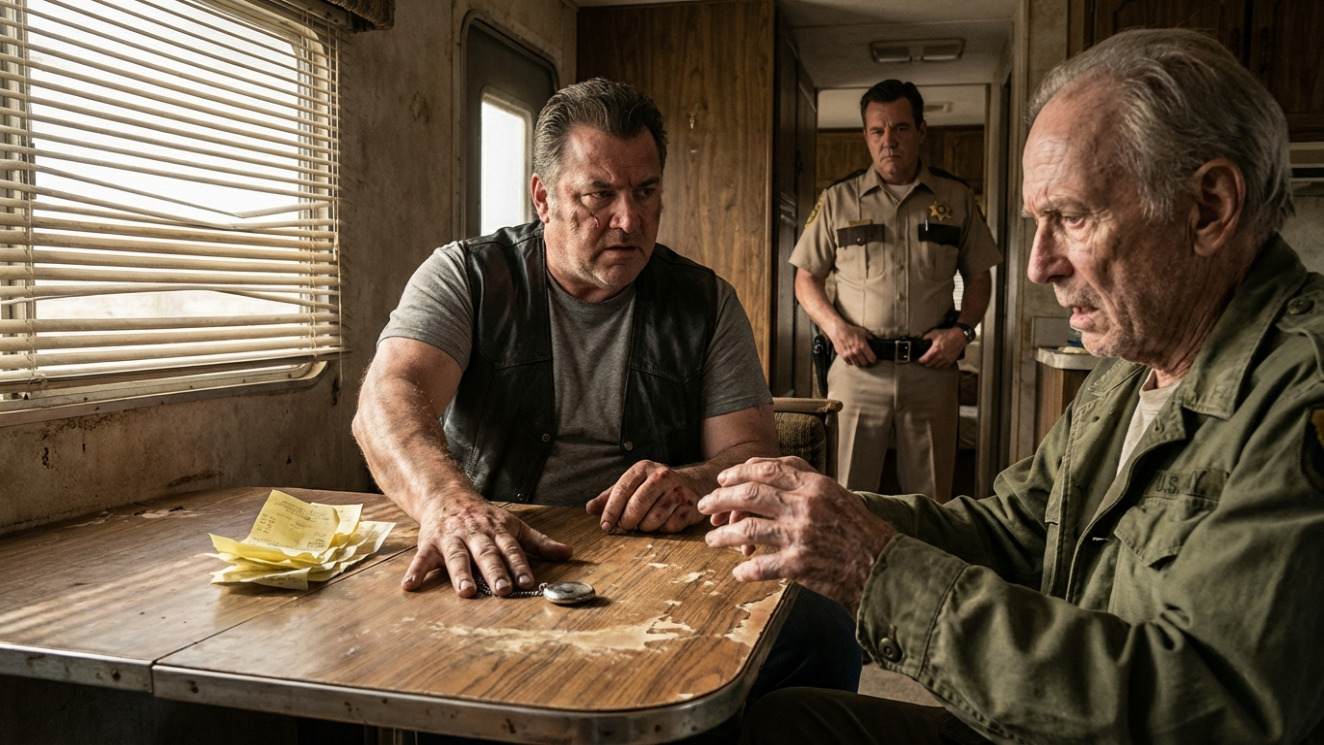
He reached into his vest. His hand was shaking. He pulled out the stack of yellow tax receipts and laid them on the table.
Elias looked at them, then at Sal. “”What’s this?””
“”The taxes,”” Sal said. “”Paid for. Every year since the fire. The land is yours, Elias. No one can take it. Not Vance, not the bank. It’s clear.””
Elias frowned, his brow furrowing. “”I don’t understand. Why would you… why would you do that? We aren’t kin, Sal.””
“”My father loved you,”” Sal said, his voice thick. “”He said you were the best man he ever knew.””
“”Your father was a good man,”” Elias said softly. “”But you… you’ve been a guardian angel to me, Sal. I don’t know why, but I thank God for you every night.””
The word angel felt like a brand. Sal felt the weight of the locket in his pocket. It felt like it was glowing, burning through the leather of his vest.
“”I’m no angel, Elias,”” Sal said.
He reached into his pocket and pulled out the charred silver locket. He slammed it onto the table next to the tax receipts.
The sound was deafening in the small space. Elias froze. He looked at the locket—the way the silver was warped by heat, the way the chain was fused together.
“”Where did you get this?”” Elias whispered.
“”I didn’t find it in the rubble,”” Sal said.
Outside, the crunch of gravel announced the arrival of the Sheriff. The blue and red lights began to dance across the trailer walls, casting long, distorted shadows.
“”I was there that night,”” Sal said, the words finally tumbling out. “”I didn’t come to save you. I came to burn the barn. I wanted to scare the crew that was using it. I didn’t care about the wind. I didn’t care about you.””
Elias looked up, his eyes swimming with a sudden, sharp clarity. “”What are you saying?””
“”I started the fire,”” Sal said. He was sweating now, the air in the trailer suddenly too thin to breathe. “”I burned your house down. I watched it happen. I only pulled you out because I couldn’t live with the murder. But I took the house. I took everything.””
Elias didn’t move. He didn’t scream. He just stared at the locket. His hand reached out, his fingers trembling as they touched the scorched metal.
“”Ten years,”” Elias whispered. “”I’ve been living in this tin can… I’ve been thanking you for ten years.””
“”I paid the taxes to keep my soul,”” Sal said, his voice breaking. “”I fought those kids because I couldn’t stand to see them do what I already did to you. But it’s a lie. All of it.””
The door to the trailer swung open. Sheriff Miller stepped inside, his badge glinting in the lamplight. He looked at the receipts. He looked at the locket.
“”Sal,”” Miller said. “”Time’s up.””
Sal didn’t look at his cousin. He kept his eyes on Elias. “”I’m sorry. I know it doesn’t mean a damn thing. But I’m sorry.””
Elias looked up. The shock was gone, replaced by a cold, hollow emptiness that was worse than anger. He looked at Sal not as a hero, and not even as a villain, but as a stranger.
“”Get out,”” Elias said.
“”Elias—””
“”Get out of my house,”” the old man repeated, his voice cracking. “”And take your money with you.””
He shoved the tax receipts off the table. They fluttered to the floor like dying birds.
Miller stepped forward and grabbed Sal’s arm. He didn’t use the handcuffs—not yet—but his grip was firm.
“”Come on, Sal,”” Miller said. “”Let’s go.””
As Sal was led out into the cold Nevada night, he looked back one last time. Elias was sitting at the table, clutching the charred locket to his chest, his head bowed. Scout was whimpering at his feet.
The sirens were quiet now, but the silence was heavier.
Chapter 6: The Bitter Absolution
The jail cell in Pahrump smelled of Pine-Sol and old sweat. Sal sat on the narrow cot, his back against the cold cinder block. He’d been there for six hours.
The door buzzed, and Maria walked in. She looked like she hadn’t slept in a week. She sat on the plastic chair on the other side of the glass.
“”They dropped the drug charges,”” she said.
Sal looked up, surprised. “”What?””
“”Miller,”” she said, a small, sad smile touching her lips. “”He found a way. He told Vance that if he pressed charges against you, he’d release the body-cam footage of his son dragging the dog. Vance didn’t want the publicity. He backed off.””
Sal felt a wave of relief, but it was quickly followed by a dark realization. “”And the assault?””
“”Community service and a fine,”” Maria said. “”Miller said you were ‘defending a vulnerable citizen.’ He’s taking a hit for you, Dad. He might lose his job over this.””
Sal leaned his forehead against the glass. “”I don’t deserve it.””
“”No,”” Maria said. “”You don’t. But Miller said the town needs a guardian angel, even if he’s a fake one.””
“”How’s Leo?””
“”He’s okay,”” she said. “”The judge heard about what you did. About the dog. He said it showed ‘strength of character.’ Brendan’s motion was denied. We’re safe, Dad.””
She reached out and touched the glass. “”But you have to stop. No more shipments. No more bikers. No more Elias.””
“”I know,”” Sal said.
He was released two days later. He walked out of the station into a bright, blinding sun. He drove his Chevy—which Miller had left in the parking lot—back to the shop.
He spent the afternoon cleaning. He threw away the manila envelopes. He scrubbed the grease off the benches. He felt like a man trying to wash away a ghost.
As evening fell, he found himself driving back toward County Road 14. He told himself he was just checking the perimeter. He told himself he wanted to make sure the kids hadn’t come back.
He pulled over fifty yards from the trailer.
The Raptor was gone. The desert was quiet. But something was different.
There was a new fence. A real one. Solid wood, built with the kind of craftsmanship that cost more than a year’s worth of property taxes. And in the driveway, there was a small, neat pile of construction materials.
Sal saw a figure moving near the trailer. It wasn’t Elias. It was a crew of men in tan uniforms—off-duty deputies. They were working on the foundation of a new house.
Miller was there, leaning against his cruiser, watching them. He saw Sal’s truck and walked over.
“”Vance didn’t just back off the charges,”” Miller said, lighting a cigarette. “”I made him pay for the materials. Professional ‘restitution’ for his son’s behavior. The guys and I are doing the labor.””
Sal looked at the house taking shape. It was small, but it was sturdy. It looked like the kind of place a man could grow old in.
“”Did he ask about me?”” Sal asked.
Miller shook his head. “”No. He won’t even say your name. He kept the locket, though.””
Sal looked toward the trailer. He saw Elias come out onto the small porch. The old man was holding a bowl of water for Scout. He looked toward the road, toward Sal’s truck.
For a long moment, their eyes met across the dusty expanse of the Nevada desert. There was no wave. No nod of forgiveness. There was only the weight of the past, as heavy and unyielding as the mountains.
Elias turned and went back inside.
“”He’s safe, Sal,”” Miller said. “”That’s what you wanted, right?””
“”Yeah,”” Sal said, his voice a whisper. “”That’s what I wanted.””
He put the truck in gear and turned around. He drove toward the lights of the town, leaving the dust and the debt behind. He was a man with a clean shop and a daughter who could keep her son.
He wasn’t a hero. He wasn’t an angel. He was just a man who had finally learned that some fires never go out—they just eventually run out of things to burn.
The road ahead was clear, lit by the moon, and for the first time in ten years, Big Sal Vitale didn’t look in the rearview mirror.”