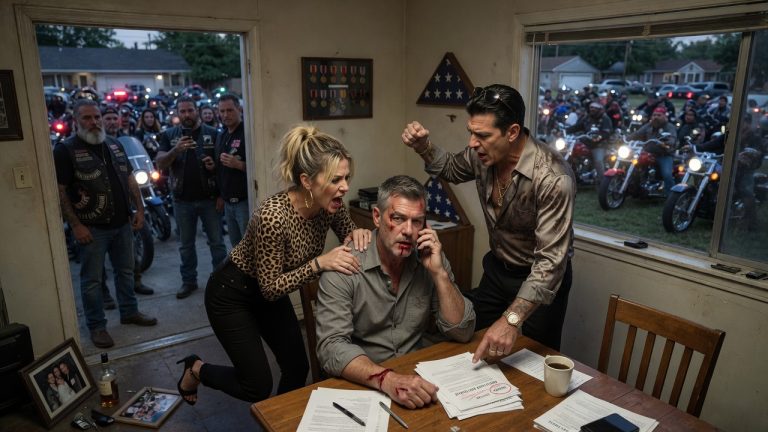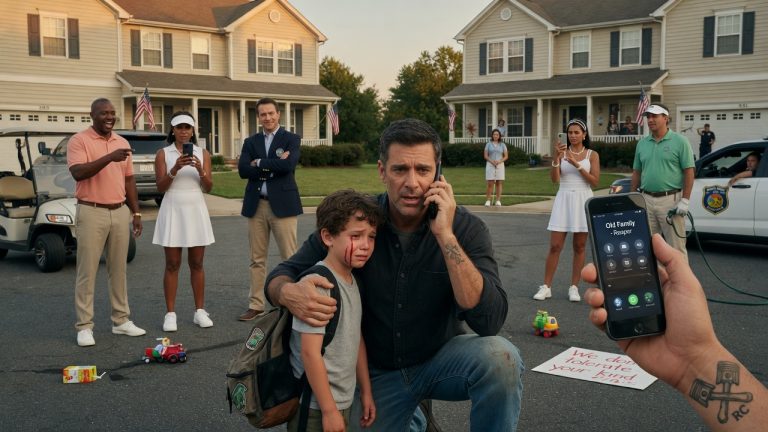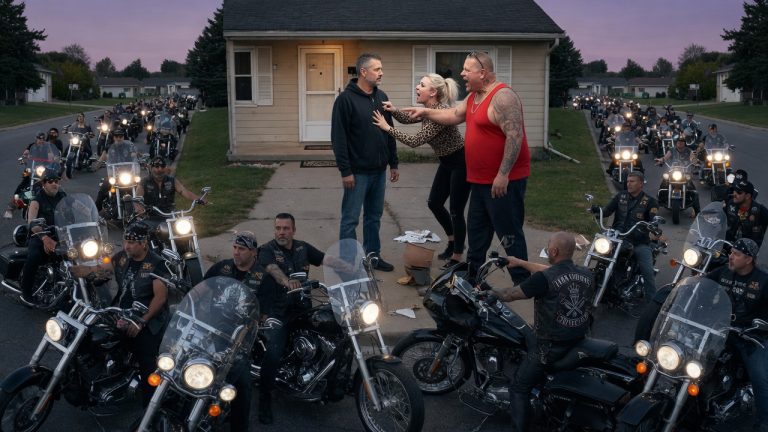
Hammer Vance didn’t come to this town to be a hero. He came to disappear.
Every month for a decade, he slipped an envelope of cash under Abraham Miller’s door. It was the only way he knew how to atone for the night he broke Abraham’s son in a bar fight twenty years ago—the night he took a young man’s future and turned it into a wheelchair and a lifetime of bitterness.
Abraham never knew. He just thought Hammer was the local biker with a soft spot for an old man and his dog, Buddy.
But when a corporate “fixer” started poisoning the only thing Abraham had left to force him off his land, Hammer had to make a choice.
Stay a ghost, or become the man he promised he’d never be again.
The truth is about to hit the South Carolina dirt, and once it’s out, there’s no going back to the silence.
FULL STORY: IRON GUARDIANS OF THE BROKEN
Chapter 1: The Weight of the Envelope
The humidity in Beaufort County didn’t just sit on you; it owned you. It was a thick, salt-heavy blanket that turned every breath into an industrial chore. Hammer Vance sat on a milk crate behind Iron Guardians, his thumb tracing the rough edge of a manila envelope. Inside were fifteen hundred-dollar bills. It was a month’s worth of side jobs—straightening frames, scouring rust off vintage Harleys, and the occasional “consultation” for people who needed a problem moved from their front yard to the next county.
He didn’t keep the money. He never did.
“You’re late,” a voice rumbled from the shop bay.
Tiny leaned against the doorframe. He was six-foot-six, with a belly that strained his leather vest and a heart that was far too large for the business they were in. He was the only one who knew where the envelopes went.
“The tide was high on the marsh road,” Hammer said, his voice like gravel being crushed. “Had to take the long way around the creek.”
“You could just hand it to him, Hammer. The old man likes you. He thinks you’re just a decent guy who stops by to check the oil in his tractor.”
Hammer stood up, the joints in his knees popping. “He likes the man he thinks I am. That man doesn’t exist.”
He mounted his Shovelhead, the engine kicking over with a violent, rhythmic snarl that shook the low-hanging Spanish moss. He rode toward the coast, where the mansions of Hilton Head gave way to the crumbling wooden docks and salt-pitted trailers of the locals who refused to sell.
Abraham Miller lived at the end of a dirt road that felt like a tunnel through the oaks. The house was a Sears-catalog bungalow from the fifties, grey and leaning, but the porch was always swept. Hammer killed the engine a quarter-mile out and walked the rest of the way.
He saw Buddy first. The Golden Retriever was usually a blur of tawny fur, barking a greeting that could be heard in the next zip code. Today, the dog was a lump on the porch rug. He lifted his head, tail giving a single, pathetic thump against the floorboards, before his chin dropped back down.
Hammer felt a cold spike of dread. He stepped onto the porch, slipping the envelope into the gap between the screen door and the frame.
“Buddy? Hey, big guy.”
The dog whined—a high, thin sound that didn’t belong in a dog that size.
“That you, Vance?”
Abraham stepped out. He was a man made of wire and memory, his skin the color of a well-oiled saddle. He moved with a hitch in his hip that Hammer knew was from a mortar fragment in ’68, but the way he looked at Buddy was the look of a man watching his last bridge burn.
“He won’t eat, Hammer. Third day. Vet says it might just be his time, but Buddy ain’t that old.”
Hammer knelt, his large, scarred hand disappearing into the dog’s fur. He felt the animal’s ribs. He felt the heat coming off the belly.
“He’s not old, Abe. He’s sick.”
“I can’t lose him,” Abraham whispered. His voice was steady, but his hands were tucked into his pockets to hide the tremor. “He’s all I got left since… well, you know. Since my boy had to move up to that facility in Columbia.”
Hammer’s heart did a slow, heavy roll in his chest. He knew. He knew the name of the facility. He knew the cost of the specialized bed. He knew exactly what it felt like to hit a man so hard his spine forgot how to talk to his legs.
“I’ll get the truck,” Hammer said. “We’re going to the clinic. Now.”
“I can’t afford a specialist, son.”
Hammer reached into the doorframe, pulled the envelope back out, and pressed it into Abraham’s hand.
“Somebody left this. Anonymous. Looks like your luck’s turning around, Abe. Don’t argue. Just get the dog.”
Chapter 2: The Shadow on the Porch
The clinic smelled of ozone and floor wax. Hammer sat in a plastic chair designed for someone half his size, his presence an intentional bruise against the clean, white walls. Dr. Aris, a woman who looked like she hadn’t slept since the Bush administration, walked out wiping her hands on a towel.
“He’s stabilized, Abraham,” she said, looking past the old man to Hammer. “But it wasn’t a virus. It was ethylene glycol. Antifreeze.”
Abraham frowned. “I don’t keep antifreeze in the shed. I haven’t worked on that tractor in a year.”
“It was in his system. High concentrations. Usually, they mix it with something sweet. Meat or corn.”
Hammer stood up. The air in the small waiting room suddenly felt very thin. “Someone fed it to him.”
Dr. Aris nodded slowly. “I’ve seen three cases this month. All along the marsh road. All people who are holding out against the ‘Palmetto Heights’ development. It’s a hell of a coincidence, isn’t it?”
Hammer walked out before the conversation could finish. He stood in the parking lot, the heat of the asphalt soaking through his boots. He knew the name Palmetto Heights. He’d seen the signs—glossy, oversized boards featuring white families in linen shirts laughing on docks that hadn’t been built yet.
When he got back to the house with Abraham and a very groggy Buddy, there was a car in the driveway. It was a black Audi, polished to a mirror finish that looked obscene against the dirt and the weeds.
A man was standing by the porch. He wore a navy suit that cost more than Hammer’s bike. He was holding a leather briefcase and a smile that didn’t reach his eyes—a professional, practiced expression of concern.
“Mr. Miller?” the man asked. “My name is Julian Vane. I’m a relocation consultant for the Sterling Group.”
Hammer stepped in front of Abraham. He didn’t say a word. He just occupied the space.
Vane’s smile faltered for a fraction of a second. He looked Hammer up and down, taking in the grease, the tattoos, and the sheer mass of the man. “I was just telling Mr. Miller that our offer has increased. Given the… recent stressors in the neighborhood, the Sterling Group wants to ensure he has the resources to move somewhere safer. Somewhere with better security.”
“Stressors?” Hammer’s voice was a low growl.
“Vandalism. Sick pets. It’s a shame when a neighborhood starts to turn,” Vane said smoothly. He reached out to pat the porch railing, his fingers gloved in thin, black leather. “It would be a tragedy if something happened to this beautiful old home. Fire, for instance. Old wiring is so unpredictable.”
Abraham moved past Hammer, his face set in a hard line. “Get off my land, Mr. Vane. My dog is sick because of people like you. I ain’t selling. Not for a million, not for a dime.”
Vane sighed, a sound of mock disappointment. He looked at Hammer. “You should talk some sense into him, big man. You look like someone who understands the value of a clean exit. Sometimes, holding on too tight is what breaks the bones.”
Vane turned and walked back to his Audi. As the car kicked up dust leaving the yard, Hammer saw a small, blue plastic jug sitting in the footwell of the passenger seat.
He felt the “monster” stir—the one he’d spent twenty years trying to starve. It was a cold, familiar hunger for violence.
“Hammer?” Abraham asked, his hand on the dog’s head. “You okay? You look… different.”
“I’m fine, Abe,” Hammer lied. “Go inside. Lock the door. I’ll be back tonight.”
Chapter 3: The Scent of Antifreeze
Hammer didn’t go back to the shop. He went to the “Pit,” a roadside bar where the light was filtered through forty years of cigarette smoke and the floor was permanently tacky. He found Tiny in a corner booth, a pitcher of beer between them.
“I need to know who Julian Vane is,” Hammer said.
Tiny didn’t look up from his glass. “He’s a fixer. Sterling Group hires him when the lawyers can’t get the job done. He doesn’t use a crowbar, Hammer. He uses pressure. Code violations, bank calls, and yeah… he’s got a thing for animals. Claims it ‘softens the heart’ of the holdouts.”
“He’s poisoning Buddy.”
Tiny finally looked up. His eyes were wide. “Don’t, Hammer. You’re on paper. You do one thing to that suit, and you’re going back to the state pen. You can’t help Miller from a cell.”
“He threatened to burn the house down with the old man inside.”
“Then call the sheriff.”
“The sheriff’s brother owns the construction company clearing the trees for Palmetto Heights,” Hammer said. He leaned forward, his knuckles white against the wood. “There is no law on that marsh road. Just us.”
Hammer spent the next six hours in the dark. He parked his bike three miles away and hiked back through the salt marsh, the mud sucking at his boots. He knew how Vane worked—he’d watched him earlier. Vane liked the direct approach after the first ‘warning.’
He crouched in the tall grass near Abraham’s shed. The crickets were a rhythmic roar, and the smell of pluff mud was overwhelming. Around 2:00 AM, a silent pair of headlights cut through the oaks. The Audi didn’t come down the driveway this time. It stopped a hundred yards away.
A figure emerged. Vane had traded the suit for a dark track jacket. He was carrying a small cooler and a spray bottle.
Hammer watched him walk toward the back porch. Vane was careful, stepping over the loud boards. He reached into the cooler and pulled out a steak—thick, red, and dripping. He began to spray it with the contents of the bottle. The sweet, chemical scent of antifreeze wafted through the humid air.
Hammer didn’t move yet. He waited. He wanted Vane to get close. He wanted him to feel the moment the world changed.
Vane reached the porch steps. He set the meat in Buddy’s empty bowl. He was smiling. It was a small, private twist of the lips.
“Time to go, puppy,” Vane whispered.
Hammer stepped out of the shadows. He didn’t make a sound until he was five feet away.
“He’s not hungry,” Hammer said.
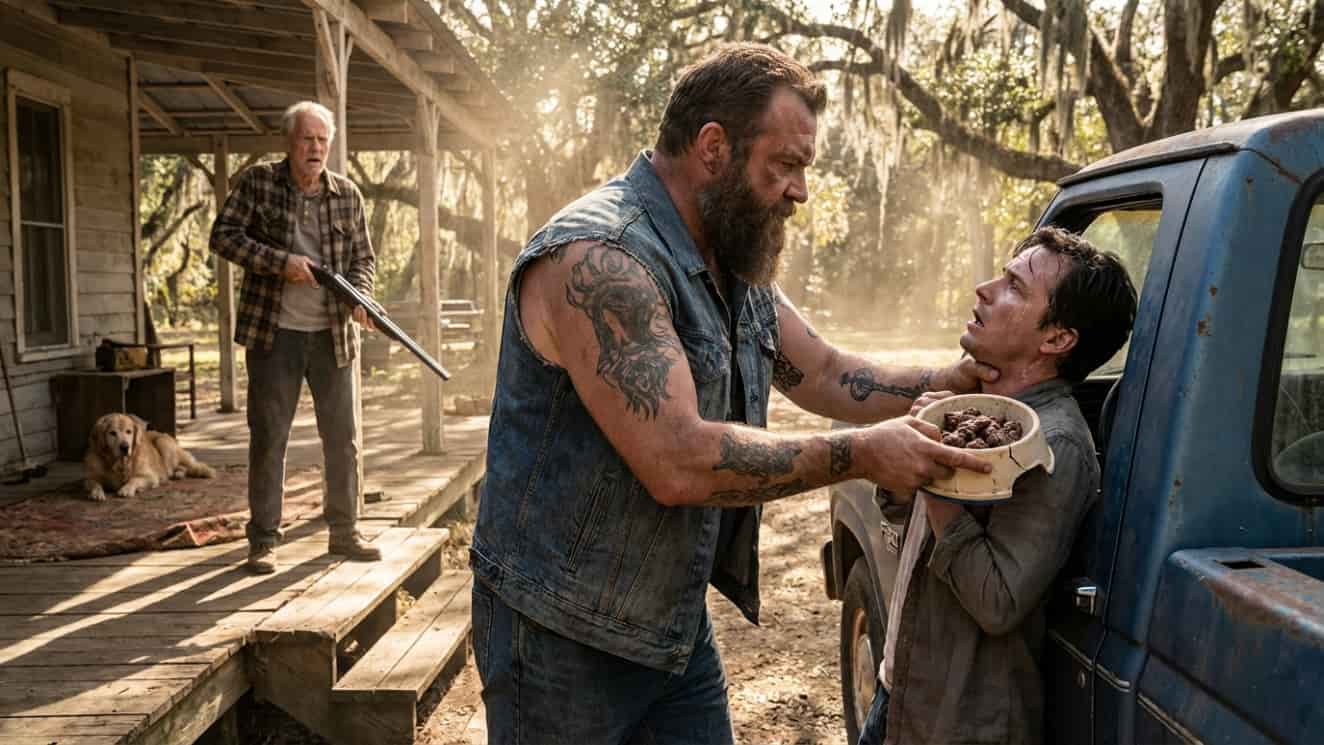
Vane jumped, the cooler lid clattering to the dirt. He reached into his waistband, but Hammer was faster. Hammer didn’t punch him—not yet. He grabbed Vane’s wrist and twisted until the sound of snapping bone echoed in the quiet yard. Vane’s scream was cut short as Hammer’s other hand clamped over his mouth, slamming him back against Abraham’s rusted truck.
Chapter 4: The Ghost in the Glass
The noise brought Abraham to the door. The old man was holding a double-barrel shotgun, his eyes wild in the porch light.
“Hammer?”
“Stay back, Abe,” Hammer said, his voice a low, vibrating warning. He dragged Vane by the collar toward the porch light. He kicked the dog bowl, sending the tainted meat skittering across the dirt. “Look at it. Look what he was feeding your dog.”
Abraham looked. He looked at the meat, then at Vane, then at Hammer. The shock on the old man’s face began to harden into something colder.
“I should kill you right here,” Abraham whispered to Vane.
“He’s not worth the shells,” Hammer said. He looked at Vane, whose face was pale and slick with sweat. “But he’s going to learn what it feels like to have something taken from you.”
Hammer dragged Vane inside the house. He forced him into a chair in the kitchen. Abraham followed, the shotgun still leveled at Vane’s chest.
“Search him,” Hammer said.
Abraham reached into Vane’s pockets. He pulled out a phone, a set of keys, and a wallet. He also pulled out a folded piece of paper. It was a ledger—a list of names, addresses, and “status updates.”
Miller, Abraham. Status: Critical. Dog neutralized. Fire scheduled for Thursday.
The room went silent. The weight of the word Fire hung in the air like a noose.
“You were going to burn me out?” Abraham asked, his voice trembling. “I served this country before you were a thought in your daddy’s head.”
Vane found his voice, though it was thin and reedy. “It’s just business, Mr. Miller. You’re an obstacle. Progress doesn’t care about your service.”
Hammer felt the old rage—the “Hammer” from twenty years ago—clawing at his throat. He looked at the wall to steady himself. That’s when he saw it.
On the small wooden mantle, next to a dusty clock, was a photograph. It was a young man in a high school football jersey. He had Abraham’s jaw and a bright, confident smile.
Hammer’s breath hitched. He knew that face. He’d seen it in his nightmares for seven thousand nights. It was Danny Miller. The kid who’d been a little too loud at the bar. The kid Hammer had decided to “teach a lesson.” The kid who never walked again.
Hammer looked at Abraham. The old man was watching him, his eyes narrowing.
“You okay, Hammer? You look like you’ve seen a ghost.”
“I have,” Hammer whispered. He looked back at Vane. The secret was a physical weight now, a stone in his gut. He realized that saving Abraham wasn’t just about the dog or the land. It was the only way he could keep the world from taking everything Danny had left.