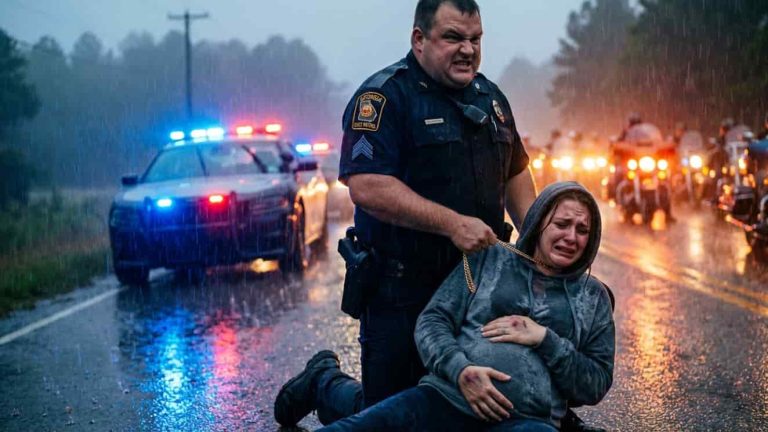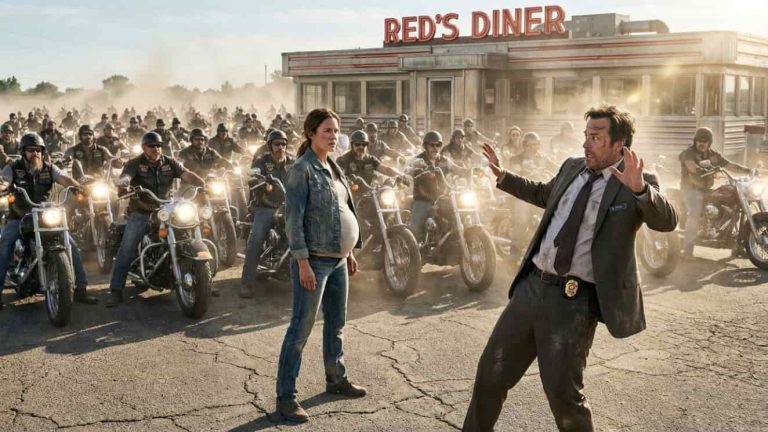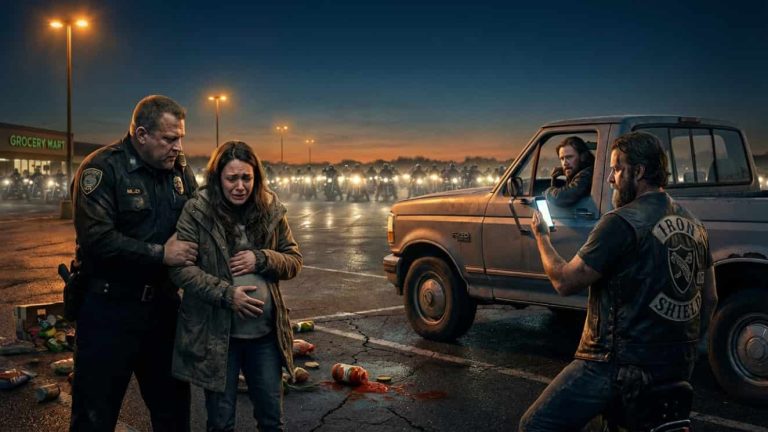
I watched him extort the shopkeeper who gave me my first job, his face twisted in a mask of pure evil. He thought a lone biker was no threat, but when 1,500 engines start screaming at midnight, he’ll wish he never crossed the man with the tattooed skull on his throat.
The bell above the door of Henderson’s Tools didn’t chime the way it used to. It gave a tired, rusty clank, much like the man who stood behind the counter. I was sitting in the back corner, grease up to my elbows, working on a stubborn carburetor for a neighbor’s lawnmower. Mr. Henderson—the only man who didn’t call the cops when I was a sixteen-year-old punk sleeping in his alley—was humming a Sinatra tune.
Then the door swung open, and the music died.
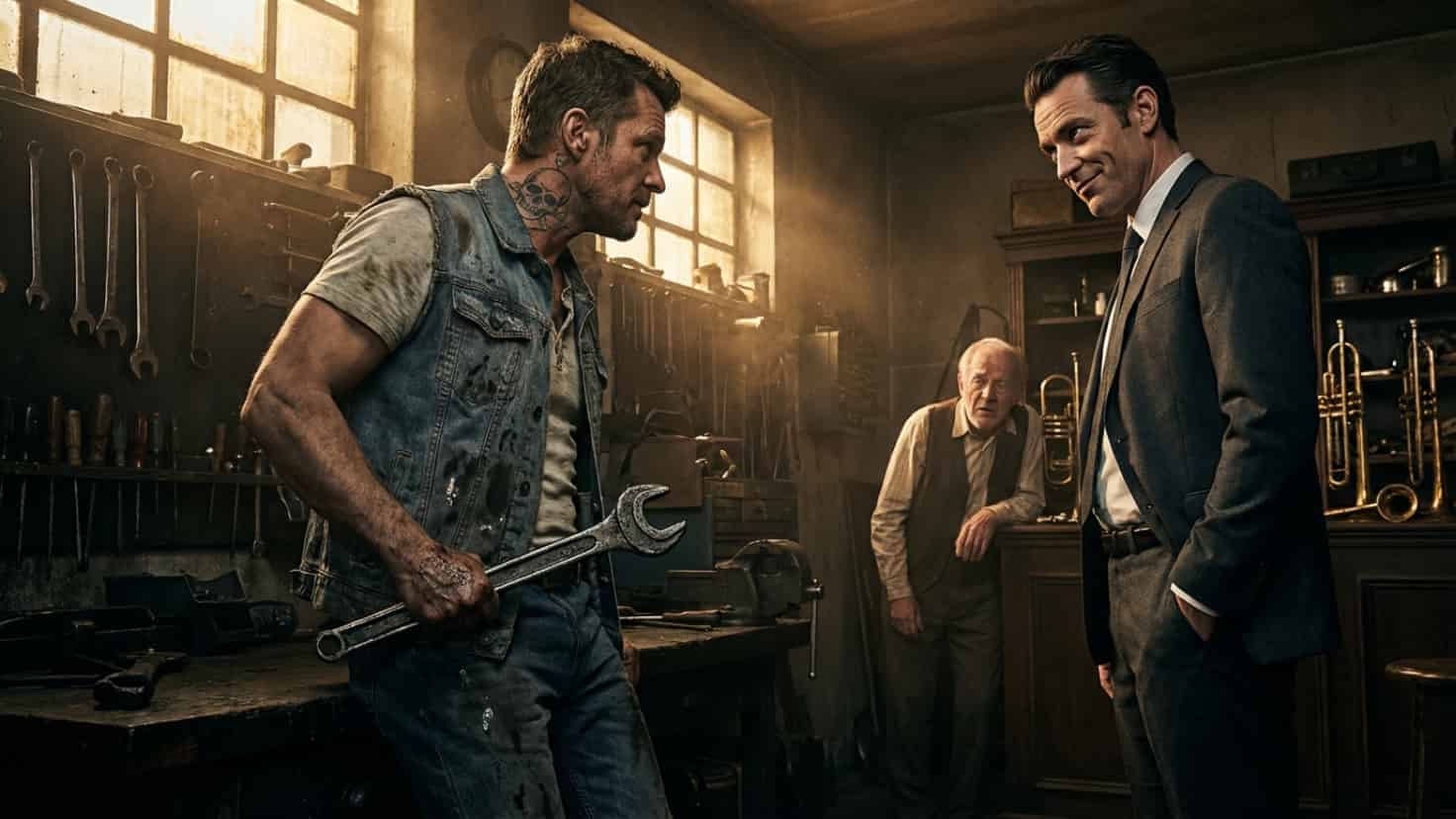
Vince walked in. He looked like he’d been vacuum-sealed into a charcoal suit that cost more than Henderson’s entire inventory. He didn’t look like a debt collector; he looked like a vulture who’d been to law school. He didn’t see me in the shadows of the workbench. All he saw was an old man with shaky hands and a dwindling bank account.
“”Seven grand, Arthur,”” Vince said, his voice like silk over a razor blade. “”And that’s just the interest for this month. You’re falling behind. The developers are getting impatient. They want this corner, and they want it clean.””
Mr. Henderson leaned on the counter, his knuckles white. “”I’ve paid the principal twice over, Vince. You’re bleeding me dry. This shop is all I have left. It’s all this neighborhood has left.””
Vince leaned in, his smile widening into something truly demonic. He reached out and knocked a display of vintage brass hinges onto the floor. Clatter. Clatter. Clatter. The sound echoed in the small shop like gunshots.
“”You don’t have a choice,”” Vince whispered. “”You pay, or we burn this place with you inside it. Who’s going to stop us? Some local beat cop? I own the precinct. Some neighbor? They’re all scared of their own shadows.””
I felt the familiar heat rising from my chest, up past my collar, settling right into the ink of the skull tattooed on my throat. I stood up, the heavy wrench in my hand feeling like an extension of my arm.
Vince finally noticed me. He looked me up and down—the oil-stained jeans, the heavy boots, the frayed denim vest of the Iron Phantoms. He chuckled, a wet, arrogant sound.
“”What’s this? The help?”” Vince sneered, turning back to Henderson. “”Tell your dog to sit, Arthur. Or I’ll have him put down before the sun sets.””
I didn’t say a word. I just looked at Mr. Henderson, who had tears of shame in his eyes. I looked at the man who taught me how to hold a wrench instead of a needle, the man who gave me a life when I was trying to throw mine away.
Vince thought he was the apex predator in a room full of sheep. He had no idea that he’d just stepped into a cage with a wolf, and the wolf had 1,500 brothers just a phone call away.
“
The smell of old oil and cedar wood always calmed me, but today, it felt like oxygen to a fire. As Vince walked out of the shop, he made sure to shoulder-check me. It was a move designed to assert dominance, the kind of thing guys like him did because they’d never actually been in a real fight. I didn’t move an inch. It was like he’d walked into a bridge piling.
“”Watch it, greaseball,”” he spat, adjusting his tie and stepping out into the late afternoon sun of Fairhaven.
I didn’t follow him. Not yet. I turned to Mr. Henderson. The old man was leaning heavily against the register, his face a pale, sickly gray.
“”Jax,”” he croaked. “”You shouldn’t have been here. You shouldn’t have heard that.””
“”How long, Pop?”” I asked, my voice low. I called him Pop because my own father’s only contribution to my life was the scar on my ribs and a deep-seated distrust of anyone in a suit.
“”Since the stroke last year,”” Henderson sighed, his shoulders sagging. “”The hospital bills were one thing, but then the property taxes tripled. I took a bridge loan. I didn’t know the people behind it were… well, people like Vince. They’re calling it ‘redevelopment.’ They want to turn this whole block into luxury condos for people who don’t know how to change a lightbulb.””
“”He said he owns the cops,”” I said.
Henderson nodded sadly. “”Chief Miller’s son works for the firm that owns the debt. It’s all legal, or legal enough that nobody’s going to fight it for a man with no family left.””
“”He has family,”” I said firmly.
I walked to the front window and watched Vince’s silver Mercedes pull away. He drove like he owned the asphalt, cutting off a young mother in a minivan without a second thought. He was the kind of rot that started at the core of a town and ate its way out until there was nothing left but hollowed-out shells of buildings and broken people.
I spent the rest of the afternoon in a haze of controlled rage. I finished the neighbor’s mower, cleaned the shop floor, and made Henderson sit down and eat the sandwich I’d bought him from the deli across the street. He tried to protest, but I just pointed to the chair.
“”Eat, Pop. I’ve got some calls to make.””
I stepped out into the alleyway behind the shop. This was my sanctuary. This was where the Iron Phantoms kept their local clubhouse—a converted warehouse that smelled of high-octane fuel and brotherhood. I pulled out my phone and hit a speed-dial button I hadn’t used for a “”serious”” matter in three years.
“”Bear,”” I said when the line picked up.
“”Jax? You sound like you just found out the beer ran out,”” a deep, gravelly voice replied. Bear was the President of our chapter, a man the size of a mountain with a heart that was just as big, provided you were on his good side.
“”I need a favor. Not for me. For the Man.””
There was a pause. Every Phantom knew who “”The Man”” was. Mr. Henderson was the unofficial grandfather of the club. He’d fixed our bikes when we were broke, let us use his tools, and never once judged the patches on our backs.
“”What happened?”” Bear’s voice had lost its playfulness.
I told him about Vince. I told him about the extortion, the threat to burn the shop, and the “”legal”” wall they’d built around the old man. I told him about the smirk on Vince’s face.
“”How many can we get?”” I asked.
“”For Henderson?”” Bear growled. “”I’ll put it on the wire. We’ve got the regional meet in Ohio this weekend. Most of the boys are already on the road or prepping. If I tell them the Man is in trouble…””
“”Tell them,”” I said. “”Midnight tomorrow. At the crossroads of Main and Elm. Right in front of Vince’s gated community.””
“”You want a riot, Jax?””
“”No,”” I said, looking at the skull tattoo in the reflection of a grease-streaked window. “”I want a haunting. I want him to realize that all the money in the world can’t buy you safety when the ghosts of the people you’ve stepped on finally come home to roost.””
“”Consider it done,”” Bear said. “”And Jax? Keep the old man safe tonight. Vince seems like the type to send his errands boys to do the dirty work while he’s at dinner.””
I hung up and looked at the sky. The sun was dipping below the horizon, casting long, jagged shadows across Fairhaven. I felt a cold calm settle over me. Vince thought he was playing a game of numbers and lawyers. He didn’t realize that in the world of the Iron Phantoms, the only currency that mattered was loyalty. And his account was about to be closed.
The next morning, the air in Fairhaven felt heavy, like the atmosphere before a massive thunderstorm. I stayed at the shop with Henderson, pretending to work on an old Harley Shovelhead, but my eyes were constantly on the street.
Around noon, a black SUV with tinted windows slowed down as it passed the shop. It didn’t stop. It just hovered there for a second, a silent threat, before accelerating away. They were watching. They wanted Henderson to feel the walls closing in.
“”You should go home, Jax,”” Henderson said, wiping a wrench with a greasy rag. “”I don’t want you caught up in this. You’ve worked hard to stay out of trouble. You’ve got that small engine repair business starting to take off. Don’t throw it away for a stubborn old fool.””
“”I’m not going anywhere, Pop,”” I said, not looking up from the bike. “”And you’re not a fool. You’re the only person who ever saw something in me besides a target for a nightstick.””
The afternoon brought a surprise visitor. Sarah, the waitress from the diner next door, slipped in through the back. She was twenty-four, with tired eyes and a fierce spirit. She’d been like a little sister to me since I started working at the shop.
“”Jax,”” she whispered, her voice trembling. “”Two men were in the diner. They were asking about you. Asking where you live, what kind of bike you ride. They weren’t cops, Jax. They looked… bad.””
I put down my tools and walked over to her, placing a hand on her shoulder. “”Did they hurt you, Sarah?””
“”No,”” she said, shaking her head. “”But they told Mr. Miller at the diner that if anyone ‘interfered’ with the Henderson property, there would be consequences for the whole street. They’re trying to turn the neighbors against him.””
It was a classic move. Divide and conquer. Make the victim the pariah.
“”Thanks for telling me, Sarah. Go back to the diner. Lock the back door. Don’t worry about tonight.””
“”What’s happening tonight?”” she asked, looking between me and Henderson.
“”Justice,”” I said.
By 6:00 PM, I closed the shop. I drove Henderson back to his small, neat house three blocks away. I sat on his porch while he ate dinner, my bike parked prominently in the driveway. I wanted them to see me. I wanted them to know I was the shield.
At 9:00 PM, my phone buzzed. It was a text from Bear.
The pack is moving. We’re picking up the brothers from the Tri-State area. Estimated count: 1,500 and climbing. Everyone wants a piece of the vulture.
I felt a chill run down my spine. Fifteen hundred. That wasn’t just a club; that was an army.
At 10:30 PM, the first sign of trouble arrived. A nondescript sedan pulled up to the curb. Two men got out. They weren’t wearing suits. They were wearing hoodies and carrying baseball bats. Professional thugs.
“”Arthur Henderson!”” one of them shouted. “”Come out here! We need to talk about your ‘insurance’ policy!””
I stood up from the porch swing, the shadows hiding my face. I stepped into the light of the porch lamp.
“”He’s sleeping,”” I said, my voice steady. “”And he’s not taking visitors.””
The guy with the bat laughed. “”Look at this. The bodyguard. Look, kid, we don’t want you. We just want to give the old man a reminder that he needs to sign those papers tomorrow. Step aside, and you don’t get hurt.””
“”You’ve got two choices,”” I said, stepping off the porch. “”You can get back in that car and drive until you hit the state line. Or you can stay here and find out why they call us the Phantoms.””
“”Big talk for one guy,”” the second thug said, stepping forward.
Just then, from miles away, a low rumble started. It was faint at first, like the sound of distant thunder on a summer evening. The thugs didn’t notice it. They were too focused on me.
“”I’m not alone,”” I said, a slow smile spreading across my face.
The rumble grew. It wasn’t a roar; it was a vibration that you felt in your teeth. The ground beneath our feet began to hum. The thugs stopped, looking around in confusion.
“”What is that? A train?”” one asked.
“”No,”” I said, looking at my watch. “”That’s midnight.””
The two thugs looked down the street, their bravado evaporating as the hum turned into a bone-shaking growl. Then, the first line of headlights appeared over the crest of the hill.
Two by two, the bikes rounded the corner. These weren’t the shiny, showroom bikes you see on weekends. These were road-worn machines—Harleys, Indians, custom choppers—ridden by men and women who looked like they’d been carved out of granite.
The two thugs backed up toward their car, their bats hanging limp at their sides. They were trapped. The street was quickly filling with the chrome and leather of the Iron Phantoms.
Bear was in the lead, his massive black touring bike idling with a sound like a predatory animal. He pulled up right to the curb, kicked his stand down, and looked at the thugs. He didn’t say a word. He just took off his sunglasses and stared.
Behind him, more bikes arrived. And more. They filled the street, then the next street over. The sound was deafening, a symphony of internal combustion that drowned out the very idea of fear.
“”Jax,”” Bear shouted over the engines. “”We heard there was a pest problem in Fairhaven.””
I pointed to the two men by the sedan. “”These two were just leaving.””
The thugs didn’t wait for a second invitation. They scrambled into their car, but they couldn’t even pull away because the road was blocked by a sea of bikers. They had to sit there, huddled in their locked car, as a thousand bikers stared them down.
“”Where’s the vulture?”” Bear asked, dismounting.
“”He lives in ‘The Heights,'”” I said, referring to the gated community on the hill. “”The one with the golden gates and the private security that thinks they’re the Secret Service.””
“”Well,”” Bear grinned, “”I think we should go pay our respects. It’s only polite.””
I went inside and checked on Pop. He was standing by the window, his eyes wide with wonder.
“”Jax… is that… are those all for me?””
“”They’re for the Man, Pop. Stay here. Lock the door. We’ll be back.””
I hopped on my bike, the familiar vibration of the engine a comfort against my thighs. I took the lead, Bear on my left, and we began the slow, rhythmic crawl toward the hills.
As we moved through the center of Fairhaven, people came out of their houses. They stood on their porches, not in fear, but in awe. Sarah was outside the diner, cheering. Even Officer Miller was there, standing by his cruiser. He didn’t turn on his lights. He just tipped his cap to me as I rode by. He knew what was happening. He knew the law had failed, and the neighborhood was taking its soul back.
We reached the gates of The Heights at exactly 12:15 AM. The security guard, a kid who looked like he’d never seen a leather jacket in his life, was frantically talking into a radio. He didn’t even try to stop us. He just opened the gate and stepped back, his hands in the air.
We rode through the manicured streets, the loud pipes echoing off the multi-million dollar mansions. We found Vince’s house—a glass and steel monstrosity that looked like it belonged in a magazine, not a home.
I signaled for the kill-switch.
One by one, the engines died. The silence that followed was even more terrifying than the noise. Fifteen hundred bikers sat in total stillness in front of Vince’s house. No shouting. No Revving. Just the hot smell of oil and the sight of a thousand cold eyes.
The lights in the house flickered on. The front door opened a crack, and Vince stepped out onto the balcony. He was in his silk pajamas, a glass of scotch in his hand. He looked down at the street, and for the first time since I’d met him, the smirk was gone. His face was the color of sour milk.
“”What is this?”” he screamed, his voice cracking. “”I’ll call the police! You’re trespassing! I have cameras! I’ll have you all in jail by morning!””
I stepped forward, the skull on my throat pulsing with every breath. I didn’t yell. I didn’t need to. In the silence of the night, my voice carried perfectly.
“”We aren’t here to hurt you, Vince,”” I said. “”We’re just here to make sure you remember something. You told Pop that nobody was watching. You told him he was alone.””
I gestured to the sea of bikes behind me.
“”Do we look like nobody to you?”””