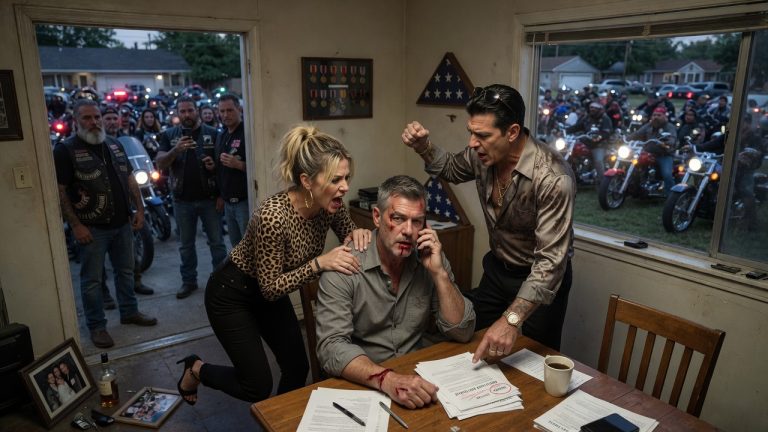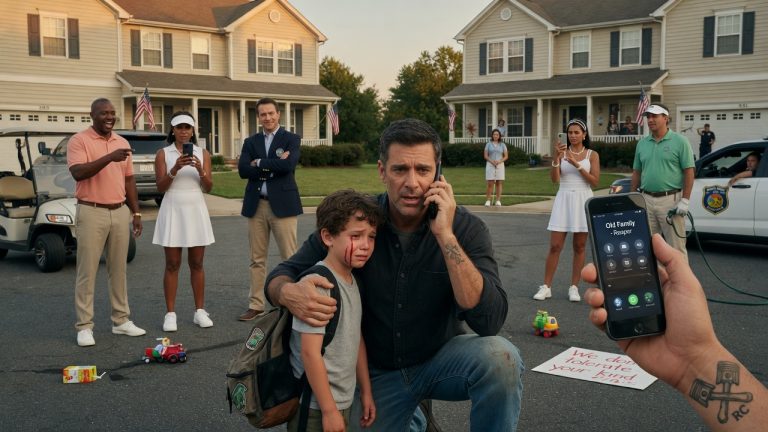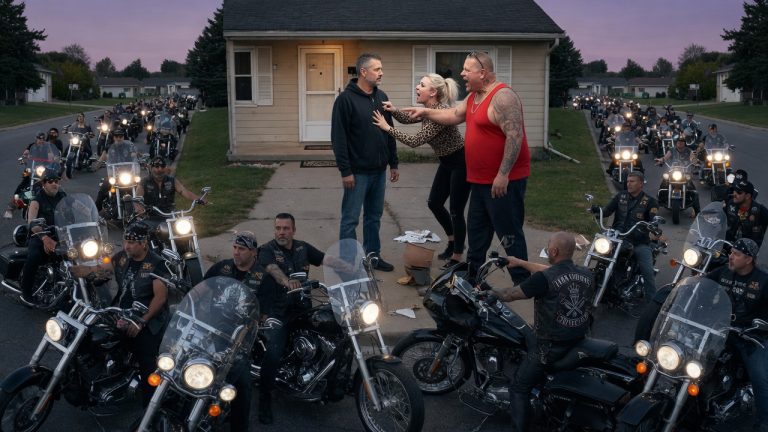
Gary had it all planned out. The land was worth millions, and his uncle was just an “old vet” who didn’t know any better. All Gary had to do was prove the old man couldn’t take care of himself.
He started with the dog. A blind, helpless Cocker Spaniel. He figured if the dog suffered, the old man would break.
He didn’t realize someone was watching.
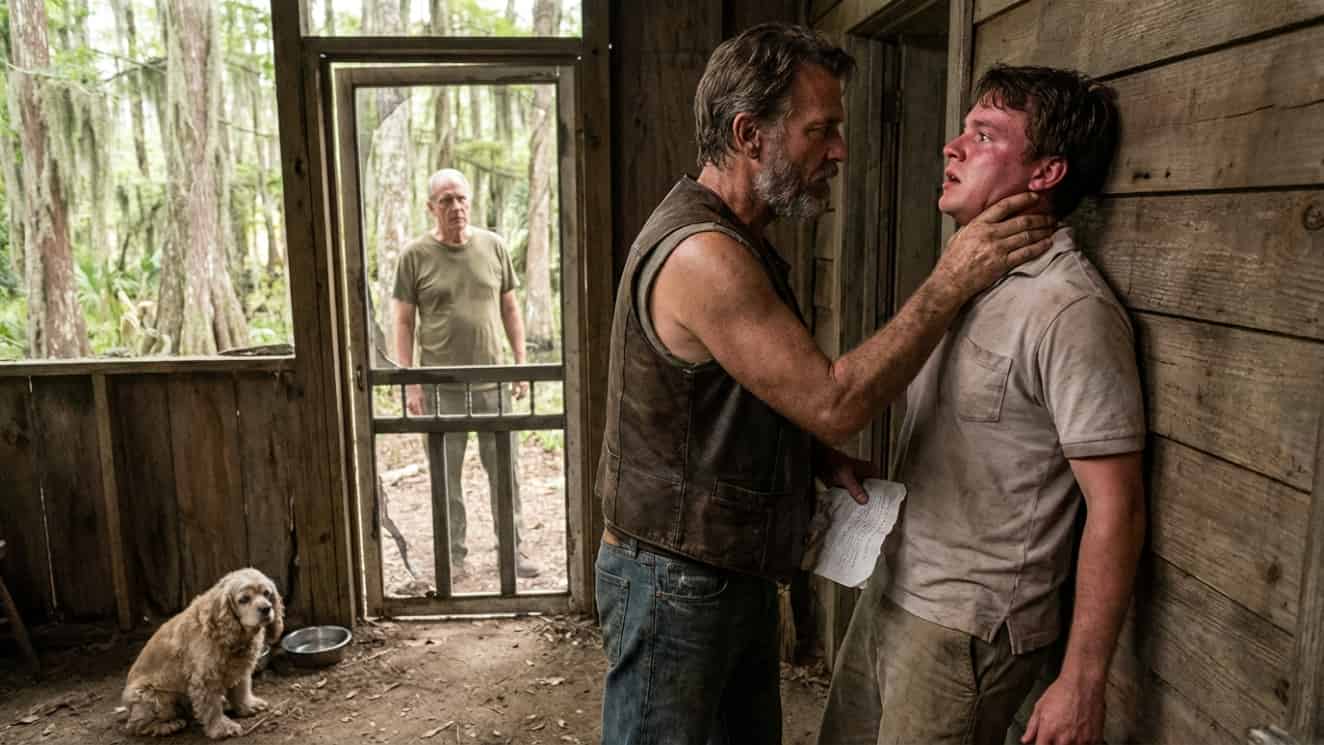
Deacon Saint isn’t a hero. He’s a fixer for the local MC, and he’s spent twenty years doing the kind of work that keeps you out of heaven. He was the one who originally sold this swamp to the developers. He was the one who put the target on his own friend’s back.
But when he saw what Gary was doing to that dog—and what he was doing to a man who had nothing left—the “fixer” decided to fix something for himself.
“You’re a vulture, Gary,” Deacon whispered, his hand tightening around the kid’s throat. “But I’m the one who decides who gets to eat in this swamp.”
Deacon just sabotaged a multi-million dollar deal for his club. He’s officially a dead man walking. And he hasn’t even told the old man the worst part yet:
The secret about who actually signed the eviction notice ten years ago.
FULL STORY: THE VULTURE AND THE VET
Chapter 1: The Weight of the Signature
The humidity in Citrus County doesn’t just sit on you; it colonizes you. Deacon Saint sat in the cab of his ‘98 Silverado, the engine idling with a rhythmic, mechanical cough that mirrored the ache in his own chest. He was looking at a manila envelope on the passenger seat. Inside was the future of the Black Iron MC, and the end of a man Deacon hadn’t seen in twenty years.
Deacon was the club’s “fixer.” That was the polite term. In reality, he was the guy who navigated the grey spaces between the law and the dirt. When the club wanted a piece of property, Deacon found the leverage. When a brother got a DUI, Deacon found the clerk with the gambling debt. It was a life built on the strategic application of pressure.
“You look like shit, D,” Rat said, leaning against the passenger door. Rat was the club’s scout, a twitchy kid with a neck tattoo of a weeping willow that looked more like a smudge of grease.
“It’s the heat,” Deacon lied. He wiped sweat from his forehead with a hand that had a slight, intermittent tremor.
“Prez wants that signature by Friday,” Rat said, tapping the glass. “The developers are flying in from Miami. They don’t give a damn about the swamp. They want the water rights and the tax break.”
Deacon nodded, but his eyes were on a memory. Twenty years ago, he’d stood in a sterile, white-tiled hallway in Ocala, watching his grandfather stare through him like he was a stranger. Deacon, you stay with me, you hear? The old man had pleaded. But Deacon had a run to make for the club, a crate of Glock parts that wouldn’t wait. He’d signed the papers, the power of attorney, and walked away. Three weeks later, his grandfather died in a room that smelled of bleach and loneliness.
He hadn’t been back to the swamp since.
“The old man’s a veteran, right?” Deacon asked, his voice a low rasp.
“Arthur Vance? Yeah. Army. Korean War, maybe? I don’t know,” Rat shrugged. “He’s got a dog. Some blind thing that keeps tripping over the porch steps. His nephew, Gary, says the old guy’s losing it. Gary’s the one who called the club. He wants a cut of the sale.”
Deacon’s stomach curdled. He’d seen plenty of vultures in his life—land sharks, dirty cops, and desperate junkies. But the family vulture was always the worst. They knew exactly where to bite to get to the marrow.
He shifted the truck into gear. The tires spit gravel as he pulled away from the clubhouse. He was the one who had negotiated the sale to the developers. He’d done his job. He’d set the trap. Now, all he had to do was spring it on a man who had survived a war just to be betrayed by his own blood and the one man he thought he could trust.
Deacon Saint was going to be the man who signed the eviction notice. Again.
Chapter 2: The Blind Anchor
The shack was exactly what Deacon expected. A grey, weathered structure built on cypress stilts, leaning into the swamp like it was tired of standing. The air was thick with the scent of stagnant water and decaying vegetation—the true smell of Florida before the air-conditioning and the theme parks.
Arthur Vance sat on a sagging porch chair, a shotgun across his lap and a blind, buff-colored Cocker Spaniel at his feet. The dog, Lady, sensed Deacon’s approach before Arthur did. She didn’t bark; she just let out a low, mournful rumble in her throat.
“I don’t need any more Bibles,” Arthur called out, his voice thin but steady. “And I don’t need any more medicine. I’ve got enough to last me until I’m dead, which should be about Tuesday.”
Deacon stepped out of the truck, his boots crunching on the shells that paved the driveway. He kept his hands visible. In the biker world, hands were the first thing you looked at.
“I’m not a preacher, Arthur,” Deacon said. “And I’m not the pharmacy.”
The old man squinted, his eyes milky with cataracts but sharp with a residual intelligence. “Saint? Is that you, boy?”
Deacon stopped. The “boy” hit him like a physical blow. He hadn’t been called that in two decades. He’d grown a beard, gained fifty pounds of muscle and scar tissue, and lived a thousand lifetimes in the dark. But Arthur Vance remembered the kid who used to fish off his dock while his grandfather drank beer in the shade.
“It’s Deacon, Arthur.”
“I heard you were with those boys on the motorcycles,” Arthur said, leaning back. He patted the blind dog’s head. Lady’s tail gave a single, tentative thump. “My nephew says you’re here to help me move.”
Deacon felt a surge of nausea. Help him move. Gary was a master of the euphemism.
“I’m here to talk, Arthur,” Deacon said, sitting on the top step. He looked at the dog. Lady nudged his hand with her wet nose. She didn’t smell like a dog; she smelled like the swamp and old blankets.
“Gary says I can’t keep the place up no more,” Arthur continued, his voice devoid of anger, which was worse. “Says the county’s going to condemn it. Says I’m a danger to myself. He’s been bringing around some social worker lady. She’s nice enough, but she keeps asking if I know what year it is.”
“Do you?” Deacon asked quietly.
“It’s 2026, Deacon. It’s the year of our Lord, and it’s the year they’re going to take my home.” Arthur’s hand gripped the arm of his chair, the knuckles white and skeletal. “I survived Chosin, Deacon. I survived the frostbite and the Chinese and the hunger. I’m not afraid of the dark. But I’m afraid of what happens to Lady if I go to one of those places. They don’t take dogs in the state home.”
Deacon looked at the manila envelope in his truck. He was the one who had told the club the land was worth six million. He was the one who had facilitated the “private sale” that would effectively erase Arthur Vance from the map.
He was the vulture.
Chapter 3: The Mirror in the Kitchen
The next morning, Deacon was back at the shack. He’d told the Prez he was “handling the final negotiations,” which was club-speak for “making sure the old man doesn’t make a scene.”
But as Deacon stepped onto the porch, he heard a different kind of scene.
“Goddammit, Arthur, look at this mess!”
It was Gary. The nephew was standing in the kitchen, a space no larger than a closet, screaming at his uncle. Gary was thirty, with the soft, pampered look of someone who had never done a day’s work in the Florida sun. He wore a crisp, white polo shirt that looked obscene in the grime of the shack.
“I’m trying, Gary,” Arthur’s voice was small, trembling. “The dog, she… she had an accident.”
“She’s a nuisance!” Gary roared. He kicked a metal water bowl across the floor. It slammed into the baseboards with a violent clang. Lady let out a sharp yelp, scurrying into the corner, her blind eyes wide and terrified.
Deacon stood in the doorway, his presence casting a long, dark shadow over the room. Gary didn’t see him at first. He was too busy being the big man.
“You’re going to the home, Arthur,” Gary hissed, leaning into the old man’s face. “The social worker is coming back tomorrow. If I find one more pile of shit on this floor, I’m calling the pound to come pick up this mutt. You hear me?”
“You touch that dog again, Gary,” Deacon said, his voice a low, vibrating hum, “and you’re the one who disappears.”
Gary spun around, his face pale and sweating. He tried to muster a look of indignation, but it withered under Deacon’s gaze. Deacon didn’t look like a “fixer” right then. He looked like a predator.
“Deacon! Hey, man,” Gary said, his voice jumping an octave. “I’m just… I’m just stressed. You know how it is. My uncle, he’s just… he’s not himself.”
Deacon walked into the kitchen. The air was thick with the smell of ammonia and desperation. He looked at Gary, and for a second, he saw himself twenty years ago. The same impatience. The same belief that the old and the broken were just obstacles in the way of a “better life.”
“I know exactly how it is, Gary,” Deacon said. He reached out and gripped Gary’s shoulder. His fingers dug into the soft muscle, a silent promise of pain. “You’re the vulture. You’re waiting for the body to stop moving so you can start picking the bones.”
“Hey, we’re on the same team, remember?” Gary whispered, his eyes darting toward Arthur. “The club gets the land, I get my inheritance, and you get your cut. Everyone wins.”
“Does Arthur win?” Deacon asked.
Gary scoffed, a short, nervous sound. “He’s ninety. He doesn’t even know where he is half the time.”
Deacon let go of Gary’s shoulder. He looked at Arthur, who was staring at his hands, his face a mask of shame. And then he looked at Lady, who was shivering in the corner.
The “old wound” in Deacon’s chest started to bleed. He’d lived his whole life as a “fixer” for other people’s problems. It was time he fixed his own.
Chapter 4: The Sabotage
The clubhouse was loud, the air thick with cigarette smoke and the heavy bass of a Black Sabbath record. Prez sat at the head of the table, his “Cuts” leather vest straining over a belly that had seen too much whiskey and not enough remorse.
“You got the signature, Saint?” Prez asked, not looking up from a ledger.
“Working on it,” Deacon said, leaning against the bar. “The old man’s being stubborn. He’s got some veteran’s group looking into the deed. Something about a historical preservation clause on the swamp.”
Prez looked up then, his eyes narrowing. “A what?”
“Historical preservation,” Deacon lied, his voice as smooth as polished stone. “Turns out the shack was a waypoint for some Seminole tribe back in the day. If the county finds out, the land becomes untouchable. The developers won’t pay a dime for a swamp they can’t pave.”
The room went silent. The threat of a “unbuildable” property was the only thing that scared the Black Iron MC more than the FBI.
“How do we fix it?” Prez growled.
“I need time,” Deacon said. “I need to talk to the nephew. He’s the one who can sign the waiver, but he’s scared of the veteran’s group. I need to… convince him.”
Prez nodded slowly. “Friday, Saint. By Friday, or I find someone who can handle it. The developers are already asking questions.”
Deacon walked out of the clubhouse and into the humid night. He had forty-eight hours. He wasn’t just sabotaging a deal; he was sabotaging his own life. If the club found out he was lying, he wouldn’t just be out of a job. He’d be a memory.
He drove back to the swamp, the manila envelope now containing something else entirely. He’d spent the afternoon at the county clerk’s office, using his “fixer” credentials to dig into the actual deed of the Vance property.
What he found was the “fragment of truth” that changed everything.
The land hadn’t been sold by Arthur. It had been sold ten years ago by Gary’s father—Arthur’s brother—using a forged power of attorney. The club didn’t actually own the land. They owned a fraudulent contract. And Gary knew it. Gary wasn’t just a vulture; he was a thief.