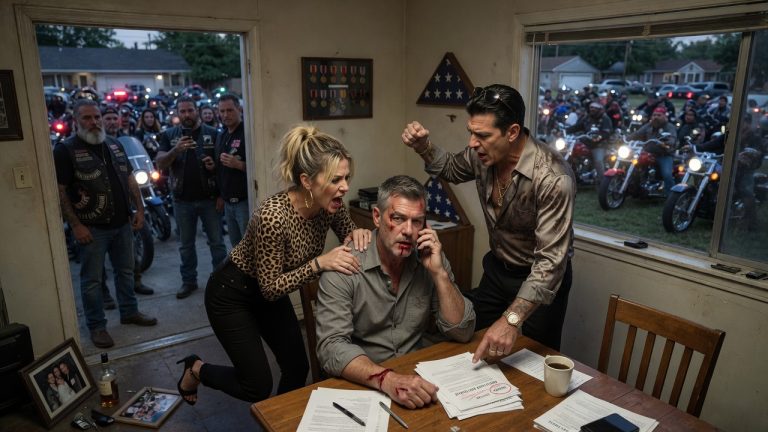
I spent ten years trying to forget the man I used to be. I buried the leather, the medals, and the blood in a trunk beneath the sawdust of my workshop. I took the insults. I took the “coward” labels from the town.
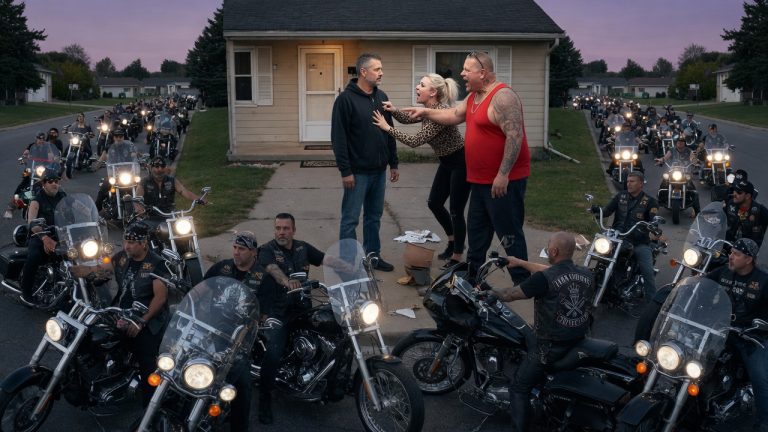
But when my wife, Naomi, walked into my sanctuary with Jax and threw their filth at my feet, she didn’t realize she wasn’t just insulting a husband.
She was waking up a ghost that five hundred men still owe their lives to.
I looked at the small wooden carving of my son—the boy I lost because I couldn’t stop being a monster. I promised I’d never use my hands for violence again.
But as Jax laughed and Naomi spat on the floor of the house I built for her, I realized some debts can’t be paid in sawdust. They have to be paid in chrome and iron.
Tank saw it first. He saw the look in my eyes and knew the peace treaty was over.
The ground is already starting to shake. The brothers are coming. And God help anyone left standing in this town when they arrive.
FULL STORY: OUTLAW’S PENANCE
Chapter 1: The Sawdust Sanctuary
The smell of cedar was the only thing that kept the ghosts at bay. It was sharp, clean, and honest—unlike the memories that lived in the scars across Cutter Vance’s knuckles.
Cutter sat on a stool in the corner of his workshop, a space converted from a sagging lean-to on the edge of a dusty Texas border town. His hands, thick-fingered and calloused, moved with a gentleness that seemed impossible for a man of his stature. Between his palms was a small block of cherry wood. He wasn’t making furniture today. He was carving a face. A small, round face with a button nose and a cowlick that would never grow out.
“Still playing with your dolls, Cutter?”
The voice was like a shard of glass dragged across silk. Naomi stood in the doorway, the harsh midday sun silhouetting her thin frame. She was wearing a dress that was too short for a woman in her late thirties and too expensive for a woman married to a man who made his living selling hand-turned bowls to tourists.
Cutter didn’t look up. He blew a fine spray of dust off the wood. “It’s not a doll, Naomi. You know what it is.”
“I know it’s a waste of time,” she snapped, stepping into the shop. She wrinkled her nose at the scent of oil and wood shavings. “The bills are piling up on the counter. The truck needs a new transmission. And you’re sitting here talking to a piece of wood like it’s going to talk back.”
Cutter stopped carving. He felt the familiar heat rising in his chest, the old “Red Tide” as the brothers used to call it. For twenty years, that rage had been his engine. It had powered him through the Death Valley skirmish where he’d held a mountain pass with nothing but a jammed glock and a tire iron until the rest of the Vipers could retreat. It was the reason he was a legend in a world he’d tried to burn down.
He forced his breath out, slow and steady. One. Two. Three.
“I’ll have the dining set finished for the Millers by Friday,” Cutter said, his voice a low rumble. “That’ll cover the truck.”
“Friday isn’t today,” Naomi said. She walked over to his workbench and picked up a heavy mallet, turning it over in her hands. “You know, people in town talk about you. They say you’ve gone soft. They say you’re scared of your own shadow.”
“Let them talk.”
“I’m tired of being married to a man people pity, Cutter. I’m tired of the quiet. I’m tired of this… penance.” She dropped the mallet. It hit the concrete floor with a dull, heavy thud that vibrated up through Cutter’s boots.
She left without another word, her heels clicking sharply on the gravel path.
Cutter picked up the carving. He traced the line of the boy’s jaw. I’m sorry, Toby, he thought. I’m trying.
A shadow fell over the doorway again, but this one didn’t move. It was massive, blocking out the sun entirely.
“She’s getting louder, Vance,” a voice said.
Cutter finally looked up. Tank was leaning against the doorframe, a man who looked like he had been forged from old engine parts and bad intentions. He wore a faded denim vest with the patches ripped off, but the ghost of the “Viper” insignia was still visible in the weathered fabric.
“She’s just frustrated, Tank,” Cutter said.
“She’s dangerous,” Tank corrected, stepping into the shop. He walked over to a heavy iron trunk in the corner, the one Cutter hadn’t opened in three thousand days. Tank tapped the lid with the toe of his boot. “The boys in the North are asking. They heard you were still alive. They heard you were hiding out here, playing carpenter.”
“I’m not hiding. I’m living.”
“You call this living? Letting that woman treat you like a dog?” Tank shook his head. “There’s a debt, Cutter. Five hundred of us wouldn’t be breathing if you hadn’t stayed behind in the Valley. You’re the only man I know who has an army at his back and chooses to spend his time with a whittling knife.”
“That army cost me my son,” Cutter said, his voice cracking like dry timber. “I’m done with the Debt, Tank. Tell them I died. Tell them I’m a ghost.”
Tank looked at the carving in Cutter’s hand. His eyes softened, just for a second. “A ghost can’t bleed, Vance. And looking at your wife… I think you’re about to bleed a lot.”
Chapter 2: The Slap
The “Rusty Spur” was the kind of diner where the coffee tasted like battery acid and the gossip was even more corrosive. Cutter sat at the far end of the counter, his large frame hunched over a plate of eggs. He liked the Spur because nobody asked him questions. They just looked at him with a mix of curiosity and disdain—the “big man who wouldn’t fight.”
The bell above the door jingled.
The room went silent, the kind of silence that precedes a car wreck. Naomi walked in, but she wasn’t alone. She was draped over the arm of a man ten years younger than Cutter, a man wearing a silk shirt that cost more than Cutter’s truck. His hair was slicked back, and a gold chain sparkled against his tanned throat.
Jax. The man who had moved into town six months ago and suddenly half the high schoolers were on oxy and the sheriff had a new boat.
“Oh, look,” Jax said, his voice loud enough to carry to every booth. “The local craftsman is taking a break. Hard work, making toothpicks?”
Naomi giggled, a high, brittle sound that made the hair on the back of Cutter’s neck stand up. She led Jax right over to where Cutter sat.
“Cutter,” she said, her voice dripping with artificial sweetness. “You remember Jax. He was just telling me how much he admires your… restraint.”
Cutter kept his eyes on his plate. He gripped his fork so hard the tines began to bend. “Naomi. Go home.”
“Don’t be like that, big guy,” Jax said, sliding onto the stool next to Cutter. He smelled of expensive cologne and cheap power. “I’m actually looking for some work. Need a new bed frame. Something sturdy. Something that can handle a lot of… activity.”
He winked at Naomi, who blushed and tucked a strand of hair behind her ear.
The “Red Tide” was slamming against the back of Cutter’s skull now. He could see the pressure points on Jax’s throat. He knew exactly how much force it would take to crush the man’s windpipe with his thumb. He knew the path to the exit. He knew how to disappear.
“I don’t do custom orders for people like you,” Cutter said quietly.
Jax’s smile didn’t falter, but his eyes turned cold. “People like me? You mean people who actually provide for their women? People who aren’t afraid to take what they want?”
Jax leaned in closer, whispering so only Cutter could hear. “She told me about the boy, Vance. Told me it was your fault. Said you were too busy playing outlaw to be a father. No wonder you’re so quiet. You’re hollowed out.”
Cutter stood up. The movement was so sudden and powerful that his stool tipped backward, clattering against the linoleum. The diner froze. The waitress dropped a carafe of water.
Cutter stared down at Jax. For a heartbeat, the quiet carpenter was gone. The man standing there was the “Reaper of Death Valley,” a man who had walked through fire and come out smiling.
Jax flinched. He reached for something under his silk shirt—the bulge of a compact pistol.
SLAP.
The sound echoed like a gunshot.
Naomi’s hand was still raised. She had stepped between them and struck Cutter across the face with everything she had. His head didn’t move, but a red welt bloomed instantly on his weathered cheek.
“Don’t you dare look at him like that,” Naomi hissed, her face contorted with a strange, frantic rage. “You’re nothing, Cutter. You’re a broken-down relic living in a shed. You don’t get to be scary anymore.”
Cutter looked at his wife. He didn’t see the woman he’d married fifteen years ago. He saw a stranger who had weaponized his grief and fed it to a predator.
He reached up and touched the welt on his face. Then, he did something that shocked everyone in the Rusty Spur.
He turned around, picked up his stool, and walked out the door.
Outside, Tank was waiting by his bike, his arms crossed over his massive chest. He had seen the whole thing through the window.
“That was the one, wasn’t it?” Tank asked. “The limit.”
Cutter climbed into his rusted truck. He looked at himself in the rearview mirror. The red mark was darkening.
“Not yet,” Cutter said, his voice sounding like it was coming from the bottom of a well. “But we’re close, Tank. We’re real close.”
Chapter 3: The Sanctuary Violated
Three days later, the rain was coming down in gray sheets, turning the Texas dust into a thick, red sludge. Cutter was in his shop, the only place he felt safe. He was sanding the dining table for the Millers, the rhythmic motion of the sandpaper a mantra for his sanity.
He heard the engines first. Not the low, rhythmic thrum of Tank’s bike, but the high-pitched, aggressive whine of modified SUVs and sportbikes.
Two black Cadillacs and a trio of bikes pulled into his muddy yard, flanking his house and workshop.
Naomi hopped out of the lead Cadillac, laughing as Jax held an umbrella over her. Behind them, four of Jax’s enforcers climbed out, men with dead eyes and tribal tattoos, carrying heavy duffel bags.
“What is this, Naomi?” Cutter asked, stepping out onto the porch of the workshop.
“The house is a dump, Cutter,” she shouted over the rain. “Jax and the boys need a place to stay while the feds are poking around the city. I told them you wouldn’t mind.”
“They aren’t staying here,” Cutter said.
Jax stepped forward, the umbrella casting a shadow over his smug face. “Actually, Vance, we are. Consider it a rental agreement. Naomi says you’re behind on the mortgage anyway. I’m just helping out a neighbor.”
One of the enforcers, a man they called “Spider,” kicked the door to Cutter’s small house open. He started tossing Cutter’s few belongings—a tattered recliner, a box of old books—out into the mud.
“Hey!” Cutter moved toward the house, but two of the other men stepped in his path. They were younger, faster, and armed.
“Stay in your hole, old man,” Spider spat.
For the next six hours, Cutter sat in his workshop and watched through the window as his life was dismantled. They brought in crates of liquor, bags of white powder, and girls who looked far too young to be there. The music started—a heavy, thumping bass that shook the sawdust off his rafters.
Around midnight, the music stopped. The door to the workshop creaked open.
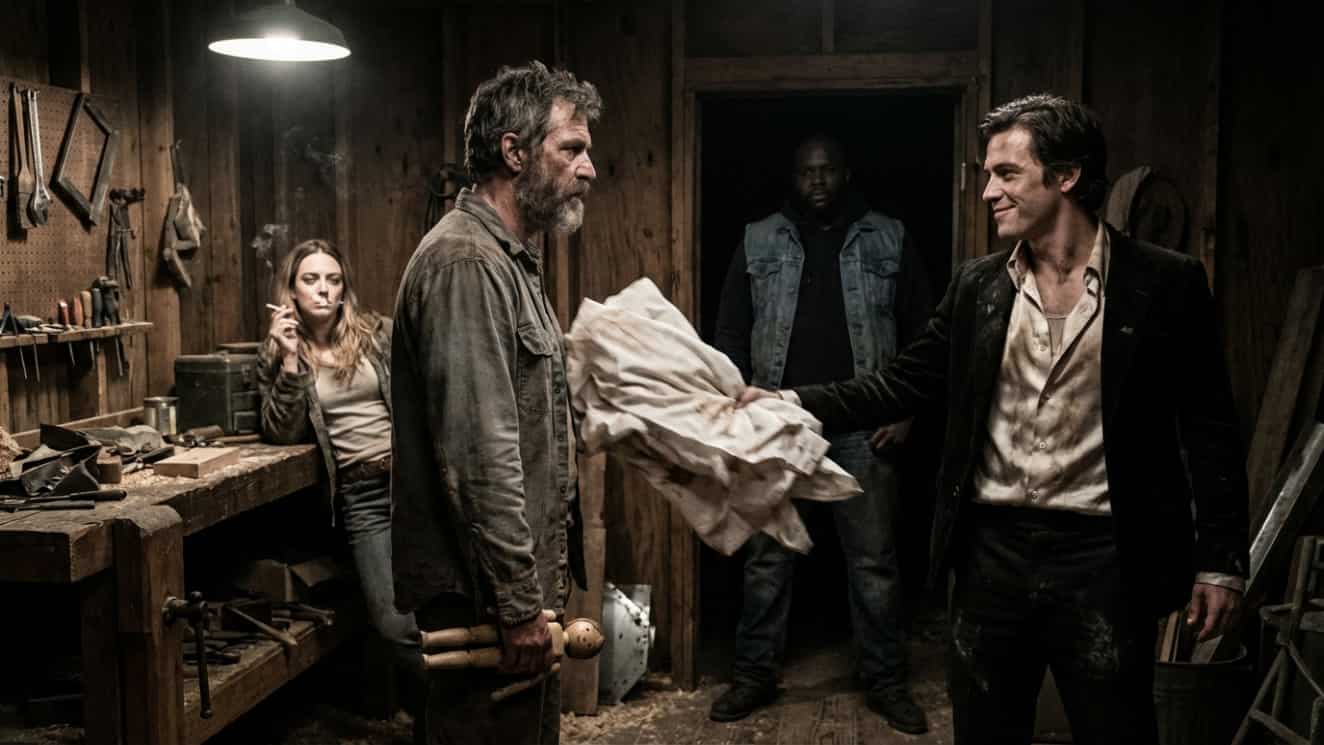
Naomi walked in, followed by Jax. They both looked disheveled, their eyes glassy. Jax was carrying a heavy, bulging trash bag and a bundle of stained bedsheets.
“We had a little spill in the bedroom,” Jax said, grinning. He tossed the trash bag at Cutter’s feet. It burst open, spilling empty bottles and used syringes across the clean cedar shavings.
Then, he threw the bedsheets. They hit Cutter in the chest, damp and smelling of sweat and Naomi’s perfume.
“Clean it up, Cutter,” Naomi said. She leaned against his workbench, the very spot where he had carved his son’s face. She lit a cigarette and exhaled a cloud of smoke into the air he used to breathe. “Like a good boy. Show Jax how good you are at following orders.”
Cutter looked down at the sheets. He looked at the trash. His hand went to his pocket, fingers brushing the small wooden carving of Toby.
“You’re in my shop, Naomi,” Cutter said. His voice was no longer a rumble. It was a whisper, cold as a tombstone.
“It’s not your shop anymore,” Jax said. He walked over to the workbench and saw the carving. He picked it up. “What’s this? The little ghost boy?”
“Put it down,” Cutter said.
“Make me,” Jax taunted. He held the carving over a lit candle on the workbench. The wood began to singe. “You’ve got all these tools, Vance. All these saws and hammers. But you’re just a coward with a broom.”
In the corner of the room, hidden by the shadows, Tank stepped forward. He had slipped in through the back. He didn’t say a word, but the metallic clack-clack of a slide racking on a .45 echoed through the shop.
Jax froze. He looked at Tank, then back at Cutter.
“You should have stayed in the house, Jax,” Tank said.
Cutter didn’t look at the gun. He looked at the sheets on the floor. He looked at his wife’s bored, cruel face.
The “Red Tide” didn’t just rise. It broke the dam.
Cutter reached out, his movement so fast Jax didn’t even have time to drop the carving. Cutter’s hand clamped around Jax’s wrist like a hydraulic vice. There was a sickening pop, and Jax screamed as his bones gave way. The carving fell into Cutter’s other hand.
“Tank,” Cutter said, not looking away from his wife. “Call the Debt.”
Tank grinned, a jagged, terrifying expression. “I’ve been waiting ten years to hear you say that.”
Chapter 4: The Old Vest
The call went out through a series of encrypted channels, old landlines, and whispers in bars from El Paso to the Canadian border. It was a simple message, two words that shouldn’t have meant anything to anyone in the year 2026:
Viper Rises.
While the world outside began to tilt on its axis, Cutter stood in the center of his workshop. Jax was slumped on the floor, clutching his shattered wrist, whimpering. Naomi was backed against the wall, her bravado evaporating like mist in a furnace.
“Cutter, honey, I was just—” she started, her voice trembling.
“Be quiet, Naomi,” Cutter said. He wasn’t angry anymore. He was focused.
He walked over to the iron trunk in the corner. He cleared the sawdust off the lid with a single sweep of his arm. He took a key from around his neck—the one he’d told himself was for a safety deposit box—and fit it into the lock.
The lid creaked as it opened.
Inside, resting on a bed of mothballs and old oilcloth, was a heavy black leather vest. The “Viper” patch on the back was a masterpiece of embroidery—a king cobra coiled around a lightning bolt, its eyes made of real rubies. Along the lapels were rows of silver medals, some official, some from the “Shadow Wars” of the border.
Next to the vest lay a pair of heavy brass knuckles and a sawed-off shotgun with a grip worn smooth by his own palms.
Cutter pulled the vest out. He shook it once, the silver medals clinking like a funeral march. He slipped it on. It was heavy—the weight of five hundred lives, the weight of his own sins. It fit perfectly.
“You… you’re one of them?” Jax gasped, looking at the patch. He knew the stories. Everyone in the trade knew about the Vipers. They were the ones who didn’t deal in drugs; they dealt in territory and blood. They were the ones who had vanished after the Valley massacre.
“I’m not one of them, Jax,” Cutter said, fastening the front of the vest. “I’m the one who led them.”
Tank came back into the shop, carrying two heavy tactical bags. He started handing out rifles to the few loyal men he’d kept on standby in the woods.
“They’re coming, Vance,” Tank said, checking his watch. “The first wave hit the county line five minutes ago. The Sheriff saw the chrome and pulled over to let them pass. He’s not an idiot.”
“How many?” Cutter asked.
“Everyone,” Tank said. “From the original five hundred? Three hundred are still riding. They brought their sons. They brought their brothers. There’s a line of headlights ten miles long coming down Highway 90.”
Naomi looked out the window. In the distance, through the rain, a low, rhythmic thumping began. It sounded like a heartbeat, or a war drum. It was the synchronized roar of hundreds of high-displacement engines.
“Cutter, please,” Naomi sobbed, reaching for his arm. “I didn’t know. I thought you were just… I thought you were nothing!”
Cutter looked at her. He felt a profound sense of pity, but no love. Not anymore.
“That was the point, Naomi,” he said. “I wanted to be nothing. I wanted to be the man who made bowls and loved his wife. But you wouldn’t let me.”
He picked up the sawed-off shotgun and checked the shells.
“Tank, take her to the basement,” Cutter ordered. “And take Jax. I don’t want them seeing what happens next.”
“What about Jax’s men?” Tank asked, nodding toward the house where the music was still blaring, the enforcers unaware that their world was about to end.
Cutter stepped out onto the porch. The rain was drumming against his leather vest. The first row of headlights appeared at the edge of his property—bright, white LEDs cutting through the dark.
“Tell the brothers,” Cutter said, his voice cold and clear. “No survivors.”