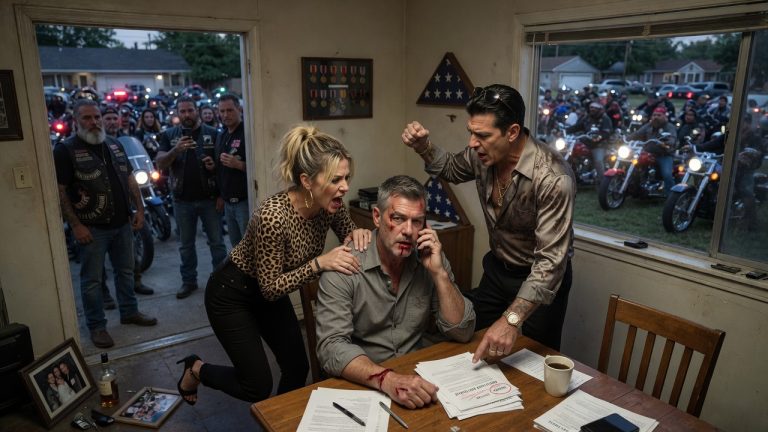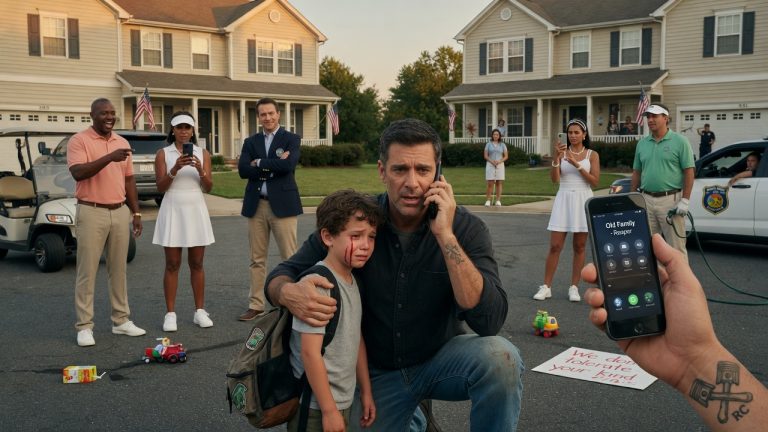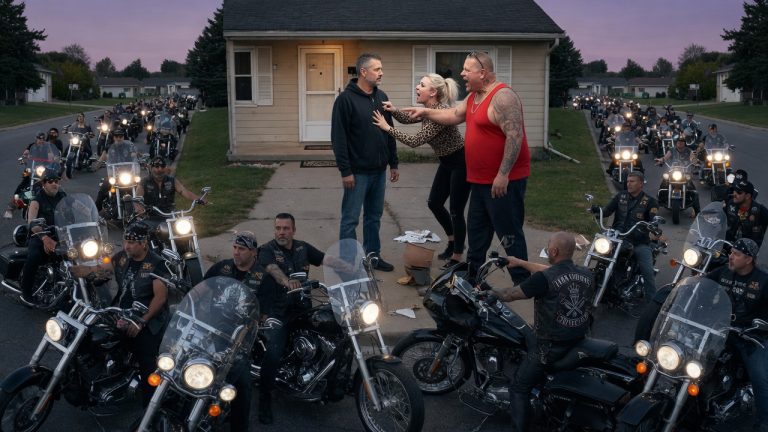
Colt Sterling was the man Oakhaven looked down on. The “washed-up farmer” who lived in a trailer and drank his regrets away. Even his own daughter, Avery, wouldn’t look him in the eye when she passed him on the street.
But when Avery’s investigation into the Mayor went too far, Silas Thorne made a fatal mistake. He thought Colt was a man with nothing left to lose.
He didn’t realize Colt was a man who had been hiding a secret for thirty years.
When the Mayor’s “fixers” cornered Avery in the mansion, they expected a terrified girl. They didn’t expect the roar of five hundred engines tearing through the cornfields.
Colt didn’t come to beg for his daughter’s life. He came to reclaim the one thing he never should have walked away from.
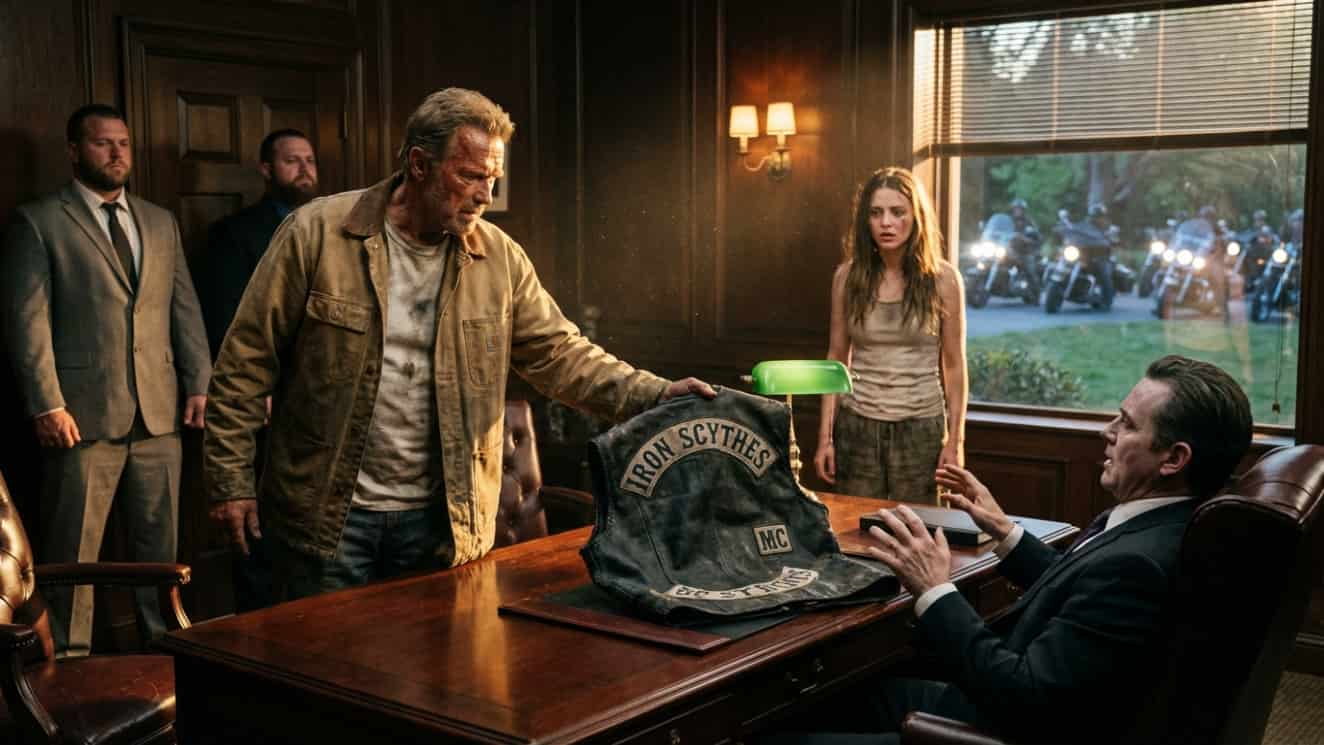
“I didn’t call the police, Silas,” Colt whispered as the leather hit the desk. “I called the Iron Scythes.”
FULL STORY
CHAPTER 1: THE DUST OF OAKHAVEN
The drought didn’t just kill the corn; it unburied the things men in Oakhaven had spent decades trying to rot.
Colt Sterling sat on the rusted tailgate of his ’98 Chevy, watching the dust devils dance across the four hundred acres that used to belong to his father. Now, the bank owned the dirt, and the bank was owned by a holding company, and the holding company was owned by Silas Thorne. Colt took a pull from a lukewarm can of Miller High Life, the aluminum stinging a fresh cut on his knuckle. He was sixty-two, but in the harsh Indiana sun, he looked eighty. His skin was the color of a cured baseball glove, and his eyes were the clouded grey of a storm that refused to break.
Across the county road, a white sedan with a local news logo on the door kicked up a plume of grit. Colt straightened his back, a sharp pain radiating from his L5 vertebra. He knew that car. He knew the girl driving it, even if she wouldn’t know him if he were on fire in the middle of Main Street.
Avery.
She stepped out of the car, clutching a digital recorder and a legal pad. She was wearing a sharp navy blazer that looked out of place against the backdrop of collapsing silos and skeletal tractors. She looked like her mother—the same defiant set of the jaw, the same way she tucked a stray lock of dark hair behind her ear when she was frustrated.
Colt climbed down from the truck, his boots crunching on the parched earth. He stayed behind the line of scrub oaks. He was a ghost in this town, a cautionary tale mothers used to keep their sons from dropping out of trade school. Don’t end up like Colt Sterling, boy. Just a drunk farmer waiting for the repo man.
Avery was walking toward the fence line of the Thorne estate, a three-story monstrosity of limestone and glass that sat on the hill like a crown on a diseased head. She was meeting someone. A man in a tan suit stepped out of the perimeter gate—Deputy Miller. Colt narrowed his eyes. Miller was a good kid once, but Thorne had bought the badge along with the rest of the town council.
“You can’t be here, Avery,” Colt heard Miller say, his voice carrying on the flat wind.
“It’s a public easement, Greg,” Avery snapped. “And I have the deposition from the foundry workers. Thorne didn’t just buy the land; he buried the toxic runoff reports under the new elementary school site.”
“Drop it,” Miller said, and there was a tremor in his voice that Colt didn’t like. “For your own sake. Silas is… he’s not in a negotiating mood today. The state primary is next week.”
“I’m not negotiating. I’m reporting.”
Colt watched Miller look around nervously. The Deputy saw Colt’s truck but couldn’t see Colt. He leaned in close to Avery. “There are people at the mansion today. People from the city. Professional people, Avery. If you don’t get in that car and drive back to Indianapolis, I can’t guarantee what happens when the sun goes down.”
Avery didn’t flinch. “Tell Silas I’ll see him at the council meeting tonight. With a camera crew.”
She turned on her heel and marched back to her car. As she drove past Colt’s property, she didn’t even glance at the man standing in the shadows of the trees.
Colt finished the beer and crushed the can. His heart was hammering against his ribs, a slow, heavy rhythm he hadn’t felt in twenty years. It was the rhythm of a pursuit. He walked back to his trailer, a single-wide that smelled of stale tobacco and WD-40.
He didn’t go to the kitchen. He went to the bedroom and pulled a loose floorboard from under the bed. Beneath it sat a heavy sea bag, sealed with a brass lock. He didn’t open it. Not yet. Instead, he sat on the edge of the bed and looked at a Polaroid taped to the lampshade. It was faded, the edges curled. A woman holding an infant. The infant had a bright red face and a tuft of dark hair.
The night that photo was taken, Colt had been three hundred miles away in a basement in Chicago, holding a shotgun for a man named Preacher while a rival club tried to burn the building down. He had chosen the patch over the fever. He had chosen the brotherhood over the cradle.
Sarah had left him forty-eight hours later. She’d moved to Oakhaven, changed her name, and raised Avery to believe her father was a drifter who had died in a motorcycle accident. Colt had followed her here five years later, not to reclaim them—he knew he was too far gone for that—but to keep a silent watch. He’d bought the failing farm next to the town she’d picked, and he’d played the part of the local failure perfectly for twenty-five years.
But Silas Thorne was a different kind of rot. Silas Thorne was the kind of man who didn’t just take your land; he took your blood.
Colt stood up, the floorboards groaning. He reached for his keys. He needed to be at that council meeting. Not as a citizen. As a ghost.
CHAPTER 2: THE CRACKS IN THE FOUNDATION
The Oakhaven Town Hall was a red-brick building that smelled of floor wax and desperation. The air conditioning was humming a losing battle against the June heat. Colt sat in the very back row, his ball cap pulled low.
Avery was in the front, her camera set up on a tripod. She looked professional, poised, and utterly unaware of the three men standing against the side wall. They weren’t from Oakhaven. They wore “security” polos that couldn’t hide the military-grade posture or the way their eyes scanned the room like they were clearing a kill zone.
Silas Thorne sat at the center of the dais. He was a handsome man in a way that felt manufactured—teeth too white, hair too perfectly silvered. He was smiling at a widow in the second row, promising her that the new industrial park would bring “generational wealth” to the county.
“Mr. Mayor,” Avery’s voice cut through the room like a cold blade.
Thorne’s smile didn’t falter, but his eyes hardened. “Ah, Miss Sterling. Our guest from the big city. I believe we’ve already addressed your concerns about the zoning.”
“We haven’t addressed the five million dollars in ‘consulting fees’ paid to a shell company owned by your brother-in-law,” Avery said, standing up. The room went silent. The local farmers looked at each other, the gears finally turning. “And we haven’t addressed the soil samples I took from the elementary school site yesterday. The lead levels are four hundred percent above the legal limit.”
One of the security men moved six inches to the left. A small movement, but Colt recognized it. He was cutting off the exit.
“Miss Sterling, this is a public forum for residents,” Thorne said smoothly. “You aren’t a resident.”
“I grew up here, Silas. My mother is buried three miles from here.” Avery stepped forward, her recorder held high. “I’m not leaving until you explain why you’re poisoning the children of this town for a kickback.”
The room erupted. Farmers began shouting. Thorne banged his gavel, but the sound was drowned out. In the chaos, Colt saw the security men move. Two of them headed toward Avery.
Colt stood up, his chair screeching against the linoleum. He didn’t head for the front. He headed for the breaker box in the hallway. He’d done maintenance on this building ten years ago when he was still sober enough to hold a ladder. He knew the wiring was ancient.
He pulled the main lever.
The Hall plunged into pitch black. Screams of confusion filled the air. Colt moved through the dark with the muscle memory of a man who had spent half his life in bar fights and back alleys. He reached the front of the room just as a flashlight beam cut through the gloom.
He saw a hand grab Avery’s arm. He saw her struggle.
Colt didn’t use a fist. He used the heavy mag-lite he’d brought in his pocket. He brought it down on the security man’s forearm. There was a sickening crack, and the man howled, releasing Avery.
“Run,” Colt hissed into her ear.
“Who are—”
“Go to the car, Avery! Now!”
She didn’t recognize his voice, but she recognized the authority in it. She grabbed her camera and bolted for the side exit. Colt stayed in the shadows, tripping a second man as he tried to follow. By the time the emergency lights flickered on, Colt was gone, slipping through the basement window he’d left unlatched.
He reached his truck just as Avery’s sedan roared out of the parking lot. He followed her at a distance, his heart hammering. He saw two black SUVs pull out of the Thorne estate’s hidden drive and swing onto the road behind her.
They weren’t going to talk to her. They were going to run her off the road.
Colt floored the Chevy. The old engine screamed, the valves clattering. He didn’t have a weapon, not really. Just two tons of American steel and a lifetime of regret.
He saw the lead SUV nudge Avery’s bumper. Her car fishtailed, the headlights sweeping across the corn rows. They were approaching the bridge over Miller’s Creek—a forty-foot drop into a rocky ravine.
“Not tonight,” Colt whispered. “Not again.”
He pulled into the left lane, drawing even with the second SUV. He didn’t look at the driver. He just yanked the wheel hard to the right. The impact sent a jolt through his spine that blurred his vision. The SUV swerved, slamming into the guardrail.
Colt didn’t stop. He accelerated, putting his truck between Avery and the lead vehicle. He rammed the lead SUV’s rear quarter panel. The driver tried to brake, but Colt kept the gas pinned. He pushed the SUV into the ditch, the black vehicle rolling twice before coming to a rest in the mud.
Avery’s car stopped a hundred yards ahead, her hazards blinking.
Colt didn’t stop to talk. He couldn’t. If she saw him now, the secret would break before he was ready. He swung the truck around and sped off into the darkness, his fender rubbing against the tire, smelling of burnt rubber and victory.
He drove straight to the trailer, parked it behind the barn, and went inside. He grabbed the sea bag from under the bed. He broke the lock with a hammer.
He pulled out the leather kutte. It was stiff, smelling of old oil and woodsmoke. He ran his hand over the “Iron Scythes” patch—the winged skull holding a bloody wheat hook.
He picked up his phone. He hadn’t called the number in twenty-five years. He didn’t even know if it still worked.
The line clicked.
“Yeah?” a voice rasped. Deep, gravelly, dangerous.
“It’s Colt,” he said. His voice broke. “It’s the Reaper.”
There was a long silence on the other end. “Reaper? We heard you were dead in a ditch in Omaha.”
“I’m in Indiana. Oakhaven. I need a Harvest, Preacher. A big one.”
“Who’s the target?”
“A man who thinks he’s king. And he’s touching blood.”
“The Scythes don’t ride for free, Colt. You left the table.”
“I know the price,” Colt said, looking at the Polaroid of Avery. “I’ll pay it. Just get the brothers here by tomorrow night. All of them.”
CHAPTER 3: THE PRICE OF THE PATCH
The next morning, Oakhaven felt like a town under siege. State police cruisers were parked at the main intersection, and Silas Thorne had declared a “security emergency,” closing the Town Hall and the local library.
Colt stood in his barn, stripping the tarp off his old 1974 Shovelhead. It was a beast of a bike, chrome pitted but the engine clean. He’d spent twenty years secretly maintaining it, a silent ritual of a life he couldn’t quite quit. He spent four hours cleaning the carb, his hands moving with a grace the town had never seen from him.
A shadow fell across the barn floor.
Colt didn’t look up. “You’re trespassing, Sarah.”
Sarah Sterling stood in the doorway. She was sixty now, her hair silvered, her face etched with the hard life of a single mother in a small town. She was holding a crumpled piece of paper—a legal notice from Thorne’s office.
“Avery came home last night,” Sarah said. Her voice was trembling. “She said a man saved her life on the road. She said he sounded like… she didn’t know. But I knew.”
Colt stood up, wiping his hands on a rag. “She’s safe. That’s all that matters.”
“Safe? Colt, Thorne’s men are at the house. They’re ‘investigating’ the accident. They took her laptop. They’re going to kill her, aren’t they?”
Colt looked at her, and for a second, the twenty-five years of silence vanished. He saw the girl who had loved him before the club took his soul. “Not while I’m breathing.”
“What are you doing?” she asked, looking at the bike. Then her eyes moved to the leather vest sitting on the workbench. She gasped, her hand going to her mouth. “No. Colt, you promised. You said that life was over.”
“It was. But Thorne isn’t a farmer, Sarah. He’s a shark. You can’t fight a shark with a lawsuit. You need something bigger.”
“You’ll go to prison. Or worse. They’ll come for you.”
“They already came for me,” Colt said, his voice flat. “The night I let Avery’s fever burn while I was guarding a crate of Uzis for Preacher. I’ve been in prison for twenty-five years, Sarah. This farm? This is just the yard.”
He stepped toward her, and for the first time, he touched her shoulder. “Keep her in the house. Lock the doors. Don’t come out, no matter what you hear. Do you understand?”
Sarah looked at the patch on the vest. “Who’s coming, Colt?”
“The family I chose,” he said. “Because the family I have deserves a father who does more than watch from the trees.”
She left, sobbing quietly. Colt finished the bike. He kicked it over. On the fourth try, the engine roared to life—a thunderous, rhythmic pulse that shook the dust from the rafters. It sounded like a war drum.
He spent the afternoon riding the perimeter of the town. He saw Thorne’s men watching from black SUVs. He saw the fear in the eyes of the locals. Oakhaven was a town that had been beaten down by the closure of the foundry, the opioid crisis, and the slow theft of its land. They were waiting for someone to show them that Thorne wasn’t God.
As the sun began to dip below the horizon, painting the sky the color of a bruised plum, Colt’s phone buzzed.
Five minutes out. Exit 42.
Colt put on the vest. He felt the weight of it—the heavy leather, the history, the blood it had seen. He climbed onto the Shovelhead and rode toward the interstate.
He pulled over on the shoulder of the overpass.
At first, it was just a hum. A low-frequency vibration in the soles of his boots. Then, the horizon began to flicker.
One headlight. Ten. Fifty.
A river of chrome and steel surged off the exit ramp. The Iron Scythes didn’t ride in a pack; they rode in a formation. Preacher was at the lead, his white beard flowing over his shoulders, his massive trike flanked by the National Sergeants-at-Arms. Behind them came the Chicago chapter, the Detroit chapter, the St. Louis brothers.
The sound was apocalyptic. It wasn’t just noise; it was physical pressure. The air tasted of exhaust and rebellion.
Preacher pulled up beside Colt, killing his engine. The silence that followed was even heavier than the noise. Five hundred bikers pulled over, lining the shoulder of the road for half a mile.
Preacher climbed off his trike. He walked up to Colt and looked him in the eye. He didn’t hug him. He didn’t shake his hand. He reached out and flicked the “Iron Scythes” rocker on Colt’s chest.
“You look like hell, Reaper.”
“The dirt will do that to you,” Colt said.
“You said there was a Harvest. You said there was a king who needed to be reminded of the law.”
Colt pointed toward the limestone mansion on the hill, its lights twinkling like cold stars. “Silas Thorne. He has my daughter. He has this town. He thinks he’s untouchable.”
Preacher turned to the sea of leather and denim behind him. He raised a fist. A five-hundred-man roar answered him.
“Tonight,” Preacher said, “we aren’t just a club. We’re the storm. Lead the way, Reaper.”
CHAPTER 4: THE OCCUPATION
The mansion sat at the end of a two-mile private drive, guarded by a wrought-iron gate and two security guards with AR-15s. They were expecting a journalist or maybe a disgruntled deputy.
They weren’t expecting five hundred motorcycles.
Colt led the charge. He didn’t stop at the gate. He didn’t slow down. He saw the guard raise his rifle, but the man’s eyes went wide as he realized the scale of what was coming. The guard dived for cover as Colt’s Shovelhead smashed through the gate, the iron buckling like tinfoil.
The “Harvest” descended on the Thorne estate.
Bikers swarmed the manicured lawns, their tires tearing up the sod Thorne had spent thousands to maintain. They surrounded the mansion, a ring of steel and leather three deep.
Colt hopped off his bike before it even stopped moving. He marched toward the massive oak front doors. Two of Thorne’s “security” thugs stepped out, hands on their holsters.
“Back off, old man!” one yelled.
He was cut off by the sound of fifty kickstands slamming down simultaneously. Fifty bikers, the “Chrome Vultures” from the Detroit chapter, stepped forward. They didn’t draw weapons. They just stood there, a wall of scarred faces and tattooed arms.
The thugs looked at the wall. They looked at the sea of bikes behind them. They stepped aside.
Colt kicked the doors open.
The foyer was a cathedral of excess—marble floors, crystal chandeliers, oil paintings of Thorne’s ancestors who had probably been just as crooked as he was.
“Silas!” Colt’s voice echoed through the house. “I’m here for the bill!”
Thorne appeared at the top of the grand staircase. He looked down, his face transitioning from annoyance to genuine, gut-level terror. He saw the bikers filling his foyer. He saw Preacher, who looked like an Old Testament prophet with a grudge, leaning against a Greek statue.
“Sterling?” Thorne stammered. “What… what is this? This is private property! I’ll have the Guard here in twenty minutes!”
“The Guard is thirty miles away at the armory, Silas,” Colt said, starting up the stairs. “And the local deputies? They’re currently busy watching five hundred men buy every gallon of gas and every pack of cigarettes in Oakhaven. You’re alone in this house.”
“You can’t do this!”
“I’m doing it.” Colt reached the top of the stairs. He grabbed Thorne by the silk tie and slammed him against the wall. “Where is she?”
“Who?”
Colt’s fist hit the wall an inch from Thorne’s ear. “Avery. My daughter.”
“She’s… she’s in the study. My men… they were just questioning her about the theft of city documents.”
Colt dragged Thorne down the hallway. He kicked open the study door.
Avery was sitting in a leather chair, her hands zip-tied behind her back. One of the thugs from the Town Hall was leaning over her, holding a pair of pliers. He looked up, his face pale.
Colt didn’t hesitate. He dived across the room, tackling the man into a bookshelf. They hit the floor hard. The thug was younger and stronger, but Colt had twenty years of repressed rage. He throttled the man, slamming his head into the floor until the thug went limp.
Colt stood up, breathing hard. He walked over to Avery. He used a pocketknife to snip the zip-ties.
Avery stood up, rubbing her wrists. She looked at Colt—really looked at him. She saw the blood on his knuckles. She saw the “Iron Scythes” patch on his chest.
“You,” she whispered. “You’re the man from the road. You’re… Colt Sterling.”
“I’m your father, Avery,” Colt said, his voice thick. “And I’m sorry it took a war for me to tell you.”
She looked past him into the hallway, where dozens of bikers were now standing, their presence turning the luxury mansion into a clubhouse.
“Who are they?” she asked.
“The people who owe me,” Colt said. He turned back to Thorne, who was cowering in the corner. “Now, Silas. We’re going to talk about that foundry runoff. And you’re going to give my daughter every file in that safe. Or I’m going to let my brothers turn this house into a bonfire.”