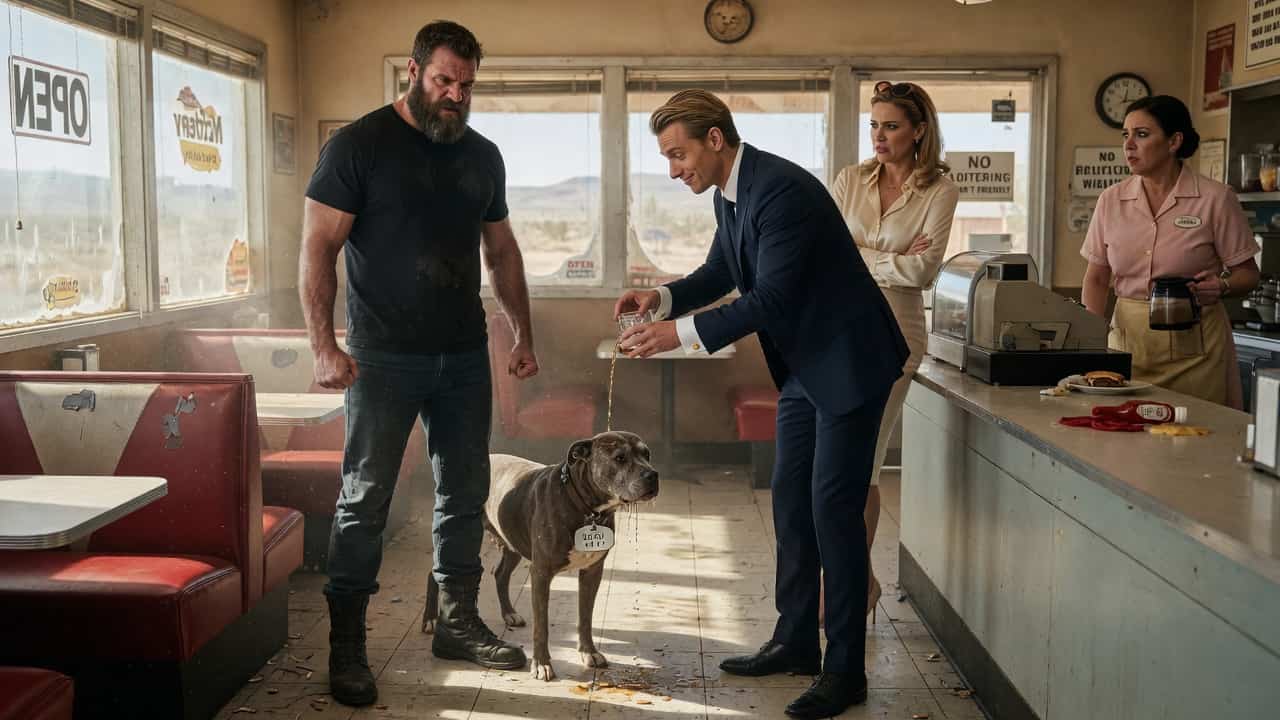
Clara just stood there, the woman I’d shared a bed with for ten years, watching her new husband humiliate me. She didn’t look away. She didn’t even blink. She just leaned in and whispered, “He’s still as pathetic as the day I left him.”
The whole room was watching. The locals in the booths had their phones out, recording the ‘dirty biker’ getting put in his place by the guy who owned the bank. They didn’t see the patch on my back hidden under my jacket. They didn’t know about the five hundred brothers currently riding toward this zip code.
And they didn’t know about the vow. I wasn’t allowed to speak. I wasn’t allowed to fight back. Not for another hour.
Julian leaned over, his polished leather boot inches from my hand. “I said, clean it. Or I’ll have the Sheriff put the dog down for being a public nuisance. Your choice, Ghost.”
I looked at the silver tag on Beau’s collar—the one with Maya’s name on it. Then I looked at the clock on the wall.
Fifty-eight minutes left.
I reached for the rag, and the room erupted in mocking laughter. They think they’ve won. They have no idea what happens when the clock hits noon.
Chapter 1
The heat in Nevada didn’t just sit on you; it tried to colonize you. It worked its way into the marrow of your bones and stayed there, humming like a low-voltage wire. Silas “Ghost” Thorne felt every degree of it as he pulled his 1998 Harley-Davidson Heritage Softail into the gravel lot of Ma’s Grill. The bike was as black as a moonless night, stripped of its chrome, the engine block caked in the fine, white alkaline dust of the High Desert.
Silas didn’t move for a long minute after he killed the ignition. He just sat there, his hands still vibrating from the three-hundred-mile stretch he’d just put behind him. His knuckles were scarred, the skin across them gray and thick like elephant hide. He was thirty-seven, but in this light, under the unforgiving glare of the midday sun, he looked like a man who had seen the end of the world and decided it wasn’t worth talking about.
Beside him, in the custom sidecar he’d welded himself three years ago, Beau stirred. The Pitbull was old, his muzzle almost entirely white, his ears notched from a life lived before Silas had found him. The dog looked up, his pale eyes clouded with cataracts but sharp with devotion.
Silas reached over and scratched the dog behind the ears. He didn’t say a word. He couldn’t.
He was six days into the Ride in Silence. It was a tradition older than the Iron Cross MC itself, a penance reserved for the Federal President when the weight of the crown became too heavy, or when the ghosts of the past started screaming louder than the wind. This ride was for Maya. It was the fifth anniversary of the night the world had gone dark, the night he’d been at a meeting in Reno while his daughter’s fever turned into something the doctors couldn’t catch in time.
The vow was simple: no speech, no violence, no identity. For seven days, he was just a man on a machine, traveling the backroads of the empire he’d built, invisible and unheard. If he broke the silence, he forfeited his patch. If he raised a hand in anger, he walked away from the brotherhood forever. It was the only way he knew how to stay human.
He swung his leg over the saddle, his boots crunching in the gravel. He was a big man, broad-shouldered and thick-necked, wearing a plain black t-shirt that stretched tight across his chest. He didn’t look like a President. He looked like a drifter, someone the local deputies would keep an eye on until he crossed the county line.
Beau hopped out of the sidecar, his gait stiff. Silas checked the dog’s collar—the thick leather band held a single silver tag. Maya Thorne, it read on one side. If found, call Silas, on the other. It was the last thing his daughter had touched before she’d slipped away.
The diner smelled of rancid grease and floor wax. It was half-full—a few truckers hunched over coffee, a couple of locals in a corner booth, and a table of suits in the center. The suits looked like they’d taken a wrong turn on their way to a golf course in Vegas. They were loud, their laughter cutting through the low hum of the ceiling fans.
Silas took a stool at the far end of the counter, as far from the noise as he could get. Beau sat obediently at his feet, his tail giving a single, soft thud against the linoleum.
Ma, a woman whose face looked like a topographic map of the state, drifted over. She looked at Silas, then at the dog, then back at Silas. She’d seen a thousand men like him pass through this stretch of Highway 50. She knew the look of someone who was just passing through a life they didn’t quite own anymore.
“Can’t have the dog in here, honey,” she said, though there was no bite in it. “Health code.”
Silas didn’t speak. He reached into his pocket and pulled out a small laminated card he’d prepared. It explained the vow in three short sentences and requested a bowl of water and two burgers, plain.
Ma read the card, her eyebrows trekking upward. She looked at Silas again, seeing the grief etched into the corners of his eyes. She sighed and slid a plastic bowl of water under the counter toward Beau.
“I didn’t see him,” she muttered, tapping the counter. “Burgers’ll be ten minutes.”
Silas nodded his thanks. He pulled a worn leather notebook from his back pocket and began to write. He was documenting the miles, the way the light hit the sagebrush at dawn, the things he would have told Maya if she were sitting on the back of his bike.
“Are you kidding me?”
The voice was high, sharp, and dripping with a localized kind of arrogance. Silas didn’t look up, but he felt the air in the room shift. The laughter at the center table had stopped.
“Julian, don’t,” another voice said.
Silas froze. He knew that voice. He’d heard it in his dreams, and he’d heard it the day he’d signed the divorce papers four years ago. Clara.
He kept his head down, his pen hovering over the paper. The scratching of his heart against his ribs felt louder than the fan.
Footsteps approached. Expensive shoes—Italian leather on thin soles—clicked against the floor. They stopped three feet away.
“Hey, buddy,” the man, Julian, said. “I’m talking to you. You’re sitting in my spot.”
Silas didn’t move. There were twenty empty stools in the diner.
“Julian, let’s just go,” Clara said. She was closer now. Silas could smell her perfume—something floral and expensive, the kind of scent that didn’t belong in a place that served ten-cent coffee.
“No, babe. I like this view. And I don’t like sharing my lunch with a flea-bitten mutt and a guy who looks like he hasn’t showered since the Bush administration.”
Julian stepped into Silas’s peripheral vision. He was leaning against the counter, a gold watch glinting on his wrist. He was handsome in a way that felt manufactured, every hair in place, his skin glowing with the kind of health only money can buy.
Clara stood behind him. She looked different. Her hair was lighter, her clothes were finer, but her eyes were the same—restless and hungry. She looked at Silas, her gaze sweeping over his dusty clothes and his scarred hands. For a second, just a flicker of a second, Silas saw a spark of recognition. Then, her face hardened into a mask of pure, cold disgust.
“Silas?” she whispered, the name sounding like an insult.
Julian turned to her, his grin widening. “You know this trash, Clara?”
She laughed, but it was a brittle, ugly sound. “Know him? This is the man I told you about. The one who thought a motorcycle was a retirement plan. My ex-husband.”
Julian turned back to Silas, his eyes lighting up with a predatory gleam. He looked like a man who had just found a new toy to break.
“Well, well,” Julian said, loud enough for the whole diner to hear. “The famous Silas. I’ve heard a lot about you, man. Mostly about how you couldn’t keep a job or a wife. You look exactly like I pictured. Maybe a little more… homeless.”
Silas gripped the pen so hard the plastic began to groan. He looked straight ahead, focusing on a crack in the tile behind the counter. Ride in Silence. No violence. No identity.
“What’s the matter?” Julian taunted, leaning closer. “Clara said you were a tough guy. Now you’re just sitting there like a beaten dog. Or maybe you’re just as slow as you look.”
He reached out and flicked Silas’s ear. It was a small gesture, a schoolyard bully’s move, but in the adult world, it was a declaration of war.
Silas didn’t flinch. He didn’t turn. He just sat there, a ghost in his own skin, while the man who had replaced him laughed in his face.
The burgers hit the counter. Ma looked at Julian, her face tight. “Leave him be, Mr. Sterling. He ain’t bothering nobody.”
“He’s bothering me, Ma,” Julian said, his voice dropping to a low, dangerous purr. “And since my bank holds the note on this property, I think my comfort matters a little more than his, don’t you?”
He turned back to Silas, his eyes landing on Beau. The dog was watching Julian, his ears flat against his head, a low rumble starting deep in his chest.
“And get this animal out of here,” Julian snapped. “Before I call the Sheriff and have it hauled off to the pound. I’m sure they have a very permanent solution for old, aggressive dogs.”
Silas finally turned his head. He didn’t speak, but he looked Julian in the eye. It was the look of a man who had buried everything he loved and had nothing left to lose but a promise.
Julian didn’t see the danger. He just saw a man who wouldn’t fight back. He saw an easy win.
“Thirty seconds, Silas,” Julian said, checking his watch. “Or I start making phone calls.”
Clara stepped up beside Julian, her hand on his arm. She looked down at Silas, her lip curling. “Just go, Silas. You were always better at running away than standing up for anything anyway. Ask Maya. Oh, wait. You can’t.”
The world tilted. The air in the diner seemed to vanish. Silas felt the vow cracking, the black rage he’d spent five years burying clawing at the back of his throat. He looked at Clara, and for the first time in his life, he didn’t see the woman he’d loved. He saw a stranger who had traded her soul for a silk blouse and a view of the mountains.
He didn’t speak. He stood up, slowly, his massive frame unfolding like a closing shadow. He picked up the burgers, whistled once for Beau, and walked toward the door.
Behind him, Julian’s laughter followed him out into the heat.
“That’s right! Run along, Ghost! Maybe someone’ll drop a nickel in your cup down the road!”
Silas stepped out into the blinding light. He walked to his bike, his hands shaking. He fed the burgers to Beau, watching the dog eat with a frantic, hungry energy.
He looked at the horizon. He had three days left on the vow. Three days to stay a ghost.
But as he looked at the black Harley, he knew the silence wasn’t going to last. The Iron Cross was coming, and when they arrived, the desert was going to burn.
Chapter 2
The motel was a collection of peeling paint and broken dreams called The Dusty Rose. It sat three miles outside of town, far enough that the neon sign didn’t compete with the stars, but close enough that the sound of the interstate was a constant, low-frequency ache. Silas sat on the edge of a bed that smelled of stale tobacco and industrial cleaner, watching Beau sleep.
The dog was twitching in his sleep, his paws padding against the stained carpet. Even in his dreams, he was running.
Silas pulled his phone from his pocket. He had hundreds of missed calls, thousands of texts. He didn’t look at them. He couldn’t. He was supposed to be dead to the world. But the image of Clara’s face—the cold, calculated cruelty in her eyes—was burned into his retinas.
She had known exactly what she was doing when she mentioned Maya. She’d spent a decade learning where his skin was thinnest, and she’d used that knowledge to drive a stake through his heart in a room full of strangers.
He stood up and walked to the window. In the distance, he could see the lights of the town. Somewhere in one of those houses, Julian and Clara were probably laughing about the biker who wouldn’t speak. They were probably talking about how easy it was to break a man who had already been shattered.
Julian Sterling. Silas knew the name now. He’d seen it on a billboard as he’d ridden out of the diner: Sterling Bank & Trust – Your Future, Our Priority. Julian was the kind of man who thought the world was a series of transactions. He thought power was something you printed on a business card. He had no idea what real power looked like. He’d never seen a thousand men in leather vests descend on a town like a plague of locusts. He’d never felt the ground shake under the weight of five hundred V-twin engines.
Silas reached into his vest, which was folded neatly in his pack. He ran his fingers over the “Federal President” patch. He could feel the weight of it, even without wearing it. It was more than just leather and thread; it was a promise. It meant that if one of theirs was touched, the world would bleed.
He was the one who kept the peace. He was the one who made the deals with the cartels and the cops to keep the streets from becoming a war zone. And now, he was sitting in a ten-dollar motel room, letting a man in a navy suit spit on his life because of a vow.
A low growl from Beau snapped him back to the present.
The dog was awake, his head cocked toward the door. Silas froze. He didn’t hear anything at first, just the wind whistling through the gaps in the window frame. Then, he heard the crunch of gravel.
A car door closed. A heavy one.
Silas moved to the side of the door, his hand instinctively reaching for the knife he kept in his boot. He didn’t draw it, but he was ready. He looked through the tiny peephole.
A man was standing under the flickering yellow porch light. He was young, maybe twenty-five, wearing a leather vest over a hoodie. The patch on his chest was a familiar one: a white cross wrapped in iron chains.
Jax. One of the new recruits Silas had personally vetted before he’d left on his ride.
The kid looked nervous. He was shifting his weight, his eyes darting around the parking lot. He reached out and knocked—three short taps, then two long ones. The Iron Cross knock.
Silas didn’t answer. He couldn’t break the silence.
Jax knocked again, louder this time. “Boss? I know you’re in there. I saw the bike. We… we have a problem.”
Silas stayed silent. He felt a pang of guilt. Jax was a good kid, loyal to a fault. If he’d tracked Silas down, it meant things were falling apart back home. But the vow was absolute. If he spoke now, the last five days meant nothing.
“Boss, please,” Jax whispered, leaning his forehead against the door. “The Lions are moving on the Stockton warehouse. They think you’re gone for good. They think the club is leaderless. Big Pete wants to hit back, but the Council won’t move without your word. We need you, Silas.”
Silas closed his eyes. The weight of the crown. It never went away. Even in the middle of the desert, on a journey to find his soul, the business of death and territory found him.
He didn’t move. He didn’t breathe.
Jax waited for another minute, then sighed. He pulled a piece of paper from his pocket and slid it under the door. “I’m staying at the diner in town, Boss. I’ll wait there until noon tomorrow. If you don’t show, I’m heading back. Pete says if you don’t come home, the war starts with or without you.”
Silas watched the tail lights of Jax’s bike disappear into the night. He picked up the paper. It was a list of coordinates and a single word: SOON.
He crumpled the paper and threw it in the trash. He lay back down on the bed, but sleep was a ghost he couldn’t catch. Every time he closed his eyes, he saw Julian’s boot. He saw Clara’s smile. He heard the sound of the whiskey hitting the floor.
The next morning, the heat was already an oven by 8:00 AM. Silas loaded his gear onto the bike. He felt a strange sense of finality. He had three days left, but he knew he wasn’t going to make it. The world was pulling him back, demanding he be the monster he’d worked so hard to tame.
He rode back into town. He needed gas, and he needed more water for Beau. He told himself that was the only reason he was stopping.
He pulled into the gas station across from Sterling Bank. It was a glass-and-steel monstrosity that looked like it had been dropped from outer space into the middle of the dust.
As he was pumping gas, a black Porsche Cayenne pulled into the lot. Julian was behind the wheel, looking like he’d just stepped off a yacht. Clara was in the passenger seat, her face hidden behind oversized sunglasses.
Julian saw Silas and his face lit up. He nudged Clara and pointed.
“Look at that,” Julian said, his voice carrying across the pavement. “The silent hero is back. I thought you’d be halfway to the border by now, Ghost.”
Silas ignored him. He focused on the numbers climbing on the pump.
Julian hopped out of the car and walked over. He was carrying a cardboard carrier with four coffees. He stopped a few feet from Silas, a look of mock concern on his face.
“You know, Silas, I’ve been thinking,” Julian said. “I felt a little bad about yesterday. I realized I never gave you a chance to apologize for being such an eyesore in my town.”
He stepped closer, his eyes flicking to Beau, who was sitting in the sidecar. “And for having this mangy beast in a place where people eat. It’s a health hazard, really.”
Silas finished pumping the gas. He replaced the nozzle and reached for his wallet.
Julian stepped in front of him, blocking his path to the bike. “I’m talking to you, biker. It’s rude to ignore people. Especially people who could have you arrested for vagrancy with one phone call.”
Clara got out of the car and leaned against the hood. She looked at Silas with a mixture of pity and contempt. “Just tell him you’re sorry, Silas. It’s not that hard. Tell him you’re a loser and you’ll leave. He might even give you twenty bucks to get some real food.”
Silas looked at her. He wanted to tell her about Maya’s tag. He wanted to tell her that he was carrying their daughter’s memory across the desert while she was carrying a designer handbag. He wanted to scream until his lungs gave out.
But he stayed silent. He moved to step around Julian.
Julian reached out and shoved Silas’s shoulder. It wasn’t a hard shove, but it was enough to make Silas stumble.
“I said apologize,” Julian hissed, his face inches from Silas’s. “Say it. Say ‘I’m sorry, Mr. Sterling. I’m a piece of trash and I don’t belong here.'”
The silence in the parking lot was absolute. The gas station attendant was watching through the window, his hand on the phone. Two construction workers at the next pump had stopped what they were doing, their eyes wide.
Silas felt the monster stir. It was a cold, heavy thing, deep in his gut. It wanted to tear Julian’s throat out. It wanted to show Clara exactly what she’d walked away from.
He reached into his pocket and pulled out his notebook. He wrote four words and held it up for Julian to see.
LEAVE. US. ALONE. NOW.
Julian read the note and burst out laughing. He grabbed the notebook out of Silas’s hand and ripped the page out.
“A note? You’re giving me a note? What are you, in third grade?”
He crumpled the paper and tossed it onto the hot asphalt. Then, he looked at the coffee in his hand.
“You look thirsty, Ghost,” Julian said.
He tipped one of the cups over. The hot, steaming liquid poured onto Silas’s boots, soaking into the leather.
“Oops,” Julian said, his eyes dancing with malice. “My hand slipped. Maybe you should clean that up. Use your shirt. It’s already filthy.”
Clara let out a small, sharp laugh. “He won’t do it, Julian. He’s too proud. Even when he’s got nothing, he’s still got that stupid pride.”
Silas looked down at his boots. The coffee was scalding, but he didn’t feel it. He just felt the clock ticking.
He looked at Julian. Then he looked at Clara.
He didn’t clean his boots. He didn’t speak. He just got on his bike, kicked it into gear, and rode away.
He didn’t look back, but he knew.
The silence was over.
Chapter 3
The diner was more crowded than the day before. It was Friday, and the local lunch rush was in full swing. Ma was rushing between tables, her brow damp with sweat. When Silas walked in, the room didn’t go quiet, but the air definitely grew heavier. Word traveled fast in a town this small, and everyone knew about the biker who wouldn’t talk and the bank director who had it out for him.
Silas took the same stool at the end of the counter. Beau sat at his feet, his tail tucked tight. Silas could feel the eyes on him—pitying looks from the waitresses, wary glances from the truckers. He didn’t care. He was counting the minutes.
At exactly 11:45 AM, the bell above the door chimed. Julian and Clara walked in, followed by two men Silas hadn’t seen before—younger guys in sharp suits, looking like Julian’s junior associates. They were all laughing, their voices booming in the cramped space.
Julian spotted Silas immediately. A slow, cruel smile spread across his face.
“Well, look who it is,” Julian said, leading his group toward the counter. “The town’s favorite mascot. I didn’t think you’d have the nerve to show your face here again after this morning.”
Julian sat on the stool next to Silas. His associates flanked him, effectively boxing Silas in. Clara stood behind Julian, her arms crossed over her chest, looking bored.
“I was just telling my friends about you, Silas,” Julian said, leaning back and signaling for Ma. “About how you’re so committed to your little ‘silent routine’ that you’ll let a man pour coffee on your boots and just ride away. It’s fascinating, really. Like watching a bug that doesn’t know it’s being stepped on.”
One of the associates chuckled. “He looks more like a bear that’s had its teeth pulled, Julian.”
Ma walked over, her face set in a hard line. “What can I get you, Julian? And keep it civil. I told you yesterday.”
“Just a round of whiskeys, Ma,” Julian said. “It’s been a long week. We’re celebrating a very successful foreclosure.”
He turned back to Silas, his eyes cold. “You know what I love about people like you, Ghost? You think you have some kind of moral high ground because you’re ‘pure’ or ‘loyal’ or whatever crap you tell yourself. But the truth is, you’re just poor. And in this world, being poor is the only sin that matters.”
He leaned in closer, his voice dropping to a whisper that only Silas could hear. “Clara told me everything, you know. About the kid. About how you weren’t even there when she died. About how you were too busy playing outlaw to be a father.”
Silas’s hands, resting on the counter, began to shake. The rage wasn’t a fire anymore; it was a glacier, cold and unstoppable, moving through his veins.
“She said you used to cry in your sleep,” Julian continued, his voice dripping with mock sympathy. “Calling out her name. Maya, right? Such a shame. A man like you shouldn’t have been allowed near a child in the first place.”
Julian reached out and grabbed Silas’s chin, forcing him to look at him. “Is that why you won’t talk? Because you’re afraid if you open your mouth, you’ll start crying like a little girl?”
Silas stared into Julian’s eyes. He didn’t pull away. He didn’t blink. He just watched, his pulse thundering in his ears.
“Julian, stop,” Clara said, though her voice lacked any real conviction. “He’s not worth it.”
“Oh, I think he is,” Julian said. He took the whiskey Ma had just set down and swirled the amber liquid in the glass. “I think he needs to understand exactly where he stands in this town.”
He looked down at Beau. The dog was watching Julian, his upper lip pulled back just enough to show his yellowed teeth.
“You love this dog, don’t you, Silas?” Julian asked. “It’s all you have left of her, isn’t it? The little tag on his collar. Clara told me it was her favorite thing.”
He reached down toward the dog. Silas’s hand shot out, grabbing Julian’s wrist in a grip that would have crushed bone if he’d squeezed.
The diner went dead silent. The only sound was the hum of the refrigerator.
Julian’s face went pale. For the first time, a flicker of genuine fear crossed his eyes. He tried to pull his arm back, but Silas was a mountain.
“Let go of me,” Julian hissed, his voice trembling. “Let go, or I’ll have you buried in a cell for the rest of your life.”
Silas stared at him for five long seconds. The clock on the wall read 11:55.
Five minutes.
Silas slowly opened his hand.
Julian stumbled back, rubbing his wrist. He looked around the room, seeing the shock on the faces of the patrons. His fear quickly turned into a humiliated, spitting rage.
“You think you’re tough?” Julian screamed. “You think you can touch me?”
He grabbed the whiskey glass and, with a quick, violent motion, poured the entire contents over Beau’s head.
The dog flinched, the stinging alcohol getting in his eyes. He let out a soft, confused whimper and looked up at Silas, his coat dripping with the cheap bourbon.
“There,” Julian panted, his face flushed. “Now he matches his owner. Smells like a drunk and looks like a loser.”
Clara let out a sharp, jagged laugh. “Look at him. He’s pathetic. Both of them.”
Julian reached down and yanked on Beau’s collar, trying to get to the silver tag. The dog growled, and the silver tag jangled against the buckle—a bright, clear sound that seemed to shatter the last of Silas’s restraint.
“I want this tag,” Julian said, his voice high and hysterical. “Consider it a down payment on the emotional trauma you just caused me.”
He pulled harder, the leather choking the old dog. Beau struggled, his paws sliding on the linoleum.
Silas stood up.
He didn’t hit Julian. He didn’t scream. He just stepped into Julian’s space, his massive body casting a shadow over the smaller man.
Julian backed away, his hands up. “Stay back! I’m serious! I’ll call the cops!”
Silas reached out and gently unhooked the silver tag from Beau’s collar. He tucked it into his palm, his thumb tracing the engraved letters of his daughter’s name.
He looked at the clock.
11:59.
The room was a vacuum. No one moved. Even Julian seemed frozen by the sheer, atmospheric pressure radiating off Silas.
Ma was behind the counter, her hand over her mouth. Jax was standing by the door, his hand on his hip, watching with an expression of grim anticipation.
Silas turned his gaze to Clara.
She looked at him, and for the first time, she saw it. She saw the man who had survived the streets of Oakland. She saw the man who had led the most dangerous organization in the country. She saw the President.
The color drained from her face. She took a step back, her hand reaching for Julian’s jacket.
“Silas…” she whispered.
The second hand on the clock clicked into place.
12:00 PM.
The silence ended.
Silas didn’t shout. His voice was low, gravelly from a week of disuse, and it carried the weight of a funeral bell.
“Julian,” Silas said.
The name sounded like a death sentence. Julian flinched as if he’d been struck.
“You have exactly one minute to get out of my sight,” Silas said, his voice perfectly calm. “And you’re going to leave the keys to the Porsche on the counter.”
Julian stared at him, his mouth agape. “What? You’re crazy! I’m not giving you—”
Silas stepped forward, his face inches from Julian’s. “Fifty-five seconds. And if you’re still in this room when the clock hits one, I’m going to show you exactly how ‘pathetic’ I can be.”
Julian looked around for help. His associates were backing away, their faces pale. The patrons were looking at the floor.
Jax stepped forward, unzipping his hoodie to reveal the Iron Cross vest underneath. He pulled a heavy chrome pistol from his waistband and laid it on the table.
“He’s not joking, Mr. Sterling,” Jax said, his voice flat. “And he’s not alone.”
Outside, the low, distant rumble of a hundred engines began to thrum against the windows.
Chapter 4
The rumble wasn’t just a sound; it was a vibration that started in the soles of everyone’s feet and climbed up their spines. It was the sound of a storm front moving across the desert, heavy and inevitable.
In the diner, the glass in the windows began to chatter in their frames. The coffee in the mugs on the counter rippled in perfect, concentric circles.
Julian’s face had gone from pale to a sickly shade of grey. He looked at the door, then back at Silas, his bravado dissolving like salt in the rain.
“What is that?” Julian whispered, his voice cracking.
“That,” Silas said, his voice gaining strength, “is my family.”
He reached out and took Julian’s phone from the counter. He didn’t snap it; he just held it, his grip a silent threat.
“You talked a lot about value today, Julian,” Silas said. “You talked about who matters and who doesn’t. You talked about my daughter.”
His eyes drifted to Clara. She was trembling now, her eyes wide and wet with sudden, terrified realization. She knew what was coming. She’d seen the Iron Cross in action once before, years ago, when a rival club had tried to push into their territory. She knew they didn’t do things halfway.
“Silas, please,” Clara stammered. “We… we didn’t know. Julian was just—”
“Julian was being exactly who he is,” Silas interrupted. “And you were being exactly who you’ve always been. A woman who thinks loyalty is something you trade in when the weather gets rough.”
He turned back to Julian. “The keys. Now.”
Julian fumbled in his pocket, his fingers shaking so badly he dropped the fob onto the floor. He scrambled to pick it up and practically shoved it onto the counter.
“Take it!” Julian yelled, his voice bordering on a sob. “Just… don’t let them… don’t let them hurt me!”
“I’m not going to hurt you, Julian,” Silas said, leaning in so close their foreheads almost touched. “I’m going to do something much worse. I’m going to let you watch.”
The door to the diner swung open.
A man stepped in. He was older, in his sixties, with a long grey beard and a vest covered in more patches than Silas’s. Big Pete. The Vice President.
He looked at the room, his eyes lingering on Julian and the associates for a second before they landed on Silas. A slow, toothy grin spread across his face.
“The week’s up, Ghost,” Pete said, his voice like grinding stones. “The boys are getting restless. We heard there was some trouble in town. Some guy who didn’t know how to talk to his betters.”
He looked at Julian, his grin widening into something truly terrifying. “Is this the one?”
Silas didn’t answer. He looked at Ma, who was still frozen behind the counter.
“Ma,” Silas said, his voice softening. “I’m sorry for the mess. Jax, pay the lady for the burgers and the trouble. Triple what we owe.”
Jax pulled a roll of hundreds from his pocket and dropped them on the counter without looking.
“Silas, let’s go,” Pete said. “The Sheriff’s on his way. He’s one of Julian’s, right?”
As if on cue, the high-pitched wail of a siren cut through the roar of the bikes outside. A white-and-green SUV skidded into the lot, its lights flashing red and blue.
A man in a tan uniform hopped out, his hand on his holster. Sheriff Miller. He was a man who looked like he’d spent thirty years eating steak and taking bribes.
He walked into the diner, his eyes immediately finding Julian.
“Julian? What’s going on here?” Miller barked. He looked at Silas and the Iron Cross members, his face hardening. “You boys are a long way from home. I want you on your bikes and out of my county in five minutes, or I start impounding.”
Julian ran to the Sheriff, grabbing his arm. “Miller! They’re threatening me! They… they stole my car! Look at them! They’re armed!”
Miller looked at Jax’s gun on the table, then at Silas. He drew his own weapon, pointing it at Silas’s chest.
“Hands up, biker,” Miller said. “Now. You’re under arrest for grand theft auto and brandishing a firearm.”
Silas didn’t move. He didn’t put his hands up. He just looked at the Sheriff with a cold, tired amusement.
“You might want to look out the window, Sheriff,” Silas said.
Miller glanced toward the door.
The parking lot was no longer empty. It was a sea of leather and chrome. Hundreds of bikers had pulled in, circling the diner like a wolf pack. They weren’t shouting. They weren’t revving their engines anymore. They were just sitting there, watching.
In the center of the pack, a man was holding a long, black case.
“You have one deputy in this town, Miller,” Silas said. “And I have five hundred brothers. Do the math. Even if you manage to get a shot off, you won’t make it to the door.”
Miller’s hand started to shake. He looked at the sheer volume of men outside, then at the calm, steady gaze of the man in front of him. He knew he was outmatched. This wasn’t a biker gang; this was an army.
“Julian,” Miller said, his voice low and tight. “Did you give him the keys?”
“I… I had to!” Julian cried. “He was going to—”
“Did you give them to him?” Miller shouted.
“Yes!”
Miller lowered his gun and sighed, a look of profound defeat on his face. He turned back to Silas. “Take the car and get out of here. If you’re gone in ten minutes, I’ll forget I ever saw you.”
“We’re going,” Silas said. He looked at Julian one last time. “But Julian, remember this. The next time you think about stepping on someone because you think they can’t fight back… remember the sound of the engines.”
Silas whistled for Beau. The dog, his head still damp with whiskey, trotted over to him. Silas picked him up and walked toward the door.
He stopped at the threshold and looked back at Clara.
She was standing alone in the center of the diner, her expensive life crumbling around her. Julian was huddled behind the Sheriff, looking like a broken child.
“Maya’s tag stays with me, Clara,” Silas said. “Always.”
He walked out into the heat.
The roar of the crowd was deafening as the President emerged. Men were pounding on their gas tanks, the sound like a thousand drums.
Silas walked to Julian’s Porsche. He reached into the back seat and pulled out a heavy, black leather vest. He put it on, the weight of it feeling right for the first time in years.
He didn’t get into the Porsche. He walked to his Harley.
“Jax,” Silas called out.
“Yeah, Boss?”
“The Porsche is yours. Take it to the scrapyard in Elko. I want it crushed. Send the cube to Sterling Bank with a note: ‘Clean your own boots.'”
Jax grinned. “With pleasure, Boss.”
Silas swung his leg over the Softail. He looked at the five hundred men waiting for his command. He looked at the silver tag in his hand, then tucked it safely into his vest, right over his heart.
He kicked the engine over. The Harley roared to life, a deep, guttural growl that drowned out everything else.
He looked at Big Pete and nodded.
“Where to, Ghost?” Pete asked.
Silas looked toward the horizon, where the road stretched out forever into the shimmering heat.
“Home,” Silas said. “We’re going home.”
He twisted the throttle, and the Iron Cross moved as one, a black tide flowing back out into the desert, leaving the little town and its small, cruel people behind in the dust.
Chapter 5
The desert at dusk was a bruised purple, the kind of color that looked like a healing wound. The heat hadn’t vanished; it had simply changed shape, rising off the blacktop in shimmering curtains that made the line of five hundred bikes look like a single, undulating organism. Silas rode at the head of the formation, the “V” of the pack cutting through the Nevada flats. To his left was Big Pete, his white beard whipping in the wind like a tattered flag. To his right was Jax, the kid still riding high on the adrenaline of the diner, his eyes bright behind his goggles.
Silas felt the weight of the leather vest against his shoulders. It was more than hide and thread. It was a pressurized suit. It kept him from exploding, but it also kept him from breathing. The silence of the last week was gone, replaced by the rhythmic, mechanical heartbeat of five hundred V-twin engines, a thunder that drowned out everything but the internal monologue he had been trying to outrun since he left the cemetery in Oakland.
He’s still as pathetic as the day I left him.
Clara’s voice was a jagged piece of glass caught in his throat. He shifted his weight on the saddle, feeling the vibration of the Softail through his thighs. He hadn’t just lost a wife four years ago; he’d lost the version of himself that believed in things like “home” and “forever.” Seeing her in that diner, draped in the trappings of Julian Sterling’s bank account, hadn’t hurt in the way he expected. It hadn’t been heartbreak. It had been a profound, soul-deep exhaustion.
He looked down at Beau in the sidecar. The dog was squinting into the wind, the whiskey smell finally beginning to dissipate from his coat, though his fur was still spiked and matted in places. Julian’s laughter echoed in Silas’s head, a high-pitched, manic sound that felt like a direct insult to the silence he had tried to gift his daughter.
He signaled for a turn. They were pulling into a “neutral ground” roadside stop—a sprawling, gravel-lot truck stop called The Iron Anchor. It was owned by a retired brother from a friendly club, a place where the law didn’t look too closely and the beer was always cold.
As the bikes rolled in, the sound was a physical assault. The gravel crunched under a thousand tires. Men dismounted, the ritual of the road beginning—stretching cramped legs, lighting cigarettes, checking oil levels. But there was a tension in the air that hadn’t been there a week ago. The brothers weren’t just riding; they were mobilizing.
Big Pete caught up to Silas near the fuel pumps. He pulled off his gloves, his hands gnarled by decades of wrenching and fighting. “We need to talk, Ghost. For real this time. Not just ‘President’ talk. Brother to brother.”
Silas nodded. He led Pete toward the edge of the lot, where the desert began its long crawl toward the mountains. Beau followed, his gait still stiff from the morning’s humiliation.
“The Lions didn’t just move on the warehouse,” Pete said, his voice low and gravelly. “They took Victor. They’re holding him at the Stockton docks. They’re waiting for you to break, Silas. They heard about the ride. They think you’ve gone soft. They think the grief finally ate you alive.”
Silas leaned against a rusted fence post, looking out at the sagebrush. Victor was the club’s treasurer, a man who had been with Silas since the beginning. Taking him wasn’t just a tactical move; it was a personal strike.
“I’m not soft, Pete,” Silas said, his voice sounding strange to his own ears—thick and rusty.
“I know that. But the boys don’t. They saw you in that diner. They saw you let that suit-and-tie prick talk to you like a dog. They saw you let him pour drink on the girl’s dog.” Pete stepped closer, his shadow long in the twilight. “I know why you did it. I know about the vow. But an MC doesn’t run on vows, Silas. It runs on respect. And right now, the respect is leaking out of the bucket.”
“Julian Sterling is a dead man walking,” Silas said, his eyes narrowing. “He just doesn’t know it yet. I gave the order to Jax. The Porsche is the first message. The bank is the second.”
“Forget the bank,” Pete snapped. “The bank is a distraction. You’re letting your pride over your ex-wife cloud the play. The Lions are the threat. They want the northern routes. If we don’t show up in Stockton with everything we’ve got, we lose the year. We lose the name.”
Silas felt the old pressure building—the “President” pressure. It was a different kind of silence. It was the silence of a man who had to decide who lived and who died while everyone else watched for a flicker of hesitation.
“We ride for Stockton at dawn,” Silas said. “Tell the men to get some sleep. No more than four hours. I want us in the valley before the sun is high.”
Pete nodded, satisfied, and headed back toward the bar.
Silas stayed by the fence. He reached into his vest and pulled out the silver tag. Maya. He remembered the way she used to hold onto his thumb with her entire hand. He remembered the smell of her shampoo—something like green apples. He had spent seven days trying to find a way to live in a world without her, and all he’d found was a diner full of people who thought his grief made him weak.
He looked at Beau. The dog looked back, his pale eyes reflecting the first stars.
“You didn’t deserve that, old man,” Silas whispered.
He felt a sudden, sharp pang of regret. Not for the silence, but for the cost of it. He had let his dog be shamed. He had let himself be mocked. He had done it for a memory, but the memory didn’t seem to care. The memory was just a hole in the ground in Oakland.
He walked back to the bar. Inside, the air was thick with the smell of leather, grease, and cheap beer. The brothers were crowded around the pool tables, their voices a low roar. When Silas entered, the room didn’t go quiet, but the temperature seemed to drop. The men were looking at him—really looking at him—searching for the man they had followed for a decade.
Jax was at the bar, a beer in front of him, looking subdued. Silas walked over and sat on the stool next to him.
“You do what I told you?” Silas asked.
Jax nodded. “Scrapyard in Elko. The guy didn’t want to touch it at first. Said a Porsche like that was worth six figures. I told him I didn’t care if it was worth a million. I told him you wanted it flat.” Jax looked at Silas, a flicker of uncertainty in his eyes. “We really doing that, Boss? Sending a cube of scrap to a bank?”
“It’s not scrap, Jax,” Silas said. “It’s an invoice. For the whiskey. For the boots. For the time he spent talking about my daughter.”
He ordered a water—he wasn’t ready for the whiskey yet—and looked at his reflection in the mirrored back-bar. He looked like a stranger. The beard was too long, the eyes too tired. He looked like the man Clara had described—a loser, a drifter.
But then he saw the “Federal President” patch reflected in the glass. It sat over his heart like a shield.
He spent the next three hours in a back booth with Pete and the other officers, moving salt shakers and beer bottles across a stained map of the Stockton docks. They planned the approach, the extraction, and the contingency if the Lions had brought in outside muscle. It was cold work, technical work. It pushed the emotion of the day into a small, dark corner of his mind.
But as the meeting broke up and the men began to find places to sleep—on benches, on the floor, in the sidecars of their bikes—Silas found himself alone again.
He walked out to his bike. He pulled a blanket from his bedroll and wrapped it around himself, leaning back against the Harley’s rear tire. Beau curled up beside him, his head resting on Silas’s boot.
The desert was silent now, the kind of silence that felt heavy, like it was made of lead. Silas thought about Julian Sterling. He thought about the man’s polished shoes and his arrogant smirk. Julian was a man who thought power was something you could buy and sell. He thought he could humiliate a man like Silas because Silas didn’t have a title he recognized.
He thought about Clara. He wondered if she was lying in her expensive bed right now, thinking about the look in his eyes when the clock hit noon. He wondered if she felt the first stirrings of the fear that was about to consume her life.
She had called him pathetic. She had told the world he was nothing.
He looked at his hands. They were the hands of a man who had built an empire from nothing. They were the hands of a man who had held his daughter as she took her last breath. They were not the hands of a pathetic man.
He realized then that the vow hadn’t been for Maya. Maya was gone. The vow had been for him. It had been a test to see if there was anything left of Silas Thorne besides the President. To see if he could endure the world’s cruelty without lashing out.
He had passed the test, but the cost had been too high.
He closed his eyes, the roar of the engines still echoing in his mind. Tomorrow, he wouldn’t be a ghost. He wouldn’t be a grieving father. He would be the President of the Iron Cross.
And the Lions were about to find out exactly what that meant.
Chapter 6
The Stockton docks smelled of salt, rotting fish, and the heavy, industrial scent of diesel. A thick fog had rolled in from the Delta, clinging to the rusted shipping containers like a wet shroud. It was the kind of morning where sound carried for miles, and the rumble of the Iron Cross was a low-frequency warning that the world was about to change.
Silas sat on his Harley, a hundred yards from Warehouse 14. The fog made it impossible to see more than twenty feet, but he could feel the presence of his men behind him. They were a dark tide, five hundred strong, their engines idling in a synchronized, menacing growl.
He wasn’t wearing the plain black t-shirt anymore. He was in full battle dress—the heavy leather vest, the reinforced gloves, the chrome-and-steel chain he used as a belt. His face was a mask of cold, focused intent. The “Ghost” was gone. Only the President remained.
“They know we’re here,” Pete said, pulling up beside him. He had a short-barreled shotgun slung over his shoulder. “Victor’s inside. I got a text from our inside guy. They’ve got him in the foreman’s office. Three Lions on the door, ten more in the main bay.”
Silas checked the clock on his dash. 6:02 AM.
“We don’t wait for a parley,” Silas said, his voice echoing in the mist. “We go through the doors. Pete, you take the North side. Jax, you take the loading docks. I’m going through the front.”
“Alone?” Pete asked, his brow furrowed.
“I have a delivery to make,” Silas said.
He signaled the pack. The idle turned into a roar.
Silas twisted the throttle, the Softail lunging forward into the fog. He didn’t use his lights. He rode by memory and instinct, the bike a part of his own body. He could hear the others peeling off, the sound of the MC surrounding the building like a tightening noose.
He reached the main gate of the warehouse. Two men in Lions vests stood there, their hands reaching for their waistbands as the black Harley erupted out of the mist. Silas didn’t stop. He kicked the bike into a higher gear, the engine screaming.
The guards dived out of the way as Silas smashed through the chain-link gate, the metal screeching as it tore. He skidded the bike in the center of the yard, the rear tire throwing up a cloud of gravel and dust.
He dismounted before the bike had even stopped moving.
The warehouse doors rolled open. A man walked out—Mick “The Mangler” Rossi, the President of the Lions. He was a thick, greasy man with a face like a bulldog and a reputation for enjoying the uglier parts of the business. Behind him, Victor was being held by two men, his face bruised, his hands tied behind his back.
“Ghost!” Mick shouted, his voice echoing off the corrugated steel. “I heard you were out in the desert playing monk! I didn’t think you’d have the stones to show up here!”
Silas walked toward him, his boots clicking on the concrete. He didn’t have a gun in his hand. He didn’t even have a knife. He just had his hands at his sides, his eyes fixed on Mick.
“Let him go, Mick,” Silas said, his voice flat and dangerous.
Mick laughed, a wet, phlegmy sound. “Or what? You’re going to stay silent at me? I heard about the diner, Silas. I heard you let a guy in a suit pour whiskey on your dog. I heard you’re a broken man.”
Silas stopped ten feet away. The fog was thinning now, the sun beginning to burn through the grey.
“You heard wrong,” Silas said.
Behind Silas, the fog seemed to solidify. One by one, the Iron Cross emerged. They didn’t come in with guns blazing. They came in silence, a wall of leather and muscle that stretched from one side of the yard to the other. Five hundred men, standing shoulder to shoulder, their faces grim.
Mick’s laughter died in his throat. He looked at the sheer scale of the force Silas had brought, and for the first time, the bulldog face showed a crack of doubt.
“You brought the whole club for one man?” Mick sneered, though his voice was higher now.
“I brought the club for the name,” Silas said. “And I brought a gift for you.”
He signaled to a flatbed truck that was pulling into the yard, driven by Jax. On the back of the truck was a strange, heavy object covered in a black tarp.
Jax backed the truck up to within twenty feet of the warehouse doors. He hopped out and yanked the tarp away.
The diner patrons wouldn’t have recognized it. The Sheriff wouldn’t have recognized it. But Julian Sterling would have.
It was a perfect cube of crushed metal, two feet by two feet. The navy blue paint was still visible in the folds of the steel. A single, chrome Porsche emblem was pinned to the top of the cube with a heavy iron spike.
“What the hell is that?” Mick asked, his eyes wide.
“That,” Silas said, “is what happens to people who think they can humiliate an Iron Cross President. It was a hundred-thousand-dollar car yesterday. Today, it’s a paperweight.”
Silas stepped closer, his voice dropping to a whisper that carried across the silent yard. “I let a man humiliate me because I had a vow to keep. I let him talk about my daughter because I was honoring her memory. But the vow is over, Mick. And the memory… the memory tells me that the world only respects what it fears.”
He looked at Victor. The man was breathing hard, but he managed a small, bloody nod to Silas.
“You have ten seconds to release my brother,” Silas said. “Or I’m going to turn this warehouse into a tomb.”
Mick looked at Silas. He looked at the five hundred men behind him. He looked at the cube of crushed Porsche. He was a bully, and like all bullies, he knew when he had run into something he couldn’t break.
“Let him go,” Mick spat, gesturing to his men.
They shoved Victor forward. Silas caught him, the older man leaning heavily on him. Silas pulled a knife from his boot and cut the zip-ties with a single, sharp motion.
“Get him to the truck,” Silas told Jax.
As Jax led Victor away, Silas turned back to Mick.
“We’re taking the northern routes, Mick. All of them. And if I see a Lions patch within fifty miles of the 80, I won’t send a cube. I’ll come myself.”
He didn’t wait for an answer. He turned his back on the rival president and walked toward his bike.
The ride back to the Oakland clubhouse was long, but it felt different. The tension had broken. The men were riding with a new sense of purpose, a renewed loyalty. They had seen their President endure the unendurable, and they had seen him come out the other side stronger.
They pulled into the clubhouse lot as the sun was setting. The building was an old brick brewery, its walls covered in ivy and history. Silas parked his bike in his reserved spot and dismounted.
He didn’t go inside for the victory party. He didn’t want the beer or the cheers.
He walked to the small garden at the back of the property, a quiet spot he’d built for Maya. There was a small stone bench and a statue of a little girl holding a bird.
He sat on the bench, his body finally beginning to ache. Beau hopped up beside him, his head resting on Silas’s lap. The dog was old, and the trip had taken a lot out of him, but he looked content.
Silas pulled the silver tag from his pocket. He looked at it for a long time, the light catching the name Maya.
He felt a hand on his shoulder. It was Pete. The older man sat down beside him, his presence a quiet comfort.
“You did good, Silas,” Pete said. “The club is solid. The Lions are done. And Julian Sterling… well, Jax says the bank was in a panic this morning when that cube showed up at the front doors.”
Silas didn’t smile. “He’ll spend the rest of his life looking over his shoulder, Pete. Every time he hears a bike, every time the sun goes down, he’ll remember the diner. That’s a worse prison than anything the law could give him.”
“And Clara?”
Silas looked at the statue. “She chose her life. I hope the money is enough to keep her warm at night.”
He looked at the silver tag, then leaned over and hooked it back onto Beau’s collar. The jingle was a small, bright sound in the twilight.
“I spent a week trying to be a ghost,” Silas said, his voice quiet. “I thought if I could just be silent enough, I could find some peace. But the peace isn’t in the silence, Pete. It’s in the noise. It’s in the brothers. It’s in the work.”
He stood up, his bones popping. He felt older, but he also felt lighter. The “Ghost” was truly gone now, buried in the desert dust. He was Silas Thorne. He was the President. He was a father who had lost his child, but he was also a man who had found a reason to keep riding.
“Let’s go inside,” Silas said. “I think I’m ready for that whiskey now.”
As they walked toward the clubhouse, the sound of laughter and music spilled out of the open doors. The Iron Cross was alive, and for the first time in five years, Silas felt like he was, too.
He didn’t look back at the desert. He looked forward, at the road he had yet to travel, with his brothers at his back and his daughter’s name ringing in every jingle of the collar at his side.
The silence was over. The story was just beginning.