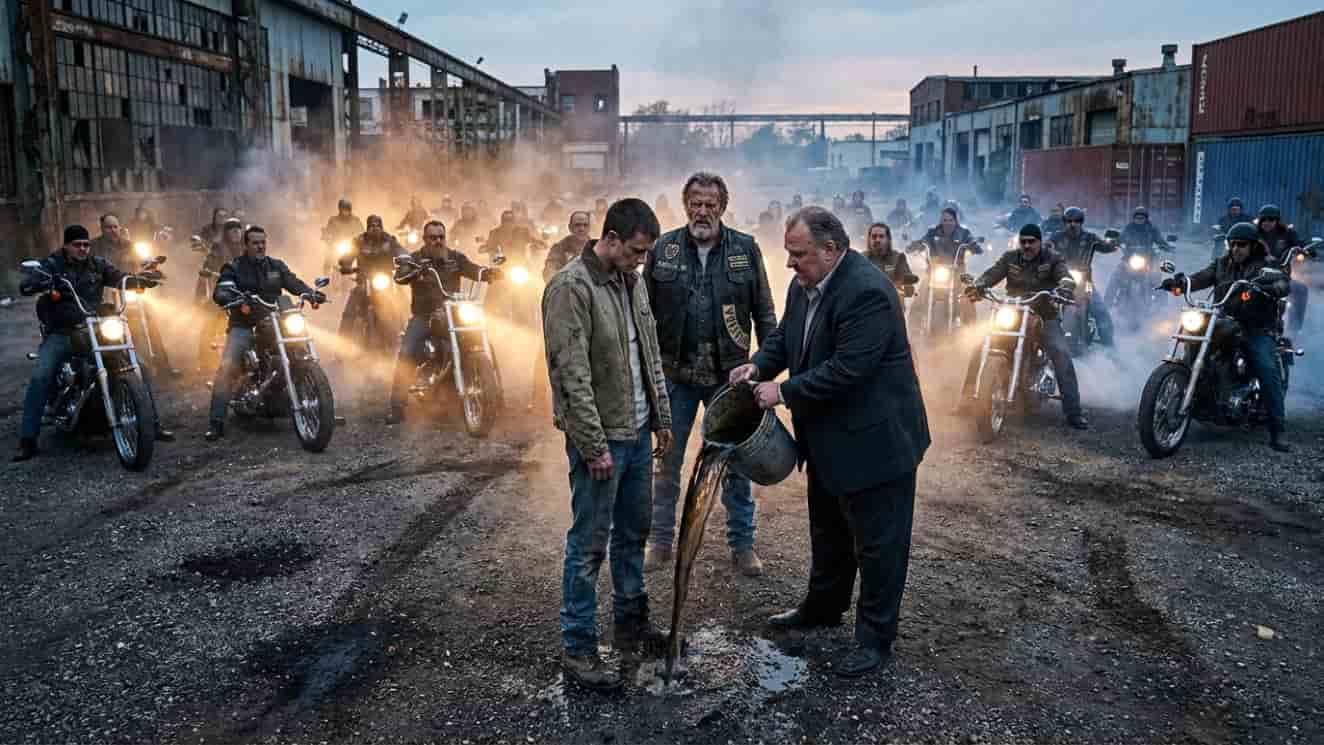
The gravel in the scrapyard felt like glass under my boots, but I didn’t move. I watched Vance, a man who’d never worked a day in his life, stand over my son and tell him he wasn’t worth the dirt on his shoes. My Jake, who used to laugh until his ribs ached, just stood there with his head down, taking the insults because he thought he had no choice. He thought being a “convict” meant he’d lost the right to stand up.
Vance didn’t see me in the shadows. He didn’t see the heavy leather vest I’d kept in a cedar chest for five years. He certainly didn’t hear the low rumble of a hundred engines gathering at the edge of the lot.
“Clean it up, jailbird,” Vance spat, kicking a bucket of oil toward Jake’s feet.
That was the moment I stepped out. I didn’t need to shout. I didn’t need to swing. I just reached into my pocket and pulled out the key to the first bike I ever gave Jake—the one he never got to ride because he was busy serving my time. Behind me, the headlights of the Vultures cut through the Detroit smog like a judgment.
Vance’s face went from pale to gray when he realized the “trash” he’d been kicking had an army standing behind him. This wasn’t about a job anymore. This was about a father finally paying the interest on a debt that nearly cost him his son’s soul.
Chapter 1: The Weight of the Vest
The air in the Vultures’ clubhouse always smelled the same: stale beer, primary-grade engine oil, and the faint, metallic tang of old cigarette smoke trapped in the rafters. It was a smell that usually felt like home, but today, it felt like a shroud.
“Old Man” Miller sat at the end of the scarred oak bar, his fingers tracing the deep gouges in the wood. He was sixty-four, but in the dim light of the neon Budweiser sign, he looked eighty. His hands were a map of a life spent turning wrenches and throwing punches—knuckles swollen with arthritis, a jagged white scar running from his thumb to his wrist where a snapped chain had tried to take his hand in ’94.
“He’s at the gate, Miller,” a voice said.
Miller didn’t look up. He knew the voice. It was Preacher, the club’s vice president and the only man who still remembered Miller when his beard was black and his back was straight. Preacher put a hand on Miller’s shoulder, the heavy leather of his own vest creaking.
“Five years is a long time,” Miller rasped. His voice sounded like gravel being turned in a drum. “He’s going to look at me and see a liar. He’s going to see the man who let him sit in a six-by-nine cell while I sat here drinking cold ones.”
“He did it for the club, Miller. He did it for you,” Preacher said, his voice low and steady. “And the club doesn’t forget. Look around.”
Miller finally lifted his head. The clubhouse was packed. There were men there who hadn’t worn their patches in years—original members with white hair and shaking hands, and the new blood, the young guys with pristine leather and hungry eyes. Nearly a hundred men stood in the shadows, their silence more deafening than any engine roar. They were waiting for the “Prince” to come home.
But Miller knew the truth. Jake wasn’t a prince. He was a kid who’d had the misfortune of being born to a man who valued a patch more than his own blood. Five years ago, a botched run near the border had gone sideways. The feds were closing in, and someone had to take the fall for the crate of unregistered steel in the back of the truck. Miller had been the one driving, but Jake, only twenty at the time, had swapped seats in the chaos of the ditch. He’d looked his father in the eye and told him the club needed a leader more than a son.
Miller had let him do it. That was the wound that wouldn’t close. Every morning for 1,825 days, Miller had woken up in his small, quiet house in the River Rouge district and hated the man in the mirror.
“I’m going alone,” Miller said, standing up. His knees popped, a sharp reminder of his expiration date.
“The boys want to ride with you,” Preacher protested. “A processional. We show the world he’s back.”
“No,” Miller said, his tone final. “He’s had enough noise. He needs a quiet ride. I’ll bring him back here when he’s ready.”
He walked out the heavy steel door of the clubhouse and into the biting Detroit wind. His bike, a 1998 Heritage Softail with more miles than most cars, was waiting in the gravel lot. He swung his leg over the seat, the familiar weight of the machine grounding him. He reached into his vest pocket and felt the cold metal of a key. It wasn’t the key to this bike. It was a key to a 1200 Sportster sitting under a tarp in his garage—the bike he’d bought for Jake’s twentieth birthday, the one Jake had never seen.
The ride to the Jackson County Correctional Facility was an hour of grey highway and skeletal factories. Detroit was a city of bones, and Miller felt like one of the oldest. He kept his speed steady, his eyes fixed on the horizon where the sun was struggling to break through the overcast sky.
When he reached the gate, he didn’t pull into the visitor lot. He stayed on the shoulder of the road, the engine idling with a low, rhythmic thrum. He watched the small pedestrian gate. A few minutes later, it clicked open.
A man stepped out. He was thin—thinner than the boy Miller remembered. He carried a small mesh bag of belongings. He wore a cheap grey sweatshirt and jeans that were too big for him. His hair, once a wild mop of blonde, was buzzed short, revealing a jagged scar over his left ear that Miller didn’t recognize.
Jake stood on the sidewalk, squinting at the light. He didn’t look like a prince. He looked like a man who had forgotten how to breathe air that didn’t smell like bleach and floor wax.
Miller shut off the engine. The silence that followed was heavy. He climbed off the bike and stood there, his hands hanging uselessly at his sides.
“Jake,” he said.
The younger man turned. His eyes were hard—not angry, but flat. They were the eyes of someone who had seen the bottom of the world and decided it wasn’t worth talking about. He looked at the Vultures patch on Miller’s chest, then up at his father’s face.
“Dad,” Jake said. The word was short, clipped. It wasn’t an embrace. It was an acknowledgement.
“I got the truck at the house, but I thought… I thought you might want the wind,” Miller said, gesturing to the bike.
Jake looked at the Softail. A shadow of a memory flickered across his face, then vanished. “The wind doesn’t change anything. But yeah. Let’s go.”
He didn’t ask about the club. He didn’t ask about his friends. He just climbed onto the back of the bike and held onto the sissy bar, refusing to put his arms around his father’s waist. As Miller pulled away from the prison, he felt the cold space between them. It was a gap that a hundred motorcycles and a thousand miles couldn’t bridge. He had his son back, but as the prison disappeared in the rearview mirror, Miller realized he was bringing home a stranger.
Chapter 2: The Sound of Silence
The house in River Rouge was a narrow, two-story frame building that leaned slightly to the left, as if tired of holding itself up against the Michigan winters. Inside, it smelled of Pine-Sol and the pot roast Miller had started in the slow cooker six hours ago. It was a “welcome home” gesture that felt increasingly pathetic as Jake walked through the door.
Jake dropped his mesh bag on the linoleum floor of the kitchen. He didn’t look around with nostalgia. He looked at the walls like he was checking for exits.
“Your room is the same,” Miller said, hovering by the table. “I cleared out the boxes. Put fresh sheets on. Even got that fan you like.”
“Thanks,” Jake said. He walked to the window and looked out at the backyard. The grass was long, and a rusted-out engine block sat near the fence like a tombstone. “Is the garage locked?”
“For now. I thought we’d go out there tomorrow. Together.” Miller hesitated. “There’s something in there for you, Jake. Something I should have given you a long time ago.”
Jake turned, his expression unreadable. “I don’t need things, Dad. I need a job. The parole officer is coming by on Monday. If I don’t have a lead, they’ll put me in a halfway house in the city. I’m not going back to a cage.”
“The club… we have connections. The union at the docks, or maybe the shop in Dearborn—”
“No club,” Jake interrupted. His voice was sharp for the first time. “No patches. No ‘favors.’ I did my time for the Vultures. That debt is settled. I want a paycheck that doesn’t come with a side of federal surveillance.”
Miller felt a sting in his chest, a sharp rebuke to the pride he’d felt wearing the leather. “The Vultures are family, Jake. They’re waiting for you. There’s a party tonight at the clubhouse. Everyone’s there. Preacher, Tiny, even old Sal drove up from Ohio.”
Jake sat down at the small kitchen table, his shoulders hunched. He looked at his hands—clean, but pale. “Tell them thanks. But tell them I’m dead. Tell them the Jake who rode with them didn’t make it out of Jackson.”
The meal was a quiet affair. The pot roast was tender, but it tasted like ash in Miller’s mouth. He tried to fill the silence with talk of the neighborhood—who had moved out, which bars had closed, how the city was trying to “revitalize” the waterfront by tearing down everything they’d ever known. Jake nodded in all the right places, but he wasn’t there. He was somewhere miles away, trapped in a memory or a fear.
After dinner, Jake went upstairs. Miller sat in his recliner in the living room, the TV flickering with some mindless game show he wasn’t watching. He listened to the floorboards creak above him. He heard the shower run for a long time—longer than necessary. He imagined his son trying to scrub the prison off his skin, trying to wash away the five years that Miller had handed him like a cursed inheritance.
Around ten o’clock, Miller’s phone buzzed on the side table. It was a text from Preacher: Where are you? The keg is tapped. The boys are restless.
Miller looked at the stairs. Then he looked at the door. He felt the pull of the clubhouse—the laughter, the brotherhood, the easy lie that everything was okay as long as you had your brothers at your back. But then he looked at the mesh bag sitting on the kitchen floor.
He typed back: Not tonight. He needs rest.
He spent the next two hours staring at the dark screen of the television. He thought about the secret he was keeping—the fact that he’d spent nearly ten thousand dollars of the club’s emergency fund to pay off a crooked guard to keep Jake safe in the hole. If the national president ever found out, Miller would be stripped of his patch and likely his teeth. But he’d do it again. He’d do anything to feel less guilty, and yet, no amount of money seemed to lighten the load.
The next morning, the silence was broken by the sound of a heavy truck idling in the street. Miller looked out the window to see a black Ford F-150 with a “Vance Industrial” logo on the door.
Vance Miller (no relation, a fact Miller took great pains to clarify to anyone who asked) was the king of the local scrap and demolition trade. He was a man who had built an empire on the ruins of Detroit, buying up foreclosed properties and stripping them of their copper and pride. He was also a man who had once tried to join the Vultures and had been laughed out of the clubhouse for being a “soft-handed vulture who didn’t know a piston from a spark plug.” He hadn’t forgotten the insult.
Jake was already at the door, wearing his one clean shirt.
“What is he doing here?” Miller asked, joining him.
“I called him last night,” Jake said, not looking back. “He’s looking for laborers for the new yard. It’s hard work, but he doesn’t care about records as long as you can lift eighty pounds.”
“Jake, Vance is a snake. He’ll work you into the ground and find a reason to stiff you on the check. Come to the shop with me. We’ll find something better.”
Jake opened the door. The cold morning air rushed in. “He’s the only one who answered the phone, Dad. I’m not a mechanic. I’m a guy with a felony and five years of empty space on my resume. I take what I can get.”
Vance leaned out the window of the truck, a smirk playing on his fleshy lips. He saw Miller standing in the doorway and his grin widened.
“Well, look at that,” Vance called out, his voice oily. “The Old Man himself. I heard the Prince was out. Didn’t think he’d be looking for a real job so soon. Usually, you Vultures just live off the scraps of your old ladies, don’t you?”
Miller felt his face heat up. His hand drifted toward his belt, where a heavy brass buckle waited. “Watch your mouth, Vance. He’s a better man than you’ll ever be.”
“He’s my employee now, Miller,” Vance said, his eyes glinting with a mean sort of triumph. “And in my yard, he’s just another number. Jump in, kid. Let’s see if those prison muscles are just for show.”
Jake didn’t look at his father. He walked down the porch steps and climbed into the truck. As they drove away, Miller stood on the porch, the morning sun finally hitting the “Vultures” logo on his back. For the first time in forty years, the leather felt cold.
Chapter 3: The Stain of the Yard
The Vance Industrial scrapyard was a wasteland of twisted rebar, rusted car frames, and the constant, rhythmic thud of a heavy magnet crane. It was located on the edge of the Detroit River, a place where the wind always felt ten degrees colder and smelled like wet iron.
Miller spent the day at the club’s garage, but he couldn’t focus. He dropped a crescent wrench three times. He stared at a carburetor for twenty minutes without seeing it. Finally, around three in the afternoon, he couldn’t take it anymore. He climbed into his old Chevy pickup—the one he kept for hauling parts—and drove toward the river.
He parked on the public road across from the yard’s main gate. Through the chain-link fence, he saw his son.
Jake was part of a “sorting line”—a group of men standing knee-deep in piles of mixed debris, pulling out copper wiring and brass fittings by hand. It was backbreaking, filthy work. Jake’s sweatshirt was soaked with sweat and grease, his face smeared with soot.
But it wasn’t the work that made Miller’s blood boil. It was Vance.
The owner was standing on a raised wooden platform, a coffee cup in one hand and a clipboard in the other. He was shouting at the men below, his voice amplified by the metal walls of the surrounding sheds.
“Move it, you lazy bastards! I’m paying for a day’s work, not a tea party! You, 402!” Vance pointed at Jake. “You missed a coil. Get back in there and dig it out.”
Miller watched as Jake hesitated. The pile of scrap he was standing on was unstable, a mountain of jagged steel. Jake reached down, his arm disappearing into the heap. He pulled out a heavy copper manifold, his muscles straining.
“Faster!” Vance yelled. “Maybe you need another five years to learn how to follow orders, huh? Is that it? You miss the communal showers?”
The men on the line chuckled nervously. Jake stayed silent. He just kept working, his jaw set in a line so tight it looked like it might snap.
Miller gripped the steering wheel of his truck until his knuckles turned white. He wanted to swing the gate open and tear Vance off that platform. He wanted to show him what a “Vulture” did to people who targeted the weak. But he remembered Jake’s words: No club. No patches.
He stayed in the truck. He watched for two hours. He saw Vance descend from the platform and walk over to Jake. Vance said something Miller couldn’t hear, then reached out and tapped Jake’s chest with his clipboard—a small, demeaning gesture. Jake didn’t flinch, but he closed his eyes for a second.
When the whistle blew at six, the men filed out of the yard like ghosts. Jake was the last one out. He walked toward the road, his gait heavy and stiff. He didn’t see Miller’s truck at first. When he did, he stopped.
“Go home, Dad,” Jake said as he reached the window. He smelled like a machine shop and old rain.
“Get in,” Miller said. “You’re not walking three miles in this.”
Jake climbed in. He didn’t lean back against the seat; he didn’t want to get grease on the upholstery. “He’s trying to break me. He knows who I am, and he’s trying to see how long it takes for me to swing at him so he can call my PO.”
“Then don’t give him the satisfaction. Quit, Jake. Come work at the garage. Preacher won’t care about the record. We’ll pay you under the table until the parole ends.”
“And then what?” Jake asked, turning to look at him. His eyes were red-rimmed and tired. “Then I’m a Vulture for life. Then I’m just like you, waiting for the day the feds decide to clean house again. I’d rather rot in that yard than owe the club another second of my life.”
They drove in silence back to the house. When they got there, Jake didn’t go inside. He walked straight to the garage.
“You said there was something in here,” Jake said.
Miller felt a flutter of hope. He pulled the heavy wooden door open and flicked on the overhead fluorescent lights. In the center of the garage, under a dusty grey tarp, stood a silhouette.
Miller walked over and pulled the tarp back.
The 1200 Sportster was beautiful. It was a custom job—matte black paint, chrome pipes that shone like mirrors, and a leather seat with a subtle, embossed vulture wing on the back.
“I built it while you were gone,” Miller said, his voice thick. “Every part is top shelf. It’s yours, Jake. I bought it the day before… the day before the run. I wanted it to be a surprise.”
Jake looked at the bike. He reached out and touched the handlebars. For a moment, he looked like the twenty-year-old kid who used to spend his weekends polishing his father’s chrome. A ghost of a smile touched his lips.
But then his hand dropped. He looked at the vulture wing on the seat.
“It’s beautiful, Dad,” Jake said quietly. “But I can’t ride it.”
“Why not? You still got your endorsement. I checked.”
“Because I can’t be that person anymore,” Jake said. He looked at Miller with an intensity that felt like a physical weight. “Every time I hear a Harley, I think of the sirens. I think of the way you looked at me when I told you to get out of the truck. You didn’t even say no, Dad. You just… you just let me go.”
The words hit Miller harder than any fist. “I was a coward, Jake. I’ve lived with that every day.”
“I don’t care about the cowardice,” Jake said. “I care that you still think a bike and a patch make up for it. Keep the bike. Sell it. Use the money for your retirement. I’m going to sleep. I have to be back at the yard at five.”
He walked out of the garage, leaving Miller alone with the perfect, useless machine.
Chapter 4: The Boiling Point
The next three days were a slow-motion car crash.
Each day, Jake came home more battered. His hands were covered in small, jagged cuts from the scrap metal. His spirit seemed to be leaking out of him, replaced by a dull, robotic endurance. Miller watched him from afar, a man trapped between his son’s pride and his own mounting rage.
On Friday, it rained—a cold, miserable Detroit soak that turned the city into a grey blur. Miller was at the clubhouse when Preacher walked in, looking grim.
“Miller. You need to get down to the diner on 4th. Now.”
“What’s happened?”
“Vance is there with a couple of his foremen. Jake’s there too. Someone saw them. It’s getting ugly, Miller. Vance is putting on a show.”
Miller didn’t ask questions. He didn’t even grab his jacket. He ran to his bike and roared out of the lot, the rain stinging his face like needles.
The diner was a greasy spoon called The Iron Skillet, a place where the local laborers went for cheap coffee and heavy breakfasts. When Miller pushed through the glass doors, the bell chimed, but no one looked. All eyes were on a booth in the back.
Vance was sitting there, flanked by two burly men in work jackets. Jake was standing at the end of the table. He was holding a tray of coffee—it looked like he’d been sent there on a run for the crew.
“I said it’s cold, 402,” Vance was saying, his voice loud enough for the whole diner to hear. “I don’t pay you to bring me lukewarm piss. Take it back.”
“The machine is down, Mr. Vance,” Jake said. His voice was trembling, but he was trying to keep it steady. “This is the best they have.”
“Not good enough,” Vance said. He looked around at the other patrons, grinning. “See, this is the problem with these ‘reformed’ types. They lose their edge. They get soft. Isn’t that right, Jake? Or should I call you ‘Prince’?”
One of Vance’s foremen laughed. “He doesn’t look like much of a prince to me. Looks like a dog waiting for a bone.”
Vance reached out and took a cup of coffee from the tray. He looked Jake in the eye, and then, with slow, deliberate malice, he tilted the cup.
The hot liquid poured over Jake’s work boots, soaking into the leather. Jake didn’t move. He didn’t cry out. He just stood there, his head bowed, as the steam rose from his feet.
“Clean it up,” Vance said, dropping the empty cup on the table. “Get some napkins and get on your knees. Show everyone how well they taught you to scrub floors in Jackson.”
The diner went silent. The waitress froze behind the counter. The only sound was the hum of the refrigerator.
Miller stepped out of the entryway. “That’s enough.”
Vance looked up, his eyes widening slightly before the smirk returned. “Well, if it isn’t the Old Man. Come to save your boy? You’re a bit late for that, aren’t you? About five years late.”
Miller walked to the booth. He didn’t look at Vance. He looked at Jake. “Jake. Put the tray down. We’re going.”
“I can’t, Dad,” Jake whispered, his eyes fixed on the floor. “I need the job. I have to stay.”
“You don’t have to do anything for this piece of trash,” Miller said. He turned to Vance. His voice was a low, vibrating growl. “I tried to do this the right way. I tried to stay out of it. But you just couldn’t leave it alone, could you?”
Vance stood up, trying to use his height to intimidate Miller. He was younger and heavier, but Miller had the stillness of a man who had nothing left to lose.
“What are you going to do, Miller? Call your little club? We’re in public. There are witnesses. You touch me, and you go to jail right next to your son. Only this time, there won’t be anyone to take the fall for you.”
Miller looked around the diner. He saw the tired faces of the working men. He saw the fear in the waitress’s eyes. And then he saw the shame on his son’s face.
“You’re right, Vance,” Miller said. He felt a strange, cold clarity wash over him. “I’m not going to touch you. Not here.”
He reached into his pocket and pulled out a thick roll of bills—his entire savings, the money he’d been keeping to help Jake get on his feet. He threw it on the table. It was nearly four thousand dollars.
“There’s your coffee, Vance. There’s your ‘damages.’ Consider Jake’s notice given.”
“Dad, no—” Jake started.
“Shut up, Jake,” Miller said, but not unkindly. He grabbed Jake’s arm. “We’re leaving. Now.”
He led Jake out of the diner and into the rain. They stood by Miller’s bike, the water pouring off the eaves of the building.
“You shouldn’t have done that,” Jake said, his voice breaking. “That was your money. Now I have nothing. No job, no money, and the PO is going to send me back.”
Miller looked at his son—truly looked at him. He saw the broken boy inside the man. He realized that Jake was never going to be able to save himself. The world was too cruel, and the stain of the past was too dark.
“You’re wrong, Jake,” Miller said. He reached out and gripped the back of Jake’s neck, pulling their foreheads together. “You have me. And you have the Vultures. You said you didn’t want the patch. You said the debt was settled. But a father’s debt is never settled.”
Miller pulled his phone from his vest. He didn’t text Preacher. He hit the speed-dial for the “Emergency Channel”—the one only used when the club was under threat.
“Preacher,” Miller said when the line picked up. “Call them all. Every chapter within fifty miles. Tell them the Prince is being disrespected. Tell them I want a wall of chrome around Vance Industrial at dawn tomorrow. No weapons. No violence. Just the patch.”
He hung up and looked at Jake.
“Tomorrow, the town finds out who you are,” Miller said. “And Vance finds out what happens when you kick a Vulture’s cub.”
“Dad…” Jake started, fear and hope warring in his eyes.
“Don’t say a word,” Miller said. “Just be ready. We’re taking your ride.”
Chapter 5: The Gathering of the Ghosts
The four o’clock hour in Detroit is a special kind of quiet. It’s the time when the night-shift workers at the remaining plants are fighting the urge to sleep and the morning crews are just starting to pull on their boots. It’s a grey, liminal space where the city feels like it could either wake up or simply crumble into the river.
Miller was in the garage. He’d been there since three, moving with the slow, deliberate care of a man preparing for a funeral or a wedding—he wasn’t sure which. He’d cleaned the 1200 Sportster again, though there wasn’t a speck of dust on it. He’d checked the oil, the tire pressure, and the tension on the drive belt. He’d polished the chrome pipes until they reflected the yellow glow of the overhead shop light like distorted mirrors.
He heard the kitchen door creak. A moment later, Jake stepped into the garage. He was wearing an old denim jacket over a hoodie, his hands shoved deep into his pockets. He looked at the bike, then at his father.
“You really did this,” Jake said. It wasn’t a question.
“I did,” Miller replied. He picked up a rag and wiped a non-existent smudge off the tank. “The boys are meeting at the staging area on Jefferson. We head to the yard at five-thirty.”
Jake walked over to the Sportster. He ran a finger along the handlebars. “Vance is going to call the cops, Dad. He’s going to say it’s gang intimidation. My PO will have a warrant out before noon.”
“Preacher’s already talked to a lawyer,” Miller said, finally looking up. “We aren’t breaking any laws. We’re riding on public roads. We’re standing on public property. If Vance wants to call the police because a hundred tax-paying citizens decided to have a morning ride past his gate, let him. It’s a free country, Jake. That’s what they tell us, anyway.”
“Tax-paying citizens,” Jake muttered, a ghost of a smirk appearing. “Most of the Vultures haven’t paid taxes since the Carter administration.”
“Details,” Miller said. He reached into his vest pocket and pulled out the key. He didn’t offer it with a speech. He just set it on the seat of the Sportster. “The bike is yours. Whether you ride it today or sell it tomorrow, it’s yours. But I’d like you to ride it today. I’d like to see you on it, just once.”
Jake looked at the key. The metal glinted under the fluorescent light. For a long minute, he didn’t move. Then, with a hand that trembled just slightly, he picked it up. He climbed onto the seat. The bike was low, aggressive, and perfectly balanced. When he gripped the bars, his shoulders seemed to settle, the tension of the last week finally finding a place to go.
“Start it up,” Miller said.
Jake turned the ignition. The fuel pump primed with a high-pitched whine. He hit the starter. The Sportster didn’t just start; it exploded into life. The sound in the small garage was physical—a rhythmic, deep-chested thrum that vibrated in Miller’s teeth. It was the sound of something coming back from the dead.
Miller pulled his Softail out into the driveway, and Jake followed. They rode through the empty streets of River Rouge, the twin exhausts echoing off the boarded-up storefronts. As they turned onto Jefferson, Miller saw the first of the headlights.
Two bikes were idling at the corner. Then four. By the time they reached the staging area—an abandoned gas station parking lot—there were dozens. The air was thick with the scent of unburnt fuel and the low, collective growl of a hundred V-twin engines.
Preacher was there, standing by his big Road King. He saw Miller and Jake pull in, and he raised a gloved hand. The other Vultures followed suit. There was no cheering, no shouting. There was just the steady, pulsing heartbeat of the club.
“Miller,” Preacher said, walking over. He looked at Jake on the Sportster. “Look at that. He fits it.”
“He does,” Miller said. He felt a lump in his throat that he had to swallow hard to clear.
“The Detroit chapter is here. Flint is on the way. We got five guys from the Steel City crew who happened to be in town,” Preacher said, his eyes scanning the growing crowd. “We got the wall, Miller. Just say the word.”
Miller looked at his son. Jake was looking at the men around him—men who had known him since he was a kid, men who had visited him in Jackson when Miller was too ashamed to go, men who had kept his name alive in the clubhouse for five years. For the first time since he’d walked through the prison gate, Jake didn’t look like a ghost. He looked like a man who belonged somewhere.
“Let’s go,” Miller said.
The procession was a mile long. They didn’t ride fast. They rode in a tight, staggered formation, a river of steel and leather flowing through the awakening city. People stepped out onto their porches to watch. Early morning commuters pulled over, mesmerized by the sheer volume of the group.
As they approached Vance Industrial, Miller saw the gates. They were closed and locked. Vance was standing there, his truck parked just inside the chain-link fence. He was holding a phone to his ear, his face pale even from a distance.
The Vultures didn’t stop at the gate. They began to circle. They rode in a massive, slow-moving loop that encompassed the entire perimeter of the yard. A hundred bikes, headlights on high beam, creating a blinding, shifting wall of light.
Miller and Jake pulled to the very front, right at the main entrance. Miller shut off his engine. Jake did the same. One by one, the other bikers followed suit, until the only sound was the clicking of cooling metal and the wind coming off the river.
The silence was heavier than the noise had been.
Vance stepped out of his truck, clutching the fence with both hands. He looked like a man watching a tidal wave approach and realizing he forgot how to swim.
“This is harassment!” Vance screamed, his voice cracking. “I’ve already called the precinct! They’re on their way! You’re all going to lose your licenses!”
Miller didn’t say a word. He just stood by his bike, his arms crossed over his vest.
“You’re trespassing!” Vance yelled again, though he knew it was a lie. The bikers were all on the public shoulder of the road.
Finally, Miller stepped forward. He walked right up to the chain-link fence, until he was inches away from Vance.
“We aren’t here for you, Vance,” Miller said, his voice quiet but carrying in the stillness. “We’re here for him.”
He gestured to Jake, who stepped up beside him. Jake was still wearing the grease-stained work boots Vance had poured coffee on. He looked at Vance, not with anger, but with a cold, clear pity.
“You thought he was a number,” Miller said. “You thought he was just another piece of scrap you could kick around because he didn’t have a voice. But you didn’t look behind him, Vance. You forgot that in this city, nobody stands alone if they’ve earned their seat.”
At that moment, the first of the police cruisers arrived, their blue and red lights dancing off the chrome. Two officers stepped out, looking at the sea of leather with wide, uncertain eyes. They knew Miller. They knew the Vultures. And they knew Vance.
“What’s the problem here?” the older officer asked, walking up to the gate.
“They’re threatening me!” Vance shouted, pointed at the bikers. “Look at them! They’re an outlaw gang!”
The officer looked at the line of bikes. He saw the grey beards, the polished chrome, the quiet, disciplined posture of the men. He saw Jake, standing there with his head held high. Then he looked at the oily puddle of coffee still visible on the pavement near the entrance from the day before—a detail Miller had mentioned in a quiet phone call to the precinct captain an hour earlier.
“Looks like a peaceful assembly to me, Vance,” the officer said. “Unless someone’s breaking a law I don’t know about?”
Vance’s mouth hung open. He looked at the police, then back at the wall of Vultures. He realized the power had shifted. The fear he’d used to rule his yard was gone, replaced by a much older, much deeper kind of authority.
Chapter 6: The Long Way Home
The confrontation at the gate didn’t end in a fight. It ended in a slow, humiliating collapse. Vance, realizing the police weren’t going to be his personal security guards, retreated to his truck and drove deep into the yard, leaving the gates locked and his business effectively paralyzed for the day. He couldn’t run a scrapyard if the men he hired were too afraid to cross a line of a hundred bikers to get to work.
But for Miller and Jake, the real work was just beginning.
The Vultures began to disperse as the sun climbed higher into the sky. They rode off in small groups, a rumble that faded into the city’s morning traffic. Preacher stayed until the end, giving Jake a firm nod before he, too, kicked his bike into gear.
“You okay?” Miller asked his son. They were standing by their bikes, the only ones left on the shoulder of the road.
“I’m alive,” Jake said. He looked back at the yard. “I’m not going back there. Not even for my last check. He can keep it.”
“He won’t keep it,” Miller said. “Preacher’s sister is a paralegal. She’s already filing a wage and hour claim for the ‘coffee incident’ and the unpaid overtime. You’ll get your money. And Vance will get a visit from the labor board.”
They rode back toward River Rouge, but Miller didn’t turn toward the house. He headed for the waterfront park—a strip of green grass and concrete benches overlooking the shipping channel. He pulled over and killed the engine. Jake followed him.
They sat on a bench, watching a massive freighter move slowly downriver toward Lake Erie. The air was cold, but the sun felt good on Miller’s face.
“I have to tell you something, Jake,” Miller said. He didn’t look at his son. He kept his eyes on the water. “About why I let you go.”
“Dad, you don’t have to—”
“I do. Because you think I was a coward, and you’re right. But it’s worse than that.” Miller took a deep breath, the cold air stinging his lungs. “I didn’t just let you take the fall. I convinced myself it was the ‘noble’ thing for you to do. I told myself you were young, that you’d bounce back, and that the club couldn’t survive without me. I put the patch before the person. And I’ve been trying to buy my way out of that choice ever since.”
Jake was silent. He picked up a small stone and tossed it into the water. Plink.
“I took ten thousand dollars from the club’s emergency fund,” Miller confessed. “I used it to pay a guard named Hennessey in Jackson. I told him to make sure you didn’t get targeted. To make sure you stayed in a single cell as much as possible.”
Jake turned his head sharply. “That was you? I thought… I thought I just got lucky with the housing assignments.”
“There’s no luck in Jackson,” Miller said, a bitter laugh escaping him. “I stole that money, Jake. If the national board ever audits the books, I’m done. I’ll be ‘out in bad standing.’ They’ll take my vest, maybe more.”
Jake looked at his father’s vest—the worn leather, the “Original Member” flash, the heavy Vultures logo. He knew what it meant to Miller. It was his identity. It was his history.
“You risked everything for a bribe?” Jake asked.
“I risked everything because I’d already lost the only thing that mattered,” Miller said. “I lost you the second I let you get in that squad car. I thought if I could just keep you safe, maybe I could live with myself. But seeing you in that yard… seeing that bastard Vance treat you like trash… I realized I was still letting you pay for my sins.”
Jake stood up and walked to the railing. He stayed there for a long time, his back to his father. The freighter blew its horn—a deep, mournful sound that seemed to vibrate through the ground.
“I hated you for three years,” Jake said, his voice so quiet Miller almost couldn’t hear it. “In the fourth year, I just got tired. I didn’t hate you anymore. I just didn’t know you. You were just a guy who sent me money orders and letters I didn’t want to read.”
“I know,” Miller said.
“But today…” Jake turned around. There were no tears in his eyes, but there was a softness that hadn’t been there before. “Today, for the first time, I didn’t feel like a convict. I felt like your son.”
Miller felt a weight lift off his chest—not all of it, but enough to let him breathe. “So, what now? You still want to sell the bike?”
Jake looked at the Sportster, sitting black and beautiful in the morning light. “No. I think I’ll keep it. But I’m not joining the club, Dad. I’m not wearing a patch. I’m going to find a job—a real one. Somewhere where they don’t know my name.”
“I can respect that,” Miller said. “But you’re always welcome at the house. And the garage is yours whenever you need to turn a wrench.”
“I might need a place to stay for a while,” Jake said, looking down at his boots. “Until I get my first paycheck.”
“The room is already made,” Miller said.
They walked back to their bikes. As Miller climbed onto his Softail, he felt the age in his bones, the arthritis in his hands, and the exhaustion of a lifetime of bad choices. But he also felt the cold, hard reality of the road ahead. It wouldn’t be easy. The damage was done, and five years of life were gone forever. There was no magic fix, no neat ending.
But as Jake kicked his Sportster into gear, the engine roared with a fierce, defiant energy. He looked at his father and nodded—a real nod, full of recognition.
Miller led the way, and Jake followed. They didn’t ride back like a king and a prince. They didn’t ride like outlaws. They just rode like two men, father and son, trying to find the long way home through the ruins of a city they both still called their own.
As they pulled onto the highway, the sun finally broke through the Detroit clouds, hitting the chrome and the asphalt with a brilliance that was almost blinding. Miller opened the throttle, and for the first time in a long time, he didn’t look in the rearview mirror. He just looked ahead.