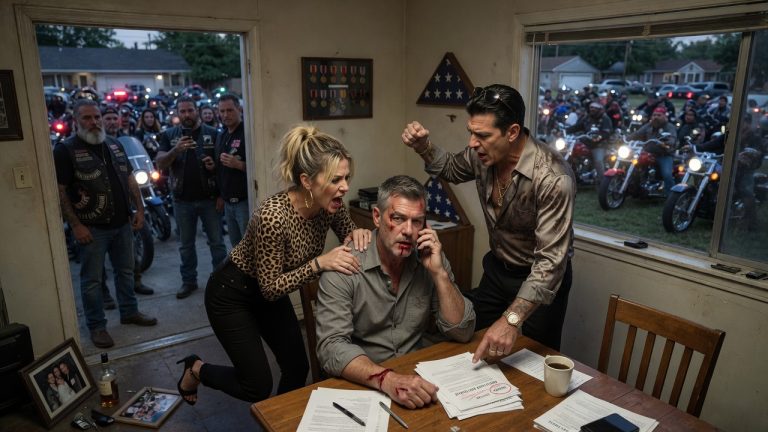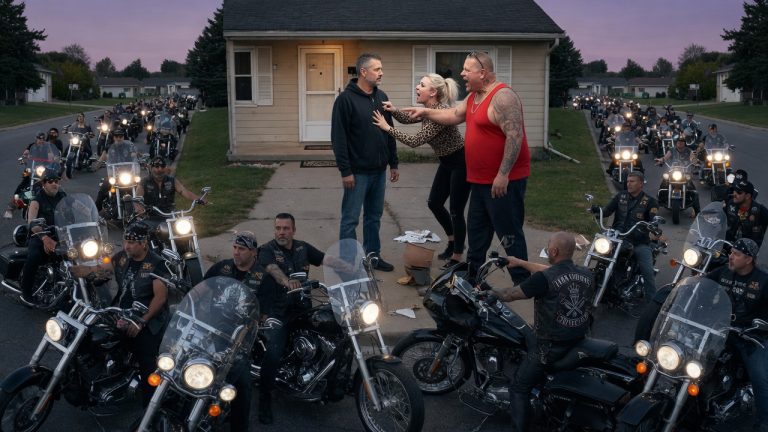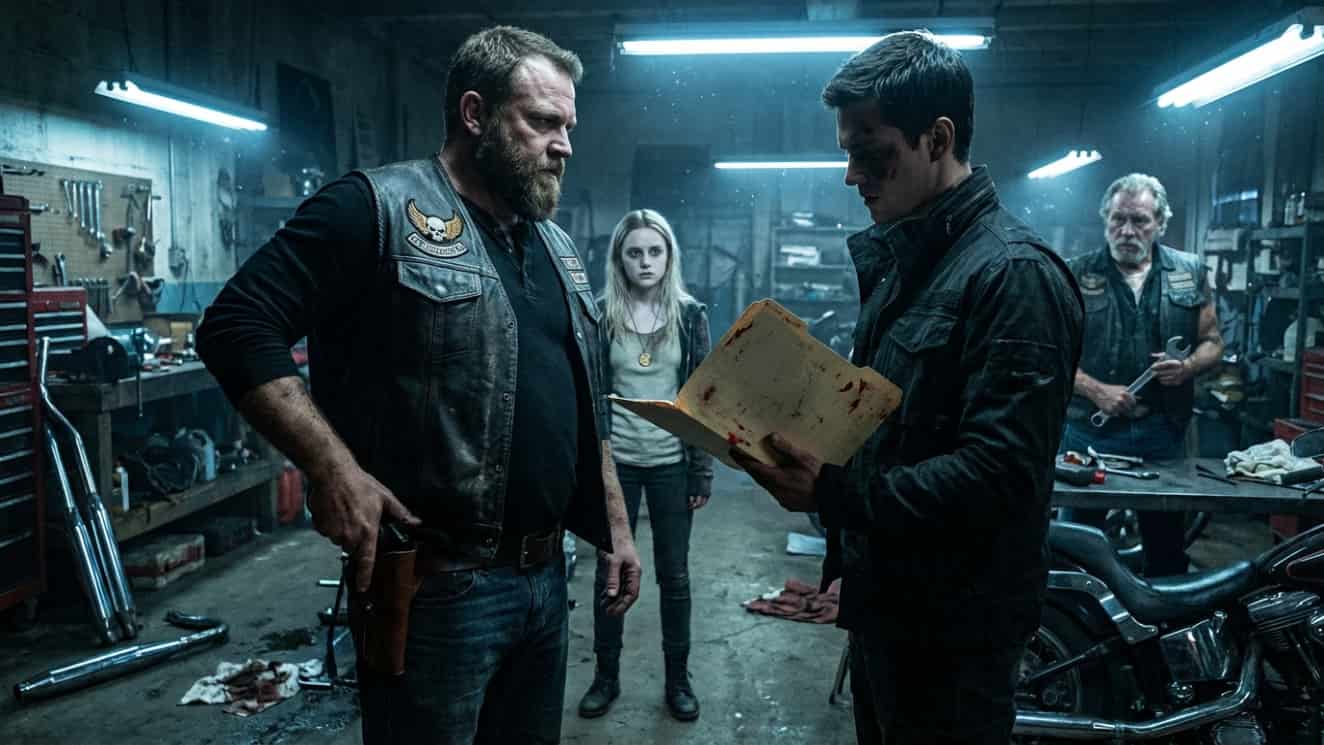
The garage smelled like 90-weight gear oil and the cheap cigarettes Silas favored. I’d spent two decades building a wall of lies to protect Lily from the truth of what I am, but that wall just crumbled in the dirt of an Atlantic City back alley. Silas didn’t just want my territory; he wanted my soul, and he knew the only way to get it was to show Lily the ledger I’d hidden in my desk since the night her father stopped breathing.
I saw the way her hand went to the “lucky coin” necklace—the only thing her dad left behind. She looked at the paper, then at me, and for the first time in twenty years, she didn’t see the man who’d tucked her in or taught her to ride. She saw the debt collector.
“Mac?” her voice was small, shaking like a leaf in a gale. “Why is there a picture of our old house in a folder labeled ‘Liquidation’?”
Silas grinned, the kind of smile that makes you want to reach for a tire iron. “Tell her, Mac. Tell her how much interest you’ve been collecting on her life.”
I couldn’t breathe. The weight of every bone I’d broken for the club was suddenly sitting on my chest, and the girl I’d die for was realizing she’d been living with the devil all along.
Chapter 1: The Ledger of Regret
The tenements on the north side of Atlantic City don’t just decay; they sour. They smell like wet drywall, boiled cabbage, and the kind of desperation that gets into the pores of your skin and stays there no matter how much Gojo you use at the end of the shift. I stood in the hallway of the fourth floor, my leather vest creaking with every breath. I’m a big man—”Big Mac” isn’t a nickname I earned for eating burgers; it’s for the way I occupy space. When I stand in a doorway, the light stops getting through.
The door in front of me was painted a peeling, institutional green. Behind it, a man named Miller owed the Bridge Street crew six thousand dollars. In the world of the Debt Collectors MC, we aren’t the ones who lend the money. We’re the ones who make sure the lending wasn’t a mistake. We’re the utility bill for the underworld—the one you can’t skip without the lights going out for good.
I didn’t knock. I kicked the door just hard enough to rattle the frame, but not enough to break the bolt. It’s a psychological thing. You want them to think you could come through the wood if you felt like it.
“Miller! Open up. It’s Mackenzie,” I rumbled.
A chain slid. The door cracked open three inches, held by a flimsy brass latch that wouldn’t stop a stiff breeze. A pale, sweating face peered out. Miller looked like he’d been living on coffee and nerves for a month. He was forty, maybe, but his hair was thinning in patches and his eyes were darting toward the shadows of his own living room.
“Mac, please,” he whispered. “I told the guys… I told them I’d have the first two thousand by Friday. My wife’s check didn’t clear.”
“It’s Saturday, Miller,” I said, my voice flat. I pushed against the door. The brass latch groaned. “And the Bridge Street guys don’t care about your wife’s payroll cycle. They care about their vig. Move back.”
He retreated, stumbling over a stray sneaker. I stepped inside. The apartment was a graveyard of better days. A plastic Christmas tree sat in the corner, though it was April. A bowl of soggy cereal sat on a coffee table made of particle board. And then I saw the kid.
A boy, maybe seven or eight, sat on the floor with a coloring book. He didn’t look up. He just colored a dinosaur blue, his small hand moving with a mechanical rhythm. He was trying to be invisible. I knew that look. I’d seen it in a mirror twenty years ago, and I’d seen it in the face of a girl named Lily when I first brought her home.
The sight of the boy hit me like a physical punch to the gut. It shouldn’t have. I’ve been doing this for thirty years. I’ve broken thumbs, I’ve repossessed cars with baby seats in the back, and I’ve burned down storefronts. But the older I get, the more the ghosts start to look like family.
“Mac, look, I got this watch,” Miller was babbling, fumbling at his wrist. “It’s a Seiko. Real. Worth five hundred, easy. Take it. Just tell them I’m trying.”
I looked at the watch. It was scratched, the crystal cracked. It wasn’t worth fifty bucks at a pawn shop on the boardwalk. I looked at the boy again. He’d stopped coloring. He was looking at his father with a terrifying, silent judgment.
“Get the kid out of the room,” I said.
“What? Why? Mac, please—”
“Get him out of the room, Miller. Now.”
Miller scrambled to the boy, scooping him up. The kid didn’t cry. He just stared at me over his father’s shoulder as he was carried into a back bedroom. When the door clicked shut, I turned to Miller. I reached out, grabbed the front of his stained T-shirt, and pinned him against the wall. A framed picture of a family at the pier rattled and fell, the glass shattering on the floor.
“Listen to me, you pathetic son of a bitch,” I hissed, my face inches from his. “If I go back and tell them you’ve got nothing, they’re going to send Jace. You know Jace? He’s twenty-two, he’s got a twitch in his left eye, and he likes the sound of snapping bone. He won’t care about the kid. He’ll do the work right in front of him.”
“I don’t have it,” Miller sobbed. “I swear to God, I don’t have it.”
I looked at his kitchen counter. There was a stack of envelopes. Overdue notices. Final warnings. It was a paper trail of a life being liquidated. I reached into my back pocket and pulled out my wallet. I took out ten hundred-dollar bills—money I’d collected from a bookie two hours ago—and shoved them into Miller’s trembling hand.
“You’re going to take this,” I said, my voice a low growl. “You’re going to call the Bridge Street office. You’re going to tell them Mackenzie came by and took a grand from you. You’re going to say you’ll have the rest in two weeks. And you’re going to use that time to get your kid and your wife out of this city. You understand me?”
Miller stared at the money like it was radioactive. “Why?”
“Because I don’t want to see that kid’s face when they find you in the marsh,” I said. I let him go. He slumped to the floor, clutching the cash.
I walked out of the apartment, the smell of the hallway hitting me again. My heart was thudding against my ribs. I was a thief. I was a liar. I was stealing from the club to pay the debts of a stranger, all because I couldn’t stop thinking about a night in 2006 when I didn’t show mercy.
I climbed onto my Harley, the engine roaring to life between my legs. The vibration usually calmed me, but not today. As I pulled away from the tenement, I saw a black SUV parked across the street. The windows were tinted dark. It didn’t belong in this neighborhood. As I passed, the driver’s window rolled down an inch. A pair of eyes watched me.
It was the New Breed. I knew it in my marrow. Silas and his crew of corporate thugs. They didn’t wear patches. They didn’t care about the “Old-School” codes of the MC. They were predators who used algorithms and tactical gear to squeeze blood from stones. And they were watching me.
I headed toward the garage, the neon lights of the casinos beginning to flicker on in the distance like a fever dream. I had a daughter to get home to. A daughter who thought I spent my days fixing bikes and my nights protecting the neighborhood. A daughter who was the only clean thing in my life.
And as the wind whipped past my face, all I could think about was the manila folder in the bottom drawer of my desk. The one with the name Thomas Ward on the tab. The man who’d been Miller twenty years ago. The man I hadn’t given a thousand dollars to.
The man whose daughter was now waiting for me to come home for dinner.
Chapter 2: New Blood, Old Methods
The clubhouse of the Debt Collectors MC wasn’t some sprawling mansion. It was a converted warehouse tucked behind a scrap yard on the edge of the marshes. It was a place of rust, grease, and the constant, low-level hum of violence. We didn’t have a pool table or a bar with top-shelf liquor. We had a long table made of reclaimed pier wood and a fridge full of lukewarm Pabst.
“Old-School” was waiting for me near the lift when I rolled in. His real name was Hank, but nobody had called him that since the Reagan administration. He was seventy, his skin like cured leather, his knuckles swollen with arthritis that made it hard for him to hold a wrench, but he still knew more about a Panhead engine than any man alive.
“You’re late, Mac,” Old-School said, wiping his hands on a rag that was more black than white. “And you look like you just ate a bag of glass.”
“Rough collection,” I said, dismounting. I started unbuckling my vest. “Miller on 4th Street.”
Old-School squinted at me. “The one with the kid?”
I didn’t answer. I didn’t have to. Old-School knew me. He’d been there when I’d brought Lily home as a toddler, claiming her father was a distant cousin who’d died in a wreck. He was the only one who knew the truth—that the “wreck” was a man jumping from a bridge because I’d threatened to take his house and everything in it.
“You’re getting soft in your old age, Mac,” Old-School whispered, stepping closer so the younger guys near the back wouldn’t hear. “The club is noticing. The New Breed is noticing.”
“Silas?”
“He was here an hour ago. Looking for you. Said he had a ‘business proposal’ for the board. Talked a lot of crap about ‘optimization’ and ‘modernizing the collection cycle.’ He’s got the young guys’ ears, Mac. Jace and that lot—they think the way we do things is dinosaur work.”
“It is dinosaur work,” I snapped. “It’s supposed to be. There’s a reason we don’t kill everyone who owes us. You kill a man, he can’t pay you back. You leave him enough to eat, he stays a customer. It’s the code.”
“Silas doesn’t care about customers. He cares about assets,” Old-School said. “He’s got a crew of guys who look like they belong in a CrossFit gym, and they’re carrying tablets instead of tire irons. They’re buying up the paper on all our old territories.”
I walked toward my office—a glass-walled cubicle in the corner of the warehouse that smelled like stale coffee and old paper. Inside, my desk was a mess of ledgers and receipts. I sat down and pulled out the bottom drawer. I reached past the spare magazines and the bottle of aspirin until my fingers touched the manila folder.
Thomas Ward.
I opened it. A photo of a smiling man in a suit sat on top. He’d been an accountant. He’d made a mistake—a big one—at an illegal casino owned by the people we worked for. They’d sent me to make an example. I’d gone to his house. I’d seen his little girl, Lily, playing in the yard. And I’d told him that if he didn’t have the money by morning, I’d come back for the girl.
I’d meant it as a scare tactic. I didn’t know he was the kind of man who’d believe me so completely that he’d go to the Great Egg Harbor Bridge that night.
“Mac?”
I slammed the drawer shut. Lily was standing at the office door. She was twenty now, a student at the local community college, with a sharp mind and eyes that saw too much. She was wearing her denim jacket and the silver necklace I’d given her for her sixteenth birthday—the “lucky coin.” It was a silver dollar her father had been carrying when they found him. I’d told her it was a family heirloom.
“Hey, kid,” I said, my voice softening instantly. “What are you doing here? I thought you had class.”
“Cancelled. Professor’s sick,” she said, leaning against the doorframe. She looked around the garage with a familiar mix of affection and disdain. “You’re still here. You promised you’d be home for the Sunday roast. It’s 6:00, Mac.”
“I know, I know. Just finishing up some paperwork.”
She walked over and sat on the edge of my desk. “You look tired. Even for you. Is something going on? Old-School looked like he was trying to hide a body when I walked in.”
“Just business, Lily. The landscape is changing. New competition.”
“The guys in the black SUVs?” she asked. My heart skipped. “I saw them outside the library yesterday. One of them—a guy with a scar on his neck—was asking people if they knew where Mackenzie’s garage was.”
I felt a cold prickle of dread. Silas was circling. He wasn’t just coming for the club; he was coming for my life outside of it. He’d done his homework. He knew Lily was my pressure point.
“If you see them again, you stay away from them,” I said, my voice sharper than I intended. “You hear me? You don’t talk to them. You don’t even look at them. You get in your car and you call me.”
Lily frowned, her brow furrowing. “Mac, you’re scaring me. Who are they? Is this about the money for my tuition? Because I can get a second job at the diner—”
“It’s not about the tuition,” I said, standing up and grabbing my keys. “It’s about… it’s just business. Let’s go. I’m hungry.”
As we walked out to the parking lot, the sun was dipping below the horizon, painting the Atlantic City skyline in shades of bruised purple and orange. I watched Lily walk to her car—a beat-up Honda I’d spent forty hours rebuilding. She was so full of life, so untainted by the filth I moved in every day.
But as I climbed onto my bike, I saw the black SUV again. It was parked at the end of the scrap yard drive, its headlights off. It sat there like a vulture waiting for something to die.
I didn’t head home immediately. I waited until Lily’s taillights vanished around the corner, then I swung my Harley around and headed straight for the SUV. I skidded to a halt inches from its front bumper, the gravel flying.
The door opened. Silas stepped out. He was younger than me, maybe thirty-five, with a groomed beard and eyes that looked like they belonged to a shark. He was wearing a grey tactical fleece and expensive boots. He didn’t look like a biker. He looked like a guy who’d fire a thousand people via email and then go to brunch.
“Mackenzie,” he said, his voice smooth and devoid of any regional accent. “You’ve got a real problem with boundary setting.”
“Stay away from my daughter,” I said, staying on the bike, my hand resting on the throttle.
“Is that what she is?” Silas tilted his head. “I’ve been looking into your history, Mac. Interesting stuff. You’re quite the philanthropist. Adopting the daughter of a man who… what was the police report? ‘Self-inflicted exit from a high altitude’?”
The world seemed to go silent. The only sound was the clicking of my cooling engine.
“I’m going to give you one warning, Silas,” I said, my voice vibrating with a rage I could barely contain. “If you speak her name again, I will bury you so deep in the marsh that they’ll need a submarine to find your remains.”
Silas didn’t flinch. He actually chuckled. “See, that’s the problem. You’re still thinking in terms of holes in the ground. I think in terms of information. I don’t need to kill you, Mac. I just need to devalue you. And right now, your value is tied entirely to that girl’s opinion of you.”
He reached into his pocket and pulled out a digital tablet. He tapped the screen. “I’ve acquired the debt archives from the old Bridge Street crew. Thousands of files. Including the ones from 2006. It’s amazing what people keep in storage.”
He looked at me, a cruel glint in his eye. “The Debt Collectors MC is a relic. Your ‘code’ is just a way to justify being a low-rent thug. I’m here to take the contracts, Mac. All of them. And if you get in my way, I’m going to hand that girl a very specific piece of paper. One with your signature on a liquidation order dated the same day her father died.”
“Get out of here,” I whispered.
“Think about it,” Silas said, stepping back into his SUV. “You have forty-eight hours to convince the board to hand over the collection rights to my firm. Or Lily gets a history lesson.”
He backed the SUV up, the tires spitting gravel, and sped away. I sat there in the dark, the smell of exhaust lingering in the air. My hands were shaking. I’d spent twenty years running from that night, but the debt was finally coming due. And the interest was going to be paid in blood.
Chapter 3: The Lucky Coin
Sunday dinner at our house was a ritual that felt like a lie. I’d spent the morning at the garage, but I hadn’t turned a wrench. I’d sat in my office, staring at the Thomas Ward folder, trying to decide if I should burn it or bury it. In the end, I did neither. Some part of me—the part that still believed in the old ways—felt like getting rid of the evidence was a coward’s move. If I was going to be ruined, I wanted the proof of my sins to be the thing that did it.
Lily had made a pot roast. The house smelled like carrots and seared beef, a “normal” smell that felt increasingly alien to me. We sat at the small kitchen table, the TV humming in the background with some mindless news broadcast.
“You’re quiet,” Lily said, poking at a potato. “Even for you.”
“Just thinking about the shop,” I said. “The engine on that Softail is giving me hell.”
Lily looked at me, her eyes narrowing. She reached up and toyed with the silver coin necklace. “Mac, you remember what you told me when you gave me this?”
I felt a tightening in my throat. “I told you it would keep you safe.”
“You said it was a reminder that even when things look bad, there’s always a flip side. A chance for things to turn out right.” She let the coin drop against her chest. “I feel like you’re waiting for the wrong side to come up lately.”
“I’m just an old biker, Lily. We worry. It’s what we do.”
“It’s more than that. I saw Old-School today. He was at the pharmacy when I was picking up your aspirin. He looked… scared, Mac. He told me to tell you that ‘the ledger is open.'”
I dropped my fork. It clattered against the ceramic plate like a gunshot. “He said what?”
“He said the ledger is open and you need to close it before someone else does. What does that mean? Is it the MC? Are you guys in trouble with the law?”
“No,” I said, perhaps too quickly. “It’s just… club business. Old-School is getting senile. He’s talking about the accounts.”
“Don’t lie to me,” she said, her voice dropping an octave. “I’m not ten years old anymore. I see the way you look at the door every time a car pulls into the driveway. I see the way you check your holster before you go to the grocery store. Who are these New Breed people, and what do they want with you?”
I looked at her—really looked at her. She had her father’s nose and her mother’s stubborn chin. She was a good person. She wanted to be a social worker. She wanted to help people who were struggling. And here I was, the man who’d created the very kind of tragedy she wanted to prevent.
“They want the business, Lily,” I said, choosing my words carefully. “They want the territory. It’s a corporate takeover, but with more leather and less HR.”
“Then let them have it,” she said. “You’ve done enough. You’ve got enough saved. We could leave. Go down to Florida. You could open a small repair shop near the coast. No clubs, no debts, no… whatever this is.”
For a second, I allowed myself to see it. The salt air, the quiet nights, the absence of the “Debt Collectors” patch on my back. But I knew it was a fantasy. You don’t “leave” the life I lead. You either die in it, or you stay until you’re the one holding the shovel. And more importantly, Silas wouldn’t let me leave. Not until he’d broken me.
“Maybe,” I said. “Let me just finish this week. I need to make sure the guys are taken care of.”
The rest of the dinner passed in a tense silence. After Lily went to her room to study, I went out to the back porch. I sat in a creaky wicker chair and watched the moon reflect off the stagnant water of the drainage canal behind the house.
I thought about Thomas Ward. I remembered the way his hands had shaken when I’d shoved him against his mahogany desk. He’d been a man who loved his daughter just as much as I loved Lily. He’d just been weaker. Or maybe he’d been stronger, in his own way. He’d chosen to end his life rather than let me touch her.
And I’d taken that sacrifice and turned it into a lie. I’d played the hero for twenty years on the grave of the man I’d destroyed.
My phone buzzed in my pocket. It was a text from an unknown number.
The board meeting is tomorrow at 10 PM. Silas is on the agenda. He brought a guest. You might want to check your garage. – OS
I stood up so fast the chair tipped over. I didn’t say goodbye to Lily. I grabbed my keys and my jacket and ran for the bike.
The ride to the warehouse felt like a blur. I pushed the Harley to ninety on the backroads, the cold air stinging my eyes. When I arrived, the scrap yard gate was hanging open. The lock had been cut clean—a professional job.
I pulled into the warehouse, the bike’s headlight cutting through the darkness. The place was quiet. Too quiet.
“Old-School?” I shouted.
No answer. I dismounted and drew my S&W .45 from the small of my back. I moved toward the lift area.
I found him near the tool bench. Old-School was slumped in a chair, his hands zip-tied behind his back. His face was a mess of purple bruises, and his breathing was ragged. Standing over him was Jace, the young punk from the club who’d always looked at me with more envy than respect.
“Mac,” Jace said, a jagged grin spreading across his face. “Glad you could make it. We were just having a conversation about the future.”
“Let him go, Jace,” I said, my voice like grinding stones.
“Can’t do that. Silas says we need to keep the ‘legacy assets’ secure until the vote.”
From the shadows of my office, Silas stepped out. He was holding the Thomas Ward folder. He looked disappointed, like a teacher catching a student with a cheat sheet.
“You really should have burned this, Mac,” Silas said, tapping the folder against his thigh. “It’s so… analog. But the contents? The contents are pure gold.”
“What do you want, Silas?”
“I told you. I want the club. I want the Bridge Street contracts. And I want you to stand up at that meeting tomorrow and tell the board that you’re retiring and handing the keys to me.”
“And if I don’t?”
Silas opened the folder and pulled out a photograph. It wasn’t the one of Thomas Ward. It was a photo of Lily, taken earlier that evening, through our kitchen window. She was laughing, holding a glass of water.
“Then I don’t just tell her the truth,” Silas said, his voice dropping to a whisper. “I make sure she pays the interest her father couldn’t. I’ve got clients who are very interested in ‘collecting’ on young, pretty things like her.”
I felt the world tilt. The rage that had been simmering in me for decades finally boiled over. I didn’t think. I didn’t plan. I just leveled the gun.
“Mac, don’t!” Old-School wheezed.
But I wasn’t looking at Silas. I was looking at Jace, who had his hand on a shotgun leaning against the bench.
“Go ahead, Mac,” Silas said, stepping in front of Jace. “Shoot me. Prove to everyone that you’re exactly the monster that file says you are. But remember—I’m not the only one who has the data. My crew has orders. If I don’t check in by midnight, the file goes to Lily’s email. And she’ll know that her ‘hero’ is just a common murderer.”
I lowered the gun. My heart felt like it was breaking. Not for me, but for the girl who was probably still sitting at the kitchen table, wondering why I’d left without saying goodnight.
“Forty-eight hours,” I said. “Then I’m done.”
“Good choice,” Silas said. “See you at the meeting.”
He walked out, Jace following him like a loyal dog. I ran to Old-School and started cutting his ties.
“I’m sorry, Mac,” the old man whispered. “They jumped me. Jace… he knew where the keys were.”
“It’s okay,” I said, helping him up. “It’s over.”
But as I looked at the empty spot on my desk where the folder had been, I knew it was only beginning. The debt was open. And it was time to see who was going to pay.
Chapter 4: The Fracture
Monday morning arrived with a grey, suffocating mist that rolled in off the Atlantic. I hadn’t slept. I’d spent the night sitting on the floor of my office, cleaning my bike parts with a focus that bordered on mania. Old-School had gone home to patch his face, leaving me alone with the ghosts of the warehouse.
Around 10:00 AM, the roar of an engine echoed through the scrap yard. It wasn’t a Harley. It was a high-performance Japanese bike, the kind the New Breed favored. A few minutes later, Jace walked in, looking smug in his new tactical vest.
“Morning, Boss,” Jace said, the word dripping with sarcasm. “Silas wanted me to remind you about the 10 PM meeting. He’s already got three of the board members on board. They like the idea of a ‘guaranteed dividend’ instead of chasing junkies for nickels.”
I didn’t look up from the carburetor I was scrubbing. “Get out of here, Jace. Before I forget you’re wearing a patch.”
“This patch?” Jace tapped the “Debt Collectors” logo on his chest. “Silas says we’re changing it. Something cleaner. ‘Asset Management Group.’ Sounds more professional, don’t you think?”
I stood up slowly. I’m six-foot-four and I have fifty pounds on Jace, most of it muscle. I walked toward him until our chests were inches apart.
“Professional?” I said. “You think wearing a fancy vest and using a tablet makes you a collector? You’re a vulture, Jace. You wait for someone else to do the kill, then you pick at the bones. You wouldn’t know how to handle a real man who doesn’t want to pay.”
Jace didn’t back down. He had the arrogance of someone who’d never truly been beaten. “The world doesn’t need ‘real men’ anymore, Mac. It needs efficiency. And you’re an inefficiency.”
He turned on his heel and walked out. I watched him go, feeling the walls closing in. My phone rang. It was Lily.
“Hey, Mac,” she said, her voice sounding brighter than it had any right to. “I’m heading over to the campus library, but I wanted to drop off some of that leftover roast for your lunch. I’ll be there in ten minutes.”
“Lily, no,” I said, panic rising. “Don’t come here. Not today.”
“Why not? I already packed it. Is everything okay? You sounded so weird last night.”
“It’s just busy, kid. We’ve got a lot of bikes on the floor and the air is full of fumes. Just… go to school. I’ll see you at home.”
“Too late, I’m already on the bridge. See you in a bit.”
She hung up. I cursed and threw my phone across the desk. I looked around the garage. It was a mess. Tools everywhere, Old-School’s blood still visible on the concrete near the bench. I grabbed a bucket of soapy water and started scrubbing frantically. I couldn’t let her see this. I couldn’t let her feel the violence that had happened here.
I was still on my knees when the Honda pulled into the yard. Lily hopped out, a Tupperware container in her hand. She was wearing a yellow sweater that made her look like a splash of sunlight in this graveyard of iron.
“You really are working hard,” she said, walking in. She stopped, her nose wrinkling. “What is that smell?”
“Degreaser,” I said, standing up and wiping my hands on my jeans. “I told you it was a mess.”
“Mac, look at your hands. You’re shaking.” She set the lunch on the bench and reached for me. “What happened to your face? You’ve got a scratch on your forehead.”
“Just a slipped wrench,” I lied.
“You’re a terrible liar,” she whispered. She looked around, her eyes landing on the office. The door was open, and the bottom drawer of my desk was still pulled out—empty.
She walked toward the office.
“Lily, wait—”
“Is this what you were looking for last night?” she asked, pointing at the desk. “The thing you were hiding?”
“It’s nothing. Just some old files we’re clearing out.”
At that moment, the black SUV rolled into the garage. It didn’t slow down; it screeched to a halt right behind Lily’s Honda. Silas stepped out, followed by two men I didn’t recognize—large, athletic types in tactical gear. Silas was carrying the Thomas Ward folder.
“Perfect timing,” Silas said, his voice echoing in the rafters. “I was hoping the whole family would be here for the closing.”
Lily turned around, her face pale. “Who are you?”
“I’m the future, Lily,” Silas said, walking toward her with a predatory grace. “And your father here? He’s the past. A very, very ugly past.”
I stepped between them, my hand going to the grip of the .45. “Silas, I told you to stay away. I’ll do the meeting. I’ll give you whatever you want. Just let her go.”
“I’m not holding her, Mac. The truth is.” Silas held up the folder. “Lily, do you know what your father does for a living? I mean, really does?”
“He fixes motorcycles,” Lily said, her voice trembling. “He protects people.”
Silas laughed. It was a cold, sharp sound. “He ‘protects’ people by breaking their legs when they can’t pay for their mistakes. He’s a debt collector. And twenty years ago, he was the best in the business.”
“Stop it!” I yelled, stepping forward. One of the tactical guys moved to intercept me, his hand on a holstered Taser.
“He went to a house in 2006,” Silas continued, ignoring me. “A house just like the one you grew up in. He was there to collect six thousand dollars from a man named Thomas Ward. Do you recognize that name, Lily?”
Lily shook her head, her eyes darting to me. “Mac? What is he talking about?”
“Thomas Ward was an accountant,” Silas said, opening the folder. “He was a good man who made a bad bet. And your ‘hero’ here told him that if he didn’t pay up, something very bad would happen to his little girl.”
Silas pulled out a sheet of paper—the liquidation order I’d signed. He held it out to her.
“Mac didn’t want the money, Lily. He wanted the fear. And it worked. Thomas Ward was so scared for his daughter that he went to the Great Egg Harbor Bridge that night and jumped. He left his daughter an orphan.”
Lily was staring at the paper. Her hand went to the silver coin at her neck.
“And then,” Silas whispered, his voice dripping with venom, “the man who killed him decided to play God. He took the orphan home. He raised her. He used the blood money from his job to buy her clothes and books and a ‘lucky coin’ that belonged to the man he destroyed.”
The silence that followed was heavier than any engine block. I couldn’t look at her. I couldn’t breathe. I felt like the floor was opening up beneath me.
“Mac?” Lily’s voice was a ghost of a sound. “Tell him he’s lying. Tell him this is a mistake.”
I looked at her then. Her eyes were filled with a desperate, pleading hope. And I knew that if I lied now, I’d lose the last shred of my humanity.
“I didn’t kill him, Lily,” I said, my voice breaking. “I never touched him. I just… I just wanted to scare him so he’d pay.”
Lily let out a sob that sounded like a physical wound. She looked at the paper, then at the coin in her hand. She ripped the necklace off her neck and threw it at my feet. The silver dollar clinked on the concrete, rolling until it stopped in a patch of oil.
“You’re the monster,” she whispered. “All this time… my whole life was a lie you told to make yourself feel better.”
“Lily, please—”
“Don’t touch me!” she screamed as I reached out. She turned and ran for her car.
Silas watched her go, a look of pure satisfaction on his face. “She’s a smart girl. She knows a bad debt when she sees one.”
I didn’t think about the Taser. I didn’t think about the meeting. I lunged for Silas, my hands reaching for his throat.
The world exploded in a burst of white light and agonizing pain. The Taser hit me in the center of my chest, fifty thousand volts dumping into my nervous system. I hit the concrete hard, my muscles seizing, my heart stuttering.
As I lay there, twitching and gasping for air, I saw Silas stand over me. He picked up the silver coin from the oil.
“See you at 10 PM, Mac,” he said. “Bring the keys. Or don’t. It doesn’t really matter anymore.”
They walked out, leaving me alone in the dark. The sound of Lily’s car speeding away echoed in the yard, a final, fading note of the life I’d tried to build. I crawled toward the silver coin, my fingers trembling. I held it to my chest, the cold metal biting into my skin.
The debt was finally called in. And I had nothing left to pay with but what remained of my life.
Chapter 5: The Toll of the Bridge
The taser’s aftershocks didn’t just fade; they settled into my joints like ground glass. Every time I tried to clench my jaw, a jagged spark of electricity seemed to fire behind my eyeballs. I lay on the oil-stained concrete of the warehouse for a long time after Silas and his crew left. The silence was heavy, broken only by the rhythmic drip-drip of a leaky coolant line somewhere in the rafters. I stared at the spot where Lily had stood—the exact coordinates where my life had finally folded in on itself.
I crawled toward the tool bench, my muscles screaming in protest. My fingers brushed something cold and metal. The silver dollar. Silas had dropped it, or maybe he’d tossed it aside like trash once it had served its purpose as a psychological blade. I pulled it into my palm, the edge of the coin cutting into my skin. It was slick with 10W-40, a dirty relic of a dirty life.
“Mac? God, Mac…”
Old-School was shuffling toward me, his face a map of bruises and broken blood vessels. He looked every bit of his seventy years, his gait unsteady, his hands trembling as he reached down to help me up. We were two relics of a dying age, battered by a world that had moved on to cleaner, more efficient ways of destroying people.
“She’s gone, Hank,” I rasped, my voice sounding like I’d swallowed a handful of gravel. I let him pull me into a sitting position against the leg of the lift. “She knows. She saw the liquidation order.”
Old-School sat down heavily next to me, his knees popping like dry kindling. He didn’t offer any platitudes. He didn’t tell me it would be okay. He just stared out at the scrap yard, where the Atlantic City mist was turning into a steady, soaking rain. “I told you that ledger would never stay closed, Mac. Paper has a way of catching the wind. Especially when there’s blood on it.”
“I have to find her,” I said, trying to stand. My legs felt like overcooked noodles. I collapsed back down, a groan escaping my throat. “Silas… he said he has people watching her. He’s going to use her to force the vote tonight.”
“He’s already got the vote, Mac,” Old-School said quietly. “Jace has been whispering in the ears of the younger guys for months. They don’t want the old codes. They don’t want the ‘burden of history.’ They want the apps, the tactical gear, and the steady kickbacks Silas is promising from the Bridge Street takeover. They see you as a liability. A guy who gets sentimental over six-grand debts.”
I looked at the silver coin in my hand. “Where would she go, Hank? Where does a girl go when she finds out her father was a ghost and her guardian was the man who made him one?”
Old-School looked at me, his eyes clouded with a weary kind of wisdom. “She wouldn’t go to the police. She knows too much about the club for that. She wouldn’t go to her friends—she’s too proud to let them see her like this. There’s only one place a person goes when the ground disappears under them. They go to the last place it felt solid.”
The Great Egg Harbor Bridge.
The realization hit me harder than the taser. It was a twenty-minute ride south. The mist would be thick out there, the water black and churning where the river met the bay. It was the place where Thomas Ward had decided that the world was too loud to keep living in.
“Give me your keys,” I said to Old-School. “My bike is still cooling, and I don’t trust my hands on the throttle of a Softail right now. I need your truck.”
“The Chevy’s out back,” he said, handing me a worn brass key. “But Mac… if she’s there, what are you going to say? You can’t lie your way out of this one. Not anymore.”
“I’m not going to lie,” I said, pulling myself up by the workbench. “I’m going to pay the bill.”
The drive south on the Garden State Parkway was a blur of grey asphalt and flickering taillights. The old Chevy vibrated at anything over sixty, the steering wheel pulling to the left as I gripped it with white-knuckled intensity. I kept checking the rearview mirror, half-expecting to see Silas’s black SUV following me, but the road stayed empty. He didn’t need to follow me. He’d already won. He’d dismantled the only thing I cared about without firing a single shot.
As I approached the bridge, the fog thickened, swallowing the tops of the concrete pylons. I saw the Honda before I saw her. It was pulled over onto the narrow shoulder at the highest point of the span, its hazard lights blinking—a rhythmic, amber pulse in the gloom.
I killed the engine and stepped out. The wind up here was fierce, smelling of salt and diesel exhaust. The bridge groaned under the weight of passing semi-trucks, the entire structure vibrating with a low-frequency hum that seemed to rattle my teeth.
Lily was standing by the railing. She wasn’t climbing it. She was just leaning against it, her forehead pressed against the cold steel, her shoulders shaking. She looked so small against the backdrop of the bay—a speck of yellow sweater in a world of grey.
I walked toward her, my boots heavy on the pavement. I stopped ten feet away. I didn’t want to startle her. I didn’t want to be the reason she took that final step, just like her father had.
“Lily,” I called out. My voice was lost in the wind for a second, then it caught. “Lily, look at me.”
She didn’t turn. “Did he jump from right here, Mac? Or was it further down?”
“I don’t know,” I said truthfully. “I wasn’t here. I was at a bar in Margate, drinking a beer and thinking I’d done a good day’s work. I didn’t find out until the next morning when the club president called me.”
She finally turned around. Her face was hollow, her eyes red-rimmed and fierce. “Why did you do it? Not the collecting—I knew what you were. I’m not stupid. I knew you were a hard man. But why the girl? Why me? Was it guilt? Were you trying to buy a spot in heaven by raising the kid of the man you killed?”
“It wasn’t that noble,” I said, stepping closer. The wind whipped her hair across her face. “I went back to the house two days later. I wanted to see if there was anything worth taking to cover the debt—that’s the kind of man I was. I found you sitting on the porch. You were wearing a dirty t-shirt and holding that silver dollar. You asked me if I was the man who was going to bring your daddy home.”
I took another step. “I looked at you, and for the first time in my life, the ‘code’ felt like a lie. I didn’t see an asset or a liability. I saw a debt I could never pay. I told you I was a friend of his. I told you there’d been an accident. I took you home because I couldn’t leave you there to be processed by the same system that had chewed your father up.”
“You lied to me for twenty years,” she spat. “Every birthday, every Christmas, every time I looked at this necklace… you were watching me love a man who didn’t exist.”
“I wanted to give you a life where you didn’t have to be afraid,” I said. “A life where names like ‘Bridge Street’ and ‘Liquidation’ didn’t mean anything. I thought if I could just get you through college, if I could see you happy, then maybe the weight of what I did to Thomas would get lighter.”
“It doesn’t work like that, Mac,” she said, her voice breaking. “You don’t get to balance the books with people’s lives. You didn’t save me. You just kidnapped me into a story you wrote for yourself.”
She reached into her pocket and pulled out a small, folded piece of paper. It was a flyer for a domestic violence shelter she’d been volunteering at. “I spend all my time helping people escape men like you. Men who use fear to get what they want. And I was going home every night to the king of them.”
A set of headlights cut through the fog behind us. A black SUV slowed down, then pulled in behind the Chevy. Silas stepped out, holding a black umbrella against the rain. He looked like he was attending a funeral. Behind him, Jace and another man stood by the doors, their hands visible but not yet armed.
“Beautiful spot for a reckoning,” Silas said, walking toward us. “The symmetry is almost poetic, don’t you think, Mac? One Ward ends, another begins.”
“Get in the car, Lily,” I said, my voice dropping to a low, dangerous growl.
“She’s not going anywhere,” Silas said. “Not until we finish our business. The board meeting is in three hours, Mac. But I’ve decided we don’t need to wait for the vote. I have the signatures. What I need now is a graceful exit from the old guard.”
He looked at Lily, then back to me. “Here’s the deal. You sign over the deed to the warehouse and the scrap yard—the physical assets of the Debt Collectors. You leave Atlantic City tonight. You never come back. In exchange, I keep the Ward file private. I don’t send the digital copies to the D.A. I don’t make sure Lily’s name is dragged through the mud as the beneficiary of twenty years of racketeering.”
“You’re a piece of work, Silas,” I said. “You think you can buy her silence with a deed?”
“I’m not buying her silence,” Silas said, smiling. “I’m buying yours. Because if you stay, I’m going to make sure she loses everything. Her scholarship, her reputation, her future. I’ll make her as toxic as that file in my hand.”
Lily looked from Silas to me. The grief in her eyes was being replaced by something else—something sharper. She looked at the silver coin I was still holding.
“Mac,” she said quietly. “Is he the one who’s taking the club?”
“He’s the one,” I said.
“He talks about debts and assets,” Lily said, her voice gaining strength. “But he doesn’t know what it’s like to actually lose something, does he? He’s just a man with a tablet and a suit.”
She stepped away from the railing, walking toward Silas. Jace moved to block her, but Silas held up a hand. He was curious. He liked the drama.
“You think you can ruin me?” Lily asked, standing inches from Silas. “You think I care about a scholarship or a reputation given to me by a lie? My father died for a six-thousand-dollar debt. That’s what a life is worth in your world, right?”
“Lily, get back,” I warned.
She ignored me. She reached out and grabbed the manila folder from Silas’s hand. He let her take it, a mocking grin on his face. She didn’t look at the papers inside. She didn’t cry. She walked back to the railing and held the folder out over the black water of the bay.
“If this is the only thing you have over him,” she said, looking Silas in the eye, “then you have nothing.”
She let go. The folder fluttered for a second, the yellowing pages scattering like dying birds in the wind, before disappearing into the dark maw of the river.
Silas’s grin vanished. “You little bitch. You think that was the only copy? I have servers full of that data.”
“Then send it,” Lily said, her voice cold as the Atlantic. “Send it to everyone. Tell the world what Mac did. Tell them I’m the daughter of a suicide and a thief. See if it gives you the warehouse. See if it makes the old guys follow a man who spends his time bullying twenty-year-old girls.”
She turned to me. “He’s right about one thing, Mac. You have to leave. But not because he told you to. Because there’s nothing left for you here. Not the club, and not me.”
She walked past me, heading for her Honda. She didn’t look back. She got in, started the engine, and pulled out into traffic, her tires screaming on the wet pavement.
I stood there, alone with Silas and his thugs in the rain. The silence was absolute. Silas looked at me, his face twisted in a mask of frustrated rage.
“You think that changed anything?” he hissed. “I’m still taking the club, Mac. I’m still taking the territory. You’re a man without a country.”
“Maybe,” I said, reaching into my pocket and pulling out the silver dollar. I looked at it one last time, then tossed it over the railing after the folder. “But I’m also a man who doesn’t have anything left to lose. And you, Silas… you’re a man who’s about to find out that some debts don’t get paid in cash.”
I walked back to Old-School’s truck. Silas didn’t try to stop me. He didn’t need to. He thought he’d won. But as I pulled away, I saw the headlights of a dozen motorcycles turning onto the bridge from the north.
Old-School hadn’t just given me his keys. He’d made a few phone calls.
The “500 brothers” wasn’t just a phrase in a charter. It was the collective weight of thirty years of favors, broken bones, and shared secrets. They weren’t coming to save me. They were coming to see the ledger closed.
Chapter 6: The Interest on Pain
The warehouse didn’t feel like a clubhouse anymore; it felt like a courtroom. By 10:30 PM, the yard was packed with bikes. Not just the local guys, but riders from the Jersey Shore chapter, the Philly crew, and even a few old-timers from down in Delaware who hadn’t worn their patches in years. They stood in the shadows, their leather vests slick with rain, their faces unreadable in the dim orange glow of the sodium lights.
I sat in my office, the glass door cracked open. I’d patched the cut on my forehead with a bit of butterfly tape and cleaned the oil from my hands. I felt a strange, hollowed-out kind of calm. It was the feeling a man gets when he knows the floor is gone and there’s no point in trying to catch the walls.
Old-School was sitting on a crate by the door, a heavy iron pipe resting across his knees. He hadn’t said a word since I’d returned from the bridge. He didn’t need to. The presence of the other chapters was his answer.
Silas and Jace walked in at 10:45. They weren’t smiling anymore. They saw the crowd, the way the older men were watching them with eyes that had seen too many “modernizations” end in shallow graves. Silas tried to maintain his composure, clutching his tablet like a shield.
“This is an unusual turnout for a standard board vote,” Silas said, his voice echoing in the vast, hollow space of the warehouse.
“It’s not a standard vote,” a voice rumbled from the back. It was Big Pete, the president of the Shore chapter, a man who looked like he’d been carved out of a granite cliff. He stepped forward, his heavy boots echoing on the concrete. “We heard there was a question of legacy. We heard the Debt Collectors were being sold off to a guy who doesn’t know the difference between a collection and a shakedown.”
“It’s an acquisition,” Silas corrected, his voice tight. “A way to ensure the long-term viability of the territory. Mackenzie here has already agreed to the terms.”
Everyone looked at me. I stood up and walked out of the office. I didn’t look like a leader. I looked like a man who’d spent the day in a gutter. My clothes were damp, my movements were stiff, and the light in the warehouse felt too bright.
“I didn’t agree to anything, Silas,” I said. “I told you I was done. There’s a difference.”
I looked around at the faces of the men I’d ridden with for half my life. “He’s right about one thing. I’m an inefficiency. I’ve been carrying a debt for twenty years that I could never pay. I’ve been lying to the club, and I’ve been lying to the girl I raised.”
A murmur went through the room. I felt the weight of their judgment, but it didn’t hurt as much as I thought it would. The truth is a cold thing, but it’s clean.
“I’m stepping down,” I said. “Tonight. The patch stays on the table.”
Jace let out a triumphant laugh. “See? I told you. The old man is finished. Silas, give them the numbers. Show them what we can do.”
Silas started to tap on his tablet, his fingers flying. “The projected revenue from the Bridge Street takeover alone—”
“Shut up,” Big Pete said. It wasn’t a shout; it was a command.
He walked over to Silas and took the tablet out of his hand. He looked at the screen for a second, then dropped it on the floor. He ground his heel into the glass, the screen shattering with a sickening crunch.
“We don’t care about your projections, son,” Pete said. “We care about the name on the back. The Debt Collectors aren’t a business. We’re the ones who keep the peace when the law won’t. If we turn into what you are—a bunch of suit-and-tie predators—then we’re just another gang. And we’ve already got enough of those in Jersey.”
He turned to the crowd. “Mackenzie is out. He made his choice. But Silas? Silas isn’t in. Not tonight, not ever.”
“You can’t do that!” Jace yelled, reaching for his waist. “The contracts—”
Before Jace could even clear leather, Old-School was behind him. The iron pipe came down with a dull, wet thud across Jace’s shoulder. Jace collapsed to his knees, his face turning white as his collarbone snapped.
The two tactical guys with Silas started to move, but they stopped when they realized they were surrounded by forty men who didn’t care about tactical gear. The air in the room grew cold. The kind of cold that preceded a massacre.
“Let them go,” I said. My voice was quiet, but it carried. “The club is theirs now, Pete. Let them take their ‘assets’ and get out.”
Pete looked at me, then at Silas, who was trembling, his polished boots scuffing the concrete as he tried to back away. “They leave the territory. If I see a black SUV within ten miles of the Parkway, I’m going to consider it a declaration of war. You understand me, Silas?”
Silas didn’t answer. He just turned and ran, his two guards hauling the groaning Jace between them. They scrambled into their SUV and tore out of the yard, the engine screaming as they fled back to whatever corporate hole they’d crawled out of.
The warehouse fell silent again. The men began to disperse, nodding to me as they passed. It wasn’t a gesture of respect; it was a goodbye. I was a dead man walking in their world. I’d broken the ultimate rule—I’d let my personal life bleed into the club’s business.
Old-School walked over to me after the last bike had roared away. He looked tired. “Where will you go, Mac?”
“I don’t know,” I said. I walked back into the office and grabbed my leather vest. I looked at the “DEBT COLLECTORS” patch on the back. I took a pocketknife from my jeans and began to cut the threads. It took a long time. The leather was thick, the stitching reinforced.
I laid the patch on the desk. “Give the keys to Pete. He’ll know who to put in charge.”
“Lily?”
“She won’t see me again, Hank. Not for a long time. Maybe never.” I looked at the empty drawer where the Ward file had lived for two decades. “I think that’s the only way the debt finally gets settled. By me disappearing from her ledger.”
I walked out to the parking lot. The rain had stopped, leaving the air smelling of ozone and wet earth. I climbed onto my Harley. It felt different now. It was just a machine—a collection of steel and oil. The myth of the road, the “brotherhood,” the “freedom”—it had all evaporated, leaving only the cold reality of what I was.
I rode through the night, heading away from the lights of Atlantic City. I didn’t go home. There was nothing there but a pot roast that was getting cold and a house full of memories that weren’t mine to keep.
I stopped at a diner near the Delaware Memorial Bridge. It was a 24-hour place, the kind with cracked vinyl booths and a waitress who looked like she’d seen everything and forgiven none of it. I ordered a black coffee and sat by the window.
I thought about Thomas Ward. I wondered if he’d sat in a place like this before he went to the bridge. I wondered if he’d felt the same hollow peace I was feeling now.
My phone buzzed. It was a text from an unknown number.
I sold the Honda. I’m taking the bus to my aunt’s in Vermont. Don’t look for me. I left the coin on the porch.
I stared at the screen until it went dark. She was gone. She was safe. She was free of me.
I looked out at the bridge in the distance, its lights reflecting in the dark water. The interest on pain is a heavy thing. It builds up over the years, compounding in the dark, until one day you realize you can’t even afford the minimum payment.
I finished my coffee and walked out to the bike. I didn’t have a destination. For the first time in sixty years, I didn’t owe anyone anything. And as I kicked the engine over and felt the familiar vibration beneath me, I realized that was the most terrifying debt of all.
I rode into the dark, a man alone, leaving the ghosts of Atlantic City to settle their own accounts.
[STORY COMPLETE]