The Death of a Quiet Man
The smell of cinnamon and yeast usually acted as my armor. For ten years, I’d worn it like a second skin, a sweet-scented shield against the metallic tang of blood and the scorched-earth scent of burning rubber that used to define my existence. I was Elias Thorne now. Not “”Ghost.”” Not the man who had once led the Iron Revenants through three states with a trail of broken bones and shattered glass in his wake.
I was the man who baked the best sourdough in Oak Creek. I was the man who donated cookies to the PTA. I was the man who had traded a heavy leather kutte for a linen apron because Elena told me she couldn’t love a monster.
“”I want a life where I don’t have to look over my shoulder, Elias,”” she’d said a decade ago, her blue eyes pleading. “”I want a man who comes home with flour on his hands, not someone else’s blood.””
So, I gave it to her. I gave it all up. I buried the Ghost in a shallow grave in the high desert and walked away without looking back.
That afternoon, I closed the bakery early. It was our tenth anniversary, and I had a surprise—a vintage-style cake and a pair of diamond earrings that had cost me three months of early-morning shifts. I pulled my modest SUV into our driveway, humming a tune I’d heard on the radio, thinking about the look on her face.
The first thing I noticed was the silence. Usually, Barnaby, my twelve-year-old Golden Retriever, would be at the front window, his tail thumping against the glass like a frantic drumbeat. But the window was empty. The porch was still.
A cold prickle of the old instinct—the one I’d tried so hard to kill—crawled up my spine.
I walked inside, the floorboards creaking under my boots. “”Elena? Barnaby?””
The house felt wrong. The air was thick with a scent that didn’t belong—a sharp, expensive cologne that smelled like ego and bad intentions. And then I heard it. A laugh. High-pitched, feminine, and utterly carefree. It was coming from upstairs. Our bedroom.
I climbed the stairs, every step feeling like I was walking through wet cement. My heart wasn’t racing; it was slowing down, turning into a heavy, rhythmic thud. I pushed the door open.
There she was. My Elena. The woman I’d changed my soul for. She was wrapped in the Egyptian cotton sheets I’d bought her for Christmas, leaning against a man I’d never seen before. He was younger, maybe late twenties, with the kind of groomed stubble and arrogant smirk that usually belonged to a trust-fund kid playing at being a rebel.
They didn’t see me at first. He was whispering something in her ear, and she was giggling—a sound that felt like a serrated blade across my throat.
“”Elena?”” My voice was quiet. The baker’s voice.
She bolted upright, her face turning the color of ash. “”Elias? You’re… you’re early.””
The man beside her didn’t look scared. He looked bored. He stretched, showing off a chest that had never seen a day of hard labor. “”So this is the baker,”” he said, his voice dripping with condescension. “”I expected someone… bigger. You look like you spend a lot of time around muffins, Elias.””
I didn’t look at him. I looked at her. “”Why?””
“”Elias, it’s not what it looks like,”” she started, the classic, pathetic lie. Then her face hardened. “”Actually, no. It is what it looks like. I’m tired, Elias. I’m tired of the ‘quiet life.’ You’re boring. You’re a shell of a man. You don’t even have a pulse anymore.””
The stranger laughed, reaching for a robe on the floor. He stood up and walked toward me, stopping just inches from my face. He was taller than me, but he didn’t have the mass. He didn’t have the scars. “”She needs a man with some fire, old man. Not someone who smells like a grocery store.””
I felt the Ghost stir in his grave. He was clawing at the dirt, smelling the air.
“”Where is my dog?”” I asked. My voice was lower now, vibrating in my chest.
The stranger’s smirk widened. He leaned in, his breath smelling of my expensive Scotch. “”The mutt? He wouldn’t stop barking while we were… busy. I had to give him something to quiet him down. A little ‘treat’ from my pocket. He’s in the backyard, Elias. He won’t be bothering anyone ever again.””
The world went white. Not the white of flour, but the white of a sun-bleached bone.
“”You poisoned my dog?””
“”I improved your yard,”” the man sneered. He then did the one thing no man should ever do to someone who has nothing left to lose. He gathered a mouthful of saliva and spat it directly onto my cheek. “”Now get out of my house. Elena and I have plans.””
I stood there for a long moment, the spit trickling down my face. I looked at Elena. She wasn’t looking at me with guilt; she was looking at me with disgust. She wanted the fire? She wanted a man with a pulse?
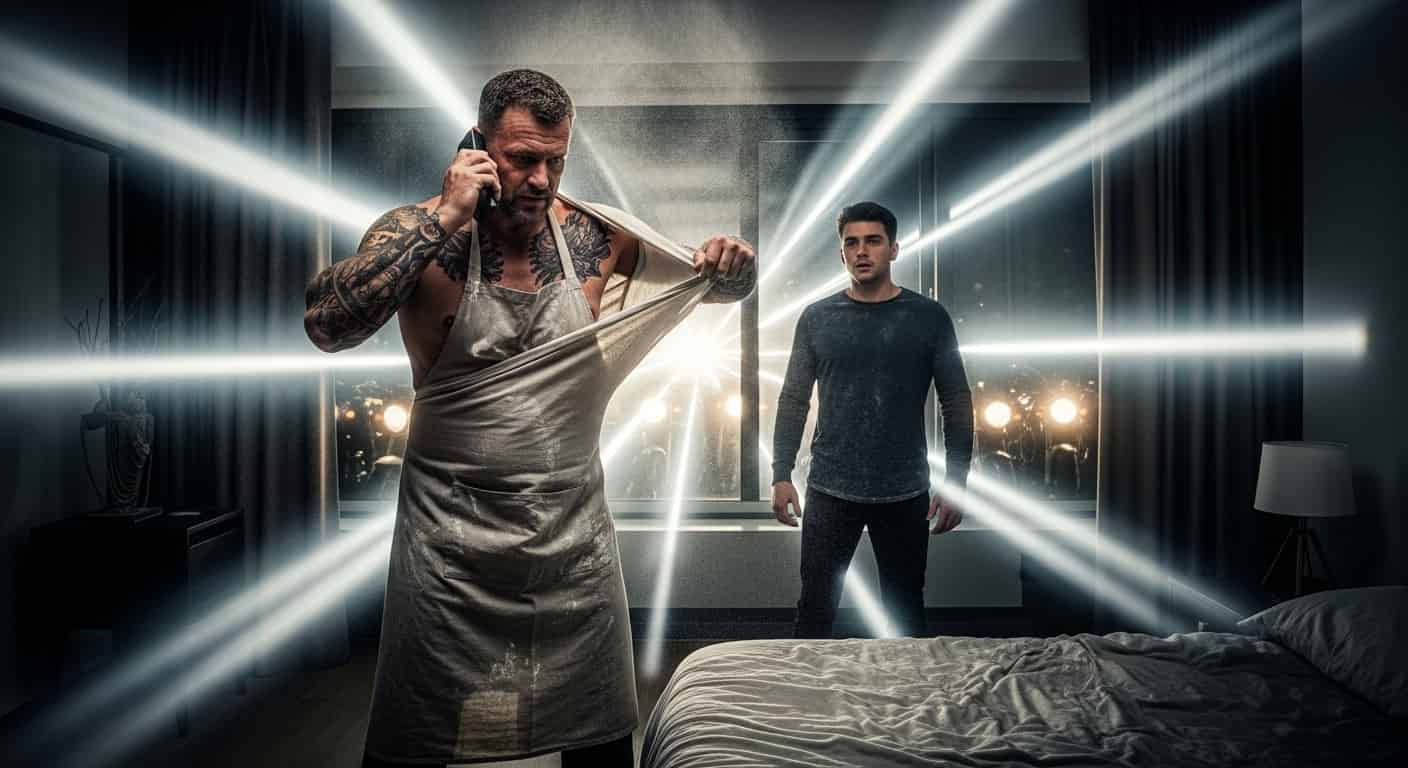
I reached up and wiped the spit away with the back of my hand. I reached into my apron pocket and pulled out my phone—not my regular one, but the burner I’d kept in a vacuum-sealed bag at the bottom of a flour bin for ten years.
I dialed a number I had memorized in another lifetime. It picked up on the first ring.
“”Thorne?”” a gravelly voice answered.
“”It’s Ghost,”” I said, and as I spoke the name, the baker died. The apron felt like a shroud. The cinnamon smell was gone, replaced by the copper scent of the storm I was about to unleash. “”I’m at the nest. I need the family. All of them.””
“”How many, Brother?””
I looked Julian dead in the eyes. He was starting to look confused. The smirk was flickering.
“”Everyone,”” I said. “”Bring everyone.””
“FULL STORY
Chapter 2: The Ghost Rising
The silence that followed the phone call was heavier than the one that had greeted me at the door. Julian, the man who had just spat on me, let out a nervous, barking laugh.
“”Who was that? Your flour supplier? You gonna have him bring an extra bag of sugar to pelt me with?”” He looked back at Elena, seeking approval. She smiled, but it was forced now. She knew me better than he did. She saw the change in my eyes. The warmth was gone, replaced by a flat, terrifying vacuum.
“”Elias, stop being dramatic,”” she said, clutching the sheet to her chest. “”Just leave. I’ll have my things moved out by the end of the week. Julian is staying here tonight.””
I didn’t say a word. I turned and walked out of the room. I didn’t go to the kitchen. I didn’t go to the garage. I went to the backyard.
The afternoon sun was starting to dip, casting long, bloody shadows across the lawn. I found Barnaby near the oak tree. He was lying on his side, his breath coming in ragged, shallow gasps. There was a piece of tainted meat just inches from his nose.
I knelt in the dirt, the linen of my apron staining brown. I put my hand on his head. “”I’m here, buddy,”” I whispered. My heart, which I thought had turned to stone upstairs, cracked wide open. Barnaby had been my only true friend during the transition. When I had night terrors about the things I’d done in the desert, he was the one who licked the sweat off my forehead. He didn’t care about the Ghost or the baker; he just cared about me.
He let out a tiny, whimpering huff and licked my thumb. Then, his body went still. The light left his eyes.
I stayed there for a long time, my hand resting on his cold fur. The grief was there, but it was being rapidly consumed by a cold, industrial rage. It was the kind of rage that doesn’t scream. It’s the kind that calculates.
I stood up. I walked to the shed and grabbed a shovel. I dug a grave under the oak tree, my movements rhythmic and tireless. I didn’t feel the blisters forming on my hands. I didn’t feel the sweat. I buried my best friend while the man who killed him laughed with my wife in the window above.
When I finished, I walked back into the house. I went to the basement. Behind a false wall I hadn’t touched in a decade, I pulled out a heavy, locked sea chest. I punched in the code.
Inside was a world I had tried to forget. My leather vest—the kutte—with the Iron Revenants “”Original”” patch on the back. My brass knuckles. A heavy, customized wrench. And a photo of fifteen hundred men standing in front of a clubhouse, all of them looking like the end of the world.
I stripped off the apron. I stripped off the polo shirt. I put on the leather. It felt heavy. It felt right. It felt like coming home.
I walked back upstairs. Julian was in the kitchen now, pouring himself a glass of my aged bourbon. He was wearing his pants, but no shirt. He looked up, the glass halfway to his lips, and froze.
The man standing in front of him wasn’t the baker. I was wearing the grease-stained leather of a high-ranking outlaw. My tattoos, which I’d kept covered by long sleeves for ten years, were visible now—the reaper on my forearm, the chains around my neck.
“”What the hell is this?”” Julian stammered, his voice jumping an octave. “”A costume? You think putting on some old leather makes you tough?””
I walked toward him. I didn’t run. I just kept coming. He tried to throw the bourbon in my face, but I was faster. I caught his wrist, and the sound of his bones grinding together filled the quiet kitchen. He screamed, dropping the glass. It shattered, just like my life had an hour ago.
“”You killed my dog,”” I said, my voice a low, terrifying growl.
“”It was just a dog!”” he shrieked, clutching his wrist. “”Elena, call the cops! This psycho is losing it!””
Elena appeared in the doorway, her face pale. “”Elias, stop! You’re proving me right! You’re a monster!””
I looked at her, and for the first time in ten years, I felt nothing for her. No love. No regret. Just the cold realization that I had wasted a decade trying to be worthy of a woman who didn’t exist.
“”I tried to be a man for you,”” I said. “”But the world doesn’t want men. It wants victims. And I’m done being yours.””
I grabbed Julian by the throat and slammed him against the refrigerator. “”The cops aren’t coming, Elena. But someone else is.””
Outside, a low vibration began to shake the kitchen windows. It started as a hum, then grew into a roar—a mechanical thunder that sounded like a thousand lions screaming at once.
Julian’s eyes went wide. “”What is that?””
I leaned in close to his ear. “”That’s the sound of fifteen hundred mistakes you just made.””
Chapter 3: The Chrome Invasion
Oak Creek was a town of manicured lawns, HOA meetings, and silent nights. It was the kind of place where a loud muffler was grounds for a formal complaint.
That afternoon, the silence didn’t just break; it was pulverized.
The first wave hit the suburb at 5:30 PM. A line of thirty motorcycles, led by a massive man named Big Sal, roared onto our street. They didn’t slow down. They rode onto the sidewalks, across the lawns, and formed a semi-circle around my house.
Big Sal kicked his kickstand down and climbed off his bike. He was six-foot-four, three hundred pounds of muscle and scars, wearing a vest that matched mine. He looked at the house, then at the neighbors who were peeking out from behind their curtains. He pulled a cigar from his pocket and lit it.
Then came the second wave. And the third.
From every entrance to the subdivision, the roar intensified. Harleys, Indians, custom choppers—the street was disappearing under a sea of chrome and black leather. The sound was deafening, a physical force that made the dishes in the kitchen cabinets rattle and break.
Inside the house, Julian was trembling. His bravado had evaporated like mist in a furnace. He looked out the window and saw the street filled with men who looked like they’d just stepped out of a war zone.
“”Who… who are they?”” he whispered, his voice shaking.
“”My family,”” I said.
I walked to the front door and stepped out onto the porch. The moment I appeared, the roar of the engines died down. A heavy, pregnant silence fell over the neighborhood. Fifteen hundred men, some of whom had ridden five hundred miles in three hours, turned their heads toward me.
Big Sal stepped forward, his eyes scanning my leather vest. A slow, toothy grin spread across his face. “”Ghost,”” he boomed. “”You look like you’ve been eating too many cupcakes, brother. You’re soft.””
“”The baker is dead, Sal,”” I said, my voice carrying through the quiet street.
“”Good,”” Sal said, his expression darkening as he looked at the house. “”We heard about the dog. We heard about the girl. What’s the word? Do we burn it down, or do we take our time?””
The neighbors were outside now, standing on their porches in a mix of terror and fascination. Sarah, the sweet woman from next door who always bought my blueberry muffins, was holding her young daughter close, her eyes wide with shock. She looked at me—at the leather, at the tattoos, at the coldness in my posture—and she didn’t recognize me.
I felt a pang of something—not guilt, but a recognition of what I was losing. The “”Quiet Man”” hadn’t just been a lie; he’d been a good neighbor. He’d been a kind soul. But that man couldn’t protect what was left.
“”Bring them out,”” I told Sal.
Two bikers, men I remembered from the old days—Viper and Jax—pushed past me into the house. A moment later, they emerged dragging Julian by his silk robe and Elena by her arm.
They threw Julian onto the lawn. He landed hard, sobbing now, his face smeared with dirt and tears. Elena stood there, her eyes darting from the sea of bikers to me.
“”Elias, please,”” she begged. “”You can’t do this. This is a civilized neighborhood! There are children here!””
“”You should have thought about that before you invited a dog-killer into our bed,”” I said.
Big Sal walked over to Julian and looked down at him with pure disgust. “”So this is the little prick who likes to poison Goldens?””
Sal reached down, grabbed Julian by the hair, and forced him to look at the fifteen hundred men surrounding him. “”Look at them, kid. Every one of these men has a dog. Every one of these men has a brother. And right now, every one of these men is wondering why you’re still breathing.””
Julian looked like he was about to faint. “”I… I didn’t know! I thought he was just a baker!””
“”He is a baker,”” Sal growled, pulling a heavy, serrated blade from his belt. “”But he’s also the man who saved my life in a Mexican prison. He’s the man who led this club through the worst years of our history. And you spat on him.””
The crowd of bikers surged forward a step. The sound of boots on pavement was like a heartbeat.
“”Elias, tell them to stop!”” Elena screamed. “”I’ll leave! We’ll go! Just let us go!””
I looked at the house. The house I’d worked sixty hours a week to pay for. The house where I’d buried my dog. The house where my wife had laughed while she destroyed ten years of my life.
“”Sal,”” I said. “”The boy needs to learn what happens when you touch something that belongs to a Revenant.””
Chapter 4: The Price of Betrayal
The “”learning”” wasn’t what the neighbors expected. They expected a bloodbath. They expected the kind of violence they saw in movies. But the Iron Revenants had a different way of doing things.
“”Jax, get the bike,”” I commanded.
A custom-built chopper with a massive rear tire roared to the front. Jax hopped off, leaving the engine idling—a rhythmic, thumping growl that felt like a predator’s purr.
“”You like fast cars, Julian?”” I asked, walking down the porch steps. “”Elena said you were ‘exciting.’ Let’s see how exciting things get.””
We didn’t hit him. We didn’t cut him. Instead, Sal produced a long, industrial-strength tow chain. He looped it around Julian’s waist, locking it with a heavy padlock. The other end was hooked to the back of the chopper.
“”No… no, please! You’re going to drag me?”” Julian was hysterical now, his hands clawing at the grass.
“”We’re going to take a tour of the neighborhood,”” I said. “”At five miles an hour. Just so everyone can see the man who poisons dogs.””
Elena tried to run to him, but Jax held her back. “”You stay right there, sweetheart,”” Jax hissed. “”You wanted the outlaw life? You’re watching the front row.””
As the bike began to move slowly, Julian was forced to crawl, then stumble, then run to keep up. The humiliation was worse than the pain. His neighbors—the people he’d probably bragged to—watched as he was led like a leashed animal through the streets of Oak Creek.
But as the procession moved, I turned my attention back to Elena. She was shaking, her eyes fixed on me.
“”You think you’re so much better than me,”” she spat, her fear turning into a desperate anger. “”But look at you! You’re just a thug! You were always a thug! I tried to change you, but you’re broken, Elias! You’re just a monster in an apron!””
I walked up to her, stopping so close she could see the reflection of her own terror in my eyes. “”You didn’t try to change me, Elena. You tried to own me. You liked the security I gave you. You liked the house, the money, the ‘nice guy’ who did whatever you asked. But you hated that you couldn’t control the part of me that actually mattered.””
I reached into my pocket and pulled out the diamond earrings. I dropped them into the dirt at her feet.
“”I spent ten years pretending I didn’t have a shadow,”” I said. “”I let you make me feel ashamed of where I came from. I let you make me feel like my brothers were trash. But when the world showed its teeth today, who came for me? Was it the neighbors? Was it your ‘exciting’ boyfriend? No. It was the trash.””
I signaled to Big Sal. He walked over to the SUV in the driveway—the one I’d used to deliver bread. He smashed the window with a single blow from his fist and pulled out my registration.
“”Everything in this house is paid for with my sweat,”” I said. “”The bakery is in my name. The deed is in my name. You have one hour to pack a bag. If you’re still here when the sun goes down, you belong to the club.””
Her face went slack. “”You can’t kick me out! I have rights!””
“”You have the right to be silent,”” Sal growled, stepping into her space. “”Ghost is being nice. If it were up to me, we’d be having a bonfire with your furniture.””
As Julian was led back to the front lawn, battered and sobbing but largely uninjured, I looked at the fifteen hundred men waiting for my command.
“”The dog,”” I said to Sal. “”He needs a proper send-off.”””