Chapter 1: The Weight of the Legend
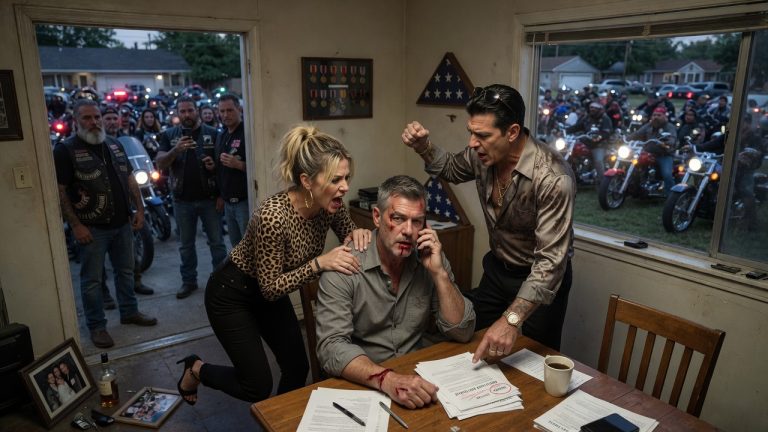
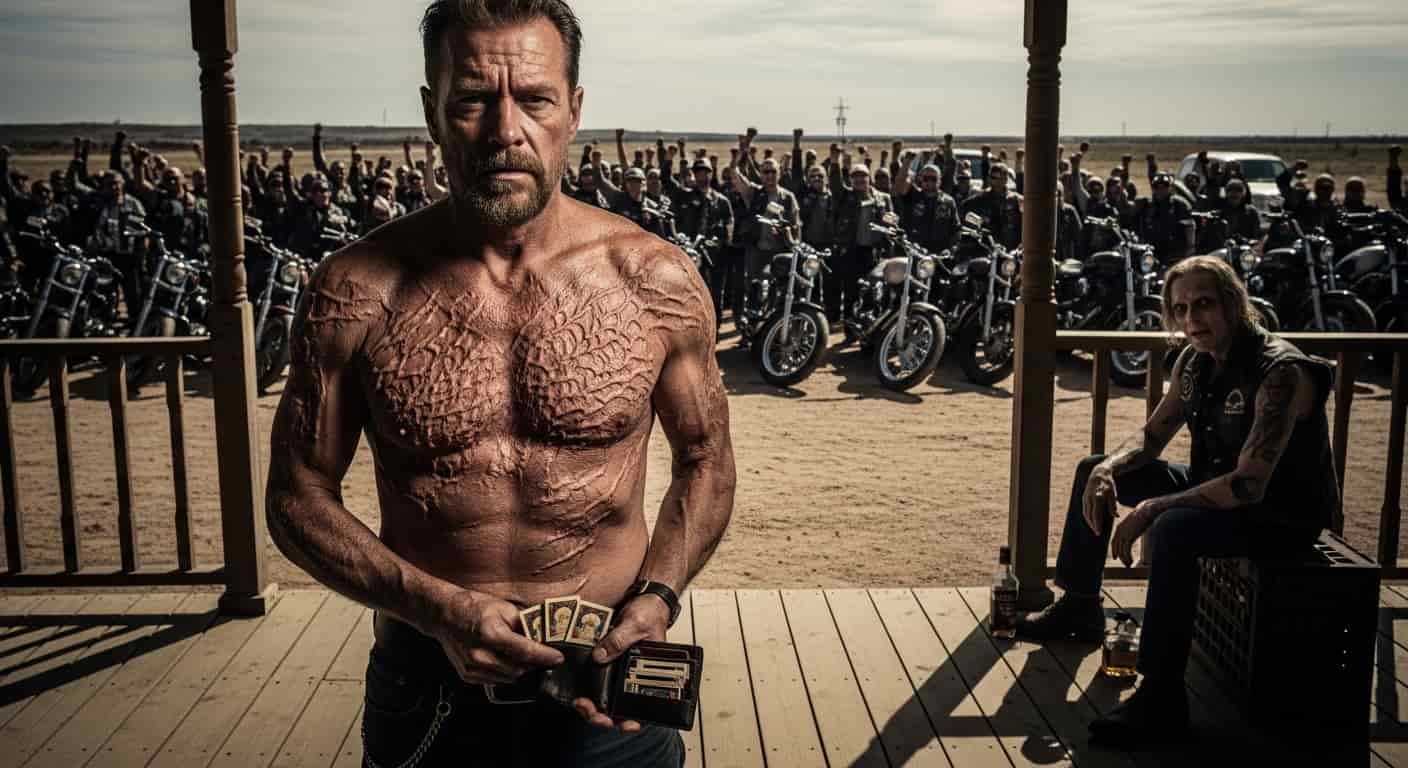
The heat in West Texas doesn’t just sit on you; it tries to get inside your bones. It’s a dry, choking heat that smells like scorched mesquite and old diesel. I stood on the porch of the Dusty Chrome Bar, watching the horizon ripple. Five hundred motorcycles were coming. I could hear them before I could see them—a low, rhythmic thrumming that vibrated in my chest like a second heartbeat.
“You okay, Pop?”
I felt a hand on my shoulder. It was Junior. My son. He’s twenty-four now, taller than me, with the same broad shoulders I used to have before the fire took a bite out of my left side. He looked at me with that look he always had—pure, unadulterated pride. To him, I wasn’t just Red. I was “Texas” Red, the man who rode a Harley through a literal wall of flame to lead five hundred trapped bikers to safety twenty years ago.
“Just the heat, son,” I lied. My voice was like sandpaper. “Stirs up the old nerves.”
I adjusted my shirt, feeling the coarse fabric rub against the puckered, knotted skin of my torso. The scars ran from my hip to my jawline. They were my medals. They were the reason I never had to pay for a drink in three counties. They were also the reason I couldn’t sleep without the lights on.
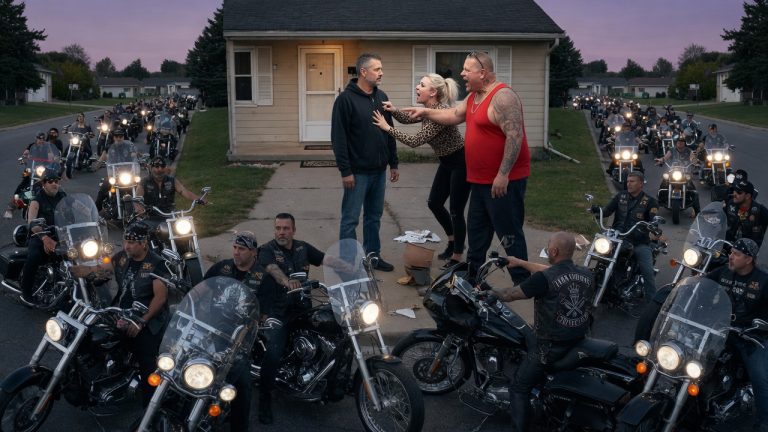
The roar grew deafening. Then, the chrome appeared—a shimmering river of metal cutting through the dust. Leading the pack was Smokey, a man who looked like he’d been carved out of a canyon wall. He pulled his massive Road King to a stop right in front of the porch, kicked the stand down, and killed the engine. The four hundred and ninety-nine bikes behind him followed suit. The silence that followed was heavier than the noise.
Smokey hopped off, his heavy boots clunking on the wooden stairs. He didn’t say a word. He just walked up and pulled me into a bear hug that made my ribs groan.
“Twenty years, Red,” Smokey rumbled into my ear. “Twenty years since you gave us our lives back. We don’t forget. A biker’s debt is paid in oil and blood, and we’re still in the red.”
He pulled back, grinning, and the rest of the crowd started cheering. Men with tattoos and scars of their own were wiping tears from their eyes. They looked at me like I was a god who had walked through hell and come back with the keys.
But as I looked past them, toward the edge of the parking lot, I saw a ghost.
A man was sitting on a rusted-out crate near the gas pumps. He was thin—skeletal, really—with a beard that looked like it was made of cobwebs. He was clutching a brown paper bag with a bottle inside. Silas.
Twenty years ago, Silas was the best mechanic in the Panhandle. Today, he was the town drunk, the man everyone blamed for the “Great Fire.” The man I had pointed the finger at while the smoke was still clearing.
Our eyes met for a split second. There wasn’t anger in his gaze. There was just a profound, hollow emptiness. He looked at my scars, then looked at the crowd cheering for me, and he took a long, slow pull from his bottle.
“Hey, Red!” Smokey shouted over the noise. “We heard Silas is still breathing. We were thinking, since it’s the anniversary… maybe it’s time he finally felt a little bit of the heat he put us through. What do you say, hero?”
The crowd went quiet. Five hundred pairs of eyes turned toward Silas, then back to me.
My stomach dropped. The secret I’d been carrying for two decades felt like a hot coal in my gut. I looked at Junior. He was nodding, his face set in a hard line of “justice.”
“Let’s handle it, Dad,” Junior whispered. “For everything he did to you.”
I looked at the matches in my pocket—the ones I’d kept for twenty years as a penance. The ones I’d used to light a fire to hide a crime I could never admit to. I looked at the hero’s welcome I didn’t deserve.
The engines started to rev again. This wasn’t a celebration anymore. It was a hunt.
FULL STORY
Chapter 2: The Shadow of the Investigator
The celebration inside the Dusty Chrome was a blur of amber glass and loud laughter, but I felt like I was underwater. Every time someone clapped me on the back, I flinched. Not because of the physical pain—the nerves in my left shoulder had been dead for two decades—but because of the moral weight of it.
I slipped out the back door, needing air that didn’t smell like stale beer and hero worship. The Texas night was cooling off, but the wind still felt like a blow-dryer.
“It’s a hell of a thing, Red. Being loved by people who don’t really know you.”
I froze. Standing by my truck was a man in a cheap suit that looked out of place in a town where denim was the formal attire. He was leaning against the fender, cleaning his glasses with a handkerchief.
“Sparky,” I said, my voice tight.
Sparky wasn’t a biker. He was an insurance investigator who had been assigned to the Great Fire claims back in 2006. He was supposed to have retired five years ago, but he was like a dog that had found a bone and forgotten how to let go.
“I saw the rally,” Sparky said, putting his glasses back on. His eyes were sharp, analytical. “Five hundred men ready to kill for you. That’s a lot of power for a man who lives in a trailer.”
“I didn’t ask for any of this,” I said, reaching for my keys.
“Didn’t you?” Sparky stepped closer. “You know, I went back to the origin site last month. Near the old highway bypass. Found something interesting. The fire didn’t start from a discarded cigarette or a faulty generator like the official report said. It started with an accelerant. High-grade racing fuel. The kind Silas never used in his shop, but the kind you used to run in that vintage shovelhead of yours.”
My heart hammered against my ribs. “Silas confessed, Sparky. Move on.”
“Silas didn’t confess. Silas stayed silent because he was in shock, and you filled that silence with a lie that fit perfectly,” Sparky countered. “Why did you do it, Red? What were you burning that night? It wasn’t just for the insurance money. You didn’t even file a claim for your bike.”
I didn’t answer. I couldn’t. If I told him about the hit-and-run—about the body of the local councilman’s son I’d accidentally hit on that dark road, and how I’d panicked and tried to burn the evidence—the legend of Texas Red would vanish in a puff of smoke. And worse, Junior would know his father was a murderer and a liar.
“I’m watching you, Red,” Sparky whispered. “The truth is like a wildfire. You can try to contain it, but eventually, the wind changes.”
He walked away into the shadows just as Junior came out the back door.
“Dad? Who was that?”
“Nobody, Junior,” I said, my voice shaking. “Just a guy asking for directions.”
Junior looked at me, his eyes narrowing. “You’re shaking, Pop. Is it the pain?”
“Yeah,” I lied again. It was becoming a habit I couldn’t break. “Just the pain.”
Chapter 3: The Gathering Storm
The next morning, the atmosphere in town had shifted. The bikers hadn’t left. They were camped out in the fields surrounding the bar, a sea of leather and denim that felt like an occupying army. Smokey was the general, and his objective was clear: “Justice” for Red.
I found Smokey sitting at a picnic table, cleaning a chrome-plated wrench.
“We found out where Silas is staying, Red,” Smokey said without looking up. “That old shack behind the scrapyard. We’re going down there at noon. We figured you’d want to be the one to lead us. You know, full circle.”
“Smokey, let it go,” I said, trying to keep my voice steady. “He’s a broken man. He’s got nothing left.”
Smokey finally looked up, and his eyes were cold. “He took your health. He almost took our lives. You’re too good of a man, Red. That’s your weakness. You’re too forgiving. But we aren’t. We’re the brothers you saved, and we’re going to make sure the man who tried to kill us understands what he did.”
I looked around. Junior was there, standing with a group of younger riders, listening with rapt attention. He looked at me, waiting for me to lead. To him, this was a righteous crusade.
“I need to talk to him first,” I said. “Alone.”
Smokey hesitated, then nodded. “Fine. Ten minutes. Then we come in. Whether you’re ready or not.”
I drove my truck to the scrapyard, my hands slick with sweat on the steering wheel. I found the shack. It was barely a building—just pieces of corrugated tin and plywood held together by hope and rust.
I stepped inside. The smell hit me first—grease, cheap whiskey, and despair. Silas was sitting on a mattress on the floor, staring at a small, charred piece of metal in his hands.
“They’re coming for you, Silas,” I said.
Silas didn’t look up. “I know.”
“You have to leave. Now. Take my truck, take whatever money I have, and just go.”
Silas finally looked at me. His eyes weren’t empty anymore; they were filled with a terrifying, calm clarity. He held up the object in his hand. It was a vintage Zippo lighter. It was blackened by fire, but the initials “T.R.” were still visible.
“I found this in the ashes twenty years ago, Red,” Silas said softly. “I knew it was yours. I waited for you to come and tell the truth. I waited years. I figured, surely, a ‘hero’ like you wouldn’t let an innocent man rot.”
“I panicked, Silas,” I whispered, dropping to my knees. “The kid… the councilman’s son… he ran out in front of me. I didn’t mean to hit him. I just wanted to hide the bike. I didn’t know the fire would spread like that. I didn’t know the wind would pick up.”
“You let them call me a monster,” Silas said, his voice cracking. “My wife left me. My kids won’t speak to me. I lost my shop. I lost my life. And you? You got a parade.”
Outside, the roar of five hundred engines began to rise. The ground started to shake.
“Give me the lighter, Silas,” I begged. “I’ll get you out of here.”
“No,” Silas said, clutching it to his chest. “I think I’d rather watch it all burn down.”
Chapter 4: The Moral Precipice
The door to the shack was kicked open with such force it hit the tin wall with a deafening clang. Smokey stepped in, followed by a dozen other bikers. Behind them, I could see the crowd—hundreds of men, a wall of leather blocking out the Texas sun.
“Time’s up, Red,” Smokey said. He looked at Silas with pure disgust. “Look at him. Cowering in the dirt like the rat he is.”
Two bikers grabbed Silas by the arms and dragged him outside. He didn’t fight. He didn’t scream. He just kept his hand clamped shut over that lighter.
They dragged him to the center of the scrapyard, where a large circle had been cleared. The bikers surrounded him, revving their engines, creating a wall of noise and heat that felt like a flashback to that night twenty years ago.
Junior was in the front row. He looked at Silas with a hatred that broke my heart. This was the boy I had raised to be kind, to be fair. And here he was, ready to watch a man be lynched because of a lie I had told.
“Give us the word, Red!” someone shouted.
“Let’s see how he likes the smell of gasoline!” another yelled.
Smokey handed me a can of kerosene. My hands shook so hard I almost dropped it. The irony was a physical weight. They wanted me to use the very thing that had ruined Silas to “execute” him.
“Do it, Pop,” Junior said, his voice firm. “For your scars. For all of us.”
I looked at Silas. He looked back at me, a faint, sad smile on his lips. He opened his hand, showing me the lighter one last time. It was a silent ultimatum. Either I told the truth, or I became the very monster everyone thought Silas was.
I looked at the five hundred men who called me a hero. I looked at the son who worshipped me. I realized then that the fire hadn’t ended twenty years ago. It had just been smoldering inside me, waiting for the right moment to consume everything I loved.
“I can’t,” I whispered.
“What was that, Red?” Smokey asked, leaning in.
“I CAN’T!” I screamed, throwing the kerosene can into the dirt.
The engines went quiet. The silence was more terrifying than the roar.
“What are you talking about, Red?” Smokey asked, his brow furrowed. “The man’s a criminal. He’s the reason you’re scarred. He’s the reason we almost died.”
“No,” I said, stepping toward Silas. I reached out and took his hand, pulling him to his feet. “He isn’t.”