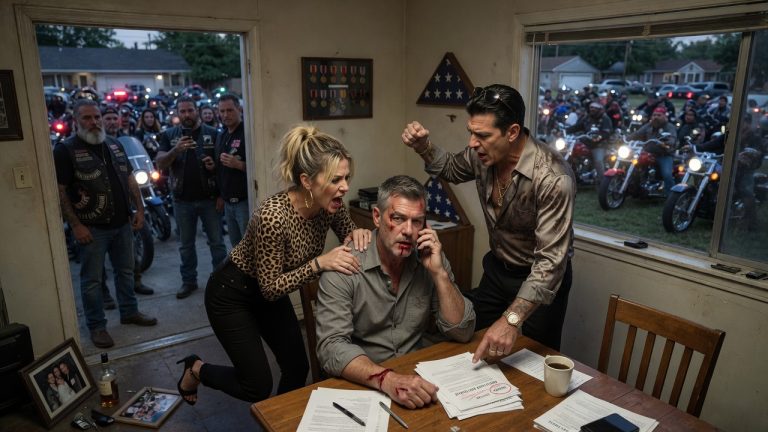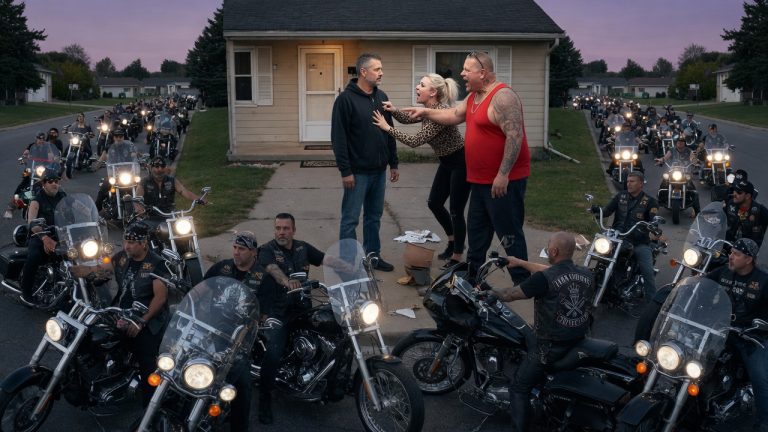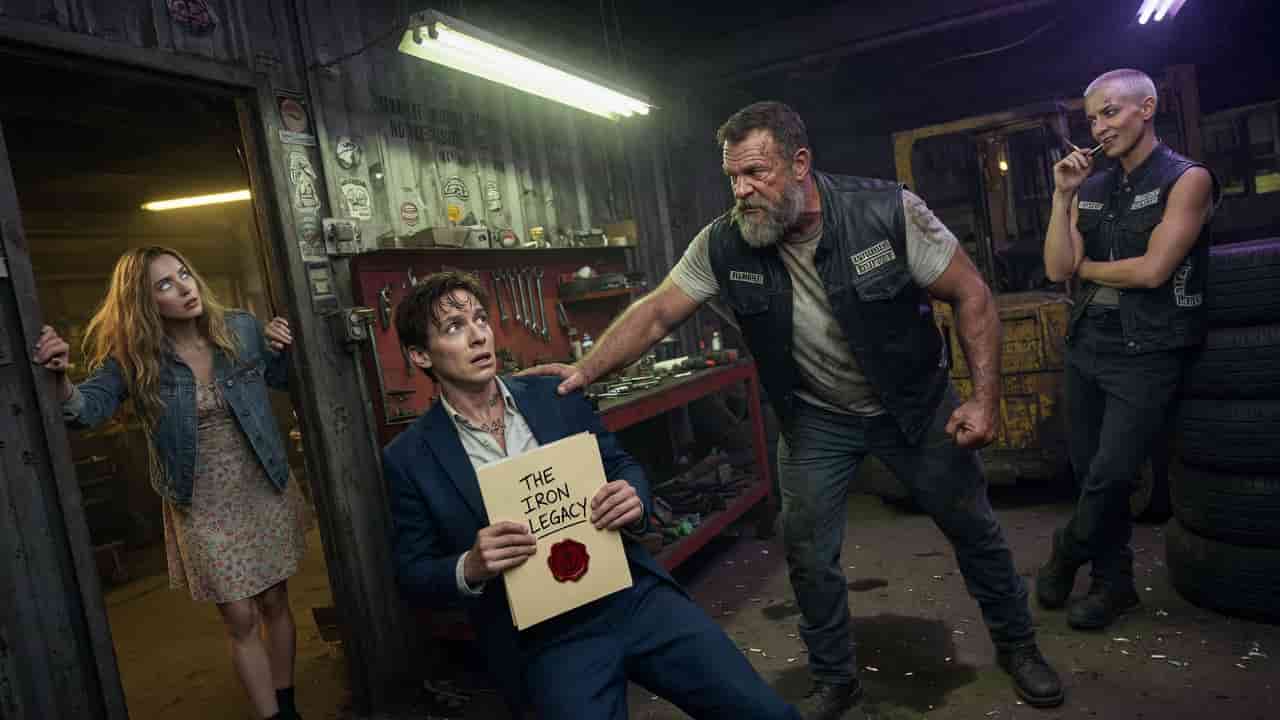
“Get on your knees, boy.”
The garage floor was cold, slick with thirty years of leaked oil and sweat. I looked up at Hammer, a man who had been my father’s shadow for three decades, and I didn’t see a friend. I saw a predator who had been waiting for the old man to stop breathing so he could finally take the throne.
He had his hand on my collar, his knuckles scarred from a thousand bar fights I’d only read about in files. Behind him, the rest of the 999 brothers were watching, their faces hard, waiting for me to break. They hated the suit. They hated the degree. Most of all, they hated that Rusty Miller had left the keys to the kingdom to a son he’d kept hidden in the suburbs for thirty years.
“It’s the law of the club,” I stammered, trying to keep my voice from cracking. I could feel my ten-year-old daughter, Sarah, standing in the doorway. She couldn’t see the sneer on Hammer’s face, but she could hear the fear in my breath.
“There is no law but mine now,” Hammer growled, shoving me down. My dress pants hit the grease, and a chorus of mocking laughter erupted from the shadows. “Now, you’re going to open that fancy little folder and you’re going to read us why a coward like you deserves a single patch on his back.”
I looked at the folder. It didn’t just contain a will. It contained the one thing that could save every man in this room from a life behind bars—and the one secret that would prove Hammer had been the one to betray my father.
The room went dead silent as I broke the red wax seal. Hammer thought he was humiliating me. He didn’t realize he was opening his own cage.
Chapter 1: The Last Grease Fire
The smell of a shipyard in Savannah is something that stays in your teeth. It’s salt, rotting wood, and the heavy, suffocating scent of industrial-grade grease. Rusty Miller lived in it. He thrived in it. Even now, with his lungs turning to ash and his heart stuttering like a cold engine, he refused to leave the workshop at the back of the yard.
I sat on a milk crate, my navy blue suit feeling like a costume. I’d spent twelve years in Atlanta becoming the kind of man who handled “complex assets,” which was just a polite way of saying I managed the money people didn’t want the IRS to see. I was thirty-two, I had a mortgage in a zip code where people mowed their lawns on Saturdays, and I hadn’t touched a motorcycle in a decade.
“You look like a witness at a mob trial, Elias,” Rusty wheezed. He was propped up in a leather armchair that had more duct tape than stuffing. An oxygen tank sat beside him, hissing a steady, rhythmic breath that seemed louder than the Atlantic tide outside.
“I look like a lawyer, Dad,” I said. “Because I am one.”
Rusty laughed, a wet, rattling sound that ended in a coughing fit. He reached out with a hand that looked like a roadmap of every mistake he’d ever made—grease permanently etched into the lines of his palms, scars from slips of the wrench, and the faded blue ink of a tattoo that said 999 across his knuckles.
“The brothers… they won’t care about the bar exam,” Rusty said, his eyes narrowing. “They see the suit. They see the soft hands. They see a man who went running the second things got heavy.”
“I didn’t run. You sent me away.”
“I sent you away to save you,” he snapped, then softened as his breath caught. “But now, I’m sending you back in to save them. All of them.”
He gestured to the heavy manila folder sitting on the workbench between us. It was sealed with red wax, stamped with the iron ring of the MC. In the world of the 999, that seal was more than a tradition. It was a contract.
I looked at the folder, then at the man who was fading before my eyes. Rusty Miller was the founder of the 999, a club that started as a bunch of Vietnam vets looking for a way to stay sane and turned into a multi-state machine. They weren’t just a gang; they were a brotherhood, a social safety net, and, in the eyes of the DOJ, a racketeering enterprise.
“The RICO case,” I whispered. “The files I found in your safe… they’re real, aren’t they?”
Rusty nodded slowly. “The feds have been building a cage for ten years. They’ve got informants, they’ve got wiretaps, and they’ve got a prosecutor in Savannah who wants to hang a thousand leather vests on her wall like trophies. Hammer… he wants to fight. He wants to go out in a blaze of glory. But that glory ends with every man in the club doing twenty to life.”
“And what’s in the folder?”
“The exit,” Rusty said. “And the proof of who opened the door for the feds in the first place.”
The heavy steel door of the workshop groaned open. The humid Georgia air rushed in, carrying the sound of a dozen idling engines. Hammer stepped in. He didn’t walk; he occupied space. He was six-foot-two of pure, aggressive muscle and resentment. His MC vest was stretched tight over his chest, and his eyes immediately went to me, then to the folder.
“Time’s up, Rusty,” Hammer growled, ignoring me entirely. “The brothers are outside. They want to know what the plan is for the hearing on Tuesday. They don’t want to hear it from some city boy in a tie.”
Rusty straightened his back, a visible effort that made the oxygen mask hiss harder. “The plan is in the will, Hammer. The plan is the legacy.”
Hammer stepped closer, the floorboards creaking under his boots. He looked at me, a slow, predatory sneer spreading across his face. “This your boy, Rusty? The one who hasn’t been to a meeting in fifteen years? The one who thinks he’s better than the men who bled to keep your name alive?”
“He’s the one who’s going to keep you out of a cell, Hammer,” Rusty said, his voice dropping to a dangerous whisper.
“I’d rather rot in a cell than take orders from a suit,” Hammer spat. He looked at me, his eyes cold and hard. “You think you’re coming in here to play King? You think because your old man is dying, we’re just gonna hand you the keys?”
I stood up, my heart hammering against my ribs. “I don’t want the keys, Hammer. I just want to finish what my father started.”
Hammer laughed, a dry, mocking sound. He reached out and flicked my silk tie with a thick, grease-stained finger. “You’ve got soft skin, kid. Savannah sun’s gonna burn you alive. And if the sun doesn’t do it, I will.”
He turned back to Rusty. “The brothers are waiting. Don’t make them wait long. Their patience is as thin as your breath.”
Hammer walked out, leaving the door swinging. Rusty looked at me, and for the first time, I saw fear in the old lion’s eyes. Not fear of death, but fear of what came after.
“He’s going to kill you, Elias,” Rusty said softly. “Unless you show them the truth before he gets the chance.”
“Dad—”
“Listen to me,” he gripped my wrist, his strength surprising me. “Sarah… keep her away from the garage tonight. Take the folder. Don’t open it until the funeral. Not until they’re all watching. Do you hear me?”
“I hear you.”
Rusty sank back into his chair. His eyes drifted toward the ceiling, toward the flickering fluorescent light that had seen forty years of his life. He took a long, shaky breath, and then, with a soft sigh that sounded like the final cooling of a hot engine, he went still.
The oxygen tank continued to hiss. Hiss. Hiss. Hiss. I stood there in my expensive suit, clutching a folder full of secrets, while my father died in a room that smelled like the past. I didn’t cry. There wasn’t time. I could already hear the bikes outside. They weren’t idling anymore. They were revving. They were waiting for a signal.
And I was the only one left to give it.
Chapter 2: The Vultures of Savannah
The funeral was held three days later, but the mourning had ended the second Rusty’s heart stopped. In the world of the 999, a vacancy at the top wasn’t a tragedy; it was a blood-scent in the water.
Savannah was sweltering. The kind of heat that made the asphalt feel like it was melting under your feet. We were at Miller & Sons Funeral Home—no relation, just a grim irony. Outside, nearly a thousand motorcycles lined the streets. A sea of black leather, chrome, and the heavy, rhythmic thrum of V-twins. The local police had blocked off four blocks, and the officers stood by their cruisers with their arms crossed, looking at the bikers with a mixture of professional wariness and genuine fear.
I stood in the small, carpeted foyer, holding Sarah’s hand. She was ten, but she stood with a stillness that made her seem older. She wore a simple black dress and a denim jacket that had been Rusty’s gift to her last Christmas. Her eyes were fixed on nothing, tilted slightly toward the sound of the bikes outside.
“They’re loud, Daddy,” she whispered.
“They’re just saying goodbye, honey,” I said, though it was a lie. They were marking territory.
“No,” Sarah said, her voice small but certain. “They sound like they’re fighting. Even when they’re just sitting there.”
She was right. The air in the foyer was thick with it. Every time a new group of bikers entered, the tension ratcheted up. They didn’t look at the casket at the front of the room; they looked at me. They looked at my suit. They looked at the way I held Sarah’s hand. To them, I was an outsider, a parasite who had returned to claim a host he hadn’t helped build.
Hammer entered with a group of five other men, the “Inner Circle.” They moved like a phalanx. Hammer had traded his grey t-shirt for a crisp black one, but his MC vest was the same—weathered, heavy, and bearing the Vice President patch that seemed to scream for a promotion.
He didn’t go to the casket. He walked straight to me.
“The brothers are getting restless, Elias,” Hammer said, his voice carrying through the quiet room. A few bikers nearby stopped talking and turned to watch. “They’re wondering why we’re wasting time with flowers and organ music when there’s business to be done.”
“It’s a funeral, Hammer,” I said, my voice tighter than I wanted it to be. “Business can wait until he’s in the ground.”
Hammer stepped closer, entering my personal space, his shadow falling over Sarah. “Business is what kept that old man alive. And business is what’s going to keep this club from falling apart now that he’s gone. You holding onto that folder like it’s a holy relic?”
I felt the folder tucked under my arm, its weight a constant pressure. “I’m following his instructions.”
“His instructions were the ramblings of a dying man,” Hammer spat. He looked down at Sarah, his expression softening for a fraction of a second before hardening again. “You should take the girl and go back to Atlanta, kid. This isn’t a place for people who need a map to find the highway.”
“I’m staying for the reading,” I said. “Every member of the 999 is required to be there. Those are the bylaws. Rusty’s bylaws.”
Viper, the woman I’d seen in the workshop, stepped forward. She had a silver chain draped over her shoulder and eyes like a hawk. “The bylaws were written for men who ride, Elias. Not for men who file taxes.”
“I ride,” I said, the words feeling like a gamble.
Viper smirked. “A Vespa doesn’t count, honey.”
The room erupted in low, mocking chuckles. The humiliation was subtle, a slow paring away of my dignity before the real strike. They wanted me to feel small. They wanted me to realize that in this room, my education and my bank account were worth less than the dirt under their fingernails.
“Let him stay,” Hammer said, his eyes never leaving mine. “Let him stand there and realize he doesn’t belong. It’ll make it easier when we strip that name off the deed.”
He turned and walked toward the casket then, finally. He stood over Rusty for a long moment. He didn’t pray. He didn’t bow his head. He leaned down and whispered something to the dead man—something low and sharp—before spitting on the floor beside the mahogany base.
The room went cold. Even the bikers who supported Hammer looked away. It was a violation of the one thing they all pretended to hold sacred: the brotherhood.
“Daddy?” Sarah whispered, her grip on my hand tightening until it hurt. “Why did that man smell like fire?”
“It’s okay, Sarah,” I lied, my heart pounding.
I looked at the folder. Rusty had told me not to open it until they were all watching. I realized then that it wasn’t just a will. It was a trap. Rusty had spent his whole life playing these men like a grandmaster, and even from the grave, he was making his move.
But I was the piece on the board. And Hammer was ready to take me.
As the service began, the “Scribe,” an older man with wire-rimmed glasses and a tattoo of a quill on his neck, stood up. He looked at me, then at Hammer.
“The reading will take place at the shipyard garage,” Scribe announced. “As per the Founder’s request. All patched members are to attend. No exceptions.”
The move to the shipyard was a tactical error on my part, or perhaps a design by Rusty I didn’t yet understand. It was Hammer’s turf. It was where the muscle lived. As I walked Sarah out to the car, the roar of a thousand engines started up simultaneously, a wall of sound that felt like a physical blow.
We weren’t going to a reading. We were going to a reckoning.
Chapter 3: The Law of the Kneel
The shipyard garage was a cathedral of rust. Giant steel beams crisscrossed overhead, and the smell of the river was stronger here, mixing with the scent of hot exhaust. The 999 had packed the space, hundreds of men in leather standing in tiered rows around a central clearing.
In the center of that clearing stood a single, battered wooden table. On it sat the “Iron Legacy” folder.
I stood beside the table, Sarah sitting on a stool just behind me. I had tried to leave her with a sitter, but she had refused to let go of my hand, and in this world, showing fear was a death sentence. Her presence was the only thing keeping me from shaking.
Hammer stood across from me, his arms crossed, his face a mask of bored contempt. Viper and the rest of the Inner Circle were flanking him, their presence a silent threat.
“Read it, Scribe,” Hammer barked.
Scribe stepped forward, his hands trembling slightly as he picked up the folder. He broke the red wax seal with a small pocketknife. The sound of the paper tearing seemed to echo through the silent garage.
He began to read. The first few pages were standard—disposition of the physical property, the shipyard, the bikes. Then he hit the section titled The Succession.
Scribe paused, his eyes widening behind his glasses. He looked at Hammer, then at me.
“Read it,” Hammer repeated, his voice low and dangerous.
“As of this date,” Scribe read, his voice cracking, “I, Rusty Miller, name my son, Elias Miller, as the sole Executor and President of the 999 MC. He is to hold all voting rights, all financial controls, and all final authority regarding the legal defense of this club.”
A silence fell over the garage that was heavier than the Savannah humidity. It was the silence of a bomb fuse burning down.
Then, Hammer started to laugh.
It wasn’t a hearty laugh. It was a jagged, ugly sound. He walked toward the table, his boots echoing on the concrete.
“You’re joking,” Hammer said, looking at Scribe. “The old man really did lose his mind at the end. He wants us to follow a civilian? A man who couldn’t tell a carburetor from a toaster?”
“It’s signed and witnessed, Hammer,” Scribe said defensively. “By the club’s legal counsel and the founding board.”
Hammer turned to the crowd. “You hear this? Rusty wants you to take orders from this suit! He wants you to trust your lives—your freedom—to a man who wasn’t here when the feds started kicking in doors! A man who hasn’t bled for this patch!”
A low growl of agreement moved through the room. It was the sound of a mob finding its rhythm.
“He’s not one of us!” someone yelled from the back.
“Strip him!” another voice cried.
Hammer turned back to me, his face inches from mine. The smell of tobacco and stale beer was overwhelming. “You think you’re the President? You think you can walk in here and take what we built?”
“I don’t want to take anything, Hammer,” I said, trying to keep my voice steady. “I’m here to save the club. The RICO case—”
“The RICO case is a war!” Hammer roared, his voice bouncing off the steel beams. “And you don’t win a war with folders! You win it with this!”
He slammed his fist onto the table, the wood splintering.
“Get on your knees, boy,” Hammer said softly.
The room went still. This was the ultimate humiliation in the club’s code. To be forced to kneel was to be stripped of all status, all dignity. It was the gesture of a servant to a master.
“I won’t,” I said.
Hammer didn’t hesitate. He lunged forward, his hand snapping out like a snake and grabbing me by the throat. He shoved me back, my heels catching on the concrete, until I was pinned against the rusted metal cabinet of my father’s old tool bench.
“Daddy!” Sarah cried, her voice piercing the air. She stood up, her hands reaching out blindly, her milky eyes wide with terror.
“Stay back, Sarah!” I gasped, the air being squeezed out of my lungs.
Hammer leaned in, his grip tightening. “You see this? This is real power, Elias. Not ink on a page. You’re going to get on your knees, and you’re going to read the rest of that will to the floor, like the dog you are. And then, you’re going to sign everything over to me.”
Viper stepped forward, a mocking smirk on her face. She reached into her pocket and pulled out a heavy steel wrench. She walked over to where Sarah was standing and kicked it across the floor. The metal clanged and slid, stopping right at my feet.
“Pick it up, suit,” Viper mocked. “Maybe you can find a bolt to turn.”
The crowd laughed. It was a cruel, communal sound. I looked at the men who had been my father’s “brothers,” and I saw only strangers. They were enjoying this. They wanted to see the golden boy broken.
“Do it,” Hammer hissed. “Or I start making your daughter cry. And I promise you, I’m much better at that than I am at being polite.”
I looked at Sarah. She was trembling, her face pale, her hands searching for me in the air. The shame of being seen like this—of being helpless in front of her—was a physical weight in my chest.
“Okay,” I whispered. “Okay.”
Hammer released my throat, and I slumped down. My knees hit the cold, greasy floor with a dull thud. The grease soaked into my expensive wool pants immediately, a dark, permanent stain.
“Read,” Hammer commanded, stepping back but keeping his hand on his belt, where a heavy knife was holstered.
I picked up the folder from the floor. My hands were shaking so hard I could barely hold the paper. I looked at the next page—the page Rusty had told me was the “exit.”
As I read the first few lines to myself, the fear started to recede, replaced by a cold, sharp realization. Rusty hadn’t just named me President. He had given me the weapon.
“Read it out loud!” Hammer yelled.
I looked up at him. I didn’t look like a lawyer anymore. I looked like a man who had just seen a ghost.
“The will stipulates,” I said, my voice gaining a sudden, strange clarity, “that the 999 MC assets are currently held in a blind trust. A trust that can only be dissolved by a unanimous vote of the Inner Circle… or by the President.”
I turned the page, my eyes locking onto a set of photocopied documents stapled to the back.
“And it also stipulates,” I continued, my voice growing louder, “that any member found to be cooperating with the US Attorney’s office is immediately stripped of all rank, all protection, and all share of the trust.”
I looked at Hammer. He had gone very, very still.
“What are you talking about?” Hammer growled, though his voice had lost its edge.
I stood up. I didn’t wait for his permission. I stood up with the grease on my knees and the folder in my hand, and I walked right into his space.
“I’m talking about the wiretap transcripts in this folder, Hammer,” I said. “The ones from the motel in Hilton Head last October. The ones where a man named ‘H’ tells the feds exactly where the club’s ledger is hidden in exchange for immunity.”
The silence in the garage wasn’t a bomb fuse anymore. It was the moment after the explosion, when the air is sucked out of the room.
Viper looked at Hammer. Scribe looked at Hammer. A thousand men in leather looked at Hammer.
“He’s lying!” Hammer screamed, but he didn’t move toward me. He backed away.
“I’m a lawyer, Hammer,” I said, my voice cold as the river. “I don’t lie about evidence. I just present it.”
I looked at Sarah. She had stopped trembling. She was standing still, her head tilted, listening to the shift in the room’s gravity.
The power hadn’t just shifted. It had shattered.
Chapter 4: The Residue of Betrayal
The aftermath of the revelation was not a riot. It was a slow-motion collapse.
Hammer tried to speak, his mouth working but no sound coming out. In the world of the 999, there was no sin greater than being a “rat.” It was the one thing that could turn a brotherhood into a pack of wolves.
“Viper,” Hammer gasped, reaching out toward her. “He’s playing you. He’s a suit. He’s trying to divide us.”
Viper didn’t move. She looked at the folder in my hand, then at Hammer. Her mocking smirk was gone, replaced by a terrifying, flat neutrality.
“Scribe,” she said, her voice like a razor. “Check the papers.”
Scribe stepped forward, his face pale. He took the folder from me with hands that were visibly vibrating. He flipped to the back, his eyes scanning the transcripts. He didn’t have to read long. He knew the dates. He knew the locations.
“It’s his voice, Hammer,” Scribe whispered, the sound carrying to the first few rows of bikers. “He’s talking about the shipyard safe. He’s talking about the cargo containers in Jacksonville.”
A low, vibrating hum started in the room. It was the sound of a thousand men realizing they had been sold.
“I did it for the club!” Hammer suddenly roared, his desperation breaking through. “The feds were gonna crush us! I was trying to negotiate a way out! I was trying to save—”
“You were saving yourself,” I said, stepping forward. I felt a strange, cold armor settling over me. The humiliation of the kneel was still there—the grease was still cold on my skin—but it had transformed into something else. It was fuel.
“Rusty knew,” I said, looking at the crowd. “He knew for months. He didn’t kill you, Hammer, because he wanted the club to see what you really were. He wanted them to know that the man who shouted the loudest about brotherhood was the first one to put a price on their heads.”
Hammer looked around the room. He saw the faces of the men he had led, and for the first time, he saw his own death reflected in their eyes. He wasn’t the Vice President anymore. He was a target.
“Sarah,” I said, turning to my daughter. “Go to the car. Now.”
“Daddy?”
“Go, Sarah. Lock the doors.”
She hesitated, her milky eyes searching for the sound of my voice. She knew something was about to happen—something she couldn’t see but could feel in the static of the air. She turned and navigated the path toward the garage exit with a practiced, haunting grace.
Once the door clicked shut behind her, the atmosphere in the garage changed. The hum became a roar.
“Wait!” Hammer yelled, his hand flying to the knife at his belt.
But Viper was faster. She didn’t draw a weapon. She simply stepped into his path, her lean frame blocking his only exit. “You’re not going anywhere, Hammer. Not until we finish the business of the will.”
“The will is a lie!” Hammer screamed, lunging at me.
He was fast for a big man, but he was clumsy with rage. I stepped aside, the movement felt instinctive, a shadow of the boy who had grown up in this garage. He crashed into the metal cabinet where he had pinned me minutes ago. The rusted steel groaned.
“Scribe,” I said, my voice cutting through the chaos. “The bylaws. What is the penalty for a traitor?”
Scribe looked up from the papers, his eyes hard. “Stripping of the patch. Forfeiture of all property. And… the Long Walk.”
The Long Walk. I knew what that meant. It meant being taken out to the marshes and left with nothing. No bike, no boots, no name. Most men didn’t make it back from the Long Walk. The ones who did were never heard from again.
“No,” I said.
The room went silent again. Viper looked at me, her brow furrowed. “He sold us out, Elias. He was gonna put us in a cage for the rest of our lives.”
“I know,” I said. “And if you kill him here, or take him to the marsh, the feds get exactly what they want. They get a murder charge to add to the RICO case. They get to prove that we’re exactly what they say we are.”
I walked over to Hammer, who was slumped against the cabinet, gasping for air. I looked down at him. The grease on my knees was a badge of office now.
“You’re not going to the marsh, Hammer,” I said. “You’re going to the US Attorney’s office. But you’re not going as an informant. You’re going as a witness for the defense.”
Hammer looked up at me, confused. “What?”
“I’m a lawyer,” I reminded him. “And I’ve just spent three days looking at your ‘deal.’ It’s a joke. They didn’t sign anything. They were using you. They were going to take your information and then indict you anyway.”
I turned back to the club. “If we turn him over to the feds now, with the proof that they coerced a confession from a high-ranking officer without counsel, we blow their entire RICO case out of the water. We don’t just save ourselves; we destroy their evidence.”
The logic was sound, but the bloodlust in the room was palpable. These men didn’t want a legal victory. They wanted retribution.
“He needs to bleed,” a voice called out.
“He will,” I said, looking at Viper. “He’ll bleed in a courtroom. He’ll lose his name, his money, and his freedom, and he’ll do it while he’s saving the men he tried to betray. That’s a much worse hell than a bullet in the marsh.”
Viper looked at me for a long time. She looked at the suit, the grease-stained knees, and the folder. Then, she looked at Hammer with pure, unadulterated disgust.
“The suit is right,” she said, her voice cold. “Let the feds have him. Let him be their problem.”
She walked over to Hammer and, with one swift motion, reached down and ripped the Vice President patch off his chest. The leather groaned as the stitches snapped.
“You’re nothing now,” she spat.
Hammer slumped to the floor, a broken, hollow shell of the man who had tried to humiliate me.
I walked out of the garage, the folder tucked under my arm. The sun was setting over the Savannah River, casting long, bloody shadows across the shipyard. My heart was still racing, and my skin felt like it was crawling with the residue of the day.
I reached the car and saw Sarah sitting in the back seat, her face pressed against the glass. I got in and took a deep breath. The smell of the shipyard was still in my teeth.
“Is it over, Daddy?” she asked.
“No, Sarah,” I said, looking at the thousand bikers who were now watching me from the shadows of the garage. “It’s just starting.”
I looked at my hands. They were stained with oil. I didn’t try to wipe it off.
I had been named President. I had saved the club. But as I looked at the dark water of the river, I realized that Rusty’s final trap wasn’t for Hammer. It was for me. He hadn’t given me a way out. He had given me a throne I couldn’t leave.
And the Long Walk was still ahead of us all.
Chapter 5: The Weight of the Gavel
The humidity in Savannah doesn’t just sit on you; it climbs into your bones and stays there. That night, the shipyard felt like a pressure cooker. The overhead lights in the main hangar were dimmed, casting long, skeletal shadows across the rows of motorcycles. Most of the 999 had cleared out, but the air still vibrated with the ghost of a thousand revving engines.
I was sitting in Rusty’s old office—a glass-walled box that overlooked the shop floor. The grease-stained desk was covered in legal pads and the transcripts from the manila folder. I hadn’t changed my suit. The navy wool was ruined, the knees dark with the oil from my kneeling, but I couldn’t bring myself to take it off. It felt like a pelt, a reminder of the skin I’d lost and the new one I was growing.
Viper leaned against the doorframe, her bleached hair glowing under the dim red exit sign. She was cleaning a fingernail with a small, wicked-looking pocketknife. She hadn’t said a word for twenty minutes.
“You’re thinking too much, Counselor,” she said finally. Her voice was a low rasp, honed by years of cigarettes and shouting over wind-shear.
“I’m trying to keep a thousand men out of federal prison, Viper,” I said, not looking up from a highlighted paragraph of the wiretap log. “Thinking is the only tool I have left.”
“Men in this club don’t trust tools they can’t see working,” she said, stepping into the room. She smelled of leather and burnt sugar. “They saw you put Hammer down, yeah. That bought you a week. But they’re already whispering. They want to know why the traitor is still breathing in the basement instead of feeding the crabs in the Delta.”
I looked up. “Because a dead traitor is a liability. A living one is a shield. If Hammer ‘disappears,’ the feds will claim we murdered a government witness. They’ll use it to freeze every asset the club has, including this shipyard. Is that what you want? To lose the roof over your heads because you wanted ten minutes of revenge?”
Viper’s eyes narrowed. She walked to the desk and slammed the knife into the wood, the blade quivering inches from my hand. “Don’t lecture me on consequences, Elias. I was here when your father started this. I’ve seen what happens when we try to play by the city’s rules. The city always wins because the city owns the referees.”
“That’s why I’m not playing by their rules,” I said, my voice dropping. “I’m using their own playbook to choke them. The US Attorney, Miller—no relation, thank God—she’s ambitious. She staked her career on this RICO case. If I show her that her lead agent coerced Hammer without a lawyer, and that they suppressed evidence of Hammer’s own crimes to make him look like a ‘clean’ witness, her entire case becomes a ethics violation. She’ll have to drop the charges or risk being disbarred.”
Viper pulled the knife out of the desk, the wood splintering. “And Hammer? What happens to him?”
“He goes to a federal facility. Protective custody. He’ll be a pariah. No club will take him. No yard will hire him. He’ll spend the rest of his life looking over his shoulder, wondering which one of the 999 is going to walk through the door of his cafeteria. That’s a longer Walk than the marsh, Viper.”
She studied me for a long moment. I could see the gears turning—the conflict between the old code of the road and the brutal reality of modern surveillance. She wasn’t just an enforcer; she was the one who kept the books before I arrived. She knew the math didn’t add up for a war.
“Rusty said you were the smartest thing he ever made,” she whispered. “I thought he was just being a proud old drunk. But you… you’ve got his eyes. Not the color. The way you look through people instead of at them.”
“I don’t feel smart, Viper. I feel like I’m drowning in a swamp.”
“Then keep swimming,” she said, turning toward the door. “I’ll keep the brothers off the basement door for tonight. But tomorrow, you better have a signature on a piece of paper, or I can’t promise the lock will hold.”
She left, and the silence rushed back in, heavier than before.
I stood up and walked to the window. Down in the shadows of the yard, I saw a small light. Sarah. She was sitting on the back of my old parked truck, her head tilted toward the river. She didn’t need a light, but she liked the warmth of the lantern I’d given her. She looked so small against the backdrop of the rusted cranes and the dark, flowing water.
I realized then that I wasn’t just fighting for the club. I was fighting for the version of the world where my daughter didn’t have to grow up in the shadow of a prison wall.
I headed down to the basement.
The “holding area” was a reinforced concrete room beneath the parts warehouse. It had been built in the seventies, back when the club dealt in things more physical than wire transfers. Hammer was sitting on a plastic chair, his hands zip-tied to a pipe behind his back.
He looked different without the patch. Smaller. Greyer. The aggressive bulk of his shoulders had slumped into a defeated curve. When the heavy steel door groaned open, he didn’t even look up.
“You come to finish it, suit?” he croaked.
“I came to give you a choice, Hammer,” I said, pulling up a crate and sitting across from him. The air was cool and damp down here, smelling of mildew.
“Choice? You took my life. You took my brothers. What’s left to choose?”
“You can choose how you’re remembered,” I said. “Right now, you’re the man who sold his family for a promise that was never going to be kept. You’re the rat who broke Rusty’s heart.”
Hammer finally looked at me. His eyes were bloodshot, rimmed with a desperate, animalistic grief. “Rusty broke his own heart when he sent you away. He chose you over the club every single day. He spent forty years building this, and for what? So some kid in a BMW could come down and sell the salvage?”
“He sent me away so I could be the one thing he couldn’t be,” I snapped. “A man with a voice that the law actually has to listen to. He knew you were weak, Hammer. He knew that when the pressure got high enough, you’d leak. He told me months ago that you were ‘looking at the exits.'”
Hammer laughed, a dry, rattling sound. “He knew? And he kept me close anyway? He let me sit at his table?”
“He wanted you to see what you were throwing away. He gave you every chance to come clean. You didn’t.”
I pulled a single sheet of paper from my pocket. It was a proffer agreement.
“Sign this,” I said. “It’s an admission that the feds approached you first. It details the threats they made against your sister’s medical practice and your nephew’s record. It proves they used ‘unconstitutional coercion’ to get you to talk. If you sign this, I can use it to kill the RICO case.”
Hammer looked at the paper, then at me. “And what do I get? A gold watch and a thank you?”
“You get to stay alive. I’ll arrange a transfer to a facility out of state. You’ll be ‘disappeared’ into the system. The club won’t come for you because you’ll be the one who saved them in the end. You won’t be a rat anymore. You’ll be the man who tripped the feds at the finish line.”
“I’ll still be a traitor,” he whispered.
“We all have our ghosts, Hammer,” I said, handing him a pen. I leaned in close, my voice barely audible. “My father died thinking you were his brother. If you sign this, you can at least pretend that he was right.”
Hammer’s hands were shaking as I cut the zip-ties. He stared at the pen for a long time. The only sound was the distant drip of water from a pipe. He was a man who had lived his life by a code of violence, and now he was being asked to save himself with a signature.
He gripped the pen like it was a dagger and scrawled his name across the bottom.
“There,” he spat, flinging the pen across the room. “I’m your puppet now. Hope you like the show.”
“I’m not the one pulling the strings, Hammer,” I said, folding the paper. “The law is. And it’s a lot less forgiving than I am.”
I walked out of the basement, the weight of the paper in my pocket feeling like a lead bar. I had the signature. I had the weapon. But as I climbed the stairs back into the humid Georgia night, I didn’t feel like a winner. I felt like I was losing my grip on the man I used to be.
I found Sarah by the truck. She heard my footsteps and turned her head, her milky eyes catching the glint of the shipyard lights.
“Is the fire man gone?” she asked.
“He’s going away, Sarah,” I said, sitting beside her. I wrapped an arm around her shoulders, feeling the thinness of her frame. “But we’re staying for a while.”
“In the garage?”
“In the garage,” I said. “Until we finish what Grandpa started.”
She leaned her head against my chest. “You smell like him now, Daddy. The oil and the old metal. I like it.”
I looked at my hands in the dark. The grease was deep in the pores, under the nails. I thought about my office in Atlanta—the glass partitions, the scent of expensive coffee, the quiet hum of the air conditioning. It felt like a dream I’d had a lifetime ago.
The residue of the day wasn’t just on my clothes. It was in my lungs. I was the President of the 999. I was a man who held the lives of a thousand outlaws in a manila folder. And for the first time in my life, I understood why my father never left the shipyard.
It wasn’t because he couldn’t. It was because once the grease gets into your blood, there isn’t enough soap in the world to wash it out.
Chapter 6: The Iron Legacy
The federal building in Savannah is a white marble fortress designed to make everyone inside feel insignificant. As I walked through the metal detectors, my suit felt heavy, as if the grease from the shipyard had added a physical weight to the fabric. I wasn’t just Elias Miller, the attorney from Atlanta, today. I was the ghost of Rusty Miller, carrying the survival of a thousand men in my briefcase.
The meeting took place in a windowless conference room on the fourth floor. US Attorney Angela Miller sat at the head of a long mahogany table, flanked by two DEA agents who looked like they’d been carved out of granite. Angela was sharp, her hair pulled back into a bun so tight it seemed to pull her eyes upward. She looked at me with the professional boredom of a shark watching a wounded seal.
“Mr. Miller,” she said, her voice echoing off the sterile walls. “I assumed you’d be here to discuss a plea deal for your father’s estate. I didn’t realize you were representing the entire MC now. That’s a lot of liability for one man to carry.”
“I’m not here to talk about pleas, Angela,” I said, sitting across from her. I didn’t open my briefcase yet. I just looked her in the eye. “I’m here to discuss the dismissal of the RICO indictment against the 999.”
One of the DEA agents let out a short, sharp bark of a laugh. Angela didn’t smile. She just leaned forward, her hands interlaced.
“On what grounds? We have three years of surveillance, six informants, and a signed confession from your Vice President, Mr. Hammer. We don’t just have a case. We have a tomb.”
“You have a tomb with a very shaky foundation,” I said. I pulled the proffer agreement Hammer had signed the night before and slid it across the table. Beside it, I placed the wiretap transcripts from the “Iron Legacy” folder.
“That document,” I pointed to the proffer, “is a sworn statement from Hammer detailing how Agent Vance—” I nodded toward the agent on the left, whose face suddenly went pale, “—threatened his family to secure a confession. It also details how your office provided Hammer with ‘undisclosed incentives’ that weren’t shared with the defense during discovery.”
Angela glanced at the paper, then at Agent Vance. The air in the room shifted. The professional boredom was gone, replaced by a cold, calculating tension.
“And these transcripts,” I continued, tapping the wiretap logs, “show that the feds were listening to privileged attorney-client conversations between my father and his counsel as far back as two years ago. That’s a fruit of the poisonous tree, Angela. If this goes to a hearing, your entire surveillance net gets thrown out. And the media will have a field day with the US Attorney’s office using Gestapo tactics on a bunch of aging bikers in Georgia.”
Angela picked up the transcripts. She read in silence for five minutes. The only sound was the hum of the HVAC system and the heavy breathing of Agent Vance.
“What do you want?” she asked finally, her voice like ice.
“Dismissal of the RICO charges,” I said. “Complete immunity for the Inner Circle. In exchange, the 999 will transition all its commercial assets into a transparent, state-monitored trust. We’ll cooperate with a civil audit of the shipyard. No more ‘off-book’ logistics. We become a legitimate business entity, or we fold the club entirely.”
“And Hammer?”
“He’s yours,” I said. “He’s already signed a full confession to the original crimes. You get your high-profile conviction. You get to stand on the courthouse steps and say you broke the leadership of the 999. But the brothers stay free.”
Angela looked at me, and for a second, I saw a flicker of respect in her eyes. It was the look of one predator acknowledging another. She knew she was beaten. She could fight this for five years and maybe win, but it would destroy her reputation and cost the taxpayers millions. Or she could take the win I was handing her and move on to the next headline.
“I need forty-eight hours to review this with the Department of Justice,” she said.
“You have twenty-four,” I replied, standing up. “Because at forty-nine hours, I’m holding a press conference in front of the shipyard with the local news and a very loud civil rights attorney.”
I walked out of the room before she could answer.
The walk back to the car felt like a victory lap through a graveyard. I had done it. I had saved the club. But as I sat in the driver’s seat of my truck, I didn’t feel the rush of triumph I used to feel after a big win in Atlanta. I just felt tired.
I drove back to the shipyard. The news had already traveled. Word in the 999 moves faster than the internet. When I pulled through the gates, the hangar doors were wide open. A thousand bikes were parked in perfect, military-style rows.
The men were waiting.
Viper was at the front of the crowd, her arms crossed. Scribe was beside her, holding a leather vest—a new one, clean and black, with a single patch on the back: President.
I stepped out of the truck. The silence was absolute. These men—men who had spent their lives defying authority—were looking at me with something I’d never expected to earn: genuine, bone-deep loyalty.
“The feds are backing off,” I said, my voice carrying through the hangar. “The RICO case is dead. We have some work to do with the trust, some paperwork to clean up the yard, but the 999 stays on the road.”
A roar went up then—a sound so loud it felt like it could shatter the glass in the office above. They weren’t just cheering for their freedom; they were cheering for the fact that the “suit” had actually stood his ground.
Viper stepped forward, holding the vest out. “You earned the ink, Elias. Put it on.”
I looked at the vest. It was beautiful and terrifying. It represented a life I had tried so hard to escape, a legacy of grease and blood and secrets. If I put it on, there was no going back. I would never be the guy with the manicured lawn in Atlanta again. I would be the man who held the leash of a thousand wolves.
I thought about Rusty. I thought about the look in his eyes when he told me he sent me away to save me. He hadn’t sent me away to keep me clean; he’d sent me away to give me the tools to protect what he loved.
I took the vest and slipped it on. It was heavy. It smelled of new leather and old ghosts.
“To the Founder,” I said, raising a hand.
“To the Founder!” they roared back.
The rest of the day was a blur of handshakes, backslaps, and the kind of rough, honest celebration that only exists among men who have just avoided a cage. But as the sun began to dip below the horizon, I slipped away.
I found Sarah down by the pier. She was sitting on the edge of the wood, her feet dangling over the dark water of the Savannah River. The tide was coming in, the water slapping rhythmically against the pylons.
“Did you win, Daddy?” she asked without turning around.
“We won, Sarah,” I said, sitting beside her.
“Are we going home now?”
I looked back at the shipyard. I saw the lights of the garage, the silhouettes of the men moving against the glow, the legacy of my father’s life etched into every rusted beam. I felt the weight of the vest on my shoulders—the new skin I had chosen.
“We are home, honey,” I said softly.
She reached out, her hand finding the rough leather of my vest. She ran her fingers over the President patch, her touch light and curious.
“It feels different,” she whispered. “It feels… strong.”
“It is,” I said. “But it’s heavy.”
“It’s okay,” she said, leaning her head against my shoulder. “I’ll help you carry it.”
We sat there for a long time, watching the river turn from gold to grey to black. The residue of the battle was still there—the memory of the kneel, the look in Hammer’s eyes, the smell of the federal conference room. It would never truly go away. But as the first stars began to appear over the marshes, I realized that the grease wasn’t a stain. It was a seal.
I was Rusty Miller’s son. I was the President of the 999. And the road ahead was long, dangerous, and entirely mine.
I took a breath of the salt air, closed my eyes, and for the first time in thirty-two years, I felt like I was exactly where I was supposed to be.
The shipyard went quiet. The engines were still. But the legacy was alive, humming in the dark, ready for the next ride.