“Chapter 5: The Weight of the Road
The next hour was a blur of motion.
The brothers didn’t just stand around. They moved with a precision that comes from years of hauling gear and setting up camps. They brought in boxes. They helped me pack Leo’s things. They helped me pack the essentials I had kept from my life before the suburb.
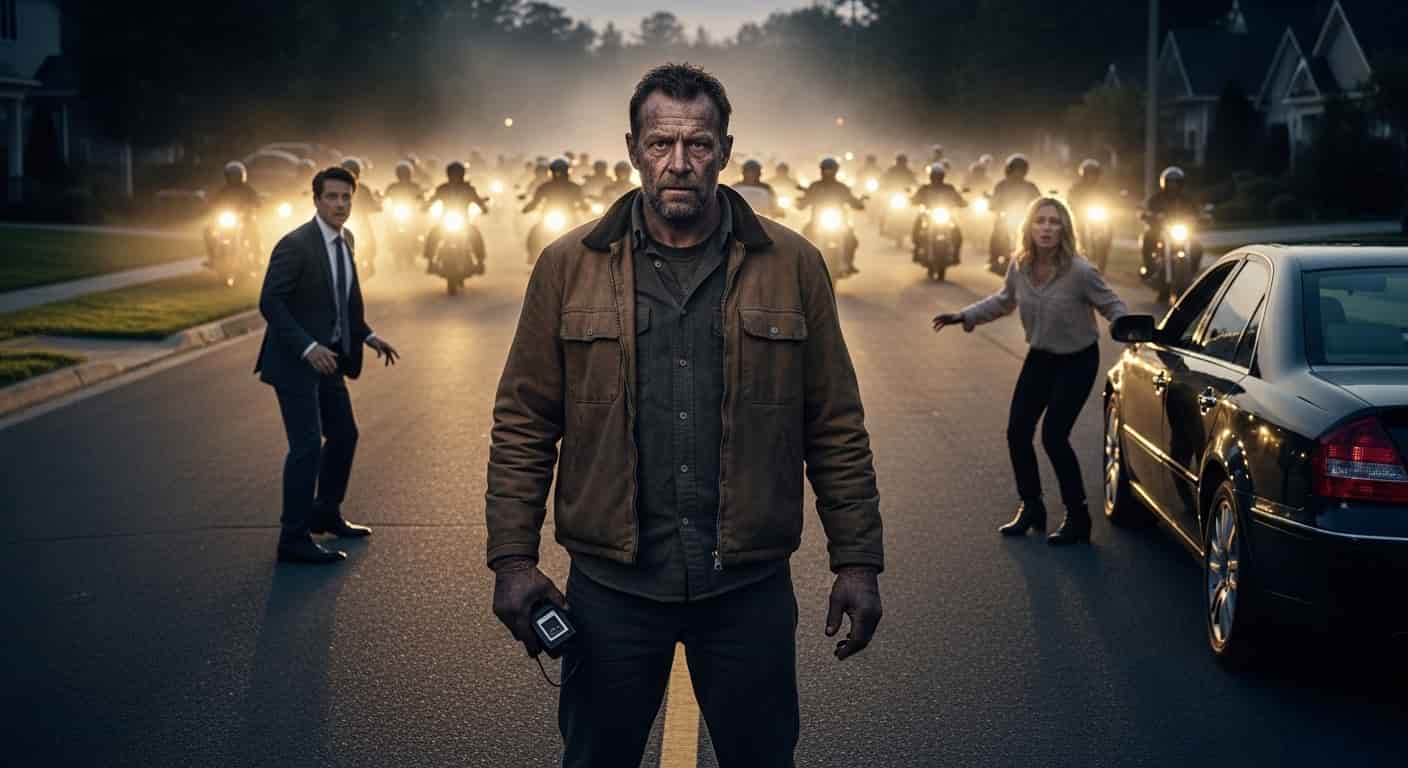
The neighbors watched from their windows, no doubt calling the HOA, but no one dared come outside. The sheer presence of the Iron Disciples and the fleet of trucks had turned Willow Creek into a fortress.
Sarah sat on the stairs, watching her life being dismantled. She tried to talk to me several times, but each time, one of the brothers would politely, but firmly, step in the way to move a crate or a piece of furniture.
“”Where are you going?”” she finally managed to yell over the sound of a revving engine.
“”To my father’s cabin,”” I said. “”The one you said was too ‘rustic’ for your tastes. It’s got a workshop. It’s got land. And it’s got a community that knows the value of a man’s word.””
I walked to the footlocker in the garage. I blew the dust off the top and flipped the latches.
Inside was my old leather cut. The leather was stiff, smelling of old oil and woodsmoke. I pulled it on. It fit perfectly, like a second skin I had been holding my breath to wear again.
I walked out into the driveway. The sun was setting, casting long, golden shadows over the line of motorcycles.
Mike walked up to me, handing me a set of keys. “”Your Shovelhead’s in the back of the trailer, Easy. We tuned her up this morning. She missed you.””
“”Thanks, Mike,”” I said, clapping him on the shoulder.
I looked at my hands. They were still greasy. They were still calloused. But they weren’t the hands of a “”poor”” man. They were the hands of a man who had built a life, lost it, and had the strength to take the pieces that mattered and walk away.
I picked up Leo and sat him on the back of Mike’s bike for a moment. “”Ready for an adventure, Leo?””
“”Is Mommy coming?”” he asked quietly.
I looked at Sarah. She was standing in the doorway of the house I had paid for, in the life I had built for her, looking smaller than I had ever seen her.
“”No, Leo,”” I said. “”Mommy has some thinking to do. But we’re going to be okay. I promise.””
I put Leo into the cab of Ghost’s truck—it was safer there for the long haul. Ghost gave the kid a trucker hat and showed him how to honk the air horn.
The blast of the horn echoed through the suburb, a final, triumphant salute to the life I was leaving behind.
Chapter 6: The Long Way Home
The convoy moved out as the first stars began to poke through the purple haze of the Pennsylvania sky.
I rode at the head of the pack, the wind tearing at my face, the roar of the Shovelhead vibrating through my chest. It was a language I had forgotten how to speak, but my body remembered every word.
Behind me were fifty bikes and three semi-trucks. A rolling wall of brotherhood that stretched back for a quarter-mile.
As we hit the highway, I looked in my rearview mirror. The lights of the suburb were fading into a dull, amber glow. Sarah was back there, in a house that was now empty of everything that gave it soul. Julian was likely already in handcuffs or halfway to a border he wouldn’t reach.
I realized then that Julian was right about one thing: I was a drone. I had let myself become small to fit into a world that didn’t value me. I had traded my fire for a steady paycheck and a woman who only loved the safety that paycheck provided.
But the road—the road doesn’t care about your paycheck. It cares about your character. It cares if you can hold your line when the rain is pouring and the visibility is zero.
We pulled into a truck stop three hours later. The brothers fanned out, taking over the parking lot. The air was filled with the sound of laughter, the clinking of coffee mugs, and the shared stories of men who had spent their lives moving the world.
I sat on a concrete barrier, Leo asleep with his head on my lap, wrapped in my old leather jacket.
Mike walked over and sat down next to me, handing me a steaming cup of black coffee. “”So, Road Captain. What’s the plan?””
I looked at my son’s peaceful face. I looked at the line of brothers standing guard around us.
“”The plan is to raise a man,”” I said. “”I want him to know that grease on your hands isn’t a sign of poverty. It’s a sign of a man who knows how to fix things that are broken.””
Mike nodded slowly. “”And the woman?””
“”She’ll get the house,”” I said. “”She’ll get the bank accounts. But she’ll never get the one thing she finally realized she needed.””
“”What’s that?””
I looked out at the dark ribbon of the highway, stretching infinitely toward the horizon.
“”A man who would move mountains just to keep her safe.””
I took a sip of the bitter coffee. It tasted like freedom. I realized then that I wasn’t the ghost anymore. For the first time in ten years, I was finally, truly visible.
The road was open, the brothers were at my back, and the only thing ahead of us was the truth.
You can take a man out of the road, but you can never take the road out of the man.”