“Chapter 5
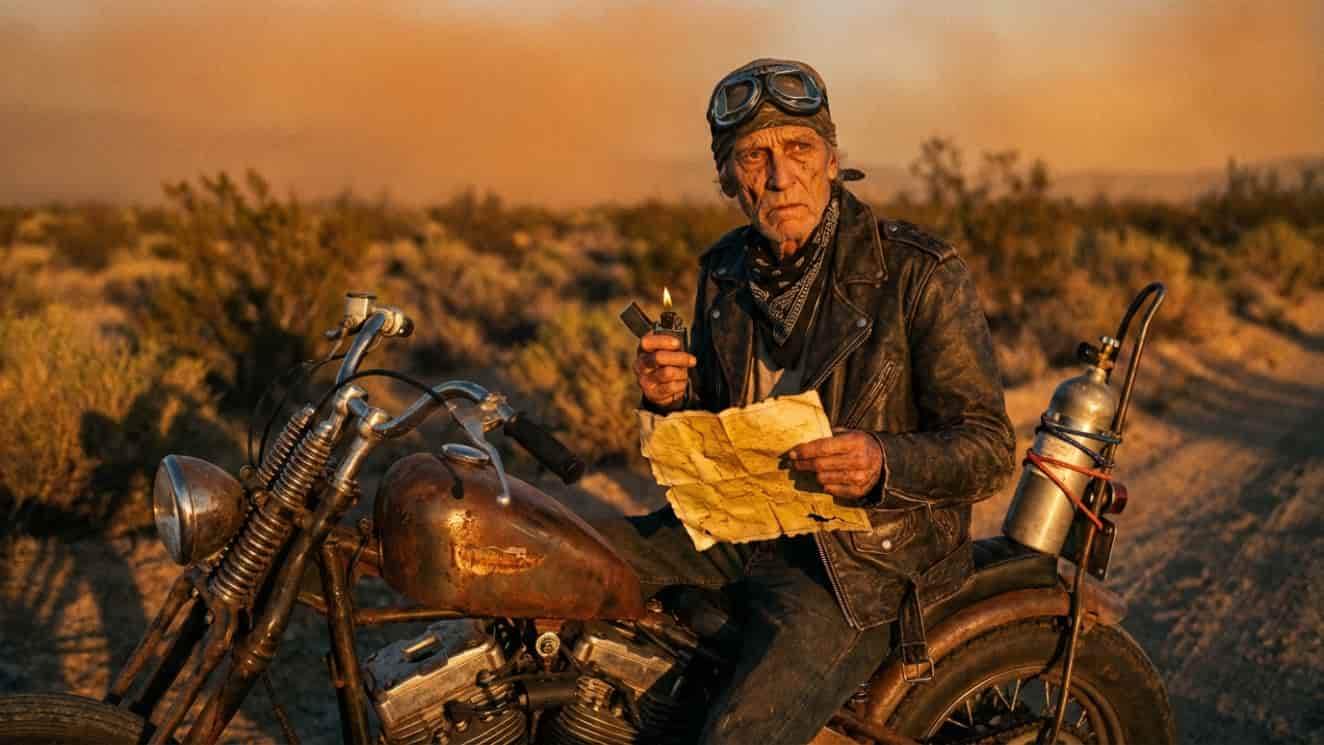
The heat began to rise off the asphalt in shimmering waves. Route 66 stretched out before him, a cracked, gray ribbon disappearing into the horizon. Dutch kept the Shovelhead at a steady sixty. Any faster and the wind would whip the oxygen mask off his face; any slower and the engine would overheat.
His chest felt like it was being squeezed by an iron band. Every few miles, he had to pull over to check the battery on the concentrator. The desert was unforgiving. It didn’t care about his mission or his remorse. It just wanted to dry him out and blow him away.
About fifty miles in, he saw the dust clouds in his mirror.
Three bikes. Mace and his lieutenants. They were moving fast, their high-performance engines whining as they gained on him. They didn’t have oxygen tanks or regrets. They just had the arrogance of the young.
Dutch didn’t speed up. He didn’t have the power to outrun them. He just kept his eyes on the road.
They swarmed him, surrounding the old Shovelhead. Mace pulled up alongside, his face obscured by a full-face helmet. He made a “”pull over”” gesture, his movements aggressive.
Dutch ignored him.
Mace veered closer, his handlebar inches from Dutch’s. He reached out and kicked at Dutch’s footboard. The old bike wobbled, the front wheel shimmying dangerously. Dutch fought to keep it upright, his muscles screaming with the effort.
He saw a roadside rest stop ahead—a derelict picnic table and a single, dead cottonwood tree. He slowed down and pulled into the gravel lot, the dust billowing up around him.
The three bikers skidded to a halt, boxing him in. Mace hopped off his bike before the kickstand was even down.
“”You think you’re just gonna ride off into the sunset?”” Mace yelled, ripping his helmet off. His face was flushed with heat and anger. “”You owe the club, Dutch. You wasted our time, you embarrassed us in front of the cops, and you still haven’t told us where the rest of the stash is.””
“”There is no rest of the stash, Mace,”” Dutch said, his breath coming in short, ragged gulps. He stayed on the bike, the engine still ticking. “”We spent it on lawyers. We spent it on booze. We spent it on trying to forget we were thieves.””
“”I don’t believe you,”” Mace said. He walked up and grabbed the oxygen tubing, yanking it.
Dutch gasped, his head snapping back. The plastic cut into his nose. He felt the darkness closing in at the edges of his vision.
“”Where is it?”” Mace hissed. “”The real money. The offshore stuff Miller talked about.””
Dutch reached into his saddlebag. He didn’t pull out a map. He pulled out one of the cans of lighter fluid. He flipped the cap and sprayed it directly into Mace’s face.
Mace screamed, clutching his eyes. The other two bikers stepped forward, but Dutch was already holding a Zippo. He didn’t flick it—not yet.
“”Back off!”” Dutch roared, the sound tearing through his throat. “”I’ve got forty years of gasoline in my blood and nothing to lose. You want to see what a ‘legend’ looks like? Stick around.””
The two bikers hesitated. They were tough, but they weren’t suicidal. They saw the look in Dutch’s eyes—the look of a man who was already halfway across the River Styx.
“”He’s crazy,”” one of them muttered, grabbing Mace by the shoulder. “”Come on, Mace. Let’s go. The feds are probably tracking the old man anyway.””
They hauled Mace back to his bike. The younger man was still cursing, wiping his eyes with his sleeve. They roared out of the lot, leaving Dutch alone in the silence.
Dutch sat there for a long time, the lighter fluid dripping from his hands onto the hot engine. The smell was intoxicating. He fumbled with the oxygen mask, getting it back into place. His heart was skipping beats now, a frantic, stuttering rhythm.
He reached into his jacket and touched the wooden box.
“”Almost there, Caleb,”” he whispered.
He kicked the bike back into gear. The sun was starting to dip below the mountains, turning the sky a bruised, angry purple. He had maybe twenty miles left in him. The battery on the concentrator was flashing red.
He rode into the sunset, the vibrations of the bike the only thing keeping his heart beating. He didn’t feel the pain anymore. He didn’t feel the heat. He just felt the road, the glorious, empty road that led to the only place he had left to go.
Chapter 6
The “”Border Drop”” was an old, abandoned cattle ranch ten miles north of the Mexican line. It was nothing now but a few falling-down fences and a stone well that had gone dry during the Nixon administration.
Dutch pulled the Shovelhead into the center of the clearing. The engine gave one final, wet cough and died. The silence that followed was absolute.
He climbed off the bike, his legs buckling. He collapsed into the dirt, the oxygen concentrator giving a final, mournful beep before the screen went dark.
He didn’t panic. He just lay there, looking up at the stars. They were so bright out here, far away from the neon of the bars and the fluorescent lights of the hospitals.
He crawled to the edge of the stone well. It took him twenty minutes to cover ten feet. Every movement was an agony, a slow-motion battle against the vacuum in his lungs.
When he reached the well, he pulled the wooden box from his jacket. He opened it. The silver ring glinted in the starlight.
“”You wanted to come back here,”” Dutch whispered. “”You wanted to start over.””
He tipped the box into the well. He heard the faint clatter-clink as the items hit the bottom, forty feet down.
“”There,”” Dutch said. “”You’re home.””
He dragged himself back to the bike. He leaned his back against the rear tire, the cooling metal clicking against his spine. He reached into his saddlebag and pulled out the second can of lighter fluid.
He poured it over the seat, the tank, and the pocket watch welded to the metal.
He looked out at the desert. In the distance, he could see the faint glow of a town. Life was going on. People were buying groceries, tucking their kids into bed, arguing over the remote. They didn’t know about the 500. They didn’t know about the money that turned to dust or the man who died for a lie.
And that was okay.
He felt a strange sense of peace. The debt was paid. Not with money, but with the only thing he had left.
He pulled the Zippo from his pocket. He didn’t have the strength to flick it. His thumb felt like it weighed a thousand pounds.
“”Dutch?””
He turned his head. Sarah was standing at the edge of the clearing. She’d followed him. Of course she had. She was a nurse; she didn’t know how to let someone die alone.
“”Don’t,”” she said, seeing the lighter.
“”It’s okay, Sarah,”” Dutch said, his voice a ghost of a whisper. “”The bike… it’s a part of it. It all has to go.””
“”You don’t have to do this,”” she said, walking toward him. She knelt in the dirt, ignoring the smell of gasoline. She took the Zippo from his hand. “”You already finished the run.””
She looked at the bike, then at the man. She saw the empty wooden box on the ground. She knew.
“”Did you find it?”” she asked. “”The peace?””
Dutch looked at her. He saw Caleb in her eyes, but he also saw something else. He saw forgiveness. Not the kind you get in a church, but the kind you earn in the dirt.
“”Yeah,”” he said. “”I found it.””
He closed his eyes. The air was getting thin, but it didn’t hurt anymore. It felt like he was floating, the road beneath him turning into a river of light.
Sarah stayed with him. She didn’t try to give him oxygen. She didn’t try to call an ambulance. She just sat in the dirt and held his hand, a weathered, grease-stained hand that had held a secret for forty years and finally let it go.
When the sun came up the next morning, it found a white sedan and an old motorcycle parked in the middle of nowhere. A young woman was sitting on the bumper of the car, watching the horizon.
Behind her, leaning against the bike, was an old man who looked like he was finally getting some rest.
The pocket watch on the tank was still frozen at 4:12. But for the first time in nearly half a century, the time didn’t matter. The run was over. The 500 were gone. And the desert, as always, kept its secrets.”