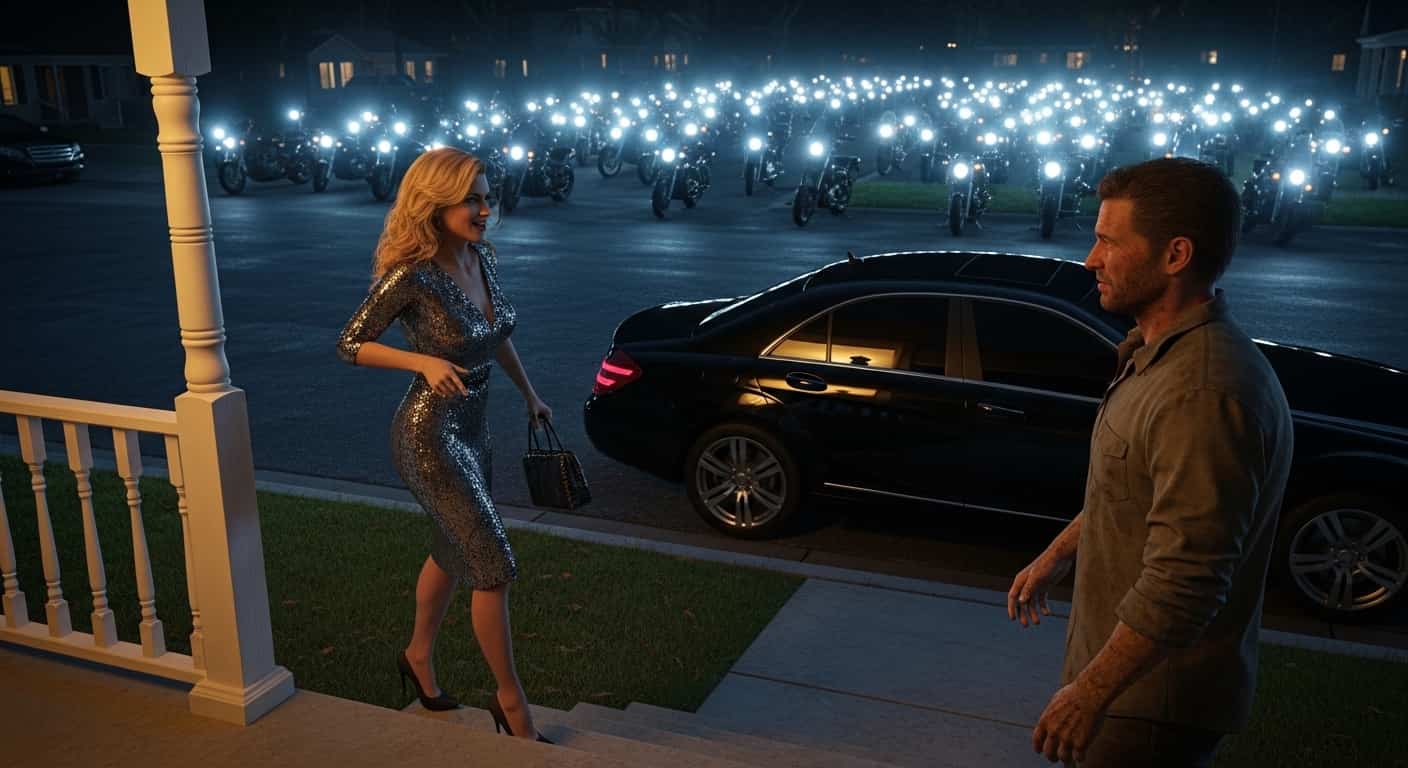
The sequins on Elena’s dress caught the porch light, shimmering like a snake’s scales. She looked beautiful. She looked expensive. And she looked like she didn’t give a damn that our six-year-old daughter was upstairs, shaking with a fever that wouldn’t break.
“”It’s just a cough, Jax,”” she spat, checking her reflection in her phone screen. “”You always were a drama king. That’s why I left. I’m not missing the Sterling Gala because you can’t handle a little sniffle.””
“”She’s burning up, Elena,”” I said, my voice cracking. I’d been up for forty-eight hours. My hands were covered in engine grease and heartbreak. “”The doctor said if the fever hits 104, we have to go to the ER. It’s at 103.8. Please. Just stay for an hour.””
That’s when she did it. She laughed. A cold, melodic sound that made my blood turn to ice. She shoved me aside with her clutch bag, stepping toward the black Mercedes idling at the curb. Julian, the “”software mogul”” she’d traded me in for, didn’t even get out of the car. He just watched through the tinted glass, probably worried he’d get “”poor”” on his Italian loafers.
“”Grow up, Jax,”” she called over her shoulder. “”Some of us have lives to lead. Real lives. Not just fixing greasy bikes in a garage.””
She didn’t notice the silence that followed. She didn’t notice that the usual suburban sounds—the lawnmowers, the distant barking dogs—had been replaced by a low, rhythmic thrumming.
She didn’t see the flash of chrome at the end of the block. She didn’t see the 1,500 men and women who call me “”Brother”” waiting for the signal.
She’s about to realize that while her “”lover”” will be the first to run when things get ugly, I have a family that never leaves a man behind. Especially not a dying little girl.
“FULL STORY
Chapter 1: The Weight of Gold and Grease
The air in the hallway smelled like peppermint oil and fear. I sat on the edge of Maya’s bed, listening to the ragged, whistling sound of her breath. Each one felt like a serrated blade across my chest. At six years old, she should have been dreaming of unicorns and playground tag. Instead, she was fighting a respiratory infection that the doctors had warned me could turn into pneumonia in a heartbeat.
“”Daddy?”” her voice was a thin thread.
“”I’m right here, Peanut. I’m not going anywhere.”” I pressed a cool washcloth to her forehead. Her skin was a furnace.
Downstairs, the front door slammed. Then came the clicking of high heels—fast, impatient, and sharp. It was a sound that used to bring me joy when I heard Elena coming home from work. Now, it just sounded like a countdown to another explosion.
I tucked the blanket around Maya and stepped out into the hall, closing her door softly. I met Elena at the top of the stairs. She was a vision in midnight blue silk, her hair pinned back in an intricate web of braids and diamonds. She looked like she belonged on a magazine cover. She looked like a stranger.
“”Where are the kids’ passports?”” she asked, not even looking at me. She started rummaging through the hall closet.
“”Passports? Elena, what are you talking about? Maya is sick. Really sick.””
She stopped and exhaled a cloud of expensive perfume. “”Julian is taking me to Cabo for the weekend after the gala. He said if I can find the passports, we can take the kids next time, but I need to make sure they aren’t expired. Where are they?””
I stared at her, stunned. “”You’re thinking about Cabo? I just told you our daughter is hitting 104 degrees. I’ve been calling you for three hours.””
“”And I told you to stop suffocating her!”” she snapped, finally looking at me. Her eyes were hard, devoid of the warmth that had once been my anchor. “”You’ve always been like this, Jax. Paranoid. Protective to the point of insanity. You want her to be weak so she’ll always need you. Just like you wanted me to stay in this tiny, grease-smelling house forever.””
“”I wanted us to be a family,”” I whispered.
She stepped closer, the smell of her gin-and-tonic breath hitting me. “”Julian offers me the world. He offers me a life where I don’t have to worry about the mortgage or whether the shop had a ‘good month.’ He’s waiting in the car, Jax. Move.””
I didn’t move. “”If you walk out that door while she’s like this, don’t bother coming back for the passports. Don’t bother coming back for anything.””
Elena let out a short, mocking laugh. It was the sound of a bridge burning. She reached out and shoved my shoulder—not hard enough to knock me down, but hard enough to show her contempt. “”You and your little bike club friends. You think you’re so tough. You’re just a bunch of middle-aged losers playing dress-up in leather.””
She brushed past me, her silk dress hissing against my work jeans. I followed her down the stairs, my heart hammering against my ribs.
“”Elena! Look at the street!”” I yelled as she reached the front door.
She didn’t listen. She swung the door open, ready to glide into Julian’s Mercedes and vanish into a world of champagne and soft lighting.
But the Mercedes wasn’t moving. And the street wasn’t empty.
The evening sun was reflecting off a thousand windscreens. The low, guttural growl of idling V-twin engines filled the air, a sound so loud it vibrated in your teeth. Lining both sides of our quiet suburban cul-de-sac were the bikers. The Iron Brotherhood. Men I’d served with in the 101st, men I’d built bikes for, men who had sat in my garage and drank beer while we talked about life, death, and everything in between.
There were 1,500 of them. And every single one of them was looking at her.
Chapter 2: The Iron Wall
Elena froze on the porch. The “”software mogul”” Julian was visible through the windshield of his Mercedes, his eyes darting frantically from left to right. He looked like a trapped rabbit. He hadn’t even put the car in gear; he was surrounded by a sea of black leather and chrome.
“”What is this?”” Elena hissed, her voice trembling for the first time. “”Jax, what did you do?””
I stepped out onto the porch behind her, crossing my arms. “”I didn’t do anything, Elena. I just sent out a text. I told them my daughter was sick and her mother was leaving her. I told them I might need a ride to the hospital if things got bad.””
In reality, it was more than that. I had sent a “”Code Red”” to Sal, my VP. In our world, a Code Red meant a brother’s blood was in trouble. For the Brotherhood, Maya wasn’t just my daughter—she was the club’s daughter.
Sal pulled his heavy Road Glide up to the curb, right next to Julian’s Mercedes. He killed the engine, the silence that followed even more deafening than the roar. Sal was a mountain of a man with a graying beard and eyes that had seen too much combat in Fallujah. He climbed off the bike, his heavy boots thumping on the asphalt.
“”Evening, Jax,”” Sal said, his voice like gravel. He didn’t even acknowledge Elena. “”How’s the little bit?””
“”Fever’s climbing, Sal. I’m worried about her lungs.””
Sal nodded, then finally turned his gaze to Elena. It wasn’t a look of anger; it was a look of pure, unadulterated disappointment. The kind a father gives a child who has failed a basic test of humanity.
“”Going somewhere, Mrs. Miller?”” Sal asked.
“”It’s… it’s none of your business,”” Elena stammered, clutching her designer bag to her chest. “”Julian! Get me out of here!””
She lunged for the car door, but Julian did something she never expected. He didn’t open it. In fact, as she reached for the handle, we heard the distinct click of the power locks engaging.
Julian’s face was pale. He looked at the 1,500 bikers—men with tattoos, scars, and a collective sense of loyalty he couldn’t even fathom—and he made a choice. He put the car in reverse, backing up inch by inch, nearly clipping a bike.
“”Julian?”” Elena tapped on the glass. “”Julian, open the door!””
Julian looked at her through the window, mouthed the words “”I can’t,”” and then executed a panicked three-point turn, scraping his expensive rims on the curb in his haste to flee the “”scary”” men in leather. He sped away, leaving a cloud of exhaust and a shattered woman in his wake.
Elena stood in the middle of the street, her midnight blue dress looking ridiculous against the backdrop of grit and grease. She turned back toward the house, toward me, her face a mask of shock.
“”He… he left me,”” she whispered.
“”No,”” I said, my voice cold. “”He just showed you who he really is. Now, get out of the way. We have work to do.””
I looked at Sal. “”Did you bring it?””
Sal reached into his saddlebag and pulled out a small, insulated medical bag. “”Fresh from the pharmacy. The good stuff the doctor called in. And I’ve got Nurse Sarah three bikes back. She’s coming in.””
A woman in a leather vest with a stethoscope around her neck hopped off her bike and headed toward the porch. This was the Brotherhood. We weren’t just a gang. We were a community. We had doctors, lawyers, mechanics, and soldiers. And right now, we were Maya’s army.
Chapter 3: The Long Night
The next four hours were a blur of cold compresses, measured doses of medicine, and the constant, comforting presence of the men outside. They didn’t leave. They didn’t even turn off their lights. The street remained illuminated by a thousand headlamps, a silent vigil for a six-year-old girl.
Nurse Sarah—a veteran combat medic who now worked in the ICU—didn’t leave Maya’s side. I sat in the corner of the room, my head in my hands, listening to the murmurs of the Brotherhood outside. Every so often, I’d hear the clink of a wrench or a quiet laugh. They were keeping watch.
Elena was downstairs. She hadn’t left, mostly because she had nowhere to go. Her “”lover”” wasn’t answering her texts, and her “”real life”” friends from the gala were busy sipping champagne two towns over. She was trapped in the reality she had tried so hard to escape.
Around 2:00 AM, Maya’s breathing changed. It went from a sharp whistle to a deep, rhythmic sigh.
Sarah checked the thermometer and finally looked up at me with a smile. “”100.2, Jax. The fever broke.””
I felt the air rush out of my lungs, a sob catching in my throat. I walked over to the bed and kissed Maya’s damp forehead. She stirred, her eyes fluttering open for a second.
“”Daddy? Is it raining?”” she whispered.
“”No, Peanut. Why?””
“”I hear the thunder,”” she said, drifting back into a deep, healthy sleep.
I knew what she was hearing. It wasn’t thunder. It was the collective heartbeat of 1,500 engines idling at low RPMs.
I walked out onto the balcony that overlooked the driveway. The sight was cinematic. A river of steel and leather stretched as far as the eye could see. When they saw me, a few riders raised their fists in the air. No cheering, no shouting—just the silent acknowledgment of brothers.
I saw Elena sitting on the porch steps below. She looked small. The diamonds in her hair had fallen out, and her dress was stained with dirt from where she’d sat on the concrete. She looked up and saw me.
“”Jax,”” she called out, her voice raw. “”Can I come up? Can I see her?””
I looked at her, and for the first time in three years, I felt nothing. No anger, no longing, no hurt. Just a vast, empty space where a marriage used to be.
“”No,”” I said. “”You chose the gala. Go find a ride.””
“”I have nowhere to go,”” she sobbed. “”Julian blocked my number. My sister won’t pick up. Jax, please. I’m her mother.””
“”A mother stays when the fever hits,”” I said. “”A mother doesn’t laugh when her child is gasping. You aren’t a mother, Elena. You’re just a guest who stayed too long.””
Chapter 4: The Truth in the Shadows
As the sun began to peek over the horizon, painting the sky in bruises of purple and orange, the reality of the situation began to set in for the neighborhood. Neighbors who had previously looked down on me for my “”loud”” friends were now out on their lawns, bringing thermoses of coffee to the bikers.
They had seen what happened. They had seen Elena’s “”prince”” flee in a cloud of cowardice, and they had seen the “”outlaws”” stand guard all night for a sick child.
I came downstairs to find Sal sitting in my kitchen, drinking a cup of black coffee. He looked tired, but his eyes were sharp.
“”She’s still out there,”” Sal said, jerking his thumb toward the front door. “”Trying to call Ubers. None of them can get through the line.””
“”Let one through,”” I said. “”I want her gone before Maya wakes up.””
Sal nodded and spoke into his radio. “”Clear a lane for a silver Camry. Let it in, let it out. No trouble.””
I walked out to the porch one last time. Elena was standing by the curb, her makeup smeared, looking like a ghost of the woman who had shoved me the night before.
“”Jax,”” she started, “”about the divorce settlement… I think we should talk. Maybe I was too hasty about the house. Julian… he isn’t who I thought he was.””
“”He’s exactly who you thought he was,”” I interrupted. “”He was rich and shiny. That’s all you ever cared about. You didn’t want a husband; you wanted an accessory. And you didn’t want a daughter; you wanted a prop for your Instagram.””
I stepped off the porch, walking toward her. The bikers watched in silence.
“”The papers are in the mail, Elena. I’m taking full custody. And after last night, after 1,500 witnesses saw you abandon a medically fragile child to go to a party… no judge in this state is going to give you anything but supervised visits.””
The color drained from her face. “”You can’t do that.””
“”I already did. Sal’s brother is the best family lawyer in the county. He spent the night drafting the emergency motion while he sat on his Harley.””
The Uber pulled up. Elena looked at the car, then at the wall of bikers, then at me. She realized that the world she had built—the one made of silk and status—had collapsed, and the world she had despised was the only thing standing strong.
She got into the car without another word. As the Uber drove away, the Brotherhood didn’t jeer. They didn’t hoot. They simply closed the gap behind the car, sealing the street once more.
Chapter 5: The Reckoning
The next few weeks were a whirlwind. True to his word, Julian vanished. Rumor had it his “”software company”” was mostly smoke and mirrors, and the scandal of him fleeing a “”biker mob”” had caused his investors to pull out. He was a coward, and in the high-stakes world he played in, cowardice was the one sin that couldn’t be laundered.
Elena tried to fight the custody arrangement, but it was a losing battle. The local news had picked up the story—””1,500 Bikers Stand Guard for Sick Child””—and the public sentiment was overwhelming. People left flowers on our porch. Local businesses offered to sponsor Maya’s medical bills.
But the most important thing happened in my own living room.
Maya was sitting on the rug, her color back, playing with a toy motorcycle Sal had brought her. She looked up at me, her eyes bright and clear.
“”Daddy? Why are there always so many uncles in the driveway?””
I knelt down beside her. “”Because, Peanut, sometimes family isn’t just the people you’re born to. Sometimes, it’s the people who show up when the lights go out.””
She hugged my neck, her small arms a reminder of why I had fought so hard. “”I like the thunder,”” she whispered.
I looked out the window. Sal was out there, helping a neighbor fix a lawnmower. Two other brothers were painting the fence. They hadn’t just stood guard for one night; they had moved in to make sure we were okay.
I received a text from Elena that evening. It wasn’t a threat or a plea. It was just a photo of a gold necklace I’d given her for our first anniversary. The caption read: I traded this for a bottle of wine. I think I’ve always been broken, Jax. I’m sorry.
I didn’t reply. Some apologies are just echoes in an empty room.
Chapter 6: The Brotherhood’s Grace
Six months later.
The air was crisp, the smell of autumn leaves mixing with the scent of pine. It was the day of the annual “”Maya Ride,”” a charity event the Brotherhood had organized to raise money for the local children’s hospital.
I stood on the stage at the local park, looking out at a sea of thousands. It wasn’t just the 1,500 anymore. It was families, police officers, teachers—the whole community.
Maya was standing next to me, wearing a tiny leather vest with “”Junior Brotherhood”” embroidered on the back. She was beaming, waving at the crowd like a little queen.
I saw a figure at the very back of the crowd, standing near a tree. It was a woman in a plain coat, her hair dull, her posture slumped. Elena. She wasn’t there to cause trouble. She was just… watching. She was watching the life she could have had, the love she could have felt, if she hadn’t been so blinded by the glitter of a fake world.
She locked eyes with me for a second. I didn’t feel hate. I felt a strange kind of pity. She had chosen a life of “”gold,”” only to find out it was just painted lead. I had stayed in the “”grease,”” and found out it was the only thing that kept the world turning.
Sal stepped up to the microphone, his voice booming over the speakers.
“”We’re here for the kids!”” he yelled. “”And we’re here because when one of us falls, we all pick him up! That’s the code! That’s the Brotherhood!””
The roar that followed was louder than any engine. It was the sound of 5,000 voices, a wall of support that would never break.
As the ride began, I put Maya on the back of my custom chopper, securing her safely. I kicked the engine over, the familiar vibration thrumming through my bones.
We pulled out of the park, leading the procession. I looked in my rearview mirror and saw a line of bikes stretching for miles. I looked at my daughter, her hair whipping in the wind, a smile on her face that could light up the darkest night.
I realized then that Elena hadn’t just lost a husband or a house. She had lost the chance to be part of something eternal. She had chosen a moment, while we had chosen forever.
The final sentence of the story wasn’t written in a book, but in the dust of the road we left behind.
Loyalty isn’t a word you say; it’s a roar you make when the rest of the world is silent.”