“Chapter 5: The Glass Room
The hospital was quiet, the 3:00 AM “”dead hour”” where the line between life and death felt thinnest. Grip moved through the service entrance, his Carhartt jacket zipped to his chin.
He reached Room 412. The hallway was empty, the nursing station unattended for a brief moment as the night shift swapped out.
He stepped inside. The only sound was the rhythmic hiss-click of the ventilator. Arthur Vance looked like a wax figure, his skin translucent, his chest rising and falling with mechanical precision.
Grip stood over him. He reached out, his hand hovering over the oxygen line. The humming started—low at first, then building into a roar in his ears.
“”I’m sorry,”” Grip whispered. “”I’m sorry for that night. I’m sorry I followed you.””
“”Grip?””
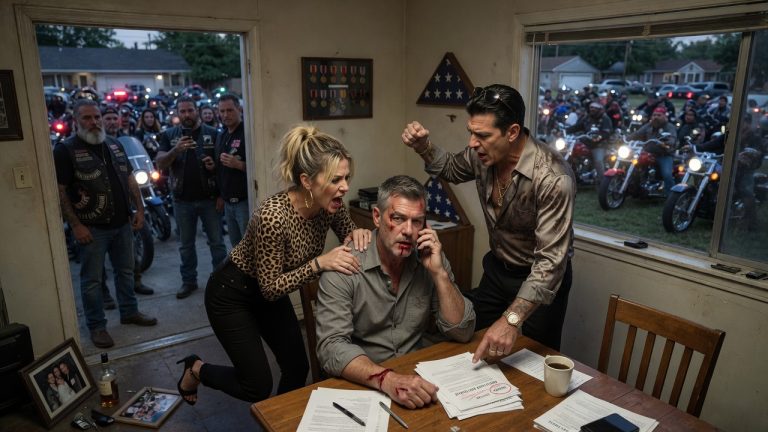
He spun around. Clara was standing in the doorway. She wasn’t supposed to be here. She was pale, her eyes wide, looking at his hand on the tubing.
“”What are you doing?”” she whispered.
Before he could answer, the door slammed open. Sarge walked in, his heavy boots loud on the linoleum. He didn’t look at Clara. He looked at Grip.
“”You’re vibrating again, Grip,”” Sarge said, his voice cold. “”Get out of the way. I’ll do it.””
“”Sarge, no,”” Grip said, stepping between the bed and the giant.
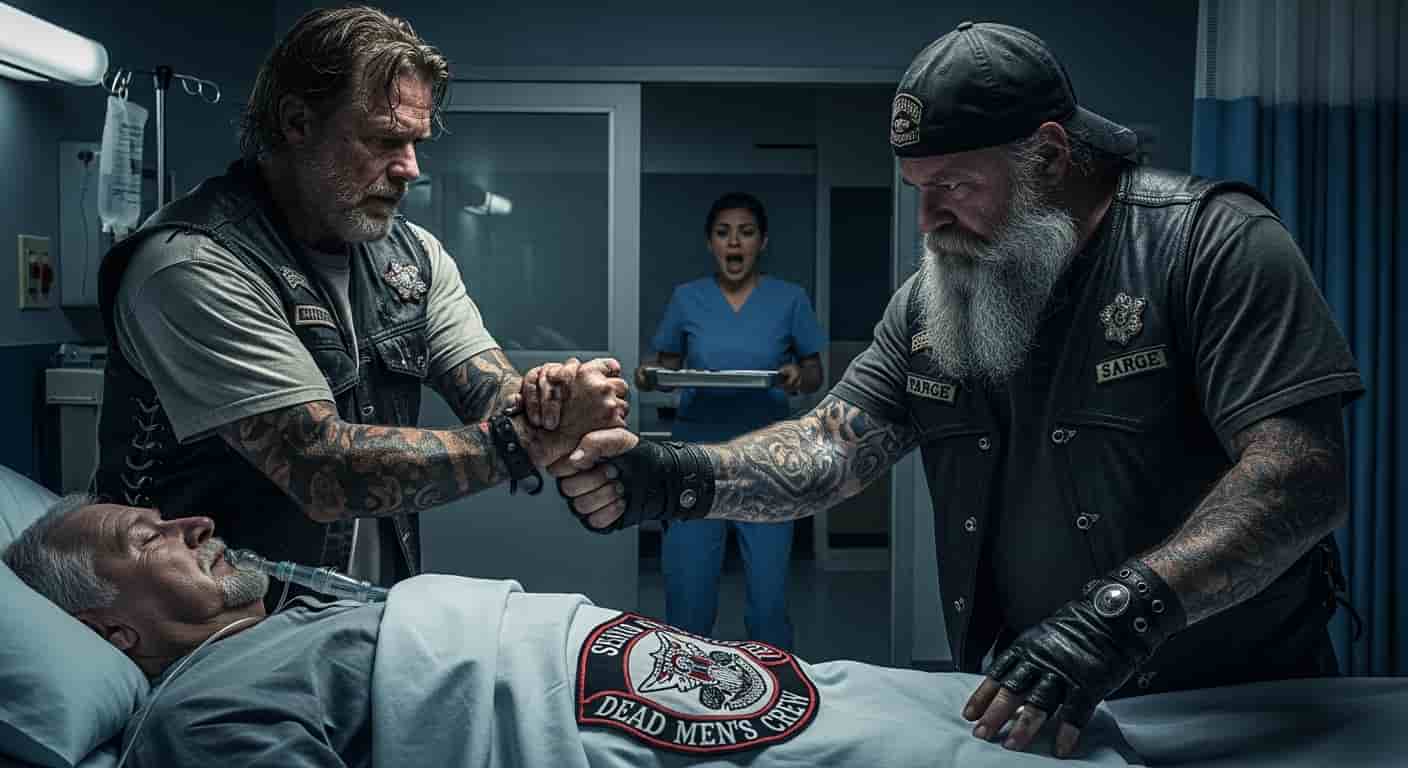
Sarge reached out and grabbed Grip’s wrist, squeezing it with bone-crushing force. He forced Grip’s hand down toward the bed. With his other hand, Sarge reached into his vest and pulled out a “”Dead Men’s Crew”” patch. He slammed it onto Arthur’s chest, the black and white embroidery a death warrant.
“”This is who you are, Grip,”” Sarge growled. “”This is who we are. Now finish it.””
Clara let out a strangled cry, her medical tray slipping from her hands. Pills and syringes scattered across the floor like hail. She looked at the patch. She looked at Sarge. Then she looked at Grip’s face—the face of the man she’d lied for.
“”You,”” she breathed. “”The headlights. My father wasn’t lying.””
“”Clara, listen to me,”” Grip pleaded, his hand shaking violently under Sarge’s grip.
“”He’s one of us, honey,”” Sarge laughed, a cruel, jagged sound. “”He’s the one who ran your old man off the road. He’s the one who killed that kid in the minivan. And now, he’s going to make sure your daddy doesn’t tell anyone about it.””
Sarge shifted his grip to Grip’s throat, pinning him against the bed rail. “”Do it, or she’s next.””
Grip looked at Clara. He saw the horror in her eyes, the way her world was shattering. And in that moment, the humming in his bones stopped. The tremor vanished, replaced by a cold, sharp clarity.
He didn’t reach for the ventilator. He reached for the heavy leather folder tucked into his waistband. He slammed it onto the tray table, knocking over a water pitcher.
“”That’s the Oakland manifest, Sarge,”” Grip gasped, the air leaving his lungs. “”Dates, times, VIN numbers. Everything. It’s already set to go to the D.A. if I don’t check in by morning.””
Sarge froze. His eyes flickered to the folder, then back to Grip. “”You’re a dead man.””
“”Maybe,”” Grip said, his voice a rasp. “”But the club goes down with me. Leave. Now. Or we all burn.””
Sarge let go, his face a mask of pure rage. He looked at Clara, then at the folder. He knew the math. The club came first. He snatched the folder, leaned into Grip’s ear, and whispered, “”We’ll find you. There isn’t a road long enough.””
Sarge turned and walked out, his heavy footsteps fading down the hall.
Grip slumped against the bed, his breath coming in ragged gulps. He turned to Clara. She was backed against the wall, her hands over her mouth.
“”Clara…””
“”Don’t,”” she said, her voice trembling. “”Don’t touch me. Don’t speak to me.””
“”I saved him,”” Grip said, gesturing to Arthur.
“”You destroyed him,”” she sobbed. “”You destroyed everything.””
She turned and ran out of the room, leaving Grip alone with the hiss-click of the machine and the ghost of the man he used to be.
Chapter 6: The Weight of the Handlebars
Two weeks later, the fog was so thick you couldn’t see the end of the pier in Eureka.
Grip sat on his Harley Glide at the edge of the coastal highway. His truck was sold. His apartment was empty. He had a bag strapped to the sissy bar and a full tank of gas.
His hands were still. They didn’t hum anymore, but they felt heavy, like they were made of lead. The doctors had told him the tremors were psychosomatic—a physical manifestation of a guilt he couldn’t process. Now that the secret was out, the body had gone quiet.
He looked at the hospital on the hill. Arthur Vance was out of the ICU. He was breathing on his own. He wouldn’t remember much—the doctors said the trauma had wiped the window clean—but he was alive. Clara would have her father. She wouldn’t have Grip, but she’d have her father.
A car pulled up behind him. He didn’t turn around. He knew the sound of the engine.
Clara got out of her small sedan. She didn’t come close. She stood ten feet away, her hands tucked into the pockets of her scrubs.
“”The police came by,”” she said. “”They found a box of evidence on the D.A.’s doorstep this morning. Sarge and four others were picked up at the clubhouse.””
“”I figured they would be,”” Grip said, staring at the gray horizon.
“”Why did you do it? You could have just run.””
“”I was already running, Clara. For three years. I was tired.”” He finally turned his head. “”I’m sorry I made you a liar.””
“”I made myself a liar,”” she said, her voice hard. “”I wanted to believe there was something good in you. I wanted to believe I saved someone worth saving.””
“”Did you?””
She looked at him for a long time. The salt spray clung to her hair. “”I don’t know. I don’t think I’ll ever know.””
She reached into her pocket and pulled something out. She walked forward and set it on the gas tank of his bike. It was the biker patch. The one Sarge had slammed onto her father’s bed.
“”Don’t leave your trash behind,”” she said.
She turned and walked back to her car. She didn’t look back. She didn’t wave. She just drove away into the mist.
Grip looked at the patch. He picked it up, feeling the rough embroidery. He thought about throwing it into the ocean. He thought about burning it. But instead, he stuffed it into the very bottom of his saddlebag.
A reminder of the cost. A scab over the soul.
He kicked the bike into gear. The engine roared, a deep, guttural vibration that matched the rhythm of his heart. He pulled out onto the 101, heading south.
His hands were steady on the bars. He didn’t know where he was going, and he didn’t know if he’d survive the night. But for the first time in years, the only thing humming was the road.”