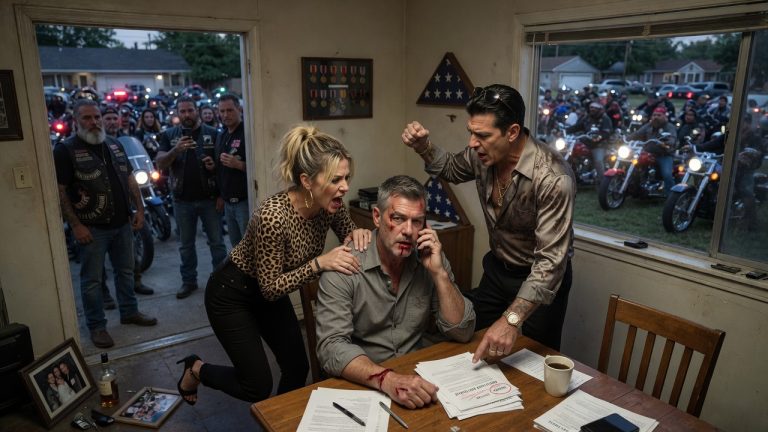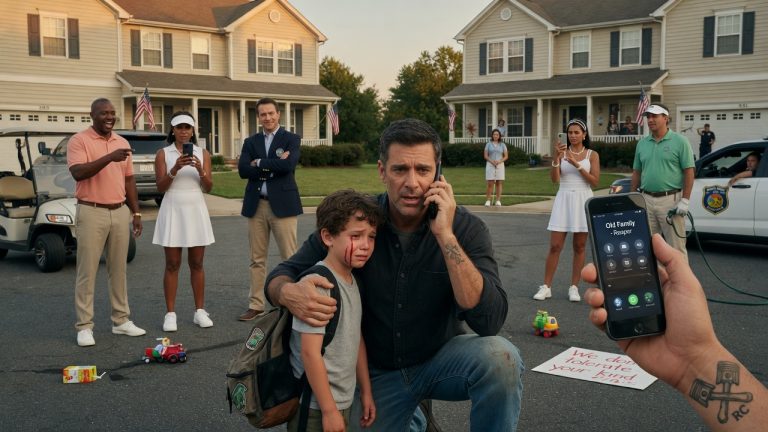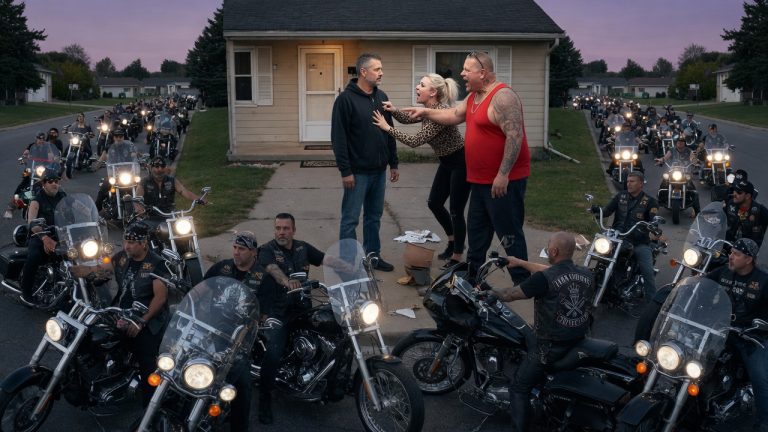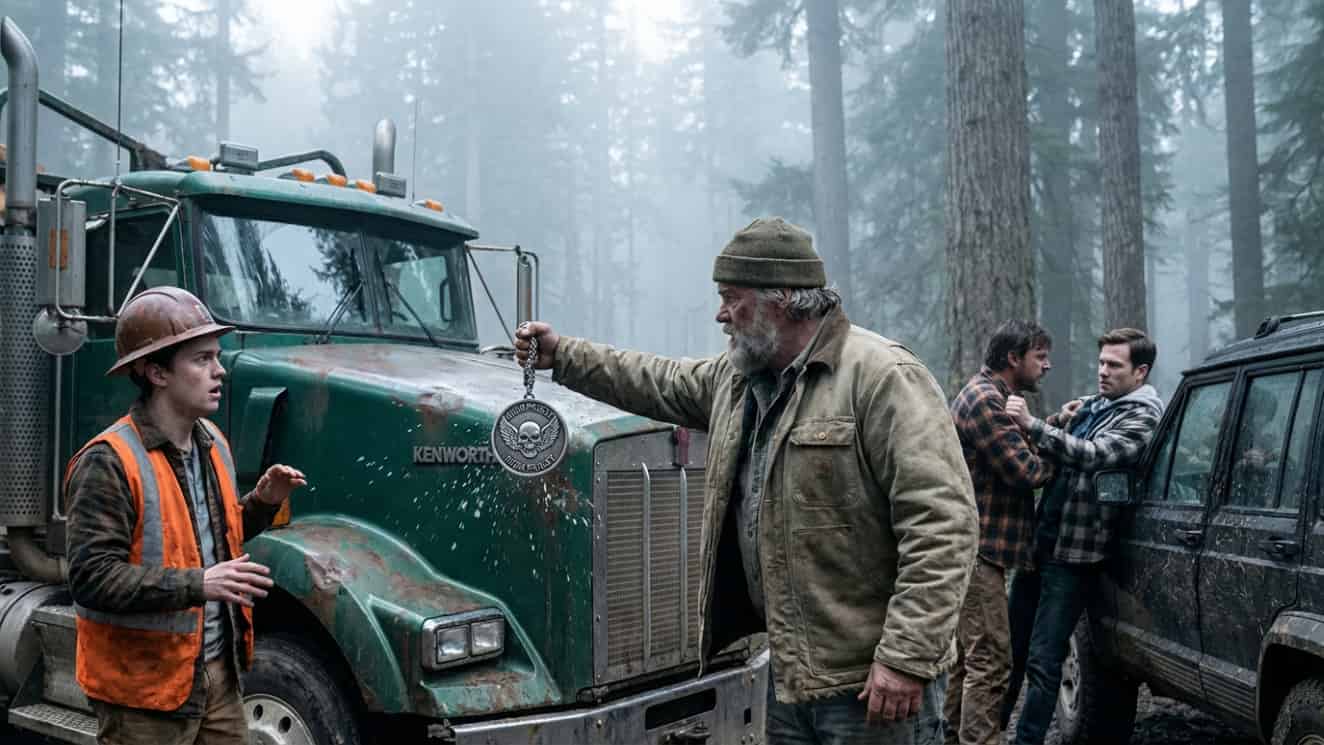
I watched from the tree line as Cutter and his crew pinned the kid against the Jeep. They called him a “tourist.” They called him “fresh meat.”
They didn’t know the kid’s name was Ben. They didn’t know he was carrying a photo of a man in a military uniform—the same man who destroyed my life thirty years ago. And they sure as hell didn’t know that Ben was my own flesh and blood.
I haven’t touched my “colors” since the court-martial. I haven’t spoken the words “High Priest” since the day the gates closed behind me.
But when Cutter raised his hand to my grandson, the mountain air changed.
I didn’t bring a gun. I didn’t need one.
I walked out of the fog and put the only thing I had left on the hood of that logging truck. A piece of silver that every biker from Seattle to the border knows by heart.
Cutter’s face went white. He knew the debt. He knew that if I made one phone call, the mountain would crawl with five hundred men who don’t care about “mountain law.”
“The boy goes,” I said.
Cutter looked at the silver, then at the road, and then he heard it. The sound of five hundred Harleys coming up the pass.
The secret I spent thirty years hiding was out. And the war was just beginning.
FULL STORY: THE LAST OUTPOST
Chapter 1: The Weight of Cedar
The fog didn’t just sit in the Cascades; it owned them. It crawled through the hemlocks and wrapped itself around the rusted corrugated roof of my cabin like a wet wool blanket. I liked it that way. Fog didn’t ask for your discharge papers. It didn’t care about the rank you used to hold or the family that stopped writing to you when the newspapers started calling you a traitor.
I was finishing a pot of black coffee, the kind that tasted like a battery terminal, when I heard the first crack of a dry branch. It wasn’t a deer. Deer moved with a purpose. This was the clumsy, rhythmic thud of a human boot hitting soft rot.
I stood up, my knees popping like small-caliber fire. At sixty-four, my body was a map of every mistake I’d ever made. Shrapnel in the left thigh, a botched set on a broken collarbone from a bike slide in ’92, and the slow, grinding rot of mountain dampness in my lungs. I grabbed the heavy canvas coat hanging by the door and stepped onto the porch.
A kid was standing in the clearing. He looked like an advertisement for an outdoor supply store—bright orange parka, pristine hiking boots, and a backpack that probably cost more than my truck. He was staring at a map, looking back and forth between the paper and the wall of grey trees.
“You’re three miles off the trailhead, son,” I said.
The kid jumped, nearly dropping his map. He looked up, and for a second, the air left my lungs. He had the same high cheekbones. The same slight cleft in his chin. But it was the eyes—a startling, piercing blue that looked exactly like the woman I’d left behind in a humid Georgia kitchen thirty years ago.
“Oh, man. Sorry,” the kid said, laughing nervously. He stayed a respectful distance. “I thought this was the Cutoff Road. I’m looking for the Old Outpost.”
“The Outpost has been a pile of rotting cedar for a decade,” I said, my voice sounding like gravel in a blender. “And this is private property. Mine.”
“I’m Ben,” he said, stepping forward with a hand out. I didn’t take it. I just stared at him. He pulled his hand back, looking embarrassed. “I’m not a hunter or anything. Just… doing some research. My grandfather used to talk about this area. Well, my grandmother did. He disappeared before I was born.”
I felt a cold prickle at the base of my neck. “Is that right? What was his name?”
“Thomas Adams,” he said. “He was a Master Sergeant. 10th Mountain.”
The name hit me like a physical blow. Thomas Adams. That was the name they’d stripped from me. That was the name on the court-martial documents. The name the Army had buried under a mountain of “dishonorable” ink.
“Never heard of him,” I lied. The lie felt like a hot coal in my throat.
Before he could answer, the low, aggressive roar of a diesel engine tore through the silence. A white logging truck, its grill caked in mud and blood from a recent deer strike, rounded the bend of the gravel drive. It skidded to a halt, kicking up a spray of grey slush.
Three men climbed out. They were wearing high-vis vests and hard hats, but they didn’t look like they were there to work. The one in the lead was Cutter—a thick-necked bully whose daddy owned half the timber rights in the county. Cutter had been trying to buy my forty acres for three years, and every time I said no, he got a little more creative with his harassment.
“Well, look at this,” Cutter sneered, spitting a stream of brown tobacco onto the pristine snow. “Grizzly’s got a visitor. You diversifying, old man? Starting a bed and breakfast for city boys?”
“The kid’s lost, Cutter,” I said, stepping off the porch. I felt the old familiar heat rising in my chest, the kind that used to get me into trouble in the barracks. “He was just leaving.”
“He’s trespassing,” Cutter said, stepping into Ben’s space. Ben backed up against his Jeep, his eyes wide. “And your gate’s been open for ten minutes. That’s a violation of the local easement, isn’t it boys?”
The two men behind Cutter—Flint and Miller—chuckled. They were the kind of men who only felt big when they were in a pack.
“I’m sorry, I didn’t know,” Ben said, his voice trembling slightly. “I’ll just turn around.”
“I don’t think so,” Cutter said. He reached out and grabbed the strap of Ben’s expensive backpack, yanking him forward. “Let’s see what a city boy carries in the woods. Maybe some fancy electronics we can trade for beer.”
“Drop the bag, Cutter,” I said. I wasn’t shouting. I was speaking with the quiet, terrifying authority I hadn’t used in decades.
Cutter turned, a nasty grin on his face. “Or what, Grizzly? You gonna yell at us? You’re an old man living in a shack. You got nothing. No friends, no family, no backup. Just a lot of dirt we’re eventually gonna take anyway.”
He shoved Ben hard. Ben tripped over a tree root, falling back against the hood of his Jeep. His backpack spilled open. A small, laminated photograph fluttered out, landing face-up in the mud.
It was a picture of a man in a dress green uniform, standing in front of an American flag. It was me. Young, proud, and completely unaware that the man standing next to me in the photo—my commanding officer—was about to frame me for a black-market fuel ring to save his own career.
Cutter looked down at the photo. He looked at me. Then he looked at Ben.
“Well, well,” Cutter whispered. “The hermit’s got a secret. This look like you, Grizzly? Or is this the hero you wish you were?”
He reached for the photo.
“Don’t touch that,” I said.
The mountain went silent. Even the birds seemed to stop. I realized then that I couldn’t stay a ghost anymore. Not if it meant watching my grandson get broken by a low-life in a neon vest.
Chapter 2: The Ghost in the Mirror
Cutter’s boot was inches away from the photograph. I watched the mud seep into the edges of the lamination, darkening the corners of my younger self. Ben was scrambling to his feet, his face a mask of confusion and fear. He looked at the photo, then at me, the gears turning in his head. He was smart; I could see him measuring the bridge of my nose against the man in the picture.
“Get in your car, Ben,” I said. I didn’t look at him. I kept my eyes locked on Cutter’s throat.
“Wait,” Ben stammered, reaching for the photo. “That’s my—”
Cutter stepped on the picture. He ground his heel into it, the plastic cracking with a sickening snap. “The kid asked a question, Grizz. Is this you? Or did you just steal a dead man’s face along with this land?”
I felt the familiar hum in my fingertips. It was the “High Priest” itch. That’s what the brothers in the Black Mountain MC used to call it. Back when I was the one they went to for judgment. Back before the military police took my rank and the club thought I’d turned informant to save myself. I’d lost everything in one year: the Army, my wife Sarah, and the brotherhood.
I took three slow steps forward. I wasn’t the man I was thirty years ago, but I still had the reach. I grabbed Cutter by the front of his high-vis vest. He was younger, stronger, and probably faster, but he didn’t have the “death-stare” of a man who had already lost everything.
“I told you once,” I whispered, my face inches from his. “Don’t touch the boy’s things.”
Cutter laughed, though it sounded a bit thin. “You’re pathetic. Hey Miller, get the winch cable. Let’s see if this Jeep can fly off the ridge.”
Miller moved toward the truck, but he hesitated. He was looking past me, toward the cabin.
I knew what he saw. In the window, propped up against the glass, was an old leather vest. It was faded, the patches removed, but the shape of it was unmistakable to anyone who knew the history of these mountains. It was the cut of a leader.
“Cutter, let’s just go,” Miller muttered. “The old man’s crazy. It ain’t worth it.”
“It’s worth whatever I say it is!” Cutter barked. He shoved me back. I stumbled, my bad leg giving out for a split second.
Ben was at my side in an instant, catching my arm. His grip was firm. “Are you okay?” he whispered. Then, louder, “Look, we’re leaving. Just let us through.”
“The road’s blocked, kid,” Cutter said, pointing to the logging truck parked sideways across the only exit. “Mountain’s closed for maintenance. Unless, of course, Grizzly here wants to sign those papers we left on his porch last week. Then maybe we find a way to clear a path.”
I looked at Ben. He was terrified, but he was standing his ground. He didn’t know who I was, not really. He didn’t know that the “Thomas Adams” his grandmother told him about was a convicted felon in the eyes of the US Government. He didn’t know his grandfather had spent three years in Leavenworth and another twenty-seven hiding in a hole in the dirt.
“Ben,” I said, my voice softer now. “Go inside the cabin. Close the door.”
“I’m not leaving you out here with them,” he said. The stubbornness. God, he got that from Sarah.
“Go inside,” I commanded. “Now.”
He hesitated, looked at the three men, and then retreated toward the porch. He didn’t go inside, though. He stood by the door, watching.
I turned back to Cutter. I reached into the inner pocket of my canvas coat. My fingers brushed against a heavy, cold object I hadn’t touched in a decade. It was tucked into a small velvet pouch, buried beneath a box of matches and an old pocketknife.
“You want the land, Cutter?” I asked.
“I want you gone,” Cutter said. “My old man wants a resort here. He wants the ‘hermit of the hills’ to be a local legend, not a living nuisance.”
“You don’t know what you’re asking for,” I said. “You think you’re the power in this forest because you have a corporate lease and a few trucks. But this mountain has a memory.”
I pulled the object out. I didn’t show it yet. I kept it closed in my fist.
“I’m going to give you one chance,” I said. “Move the truck. Let the boy go. If you do that, I’ll stay in my hole. I’ll let you keep pretending you’re the king of the dirt.”
Cutter pulled a folding knife from his pocket. He didn’t open it, just tapped it against his palm. “And if I don’t?”
“Then I stop being a hermit,” I said. “And I start being the High Priest again.”
Cutter’s face went blank. “The what? What kind of cult bullshit is that?”
But behind him, Miller’s eyes went wide. Miller was local. His father had been a mechanic for the old clubs back in the eighties. He knew the name. He knew the myth of the man who had supposedly disappeared after a military hit squad came for him.
“Cutter,” Miller whispered, his voice cracking. “Look at his hand.”
I opened my fingers.
The silver medallion caught the dim mountain light. It was the size of a silver dollar, etched with a weeping mountain and a flaming sword. It wasn’t jewelry. It was a debt. A “High Priest” coin meant that the bearer had saved the life of a founder. It meant that every patched member of the Vintage MC—a brotherhood that spanned five states and three generations—owed the holder a “Blood Day.”
Cutter looked at the coin. He didn’t understand. He reached out to grab it.
“Don’t,” Miller warned, stepping forward to pull Cutter back. “Don’t touch that metal, man. You touch that, and we’re all dead before the sun goes down.”
“It’s a piece of tin!” Cutter yelled, though he didn’t move forward.
“It’s not tin,” I said, my voice dropping to a low, predatory hum. “It’s a signal. And I’m about to send it.”
Chapter 3: Pressure Points
The silence that followed was heavy, punctuated only by the drip of melting snow from the hemlocks. Cutter was breathing hard, his ego battling the genuine fear radiating off Miller. He looked at the silver medallion in my palm, then at his two friends.
“You’re listening to this?” Cutter asked, gesturing wildly at me. “He’s a crazy old man with a souvenir! Miller, you’ve been hitting the pipe if you think some biker fairy tale is gonna stop us.”
Miller didn’t move. He looked like he wanted to vomit. “My dad told me about the High Priest, Cutter. He said back in ’94, a developer tried to bulldoze the old clubhouse in Tacoma. The man who held that coin made one call. By midnight, there were two hundred bikes parked on the developer’s front lawn. They didn’t say a word. They just sat there. The developer moved to Idaho the next day.”
I didn’t say anything. I just let the weight of the story sit. It was mostly true, though there had been more than two hundred, and we’d done a lot more than sit there.
“Get out of the way,” Cutter spat, shoving Miller aside. He stepped right into my chest, trying to use his height. “I don’t care about Tacoma. I don’t care about your biker buddies. I care about this property. Now, you’re gonna tell the kid to give me his keys, or I’m gonna start breaking things. Starting with that pretty cabin.”
He reached out to grab the medallion from my hand.
I didn’t think. The training from thirty years ago, the muscle memory of a hundred bar fights, it just took over. I caught his wrist mid-air. I twisted, heard the cartilage groan, and slammed him chest-first onto the hood of his own truck. The metal groaned under the impact.
“Hey!” Flint shouted, stepping forward, but I pointed a finger at him that stopped him cold.
“Stay back,” I growled.
I leaned over Cutter, my forearm pressed into the back of his neck, pinning him to the cold steel. I took the medallion and slammed it down right in front of his eyes.
“Look at the metal, Cutter,” I said. The words felt like they were being dragged over sandpaper.
“You’re dead,” Cutter wheezed, his face pressed against the hood. “My dad… he’ll have the sheriff here in twenty minutes.”
“The sheriff won’t come up this road,” I said. “He knows who lives here. He’s been paid to look the other way for thirty years, but he’s also been warned what happens if he crosses the property line. Ask your father about the ‘High Priest’ before you touch the boy again.”
I let him up. He scrambled back, clutching his wrist, his face a mixture of fury and genuine panic.
“Ben,” I called out. “Get your bag. Get in the Jeep.”
Ben didn’t move for a second. He was staring at me, his eyes searching my face for the man in the photograph. “Is it true?” he whispered. “Are you… Thomas?”
“Get in the car, Ben,” I said, more sharply this time.
He grabbed his bag, his eyes never leaving mine, and climbed into the driver’s seat. He started the engine. The Jeep purred, a contrast to the jagged tension in the air.
“Move the truck, Cutter,” I said.
Cutter looked at his two men. Flint was looking at the ground. Miller was already walking back toward the cab of the logging truck.
“This isn’t over,” Cutter said, pointing a trembling finger at me. “You think you’re a legend? You’re a ghost. And ghosts are easy to bury.”
He climbed into the truck. The diesel engine roared, belching black smoke into the fog. Miller backed the massive vehicle up, clearing the drive just enough for the Jeep to squeeze through.
As Ben pulled forward, he stopped next to me. He rolled down the window. The blue eyes were wet now.
“I have the letters,” Ben said softly. “The ones you wrote to my grandma. She kept them in a cedar box. She told me you died in the war.”
My heart, which I thought had turned to stone years ago, gave a painful, jagged thump. “She was right, kid. That man did die.”
“No,” Ben said, his voice firm. “He’s right here. And I’m not leaving the state until I hear the rest of the story.”
“Go, Ben. Get to the highway. Don’t stop until you hit the diner in Ashford.”
He looked like he wanted to argue, but the logging truck was still idling nearby, a predatory weight. He nodded once, put the Jeep in gear, and disappeared into the mist.
I watched his taillights vanish. Then I turned to the logging truck. Cutter was staring at me through the windshield, his cell phone pressed to his ear. He wasn’t calling the sheriff. He was calling his father’s “security” detail—a group of ex-cons who didn’t care about biker myths.
I walked back to my cabin. My hand was shaking. I went to the wall, pulled back a loose floorboard, and reached for the old short-wave radio I hadn’t turned on in a decade.
It was time to see if the debt still held value.
Chapter 4: The Ledger of Debts
The radio crackled with static, a dry, lonely sound that filled the small cabin. I tuned the dial, my fingers remembering the frequencies like a secret language. 146.52. The old hailing frequency for the “Vintage” scouts.
I sat at the small wooden table, the silver medallion sitting in front of me. In the dim light of a kerosene lamp, the weeping mountain on the coin seemed to move.
“This is Outpost One,” I said into the mic. My voice felt foreign in the room. “Hailing the High Priest’s line. Does anyone still hold the ledger?”
Nothing but the hum of the atmosphere. I waited. Five minutes. Ten. I looked at the photo of Sarah I kept tucked into the radio’s casing. She was smiling, holding a toddler—my daughter, Ben’s mother. The daughter I’d never seen grow up.
“This is Outpost One,” I repeated. “The silver is on the table. The mountain is weeping. Do you copy?”
A burst of static, then a voice. It was deep, rasping, and sounded like it had smoked a million cigarettes.
“Outpost One? That frequency hasn’t been touched since the ’98 freeze. Who is this?”
“I’m the man who paid the debt in ’94,” I said. “I’m the man who walked out of Leavenworth with nothing but a coin and a promise.”
Silence on the other end. A long, heavy silence.
“Grizzly?” the voice whispered. “Is that you, old man? We thought you were six feet under in the pines.”
“I’m still breathing, Vance. But the air’s getting thin. I’ve got a problem on the ridge. Logging crew. They’re touching things they shouldn’t. They’re touching blood.”
“Blood?” Vance asked. “You got family up there?”
“My grandson,” I said. The word felt heavy and right. “He’s being hunted. Cutter’s crew. They’re coming back tonight to finish what they started.”
“Cutter,” Vance spat. “The billionaire’s kid. He’s been a thorn in our side for years. Thinks he owns the mountain because he has a deed. He doesn’t understand that we own the roads.”
“I need a show of force, Vance,” I said. “I need the debt paid. Tonight. At the Ashford Cutoff.”
“How many?” Vance asked.
“All of them,” I said. “I want the world to know the High Priest is still watching.”
“Copy that, Outpost One. Light the beacon. We’ll see you at midnight.”
The radio went dead. I let out a breath I’d been holding for thirty years. I stood up and walked to the closet. I pulled out the old leather vest. It was dusty, smelling of old oil and highway miles. I slid it on. It was tight across the shoulders, but it felt like armor.
I spent the next three hours preparing. I didn’t have much. An old Remington 870, a box of buckshot, and a tactical flashlight. But I knew the terrain better than any logger. I knew where the shadows lived.
At 11:00 PM, I heard the sound of multiple engines. Not bikes. Trucks. Heavy, powerful trucks.
I stepped onto the porch. Three sets of headlights were winding up the drive. Cutter hadn’t waited for morning. He’d brought the heavy hitters.
They stopped fifty yards from the cabin. Six men stepped out. They weren’t wearing high-vis vests this time. They were wearing tactical gear, carrying AR-15s. This wasn’t a corporate dispute anymore; it was a hit.
Cutter stepped into the light of the lead truck’s beams. He had a bandage on his wrist and a manic look in his eyes.
“Where’s the kid, Grizzly?” Cutter shouted. “We saw his Jeep at the diner. We sent some boys to pick him up. But I figured I’d come handle you myself.”
My stomach dropped. They had Ben.
“If you hurt him, Cutter,” I said, my voice low and dangerous, “there isn’t a hole deep enough in these woods to hide you.”
“Big talk for an old man with a shotgun,” Cutter said, gesturing to the men with rifles. “We’re gonna burn this shack down. And then we’re gonna take that little silver coin and melt it into a hood ornament.”
He raised his hand to give the order.
But then, the wind changed.
It started as a low vibration, something you felt in your teeth before you heard it. A deep, rhythmic thrum that echoed off the granite cliffs. It sounded like thunder, but it was too steady, too deliberate.
Cutter froze. He looked toward the road.
The fog began to glow. Not with the white light of trucks, but with the amber flicker of hundreds of headlights.
One bike rounded the corner. Then ten. Then fifty.
They came in a perfect, silent formation, the only sound the synchronized roar of five hundred heavy V-twin engines. They didn’t stop at the gate. They rode right onto the property, a river of chrome and black leather that surrounded the trucks in seconds.
The loggers backed up, their rifles lowered in confusion. You can shoot one man. You can even shoot ten. But you can’t shoot a tidal wave.
At the head of the pack was a man on a customized Fat Boy, his white beard streaming in the wind. Vance. He killed his engine, and the five hundred bikes behind him went silent at the exact same moment.
The silence was more terrifying than the noise.
Vance hopped off his bike and walked toward the trucks. He didn’t look at the men with rifles. He looked at me.
“Grizzly,” he said, nodding. “You look like hell.”
“I feel like it, Vance.”
Vance turned to Cutter, who was shaking so hard his knees were knocking.
“You must be the kid who thinks he owns the mountain,” Vance said. He reached out and plucked the rifle from Cutter’s hand like he was taking a toy from a child. Cutter didn’t even resist.
“We… we have a legal lease,” Cutter stammered.
“And we have a memory,” Vance said. “And right now, our memory says you have a boy that belongs to our brother.”