“Chapter 5
Tuesday was a day of ghosts. The wind had picked up, carrying the scent of rain that never quite fell, a tease of moisture that only made the heat feel more oppressive. Wyatt spent the morning at the shop, but he wasn’t working. He was watching.
He watched the way people moved through the town—the tired mothers at the grocery store, the old men leaning against their trucks, the kids riding their bikes through the dust. He realized that everyone here was carrying something. A debt, a secret, a regret. This town was a graveyard for things people couldn’t fix.
In the afternoon, Tyler came back. The cover-up tattoo was healing, a dark, heavy mass of black-and-grey shading that now sat where Jasmine’s name used to be. The kid looked better. The swelling in his lip had gone down, and his eyes had lost that frantic, cornered look.
“”Thanks for Sunday, Wyatt,”” Tyler said, leaning against the doorframe. “”It helped. Having it gone.””
“”It’s not gone, Tyler. It’s just under something else. You still know it’s there.””
“”Yeah, but nobody else does. That’s enough for now.””
The kid hesitated, then reached into his pocket and pulled out a small, crumpled envelope. “”I found this in my truck. Jasmine left it. I was gonna burn it, but… I thought maybe you’d want it.””
Wyatt took the envelope. Inside was a Polaroid. It showed Tyler and a young woman—presumably Jasmine—standing in front of a Ferris wheel. They were both laughing, their faces pressed together. They looked happy. They looked like they believed the world was a good place.
“”Why give this to me?”” Wyatt asked.
“”Because you told me names are easy to ink, but the skin underneath rots. I looked at that photo and realized the skin wasn’t rotting when we were there. It was good. For a minute, it was real.””
The kid turned and walked away, leaving Wyatt with the photo. Wyatt looked at it for a long time. He thought about his own photos of Clara. Of Cody. He realized he’d spent so much time focusing on the rot that he’d forgotten the skin was once healthy.
He went to the back room and pulled out a small metal box he kept under the floorboards. Inside were his old club papers, his marriage license, and a single, grainy photograph of him and Cody standing next to their first bikes. They were nineteen, covered in grease and pride.
He put Tyler’s Polaroid in the box. Then he took out his phone and dialed Leo’s number.
“”Yeah?”” Leo answered on the second ring, his voice sounding distracted.
“”Meet me at the shop. Tonight. Eight o’clock. Alone.””
“”I thought we were meeting Wednesday with the realtor.””
“”Tonight, Leo. Or I go to the clubhouse and tell them what I saw on the Old Vegas road. And I’ll tell them about the warehouse job.””
There was a long pause on the other end. “”Eight o’clock. Don’t be late, brother.””
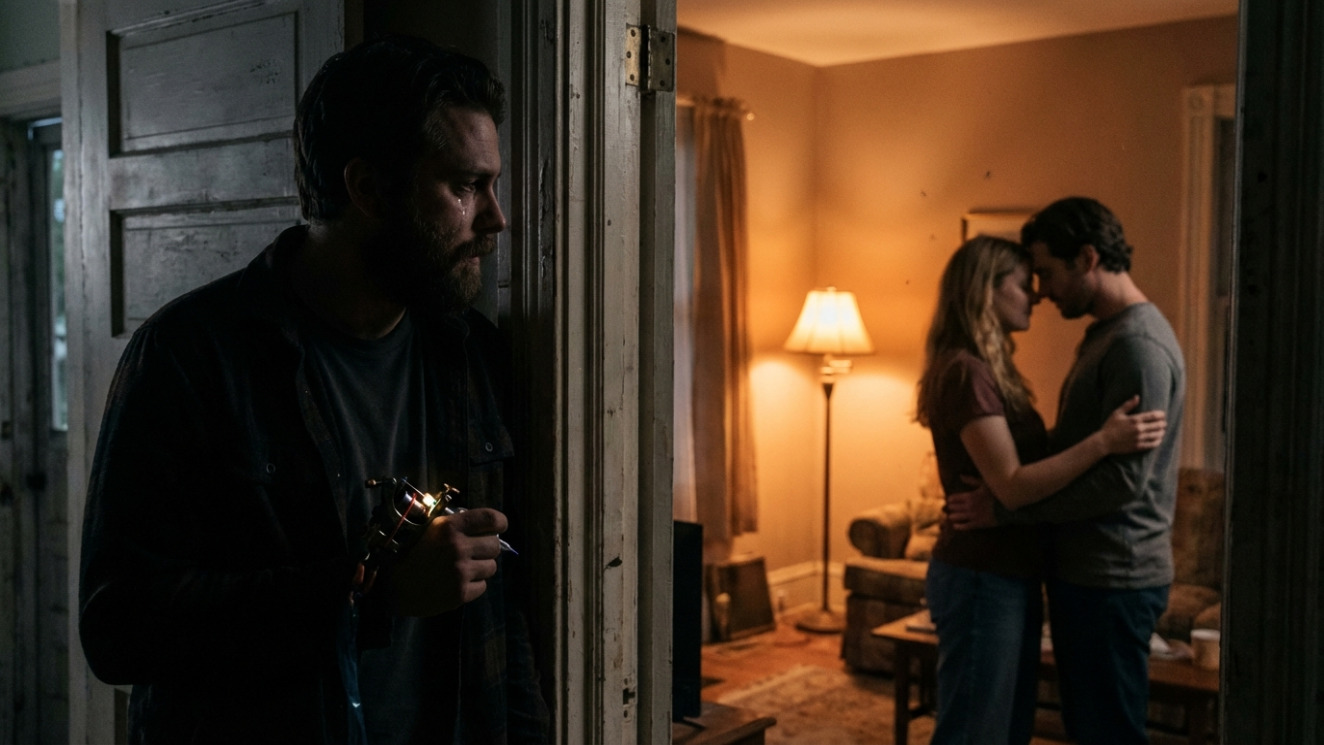
Wyatt hung up. He felt a strange, cold calm. He spent the next few hours preparing. He didn’t clean the shop this time. He let the dust settle. He set up his station—the machine, the ink, the needles. He placed a single chair in the center of the room, under the brightest light.
At seven-thirty, Clara arrived. She didn’t knock; she had her own key. She walked in and saw him sitting there, the machine buzzing in his hand as he tested the tension.
“”What are you doing, Wyatt?”” she asked, her voice trembling.
“”Ending it, Clara.””
“”Ending what? The house? The marriage?””
“”The lie. All of it.””
He looked at her, and for the first time in years, he didn’t see a reminder of Cody. He saw a woman he had failed. “”I’m sorry, Clara. For being a statue. For leaving you alone in that house.””
She stepped toward him, her eyes filling with tears. “”Wyatt, please. Let’s just go. We can leave tonight. We don’t need the house, we don’t need the club. We can just drive.””
“”We can’t drive away from this. It’s in the skin. It has to be worked out.””
“”Leo is dangerous, Wyatt. You don’t know what he’s capable of.””
“”I know exactly what he’s capable of. He’s a man who’s afraid of his own shadow. He’s been trying to be Cody for three years, but he’s just a cheap imitation.””
Wyatt stood up and walked to her. He took her hands in his. They were cold, despite the heat. “”Go to your mother’s house. Stay there tonight. If I’m not there by morning, take the metal box from under the back room floorboards and go to the police. There’s a detective named Miller. Give him the box.””
“”Wyatt, no—””
“”Go, Clara. Please. For once, just trust me.””
She looked at him for a long, agonizing moment, then leaned in and kissed him. It tasted of salt and desperation. Then she turned and ran out the door.
Wyatt sat back down and waited.
At eight o’clock, Leo’s truck pulled up. He didn’t stroll in this time. He walked with a heavy, measured step. He was wearing his leather vest, the patches gleaming in the shop light. He looked like a man prepared for war.
“”Where is she?”” Leo asked, scanning the room.
“”She’s gone, Leo. It’s just us.””
Leo sat in the chair Wyatt had prepared. He looked around the shop, his lip curling in a sneer. “”You think you’re gonna do something here, Wyatt? You think you’re gonna intimidate me in your little ink-stained hole?””
“”I’m not gonna intimidate you, Leo. I’m gonna give you what you’ve always wanted. I’m gonna give you the mark of the leader.””
Wyatt picked up the sketch he’d made—the map of the desert with the X. He held it up for Leo to see.
“”You know this spot, don’t you? It’s where the warehouse stuff was buried. The stuff Cody was gonna tell the feds about.””
Leo’s face went pale. “”How do you know about that?””
“”Cody didn’t just talk to the feds, Leo. He talked to me. He told me everything. He told me you were the one who pushed for the job, and you were the one who tipped off the Kings when you realized Cody was getting cold feet. You didn’t just let him die. You killed him.””
“”That’s a lie! You can’t prove that.””
“”I don’t need to prove it to a judge. I just need to prove it to the club. And I think they’ll find it very interesting that their ‘hero’ died because his own brother sold him out.””
Wyatt stepped closer, the machine buzzing—a low, menacing growl. “”But I’m not gonna tell them. Not if you do one thing for me.””
“”What?”” Leo asked, his voice cracking.
“”Take off your vest.””
Leo hesitated, then slowly unbuttoned the leather and let it drop to the floor. Underneath, his white t-shirt was damp with sweat.
“”Now sit still,”” Wyatt said. “”This is gonna be the most honest thing you’ve ever done.””
Wyatt didn’t use a stencil. He didn’t use a plan. He began to tattoo Leo’s chest, right over his heart. He worked with a violent, surgical precision. He didn’t draw a symbol of the club. He didn’t draw a name.
He tattooed a single word in bold, black letters: COWARD.
Leo tried to pull away, but Wyatt’s hand was like iron. “”Stay still, Leo. Or I’ll slip. And we both know what happens when a needle goes too deep.””
Leo whimpered, a small, pathetic sound that filled the shop. He sat there, trembling, as Wyatt marked him. The pain was real, the blood was real, and for the first time in three years, the truth was being written in a way that couldn’t be erased.
When Wyatt was finished, he stepped back. He wiped the blood from Leo’s chest and held up a mirror.
“”There it is,”” Wyatt said. “”Your new patch. You can wear the vest over it, you can hide it from the club, you can hide it from the world. But every time you look in the mirror, you’ll know. And every time you touch a woman, she’ll see it.””
Leo looked at the mirror, his face a mask of horror and rage. He stood up, grabbed his vest, and stumbled toward the door. He stopped at the threshold, looking back at Wyatt.
“”I’ll kill you for this,”” Leo whispered.
“”No, you won’t,”” Wyatt said. “”Because then the box under my floorboards goes to the police. And you’ll spend the rest of your life in a cell with that word on your chest. Now get out.””
Leo disappeared into the night. Wyatt sat in the silence, the machine finally still. He felt empty. He felt tired. But for the first time in a long time, he felt like he could breathe.
Chapter 6
The aftermath wasn’t a explosion; it was a slow, quiet leak.
Wednesday morning came with a pale, washed-out sun that didn’t provide any warmth. Wyatt was still at the shop. He hadn’t slept. He’d spent the night dismantling his station, packing his needles and his inks into a single large case.
He didn’t wait for the realtor. He called the number Leo had given him and left a message saying the deal was off, that the house wasn’t for sale, and that if anyone set foot on the property without his permission, he’d be waiting with a shotgun.
Then he rode home.
The house was quiet. Clara wasn’t there yet, but the scent of her perfume lingered in the hallway. Wyatt went to the kitchen and made a pot of coffee. He sat at the table and waited.
An hour later, her car pulled into the gravel driveway. She walked in slowly, looking like she expected to find the house in ruins. When she saw him sitting there, she stopped, her hand going to her throat.
“”Wyatt?””
“”He’s gone, Clara. He won’t be coming back. Not to you, and not to this house.””
She sat down across from him. “”What did you do?””
“”I gave him a reminder of who he is. He’s gonna have a hard time living with it.””
He told her then—everything. He told her about the warehouse job, about Cody’s plan to flip, and about what he’d done to Leo. He didn’t leave anything out. He didn’t try to make himself look like a hero. He just laid it all out on the table like a series of sketches.
Clara listened in silence, her face unreadable. When he was finished, she looked out the window at the dusty yard.
“”So Cody wasn’t who we thought he was,”” she said quietly.
“”None of us are, Clara. We’re all just trying to hide the parts of ourselves that don’t fit the story we want to tell.””
“”And what about us? What’s our story now?””
Wyatt reached across the table and took her hand. “”I don’t know. I think we need a new map. This one is too full of holes.””
The next few weeks were a blur of small, painful adjustments. Leo didn’t come back. Word got around the club that he’d had a “”falling out”” with Wyatt and had decided to take a leave of absence to clear his head. Some people suspected more, but in a world built on silence, no one asked too many questions. Miller, the old biker, stopped by the shop once, looked at Wyatt’s bandaged arm, and nodded.
“”Sometimes the skin needs to be peeled back to let the infection out,”” Miller said. He didn’t say anything else.
Wyatt and Clara stayed in the house. They didn’t move to the north side. They spent their weekends fixing the roof and replacing the old wiring. They didn’t talk about Cody much anymore. The white cross by the side of the road remained, but they stopped visiting it. The flowers eventually blew away, leaving only the sun-bleached wood.
Wyatt went back to work at Iron & Ink. He didn’t paint anymore, but he started taking on more custom work—pieces that weren’t from a book of flash. People started coming from other towns, hearing about the man who could capture a feeling in a line of ink.
One afternoon, a year after the night in the shop, Wyatt was closing up when a man walked in. He was older, with a tired face and hands that looked like they’d spent a lifetime in the sun.
“”I heard you’re the one to see if you want something that stays,”” the man said.
“”That’s what they say,”” Wyatt replied.
The man sat in the chair and pulled a folded piece of paper from his pocket. It was a drawing of a sidecar, empty and rusted, sitting in a field of sagebrush. It was the painting Wyatt had scraped the faces off of.
“”I found this at an estate sale in Tonopah,”” the man said. “”The guy who was selling it said it was junk, but I couldn’t stop looking at it. I want you to put it on my back. But I want you to put two people in the background. Just silhouettes. No faces.””
Wyatt looked at the drawing. He remembered the anger he’d felt when he’d painted it, the sharp, jagged edge of the betrayal. But looking at it now, it just felt like a memory. A piece of skin that had healed over a wound.
“”I can do that,”” Wyatt said.
He set up his station, the familiar buzz of the machine filling the room. He worked for hours, the needle moving rhythmically across the man’s skin. He felt the weight of the story, the way it lived in the ink and the blood.
When he was finished, the man looked in the mirror and nodded. “”It’s perfect. It looks like… it looks like something that’s finally finished.””
Wyatt watched the man walk out, his boots clicking on the pavement. He locked the door and turned off the lights. He stood in the dark for a moment, listening to the Nevada wind. It didn’t sound like a ghost anymore. It just sounded like the wind.
He walked to his bike, the Dyna he’d rebuilt so many times. He mounted it, feeling the heat of the engine between his legs. He didn’t go straight home. He rode out toward the Old Vegas road, toward the spot where the desert was wide and the sky was big enough to hold everything.
He stopped the bike at the edge of the highway and looked out at the mountains. They were dark against the twilight, old and indifferent to the small, messy lives of the people below.
He reached into his pocket and pulled out the small metal box. He opened it and took out the photograph of him and Cody. He looked at it one last time, then he struck a match.
He watched the flame eat the edges of the photo, turning the grease and the pride into ash. When the fire reached his fingertips, he let it go. The wind caught the charred remains and scattered them across the sagebrush.
He got back on his bike and turned back toward town. He wasn’t riding away from anything. He was just riding.
He thought about Clara, waiting at home with a pot of coffee and a book. He thought about the shop, the smell of the soap and the ink. He thought about the skin—how it heals, how it scars, and how it carries the marks of everything we’ve survived.
He twisted the throttle, the engine roaring in the quiet night, and for the first time in three years, Wyatt Reed wasn’t a ghost. He was just a man, riding home through the dust.
The final sentence of his story wasn’t written in ink, but in the steady hum of the highway beneath his wheels—a rhythm that didn’t ask for loyalty, only for the strength to keep moving forward.”