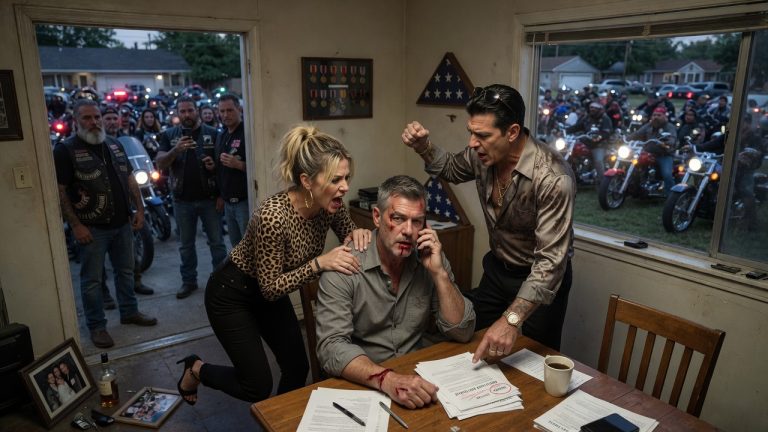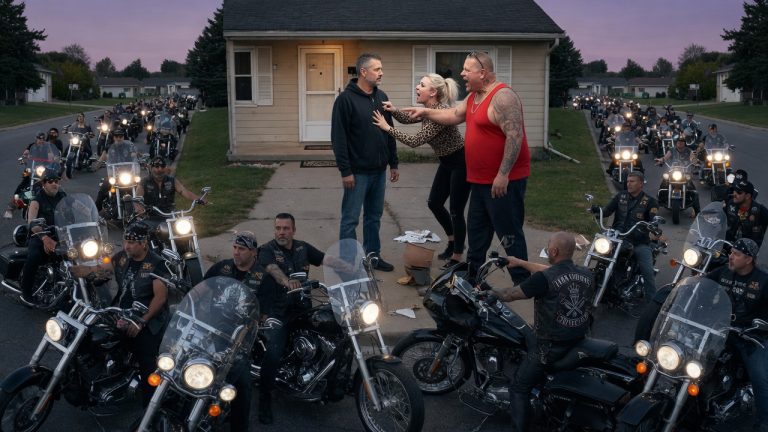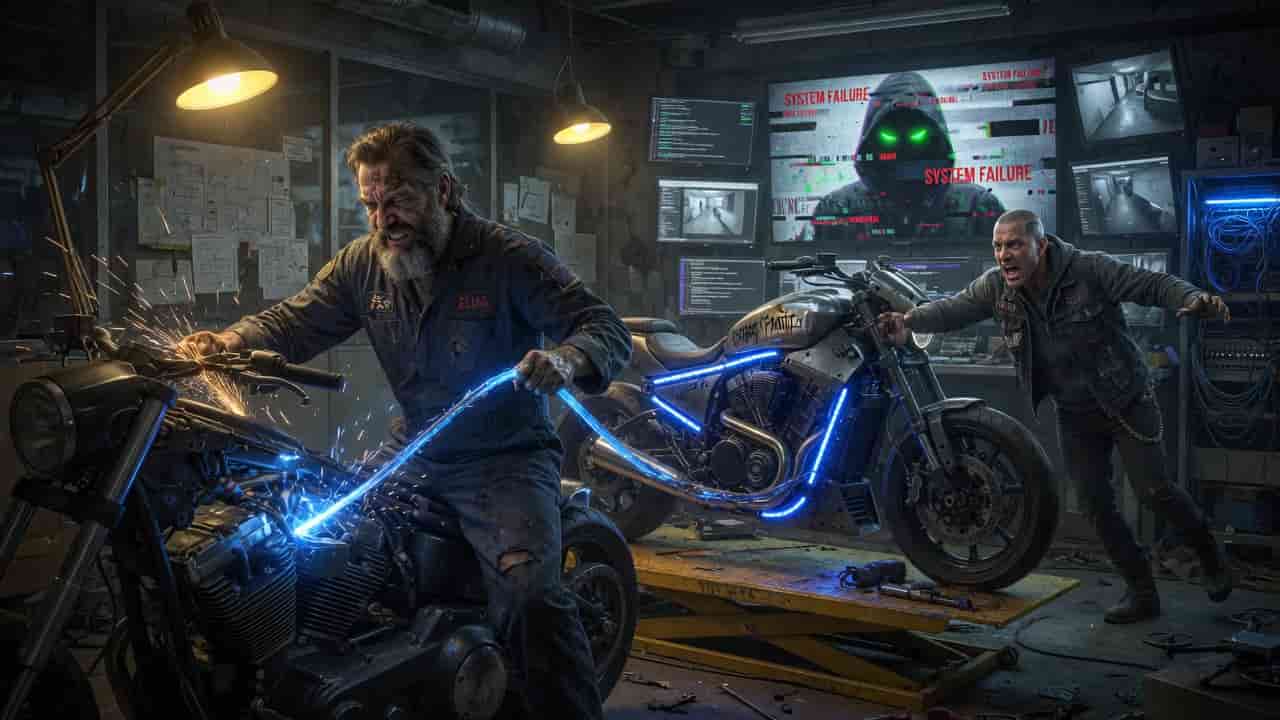
“He isn’t breathing, Jax! Look at the machine—it’s doing all the work!”
Elias didn’t care about the rules of the 999. He didn’t care about the patches, the brotherhood, or the myth of the man they called Static. He only cared about the way a piston should fire and the way a man’s weight should shift in a turn. For three years, he’d watched Static lead the pack through the graveyard shifts of Silicon Valley, and for three years, something had felt… wrong.
The riding was too perfect. The lean was too calculated. It wasn’t the movement of a man with a pulse; it was a mathematical equation on two wheels.
When Elias finally cornered the “Legendary Bike” in the back of the clubhouse, he didn’t find a warrior. He found a motherboard.
“Don’t touch that, Elias,” Jax warned, his hand moving to his belt. “The Boss doesn’t like people messing with his tech.”
“Your boss isn’t here, Jax. He’s never been here.”
With one violent tug, Elias ripped the data cable from the bike’s heart. The lights died. The engine hissed. And then, the voice came over the speakers—not the deep, distorted growl of a biker king, but the terrified, cracking sob of a child.
“Please,” the voice whimpered. “You’re breaking my dad.”
The whole room went cold. Jax froze. The legend was dying, and the truth was far more heartbreaking than any of them could have imagined.
Chapter 1: The Ghost in the Chrome
The fog didn’t just roll into East Palo Alto; it crawled, heavy with the smell of salt from the Bay and the metallic tang of the tech campuses that loomed on the horizon like glass fortresses. Down here, in the cracks where the pavement was more weed than asphalt, the 999 didn’t worry about the law. They worried about the rhythm.
Elias sat on a rusted milk crate outside “The Ground Loop,” a bar that had been a dive when the first microchips were being etched and was now a tomb for those who couldn’t afford a zip code in San Jose. He held a lukewarm coffee in hands that had never been entirely clean of 10W-40 since the Ford administration. His joints ached with the coming damp, but he didn’t move. He was waiting for the sound.
It started as a hum—a high-frequency vibration that rattled the loose glass in the bar’s window. Then came the bass, a rhythmic thrumming that felt like a second heartbeat.
“Here they come,” Jax muttered, stepping out from the shadows of the doorway. Jax was the club’s Enforcer, a man whose neck was wider than his head and whose loyalty was a physical weight he carried in his chest. He looked at his watch. “Twelve-oh-one. On the second.”
Elias didn’t look at Jax. He looked at the bend in the road where the streetlights had been shot out years ago.
First came the scouts, twelve bikes in a tight diamond formation, their chrome reflecting the dim amber glow of the distant city. Then, the main body—hundreds of them, a river of leather and steel, moving with a synchronized discipline that felt more like a military parade than a biker run. The 999. Nine hundred and ninety-nine men, bound by a patch and a secret.
But it was the man at the front who held the air in the room.
Static.
He rode a matte-black beast that seemed to swallow the light around it. He wore a heavy, hooded tactical jacket, his face always obscured by a darkened visor that reflected nothing. They called him Static because he never spoke in person. His orders came through encrypted channels, his voice a distorted, electronic growl that echoed in the riders’ earpieces. He was the man who had unified the fractured gangs of the Valley, turned them into a logistics empire that moved “sensitive data” in hard drives across state lines faster than any fiber-optic cable.
As Static swept past the bar, the bike leaned into the turn.
Elias narrowed his eyes. He’d been a mechanic for forty-five years. He knew the physics of a motorcycle better than he knew the names of his own children. He knew how a man’s hips should shift to counter the centrifugal force. He knew the micro-adjustments of the wrist on the throttle.
Static didn’t shift. He didn’t adjust. The bike moved with a terrifying, fluid perfection. It didn’t look like a man riding a machine; it looked like a single organism directed by a god.
“Look at him,” Jax whispered, a note of genuine awe in his voice. “That’s not a man. That’s a legend.”
“It’s a ghost,” Elias said, his voice like gravel.
Jax turned, his brow furrowing. “What’s that supposed to mean?”
“A man makes mistakes, Jax. A man has a heavy side. A man flinches when a pebble hits the fender. He’s been riding for three years, and I’ve never seen him clip a curb or miss a gear. Not once.”
“Maybe he’s just that good,” Jax snapped. “He saved this club. He gave us a purpose. Before him, we were just brawling over scrap metal and territory. Now? We’re the backbone of the Valley. People respect the 999.”
Elias stood up, his knees popping. He watched the tail-lights of the formation vanish into the fog. “Respect is for people you can look in the eye, Jax. Fear is for the things you can’t.”
He walked back into the garage area of the bar, a space he’d claimed as his own. It was filled with the skeletons of old Harleys and Triumphs, the things he understood. But in the center of the room, on a clean, white-tiled dais, sat the prototype. Static’s backup bike.
No one was allowed to touch it. No one but Elias was allowed to even clean it.
He approached the machine. It was a marvel of engineering. The frame was carbon fiber, the engine a hybrid of high-output internal combustion and electric torque. But it was the wiring that bothered him. Thick bundles of blue fiber-optic cables snaked through the guts of the bike, disappearing into the fuel tank and the seat.
Static had told them it was “telemetry.” A way to record his runs for the “archives.”
Elias reached out, his rough fingers hovering over a sensor on the handlebars. He’d seen the way Static’s hands moved during the run tonight. They didn’t grip. They rested.
A shadow fell over the bike.
“Elias.”
It was the voice. The electronic, digital rasp of Static, coming from the wall-mounted speakers in the garage.
Elias didn’t jump. He’d grown used to the surveillance. Static was always watching. Static was the walls, the cameras, the very air of the Ground Loop.
“Yeah, I’m here,” Elias said, not looking up.
“The run was successful. The package is delivered. Why are you staring at my spare?”
“Just checking the tension on the drive belt,” Elias lied. He knew the AI—or whatever was behind that voice—could detect a lie in the pitch of a human voice. He kept his tone flat.
“The drive belt is optimal,” Static said. the distortion on the voice felt heavier tonight, like a radio station losing its signal. “Go home, Elias. You’re old. You need sleep.”
“I’ll sleep when the work’s done,” Elias muttered.
“The work is never done. The 999 is a machine. And machines don’t sleep.”
The speakers clicked off.
Elias waited for the hum of the cameras to change, the slight shift in the infrared light that told him the focus had moved. He stayed still for ten minutes, his hand resting on the matte-black tank.
He felt a vibration. Not from the engine. Not from the road.
It was a tiny, rhythmic ticking coming from inside the fuel tank.
Tick. Tick. Tick.
Like a clock. Or a heart.
Elias leaned closer, his ear against the cold metal. Beneath the ticking, he heard something else. A faint, high-pitched whirring. The sound of a cooling fan. A computer fan.
He straightened up, his heart hammering against his ribs. He looked toward the back of the bar, toward the heavy steel door that led to the basement. The “Server Room,” Static called it. The place where the data was processed. Only Jax and a few “Techs” were allowed in there.
Elias looked at his hands. They were shaking.
He wasn’t just a mechanic. He was a father who had lost a son to the same streets these men rode on. He knew what grief looked like when it was dressed up in leather and chrome. And he knew that the man leading the 999 wasn’t a man at all. He was a lie.
And Elias was the only one who knew how to take it apart.
Chapter 2: The Boy Behind the Curtain
Twenty feet below the oil-stained floorboards of the Ground Loop, the air was different. It was cold, recycled, and smelled of ozone and expensive silicone.
Leo sat in a high-backed ergonomic chair that was far too large for his fourteen-year-old frame. His legs, thin and pale, dangled several inches above the floor. A pair of oversized noise-canceling headphones was clamped over his ears, piping in the sound of a roaring V-twin engine and the wind-rush of the 101 freeway.
Before him was a semi-circle of twelve monitors. They glowed with telemetry data, GPS maps, and infrared camera feeds from the helmet of a suit that sat empty on a mannequin in the corner of the room.
On the center screen, a 3D wireframe of a motorcycle leaned into a virtual turn. Leo’s hands were not on a steering wheel, but on a pair of haptic-feedback joysticks. His fingers moved with a frantic, twitchy grace.
“Ninety-two percent efficiency,” Leo whispered, his voice cracking. He reached up and wiped sweat from his forehead with the back of a sleeve that was frayed at the wrist. “The wind shear on the bridge was higher than predicted. Come on, Dad. Adjust.”
He tapped a sequence on a secondary keyboard. On a monitor to his left, a window opened labeled: PROJECT STATIC: PERSONALITY OVERLAY.
A waveform appeared. It was a recording of a man’s voice—deep, warm, and full of the rough humor of a life lived on the road.
“Don’t overthink the curve, Leo. You feel the road, you don’t calculate it. The bike knows where it wants to go. You’re just the one who gives it permission.”
Leo closed his eyes for a second, letting the voice wash over him. Then he clicked a button. The waveform was processed through a distortion filter, crushed and digitized until it became the terrifying, inhuman growl of Static.
“The curve is an equation. Precision is permission.”
“I’m trying, Dad,” Leo said to the empty room. “I’m keeping it together. I’m keeping them all together.”
He’d been doing this for three years. Since the night the real Static—his father, Marcus—hadn’t come home from a run. Marcus hadn’t died in a crash; he’d been taken by a rival crew, a group of “disruptors” who wanted the 999’s routes. They’d found his bike, but they’d never found him.
Leo had been twelve then. He was already a prodigy, a kid who’d been building servers since he was eight while his father taught him how to change a tire. When the 999 started to fracture after Marcus’s disappearance, when the men started talking about war and blood, Leo had done the only thing he could think of.
He’d finished his father’s last project. The “Ghost-Drive.”
It was supposed to be an assisted-riding system for older bikers, a way to keep them safe as their reflexes dimmed. Leo had turned it into a remote-control rig. He’d built an AI based on his father’s riding data, his voice, his tactical decisions. He’d put a mannequin in the suit, a computer in the tank, and he’d become the ghost.
It had worked. The 999 thought their leader had become something more than human. They thought Static was a visionary who had evolved. They followed the machine because the machine never failed.
But Leo was failing.
A red light began to pulse on the far right monitor.
CAUTION: HYDRAULIC PRESSURE DEVIATION – UNIT 01.
“No, no, no,” Leo hissed. He pulled up the camera feed from the garage. He saw Elias standing over the spare bike.
Elias. The old man who looked at the world as if it were a puzzle that needed solving.
Leo watched through the infrared camera as Elias leaned his ear against the tank. He saw the old man’s face pale.
“He knows,” Leo whispered. He felt a cold spike of panic in his gut. “He knows I’m here.”
Leo reached for the microphone. He toggled the voice-modulator.
“Elias.”
He watched the mechanic on the screen. The old man didn’t flinch. He just stood there, his hand on the metal.
“Go home, Elias. You’re old. You need sleep.”
Leo’s hand was shaking on the mic. He was a 14-year-old boy in a basement, talking to a man who had been a father figure to him before the world fell apart. He wanted to scream. He wanted to tell Elias that his legs were paralyzed from the waist down because of the accident that had nearly killed him and his father five years ago. He wanted to tell him that he was lonely, that the only “people” he talked to were lines of code and the 999 men who only saw him as a digital god.
But if he told the truth, the 999 would vanish. They were men of pride and violence. If they realized they were being led by a crippled child using a puppet-show, they wouldn’t just leave. They’d burn the Ground Loop to the ground. They’d kill Jax for helping him hide it. They’d kill Leo for the humiliation of it.
The screen flickered. A notification popped up in the corner of the main display.
INCOMING TRANSMISSION: THE GHOST-BREAKER.
Leo’s breath hitched. It was the hacker. The one who had been probing the 999’s firewall for months.
“I see you, little ghost,” the message read. “I see the wire. I see the lie. 999 men are a lot of witnesses for a funeral. How much is the truth worth?”
Leo deleted the message, his heart thudding. He looked at the mannequin in the corner. The empty visor stared back at him.
“I’m doing this for you, Dad,” Leo whispered. “I’m keeping the name alive.”
He looked back at the monitor. Elias was still there. The old man hadn’t moved. He was looking directly into the camera lens, as if he could see through the layers of glass and steel, through the algorithms and the filters, and see the scared boy sitting in the dark.
Leo reached out and touched the screen, his fingertips brushing the image of Elias’s face.
“Don’t break him,” Leo pleaded silently. “Please. He’s all I have left.”
He turned back to the controls. The 999 were preparing for another run—a high-stakes delivery of encrypted servers for a client in the hills. If the bike failed tonight, if the algorithm stumbled, the legend would die.
And Leo would be alone in the dark.
Chapter 3: The Fracture
The clubhouse of the 999 was a cathedral of exhaust and toxic masculinity. It was a converted warehouse attached to the Ground Loop, filled with long tables, pool tables that were never leveled, and a bar that served only two types of beer: cheap and colder.
Tonight, the air was thick with more than just cigarette smoke. It was thick with doubt.
Jax stood at the head of the main table, his arms crossed over his massive chest. Around him sat the lieutenants—men with names like Iron, Gravel, and Sledge. They were the muscle of the operation, the ones who kept the 999’s “logistics” running smoothly.
In the center of the table was a large, flat-screen monitor mounted to a rolling stand. It was currently showing a topographic map of the Santa Cruz mountains.
“Static says we take the Old Creek road,” Jax said, his voice booming. “The highway is too hot with CHP tonight. We move in three waves. No lights until we hit the ridge.”
“Old Creek?” Sledge spat, leaning forward. He was an older man, his face a map of scars from a hundred bar fights. “That road is a death trap at night. It hasn’t been paved since the 90s. The curves are tight, and there’s no shoulder. Static wants us to run that at seventy?”
“Static doesn’t ‘want’ us to do anything,” Jax countered. “Static knows the route. He’s already run the simulations. The math says it’s the safest path.”
“The math?” Sledge laughed, a bitter, dry sound. “I’m not a goddamn equation, Jax. I’m a man on a bike. My tires don’t care about simulations. They care about gravel and moisture.”
He looked around the table, seeking support. “And where is he? Why isn’t he here telling us this? Why is he always behind a screen? I’ve been in this club twenty years. I followed Marcus because Marcus bled with us. This guy? He’s a voice in a box.”
The room went silent. This was the fracture. The gap between the old guard who remembered the man and the new guard who worshipped the myth.
“Static is the reason you’re not in a state pen right now, Sledge,” Jax said, his voice dropping to a dangerous low. “Static is the reason your kids have health insurance. You want to question the lead? Question it to his face.”
Jax reached out and tapped a command on his tablet.
The screen flickered. The map disappeared, replaced by the hooded silhouette of Static. The speakers hummed with that low, subsonic vibration that always preceded his voice.
“Sledge.”
The name echoed through the warehouse. Sledge stiffened, his hands clenching on the table.
“You speak of blood and dirt. You speak of the old ways. But the old ways led to Marcus’s disappearance. The old ways were sloppy. The old ways were predictable.”
“Predictable is better than being a ghost,” Sledge growled, though his voice lacked its previous bravado.
“Is it? You have a daughter, Sledge. Sarah. She’s at San Jose State. Biology major. You want her to be predictable? Or do you want her to be safe?”
The silence that followed was absolute. Sledge’s face went pale, then a deep, mottled red.
“You stay away from her,” he whispered.
“I am the reason no one knows who her father is, Sledge. I am the firewall between your life and your work. If you cannot follow the rhythm, you are a vibration the machine must eliminate.”
“Are you threatening me?” Sledge stood up, his chair scraping harshly against the floor.
“I am stating a fact. The run starts at 01:00. If you are not on your bike, your patch is stripped. Your accounts are frozen. And the firewall… drops.”
The screen went black.
Jax looked at Sledge. There was no pity in his eyes. Only the cold, hard logic of the 999. “You heard the boss. Get your gear.”
Sledge stood there for a long moment, his chest heaving. He looked like a man who wanted to scream, to hit something, to tear the screen off the wall. But he didn’t. He turned and walked out of the room, his shoulders slumped.
Elias watched from the corner, leaning against a stack of tires. He saw the residue of the exchange—the way the other men looked at their boots, the way the atmosphere in the room had shifted from brotherhood to something closer to an occupation.
He followed Jax out into the hallway.
“That was cold, Jax,” Elias said. “Using the man’s kid against him? That’s not how Marcus did things.”
Jax stopped, his back to Elias. He stayed silent for a long time. When he turned around, the mask of the Enforcer had slipped just a fraction. There was a look of exhausted desperation in his eyes.
“It’s the only way, Elias,” Jax whispered. “The club is falling apart. Everyone’s looking for a reason to jump ship. If Static doesn’t look strong, if he doesn’t look like he knows everything… we’re dead. All of us.”
“And what happens when the lie gets too big to carry?” Elias asked. “What happens when Sledge realizes that Static isn’t a god? He’s just a bully with a computer?”
“Static isn’t a bully,” Jax snapped. “He’s a kid trying to survive.”
He stopped, his eyes widening as he realized what he’d said.
Elias stood very still. The last piece of the puzzle clicked into place. The ticking in the tank. The high-pitched voice he’d heard through the door. The way the bike moved with the reflexes of a gamer, not a rider.
“A kid,” Elias repeated. “Marcus’s boy. Leo.”
Jax looked around frantically, making sure the hallway was empty. He grabbed Elias by the front of his jumpsuit and shoved him back against the wall.
“You didn’t hear that,” Jax hissed. “You don’t know anything. If you say a word—to anyone—I’ll make sure you never pick up a wrench again. Do you understand?”
Elias looked at Jax, and for the first time in years, he felt a deep, piercing pity. Jax wasn’t a villain. He was a man trying to protect a ghost.
“I’m not the one you should be worried about, Jax,” Elias said softly. “There’s someone else. A hacker. They’re in the system. They know about the boy.”
Jax’s grip loosened. His face went grey. “What?”
“I’ve seen the logs,” Elias said. “I’m a mechanic, Jax. I know when a machine is being tampered with. The ‘Ghost-Breaker’ is coming for him. And if you don’t let me in there, if you don’t let me help him fix that bike… he’s going to crash. For real this time.”
Before Jax could answer, a siren wailed from the garage.
The run had started early. But it wasn’t the scouts.
Static’s bike was moving. Alone.
The matte-black beast was rolling out of the garage, the kickstand retracting on its own. It wasn’t a man riding it. It was the mannequin, its visor reflecting the harsh fluorescent lights.
But the riding wasn’t perfect. The bike was jerking. The front wheel was wobbling.
From the speakers, Leo’s voice came through—not distorted, not modulated. A raw, panicked scream.
“Jax! I can’t stop it! Someone else is in the drive! Jax, help!”
The bike accelerated, its engine screaming as it tore out into the fog, heading straight for the mountain road.
Chapter 4: The Exposure
The garage was a chaos of red emergency lights and the smell of ozone.
“Lock the doors!” Jax screamed, his voice cracking with a panic that the 999 had never heard from him. “Nobody in! Nobody out!”
But the men were already pouring out of the clubhouse. They saw the “Leader” on his bike, weaving erratically down the access road. They saw the sparks flying from the rear tire as the traction control fought a war with an invisible intruder.
“What’s wrong with him?” Sledge shouted, grabbing a helmet. “Is he hit? Did someone take a shot?”
“Stay back!” Jax roared, blocking the exit.
Elias didn’t wait for permission. He ran for the “Spare” bike, the one on the dais. He knew the architecture now. He knew that the spare was slaved to the main unit—a redundant system meant to take over if the primary failed.
He jumped onto the bike. He didn’t have a key. He didn’t need one. He grabbed a screwdriver from his pocket and jammed it into the ignition housing, twisting. The bike didn’t start with a roar; it hummed with a digital whine.
“Elias, what are you doing?” Jax yelled, lunging for him.
“I’m going to cut the signal!” Elias shouted back. “If I can get close enough, I can bridge the connection and shut it down manually!”
“You can’t ride that thing! It’s all fly-by-wire!”
“Then I’ll fly it!”
Elias kicked the bike into gear. The haptic feedback in the handlebars fought him, trying to force his hands into a “optimal” position. He fought back, his old, scarred muscles straining against the motors. He tore out of the garage, the cool night air hitting his face like a slap.
He could see Static’s bike half a mile ahead, its tail-light a frantic red pulse in the fog. It was moving toward the Old Creek bridge—a narrow, rusted span over a hundred-foot drop.
Elias pushed the throttle. The bike surged with a terrifying, instantaneous torque. He felt the machine trying to calculate the road for him, but he ignored the HUD flashing on the windscreen. He rode like a man who had learned on dirt tracks and gravel pits. He rode with his gut.
He drew closer. He could see the mannequin in the suit, its head lolling unnaturally with every jerk of the handlebars.
“Leo!” Elias screamed into the comms unit he’d snatched from the workbench. “Leo, can you hear me? It’s Elias!”
A burst of static, then the boy’s voice, thin and terrified. “Elias? I can’t… it’s not me! Someone’s rewritten the collision avoidance! It’s aiming for the rail!”
“Listen to me, son! I’m right behind you! I’m going to pull alongside. You have to give me manual override!”
“I can’t! They’ve locked the root directory! I’m shut out!”
Elias looked at the bridge. It was two hundred yards away. The black bike was accelerating, the AI—or the hacker—forcing it into a suicide run.
Elias leaned into the wind, his jumpsuit whipping around him. He pulled alongside the “Legend.” Up close, it was horrifying. The suit was stiff, the “man” inside nothing but carbon fiber and padding.
He reached out his right hand, steering with his left. He needed to find the emergency bypass—the blue cable he’d seen in the garage. It was tucked behind the fairing.
“Elias, watch out!” Leo’s voice screamed.
A black SUV tore out from a side road, its headlights blinding. It slammed into the side of Elias’s bike.
The world tilted. Elias felt the bike slide out from under him. He hit the asphalt hard, the friction burning through his jumpsuit, the smell of melting nylon and skin filling his nose. He tumbled, the world a blur of grey road and black sky.
He stopped ten feet from the bridge railing. His bike was a wreck of twisted metal and sparking wires fifty feet back.
Static’s bike was at the edge of the bridge. It had stopped, the front wheel dangling over the precipice. The mannequin sat perfectly still.
The SUV stopped. A man stepped out—a young guy in a designer suit, holding a laptop. He looked at the bike, then at Elias.
“Impressive riding, old man,” the hacker said, his voice smooth and devoid of empathy. “But you can’t fight the future with a wrench.”
He tapped a key on his laptop.
The bike’s engine began to rev. The rear tire began to spin, smoking against the wet pavement. It was preparing to launch itself over the edge.
“No!” Leo’s voice came over the bike’s external speakers. “Please! Don’t do this! My dad is in there!”
The hacker laughed. “Your dad is a ghost, kid. And ghosts belong in the ground.”
Elias struggled to his feet, his breath coming in ragged gasps. His left arm was useless, hanging at a strange angle. He looked at the bike. He looked at the hacker.
“He’s just a boy,” Elias rasped, blood trickling down his beard. “He’s just a kid who wanted his father back.”
“He’s a vulnerability,” the hacker said. “And I’m a disruption.”
He raised his finger over the ‘Enter’ key.
Suddenly, a roar echoed from the road behind them.
Nine hundred and ninety-nine lights cut through the fog.
The pack had arrived. Jax was at the front, his face a mask of fury. Sledge was right behind him.
They saw Elias on the ground. They saw the SUV. And they saw the bike at the edge of the bridge.
The hacker’s eyes widened. He looked at the sea of leather and steel descending on him. He turned back to his laptop, his fingers flying. “Doesn’t matter. The legend dies tonight.”
He hit the key.
The bike lunged forward.
But Elias had already moved. He’d crawled across the pavement, his one good hand reaching for the blue cable hanging from the underside of the bike.
He gripped it. He yanked.
Sparks erupted, blindingly bright. The bike’s headlights flickered and died. The engine cut out.
The bike tilted. The front wheel slipped off the edge.
Elias lunged, his body hitting the cold matte-black metal. He wrapped his arms around the bike’s frame, his weight anchoring it to the bridge.
“He isn’t breathing, Jax!” Elias screamed as the 999 riders skidded to a halt around them. “Look at the machine—it’s doing all the work!”
Jax jumped off his bike, sprinting toward them. He grabbed the rear of the bike, helping Elias pull it back from the edge.
The hacker tried to run for the SUV, but Sledge was already there. He didn’t use a weapon. He used his bike, blocking the door, his engine revving in a terrifying, metallic threat.
The silence that followed was heavy. The only sound was the wind whistling through the bridge’s rusted struts and the ticking of the cooling engines.
Elias sat on the pavement, his back against the “Legendary” bike. He looked at the mannequin. He reached up and flipped the visor.
Empty.
The 999 men stood in a circle, their headlights illuminating the hollow shell of their god.
A small, tinny sound came from the speakers. It was Leo. He was crying.
“I’m sorry,” the boy sobbed. “I just… I didn’t want him to be gone. I didn’t want to be alone.”
Sledge stepped forward, his face unreadable. He looked at the empty suit, then at Jax.
“You knew,” Sledge said.
Jax looked at the ground. “I knew.”
Sledge turned to Elias. “And you?”
“I knew it was a lie,” Elias said, his voice tired. “But I knew the heart was real.”
Sledge looked back at the bike. He reached out and touched the matte-black tank. He felt the vibration of the computer fans dying down.
He looked at the 999 men. The legend was dead. The god was a mannequin. The empire was built on the grief of a fourteen-year-old boy.
“Where is he?” Sledge asked.
“The basement,” Jax whispered. “Under the bar.”
Sledge nodded. He looked at the hacker, who was being held by two of the scouts. “Give him to the cops. He’s not worth the gas.”
He turned to his bike. “The rest of you… go home. The run is over.”
“What about the club?” Iron asked. “What about Static?”
Sledge looked at the “Legend” one last time.
“Static is dead,” Sledge said. “But the boy is still alive.”
He kicked his bike into life and turned back toward the city. One by one, the lights of the 999 followed him, leaving Elias and Jax alone on the bridge with the hollow ghost of their king.
Elias looked at the blue cable in his hand. He looked at the sparks still dancing in the engine block.
“We have to go to him, Jax,” Elias said. “He’s scared.”
“He’s more than scared, Elias,” Jax said, helping the old man up. “He’s finally real.”
They left the bike on the bridge, a monument of chrome and lies, and headed back into the fog to find the boy who had built a god.
Chapter 5: The Weight of the Basement
The ride back from the Old Creek bridge was the loudest silence Elias had ever experienced. Usually, when the 999 moved together, the air was charged with a predatory electric hum, a collective arrogance that made the world feel small. Tonight, the roar of the engines sounded hollow, like wind whistling through a graveyard. Sledge led the pack, his back rigid, never once checking his mirrors. Jax rode beside the “Legendary” bike, which was now strapped onto the back of a recovery trailer, its matte-black frame covered in a tarp like a corpse.
Elias sat in the passenger seat of the truck towing the trailer, his left arm wrapped in a makeshift sling and his ribs screaming every time the tires hit a pothole. He watched the back of Jax’s head through the rear window. The Enforcer hadn’t spoken a word since they’d pulled the bike back from the ledge. He looked smaller somehow, the bulk of his leather vest no longer signifying power, but a heavy, useless armor.
They reached the Ground Loop just as the first grey light of dawn began to bleed through the Silicon Valley smog. The bar looked different in the morning light—uglier, more honest. The neon signs were flickered out, and the peeling paint on the siding looked like dead skin.
Sledge killed his engine and sat there for a long minute, his hands still gripping the handlebars. The rest of the men followed suit, one by one. There was no joking, no talk of the night’s haul, no ritualistic beer-cracking. Nine hundred and ninety-nine men—or at least the thirty who had seen the truth on the bridge—stood in the parking lot, waiting for the reality to settle.
“Inside,” Sledge said finally. It wasn’t a command; it was a groan.
They didn’t go to the clubhouse. They went to the bar, and then, led by Jax, they moved toward the heavy steel door in the back. Jax fumbled with the keycard, his fingers trembling so much he missed the slot twice. Sledge watched him, his eyes hard and glassy.
When the door finally hissed open, the cold air of the server room spilled out. It smelled of ozone, expensive plastic, and the faint, sweet scent of a half-eaten bag of gummy worms.
They descended the stairs. The clatter of heavy biker boots on the metal grating sounded like a machine gun. At the bottom, in the center of the glow from a dozen monitors, sat the chair.
Leo was there. He hadn’t moved. He was still wearing the noise-canceling headphones, though they were around his neck now. He looked tiny. In the harsh fluorescent light, his skin was the color of unbaked dough, and his eyes were rimmed with red from crying and caffeine. His wheelchair was tucked under the desk, the specialized haptic joysticks he’d used to lead the 999 still shimmering with the last traces of data.
The boy looked up as the wall of leather and muscle filled his room. He didn’t cower. He just stared, his chest heaving under a faded “NASA” t-shirt.
Sledge stopped three feet from the desk. He looked at the monitors, at the wireframe models of the bikes, at the voice-modulator software with the label “STATIC” at the top of the window. Then he looked at Leo’s legs, thin and motionless in his sweatpants.
The silence stretched, thick and suffocating.
“Three years,” Sledge said. His voice was a low, dangerous rumble. “For three years, I took orders from a kid who hasn’t even hit his growth spurt.”
Leo swallowed, his throat clicking in the quiet room. “I did what my dad started. I kept the routes open. I kept the money coming in.”
“You threatened me,” Sledge said, stepping closer. The air in the room seemed to vanish. “You sat in this air-conditioned hole and threatened my daughter. You told me you’d drop the firewall. You told me you were the one keeping her safe.”
“I was,” Leo whispered. “The data… the encryption… it worked. No one touched her. No one even knew who you were.”
Sledge slammed his hand down on the desk, the sound echoing like a gunshot through the server racks. A half-empty can of soda tipped over, the dark liquid seeping across a motherboard.
“It wasn’t you!” Sledge roared. “It was a machine! You’re just a kid playing a game with our lives! We’re out there bleeding, dodging the CHP, fighting for every inch of pavement, and you’re down here… what? Leveling up?”
“It wasn’t a game!” Leo screamed back, his voice cracking, the raw, high pitch of a child finally breaking through. “Do you think I wanted this? Do you think I like sitting in the dark while the rest of the world goes by? I sat here because if I didn’t, my dad would have been forgotten. If the 999 fell apart, he died for nothing!”
“Marcus didn’t die for a puppet show!” Sledge yelled.
“Marcus is the one who built the code!” Jax interrupted, stepping between Sledge and the boy. His voice was desperate. “Sledge, listen. Marcus knew his body was giving out. He knew the club was getting too big, too exposed. He wanted to build something that couldn’t be killed. He wanted to build an icon.”
“He built a lie, Jax,” Sledge said, turning his fury on the Enforcer. “And you fed it to us. Every run, every meeting. You looked us in the eye and told us the Boss was watching. You let us think we were part of something… something evolved. You made us look like fools.”
This was the residue Elias had feared. It wasn’t just the betrayal of the secret; it was the humiliation of the men. These were men whose entire identities were built on a specific brand of rugged, independent power. To realize that their “visionary leader” was a fourteen-year-old boy in a wheelchair was a social death sentence.
Elias stepped forward, his boots clicking softly on the floor. He put a hand on Sledge’s shoulder. Sledge flinched, but didn’t pull away.
“Look at the room, Sledge,” Elias said quietly. “Look at the work.”
He pointed to the screens. The complexity was staggering. Thousands of hours of coding, of mapping, of tactical analysis. It wasn’t the work of a child playing a game; it was the work of a genius trying to bridge the gap between his own broken body and the legacy of a father who had been the only thing he had.
“He didn’t just play a game,” Elias continued. “He protected nine hundred and ninety-nine men. He moved millions of dollars of data without a single arrest. He handled the logistics better than any man I’ve ever seen. Yeah, it was a lie. But the protection was real. The money was real. The fact that you’re standing here instead of in a cell is real.”
Sledge looked at Elias, then back at Leo. The anger was still there, but it was being crowded by something else—a messy, uncomfortable pity.
“Who else knows?” Sledge asked.
“The hacker,” Leo said, wiping his nose with his sleeve. “The one they call the Ghost-Breaker. He’s with the Syndicate. They’ve been trying to find the source of the 999’s encryption for months. Tonight was just the beginning. If they know I’m the one behind the screen, they’ll come for the bar. They’ll come for all of you.”
Sledge let out a long, ragged breath. He looked around the room—at the blinking lights, the humming fans, the pale boy in the chair. He looked like a man who had been told the sky was actually green and was trying to figure out how to walk on the grass again.
“We can’t stay here,” Sledge said. “If the Syndicate is coming, this basement is a trap.”
“I have a backup,” Leo said quickly, his fingers hovering over the keyboard. “A cloud-based server in a secure facility. If I can move the core files, I can shut this place down and wipe the physical drives. But I need time.”
“We don’t have time,” Jax said, checking his watch. “The sun’s up. The scouts will be wondering why we haven’t checked in. The word is going to spread, Sledge. The guys outside… they’re already talking.”
“Let them talk,” Sledge said, his voice hardening. He looked at Leo. “Fix the machine, kid. Move your files. But the 999 is done. The patch is dead. We’re not following a ghost anymore.”
Leo flinched as if he’d been struck. “But… my dad…”
“Your dad is gone, Leo,” Elias said gently, kneeling beside the wheelchair. “He’s been gone a long time. It’s time you came upstairs.”
Leo looked at the monitors, at the digital avatar of Static that was still flickering on the main screen. He looked at the empty visor of the mannequin in the corner. Then, with a shaking hand, he reached out and hit the “Initiate Wipe” command.
The monitors began to cascade with lines of red code. One by one, the server racks began to hum with a high-pitched whine as the drives were overwritten. The digital kingdom was dissolving.
As they left the room, Sledge stopped at the bottom of the stairs. He looked back at Leo, who was being pushed by Jax.
“You ever mention my daughter again,” Sledge said, his voice cold but devoid of the previous rage, “and I don’t care how smart you are. I’ll find you.”
Leo nodded, his head hanging low.
They emerged into the bar, the morning light stinging their eyes. The men in the parking lot were still there, a silent, waiting army. Sledge walked out onto the porch, his boots heavy on the wood. He looked out at the rows of motorcycles, the chrome glinting in the sun.
He reached up to his vest and, with a slow, deliberate motion, he unzipped the front. He pulled the leather off his shoulders and threw it onto the dusty ground of the parking lot.
“The ride is over!” he shouted, his voice carrying across the asphalt. “Static is gone! The 999 is done!”
A murmur went through the crowd, a wave of confusion and growing anger. Some men started toward him, but the look on Sledge’s face—a mixture of grief, shame, and a strange, new freedom—stopped them in their tracks.
Elias stood in the doorway, his hand on Leo’s shoulder. He felt the boy shaking. He knew the world was about to get a lot louder, and a lot more dangerous, for both of them. But as he looked at the boy’s face, he saw something he hadn’t seen before.
He saw a kid who was finally breathing the air of the real world. And even if it smelled like exhaust and failure, it was better than the ozone of a tomb.
Chapter 6: The Ground Loop
The transition from a digital god to a teenage boy was not a clean one.
Six months had passed since the night on the Old Creek bridge. The Ground Loop was no longer a biker bar. The “999” patch had become a collector’s item, a relic of a strange era in the Valley’s history that people whispered about in the tech hubs but didn’t quite believe. Some of the men had moved on to other clubs; some had simply sold their bikes and taken jobs in security or construction. Sledge had disappeared, rumored to be living somewhere near the coast, finally being the father he’d hidden behind the firewall.
The bar was now “Elias & Son’s Custom Works.” The beer taps had been replaced by espresso machines and soda dispensers, and the pool tables were gone, replaced by workbenches where teenagers from the surrounding neighborhoods came to learn how to build drones, repair laptops, and—if they were lucky—understand the soul of a combustion engine.
Elias stood at the center of the garage, his arm mostly healed but his gait still favoring the right side. He was holding a magnifying glass, squinting at the motherboard of a high-end racing drone.
“The soldering is sloppy on the third port, Leo,” Elias said, not looking up.
“It’s not sloppy,” Leo’s voice came from the back of the room. He was in a new wheelchair, one with rugged tires and a custom-built frame that Elias had welded himself. “It’s a deliberate bypass. It increases the signal-to-noise ratio by twelve percent.”
“It’s a fire hazard,” Elias grumbled, but there was no heat in it.
Leo rolled over to the bench. He looked healthier. His skin had a bit of color, and he’d gained a few pounds. He was wearing a grease-stained hoodie, his hands covered in a mixture of thermal paste and motor oil.
“The Ghost-Breaker sent another ping this morning,” Leo said, his voice dropping.
Elias stopped his work. He looked at the boy. “The same one?”
“No. Different signature. But the same source. The Syndicate doesn’t like losing their best route-planners. They think I’m still for hire.”
“And what did you tell them?”
“I didn’t tell them anything,” Leo said, looking at the matte-black motorcycle that sat in the corner of the shop. It was the “Legendary” bike, but it had been stripped of its sensors, its cables, and its computer. It was just a machine now. A very fast, very beautiful machine. “I just sent them a loop of a cat playing a piano. Then I fried their node.”
Elias chuckled. “Good lad.”
The door to the shop opened, and Jax stepped in. He wasn’t wearing leather anymore. He was wearing a tan work shirt with “Security” stitched over the pocket. He worked for a big data center in Santa Clara now—a job Leo had helped him get by “optimizing” his resume with a few untraceable certifications.
“Hey, Elias. Hey, kid,” Jax said, tossing a bag of burgers onto the bench. “The sensors at the perimeter picked up a black SUV about twenty minutes ago. It sat at the corner for a while, then moved on.”
The room went still. The residue of the past was like a low-grade fever—it never quite went away.
“Did you get a plate?” Elias asked.
“Digital scrub,” Jax said, unwrapping a burger. “Standard Syndicate move. They’re still looking for the boy wonder.”
Leo looked at the floor. “I should have just stayed in the basement. As long as I was a ghost, you guys were safe.”
“As long as you were a ghost, you were dying, Leo,” Elias said, stepping around the bench and putting a heavy hand on the boy’s head. “We’re not safe because of a firewall. We’re safe because we’re together. Let them come. They’ll find a mechanic, a security guard, and a kid who’s really good with drones. They won’t find a god. And they definitely won’t find Static.”
Leo looked up, and for the first time, Elias saw a genuine, unrestrained smile on the boy’s face. It wasn’t the smile of a legend. It was the smile of a kid who had finally found a place where he didn’t have to be anything else.
“I finished the new motor for the wheelchair, by the way,” Leo said, his eyes bright. “It’s got a lithium-sulfur battery and a dual-stage gearbox. I can hit thirty on the straightaway.”
“Thirty?” Elias barked a laugh. “You’ll kill yourself, you crazy brat.”
“It’s mathematically safe, Elias! The center of gravity is perfectly balanced!”
“I don’t care about the math! I care about my floorboards!”
They argued for another ten minutes—a comfortable, familiar rhythm that felt more like family than any club ever could. Jax sat on a stool, eating his burger and watching them with a quiet, satisfied look on his face.
As the sun began to set, casting long shadows across the garage, Elias walked over to the matte-black bike. He picked up a polishing cloth and began to rub a smudge off the tank.
He thought about Marcus. He thought about the man who had wanted to build a legacy that would outlast his own failing body. Marcus had been right about one thing: the machine was powerful. But he’d been wrong about the rest. The machine didn’t protect the boy. The boy had been the one protecting the machine, carrying the weight of a father’s ghost until it nearly crushed him.
Elias looked at Leo, who was currently showing Jax how to hack a digital padlock using a paperclip and a smartphone.
The 999 was gone. The legend was a memory. But here, in the middle of the smog and the silicon, something real had grown in its place.
Elias looked at the blue data cable he’d kept. It was coiled on a hook above his workbench, a reminder of the night he’d pulled the plug on a god. He reached up and took it down. He didn’t throw it away. Instead, he handed it to Leo.
“Here,” Elias said. “You wanted a bridge for that drone controller? Use this. It’s high-quality fiber.”
Leo took the cable, his fingers tracing the braided blue casing. He looked at it for a long moment, the light from the overhead lamps reflecting in his eyes.
“Thanks, Elias,” Leo said softly.
He didn’t use it to lead an army. He didn’t use it to threaten a man’s daughter. He just plugged it into a circuit board and started to build something new.
Outside, the fog began to roll in from the Bay, swallowing the lights of the tech campuses and the cracked pavement of East Palo Alto. Somewhere in the distance, the sound of a motorcycle roared—a lone rider, pushing too hard through a turn.
Elias closed the garage door, locking out the night. Inside, the air was warm, the coffee was fresh, and the only ghosts left were the ones they’d finally learned how to live with.
The legend of Static was over. But for Leo, the ride was just beginning.