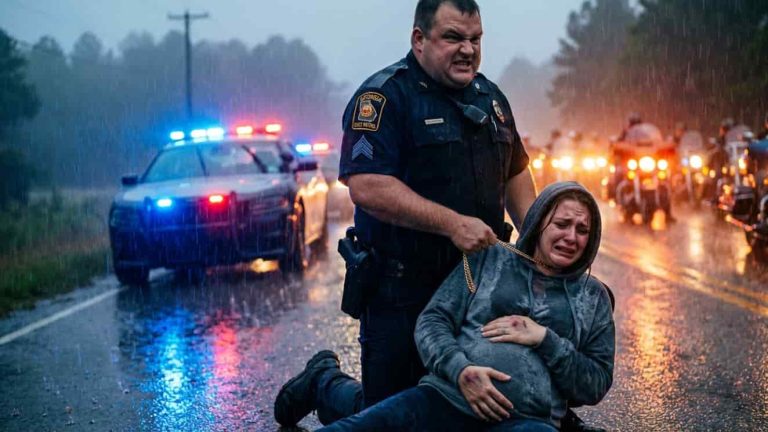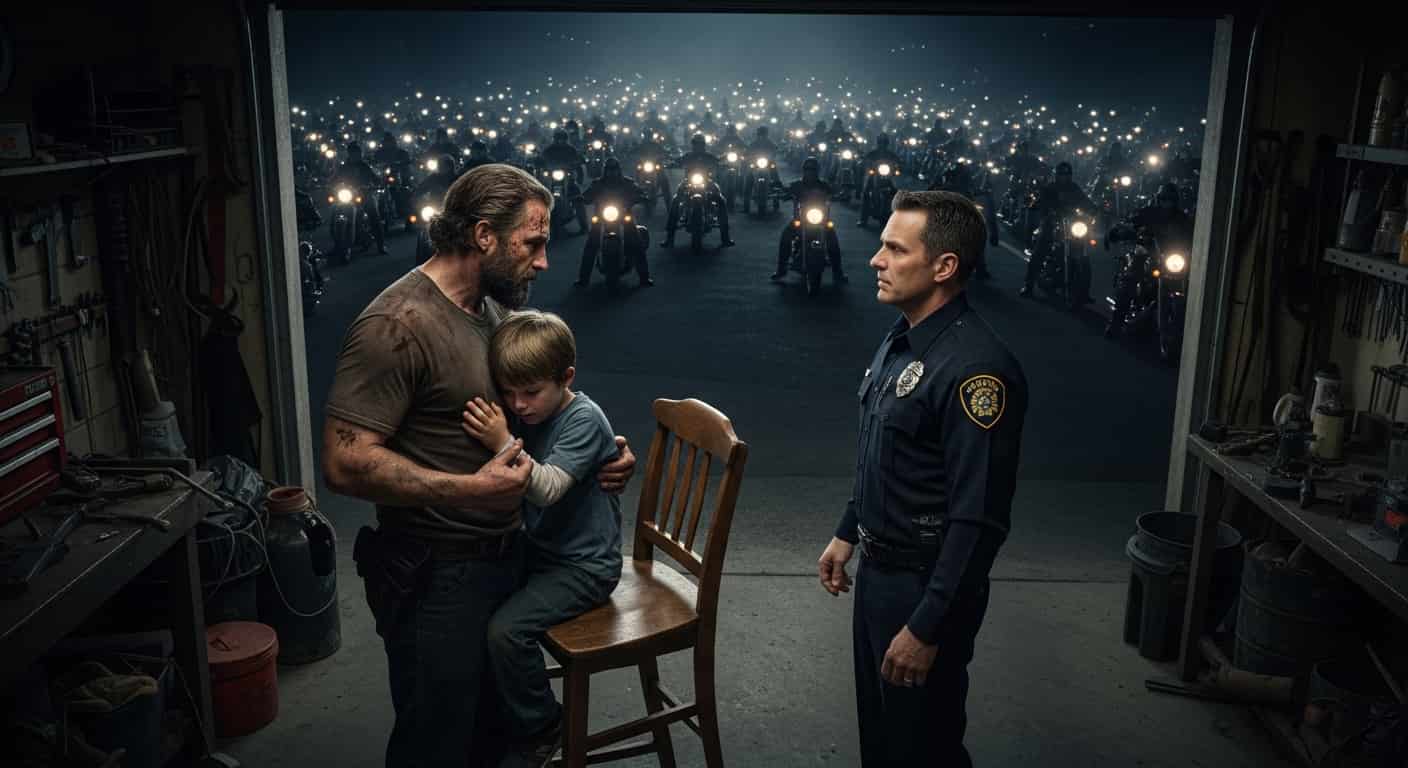
The officer’s boot hit the small, hand-carved wooden chair with a sickening crack. It was the only thing Leo had left of his father.
“”Do you know who I am?”” Officer Miller spat, his finger inches from my face. He smelled like stale coffee and unearned power. “”I’m the law in this zip code. You and this brat are footnotes in a report I haven’t even bothered to write yet.””
I didn’t flinch. I didn’t even blink. I just looked at the broken chair, then at the terrified ten-year-old boy trembling behind my legs. Leo wasn’t just some “”orphan”” to me. He was the son of the man who pulled me out of a burning Humvee in Fallujah.
“”You’re a thief, Miller,”” I said, my voice low and steady. “”You’ve been skimming from the Youth Outreach fund for years. And you just made the biggest mistake of your career.””
Miller laughed, a jagged, ugly sound. “”And who’s going to stop me? You? You’re a grease monkey with a dead-end garage.””
I didn’t argue. I just reached up, put two fingers to my teeth, and let out a whistle that sliced through the humid afternoon air.
For a second, it was silent. Then, the earth began to moan.
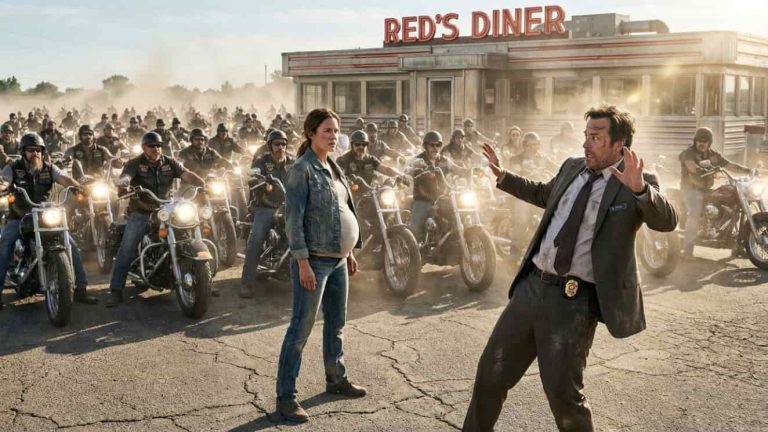
It started as a hum in the soles of our boots. Within ten seconds, it was a physical weight against our chests. From the North, the South, and every side street in between, the roar of 2,000 V-Twin engines drowned out the sound of Miller’s arrogance.
The look of pure, unadulterated terror on that embezzler’s face when he realized his “”authority”” meant nothing against a brotherhood of two thousand was the most beautiful thing I’d ever seen.
The cavalry didn’t wear uniforms. They wore denim, leather, and scars. And they were all here for Leo.
“FULL STORY
Chapter 1: The Broken Chair
The humidity in Oakhaven, Georgia, always felt like a wet wool blanket, but today it was suffocating for a different reason. I was standing in the gravel driveway of a tiny, peeling bungalow that the state called a “”temporary placement.”” To ten-year-old Leo, it was just the latest place where he wasn’t wanted.
I was there to drop off a restored bike for the homeowner when I saw Officer Miller’s cruiser pulled up on the lawn. Miller wasn’t there for a welfare check. He was there for the same reason he’d been hounding me for months: I knew where the money was going.
Leo was sitting on a small, rickety wooden chair on the porch, clutching a plastic dinosaur like it was a shield. Miller was towering over him, his face flushed with the kind of heat that doesn’t come from the sun.
“”I asked you a question, kid,”” Miller barked. “”Where did your dad keep the lockbox? I know it wasn’t in the house when the fire happened.””
Leo’s lower lip trembled. “”I… I don’t know, sir. Please.””
Miller didn’t like “”I don’t know.”” He reached out and shoved the boy’s shoulder, not hard enough to bruise, but hard enough to send a message. Then, with a casual, cruel flick of his leg, he kicked the wooden chair out from under the boy. Leo sprawled onto the porch floor, the dinosaur skittering into the dirt.
That was the moment the world went quiet for me. The “”grease monkey”” Miller despised—Jaxson “”Jax”” Teller (no relation to the show, though the irony wasn’t lost on me)—stepped out of the shadows of the garage.
“”Pick it up,”” I said.
Miller turned, his hand hovering near his belt. “”Excuse me, Jax? You got something to say to the law?””
“”I said pick up the chair, Miller. And apologize to the boy.””
Miller’s eyes turned into slits. He walked down the porch steps, stopping until we were chest to chest. He was taller, but I was denser—made of gym weights and spite.
“”Do you know who I am?”” he spat, the spit landing on my cheek. He pointed his finger inches from my nose. “”I am the thin blue line between you and a jail cell. I’ve been running this town since you were overseas playing hero. You’re a mechanic. I’m the authority.””
I didn’t flinch. I didn’t reach for a weapon. I didn’t need to. I just looked past him at the street.
“”Authority is earned, Miller. Not stolen from children’s funds.””
“”You’re done,”” Miller hissed, reaching for his handcuffs. “”Resisting, interference, maybe I’ll find some ‘contraband’ in your shop. You’re going away, and the kid goes to the system.””
I smiled. It wasn’t a nice smile. It was the smile of a man who had spent three tours in the desert learning that the loudest person in the room is usually the weakest.
“”I’m not the one going away,”” I whispered.
I put my fingers to my lips. The whistle was loud—ear-splitting, actually. It was the signal we’d practiced for “”Code Black.””
Miller started to laugh, his hand closing around my wrist. “”What was that? A bird call? You’re pathetic, Jax.””
Then the vibration started.
It wasn’t a car. It wasn’t a truck. It was a rhythmic, soul-shaking thrum that made the windows of the bungalow rattle in their frames. Miller froze. He looked toward the end of the cul-de-sac.
A single headlight appeared. Then two. Then fifty. Then a literal wall of chrome and black steel. The “”Iron Disciples””—not a gang, but a coalition of every veteran, blue-collar worker, and rider from three counties—had answered the call.
Two thousand engines roared in unison, a mechanical choir of vengeance. They didn’t stop at the curb. They surrounded the lawn, the driveway, and the cruiser, effectively turning Miller’s world into a cage of leather and iron.
The look of pure terror on that embezzler’s face when he realized his “”authority”” was outnumbered two thousand to one was priceless.
Chapter 2: The Siege of Oakhaven
Miller’s hand dropped from my wrist as if it had been burned. He stumbled back, his boots crunching on the gravel, his eyes darting frantically from left to right. The cul-de-sac was no longer a quiet suburban street; it was a sea of idling engines and grim-faced men and women.
At the front of the pack was Big Mike, a man whose beard reached his chest and whose arms were the size of my thighs. He killed his engine, and the silence that followed was heavier than the noise.
“”Problem, Jax?”” Mike asked, his voice a low rumble that seemed to come from the earth itself.
“”Officer Miller here was just explaining how the law works,”” I said, wiping the spit from my cheek with the back of my hand. “”He was also about to apologize to Leo for breaking his chair.””
Miller found his voice, though it was two octaves higher than it had been a minute ago. “”This is an illegal assembly! Get these… these bikes off the road! I’ll have every one of you cited! I’ll call for backup!””
Big Mike pulled a cigar from his vest pocket and lit it, the flame reflecting in Miller’s wide, panicked eyes. “”Go ahead, Officer. Call ’em. We already called the Sheriff. And the State Bureau of Investigation. And a couple of friends from the District Attorney’s office.””
Miller’s face went from pale to a ghostly, translucent white. “”What are you talking about?””
I stepped toward him, forcing him to back up until he hit the side of his own patrol car. “”We’ve been watching you, Miller. We know about the ‘donations’ to the fallen officers’ fund that never made it past your personal bank account. We know about the fire at Leo’s dad’s house—the one you conveniently showed up to first, looking for a certain ledger.””
“”You have no proof,”” Miller stammered, his hand shaking as he tried to adjust his belt.
“”Actually,”” a woman’s voice called out. Sarah, a local social worker who had been fired by Miller’s brother-in-law six months ago, hopped off the back of one of the bikes. She held up a thick, leather-bound book. “”Leo’s dad wasn’t just a soldier, Miller. He was an accountant for the city before he went overseas. He kept a duplicate of every transaction you ever made. He hid it in the one place you were too arrogant to look: the lining of Leo’s old toy chest.””
Leo, seeing the tide had turned, stood up on the porch. He clutched his plastic dinosaur tighter, but his eyes were no longer full of tears. They were full of the same fire I’d seen in his father’s eyes during a firefight in Ramadi.
“”You’re a bad man,”” Leo said, his voice small but clear.
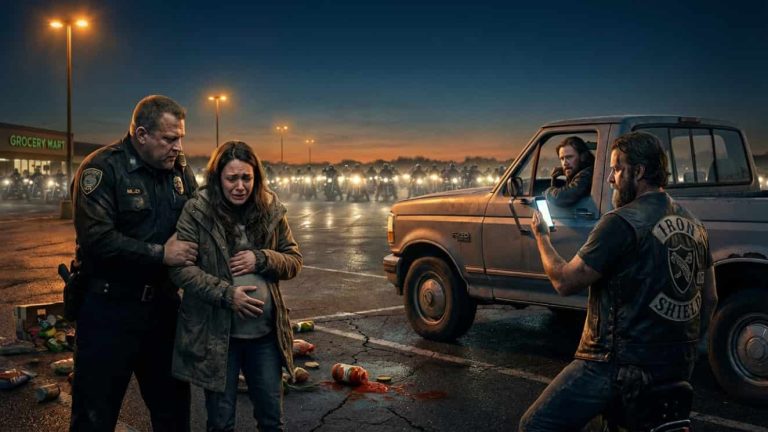
Miller looked around. Two thousand people were watching him. There were cameras out now—phones recording every second. In the digital age, a corrupt cop in a small town couldn’t hide behind a badge once the light was bright enough.
“”This is a setup,”” Miller hissed, looking at me. “”You think you’re so smart? You think these bikers are going to protect you when I’m gone? There are people higher up than me, Jax. People who won’t like you poking your nose into their pockets.””
“”I’m not worried about them,”” I said, leaning in close. “”Because I’m not the one who’s going to prison. You are.””
In the distance, the real sirens began to wail—the high-pitched, steady tone of the State Police. Miller tried to bolt for his car door, but Big Mike simply leaned his bike against the frame, pinning the door shut.
The “”authority”” of Oakhaven slumped against the hood, a broken man in a pressed uniform, as the realization finally sank in: he had bullied the wrong orphan, and the world had finally roared back.
Chapter 3: The Ghost of Ramadi
As the State Troopers led a handcuffed Miller away, the roar of the engines began to fade into a low, respectful purr. The street was still packed, but the tension had shifted from a coiled spring to a heavy, somber weight.
I sat on the porch steps next to Leo. The boy was looking at the broken pieces of his chair. It was a simple thing—pine wood, stained dark, with a small “”L”” carved into the backrest.
“”My dad made that,”” Leo whispered. “”He said as long as I sat in it, I was the king of the house.””
I felt a pang in my chest that no amount of heavy lifting or engine grease could dull. I remembered the man who made that chair. Sgt. David Miller—no relation to the corrupt cop—was the kind of man who would share his last liter of water in a sandstorm. We had served together for three years. He was the one who taught me that a man’s worth isn’t measured by what he takes, but by what he guards.
“”I know, Leo,”” I said softly. “”I remember when he was carving it. He used a combat knife because he couldn’t wait to get home to a real woodshop.””
Leo looked up at me, his eyes wide. “”You were there?””
“”I was there. He talked about you every single day. He told me that if anything ever happened to him, I had to make sure you never forgot you were a king.””
The truth was, I had failed David for a long time. When he died in that house fire a year ago—a fire that the investigators “”couldn’t explain””—I had crawled into a bottle. I let the grief turn me into a ghost. I watched from a distance as Miller and his cronies picked apart David’s estate, claiming he owed debts he never had, while Leo was bounced from one cold house to another.
It wasn’t until Leo showed up at my garage three weeks ago, hungry and bruised, that I finally woke up. He hadn’t asked for money. He’d asked if I could fix his bike.
That was when I saw the bruises on his wrists—the kind that come from being grabbed too hard by someone in a position of power. That was the day I stopped being a ghost and started being a brother again.
Big Mike walked up the steps, his heavy boots echoing. He handed me a cold bottle of water and looked at Leo.
“”Hey, kid,”” Mike said, his voice surprisingly gentle. “”You like motorcycles?””
Leo nodded tentatively.
“”Good. Because you’ve got about two thousand uncles now. And none of us like to see a king without a throne.”” Mike looked at me. “”The ledger is with the DA, Jax. Sarah’s testifying. But Miller was right about one thing. He wasn’t working alone. The Mayor’s office is already scrubbing their hard drives.””
“”Let them scrub,”” I said, looking out at the sea of leather vests. “”They can’t scrub two thousand witnesses. And they can’t scrub the truth.””
“”What happens now?”” Leo asked, looking between us.
I reached out and squeezed his shoulder. “”Now, we go get your things. You’re coming home with me. And tomorrow, we’re going to build you a new chair. Out of oak this time. Something that won’t break when a coward kicks it.””
But as I looked at the retreating tail lights of the State Police, I knew the fight was far from over. Miller was a symptom. The disease ran much deeper in this town, and we had just declared war on the people who ran it.
Chapter 4: The Paper Trail of Blood
The next three days were a blur of depositions, legal filings, and the constant, reassuring presence of at least twenty motorcycles parked outside my house at all times. The Iron Disciples had set up a perimeter, a wall of brothers that the local police—the ones still loyal to the old guard—didn’t dare cross.
Inside the house, Sarah was spread out across my dining room table, surrounded by photocopies of the ledger David had hidden.
“”It’s worse than we thought, Jax,”” Sarah said, rubbing her tired eyes. “”Miller wasn’t just skimming. He was the muscle for a land-grab scheme. The city wanted the land where Leo’s dad lived for that new shopping development. David wouldn’t sell. He knew the soil was worth more than they were offering because of the mineral rights.””
I felt a cold rage settle in my marrow. “”The fire. It wasn’t an accident.””
“”No,”” Sarah whispered. “”According to these notes, Miller was supposed to ‘scare’ him. But David fought back. The ledger has a date—two days before the fire—where David recorded a direct threat from the Mayor’s Chief of Staff.””
I looked over at Leo, who was in the backyard with Big Mike, learning how to clean a carburetor. The boy was laughing for the first time in a year. The thought that his father had been murdered for a strip mall made me want to burn the whole town down.
“”We need the physical evidence from the Mayor’s office,”” I said. “”The digital stuff is gone. But men like that… they always keep a paper trail as insurance against each other.””
“”You can’t just walk into City Hall, Jax,”” Sarah warned. “”They’ve got private security now. And they’re labeling the Disciples as a ‘militia’ in the local news.””
I looked at my vest hanging on the back of the chair. The patch on the back wasn’t just a logo; it was a promise.
“”I don’t need to walk in,”” I said. “”I just need to whistle.””
That night, the town of Oakhaven learned what happens when a community stops being afraid. We didn’t use violence. We used presence.
One thousand bikers lined the streets leading to City Hall, standing in total silence. No engines. No shouting. Just thousands of eyes watching the windows.
Inside, the lights stayed on all night. We knew they were panicked. We knew they were shredding documents. But what they didn’t know was that we had a man on the inside—a janitor who had served with the 101st Airborne and had been a Disciple since the club started.
At 3:00 AM, the side door opened. A small, unassuming man in a gray uniform walked out, carrying a heavy trash bag. He didn’t look at the line of bikers. He just walked straight to my bike and dropped the bag in the sidecar.
“”The shredder jammed,”” he muttered with a wink. “”Must have been divine intervention.””
Inside that bag were the half-shredded remains of the land-grab contracts, including a signed memo from the Mayor himself, authorizing “”aggressive relocation tactics”” for the residents of David’s neighborhood.
The perpetrator wasn’t just a rogue cop. It was the very system that was supposed to protect us.”