CHAPTER 5: THE THUNDERING JUSTICE
The ride back to the 4th Precinct was something they’d tell stories about for fifty years.
It started with fifty bikes. By the time we hit the main drag, it was two hundred. By the time we crossed the city limits, the sound was like a continuous roll of thunder that shook the glass in the skyscrapers.
Bikers from every walk of life—doctors who rode on weekends, veterans who lived on their cruisers, and the hard-core 1%ers—joined the line. Word had spread through the underground like wildfire: The Law was eating its own. Judge Sterling’s boy was being sacrificed.
We didn’t use sirens. We didn’t need them. The sheer volume of the engines cleared the path.
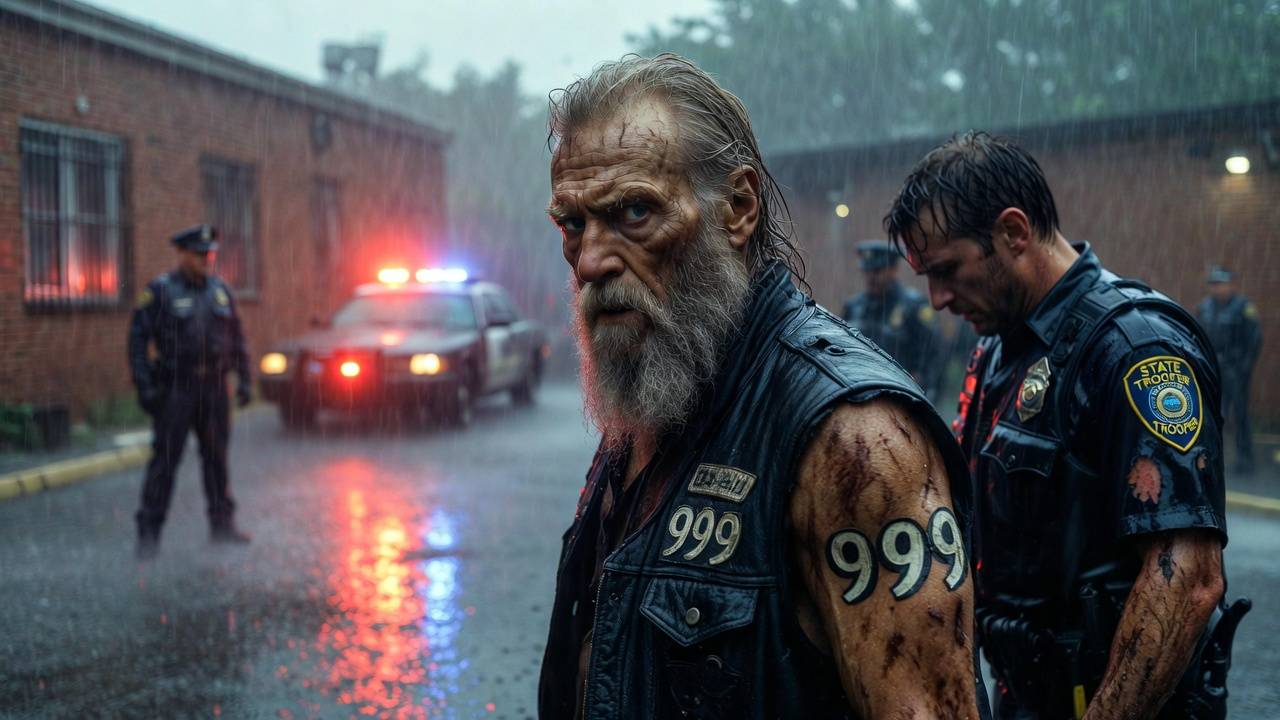
When we pulled back into that parking lot, the rain had turned into a torrential downpour. But the lot wasn’t empty this time. Henderson had called in reinforcements. A line of riot police stood in front of the precinct doors, shields up, batons ready.
I pulled my Panhead to the very front, Mark riding pillion behind me. I killed the engine, and one by one, the hundreds of bikes behind me went silent.
The silence was scarier than the noise.
Henderson stood behind the riot line, a megaphone in his hand. “This is an illegal assembly! Disperse immediately or we will use force!”
I stepped off the bike. I didn’t have a weapon. I just had the truth.
“Henderson!” I yelled. “The footage is gone! You did a real nice job with the servers! But you forgot about the one thing you can’t hack!”
I pointed to the crowd of bikers. But I wasn’t pointing at the men in leather. I was pointing at the dozens of people who were pulling up in regular cars behind us.
Civilians. People from the Bottoms. People whose sons had been arrested by Miller. People whose businesses had been burned in “unexplained” fires.
“They know,” I shouted. “They’ve always known you were rotten. But tonight, they saw you put the cuffs on one of your own. They saw you betray the one man who actually tried to protect them.”
Mark stepped forward, standing beside me. He looked at the line of riot cops. He recognized the men behind the shields.
“Donnelly!” Mark called out, his voice cracking the tension. “You were at my wedding! You know I didn’t touch those drugs! Are you really going to stand there and protect a man who’s selling out your city?”
A young officer in the riot line hesitated. His shield lowered an inch.
“Shut up, Sterling!” Henderson screamed into the megaphone. “Officers, prepare to engage!”
“Engage who, Henderson?” I asked, walking toward the line. “The whole town? Look around you.”
Cell phones were out. Hundreds of them. Every single person was livestreaming. The “Blue Wall” was being watched by a million eyes in real-time.
“You can’t kill us all,” I said. “And you can’t hide anymore.”
Suddenly, the side door of the precinct opened. It wasn’t more cops. It was a man in a suit—the District Attorney—followed by two grim-faced men in windbreakers that read FBI.
My heart skipped a beat. I’d made a call. Not to a club, but to an old contact—a man I’d saved in prison twenty years ago who now worked for the Bureau.
“Director Henderson,” the DA said, his voice amplified by the precinct’s own external speakers. “Step away from the line. We have a warrant for your arrest, and for Captain Miller.”
The riot police froze. Henderson turned, his face a mask of pure, unadulterated terror.
“On what grounds?” Henderson stammered.
“On the grounds of the physical hard drive Mr. Sterling’s associates delivered to the field office an hour ago,” the FBI agent said.
I looked at Lawless. He gave me a slow, wicked grin. He hadn’t kept the drive at his house. He’d hidden it in the one place a cop would never look: the bottom of a grease trap in the clubhouse kitchen. The “raid” on his house had been a wild goose chase.
The tension snapped. The riot police didn’t move to protect Henderson. They moved aside.
It was over.
As the feds moved in to cuff Henderson and Miller, the crowd erupted. Not in a riot, but in a roar of vindication.
Mark stood there, the rain washing the grime from his face. He looked at me, and for the first time in ten years, he reached out and hugged me. It wasn’t a quick pat on the back. It was the desperate, soul-searching hold of a son who had finally found his way home.
“I’m sorry, Dad,” he sobbed into my leather vest. “I’m so sorry.”
“Don’t be,” I whispered, holding him tight. “You had to learn that the badge is just metal. It’s the man who gives it value. And you, son… you’re the best man I know.”
CHAPTER 6: THE ROAD AHEAD
Two weeks later, the sun finally came out.
The 4th Precinct was under federal oversight. Henderson and Miller were facing twenty years to life. The “warehouse scandal” had dominated the news, and Mark’s name had been cleared. He was a hero in the eyes of the public, the “Whistleblower Trooper.”
But he didn’t go back.
He sat on the porch of his house—the house I’d paid for—watching his daughter play in the yard. Sarah was inside, humming a tune, the weight of the world finally off her shoulders.
I pulled up in the driveway, the Panhead purring. I wasn’t wearing my colors. Just a plain black t-shirt and jeans.
Mark stood up and walked down the steps. He looked different. Younger. The hardness in his eyes had been replaced by a quiet peace.
“Heard you turned down the promotion,” I said, leaning against my bike.
“Yeah,” Mark said, shoving his hands in his pockets. “They offered me Captain. Said they wanted me to lead the ‘new’ department. But I realized something, Dad.”
“What’s that?”
“I don’t want to be the man who enforces the law,” he said, looking at the road. “I want to be the man who lives it. There’s a difference.”
He reached into his pocket and pulled something out. It was the vintage watch—the one I’d tried to give him at his wedding. Sarah had found it in my truck that night at the precinct and brought it to him.
“It still keeps perfect time,” Mark said, checking the dial.
“Just like your old man,” I joked, though my voice was thick.
“Listen,” Mark said, looking at me seriously. “The club… the 999. They saved my life. I know I said some things. Awful things.”
“Forget it,” I said. “We’re outlaws, Mark. We’re used to being the bad guys in someone’s story. As long as we’re the good guys in yours, that’s all that matters.”
Mark nodded. He looked at the Panhead, then back at me.
“You think you could teach me how to wrench on a bike? Not the new stuff. The old iron. Like yours.”
I felt a grin spread across my face—a real one, the kind that reached my eyes.
“I think I can manage that,” I said. “But you’re going to get your hands dirty. No more ‘clean’ life, kid.”
“I think I’ve had enough of ‘clean’ to last a lifetime,” Mark said.
I looked at my son, the former Trooper, the honest man, the Sterling boy. We had walked through the fire, and while the badge had melted away, the bond had been forged into something unbreakable.
I realized then that family isn’t defined by the clothes we wear or the rules we follow, but by who stands beside us when the rain starts to fall and the world turns its back.
I climbed back onto my bike and kicked the starter. The engine roared to life, a song of defiance and pride.
“See you at the shop, Dad,” Mark called out.
I waved a hand and pulled out onto the open road, the wind in my face and the sun at my back, knowing that for the first time in my life, I wasn’t riding away from anything—I was finally riding toward something that mattered.
True justice isn’t found in a courtroom or on a badge, but in the quiet strength of a father’s love and the heavy rumble of a brother’s engine.