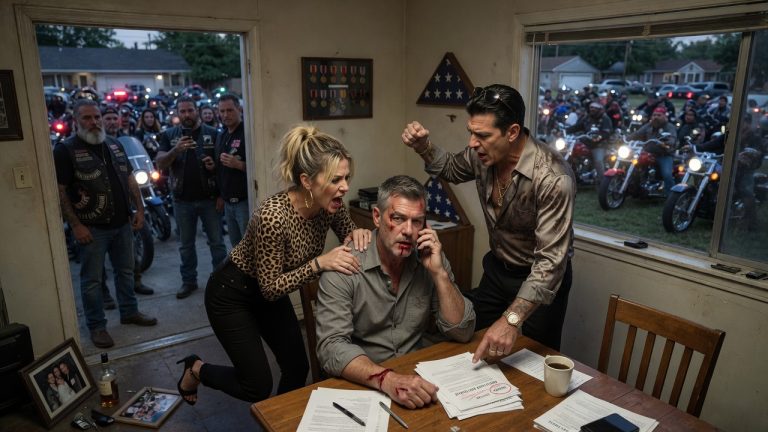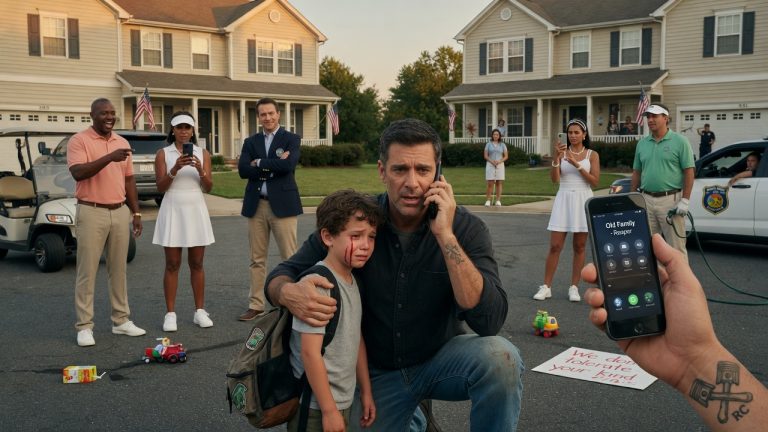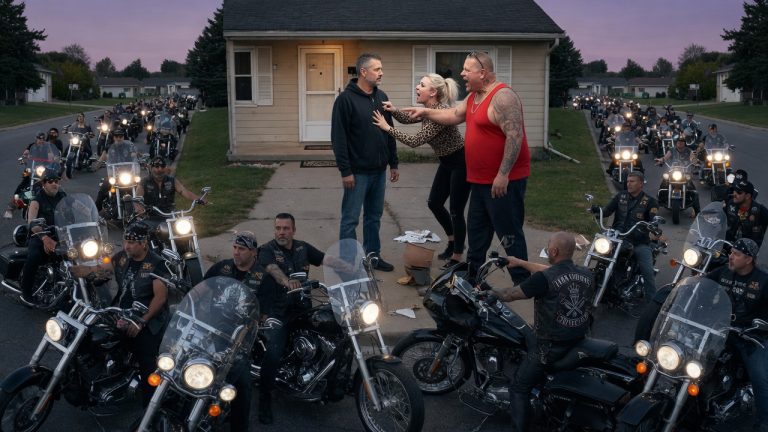
I spent twenty years earning the name “Grave.” I buried the people the Iron Saints wanted gone, and I never asked why. I was a foster kid who found a family in a biker gang, and I owed them everything.
Then King gave me the contract on “The Ghost.” An old traitor hiding in the high country.
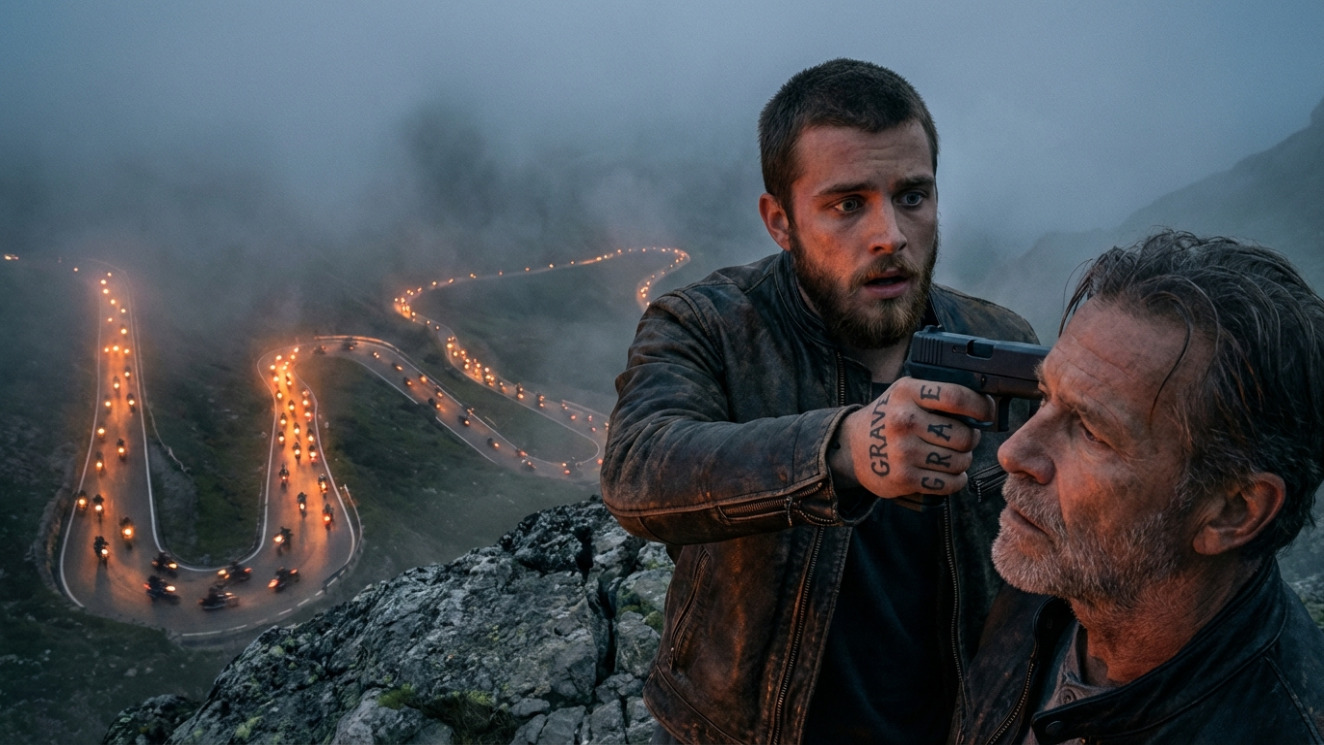
I found him. I had the barrel of my gun pressed against his temple. I was ready to pull the trigger and go home for a beer.
Then he said my real name. A name no one in the club knows.
He didn’t look like a ghost. He looked like a mirror.
Now, King is sending 500 riders behind me to “escort” the traitor to his execution. They think I’m leading them to a kill. They don’t know I’m leading them to the only man I have left in this world.
One road. Five hundred brothers. One father I just met.
And only one of us is making it off the mountain.
FULL STORY
Chapter 1
The cold in Montana doesn’t just sit on your skin; it hunts for your joints. It finds the old breaks, the hairline fractures from bar fights ten years ago, and it settles in like a debt collector. Silas “Grave” Vane felt it in his left knee as he kicked the kickstand down on his Harley. The metal crunched into the frozen slush of the clubhouse parking lot.
The “Saints’ Den” was a windowless cinderblock box painted charcoal grey, tucked behind a defunct rendering plant outside of Kalispell. It smelled like diesel, stale cigarettes, and the kind of desperation that only men with nothing to lose can generate. Above the door, the neon sign of a winged skull flickered, humming a low, electric tune that set Grave’s teeth on edge.
He didn’t go inside immediately. He stood by his bike, rubbing his gloved hands together. He was a big man, built like a redundant bridge—thick-necked, heavy-shouldered, with a beard that had more grey in it than he liked to admit. His leather vest, the “cut,” felt heavy today. The “Enforcer” patch on his chest was a weight he’d carried for fifteen years.
“Grave! King wants you. Now.”
Shovel was standing in the doorway. He was twenty-four, skinny, and had a nervous energy that made him look like he was constantly vibrating. He’d earned his name because he was the one Grave called when a hole needed to be dug in the woods. Shovel looked up to Grave with a terrifying, puppy-like devotion that Grave found exhausting.
“I’m coming,” Grave grunted. “Keep your shirt on.”
“He’s in a mood, man. He’s got the map out.”
Grave stiffened. The map only came out when the Iron Saints were expanding or when someone was being erased.
Inside, the air was thick with the smell of frying onions from the small kitchen in the back. A dozen members were scattered around the pool tables, their voices low. They went quiet when Grave walked past. That was the tax of being the Enforcer. You didn’t get “hello,” you got silence.
Mick “King” Sullivan was sitting at the head of a heavy oak table in the back room. King was sixty-five, with a mane of white hair tied back in a grease-stained cord and eyes the color of a winter sky. He’d taken Grave in when Grave was eighteen, fresh out of the state foster system with a rap sheet and a chip on his shoulder the size of a mountain. King hadn’t just given him a job; he’d given him a spine.
“Close the door, Silas,” King said. He was the only one allowed to use Grave’s real name.
Grave shut the heavy steel door. The noise of the clubhouse muffled to a dull throb. On the table was a topographic map of the Flathead National Forest. A red circle was drawn around a remote drainage near the Canadian border.
“We found him,” King said. He didn’t look up. He was cleaning his fingernails with a buck knife. “The Ghost.”
Grave felt a prickle of heat behind his neck despite the cold. “Arthur Penhaligon?”
“The man who nearly burned this club to the ground twenty-five years ago,” King said, his voice dropping to a sandpaper rasp. “The man who stole eighty grand of the brotherhood’s money and disappeared while the feds were kicking in our doors. Yeah. That Ghost.”
“I thought he was dead,” Grave said. “The rumor was he hit a tree in the Yukon.”
“Rumors are for people who can’t afford facts,” King spat. He finally looked up, his eyes boring into Grave. “He’s been living in a trapping cabin up near Whale Creek. Some local kid saw him buying supplies in Polebridge. Recognized the ink on his forearm. The old Saints’ sunburst.”
King leaned back, the chair creaking under his weight. “He’s old now. Probably thinks we’ve forgotten. But the North remembers, Silas. And the Saints don’t forgive a thief.”
“You want me to take Shovel?”
“No. Shovel’s a kid. This is a debt that needs a man’s hand.” King stood up, walking around the table. He put a hand on Grave’s shoulder. The leather of King’s glove was cold. “You’re the closest thing I have to a son, Silas. You know that. I trust you more than I trust my own blood. Go up there. Confirm it’s him. Then put him in the ground. I don’t want a body to bring back. I just want his patch. If he’s still got it.”
“He won’t have it,” Grave said. “Not after twenty-five years.”
“Then bring me his finger. The one with the ring.” King’s grip tightened on Grave’s shoulder. It was a gesture of affection that felt like a threat. “Do this, and you’re next in line for the VP slot. It’s time you moved up.”
Grave nodded. He didn’t feel the excitement he should have. Being VP meant more paperwork, more meetings with the lawyers, and more responsibility for the idiots like Shovel. But in the Saints, you moved up or you moved out. And nobody ever moved out on their own feet.
He left the clubhouse twenty minutes later. He didn’t take his bike—the snow was getting too deep for two wheels. He took his rusted-out F-150, the one with the heater that only worked if you kicked the dashboard twice.
As he drove north, the suburban sprawl of Kalispell gave way to the dark, oppressive majesty of the pines. The sky was a flat, bruised purple.
Grave’s mind drifted, as it always did when he was alone, to the “Before.” The series of foster homes, each one a little bleaker than the last. The smell of Pine-Sol and boiled cabbage. The social workers with their clipboards and their pitying smiles. He’d never known his mother—she’d died of an overdose when he was three. And his father? His father was a blank space in a government file. “Identity Unknown.”
He’d spent his whole life looking for a place to belong, and he’d found it in the roar of an engine and the violent loyalty of the Saints. They were his father. King was his father.
The drive took three hours. The road turned into a logging trail, then a goat path. He had to park the truck a mile out and hike the rest of the way through knee-deep snow. He carried a Remington 700 over his shoulder and a heavy sense of routine in his chest. This was just work.
He found the cabin just as the sun dipped behind the peaks. It was a miserable shack, built of unpeeled logs and capped with a rusting tin roof. Smoke curled thin and grey from a stone chimney.
Grave moved through the trees with the practiced silence of a hunter. He circled the cabin, checking for exits. There was only one door and two small windows, thick with grime. He approached the door, his boots crunching softly. He didn’t knock. He kicked the door open.
The wood splintered. Grave stepped inside, the rifle leveled, the barrel sweeping the room.
“Don’t move!” he roared.
An old man was sitting at a small table, a bowl of canned peaches in front of him. He was thin—skeletal, almost—with a shock of white hair and a beard that reached his chest. He was wearing a threadbare flannel shirt and wool trousers that were held up by pieces of twine.
The old man didn’t jump. He didn’t reach for a weapon. He slowly lowered his spoon into the bowl and looked up at Grave. His eyes were a startling, familiar blue.
“You took your time,” the old man said. His voice was a dry rattle, like dead leaves on pavement.
“Arthur Penhaligon?” Grave asked, his finger tightening on the trigger.
The old man smiled, showing yellowed teeth. “Nobody’s called me that in a long time. They call me Artie now. Or just the Ghost.”
Grave stepped closer, the light from a single kerosene lamp flickering between them. He looked for the sunburst tattoo on the man’s forearm, but the sleeves were down. “King says you owe the club eighty thousand dollars and a pound of flesh.”
“King,” Artie whispered, shaking his head. “Mick Sullivan. Is he still wearing that ridiculous crown ring? Still thinks he’s the king of the dirt?”
“He’s the President of the Iron Saints. And I’m his Enforcer.”
Artie looked Grave up and down, his gaze lingering on Grave’s face. The old man’s expression shifted from defiance to something else. Something soft. Something that looked like recognition.
“What’s your name, boy?” Artie asked.
“Grave. That’s all you need to know.”
“No,” Artie said, his voice gaining a sudden, sharp clarity. “Your real name. Your mother… did she name you Silas? Silas Vane?”
Grave froze. The world seemed to tilt. The cold from outside rushed into the room, making the lamp flame dance. He hadn’t heard that name in a decade. He never used it. It wasn’t on his cut. It wasn’t in the club records.
“How do you know that name?” Grave’s voice was a low, dangerous growl. He pressed the barrel of the rifle against the old man’s chest.
Artie didn’t flinch. He reached out with a trembling hand, not toward the gun, but toward Grave’s face. Grave flinched back, but not before the old man’s fingers brushed his cheek.
“Because I named you,” Artie whispered. “I named you after my grandfather. And I left you with Elena because I knew if King found out I had a son, he’d use you to keep me on a leash. I thought if I ran, if I took the money and drew them away from you, you’d have a chance.”
Grave felt a roar in his ears. “You’re lying. You’re a thief and a traitor, and you’re trying to save your skin.”
“Check the floorboard under the bed,” Artie said, his breath hitching. “There’s a cigar box. Look at the photo inside, Silas. Just look at the photo.”
Grave didn’t lower the rifle. He backed toward the bed, keeping the barrel on Artie. He kicked the bed frame aside and saw a loose board. He pried it up with the toe of his boot. Beneath it sat a faded wooden cigar box.
He flipped the lid. Inside was a stack of old letters and a single, grainy Polaroid.
Grave picked it up with a shaking hand. It was a photo of a young man—maybe twenty-five—with the same heavy shoulders and broad jaw as Grave. He was wearing an Iron Saints vest. Beside him was a young woman with dark hair and a tired, beautiful smile. They were holding a baby wrapped in a blue blanket. On the back, in fading ink, were the words: Silas’s first month. 1986.
Grave looked from the photo to the old man at the table. The blue eyes were the same. The shape of the nose was the same.
“You’re the Ghost,” Grave whispered.
“I’m your father, Silas,” Artie said. “And if you’re going to kill me for Mick Sullivan, you’d better do it now. Because I’m tired of running.”
Grave’s finger stayed on the trigger, but the world outside the cabin felt very far away. He looked at the man he’d been sent to murder, and for the first time in his life, the “Enforcer” patch felt like a lie.
Chapter 2
The silence in the cabin was heavy, thick with the smell of woodsmoke and the sharp, metallic tang of the rifle. Grave didn’t move. He couldn’t. His entire identity—every punch he’d thrown for the Saints, every mile he’d ridden, every year he’d spent trying to be the son King wanted—felt like it was dissolving into the dirt floor.
“Put the gun down, Silas,” Artie said. It wasn’t a command; it was an invitation.
Grave didn’t put it down. He lowered the barrel a fraction, his heart hammering against his ribs like a trapped bird. “Why? Why now? Why didn’t you come for me?”
“I did,” Artie said, his voice cracking. “I came back three years after I ran. I went to Elena’s. She told me the state had taken you. She told me you were in a home in Missoula. I went there, Silas. I sat in my truck outside that fence for six hours. I saw you playing in the yard. You were a tough little kid, even then. Always fighting.”
Artie wiped a hand across his eyes. “But I had the Saints on my tail. King had a bounty on my head that every low-life in three states wanted to collect. If I took you, I was handing you a death sentence. I thought… I thought if I stayed dead to you, you might actually grow up to be something. A doctor. A lawyer. Something with clean hands.”
Artie looked at Grave’s cut, at the skull and wings, at the “Enforcer” patch. A bitter laugh escaped his throat. “I guess the apple doesn’t roll too far from the tree, does it? You ended up right back in the devil’s mouth.”
“King raised me,” Grave said, his voice thick. “He gave me a life.”
“He gave you a cage,” Artie snapped. “He gave you a job doing his dirty work because he knew you were hungry for a father. He didn’t love you, Silas. He used you. He’s been using you to replace the man I was.”
Grave wanted to scream. He wanted to pull the trigger just to make the old man stop talking, to make the truth stop clawing at him. But he looked at the Polaroid again. His mother. He didn’t remember her face, but looking at the photo, he felt a phantom warmth, a memory of a song or a smell that he’d buried under layers of scar tissue.
“Get out,” Grave said suddenly.
Artie blinked. “What?”
“Get out. Now. Take whatever you can carry and start walking. There’s a logging road two miles east. If you hit it by midnight, you can hitch a ride to the border.”
“Silas…”
“Don’t call me that!” Grave roared, slamming his fist against the log wall. The cabin shook. “If I see you again, I’ll kill you. If King finds out, he’ll kill us both. Move!”
Artie stood up slowly, his joints popping. He reached for a heavy wool coat hanging by the door. He didn’t try to argue. He knew the look in Grave’s eyes—it was the look of a man whose world had just been set on fire.
As Artie reached the door, he paused. “The money, Silas. The eighty thousand. I didn’t steal it for me. I gave it to Elena. For you. For your school, for your clothes. I don’t know if she ever got it to you, but that’s where it went.”
He stepped out into the snow, a frail shadow against the white. Grave watched him disappear into the trees, his heart a cold stone in his chest.
He stayed in the cabin for an hour. He burned the letters. He burned the cigar box. But he tucked the Polaroid into the inner pocket of his vest, right against his ribs. He used his knife to hack a chunk of wood out of the table where Artie had been sitting, making it look like there had been a struggle. Then, he took his handgun and fired a single shot into the floorboards.
He hiked back to his truck in a daze. The wind had picked up, howling through the pines like a choir of the damned. He drove back toward Kalispell, his mind racing. He needed a story. He needed a lie that King would believe.
He walked into the clubhouse at 3:00 AM. The party was still going, though it had turned sloppy. The air was thick with the smell of spilled beer and weed.
Shovel met him at the door, his eyes wide. “Grave! You’re back. Did you find him?”
Grave didn’t answer. He pushed past Shovel and went straight to the back room. King was still there, sitting in the same chair, a bottle of bourbon half-empty in front of him.
Grave threw a blood-stained piece of flannel onto the table. It wasn’t Artie’s blood—Grave had sliced his own palm in the truck to soak the fabric.
“It’s done,” Grave said.
King picked up the cloth, sniffing it. He looked up at Grave, his eyes narrowed. “Where’s the finger, Silas? Where’s the ring?”
“He jumped,” Grave said, his voice flat and rehearsed. “We were on the ridge above the creek. I got a shot off, hit him in the shoulder, but he went over the edge. It’s a two-hundred-foot drop into white water. Nobody survives that. Not an old man.”
King stared at him for a long beat. The silence in the room stretched until it felt like it would snap. King stood up and walked over to Grave. He reached out and touched the cut on Grave’s hand.
“You’re bleeding, son.”
“He had a knife,” Grave said. “He was scrappy for a ghost.”
King’s thumb pressed into the wound. Grave didn’t flinch.
“A two-hundred-foot drop,” King mused. “That’s a long way down. But ghosts have a habit of floating, don’t they?”
“He’s dead, King. I saw him go under.”
King smiled, but the warmth didn’t reach his eyes. “I believe you. Of course I believe you. But the club… the club needs more than a piece of shirt. They need to see the price of betrayal. They need a show.”
King turned back to the map. “We’re going to do an Honor Run. The whole chapter. Five hundred bikes from across the state. We’re going to ride up to that ridge, and we’re going to plant a Saints flag where he fell. We’ll call it a funeral for a traitor.”
Grave felt a cold sweat break out on his forehead. “King, the weather is turning. The passes are closing.”
“Then we’ll ride in the snow,” King said, his voice turning to iron. “We leave in forty-eight hours. You’ll lead the escort, Grave. Since you’re the one who finished the job.”
Grave nodded, his throat dry. He turned to leave, but King’s voice stopped him.
“Oh, and Silas? I sent Shovel up there about an hour after you left. Just to keep an eye on things. You know, for your safety.”
Grave’s heart stopped. He looked at Shovel, who was standing by the door. Shovel wouldn’t look him in the eye. The kid’s face was pale, his hands trembling as he messed with his keys.
“He said he saw you talking to the old man,” King said softly. “He said it looked like a very long conversation for a hit.”
Grave felt the walls closing in. He looked at Shovel, and then back at King. He realized then that the “Honor Run” wasn’t a funeral for Artie.
It was a funeral for him.
“We talked,” Grave said, his voice steady despite the roar in his ears. “He tried to beg. I let him talk so I could find out if he’d hidden the money. He hadn’t. So I pushed him.”
King stared at him for a long, agonizing minute. Then he laughed—a sudden, booming sound that made Grave’s skin crawl.
“Good man,” King said, clapping him on the back. “I knew you wouldn’t let me down. Get some sleep, Silas. You’ve got a long ride ahead of you.”
Grave walked out of the room. He didn’t look at Shovel. He walked out to his truck and sat in the dark, the Polaroid of his father and mother burning a hole in his pocket. He had forty-eight hours to figure out how to save a man he’d just met from a brotherhood he’d served his whole life.
And he knew, with a sinking certainty, that 500 bikes were a lot of weight to stop once they started rolling.
Chapter 3
The next morning, the sky was the color of a wet sidewalk. Grave didn’t go to the clubhouse. He drove to a small, sagging bungalow on the outskirts of Whitefish. The yard was filled with dormant rose bushes wrapped in burlap, looking like small, huddling ghosts.
He knocked on the door. After a minute, it was opened by a woman in her late sixties. She was wearing a faded cardigan and nursing scrubs. Her face was a map of hard shifts and low pay, but her eyes were sharp.
“Silas,” she said. She didn’t sound surprised. “I figured you’d show up eventually. I heard the Saints were making noise.”
“Elena,” Grave said. “I need to talk to you.”
Elena stepped back, letting him in. The house smelled of lavender and old paper. It was a far cry from the grease and testosterone of the Den. She led him into a small kitchen and poured him a cup of coffee that tasted like battery acid.
“I saw him,” Grave said, sitting at the small Formica table. “I saw Arthur.”
Elena sat down across from him, her hands folded. She didn’t blink. “And? Is he still alive?”
“For now. I let him go. But King… King knows. Or he suspects. He’s calling for a mass run. Five hundred riders heading up to the cabin.”
Elena sighed, a long, weary sound. “Mick Sullivan never could let go of a grudge. He’s like a dog with a bone made of poison.”
“He told me he left the money with you,” Grave said, leaning forward. “The eighty thousand. He said he did it for me.”
Elena looked away, her gaze drifting to a framed photo of a younger Silas on the mantel—a school picture from when he was ten, looking angry and lost.
“He did,” she said softly. “He showed up in the middle of the night, covered in mud and blood. He handed me a gym bag full of cash and told me to take care of you. He said if he stayed, the club would kill you just to get to him.”
“Then why did I end up in the system, Elena? Why was I sleeping on floor mats in group homes while you had eighty grand in a gym bag?”
Elena looked back at him, and for the first time, Grave saw the shame in her eyes. “Because the feds came two days later, Silas. They knew Arthur had run. They knew he’d been at my place. They searched everything. They found the money.”
Grave felt the air leave his lungs.
“They took it as evidence,” Elena continued. “They threatened to charge me with conspiracy. I couldn’t keep you. The state took you before I could even hire a lawyer. I tried to find you, Silas. I really did. But the Saints… they made it clear that if I kept digging, I’d end up in a ditch. I was scared. I’m sorry.”
Grave rubbed his face with his hands. The truth was messier than the lie. His father hadn’t just abandoned him; he’d tried to save him and failed. And the club—the family Grave had chosen—was the reason he’d been alone in the first place.
“He loved you, Silas,” Elena said, reaching across the table to touch his scarred hand. “In his own broken way. He was a biker, not a saint. But he wasn’t the monster King made him out to be.”
“King is the only father I’ve ever known,” Grave said, his voice cracking.
“No,” Elena said firmly. “King is the man who stole your father’s life and then convinced you to be grateful for the crumbs he dropped.”
Grave stood up, the chair screeching against the linoleum. He couldn’t stay here. The walls were closing in again. “The run leaves tomorrow morning. If they find him, they’ll string him up. And they’ll probably do the same to me.”
“Then don’t let them find him,” Elena said.
“There’s five hundred of them, Elena! I’m one man.”
“You’re the Enforcer,” she reminded him. “You know where the bodies are buried. You know how that club breathes. Use it.”
Grave left without another word. He drove back to his apartment—a one-room studio above a garage. He took his vest off and laid it on the bed. He looked at the patches. Iron Saints. Montana Chapter. Enforcer.
He took a seam ripper from a small sewing kit he kept for repairs. Slowly, meticulously, he began to cut the threads. He pulled the “Enforcer” patch off first. Then the “Iron Saints” rocker.
Underneath the leather was darker, unweathered. It looked like a scar.
He heard a knock at the door. He shoved the patches under his pillow and grabbed his pistol. “Who is it?”
“It’s Shovel.”
Grave opened the door. Shovel was standing there, shivering. He looked like he’d been crying.
“Grave, I’m sorry,” the kid whispered. “King… he put me in the chair. He started talking about loyalty and brotherhood, and then he pulled out the pliers. I didn’t want to tell him. I swear.”
Grave looked at Shovel’s hands. The fingernails on his left hand were gone, the tips raw and bloody.
“He didn’t believe you anyway,” Grave said, his voice softening. “He just wanted to see if you’d break.”
“He’s going to kill you, Grave. At the ridge. He told me to stay behind you. He said when we get to the flag-planting, I’m supposed to… I’m supposed to finish it.”
Shovel looked up at him, his face a mask of terror. “I can’t do it, Grave. You taught me everything. You’re the only one who didn’t treat me like trash.”
Grave looked at the kid. He saw himself twenty years ago. Lost, desperate for a place to stand.
“Listen to me,” Grave said, grabbing Shovel by the shoulders. “Tomorrow morning, when the pack moves out, I’m going to be at the front. You stay five bikes back. When we hit the pass at Blacktail, there’s going to be a bottleneck. The snow is going to be heavy. I need you to create a distraction.”
“What kind of distraction?”
“Something loud. Something that stops the line.” Grave reached into his closet and pulled out a heavy canvas bag. Inside were several blocks of commercial grade construction explosives he’d skimmed off a job site years ago. “You remember how to set a timer?”
Shovel’s eyes went wide. “Grave… that’s treason. They’ll hunt us to the ends of the earth.”
“They’re already hunting us, kid,” Grave said. “The only question is whether we’re going to sit and wait for the bullet or start running.”
Shovel looked at the explosives, then at Grave’s raw, patchless vest. He nodded slowly. “Okay. Okay, Silas. I’m in.”
Grave felt a strange sense of peace. For the first time in fifteen years, he wasn’t an Enforcer. He wasn’t a Saint. He was just a man trying to protect his father.
He spent the rest of the night prepping. He cleaned his weapons. He packed a bag for Artie. He looked at the Polaroid one last time before tucking it into his pocket.
At dawn, the roar of five hundred engines shook the valley. The Iron Saints were gathering. The sound was like a physical weight, a thrumming in the earth that signaled the coming of a storm.
Grave pulled his vest on—blank and black—and walked out to his bike. He didn’t look at the other riders. He didn’t acknowledge the nods of the men he’d bled with. He rode to the front of the line, where King was waiting on a custom-built chopper that gleamed like a polished tooth.
King looked at Grave’s vest. He saw the missing patches. He didn’t say a word. He just smiled, a cold, predatory baring of teeth, and twisted his throttle.
The Great Run had begun.
Chapter 4
The roar of five hundred motorcycles is not a sound; it is a vibration that colonizes your bones. As the Iron Saints crested the first ridge out of Kalispell, the column stretched back for two miles—a glittering, oil-smelling snake of chrome and leather winding through the white landscape.
Grave rode at the head, twenty feet behind King. The wind was a whetted blade, slicing through his heavy leather jacket. He could feel the eyes of the men behind him—the “brothers” who would turn on him the second King gave the word.
The social hierarchy of the club was on full display. The officers were up front, followed by the full-patch members, then the prospects, and finally the “hang-arounds” in their trucks, hauling fuel and beer. It was a feudal army on wheels, and Grave was the disgraced knight leading them to the gallows.
He kept his eyes on the road. The snow was deepening as they climbed toward the Blacktail pass. The highway department hadn’t plowed this far up yet, and the bikes were fishtailing in the slush.
“Keep the pace!” King’s voice crackled over the radio in Grave’s helmet. “We don’t stop for weather!”
King was riding like a madman, pushing his chopper through drifts that should have grounded it. He wanted blood. He wanted the Ghost. But more than that, he wanted to see Grave break.
Grave glanced in his mirror. Five bikes back, Shovel was tucked low, his face hidden behind a tinted visor. The kid looked small against the backdrop of the massive column. Grave hoped to God he hadn’t lost his nerve.
The plan was simple, which meant it had a thousand ways to fail. At the Blacktail bottleneck, the road narrowed between a sheer rock face and a steep drop-off. If Shovel could drop the charge near the overhang, the resulting slide would block the road for hours. It wouldn’t hurt anyone—Grave had told him to wait for a gap—but it would sever the head of the snake from the body.
In that chaos, Grave would break off. He’d use the old logging trails he knew like the back of his hand to reach the cabin before the rest of them could find a way around.
As they reached the 5,000-foot marker, the sky turned a blinding, opaque white. A “whiteout” was rolling in.
“Perfect,” Grave whispered to himself.
He clicked his radio. “King, visibility is dropping. We should tighten the formation.”
“Keep riding, Silas!” King roared back. “I can smell the traitor from here!”
They hit the bottleneck ten minutes later. The rock walls loomed on either side, slick with ice. The sound of the engines echoed off the stone, creating a deafening, disorienting wall of noise.
Grave saw Shovel move. The kid drifted toward the edge of the line, his hand reaching into his saddlebag.
Grave held his breath. Do it, kid. Do it now.
Suddenly, a bike roared up beside Shovel. It was Big Paulie, the Sergeant-at-Arms, a man who lived for the club’s rules. Paulie saw Shovel reaching into the bag. He saw the flash of the timer.
“What you got there, boy?” Paulie’s voice boomed over the open channel.
Shovel panicked. Instead of dropping the charge on the slope, he tried to shove it back into the bag. Paulie lunged across the gap between the bikes, grabbing Shovel’s arm.
“No!” Grave screamed, but his voice was drowned out by the wind.
The bikes collided. Shovel’s Harley washed out, sliding into Paulie’s heavy dresser. Both men went down in a spray of sparks and chrome. The charge tumbled out of the bag, bouncing across the asphalt.
It didn’t hit the slope. It hit the base of the rock wall.
BOOM.
The explosion wasn’t the thunderous roar of a movie; it was a sharp, concussive “thwack” that slapped Grave’s eardrums. A section of the rock wall disintegrated, sending a cascade of boulders and frozen earth onto the road.
Grave felt the shockwave push his bike toward the ledge. He wrestled the handlebars, his tires screaming for purchase. Behind him, the column slammed into itself. Bikes piled up like discarded toys. Screams and the sound of crushing metal filled the air.
Grave didn’t look back. He couldn’t. He saw the opening—a small gap between the falling rocks and the ledge. He twisted his throttle to the stop.
His Harley roared, the back tire spinning before grabbing a patch of dry pavement. He shot through the gap just as a massive slab of granite slammed down, sealing the road behind him.
He was alone.
He rode for five miles in a blind fury, the engine screaming in second gear. He reached the turn-off for the logging trail and dumped the bike. It was too heavy for the deep snow here. He grabbed his pack and his rifle and started to run.
His lungs burned. His knee, the one that hated the cold, felt like it was being pierced with a hot needle. But he didn’t stop.
He reached the cabin twenty minutes later. The smoke was still curling from the chimney.
“Artie!” Grave roared, bursting through the door. “Artie, get up! We have to go!”
The old man was sitting by the fire, sharpening a skinning knife. He looked up, his blue eyes calm. “I thought I told you to stay away, Silas.”
“The club is coming. There was an accident on the pass, it bought us some time, but they’ll be here. They have snowmobiles in the trucks. They’ll be here in an hour.”
Artie didn’t move. He looked at the pack Grave had brought, at the extra ammunition and the dried meat. “You’re throwing it all away, aren’t you? The vest. The brothers. All of it for a man you don’t even know.”
“I know you’re my father,” Grave said, his voice trembling. “And I know I’m not letting them kill you.”
“Silas…”
“Shut up and put your coat on!” Grave grabbed Artie by the arm, hauling him to his feet.
They stepped out into the snow. The silence of the forest was eerie after the roar of the bikes. But then, Grave heard it. A high-pitched whine, like a swarm of angry bees.
Snowmobiles.
“They’re here,” Grave whispered.
He looked toward the treeline. Three figures emerged from the white, riding high-powered mountain sleds. They weren’t wearing helmets, just goggles and Saints rags tied around their faces.
In the lead was King. He wasn’t on a sled; he was on a modified quad-bike with tracks. He looked like a dark god of the tundra, his white hair flying in the wind.
He stopped fifty yards away, the engine idling with a low, predatory chug. He hopped off the quad and started walking toward them, his boots sinking deep into the snow.
“I have to hand it to you, Silas,” King called out, his voice carrying easily in the cold air. “The explosion? The rockslide? That was inspired. A bit theatrical, but inspired.”
Grave raised his rifle, leveling it at King’s chest. “Stay back, Mick. I mean it.”
King stopped. He looked at the rifle, then at Artie, who was standing behind Grave, looking small and frail.
“You’re going to kill me for him?” King asked, gesturing toward Artie. “For the man who left you to rot? For the man who stole from us?”
“He didn’t steal it for himself,” Grave said. “He gave it to the kid you left in a cage.”
King’s expression didn’t change. “I gave you everything, Silas. I gave you a name. I gave you a family. And you’re choosing a ghost over the men who bled with you?”
“They aren’t my brothers,” Grave said. “They’re your shadows. And I’m done being one of them.”
King reached into his pocket. Grave’s finger tightened on the trigger. But King didn’t pull a gun. He pulled out a small, silver object.
The crown ring.
“You were going to be the next President, Silas,” King said softly. “I was going to step down in the spring. I was going to give you the keys to the kingdom.”
He tossed the ring into the snow between them. It sank out of sight.
“But now?” King looked back at the men on the snowmobiles. “Now, you’re just another body for the hole.”
King raised his hand. The two men behind him unslung short-barreled shotguns.
“Artie, get behind the woodpile!” Grave yelled.
The first blast shredded the porch railing. Grave dove for cover, his rifle barking as he returned fire. The world dissolved into a chaotic blur of white snow and orange muzzle flashes.
He was the Enforcer. He knew how to fight. But he’d never fought a father for a father. And as the bullets began to chew through the logs of the cabin, Grave realized that only one of them was walking off this mountain alive.