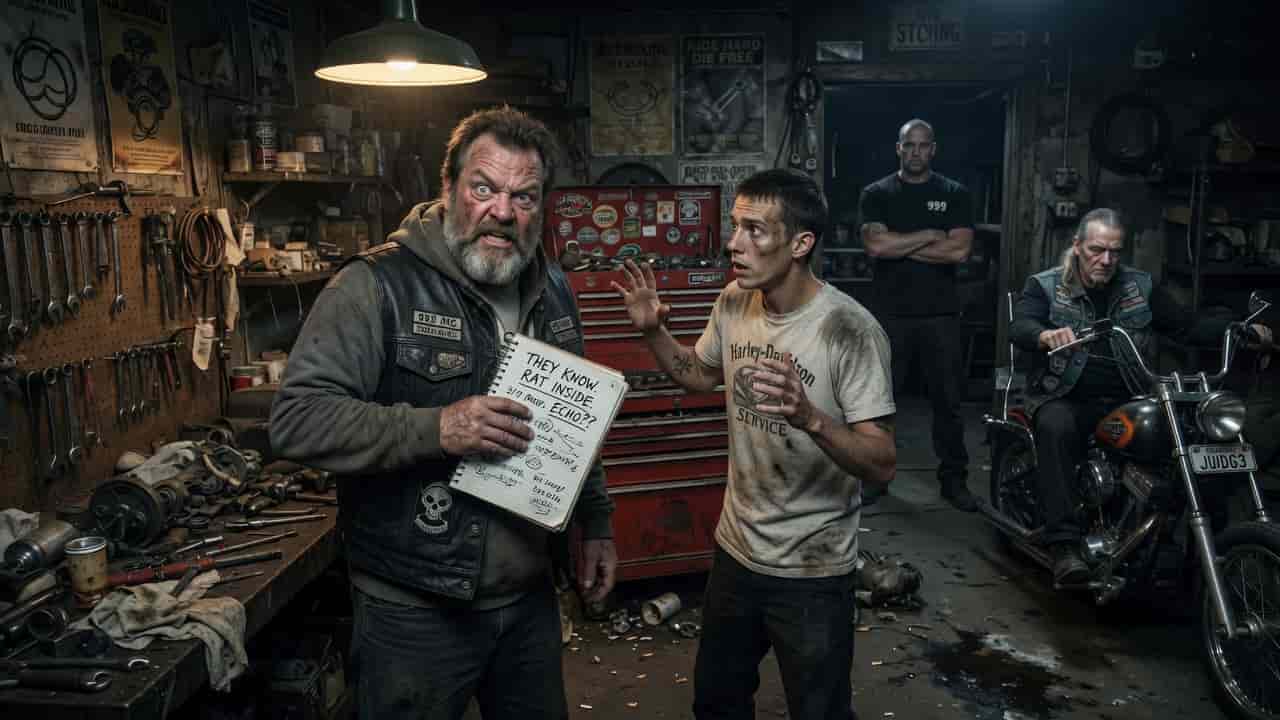
“You weren’t supposed to find that, Static. Nobody was.”
Ghost slammed the notebook onto the oil-stained workbench, the spiral wire screeching against the metal. He didn’t look like the man who had led the 999 MC for fifteen years. He looked like a cornered animal, his eyes darting to the shadows of the garage as if the ghosts of the men he’d already sent away were standing there, watching.
Static looked down at the page. His own name was at the bottom, circled in jagged, bleeding ink. Above it were the names of three brothers who had “disappeared” in the last month. The room went ice-cold. Outside, the rain drummed against the corrugated tin roof, but inside, the only sound was Ghost’s ragged, uneven breathing.
“Ghost, these men… they were loyal,” Static whispered, his voice cracking. “Bones had been with you since the beginning. Why is his name crossed out?”
Ghost stepped into Static’s personal space, the smell of stale tobacco and old regrets rolling off him. He grabbed Static’s wrist, his grip like a vice. “Loyalty is a feeling, Static. I deal in certainties. The voices in the exhaust… they don’t lie. They told me what you’re planning.”
Behind them, Echo stood in the doorway, his face unreadable. He didn’t move to help. He didn’t say a word. He just watched as the leader of their world prepared to erase his best friend.
Chapter 1
The air in the garage smelled of spent primary oil and the kind of dampness that only settles into Tennessee cinderblocks after three days of steady rain. Ghost Miller didn’t mind the smell. It was the sound that bothered him. Not the rain—the other sound. The low, rhythmic thrumming that came from the tailpipes of the big Twin Cams even when the ignitions were off. It sounded like whispering. It sounded like the guys from the 3rd Infantry, the ones who hadn’t made it back from the valley in Kunar.
He was fifty-five, but his hands felt eighty. He was currently “cleaning” a 2018 Road Glide. He’d been wiping the same chrome primary cover for twenty minutes, his rag moving in small, obsessive circles. He wasn’t looking at the chrome. He was looking at the reflection of the doorway behind him.
“You’re missing a spot, Miller.”
The voice was soft, like silk being pulled over a blade. Ghost didn’t flinch. He knew that voice. It was Clara. She’d been gone for six years, taken by a cancer that ate her from the inside out until she was just a collection of sharp bones and translucent skin. In his mind, though, she was still thirty, wearing that faded Harley-Davidson tank top and smelling of vanilla and chain grease.
“I’m busy, Clara,” Ghost muttered, his voice a gravelly rasp.
“You’re being watched,” she whispered. “The young ones. They think you’re slowing down. They think the 999 belongs to them now. You see how Static looks at you? Like you’re a bike with a cracked frame. Disposable.”
Ghost’s grip tightened on the rag. Static. He was the club’s best mechanic, a man Ghost had hand-picked to be his Sergeant-at-Arms after Bones… went away. Bones had been Ghost’s right hand for two decades. But Bones had started talking. Ghost was sure of it. He’d seen Bones whispering to a guy in a suit at a gas station in Clarksville. The exhaust had told Ghost the truth that night. He’s selling the routes, Ghost. He’s selling your life for a plea deal.
Bones hadn’t been seen since the club run to the Smokies. Ghost told the patch-holders that Bones had decided to go “nomad,” to clear his head. Most of them believed it. You didn’t question Ghost Miller. Not if you wanted to keep your teeth.
“Static is a good man,” Ghost said, though he was really talking to the primary cover.
“Static is smart,” Clara’s voice countered. “Smart men are the most dangerous. They don’t use their fists, Miller. They use their eyes. They find the cracks. And you’re full of cracks, honey.”
The heavy steel door at the front of the shop creaked open. The sound of the rain intensified for a second before the door slammed shut. Ghost didn’t turn around. He watched the reflection. It was Echo. The kid was barely thirty, a mountain of a man with a shaved head and a stoic temperament that made him the perfect enforcer. He did what he was told and didn’t ask questions. That was why Ghost liked him.
“Boss,” Echo said, his voice deep and steady. “The Judge is asking about the inventory for the North Carolina run.”
Ghost finally stopped the circular motion of his hand. He stood up slowly, his knees popping like small-caliber rounds. He turned to face Echo, keeping the rag draped over his hand. “The Judge can wait. I’m not finished here.”
Echo stayed by the door, his boots tracking mud onto the floor Ghost had swept three times that morning. “He’s in the back room with Static. They’re looking over the ledgers. Static said some of the numbers for the last shipment didn’t add up.”
Ghost felt a cold prickle of sweat break out along his spine. The ledgers. He kept the real books in his head, but he kept a notebook in his desk—a spiral-bound thing where he vented the things the exhaust told him. It was where he wrote the names. The ones who were “leaking.” The ones who needed to be “serviced.”
“Static needs to stay in his lane,” Ghost said, his eyes narrowing. “He’s a mechanic. Not an accountant.”
“He was just helping Judge,” Echo said defensively, his eyes shifting slightly. It was a tell. Echo was uncomfortable. He could feel the pressure in the room.
Ghost walked toward Echo, his heavy engineer boots thudding on the concrete. He stopped six inches from the younger man’s chest. Ghost was shorter, but he carried a density of violence that made him feel twice as large. “Did he touch my desk, Echo?”
“I don’t know, Boss. I just came to get you.”
“Go back there,” Ghost commanded. “Tell them I’m coming. And Echo?”
“Yeah?”
“Don’t let Static leave the room.”
Ghost watched Echo turn and walk toward the back of the garage. As soon as the kid was out of sight, Ghost leaned over the Road Glide. He could hear it again. The low hum of the exhaust, even though the bike had been cold for hours.
He saw it, the exhaust whispered. He saw the list. He knows about Bones. He knows he’s next.
Ghost felt the familiar surge of adrenaline, the sharp, metallic taste of PTSD-driven panic that he always mistook for clarity. He reached into the pocket of his hoodie and felt the small plastic orange bottle. He took two of the white pills—double his dose—and swallowed them dry.
“Time to clean the house, Miller,” Clara’s voice laughed in his ear.
He walked toward his office, his hand sliding behind his back to check the familiar weight of the .45 tucked into his waistband. He wasn’t going to let them take it. Not the club. Not the legacy. He’d seen his whole squad die in a ditch in Kunar because one man had hesitated. He wouldn’t hesitate again.
The garage felt longer than usual. The rows of bikes looked like sentinels, their chrome eyes watching him pass. He could hear the muffled voices of Static and Judge coming from behind the plywood door of the office. They were talking low. Planning.
Ghost didn’t knock. He kicked the door open.
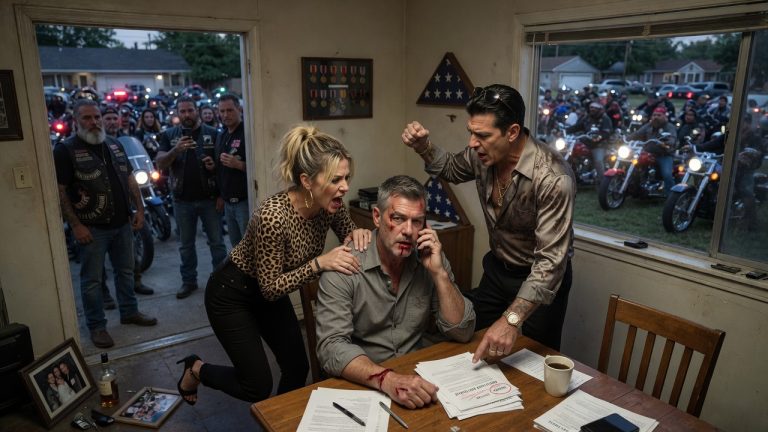
The room was small, lit by a single flickering fluorescent tube that hummed in B-flat. Judge, a man who looked like he’d been carved out of an old tire, was sitting in the swivel chair. Static was leaning over the desk, his hands planted firmly on the blotter. Between them lay the ledgers. And right next to the ledgers was the spiral notebook.
The room went dead silent.
Static looked up, his face pale under the fluorescent light. He didn’t look like a traitor. He looked like a man who had just seen a ghost. His eyes flicked from Ghost’s face down to the notebook, then back up.
“Ghost,” Static said, his voice carefully neutral. “We were just looking for the fuel receipts.”
Ghost didn’t look at the receipts. He looked at the notebook. It was open to the middle. The page where he’d written STATIC – TOO SMART – TALKS TO JUDGE – MONITOR FOR EXIT.
“Did you find what you were looking for?” Ghost asked. He stepped into the room, and Echo followed, closing the door behind him. The small space suddenly felt like a pressurized chamber.
Judge cleared his throat. He was the club’s elder, the man who kept the laws. He’d seen Ghost through the war, through the founding of the 999, through Clara’s funeral. “Ghost, sit down. We need to talk about these entries. Some of this… it doesn’t make sense.”
“The entries make perfect sense to me,” Ghost said. He walked around the desk, forcing Static to step back. Ghost picked up the notebook and closed it with a snap. He felt the weight of it, the physical manifestation of his paranoia. “This is my personal property. Why is it on the desk?”
“It was in the top drawer,” Static said, his voice gaining a bit of an edge. “The drawer was open, Ghost. I saw Bones’s name. I saw the date. The day he ‘went nomad.’”
Ghost felt the air leave his lungs. He looked at Static, really looked at him. He saw the betrayal he expected, but underneath it, he saw something worse: pity.
“You think you’re better than me?” Ghost asked, his voice a low, dangerous growl. “You think because you can tune an EFI system, you can judge how I run this family?”
“Nobody’s judging you, Ghost,” Judge said, though he didn’t move to defend him. “But we’re a brotherhood. We don’t cross our own out. Not without a vote. Not without proof.”
“I have all the proof I need,” Ghost said. He looked at Echo, who was leaning against the door. “Echo. What do we do with rats?”
Echo didn’t answer. He looked at the floor. The silence stretched, heavy and suffocating.
“Answer me!” Ghost screamed, the sound tearing through the small room.
Static didn’t flinch. He took a step forward, putting himself between Ghost and the door. “The only rat in this room is the one in your head, Ghost. You’re sick. Doc told me months ago you weren’t taking the meds. You’re killing your own brothers because you’re scared of shadows.”
Ghost’s hand went to the grip of the .45. He felt the cold steel, the promise of an end to the whispering. But then he saw Clara in the corner of his eye. She was shaking her head.
No, Miller. Not yet. Make them see. Make them understand who the king is.
Ghost let go of the gun. Instead, he grabbed the notebook and slammed it into Static’s chest, hard enough to knock the younger man back against the wall of filing cabinets.
“You want to talk about brotherhood?” Ghost spat. “You want to talk about trust? You’re in my office, reading my private thoughts, conspiring with the Judge to take my patch. That’s the betrayal, Static. Not what I did to Bones. What you’re doing right now.”
Static held the notebook against his chest as if it were a shield. “I’m trying to save the club, Ghost. Before there’s nobody left to ride.”
“Get out,” Ghost said, his voice suddenly cold and flat. “Both of you. Echo, stay here.”
Judge stood up, his old joints groaning. He looked at Ghost for a long time, a look of profound sadness. “We’re having a meeting tonight, Ghost. Full patch. No exceptions. You be there. And you bring the real books.”
Judge and Static walked out. Static paused in the doorway, the notebook still in his hand. He looked like he wanted to say something, but Ghost just stared through him. Static finally turned and left, leaving the door swinging.
Ghost sat down in the swivel chair. He felt the pills starting to hit, a dulling of the edges, a grey fog rolling into his mind.
“They’re going to take it, Miller,” Clara whispered from the desk. “They’re going to take everything we built.”
“Let them try,” Ghost whispered back. He looked at Echo, who was still standing by the door. “Echo. You’re with me, right? No matter what?”
Echo didn’t look at him. He was looking at the grease stain on the floor where Static had been standing. “I’m with the club, Ghost. You know that.”
Ghost closed his eyes. The exhaust was louder now. It wasn’t whispering anymore. It was roaring.
Chapter 2
The “Holy Ground” was what they called the assembly room at the back of the Tennessee warehouse. It was a space that had seen thirty years of blood, whiskey, and the kind of secrets that could bury a man in a shallow grave out by the Interstate. The walls were lined with the colors of the 999—triple nines in a circle of fire. Usually, the room felt like a fortress. Tonight, it felt like a tomb.
Ghost sat at the head of the long mahogany table. He had cleaned himself up, swapped the hoodie for a crisp black shirt under his vest, and polished his boots until they shone like obsidian. He wanted to look like the leader they feared. But inside, his mind was a fractured landscape. The double dose of pills had stopped the voices, but they’d replaced them with a heavy, viscous static that made it hard to follow the rhythm of the room.
Static was sitting halfway down the table. He’d changed into a clean shirt too, but his eyes were red-rimmed. He hadn’t returned the notebook. He’d kept it. Ghost could see the corner of it poking out of Static’s vest pocket.
There were twenty-four patched members in the room. The air was thick with the scent of stale beer and the electric tension of a storm about to break.
“Meeting is in session,” Judge said, striking a heavy wooden gavel against a brass plate. The sound echoed, sharp and final. “We’re here on a matter of club integrity. A grievance has been filed against the President.”
A low murmur rippled through the room. Ghost didn’t move. He kept his hands flat on the table, watching the way the light glinted off the heavy silver rings on his fingers.
“Who filed it?” a member named Rooster asked from the back.
“I did,” Static said, standing up. He didn’t look at the other members. He looked straight at Ghost. “And I did it because three of our brothers are missing, and I found the reason why.”
Static reached into his pocket and pulled out the spiral notebook. He held it up like a piece of evidence in a capital murder trial. “This belongs to Ghost. In it, he’s listed every one of us. He’s rated us on ‘loyalty.’ He’s been watching our phones, tracking our bikes. And he’s been crossing people out.”
“It’s a journal, you idiot,” Ghost said, his voice surprisingly steady despite the fog in his head. “A leader keeps notes. A leader watches for weakness. That’s why we’ve survived for thirty years while the other clubs are getting raided by the feds.”
“Bones wasn’t a weakness!” Static shouted, his composure finally breaking. “Bones was your brother! He was my mentor! You didn’t just cross him out, Ghost. You ended him. And you did it because you thought he was talking to the feds? Bones would have died before talking to a badge. We all know that.”
Ghost felt the room turning. He could see it in the eyes of the younger members—the “Mirror,” a kid named Jax who had just come back from a tour in Iraq. Jax was looking at Ghost with a mix of confusion and dawning horror. Jax had the same thousand-yard stare Ghost had carried for decades. He was the one Ghost had hoped to mold, to make sure the 999 stayed “clean.”
“Bones was compromised,” Ghost said, standing up slowly. He leaned over the table, his shadow stretching long and jagged across the members. “I saw him. I heard him. You think you know what goes on in the dark? You think you know the pressure of keeping this family safe? None of you have the stomach for what it takes.”
“We have the stomach for the truth,” Judge said, his voice weary. “Ghost, if you had proof, you should have brought it to the table. You don’t get to be judge, jury, and executioner in the dark. That’s not the 999 way.”
“The 999 way is whatever I say it is!” Ghost roared, slamming his fist onto the mahogany. The whiskey glasses on the table rattled. “I built this! I bled for this! When the Outlaws tried to take this territory in ’98, where were you, Static? You were in middle school! I’m the one who buried the bodies that kept you safe!”
“And now you’re burying us,” Static said quietly. He opened the notebook and began to read. “November 12th. Echo is hesitant. Needs a reminder of who owns him. December 4th. Static is asking too many questions about the North Carolina run. Possibly working with Judge to undermine authority.”
Static looked up, his eyes wet. “You think we’re enemies, Ghost. We’re the only family you have left. But you’ve pushed Clara away, and now you’re pushing us into the ground.”
The mention of Clara was like a physical blow. Ghost felt the grey fog in his mind snap. For a second, he saw her standing behind Static, her hand on the younger man’s shoulder, nodding.
He’s right, Miller, she whispered. You’re the one who’s leaking. You’re the one who’s broken.
“Don’t you talk about her,” Ghost hissed, his hand hovering near his belt. “Don’t you ever say her name.”
“Why not?” Static challenged, stepping around the table. He was baiting him. Ghost could see it, but he couldn’t stop himself. “Because you’re ashamed? Because you know she’d be disgusted by what you’ve become? You’re not a leader anymore, Ghost. You’re a sick old man playing God in a garage.”
The room erupted. Half the members were on their feet, shouting. Judge was slamming the gavel, but nobody was listening.
In the chaos, Ghost saw the world in high-definition fragments. He saw the sweat on Static’s upper lip. He saw the way Echo was standing by the door, his hand on his holster, looking not at the room, but at Ghost. He saw the “Mirror,” Jax, looking down at his own hands, trembling.
Ghost felt the rage boil up, a hot, black tide that drowned out the pills. He reached across the table and grabbed Static by the front of his vest, yanking him forward. The notebook fell to the floor, forgotten.
“You want to see a sick old man?” Ghost growled into Static’s face. “I’ll show you what a sick old man can do.”
He shoved Static backward, sending him sprawling over his chair. Ghost didn’t stop. He went over the table, a lifetime of combat muscle memory taking over. He pinned Static against the floor, his knees on the man’s biceps, his hands around his throat.
“Ghost, stop!” Judge was screaming.
“Get off him!” Rooster yelled.
But Ghost didn’t hear them. He heard the exhaust. It was screaming now, a high-pitched wail of agony and betrayal.
Kill him, Miller. Clean the house. He saw the list. He knows.
“You’re the rat,” Ghost choked out, his thumbs pressing into Static’s windpipe. “You’re the one who’s going to destroy everything.”
Static’s face was turning purple. His hands clawed at Ghost’s wrists, but Ghost was a block of granite. He felt a strange sense of peace. If he just finished this, the voices would stop. The house would be clean.
Then, a pair of massive hands grabbed Ghost by the shoulders and yanked him backward.
It was Echo.
The enforcer didn’t strike Ghost. He just held him, his grip unbreakable. He pulled Ghost off Static and pinned him against the wall.
“Enough, Boss,” Echo said. There was no anger in his voice, only a profound, hollow disappointment. “It’s over.”
Static rolled onto his side, gasping for air, clutching his throat. The rest of the club stood in a semi-circle, watching their leader struggle in the arms of his own enforcer.
Ghost stopped fighting. He slumped against the wall, his chest heaving. He looked at the faces of his “brothers.” He didn’t see loyalty. He didn’t even see fear anymore. He saw what he had dreaded most: they were looking at him like he was a stray dog that needed to be put down.
“Ghost Miller,” Judge said, his voice shaking. “By the laws of the 999, you are hereby stripped of your patch. You have one hour to clear your personal effects from the property. If you’re seen on club land after that, you’ll be treated as a trespasser.”
Ghost looked at Judge. The man he’d known for forty years. The man who had held his head while he cried at Clara’s wake.
“You’re taking my life,” Ghost whispered.
“You already gave it away, Ghost,” Judge said. He turned to the room. “Meeting adjourned.”
The members began to file out, none of them meeting Ghost’s eyes. Even Jax, the young mirror of himself, walked past without a word, his head bowed.
Static was the last to leave the table. He picked up the spiral notebook from the floor. He looked at it for a long time, then looked at Ghost. He didn’t say anything. He just dropped the notebook onto the mahogany table and walked out.
Echo finally let go of Ghost’s shoulders. He stepped back, his face a mask of stone. “I’ll help you pack your bike, Boss.”
“Get out, Echo,” Ghost said, his voice hollow.
“Ghost—”
“I said get out!”
Echo hesitated, then turned and left, closing the heavy doors behind him.
Ghost was alone in the Holy Ground. The silence was deafening. He looked at the notebook sitting on the table. He walked over and picked it up. He turned to the last page.
There, in his own handwriting, was a final entry he didn’t remember writing.
January 10th. The exhaust is gone. It’s just me now.
He felt a cold wind blow through the room, though the windows were shut. He looked toward the corner. Clara wasn’t there.
He was truly alone.
Chapter 3
The rain hadn’t stopped; it had only grown more insistent, a cold, grey curtain that wrapped around the Tennessee hills like a shroud. Ghost Miller stood in the center of the garage, the space that had once been his kingdom, now feeling like a foreign territory. He had forty-five minutes left.
He moved to his workbench. He didn’t look at the bikes. He looked at the small things. A worn 1/2-inch wrench that had belonged to his father. A photograph of the 999’s founding members, taken outside a dive bar in Memphis in 1994. Half of the men in that photo were dead. The other half had just voted him out.
He felt the residue of the confrontation in the Holy Ground. His hands were still shaking, a fine, rhythmic tremor that no amount of pills could steady. His throat felt raw from screaming, and his chest ached where Echo had pinned him. But the physical pain was nothing compared to the psychological weight. The club wasn’t just a group; it was the architecture of his identity. Without the patch, he was just a man with a broken brain and a garage full of ghosts.
“You can’t just leave it like this,” a voice said.
Ghost froze. It wasn’t Clara this time. It was Static.
The younger man was standing in the shadows by the tool chests, his arms crossed. He had a dark bruise already forming on his neck where Ghost’s thumbs had dug in.
“Judge said an hour,” Ghost said, not turning around. “I’m moving as fast as I can.”
“I’m not talking about the clock, Ghost. I’m talking about the names.” Static stepped into the light. He held a manila folder in his hand. “I went to Bones’s house. After the meeting. I talked to his sister.”
Ghost felt a sharp, icy spike of fear. “She doesn’t know anything.”
“She knew enough to give me this,” Static said, tossing the folder onto the workbench. It slid across the grease-stained wood and hit Ghost’s hand. “Bones wasn’t talking to the feds, Ghost. He was talking to a lawyer. He was trying to set up a trust for Clara’s medical debts. He knew you were drowning in the bills from the private clinic. He was trying to use his own share of the North Carolina runs to pay them off without telling you, so you wouldn’t feel like a charity case.”
Ghost stared at the folder. He didn’t open it. He couldn’t.
“The guy in the suit at the gas station?” Static continued, his voice low and painful. “That was a paralegal. Bones was signing the papers that day. He wanted it to be a surprise for your anniversary.”
The room seemed to tilt. The whispering exhaust wasn’t there, but the silence that replaced it was worse. It was a vacuum that sucked the air out of his lungs.
“No,” Ghost whispered. “He was… I heard him. The voices… they said he was selling us out.”
“The voices lied to you, Ghost. Just like they’re lying to you about me. Just like they’re lying to you about everything.” Static walked closer, stopping just out of arm’s reach. “You killed the most loyal man you ever knew because you couldn’t tell the difference between your trauma and the truth.”
The humiliation of it landed in Ghost’s gut like a lead weight. To be stripped of his patch was one thing; to realize he had murdered his brother for a gesture of love was a destruction he wasn’t sure he could survive. He felt small. He felt diminished. He looked at his hands—the hands of a leader, a warrior—and saw only the instruments of a tragic mistake.
“Why are you telling me this now?” Ghost asked, his voice breaking. “To make sure I hurt more before I go?”
“No,” Static said. “I’m telling you because I’m not the one who’s going to lead this club. I’m leaving too.”
Ghost looked up, surprised. “What?”
“I can’t stay here,” Static said, looking around the garage with a expression of pure exhaustion. “Every time I look at the bikes, I’ll see Bones. Every time I look at the table, I’ll see you. The 999 died a long time ago, Ghost. We just didn’t notice because you kept the chrome so shiny.”
Static reached out and picked up the spiral notebook, which was still sitting on the bench. He didn’t open it. He just held it. “I’m taking this. If I leave it here, Judge will use it to justify his own purge. He’s already looking at Rooster and Jax. He wants a ‘clean’ club too, Ghost. Just a different kind of clean.”
The realization hit Ghost then—the cycle of paranoia wasn’t just in his head. It was built into the social structure of the club itself. He had been the one to start it, but it was a machine that would keep grinding long after he was gone.
“Static,” Ghost said, reaching out a hand, then pulling it back. “I’m… I’m sorry.”
The words felt inadequate, thin and pathetic in the heavy air of the garage.
Static looked at the bruise on his neck in the reflection of a nearby windshield. “Don’t be sorry, Ghost. Just be gone. Before I change my mind and call the sheriff about what happened in the Smokies.”
Static turned and walked toward the back exit. He didn’t look back. He vanished into the rain, leaving the door standing open.
Ghost stood alone. He looked at the manila folder. He finally opened it. Inside were the trust documents. Bones’s signature was at the bottom, bold and familiar. There was a small note clipped to the back.
For the Boss. Because he carries enough. – Bones.
Ghost felt a sob tear through his chest, a raw, jagged thing that he couldn’t suppress. He leaned over the workbench and wept, the sound lost in the roar of the rain on the roof.
He heard a soft footstep behind him.
“He’s right, you know,” Clara’s voice said. She sounded different now. Not sharp. Just tired. “You carry too much, Miller. You always did. That was the problem. You thought if you let go, the world would stop turning.”
Ghost wiped his eyes with the back of a greasy hand. He didn’t look at her. “I have to leave.”
“Where will you go?”
“I don’t know,” he said. “Somewhere quiet. Somewhere without engines.”
He grabbed his leather duffel bag and stuffed the folder inside. He didn’t take the tools. He didn’t take the photos. He took only the things that belonged to the man, not the President.
He walked over to his personal bike, a 1996 Heritage Softail. It was the bike he’d ridden when he first met Clara. No chrome. Just matte black paint and the steady, reliable heart of an Evolution motor. He swung his leg over the saddle and kicked it over.
The engine roared to life. He waited for the whispering. He waited for the voices to tell him who to watch, who to fear.
But there was nothing. Only the mechanical rhythm of the pistons and the steady beat of the rain.
He rode out of the garage, his headlight cutting a lonely path through the darkness. As he passed the gate of the 999 compound, he saw Echo standing by the guard shack. The big man didn’t move. He didn’t wave. He just stood there in the rain, a silent witness to the end of an era.
Ghost didn’t look back. He rode toward the Interstate, the cold air biting through his shirt. He was a man without a patch, without a family, and without a future. But for the first time in years, the only voice he heard was his own.
Chapter 4
The motel was called The Blue Ridge, a collection of sagging plywood cabins on the edge of a forgotten town called Hopewell. It was thirty miles from the compound, but it felt like another planet. Ghost sat on the edge of the sagging mattress, the room smelling of lemon-scented bleach and ancient cigarette smoke. His bike was parked right outside the door, the metal ticking as it cooled in the night air.
The silence of the motel room was its own kind of pressure. For years, his life had been defined by the constant presence of men—the brotherhood, the noise, the drama of the 999. Now, the only sound was the hum of the mini-fridge and the occasional car passing on the highway.
He felt the emotional residue of the last twenty-four hours clinging to him like road grime. Every time he closed his eyes, he saw Bones’s face. Not the dead version from his nightmares, but the living one—the man who had been trying to save him while Ghost was planning his end. The guilt was a physical weight, a constriction in his chest that made every breath a struggle.
He reached for his duffel bag and pulled out the orange pill bottle. He looked at it for a long time. The doctor had told him these would “even out the spikes,” but they’d only blurred the lines between reality and his own fears. He opened the bottle and dumped the white tablets into the palm of his hand.
“They’re the only thing keeping you from the dark, Miller,” Clara’s voice said from the chair by the window. She was sitting in the shadows, her face obscured.
“The dark is already here, Clara,” Ghost said. He looked at the pills. “They didn’t save Bones. They didn’t save the club. They just made me a better monster.”
He walked to the small bathroom and flushed the pills down the toilet. He watched them swirl and disappear, feeling a strange sense of finality. He was going to face the voices. All of them.
He went back to the bed and opened the manila folder again. He read through the trust documents one more time. Bones had allocated nearly fifty thousand dollars—his entire life savings—to ensure that Ghost would never lose the house they’d shared. It was a level of loyalty that Ghost had preached about but never truly practiced.
He felt a sudden, urgent need to talk to someone. Not a ghost. Not a memory. A living person who knew the truth of what he was.
He picked up his phone. He had one number saved that wasn’t club-affiliated.
“Hello?” the voice on the other end was cautious, weary. It was Doc, the club’s former medic who had left two years ago after Ghost had accused him of stealing morphine.
“Doc. It’s Miller.”
There was a long silence. Ghost could hear the sound of a television in the background.
“I heard what happened tonight,” Doc said finally. “The word travels fast in the MC world, Ghost. Even to us retirees.”
“I need to know the truth, Doc. About the meds. About my head.”
Doc sighed, a heavy sound. “I told you two years ago, Ghost. You have a severe case of combat-related PTSD, likely compounded by early-onset cognitive decline. The paranoia wasn’t a choice. It was a symptom. But you didn’t want to hear it. You wanted to believe everyone was a traitor because that was easier than believing you were losing your mind.”
“I killed Bones,” Ghost said, the words finally spoken aloud to someone who could understand.
“I know,” Doc said softly. “Everyone suspected it, Ghost. But nobody wanted to be the one to say it. Because we all loved you. And we were all afraid of you.”
The “afraid” part hit Ghost harder than the “love.” He had built a life on being the man people feared, thinking that fear was the same thing as respect. Now he saw it for what it was: a wall that kept the truth out until it was too late.
“What do I do now?” Ghost asked.
“You go to the VA, Ghost. You check yourself in. You tell them everything. The war, the club, the voices. You start the work. It’s going to be ugly. It’s going to hurt worse than any road rash you’ve ever had. But it’s the only way you get to be a human being again.”
“I don’t know if I can,” Ghost said, looking at his shaking hands.
“You’re a 999, Miller. Or at least you were. You survived Kunar. You can survive yourself.”
Ghost hung up the phone. He sat in the dark for a long time, watching the neon sign of the motel flicker blue and red against the curtains.
He thought about Static. He thought about the notebook. He hoped Static was far away by now, away from the shadow of the club and the legacy of the man he’d once looked up to.
Around 3:00 AM, the voices started to return. Not as whispers from the exhaust, but as a low, persistent humming in the back of his skull. They were calling his name. They were reminding him of the things he’d done, the blood on the chrome, the lies he’d told himself.
He didn’t reach for the pills. He didn’t reach for the bottle of whiskey in his bag.
He sat on the floor, his back against the bed, and he listened. He let the ghosts into the room. He let Bones sit across from him. He let the boys from the 3rd Infantry stand in the corners. He let them all speak.
He didn’t argue. He didn’t defend himself. He just sat there and endured the humiliation of his own memory.
As the first grey light of dawn began to bleed through the curtains, the voices finally grew quiet. Not because they were gone, but because he had stopped fighting them. He was exhausted, broken, and alone. But he was also, for the first time in thirty years, seeing the world as it actually was.
He stood up, his joints screaming, and walked to the window. He looked out at his bike. It looked smaller now. Just a machine.
He grabbed his bag and walked out to the parking lot. The rain had stopped, leaving the world feeling scrubbed and raw. He swung his leg over the saddle and started the engine.
He didn’t head back to the compound. He didn’t head toward the Interstate.
He headed toward the VA hospital in Nashville.
As he rode, he saw a black SUV following him at a distance. He knew who it was. It was Echo. The club wouldn’t just let him go. Not yet. They wanted to make sure the “trash” was properly disposed of.
Ghost didn’t care. He didn’t check his mirrors. He just kept his eyes on the road ahead, the wind on his face, and the silence in his heart.
The story of Ghost Miller, the king of the 999, was over. The story of Arthur Miller, the man, was just beginning. And Arthur Miller was done with ghosts.
Chapter 5
The Nashville VA Medical Center sat like a concrete fortress on the edge of Vanderbilt’s sprawl, a monument to a bureaucracy that specialized in the slow processing of broken men. Ghost Miller pulled his Heritage Softail into the motorcycle parking area, the engine’s final chug sounding like a tired sigh. He didn’t turn the handlebars to lock the fork. He just sat there, his boots planted in the gravel, watching the black SUV pull into a space fifty yards away.
Echo didn’t get out of the car. He didn’t turn off the engine. The tinted windows were like dead eyes, reflecting the humid Tennessee morning.
Ghost felt the pressure of the SUV’s presence in the small of his back. It was the residue of the 999—the club’s long reach, reminding him that a man didn’t just walk away from thirty years of blood and chrome because he had a bad night in a warehouse. He took a deep breath, trying to find the air. It felt thin, filtered through the memory of the exhaust fumes he’d been inhaling since the nineties.
“He’s waiting for you to fail, Miller,” Clara’s voice said. She wasn’t in the shadows this time. She was sitting on the pillion seat behind him, her phantom weight familiar and agonizing. “He’s waiting for you to turn that bike around and ride back to the compound. He thinks you’re just having a moment.”
“It’s not a moment, Clara,” Ghost whispered. He reached for his duffel bag, pulling it over his shoulder. The weight of the trust documents for Bones’s family felt heavier than his tools ever had.
He stood up, his knees screaming. He walked toward the main entrance, his leather vest—the one with the empty space where the colors used to be—feeling like a suit of lead. Every step toward the sliding glass doors felt like a betrayal of the only world he’d ever known.
The lobby was a cavern of fluorescent lights and the smell of industrial-grade lavender soap masking something sour. It was crowded. Men in faded camo hats, men in wheelchairs, men staring at nothing with eyes that had seen too much sand and not enough sleep. Ghost felt a sudden, sharp pang of humiliation. He was Arthur Miller here. He wasn’t the President. He wasn’t the man who decided who lived and who went “nomad.” He was just another number in the triage line.
He approached the intake desk. The woman behind the plexiglass, a nurse named Mrs. Gable with tired eyes and a name tag that was slightly crooked, didn’t look up from her screen.
“Name?” she asked, her voice a flat, practiced monotone.
“Miller. Arthur.”
She typed it in. “Date of birth?”
He gave it. She paused, her eyes flicking up to his vest. She’d seen a thousand men like him—old bikers, old soldiers, men who carried their history in their scars and their leather. She didn’t look impressed. She looked like she was counting the hours until her shift ended.
“What brings you in today, Mr. Miller?”
Ghost looked at the plexiglass. He saw his own reflection—the grizzled beard, the hollowed-out eyes, the shaking hands he couldn’t hide. He thought about the warehouse. He thought about the look on Static’s face as Ghost’s thumbs had pressed into his throat. He thought about Bones, buried in a place no one would ever find.
“I… I’m hearing things,” Ghost said, his voice barely a whisper. “The engines. They don’t stop talking to me. I think I’m going to hurt someone else if I don’t stop.”
Mrs. Gable’s expression didn’t change, but her fingers stopped moving on the keyboard. She looked at him, really looked at him, for the first time. It wasn’t pity. It was a cold, professional assessment.
“Have you hurt someone recently, Arthur?”
The question hung in the air like a live wire. Ghost felt the sweat bead on his forehead. He could see Echo through the glass doors of the lobby, leaning against the hood of the SUV now, lighting a cigarette. A silent witness.
“Yes,” Ghost said. “I have.”
“Are you a danger to yourself or others right now?”
“I don’t know,” Ghost admitted. “I think I’m just… I’m done. I can’t be in the room anymore.”
Mrs. Gable nodded slowly. She reached for a yellow clip-on tag. “Take a seat in the blue section, Arthur. A crisis counselor will be with you shortly. Don’t leave the building.”
Ghost took the tag. He walked to the blue chairs, a row of plastic seats that felt as welcoming as a prison bench. He sat down, clutching his duffel bag to his chest. He felt small. The psychological armor of the 999 had been stripped away, leaving only the raw, vibrating nerves of a man who had realized too late that he was his own worst enemy.
Ten minutes later, the sliding doors opened. Echo walked in.
The big man didn’t look like an enforcer here. In the sterile light of the VA, he just looked like a large, out-of-place biker. He scanned the room and locked onto Ghost. He walked over, his heavy boots silent on the linoleum, and sat in the chair next to Ghost.
“Judge sent me,” Echo said. He didn’t look at Ghost. He looked at a poster on the far wall about tobacco cessation.
“I’m sure he did,” Ghost said, his voice flat. “Is he worried about my health? Or is he worried about the books?”
“He’s worried about the silence, Ghost. He thinks you might start talking to the wrong people. People in white coats. People with badges.”
Ghost looked at Echo’s profile. He saw the tension in the younger man’s jaw. Echo had been Ghost’s shadow for five years. He’d seen the “cleansings.” He’d been the one to drive the truck on the nights when the exhaust was the loudest.
“I already told the nurse I hurt people, Echo. I’m already talking.”
Echo finally turned his head. His eyes were hard. “You think this place can protect you? Judge is already moving the shipments. He’s re-routing everything through the mountains. He wants you to come home. He says all is forgiven if you just come back and take your seat as Elder. No more President. Just… the old man in the back room.”
The offer was a death sentence disguised as a mercy. If Ghost went back, he’d be a figurehead, a puppet for Judge to use until the memory of Bones faded, and then Ghost would have his own “nomad” moment.
“I’m not an old man in a back room, Echo. I’m a murderer.”
Echo flinched. It was a small movement, but in the stillness of the waiting room, it felt like a gunshot. “Don’t say that word. Not here.”
“Why? Because it makes it real? Because it means you’re an accomplice?” Ghost leaned in, his voice a low, jagged rasp. “Static was right. We killed our brothers for a lie I told myself. We didn’t save the club. We gutted it.”
“I was following orders,” Echo whispered, his voice cracking. “I was loyal.”
“Loyalty to a madman isn’t a virtue, Echo. It’s a tragedy.”
Ghost reached into his bag and pulled out the manila folder. He handed it to Echo. “This is Bones’s legacy. He was trying to pay off Clara’s bills. He loved me more than I loved myself. And I let you help me put him in the ground.”
Echo took the folder. His hands, usually so steady, were trembling as he looked at the trust documents. He read the note from Bones. He sat there for a long time, the paper crinkling in his grip.
“Judge knew,” Echo said suddenly. It was a realization that seemed to hollow him out from the inside. “He knew Bones was talking to a lawyer. He told me it was the feds. He told me to let you believe the voices, because it was the only way to get Bones out of the way so he could take the books.”
The betrayal was complete. It wasn’t just Ghost’s mind; it was the cold, calculated ambition of the man who had been his brother for forty years. Judge had weaponized Ghost’s PTSD to clear a path to the throne.
“We’re both fools, Echo,” Ghost said.
“Arthur Miller?” a voice called out.
A young man in a lab coat stood at the entrance to the clinical wing. He looked kind, and he looked like he was about twenty years younger than the problems he was about to inherit.
Ghost stood up. He looked at Echo. “You have a choice, kid. You can go back and tell Judge I’m a lost cause. Or you can sit here and tell me where the rest of them are buried.”
Echo looked at the folder, then at the doors. He looked at the black SUV waiting in the sun. He looked at Ghost, seeing not the President, but a man who had finally stopped running.
“I’ll stay,” Echo said.
Ghost nodded. He walked toward the young doctor, leaving the leather vest on the plastic chair. He didn’t need the armor anymore. He was going into the room. And this time, he was going in with the lights on.
Chapter 6
The “Room” wasn’t a room at all; it was a secure psychiatric ward on the fourth floor of the VA. It smelled of floor wax and the faint, lingering scent of unwashed bodies. There were no sharp edges. No belts. No laces. No patches.
Ghost Miller sat in a plastic chair in the common area, watching the sun set over the Nashville skyline through the reinforced glass. He’d been there for three days. The “static” in his head hadn’t disappeared, but it had slowed down. The doctors had him on a new regimen—meds that didn’t just numb the fear, but seemed to ground him in the present.
For the first time in decades, the exhaust was silent.
He looked down at his hands. They were still, resting on the knees of his hospital-issued grey sweats. He felt a strange, hollowed-out peace. The humiliation of the intake—the stripping, the searching, the loss of his name—had acted like a cauterization. The President of the 999 was dead. Arthur Miller was just a patient.
“You have a visitor, Arthur,” a tech said, tapping on the door frame.
Ghost didn’t expect anyone. He figured Echo had vanished into the wind, and Static was halfway to the coast by now.
Static walked into the room.
He looked different. He wasn’t wearing his vest. He was wearing a plain flannel shirt and jeans. He looked younger, the stress of the club life having drained from his face, replaced by a deep, pensive sadness. He sat across from Ghost, leaning his elbows on his knees.
“I heard you stayed,” Static said.
“I didn’t have anywhere else to go,” Ghost replied. His voice was soft, lacking the gravelly authority it once held.
“Judge is gone,” Static said. He said it casually, as if talking about a bike that had finally given out. “Echo went back to the compound. He didn’t go for his patch. He went for the books. He showed the trust documents to the full table. He told them what Judge did—how he played you, how he let Bones die for a ledger.”
Ghost felt a ripple of something—not joy, but a grim satisfaction. “And?”
“Rooster and Jax… they didn’t take it well. There was a fight. Judge tried to pull a piece, but Echo was faster. He didn’t kill him. He just… broke him. Broke his hands, Ghost. Said a man who plays with other people’s lives doesn’t get to hold a gavel anymore.”
Ghost closed his eyes. He could picture the scene. The Holy Ground turned into a butcher shop. The residue of his own leadership, coming back to haunt the man who had usurped him.
“The club?” Ghost asked.
“Dissolved,” Static said. “Most of the guys just walked away. They realized the patch didn’t mean anything if the man wearing the center-piece was a lie. 999 is a memory now. A bad one.”
The realization hit Ghost with the force of a physical blow. Thirty years. His entire life, his identity, the family he’d built with Clara—all gone. It was the consequence he had earned. He had burnt his house down to find a ghost, and all he’d found was ash.
“I’m going to the feds, Static,” Ghost said. He opened his eyes and looked at the younger man. “I’m going to tell them about the Smokies. I’m going to tell them where Bones is.”
Static didn’t look surprised. He just nodded. “I figured you might. Echo said he’d testify too. He’s done being the shadow.”
“Why are you here, Static? You should be a thousand miles away from me.”
Static reached into his pocket and pulled out the spiral notebook. He set it on the table between them. “I couldn’t leave this with him. And I couldn’t throw it away. It’s not just a list of names, Ghost. It’s a map of a man falling apart. It’s the truth of what we were.”
Static stood up. He didn’t offer his hand. He didn’t offer forgiveness. He just looked at Ghost with a complicated mix of pity and respect for the choice he was making.
“I hope you find some peace, Arthur. Real peace. Not the kind that comes in a bottle.”
Static walked out, leaving the notebook on the table.
Ghost looked at the spiral wire. He didn’t open it. He didn’t need to read the entries anymore. He remembered every word, every paranoid thought, every name he’d crossed out. He stood up and walked to the nurse’s station.
“I need to make a phone call,” he said to the nurse. “To the District Attorney’s office.”
The process took hours. There were detectives, there were statements, there were lawyers. Ghost sat in a small room with a tape recorder, and for the first time in his life, he told the absolute, unvarnished truth. He told them how he’d killed his best friend. He told them how the war had never really ended for him, just shifted to a different battlefield.
By the time the sun came up the next morning, Ghost was in handcuffs, being led out of the VA by two marshals. He wasn’t afraid. He felt a lightness he hadn’t known since he was a kid in East Tennessee, before the recruiters and the bikes and the blood.
He was led past the entrance where he’d parked his bike three days ago. The Heritage Softail was gone—probably towed or stripped for parts. He didn’t care.
As he was being put into the back of the transport van, he saw a woman standing by the edge of the parking lot. She was wearing a faded Harley-Davidson tank top and smelling of vanilla and chain grease. She wasn’t whispering. She was just standing there, her hands in her pockets, watching him.
She didn’t look thirty anymore. She looked her age. She looked tired. But she was smiling.
“You’re finally home, Miller,” she said.
Ghost didn’t answer. He couldn’t. He just sat in the back of the van and listened to the sound of the engine. It was just an engine. No voices. No whispers. Just the steady, mechanical heartbeat of a world that was moving on without him.
The van pulled away, heading toward the courthouse and the life that awaited him—a life of cells and silence and the long, slow work of atonement. But as the Nashville skyline faded into the distance, Ghost Miller realized he wasn’t alone. He had his memories, he had his truth, and for the first time in thirty years, he had himself.
The king was gone. The man remained. And that was enough.