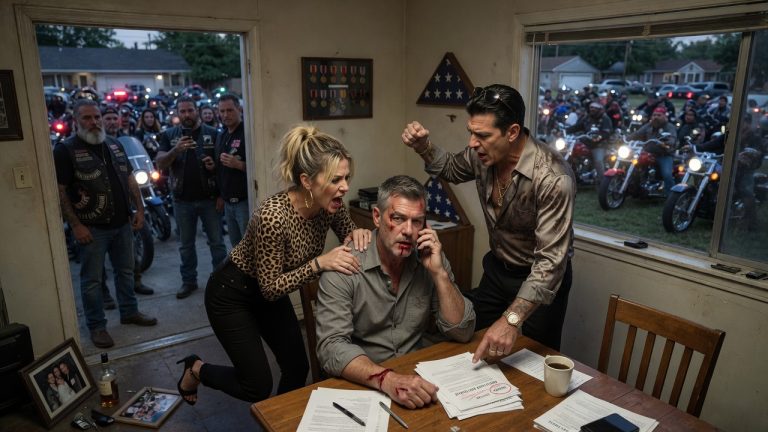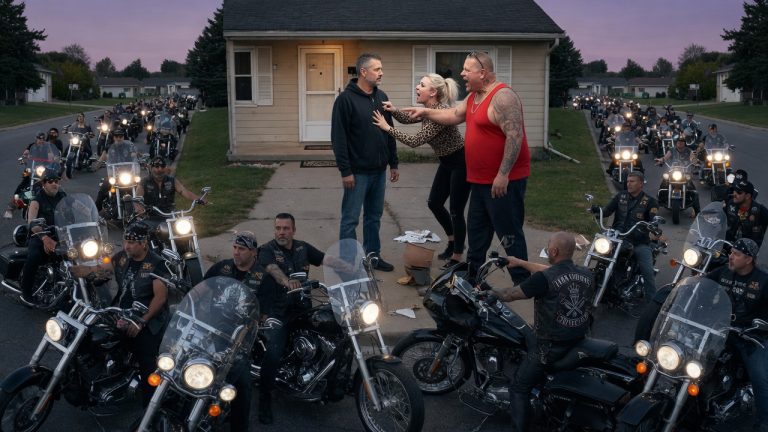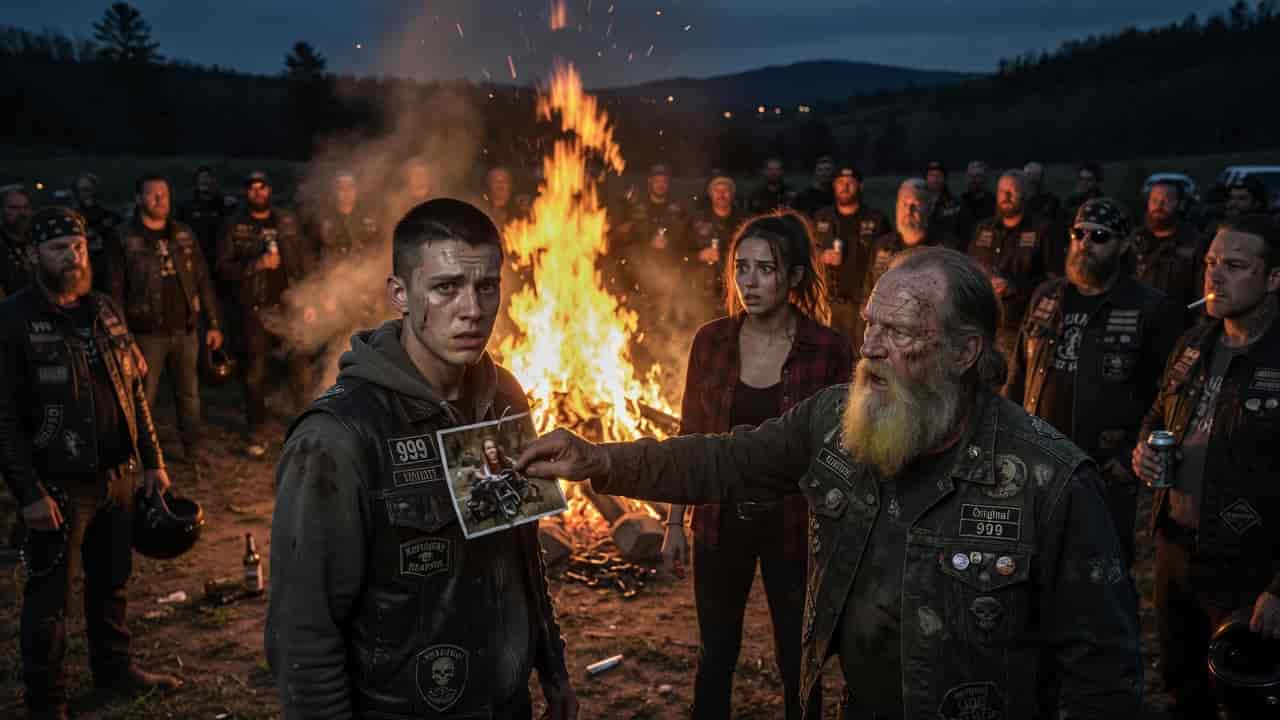
“Look at the photograph, Cade. Tell the men why you were standing by your father’s bike an hour before it went off the road.”
The firelight turned Old Man Joe’s face into a mask of jagged shadows. He didn’t just hold the picture; he weaponized it, shoving the stained paper against my chest until I could smell the old engine oil on his skin. Behind him, nine hundred and ninety-nine men—men I was supposed to lead—stood in a silence so heavy it felt like it was crushing the air out of my lungs.
I looked at the photo. I saw myself, younger, thinner, holding the heavy shears I’d used to ensure the tragedy happened. I looked at Lena, my sister, who was the only one who knew the truth about what our father had done to us behind closed doors. She was shaking, her eyes begging me to lie, but Joe wasn’t giving me a way out.
“It was an accident,” I whispered, but my voice broke.
“An accident doesn’t leave tool marks on a brake line, boy,” Joe shouted, his voice echoing off the Kentucky hills. “Now look at these men—men who bled for your father—and tell them what you really did.”
I realized then that I wasn’t the king of this club. I was just the next victim of the legacy my father had built with his fists.
Chapter 1: The Weight of Steel
The air in the Kentucky hills doesn’t just sit; it hangs, heavy with the scent of damp pine, woodsmoke, and the metallic tang of old motor oil. It’s a smell that gets under your fingernails and stays there, no matter how hard you scrub at the shop sink. For me, that smell was the only inheritance I ever really wanted, even if the rest of it was a curse I couldn’t outrun.
I sat on the edge of the stone slab that marked my father’s rest, the leather of my vest creaking as I leaned forward. It was a massive piece of granite, far too grand for a man who had spent his life making sure everyone around him felt small. Elias Hudson. Founder. Father. Leader. The words were etched deep, but they didn’t say anything about the way his knuckles felt against a jawbone or the way he could make a room go cold just by walking into it.
“One year, Dad,” I muttered, my voice disappearing into the rustle of the trees. “One year since the road took you.”
I reached into the pocket of my hoodie, my fingers brushing against the cold, jagged edge of a pair of heavy-duty wire cutters. They stayed in my pocket most days, a secret weight that kept me grounded. They were the tools that had changed the world. Or at least, they had changed my world.
The sound of a heavy engine thrummed in the distance, a low-frequency vibration that I felt in my teeth before I heard it. It was a Harley, tuned perfectly, the unmistakable rhythm of the Iron Crown Motorcycle Club. I didn’t have to look to know who it was. There was only one man who rode that specific Panhead with that specific arrogance.
Old Man Joe pulled up to the edge of the cemetery, the gravel spitting beneath his tires. He didn’t kill the engine immediately. He let it idle, a rhythmic mechanical heart beating in the silence of the dead. He sat there for a long moment, his greying beard caught in the wind, his eyes fixed on me. Joe had been my father’s right hand, the man who handled the money and the secrets while my father handled the violence. Since the accident, Joe had been a shadow I couldn’t shake.
Finally, he thumbed the kill switch. The silence that followed was worse than the noise.
“You spend too much time up here, Cade,” Joe said, his voice like two stones grinding together. He didn’t get off the bike. He just leaned back, his heavy silver rings glinting in the late afternoon sun. “The men are starting to talk. They say a leader should be at the clubhouse, not whispering to a ghost.”
“I’m not whispering,” I said, standing up and wiping the dust from my jeans. “I’m thinking.”
“Thinking is dangerous when you’ve got nine hundred and ninety-nine brothers waiting for a direction,” Joe countered. He spat a dark stream of tobacco juice into the dirt. “Tonight is the anniversary. The bonfire is already taller than the oaks. Everyone is coming. Even the chapters from the coast. They want to see if the son is half the man the father was.”
I felt a familiar spark of heat in my chest—the displaced anger that always surfaced when someone compared us. I looked at Joe, really looked at him. He was wearing the same charcoal denim vest he’d worn for twenty years, the patches faded but the authority still intact. He didn’t look at me with respect. He looked at me like a problem that needed solving.
“I’m doing things differently, Joe. You know that.”
“Differently,” Joe repeated, a small, cold smile touching his lips. “You mean you’re being soft. You let Miller slide on his dues. You let the Prospect from the South End walk away after he lost a shipment. Your father would have had their patches and their skin for that.”
“My father is dead,” I said, the words sharper than I intended.
Joe’s eyes narrowed. “Yeah. He is. And the way he went… it’s still a bitter pill for some of us to swallow. A man like Elias, a master of the machine, losing his brakes on a straightaway? It doesn’t sit right, Cade. Never has.”
My heart did a slow, heavy roll in my chest, but I kept my face flat. I’d practiced this. I’d lived in this lie for three hundred and sixty-five days. I was an expert in the art of the blank stare.
“He was old, Joe. He was tired. People make mistakes.”
“Elias didn’t make mistakes with steel,” Joe said. He finally dismounted, his boots heavy on the grass. He walked toward the grave, stepping close enough that I could smell the stale coffee and tobacco on his breath. “I’ve been going through his old ledgers. Found something interesting. A receipt for a set of shears. Heavy-duty. Industrial grade. Bought two days before the crash. Strange thing is, they aren’t in the shop. I looked everywhere.”
I kept my hand in my pocket, my fingers tightening around the cutters. The metal was warm now, heated by my own body.
“Maybe he lost them,” I said.
Joe stepped even closer, his presence a physical weight. He was shorter than me, but he felt twice as large, a relic of a more brutal era. “Maybe. Or maybe they’re exactly where they need to be. Just waiting for the right moment to show up.”
He reached out and patted my shoulder. It wasn’t a gesture of affection. It was a test. He felt the tension in my muscles, the way I was coiled like a spring. He stayed there for a beat too long, his eyes searching mine, looking for the fracture.
“See you at the fire, Chief,” he said, the title sounding like a slur.
He turned and walked back to his bike. I watched him go, my breath coming in shallow, jagged hitches. When the roar of his engine finally faded, I looked back at the granite slab.
“You’re still doing it,” I whispered. “You’re still using him to choke me.”
I walked down the hill to my own bike, a blacked-out Dyna that I’d built from the frame up. It was the only thing in my life that didn’t feel like it belonged to a dead man. I swung my leg over the seat and kicked it over. The engine roared to life, a violent, beautiful sound that drowned out the voices in my head.
As I rode back toward the compound, the Kentucky landscape blurred into streaks of green and grey. I passed the spot on Highway 42 where it had happened. There were still black scorch marks on the asphalt, a permanent scar on the road. I didn’t look. I never looked.
The compound was a fortress—ten acres of fenced-in land with a central warehouse that served as the clubhouse, bar, and chapel. As I pulled through the gates, the sheer scale of the gathering hit me. There were bikes everywhere. Rows upon rows of chrome and leather, a sea of black vests with the Iron Crown logo—a skull wearing a crown of thorns and pistons.
The “999” wasn’t just a number. It was the legend of the club. Nine hundred and ninety-nine members, never more, never less. To get in, someone had to die or be cast out. It was a closed system, a pressure cooker of loyalty and resentment.
I parked in the spot reserved for the President, right in front of the main doors. A few of the younger guys nodded to me, their eyes filled with a mix of awe and skepticism. They wanted to see if I would break. They were waiting for the moment the “Orphaned Crown” would slip and reveal the boy underneath.
I headed straight for the kitchen at the back of the clubhouse. I needed to see Lena.
She was there, standing over a massive pot of chili, her red flannel sleeves rolled up. She looked like our mother—same dark hair, same fragile beauty—but there was a hardness in her eyes that our mother never had. Lena had survived the same house I had. She knew the sound of the belt hitting the floor. She knew the way the air changed when he was drinking.
She looked up as I entered, her face softening for a fraction of a second before she masked it.
“You’re late,” she said, stirring the pot. “Joe’s already been in here twice, asking if I’d seen the ‘Prince.’”
“I was at the hill,” I said, sitting at the small wooden table in the corner.
Lena stopped stirring. She leaned against the counter, her eyes searching mine. “Cade, you have to stop going there. People are watching. They’re looking for a reason to doubt you.”
“Joe already does,” I said. “He’s asking about the tools, Lena. He’s digging.”
The color drained from her face. She stepped toward me, her voice dropping to a whisper that barely cleared the bubbling of the chili. “He can’t know. We agreed. It was for us. For everyone.”
“I know what we agreed,” I snapped. “But Joe isn’t a fool. He loved that old man more than we ever did. He won’t stop until he finds a villain.”
Lena reached out and took my hand. Her skin was hot from the stove, her grip desperate. “You’re the leader now. You have the power. If he pushes, you push back. That’s what Dad would have done.”
I pulled my hand away, the irony cutting deep. “That’s the problem, Lena. I’m trying not to be him. But every time I try to be decent, they see it as weakness. And every time I feel the rage coming up, I see his face in the mirror.”
“Just get through tonight,” she pleaded. “The anniversary. Once the fire is out, the year is over. The dust will settle.”
I wanted to believe her. I really did. But as I looked out the window at the massive pile of wood in the center of the yard, I saw Old Man Joe standing by the stacks. He was talking to a group of the older members, men with ‘Original’ patches on their chests. He was holding something in his hand—a small, rectangular object.
A photograph.
My stomach dropped. I didn’t know what was in that photo, but I knew the look on Joe’s face. It was the look of a hunter who had finally found the scent.
“I have to go,” I said, standing up so fast the chair screeched against the floor.
“Cade, wait!” Lena called out, but I was already gone.
I walked out into the yard, the sun beginning to dip behind the hills, casting long, bloody shadows across the compound. The air was getting colder, the excitement of the crowd building. People were drinking, laughing, revving engines. It was a celebration of a man who had been a god to them and a devil to me.
I headed toward Joe, my heart hammering against my ribs. I needed to know what he had. I needed to take it from him. But as I got closer, he looked up and saw me. He didn’t hide the photo. He tucked it into the front pocket of his vest and gave me a slow, deliberate nod.
“Almost time, Cade,” he called out. “The 999 are waiting for their King to speak.”
I stood there, surrounded by the men who called me brother, feeling more alone than I ever had in the woods. The crown felt heavy. It felt like it was made of lead and jagged glass. And as the first match was struck and the bonfire began to roar, I knew the dust wasn’t going to settle. It was going to burn.
Chapter 2: The Silent Vault
The clubhouse was a cavern of noise, but it felt like a tomb to me. The walls were lined with photos of the club’s history—grainy shots of men on panheads from the seventies, blurred images of runs to Sturgis, and everywhere, the face of my father. Elias Hudson. He was the sun this entire solar system orbited around, and even dead, his gravity was pulling me toward the floor.
I retreated to the “Vault,” the small, reinforced office at the top of the stairs. It was where the club’s business happened. The door was heavy oak, scarred with cigarette burns and a bullet hole from a night I didn’t want to remember. I locked it behind me and leaned my forehead against the cool wood.
The room smelled like him. Old cigars and the expensive bourbon he used to hide from the rest of the guys. I sat in his chair—a massive throne of cracked leather—and opened the bottom drawer.
Inside was a small, locked metal box. I didn’t have the key. I’d never needed it. I just liked knowing it was there. It contained the only things I’d kept of his: a set of silver cufflinks he’d won in a poker game and a ledger that didn’t match the club’s official books. It was a record of the people he’d broken, the debts he’d collected in blood instead of cash.
A soft knock at the door made me jump.
“Cade? It’s me.”
I unlocked it. Lena slipped inside, her face pale in the dim light of the desk lamp. She looked around the room with a shudder. She hated this office as much as I did. This was where the “lessons” usually happened.
“Joe is out there stirring the pot,” she said, her voice tight. “He’s telling stories about the early days. About how Dad once rode fifty miles with a broken leg just to finish a run. He’s making everyone remember how ‘strong’ he was.”
“He’s building a contrast,” I said, sitting back down. “He’s showing them what they’re missing so they’ll see what I’m not.”
Lena sat on the edge of the desk, her fingers nervously picking at a loose thread on her flannel shirt. “I saw the photo, Cade. I saw it when he went to the bar to get a drink. He left it on the table for a second, on purpose. He wanted me to see.”
I felt the air leave the room. “And?”
“It’s the security camera shot from the back of the garage,” she whispered. “The night before. It’s dark, and the quality is terrible, but you can see the grey hoodie. You can see the shape of the shears in your hand. He hasn’t shown anyone else yet, but he’s waiting. He’s waiting for the fire to be at its peak.”
I closed my eyes. I could still feel the weight of those shears. I could still hear the snip of the brake line—a small, pathetic sound for such a massive consequence. I’d done it for her. I’d done it because I’d seen the bruise on her neck that morning, the one he thought he’d hidden under her collar. I’d done it because if I hadn’t, one of us wouldn’t have made it to the end of the month.
“He’s going to humiliate me,” I said. “He’s not just going to turn me in. He’s going to strip me in front of everyone. He wants the club back, Lena. He thinks he’s the rightful heir.”
“You have to stop him,” she said, her eyes flashing with a sudden, sharp desperation. “You’re the President. Use the rules. Accuse him of something. Anything.”
“And then what? I become him? I start throwing around false accusations to protect a lie?”
“It’s not a lie!” she hissed. “It was survival! If a dog is rabid, you put it down. That’s not a crime, Cade. That’s mercy.”
I looked at my hands. They were shaking. I wondered if he’d ever felt this way—this combination of terror and power. Probably not. He’d probably enjoyed it.
“Go back down there,” I told her. “Keep an eye on him. If he starts heading for the mic, signal me.”
She nodded, lingered for a second as if she wanted to say more, then slipped back out into the hall.
I stayed in the dark for a long time. The noise from downstairs was escalating—the shouting, the clinking of glasses, the heavy thud of boots on the floorboards. It was the sound of a beast waking up.
I stood up and walked to the window. Down in the yard, the bonfire was a towering pillar of orange flame, sending sparks spiraling into the black Kentucky sky. The 999 were gathered around it in a rough circle, their leather vests reflecting the firelight like scales.
I saw Joe. He was standing near the fire, a bottle of beer in one hand, the other tucked into his vest pocket. He was the center of a small group of veterans. I watched him laugh, watched him clap a younger biker on the back. He looked like a man who had already won.
I left the office and headed downstairs. I didn’t go to the bar. I went to the garage.
The garage was a separate building, a long, corrugated metal shed that smelled of grease and cold steel. It was empty now, everyone having moved to the fire. I walked to the back, to the heavy work bench where my father had spent his final hours.
I reached under the bench, my fingers searching for the hidden magnetic box I’d tucked into the frame months ago. I pulled it out and opened it.
The shears were there. They were heavy, industrial-strength, the blades still stained with a dark, tacky residue that might have been oil or might have been something else. I looked at them, and for a second, I felt a strange sense of peace. The truth was right here. It was tangible.
“Nice set of tools.”
I spun around, my heart leaping into my throat.
Miller was standing in the doorway. He was a mid-level member, a guy with a mean streak and a habit of talking too much. He was lean, with a jagged scar running from his ear to his chin, and he was currently leaning against the doorframe with a predatory grin.
“Joe said you might be hiding something in here,” Miller said, stepping into the light. “He said the Prince was acting nervous.”
I tucked the shears behind my back, my mind racing. “I’m just checking the inventory, Miller. Go back to the fire.”
“I don’t think so,” Miller said. He walked closer, his eyes fixed on my hands. “Joe’s offering a lot of credit to whoever helps him clear the air tonight. He thinks the accident wasn’t so accidental. And seeing you here, clutching those… what are they? Kìm cắt dây? It’s a bad look, Cade.”
“You’re out of your depth,” I said, my voice dropping into a low, dangerous register I’d inherited from my father. “Walk away. Now.”
Miller laughed, a dry, rasping sound. “Or what? You’ll call a vote? The men don’t want a vote, Cade. They want a leader who isn’t a coward. If you did it, you should have just stood over his body and claimed the patch. But doing it in the dark? Cutting a man’s lines like a thief? That’s not Iron Crown. That’s just pathetic.”
He stepped into my space, his chest nearly touching mine. He was trying to provoke me, trying to get a reaction he could take back to the fire. He thought I was soft. He thought the grey hoodie meant I was just a kid playing dress-up.
“Give me the shears, Cade,” he whispered. “I’ll take them to Joe, and maybe he’ll let you leave with your bike.”
I felt something snap. It wasn’t a conscious decision. It was a physical reaction, a surge of heat that bypassed my brain and went straight to my nerves.
I didn’t give him the shears. I swung them.
The heavy metal handle caught him square in the temple. It wasn’t a clean hit, but it was hard. Miller’s eyes rolled back, and his knees buckled. He hit the concrete floor with a sickening thud, his head bouncing once before he went still.
The silence that followed was deafening. I stood over him, the shears still gripped in my hand, my breath coming in ragged gasps. A thin trickle of blood began to seep from his temple, spreading across the grey concrete.
“Miller?” I whispered.
He didn’t move. He didn’t groan. His chest didn’t seem to be rising.
I dropped the shears. They clattered against the floor, the sound echoing off the metal walls. I knelt beside him, my fingers trembling as I reached for his neck.
No pulse.
I backed away, my boots slipping on the concrete. I’d killed him. I hadn’t meant to—it was just a reflex, a moment of blind, stupid rage—but he was dead. I had become the thing I feared most. I had used violence to solve a problem, just like Elias.
I looked at the doorway. No one was there. The music and the shouting from the fire were still loud, a wall of sound that had swallowed the noise of the struggle.
I had to move. I had to hide him. If they found Miller like this, the night was over. Joe would have everything he needed.
I grabbed Miller by the shoulders and began to drag him toward the back of the garage, toward the heavy plywood floorboards that covered the old oil pit. My muscles screamed with the effort, the weight of the man feeling like a mountain. I was sweating, the salt stinging my eyes, my mind a chaotic blur of panic and resolve.
I pried up the boards, the smell of old, stagnant oil wafting up. It was a dark, narrow hole, barely large enough for a body. I didn’t think about it. I couldn’t afford to think. I pushed him in.
He slid into the darkness with a soft splash. I replaced the boards, my hands covered in grease and dust. I looked at the floor where he’d fallen. There was a smear of blood, dark and accusing. I grabbed a rag and a bottle of degreaser, scrubbing frantically until the concrete was clean.
I stood up, my heart still racing, my skin crawling. I was covered in the residue of a new sin. I looked at the shears, lying on the floor. I picked them up and shoved them into the deep pocket of my vest.
I walked out of the garage, the cool night air hitting my face like a slap. I looked toward the bonfire. The flames were higher now, a monstrous, hungry orange. The 999 were cheering, their voices rising in a jagged chorus.
I had to go back. I had to stand in front of them. I had to wear the crown.
But as I walked toward the light, I felt the weight of the oil pit behind me. I had killed to protect a secret, and in doing so, I’d made the secret part of my bones. I wasn’t just an orphan anymore. I was a monster in the making.
Chapter 3: Blood and Grease
The transition from the cold, silent garage back into the sweltering, loud reality of the yard felt like stepping into a furnace. My skin felt too tight for my body. Every time someone brushed past me, I flinched, certain they could smell the stagnant oil and the fresh iron of Miller’s blood on my clothes.
I made my way to the bar, my movements stiff, like a wooden puppet. I needed to wash my hands. I needed to see my face.
The clubhouse bathroom was a disaster of cracked tile and graffiti. I stood at the sink, the water running cold and rusty. I scrubbed my hands until the skin was raw, watching the grey-brown water swirl down the drain. I looked into the mirror, and for a split second, I didn’t see myself. I saw Elias. I saw the same cold, flat eyes, the same set of the jaw.
“Stop it,” I whispered, splashing water on my face.
I walked back out into the main room. The party had shifted gears. The older guys were settled in, their voices loud with nostalgia, while the younger members were getting reckless, pushing each other, revving engines just to hear the roar.
I saw Joe. He was standing on a crate near the entrance to the yard, holding a megaphone. He caught my eye and smiled. It wasn’t a friendly smile. It was the smile of a man who had just seen the trap snap shut.
“Brothers!” Joe’s voice boomed through the speakers, cutting through the music. “Gather ‘round! It’s time!”
The crowd began to move toward the fire. Hundreds of leather vests, a sea of black and silver, funneling out into the yard. I felt myself being swept along, a leaf in a dark river.
I found Lena near the edge of the circle. She looked at me, and her eyes immediately went to the grease stains on my hoodie.
“Where were you?” she hissed, grabbing my arm. “You look like you’ve been through a wreck.”
“Miller found me,” I said, my voice barely audible over the crackle of the fire.
She froze. “What happened? Did he see…?”
“He’s gone, Lena. He won’t be talking to Joe. Or anyone else.”
Her grip on my arm tightened until it hurt. Her face went from pale to a ghostly, translucent white. “Cade… what did you do?”
“I did what I had to,” I said, and the words tasted like ash. “I’m going to the fire. Stay here.”
I walked into the center of the circle. The heat was immense, the bonfire a towering column of fire that seemed to touch the stars. The 999 were packed tight, their faces orange and flickering, their eyes fixed on the man standing on the podium next to the flames.
Old Man Joe.
He looked like a prophet of a dying religion. He had the photo in his hand now, held high so everyone could see the shape of it, if not the details.
“One year ago!” Joe shouted, his voice echoing off the surrounding hills. “One year ago, we lost the man who built this club! A man who taught us that loyalty is the only law! Elias Hudson was the Iron Crown! And tonight, we honor him!”
A roar went up from the crowd—a guttural, collective sound of nine hundred and ninety-nine men. It was a sound of pure, unadulterated power, and it made the ground tremble.
“But honor isn’t just about drinking and stories!” Joe continued, his voice dropping into a lower, more ominous tone. “Honor is about truth! And there’s a truth that’s been rotting in the heart of this club for three hundred and sixty-five days!”
He turned his head slowly, his eyes locking onto mine. The crowd followed his gaze. Suddenly, I was the focus of nearly a thousand pairs of eyes. I felt the social pressure like a physical blow. The silence that fell over the yard was absolute, broken only by the roar of the fire.
“Cade,” Joe said, his voice soft now, amplified by the speakers. “Come here, son.”
I walked forward. Every step felt like I was wading through deep water. I stepped onto the podium, standing a few feet away from Joe. The heat from the fire was blistering, but I felt a deep, inner cold.
“You’ve been leading us for a year,” Joe said, stepping into my space. He was small, but in this light, he looked like a giant. “You’ve been telling us to be patient. To be ‘different.’ But a leader shouldn’t have secrets from his brothers, should he?”
“I don’t have secrets, Joe,” I said, my voice steady despite the hammer in my chest.
Joe laughed, a sharp, barking sound. He turned to the crowd. “He says he doesn’t have secrets! But I found something. Something that belongs to the night the Crown fell.”
He held up the photo. “This is a shot from the garage. The night before the crash. Take a look at the figure in the shadows. Take a look at what he’s holding.”
He handed the photo to Deacon, the club’s historian, who stood nearby. Deacon looked at it, his brow furrowing, then passed it to the next man. It began to move through the crowd like a virus.
“That’s a grey hoodie, isn’t it, Cade?” Joe asked, leaning in close. “The one you’re wearing right now? And those shears… those industrial cutters? They look a lot like the ones used to sever the brake lines on your father’s bike.”
A low murmur began to ripple through the 999. It wasn’t a sound of support. It was the sound of a predator sensing weakness.
“I was fixing my own bike, Joe,” I said. “You know I’m always in the shop.”
“Is that right?” Joe stepped even closer, his hand reaching out to grab the front of my vest. He didn’t just grab it; he yanked me toward him, forcing me to look down at him. “Then why did Miller tell me he saw you hiding those very same cutters in the oil pit ten minutes ago?”
My heart stopped. He was lying—or guessing. Miller hadn’t told him anything. Miller was at the bottom of the pit. But the mention of the name, the mention of the location, hit me like a physical strike.
“Miller’s drunk,” I said, but I could hear the desperation in my own voice.
“Miller isn’t drunk,” Joe hissed, his face inches from mine. “Miller is missing. Just like the truth. You killed your father, didn’t you? You cut his lines and watched him ride to his end. And now, you’re trying to lead the men he built?”
He let go of my vest and turned to the crowd, his arms spread wide. “Look at him! The Prince of Peace! The man who wants to change the club! He didn’t change it with vision! He changed it with a pair of shears and a coward’s heart!”
The humiliation was a tangible thing, a thick, greasy layer of shame that coated my skin. I looked out at the faces of the 999. I saw confusion, I saw anger, but mostly, I saw contempt. I was the target. I was the one being publicly degraded, and there was no one to stop it.
“Answer me, Cade!” Joe shouted, his voice cracking with a manufactured outrage. “In front of your brothers! In front of your sister! Did you cut the lines?”
I looked over Joe’s shoulder and saw Lena. She was standing at the edge of the light, her face a mask of horror. She wasn’t moving. She couldn’t.
I looked back at Joe. The fire behind him seemed to flare, a wall of heat that was pushing me toward the edge of the podium. I felt the weight of the cutters in my pocket. I felt the ghost of Miller’s blood on my hands.
“My father was a monster,” I said, the words coming out low and jagged.
The crowd went silent. Even Joe seemed to freeze for a second.
“He was a tyrant,” I continued, my voice gaining strength. “He broke this club. He broke his family. He used every one of you to build a throne of fear.”
“He was your King!” Joe roared.
“He was a bully!” I shouted back, the rage finally breaking through the panic. “And you’re just like him, Joe! You don’t care about the club! You just want the power he left behind!”
Joe didn’t argue. He didn’t need to. He just reached into his other pocket and pulled out a small, heavy object. He held it up for everyone to see.
It was a piece of braided steel cable. It was frayed at one end, the cut clean and deliberate.
“I didn’t just find a photo, Cade,” Joe whispered, his voice carrying through the megaphone to every man in the yard. “I went to the wreckage. I kept the evidence. This isn’t just a cut. It’s a signature.”
He stepped toward me, shoving the piece of cable against my cheek. The cold metal felt like a brand.
“You’re not a King,” Joe said, loud enough for the first ten rows to hear. “You’re just a scared little boy who couldn’t take a beating. And tonight, the 999 are going to show you what happens to cowards.”
He shoved me. It wasn’t a hard shove, but it was enough to send me stumbling back toward the edge of the fire. The crowd groaned, a sound of collective disgust. I looked up and saw the circle closing in. The witnesses were no longer watching a trial; they were preparing for an execution.
I was trapped. The fire was at my back, and a thousand men were in front of me, led by a man who had finally found the perfect way to destroy me.
But then, a voice cut through the noise.
“Stop!”
It was Lena. She was pushing through the crowd, her face set in a look of fierce, suicidal determination. She stepped into the light of the fire, standing between me and the 999.
“You want to talk about signatures, Joe?” she shouted, her voice trembling but clear. “Then talk about the one on my neck! Or the one on Cade’s ribs!”
The crowd wavered. Joe looked at her, his eyes narrowing. “Get out of here, girl. This is club business.”
“It’s family business!” Lena screamed. “And you knew! You watched him do it for twenty years and you did nothing! You’re not an elder, Joe! You’re an accomplice!”
The pressure in the yard shifted. It didn’t break, but it changed. The 999 looked at Lena, then at me, then at Joe. The power structure of the room was fracturing.
Joe didn’t hesitate. He reached out and grabbed Lena by the arm, yanking her toward him. “I said get out!”
I didn’t think. I didn’t feel the fear anymore. I only felt the heat.
I lunged forward.
Chapter 4: The Gathering
The collision was messy. I didn’t hit him with a punch; I hit him with the full weight of my body, a desperate, graceless tackle that sent us both sprawling into the dirt. The megaphone clattered away, a screeching feedback loop filling the air.
The 999 surged forward, a wall of leather and shouting. I felt hands on my back, grabbing at my vest, trying to pull me off. I didn’t let go. I had Joe’s collar in my grip, and I was looking into his eyes. For the first time, I saw it. Not anger. Not righteousness.
I saw fear.
“Get him off!” Joe wheezed, his face turning a mottled purple in the firelight.
A heavy boot slammed into my ribs, and the world turned white for a second. I was ripped away, two large bikers—men I’d known since I was a kid—holding my arms, pinning me back. Joe scrambled to his feet, dusting off his denim vest, his breathing ragged.
“See?” Joe shouted, pointing at me. “See the animal? He’s just like his old man! He can’t lead, so he strikes!”
The crowd was a chaotic sea of noise now. Some men were shouting for my blood, others were looking at Lena, who was standing a few feet away, her chest heaving, her eyes fixed on me. The “999” was no longer a unified force; it was a fractured mass of conflicting loyalties and old grievances.
“He’s right!” a voice shouted from the crowd. It was Deacon. He stepped forward, the photo still in his hand. “Elias was a hard man. Maybe too hard. But he was our man. If Cade killed him, he doesn’t get to wear the patch. That’s the law.”
“The law?” Lena stepped toward Deacon, her voice dripping with contempt. “The law says we protect our own! Who was protecting us when Elias was using us as punching bags? Who was protecting the club when he was skimming from the pension fund to pay for his ‘habits’?”
The yard went silent again. This was a new secret, one I hadn’t even known. skimmimg? My father?
Joe’s face went from purple to a sickly grey. “She’s lying. She’s just trying to save her brother.”
“Am I?” Lena reached into her pocket and pulled out a small, leather-bound notebook. I recognized it instantly. It was the one from the metal box in the Vault. I must have left it out. “I found the real books, Joe. The ones Dad kept in the office. The ones that show exactly where the money went. And guess whose name is next to every withdrawal for the last five years?”
She looked directly at Joe.
“You,” she whispered.
The 999 shifted again. The anger that had been directed at me was suddenly looking for a new target. The veterans, the men who had spent their lives paying into that fund, began to mutter. The circle tightened, but the focus was no longer on me.
Joe backed away, his hands raised. “It’s a forgery. Cade made her do it. He’s been in that office for months!”
“I didn’t make her do anything,” I said, my voice low and rasping. I pulled against the men holding me, and this time, they let go. I stepped forward, the heat of the fire at my back, the weight of the shears in my pocket feeling like a heavy, cold truth.
“I did cut the lines,” I said.
The words hung in the air, heavier than the smoke. Lena closed her eyes. Joe froze. The 999 went dead silent.
“I did it because I was tired of being afraid,” I continued, walking toward Joe. “I did it because I was tired of watching him break everyone around him. And I did it because I knew that if I didn’t, he was going to kill my sister.”
I stopped a foot away from Joe. I could see the sweat beading on his forehead, reflecting the orange light of the flames.
“But I’m not him,” I said. “I didn’t do it to take the crown. I did it to end it. And if you think I’m a murderer, then judge me. But don’t let a thief like Joe tell you what honor is.”
I reached into my pocket and pulled out the industrial shears. I held them up, the blades glinting in the firelight. The evidence. My sin.
“Here they are,” I said, my voice echoing in the stillness. “The tools I used. I’m not hiding them anymore.”
I dropped them. They hit the dirt with a dull thud.
The silence lasted for what felt like an hour. I looked out at the faces of the men. I saw some of them nodding. I saw others looking away. I saw the “999” beginning to break apart, the legend of the club dissolving into the reality of a broken family.
Joe looked around, his eyes darting from face to face, searching for an ally. He found none. The men who had been standing with him a few minutes ago were now stepping back, leaving him alone in the center of the yard.
“You think this is over?” Joe hissed, his voice trembling with rage. “You think they’ll just let you stay? You’re a kinslayer, Cade. That stain doesn’t wash off.”
“Maybe not,” I said. “But at least I’m not a parasite.”
I turned my back on him. It was the most dangerous thing I’d ever done, but I didn’t care. I walked toward Lena. She met me halfway, her eyes filled with tears, her hand reaching out to touch my face.
“We have to go,” she whispered.
“Not yet,” I said.
I looked back at the fire. The wood was beginning to collapse, the towering structure folding in on itself, sending a massive cloud of sparks into the sky. It was a beautiful, violent end.
But as I watched the flames, I saw a movement in the shadows near the garage. A figure was standing there, watching us. It was Wrench, the club’s best mechanic. He was holding something in his hand—a heavy iron bar. He looked at me, then at the garage, then back at me.
He knew. He’d found the pit.
The realization hit me like a physical blow. The night wasn’t over. The secrets were still surfacing, and the residue of what I’d done was already poisoning the ground I stood on.
“Cade?” Lena asked, sensing the change in me.
“Stay with the bikes,” I told her, my voice hard. “Don’t move.”
I started walking toward the garage, my heart hammering a rhythm of pure, unadulterated dread. I’d survived Joe’s humiliation. I’d survived the exposure of the accident. But I didn’t know if I could survive what was waiting for me in the dark.
The 999 were still gathered, their voices a low, discordant hum. Joe was still shouting, but no one was listening. The bonfire was dying, the light fading, the shadows growing longer and deeper.
I reached the garage door. Wrench was gone. The plywood boards over the oil pit were slightly askew.
I stepped inside, the smell of grease and blood returning to greet me like an old friend. I walked to the pit and looked down.
The hole was empty.
Miller’s body was gone.
A cold chill that had nothing to do with the night air washed over me. I turned around, my hand reaching for a weapon I no longer had.
The garage was silent. But as I looked at the back wall, I saw words scrawled in fresh, dark oil.
THE CROWN IS NEVER ORPHANED.
I backed out of the garage, my breath coming in short, sharp bursts. I looked toward the yard, toward the dying fire and the men who were supposed to be my brothers. I saw Lena waiting by the bikes, her face a pale dot in the darkness.
I realized then that the accident hadn’t been the end. It had been the beginning. And the man who had built this throne of fear was still ruling from the grave, one secret at a time.
I walked back into the light, but I knew the darkness was following me. And as I looked at the faces of the 999, I wondered which one of them was holding the next piece of the truth.
The year was over. But the burning had just begun.
Chapter 5: The Ghost in the Grease
The garage was a hollow ribcage of corrugated steel, and standing in the center of it, I felt like the meat being slowly chewed by the silence. The message on the back wall—THE CROWN IS NEVER ORPHANED—wasn’t just words. It was a smear of used 10W-40, thick and black, the bottom of the letters still weeping trails down the metal siding. It looked like blood that had stayed in the body too long.
I didn’t move for a long time. My heart was a frantic bird trapped in a cage of ribs, hammering against the wire cutters still sitting in my pocket. I looked at the oil pit. The plywood was pushed aside, revealing the dark, rectangular throat of the hole. Miller had been heavy—a dead-weight of muscle and leather—and the idea that he had simply vanished felt like a glitch in reality.
I checked the floor again. There were no new drag marks. No fresh blood. Just the old stains I’d tried to scrub away, now mocked by the empty space where a body should be.
“Looking for something?”
The voice didn’t come from the door. It came from the rafters.
I spun around, my boots slipping on a patch of degreaser. Up in the mezzanine, where the spare tires and rusted exhaust pipes were stacked like skeletal remains, Wrench was sitting on a crate. He was the club’s master mechanic, a man of sixty who spoke mostly in grunts and had hands that looked like they’d been forged in a furnace. He was holding a heavy iron pry bar across his knees, and his eyes, visible under the brim of a grease-stained cap, were as flat as slate.
“Wrench,” I said, my voice sounding thin and metallic to my own ears. “What are you doing up there?”
“Watching,” he said. He didn’t move. He didn’t even blink. “Watching a boy try to be a man. Watching a man try to be a ghost. It’s a hell of a show, Cade.”
I looked at the scrawl on the wall, then back at him. “Where is he?”
Wrench stood up, the pry bar clinking against the metal railing as he descended the stairs. He moved with a slow, deliberate rhythm, each step a judgment. When he reached the floor, he walked straight to the oil pit and looked down into the dark.
“Gone,” he said. “He’s where the secrets go when they get too loud. I moved him while you were out there playing king of the mountain with Old Man Joe.”
The air rushed out of my lungs. “You… you helped me?”
Wrench turned to me, and the look in his eyes wasn’t one of brotherhood. It was something closer to pity, the kind you feel for a dog that’s too broken to realize it’s dying.
“I didn’t do it for you,” Wrench said. He stepped into my space, the smell of burnt rubber and cold sweat coming off him in waves. “I did it for the 999. If the men see Miller like that—killed with a shop tool because the President lost his temper—the club dies tonight. Not just the leadership. The whole thing. The cops come. The feds move in. Everything your father built, even the parts that weren’t rotten, goes into the shredder.”
“Joe knows,” I whispered. “He said Miller told him…”
“Joe was fishing,” Wrench interrupted, his voice a low growl. “He saw you twitchy. He saw Miller go missing. He’s a vulture, Cade. He smells rot and he starts circling. But he didn’t see the hit. Only I saw that.”
He reached out and tapped the “President” patch on my chest. His finger felt like a hot iron.
“You’re wearing his colors, but you’re using his methods. Elias was a son of a bitch, but he was a son of a bitch in the light. He’d have hit Miller in front of everyone and told them why. You? You’re doing it in the dark. You’re cutting lines and hiding bodies. That makes you something else.”
“I’m trying to save us!” I shouted, the frustration finally boiling over. I shoved his hand away. “Joe is stealing from the pension! He’s been bleeding the club dry for five years! Lena has the books!”
Wrench didn’t look surprised. He just leaned back against the workbench, the iron bar still gripped in his hand. “I know about the money. Most of the ‘Originals’ do. We let him do it because it was the price of peace. Joe kept the wheels turning while Elias broke bones. It was a balance. A ugly one, but it worked.”
“It didn’t work for me,” I said. “It didn’t work for my sister.”
“Then you should have left,” Wrench said simply. “You could have taken her and ridden until the gas ran out. But you wanted the crown, Cade. You wanted to stay in the house he built. And you can’t stay in this house without getting the soot on your face.”
He pointed to the message on the wall. “I wrote that for you. So you’d remember. The crown is never orphaned. It always has a father. And yours is standing right behind you every time you look in the mirror.”
He started toward the door, then stopped. He didn’t look back. “I put Miller in the old incinerator behind the scrap yard. By morning, he’ll be ash and bone fragments. That’s the last bit of help you get from me. From here on, you’re on your own. And if I were you, I’d figure out what to do with Joe before he figures out that I’m the one who cleaned up your mess.”
He disappeared into the night, leaving me alone with the scrawl and the empty pit.
I walked to the wall and tried to wipe away the oil with my sleeve, but it only smeared, turning the message into a jagged, black void. I felt a sudden, sharp nausea. I leaned against the metal siding, my head spinning. Wrench was right. I hadn’t ended my father’s reign. I’d just moved it into a deeper shadow.
I left the garage and headed back toward the yard. The bonfire was a dying glow now, a bed of red coals that looked like a wound in the earth. Most of the men had drifted back toward the clubhouse or their tents, but a few dozen were still huddled in small groups, their voices low and suspicious.
I found Lena sitting on the tailgate of a rusted pickup truck near the gate. She had the leather-bound ledger clutched to her chest like a shield. Her eyes were red-rimmed, her face etched with a fatigue that went all the way to the bone.
“We have to leave, Cade,” she said as I approached. “The bikes are ready. We can go now. Before the sun comes up.”
I looked at the clubhouse. I could see the light in the “Vault” window. Joe would be in there. He’d be drinking, planning, waiting for the moment he could strike again. If I left now, I’d be a fugitive for the rest of my life. Joe would tell the club I ran because I was guilty. He’d turn the 999 into a hunting party.
“I can’t,” I said.
“Why?” she cried, standing up. “You have the truth out there! You told them! They know what he was!”
“They know what he was,” I said, looking at my hands. “But they don’t know what I am yet. And if I run, Joe wins. He stays in power, he keeps the money, and he turns our father into a martyr. I won’t let him have that. I won’t let him own the memory of what happened.”
“He already owns it!” Lena whispered, her voice cracking. “Look at you! You’re covered in grease and you’re talking about power. You’re doing exactly what he wanted. You’re fighting for a pile of scrap metal and a name that doesn’t mean anything.”
“It means everything to these men,” I said. “And right now, they’re the only thing standing between us and a shallow grave.”
I took the ledger from her hands. It was heavy, the leather cold and smooth. “Go to the motel in town. The one near the interstate. Don’t use your real name. I’ll come for you when it’s done.”
“When what’s done, Cade?”
“The transition,” I said.
She looked at me for a long time, and I saw the moment the last bit of the brother she knew died in her eyes. She didn’t argue. She didn’t plead. She just turned and walked toward her bike. I watched the taillight of her Rebel disappear down the long, gravel driveway, a single red spark fading into the Kentucky night.
I was alone.
I walked back into the clubhouse. The main room was empty except for Deacon, who was sitting at a corner table, a half-empty bottle of whiskey in front of him. He looked up as I entered, his face unreadable.
“Joe’s upstairs,” Deacon said. “He’s waiting for the ‘council’ to arrive. He’s calling for a formal trial at dawn. He says he has more proof. Something about Miller.”
“Miller isn’t coming,” I said, walking past him toward the stairs.
“I know,” Deacon said, his voice stopping me at the first step. “Wrench told me. He said the President found a way to resolve the conflict.”
I turned and looked at him. Deacon had been the one who passed the photo around. He was the record-keeper. He was the one who decided how the story was told.
“Which version are you going to write, Deacon?” I asked. “The one where I’m a murderer, or the one where Joe is a thief?”
Deacon poured another glass of whiskey. He didn’t look at me. “History isn’t written by the good guys or the bad guys, Cade. It’s written by the one who’s left standing when the fire goes out. Right now, the room is still full of smoke. I’m just waiting for the air to clear.”
I climbed the stairs, each step feeling like a mile. The “Vault” door was closed, but I could hear the low murmur of voices from inside. I didn’t knock. I kicked it open.
The room was full of smoke—real smoke this time, thick and acrid from Joe’s cigars. There were four men in the room: Joe, and three of the other “Originals.” They all looked up as I entered, their faces hard and expectant.
Joe was sitting in my father’s chair. He had a glass of bourbon in his hand and a look of smug satisfaction on his face.
“Late for your own funeral, Cade?” Joe asked, gesturing to the empty chair across from him. “Sit down. We were just discussing the logistics of the morning. We’ve decided that since you’ve admitted to the act, the only thing left to determine is the… compensation.”
“There won’t be a trial,” I said, stepping to the desk. I laid the ledger down in front of the three veterans. “And there won’t be any compensation for you, Joe.”
The men looked at the ledger. They knew what it was. One of them, a man named Scar who had a patch of skin missing from his jaw, reached out and opened it. He began to flip through the pages, his eyes widening as he saw the numbers.
“This is Elias’s book,” Scar muttered. “The one he said was lost in the fire at the old shop.”
“It wasn’t lost,” I said. “It was hidden. Just like the truth about where our dues have been going for the last five years. Look at the signatures, Scar. Look at the bank accounts.”
Joe didn’t move. He didn’t even put down his glass. “It’s a fake. The boy’s desperate. He’s trying to deflect from the fact that he’s a kinslayer.”
“I’m a kinslayer,” I said, looking Joe directly in the eye. “I admitted it. I’ll stand before the 999 and take whatever they give me for that. But you? You’re a parasite. You’ve been eating this club from the inside out while we were out there bleeding for the name. You took money from the widows. You took money from the guys who can’t walk because they took a slide on a club run.”
I leaned over the desk, my face inches from his. “The men don’t care about my father anymore, Joe. They care about their future. And you’ve been stealing it.”
The three veterans looked at each other. The air in the room was suddenly very heavy. Scar looked at Joe, then back at the ledger.
“Is this true, Joe?” Scar asked, his voice low and dangerous.
“Don’t be a fool,” Joe snapped. “He’s a murderer! He’s trying to divide us so he can keep the patch!”
“I don’t want the patch,” I said. The realization hit me as I said it. It was the truest thing I’d said all night. “I don’t want any of it. I just want the truth to be the only thing left standing.”
I reached into my pocket and pulled out the wire cutters one last time. I didn’t use them. I just set them on top of the ledger.
“The council can decide,” I said. “A murderer versus a thief. You choose who you want to follow into the morning.”
I turned and walked out of the room. Joe was shouting behind me, a desperate, frantic sound that had no power left in it. I walked down the stairs, past Deacon, and out into the yard.
The sky was beginning to turn a pale, bruised grey. The first light of the anniversary morning was touching the tops of the Kentucky hills. I walked to my bike and sat on the seat, watching the clubhouse.
The 999 were starting to wake up. They were coming out of their tents, rubbing their eyes, looking toward the building. They were waiting for the word. They were waiting to see who would emerge from the Vault.
I felt a strange, hollow peace. I had done the only thing I could. I had broken the cycle by throwing myself into the gears. I didn’t know if I’d survive the morning, but for the first time in a year, I could breathe.
The residue of the night was everywhere—the smell of the fire, the stain of the oil, the weight of the missing body. But as the sun finally broke over the horizon, I saw the clubhouse door open.
It wasn’t Joe who came out. It was Scar. He was holding the ledger in one hand and my father’s gavel in the other. He walked to the center of the yard and struck the gavel against a metal post. The sound rang out across the compound, sharp and final.
“Brothers!” Scar shouted. “To the circle! Now!”
The 999 began to move. I stood up and walked toward them, the Orphaned Crown feeling like nothing more than a piece of tin in the cold morning light.
Chapter 6: The Residue of the Crown
The morning was cold, the kind of damp Kentucky chill that settles into the marrow and refuses to leave. The fog was rolling off the hills in thick, grey blankets, clinging to the rows of bikes like a shroud. In the center of the yard, the charred remains of the bonfire were still smoking, a black scar on the earth.
The 999 were gathered. They didn’t cheer this time. There was no revving of engines, no shouting of names. They stood in a perfect, suffocating circle, a wall of leather and silent judgment. In the center of the circle stood three empty chairs and a single wooden table.
Scar, Deacon, and Wrench were already there. They were the three pillars now—the strength, the record, and the machine. They looked at me as I stepped into the circle, and for the first time, I didn’t see a boy or a prince. I saw a man they were preparing to weigh.
Then, the clubhouse doors opened again.
Joe was pushed out. He wasn’t walking with his usual swagger. His charcoal vest was rumpled, his grey beard tangled, and his hands were zip-tied behind his back. He was being led by two of the “Originals,” men who had looked up to him for decades. They threw him into the dirt in front of the table.
The humiliation was absolute. The man who had spent the night trying to destroy me was now kneeling in the mud, his face a mask of frantic, impotent rage.
“This is a mockery!” Joe screamed, his voice cracking. “He’s the killer! I have the photo! I have the evidence!”
Scar didn’t look at him. He looked at the crowd. “The evidence of a son protecting his own is one thing. The evidence of a brother stealing from his own is another. We’ve spent the last three hours going through the ledger. Every cent, every withdrawal, every lie.”
He turned his gaze to me. “Cade. Step forward.”
I walked to the table. I felt the weight of nine hundred and ninety-nine pairs of eyes. I could see the faces of the men I’d grown up with—men who had seen me bleed, men who had taught me how to ride, men who were now deciding if I was worth the air I was breathing.
“You admitted to the act,” Scar said. “You admitted to cutting the lines on the Founder’s bike. By the laws of the Iron Crown, that is a capital offense. The penalty is the loss of your patch, your bike, and your standing. If the council deems it necessary, the penalty is… final.”
A low murmur went through the crowd. I looked at Wrench. He was staring at the ground, his face a mask of iron. He knew about Miller. He knew I’d killed again to keep the secret. But he wasn’t speaking. He was letting the theater play out.
“But,” Scar continued, his voice rising, “the laws also say that a leader who betrays the trust of the 999 forfeits his life to the club. Joe has been found guilty of grand larceny, betrayal of the brotherhood, and the systematic theft of our future.”
He looked down at Joe. “What do you have to say for yourself, Joe?”
Joe looked up, and for a second, the old predator was back. He spat a mouthful of blood and dirt onto Scar’s boots. “I did what had to be done! Elias was reckless! He was going to get us all killed with his wars! I was building a war chest! I was making sure we had a way out when the heat came!”
“You were making sure you had a way out,” Deacon said, his voice cold and analytical. “The accounts were in your name, Joe. The property in Florida is in your name. There was no war chest. There was only a pension for a man who didn’t earn it.”
Joe turned his head and looked at me. His eyes were wide, bloodshot, and filled with a loathing so pure it was almost beautiful. “You think you’ve won, boy? You think they’ll let you stay? You’re a murderer. You’re just like him. You’ll wake up every day and wonder when the next Miller is going to show up. You’ll wonder which one of these ‘brothers’ is going to be the one to cut your lines.”
The mention of Miller sent a jolt of ice through my chest. I looked at Wrench, but his expression didn’t change.
“Joe is right about one thing,” I said, my voice surprisingly steady. “I am like him. I have his blood. I have his temper. And I have his sins.”
I looked at the crowd, at the sea of black vests. “I didn’t do what I did to lead you. I did it because I couldn’t live in his shadow anymore. And I won’t live in Joe’s shadows either.”
I reached up and unzipped my vest. I pulled it off—the heavy leather, the “President” patch, the “Hudson” name-tape. I laid it on the table in front of Scar.
“I’m leaving,” I said. “I’m taking my bike and I’m taking my sister, and I’m leaving the Iron Crown behind. You decide what to do with Joe. You decide how to lead yourselves. But the Hudsons are done.”
The silence that followed was different from the others. It wasn’t heavy with judgment; it was hollow with shock. No one walked away from the 999. No one gave back the crown.
Scar looked at the vest, then back at me. “You know the price, Cade. If you walk, you walk with nothing. You never speak the name again. You never wear the colors again. If we see you on the road, you’re a stranger. Or worse.”
“I know,” I said.
“And what about the justice for Elias?” Scar asked.
I looked at the charred remains of the fire. “The justice for Elias is that his name ends with me. He didn’t build a legacy. He built a cage. I’m just opening the door.”
I turned and walked away. I didn’t look at Joe. I didn’t look at Scar. I walked through the wall of bikers, and as I moved, the circle opened. They stepped aside, their expressions a mix of confusion, respect, and a strange kind of envy.
I reached my bike—the blacked-out Dyna. I kicked it over, the engine roaring to life, a violent, honest sound in the quiet morning. I didn’t look back at the clubhouse. I didn’t look back at the “Vault.” I rode through the gates of the compound, the gravel spitting beneath my tires.
I found Lena waiting at the gas station three miles down the road. She was sitting on her bike, her bags packed, her eyes fixed on the highway. She looked up as I pulled in, and when she saw I wasn’t wearing my vest, she let out a breath she’d been holding for a year.
“Is it over?” she asked.
“It’s over,” I said.
We rode south, away from the hills, away from the smoke and the grease. We rode until the sun was high in the sky, the Kentucky landscape flattening out into the rolling plains of Tennessee.
But as the miles piled up, I felt the residue. I felt the ghost of the wire cutters in my pocket. I felt the memory of the hit on Miller’s temple. I felt the way the “999” had looked at me as I walked away.
The crown was gone, but the weight was still there.
We stopped at a diner late that afternoon. I went into the bathroom and washed my face, staring at the man in the mirror. I looked older. I looked harder. I looked like someone who had survived a war only to realize he’d brought the battlefield home with him.
I looked at my hands. They were clean, but I could still see the oil under the nails. I could still smell the stagnant scent of the pit.
I walked back out to the booth where Lena was sitting. She was looking at a map, a small, hopeful smile on her lips. She was talking about starting over. About a place where no one knew our name.
“We’ll be okay, Cade,” she said, reaching across the table to touch my hand.
“Yeah,” I said. “We’ll be okay.”
But as I looked out the window at the highway, I saw a black Harley pull into the parking lot. The rider was wearing a denim vest, the patches removed, but the shape of the man was unmistakable. It was Wrench.
He didn’t come inside. He just sat on his bike, his engine idling, his eyes fixed on the diner window. He stayed there for a long minute, a silent sentinel from a life I’d tried to bury.
Then, he reached into his pocket and pulled out something small. He set it on top of the gas pump and rode away, disappearing into the heat haze of the afternoon.
I walked out to the pump.
Sitting there, glinting in the sun, was a small, silver ring. It was a crown of thorns and pistons. It wasn’t a patch. It wasn’t a title. It was a reminder.
I picked it up and held it in my palm. It was heavy. It was cold. It was the truth.
The crown was never orphaned. It was just waiting for the next head to grow into it.
I shoved the ring into my pocket, the metal clinking against the wire cutters I’d never quite been able to throw away. I walked back to my bike, the wind picking up, carrying the scent of rain and old motor oil.
I kicked the Dyna over and pulled out onto the road, Lena riding right beside me. We were moving, but I knew we weren’t escaping. You don’t escape a history written in blood and grease. You just learn to ride with the weight of it.
The Kentucky hills were far behind us, but the shadow of the Orphaned Crown was long, and as the sun began to set, it stretched all the way to the horizon, waiting for us to stop.
I didn’t stop. I just shifted into fifth and twisted the throttle, the roar of the engine the only thing keeping the silence at bay.
The crown was never meant to be a gift. It was a trap. And I was the only one who knew that the only way to beat a trap was to be the one who set it.
I rode into the dark, the residue of the night clinging to my skin like a second soul, and for the first time in my life, I wasn’t afraid of the ghost in the mirror. I was the ghost. And the road ahead was as black and endless as the oil in the pit.