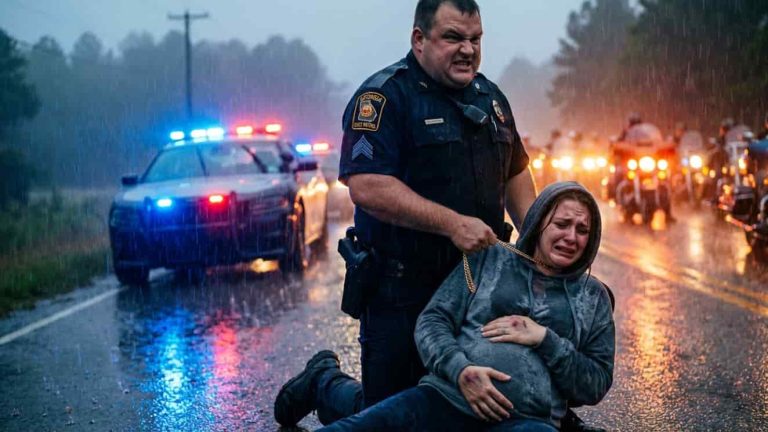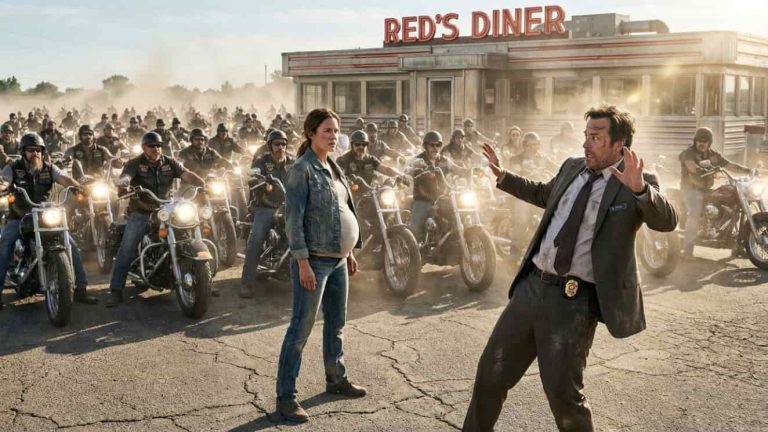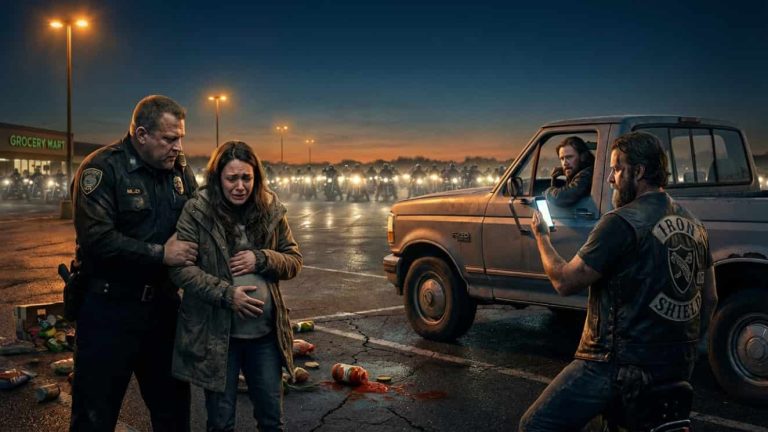
The air in Blackwood, Montana, usually smelled like pine and incoming rain. Today, it smelled like grease, stale coffee, and the rotting soul of Officer Miller.
I watched from the corner booth of ‘The Rusty Spoon’ as Miller leaned his heavy frame against the counter. He wasn’t there for the cherry pie. He was there for the “”protection tax””—a polite word for the bribe he squeezed out of Elara’s mother every month to keep her diner license from being “”reviewed.””
Elara was only nineteen, with eyes that still believed the world could be fixed. She was the only person in this godforsaken town who didn’t look at my tattoos like they were a roadmap to hell. When I’d arrived here six months ago, bleeding out from a botched job, she hadn’t called the cops. She’d hidden me in the cellar and prayed over me until the fever broke.
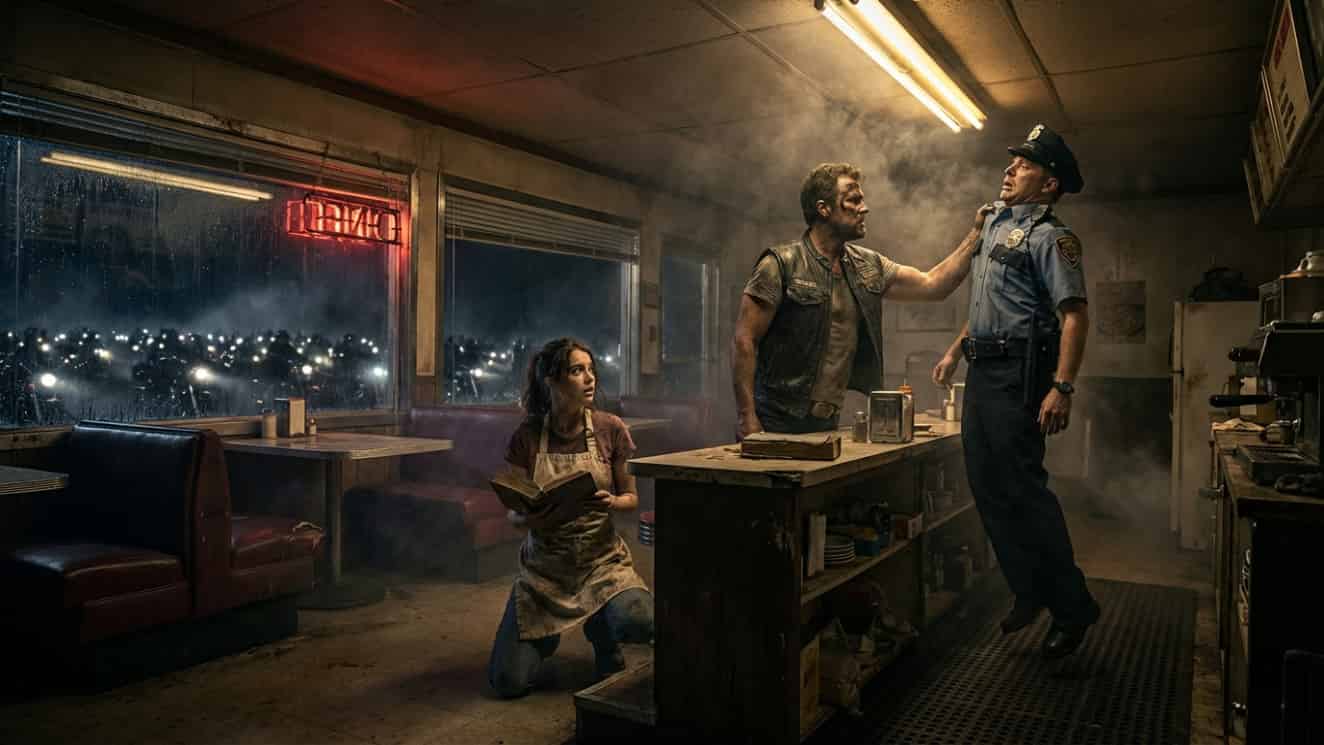
Now, I watched Miller’s hand snake out and grab Elara’s small, worn Bible from the counter.
“”Still talking to the big guy, Elara?”” Miller mocked, his voice a gravelly rasp. “”Maybe you should ask Him for the three hundred bucks your mom owes the precinct.””
“”Please, Officer,”” Elara whispered, her voice trembling. “”Business has been slow. We’ll have it by Monday.””
Miller laughed, a sound like dry leaves. “”Monday is too late.”” He looked at the Bible, then back at her. With a slow, deliberate movement, he gathered a mouthful of phlegm and spat directly onto the open pages of the New Testament.
The diner went silent. The clatter of forks stopped. The only sound was the hum of the refrigerator and the pounding of the blood in my ears.
I didn’t think. I didn’t plan. I just moved.
I was across the floor before Miller could even blink. My hand, scarred and calloused, wrapped around his thick neck like a vise. I didn’t just grab him; I hoisted him. I felt his vertebrae pop as I lifted his two-hundred-pound frame until his polished black boots were dangling six inches off the linoleum.
“”She prayed for me when no one else would,”” I growled, my face inches from his. The smell of his fear was sweeter than any meal I’d ever had. “”Today, her prayers were answered by 2,000 outlaws. Start praying, Miller, because we don’t listen.””
“FULL STORY
Chapter 1: The Weight of a Spat-On Soul
The neon sign of The Rusty Spoon flickered, casting a sickly yellow glow over the scene that was unfolding. For most people in Blackwood, the diner was a sanctuary. For me, Jax Thorne, it was the only place where I felt like a man instead of a ghost. I’d spent a decade in the Iron Skulls MC, riding through the mud and blood of the Midwest, but here, in this quiet corner of Montana, Elara Vance had made me feel like I could actually breathe.
But today, the air was thick with the stench of corruption.
Officer Miller was the kind of man who wore a badge like a license to bully. He’d been shaking down the local businesses for years, but the Vances were his favorite targets. Sarah Vance, Elara’s mother, was a widow trying to keep a sinking ship afloat.
“”You’re making a scene, Thorne,”” Miller wheezed, his hands clawing at my wrist. His face was turning a deep, bruised purple. “”Put… me… down.””
I didn’t move a muscle. Out of the corner of my eye, I saw Elara. She was frozen behind the counter, her hands pressed to her mouth. The Bible—the one her grandmother had given her, the one she’d read to me while I was shivering with sepsis in her basement—lay on the floor. The spit was a glistening insult on the word ‘Love.’
“”You think that badge makes you a god?”” I asked, my voice low and dangerous. “”In this town, maybe. But I’m not from this town, Miller. I’m from a world where we handle our own trash.””
I threw him.
It wasn’t a gentle release. I sent him flying through the swinging double doors of the diner and out onto the sidewalk. He hit the pavement hard, his duty belt clattering against the concrete.
I walked out after him, the bell above the door ringing a frantic warning.
A crowd was already gathering. People I’d seen every day for months—the mechanic, the librarian, the kids coming home from school. They all looked at Miller, then at me. They were terrified. Not of Miller, but of what was about to happen. Because everyone knew Miller wasn’t alone. He had the whole precinct of the Blackwood PD behind him, and they were just as crooked as he was.
Miller scrambled to his feet, reaching for his sidearm. “”You’re under arrest, you piece of—””
“”Touch that gun, and you won’t live to see the handcuffs,”” I said, my voice carrying across the street.
I pulled my burner phone from my pocket and hit one button. I didn’t need to say a word. The signal had already been sent.
“”You think you’re tough?”” Miller spat, wiping his mouth, though his hand was shaking. “”You’re one man. One biker trash. I have the law. I have a dozen guys in cruisers heading here right now.””
“”You have the law,”” I agreed, a cold smile spreading across my face. “”But I have a family. And they’re about ten minutes away.””
The rumble started then. It was faint at first, like a coming storm behind the mountains. But as the seconds ticked by, the vibration began to rattle the windows of the storefronts. The birds stopped singing. The very ground beneath our feet began to thrum with a rhythmic, mechanical heartbeat.
Elara stepped out onto the porch of the diner, her face pale. “”Jax? What did you do?””
“”I called for backup, Elara,”” I said softly, not taking my eyes off Miller. “”The kind of backup that doesn’t care about jurisdiction.””
Down the main artery of the town, a cloud of dust rose into the sky. And then, they appeared. A line of chrome and steel that stretched as far as the eye could see. The Iron Skulls. The Road Reapers. The Black Flags. Five different charters, two thousand riders, all moving as one.
Miller’s face went from purple to a ghostly, translucent white. He looked at the horizon, then at me, then back at the sea of leather jackets and roaring engines.
“”Who… who are you?”” he stammered.
“”I’m the guy who remembers what it’s like to be protected,”” I said. “”And today, this town is under new management.””
Chapter 2: The Shadows We Carry
The roar of two thousand engines is a sound you don’t just hear; you feel it in your bone marrow. It sounds like the end of the world, or the beginning of a revolution. As the lead riders pulled up, skidding their bikes into a massive semi-circle that blocked off the entire block, the silence that followed was even more deafening.
Hank, a man with a beard down to his chest and arms the size of tree trunks, killed his engine and hopped off his Harley. He was my second-in-command back in the day, a man who had lost his only son to a “”justified”” shooting by a cop exactly like Miller.
“”Jax,”” Hank said, his voice a deep rumble. “”You sounded like you needed a lift.””
“”Something like that, Hank,”” I replied.
I looked back at Elara. She was staring at the sea of outlaws. These were the men mothers warned their daughters about. Rough, scarred, smelling of tobacco and gasoline. But as Hank walked past her, he tipped his cap.
“”Evening, Miss. Sorry about the noise,”” he said, his voice surprisingly gentle.
That was the side of us the world didn’t see. We were a brotherhood born of trauma. Every man on those bikes had a story of being failed by the system. We were the collateral damage of the “”American Dream.””
Miller was backed up against his cruiser now, his hands raised in a half-hearted gesture of authority. “”This is an illegal assembly! I’m calling the Sheriff!””
“”The Sheriff is currently being ‘detained’ at his house by fifty of our boys,”” Hank said, lighting a cigarette. “”He’s fine. Just having a very long conversation about ethics.””
I walked over to Miller. The bravado he’d had inside the diner was gone, replaced by a raw, primal terror.
“”Why do you do it, Miller?”” I asked. “”Sarah Vance works sixteen hours a day. Elara spends her weekends at the church or the soup kitchen. They have nothing, and you still try to take more. Why?””
Miller swallowed hard. “”Because I can. Because in this town, I’m the one who decides who eats and who starves. That’s how the world works, Thorne. Might makes right.””
“”I couldn’t agree more,”” I said. I gestured to the two thousand men standing behind me. “”And right now, we’re a lot mightier than you.””
I turned to the crowd of townspeople. “”How many of you have paid this man? How many of you have lost your businesses, your homes, or your dignity because of this precinct?””
A long silence followed. Then, Deacon, the old mechanic from across the street, stepped forward. His hands were stained with oil that would never come out.
“”He took my son’s truck,”” Deacon said, his voice cracking. “”Claimed it was ‘evidence’ in a case that didn’t exist. Then I saw his nephew driving it a week later.””
“”He threatened to deport my cook,”” another business owner shouted.
The floodgates opened. For years, the fear of Miller and his cronies had acted like a dam. But now, with a literal army of outlaws standing guard, the dam broke. Stories of extortion, physical abuse, and planted evidence poured out like a confession.
I looked at Miller. He looked like he wanted to vanish into the pavement.
“”Here’s the deal,”” I said, leaning in so only he could hear. “”You’re going to give back every cent you took this month. And then, you’re going to leave. Not just this street. This state.””
“”You can’t do this,”” Miller whispered.
“”I’m not doing it,”” I said, pointing to Elara, who was standing on the diner steps, still holding her soiled Bible. “”She is. Because even after everything you did, she told me she didn’t want you dead. She just wanted you to be better. But me? I’m not a saint, Miller. I’m an outlaw. And if I see your face in Montana after sunrise tomorrow, I’ll show you exactly how ‘better’ I can be.””
Chapter 3: The Siege of Blackwood
The night didn’t bring peace; it brought a standoff.
While the majority of the riders set up camp in the fields outside town, a core group of us stayed at the diner. We knew the Blackwood PD wouldn’t go down without a fight. They weren’t just cops; they were a cartel in blue.
Around 2:00 AM, the headlights appeared.
Six cruisers, sirens off but lights flashing, pulled into the intersection. Out stepped Captain Vance—no relation to Elara, though he took a perverse pleasure in the irony. He was a sleek, corporate-looking man who ran the precinct like a Fortune 500 company.
“”Thorne!”” he yelled through a megaphone. “”You have thirty minutes to disperse. You’re obstructing justice and kidnapping a police officer.””
I stepped out onto the porch, Hank by my side. “”We’re not kidnapping anyone, Captain. Miller is free to go. He’s just choosing to stay here until he finishes writing out his confession.””
Inside the diner, under the watchful eye of Deacon and a few other locals, Miller was currently being forced to document every bribe and shakedown he’d participated in over the last five years.
“”You think a bunch of bikers can take on the state?”” Vance laughed. “”I’ve already called the National Guard. They’ll be here by morning.””
“”Maybe,”” I said. “”But ask yourself this: How many of those Guard members have brothers, cousins, or fathers riding in my ranks? We aren’t an invading army, Vance. We’re the people you forgot existed.””
The tension was a physical weight. On one side, the high-tech equipment and authority of the law. On the other, the raw, unfiltered rage of the marginalized.
Elara came out with a tray of coffee. Her hands weren’t shaking anymore. She walked right past me and toward the line of police cruisers.
“”Elara, get back!”” I yelled.
She ignored me. She walked right up to the hood of Captain Vance’s car and set a cup of coffee down.
“”You used to come to my father’s funeral,”” she said, her voice clear and piercing in the night air. “”You sat at our table and promised to look out for us. Is this what looking out for us looks like, Captain? Spitting on our faith? Stealing from widows?””
Vance looked at her, and for the first time, his polished mask slipped. He looked away.
“”Go home, Elara,”” he said quietly.
“”I am home,”” she replied. “”This diner is my home. This town is my home. And for the first time in ten years, I actually feel safe. Because the ‘criminals’ are the ones protecting me from the ‘police.'””
She turned and walked back to us. That moment did more damage to Vance’s resolve than any threat I could have made. I saw the officers behind him shifting uncomfortably. They weren’t all monsters like Miller. Some were just men who had been told to follow orders, now realizing those orders were rotten.
“”The clock is ticking, Vance,”” I shouted. “”The confession is almost done. Once it’s signed, we’re sending it to the FBI and the Governor’s office. You can either be the hero who helped clean up his precinct, or the captain who went down with the ship.””
Chapter 4: The Outlaw Treaty
The sun began to peek over the Bitterroot Range, painting the sky in shades of bruised orange and purple. The “”National Guard”” Vance had threatened never showed up. It turned out the roads into Blackwood had been mysteriously blocked by “”mechanical failures”” of several dozen large trucks—all driven by men who wore outlaw patches under their flannel shirts.
By 6:00 AM, the diner was packed. Not with customers, but with the people of Blackwood. They had brought food for the riders. Sarah Vance was in the kitchen, cooking the biggest breakfast the town had ever seen.
I sat at the counter, nursing a black coffee. Hank sat next to me.
“”You know we can’t stay forever, Jax,”” Hank said quietly. “”Once we leave, these people are vulnerable again.””
“”I know,”” I said. “”That’s why we’re not just leaving. We’re setting up a Chapter.””
Hank raised an eyebrow. “”Here? In Blackwood? It’s a dead-end town.””
“”It’s a town that needs a different kind of law,”” I said. “”Deacon wants to join. A few of the other locals, too. We leave a permanent presence here. A ‘social club.’ If Miller or Vance even think about stepping out of line, they’ll know 2,000 brothers are just a phone call away.””
Suddenly, the front door opened. Captain Vance walked in. He wasn’t wearing his hat, and his tie was loose. He looked like a man who hadn’t slept in a decade.
He walked up to the counter and placed his badge on the wood next to my coffee.
“”Miller signed the confession,”” Vance said, his voice hollow. “”He also implicated me in three counts of racketeering. I’m not going to fight it.””
He looked at Elara. “”I’m sorry. Your father was a good man. He’d be ashamed of what I let this place become.””
He turned to me. “”The FBI is at the edge of town. I called them myself. I’ll go quietly, but you need to get your boys out of here. If there’s a shootout, nobody wins.””
I looked at the badge. It was a piece of tin that had caused so much misery. “”We’re leaving, Vance. But we’re leaving eyes behind.””
As the FBI cruisers rolled into town, they didn’t find a riot. They found a town festival. Outlaws and locals were shaking hands. Bikers were helping Deacon fix a broken tractor. Elara was handing out the last of the cinnamon rolls.
The corrupt officers were taken away in handcuffs—not by us, but by federal agents who had finally been given enough evidence to act. When they led Miller out, he looked at me one last time. There was no hate left in him, only a crushing realization that his reign of terror was over.
I walked over to Elara as the last of the outlaws started their engines. The thunder was returning, but this time, it felt like a celebration.
“”What now?”” she asked, her eyes searching mine.
“”Now, you run your diner,”” I said. “”And you don’t pay anyone a single cent for protection. Because you’ve already paid it in prayers.””
I reached into my pocket and handed her the Bible. I had stayed up half the night cleaning it. The pages were a little wrinkled, but the stain was gone.
“”I have to go with the pack for a while,”” I said. “”There are other towns. Other Millers.””
“”Will you come back?”” she asked.
I looked at the town—this dusty, broken, beautiful place that had saved my life. “”Yeah. I think I’ve finally found a place worth riding back to.”””