He didn’t come for the sermon. He didn’t come for the wine.
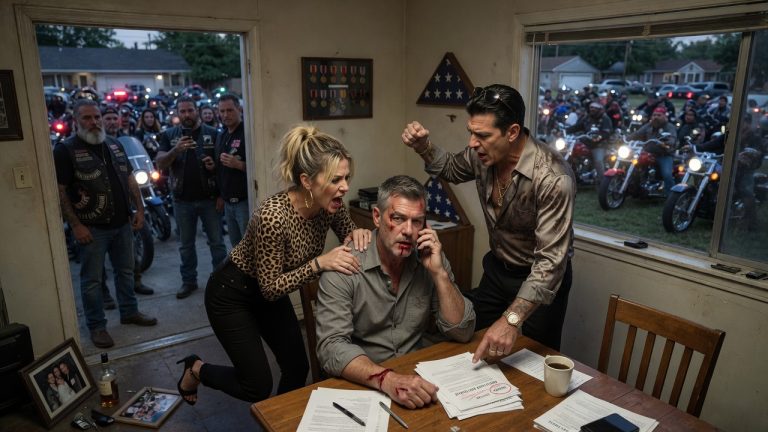
Bishop walked into the most “righteous” town in the Texas Hill Country with 500 engines screaming behind him and a secret in his pocket that was about to ruin the most powerful man in the county.
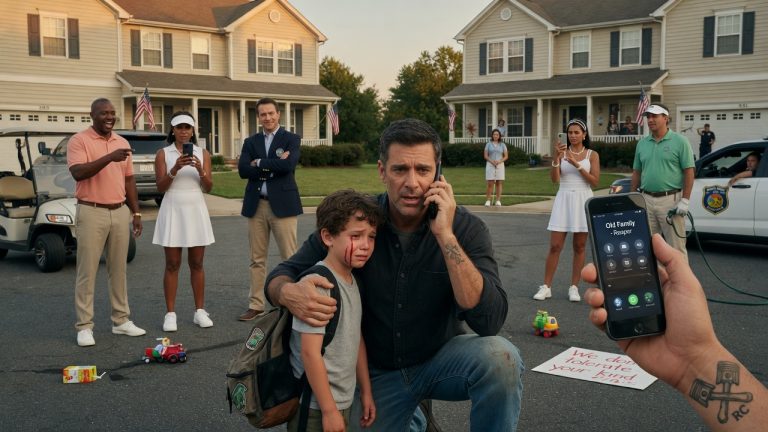
They had Mac in handcuffs—a man who’d given everything to a country that forgot him—all because he tried to save a four-pound dog from the Judge’s nephew.
The Judge thought he was making an example out of a “low-life.”
He thought he was the only one who knew how to use the Law.
He was wrong.
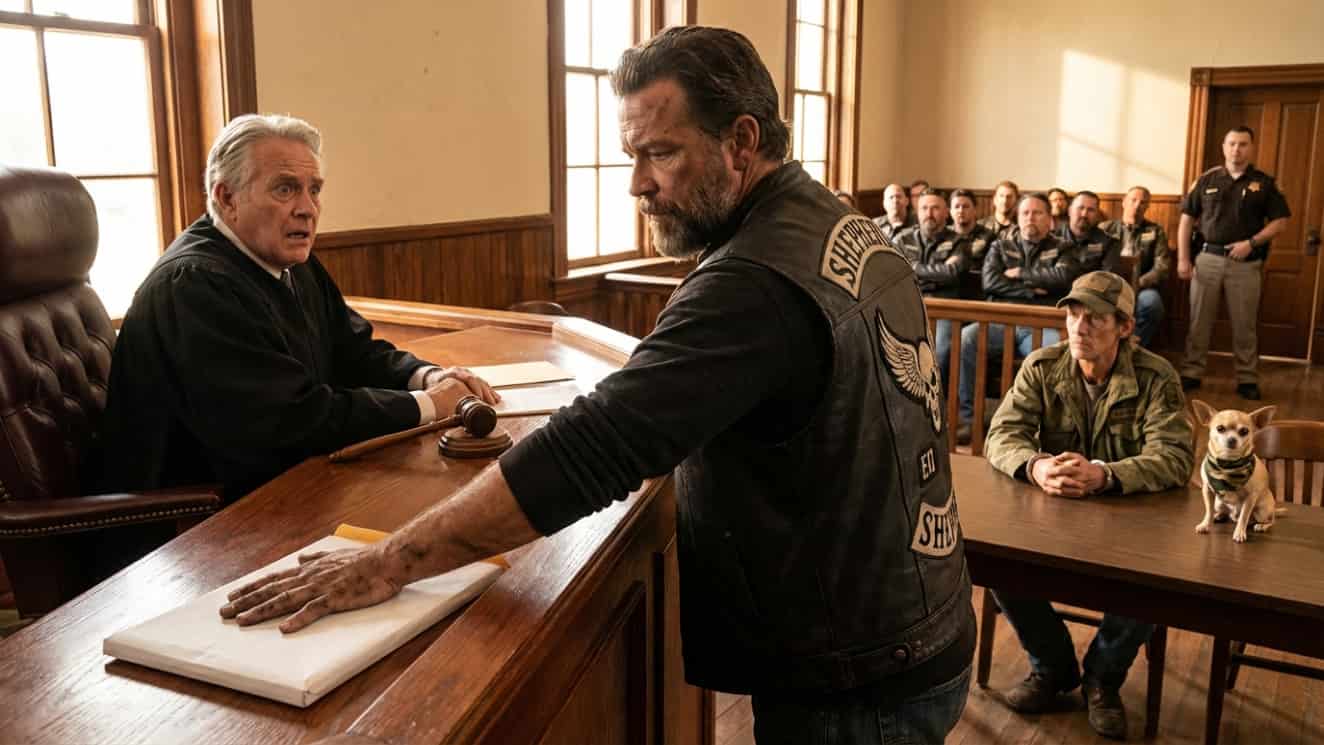
Bishop leaned over that bench, the leather of his vest creaking in the dead silence of the court, and dropped the one thing the Judge thought was buried forever.
“I remember you from the seminary, Miller,” Bishop whispered, loud enough for the whole town to hear. “You were always better at spending money than keeping the commandments. Especially my father’s money.”
The color didn’t just leave the Judge’s face. It left his soul.
FULL STORY: THE SHEPHERD’S DEBT
CHAPTER 1: THE DUST AND THE DOG
The heat in the Texas Hill Country doesn’t just sit on you; it tries to get inside your lungs. Bishop felt it radiating off the blacktop of Highway 16, a shimmering haze that made the scrub oaks look like they were drowning in thin air. He shifted his weight on the seat of his ’78 Shovelhead, the vibration of the engine a familiar, grinding comfort against his thighs. He wasn’t looking for trouble. He was looking for a reason to keep moving, which was the only prayer he had left since he’d walked out of the St. Jude’s Seminary fifteen years ago.
He saw the flashing lights first—blue and red, looking cheap and garish against the vast, honest brown of the landscape. Then he saw the man.
Mac was kneeling in the dirt at the edge of a gravel turnout. He looked like a collection of sticks held together by a faded M65 field jacket. His hair was a wild, nicotine-stained white, and his eyes were fixed on a dusty black SUV parked ten feet away. Standing over him was a younger man, maybe twenty-four, wearing a polo shirt that cost more than Mac’s motorcycle—a rusted-out sidecar rig that looked like it belonged in a museum or a scrapyard.
Bishop slowed the Shovelhead, the rumble of his pipes dropping to a low, guttural snarl. He pulled onto the shoulder, kicking the stand down. He didn’t take off his helmet immediately. He just watched.
“Give him back,” Mac was saying. His voice was a dry rattle, the sound of a man who hadn’t used his vocal cords for anything but coughing in a long time. “He didn’t do nothing. He was just thirsty.”
The younger man laughed, a sharp, entitled sound. He was holding a small, frantic bundle of tan fur by the scruff of its neck. It was a Chihuahua, no bigger than a loaf of bread, wearing a tiny bandana that matched the olive drab of Mac’s jacket. The dog wasn’t barking; it was making a high, whistling sound of pure terror.
“Your mutt scratched my paint, old man,” the younger man said. He pointed to a microscopic scuff on the door of the SUV. “In this town, that’s property damage. And since you clearly don’t have a dime, I think I’ll just take the dog to the pound. Or maybe I’ll just let him go… out in the brush. See how he likes the coyotes.”
“Please,” Mac said, reaching out a trembling hand. “That’s Goliath. He’s… he’s my unit. He’s all I got left of the boys.”
Bishop swung his leg over the bike. He was a big man, built like a fortress, his presence amplified by the heavy leather vest that bore the “SHEPHERDS” rocker. He unclipped his helmet and hung it on the handlebar. His face was a map of hard miles and deep silence.
“The man asked for his dog,” Bishop said. His voice was low, resonant, the kind of voice that used to carry to the back of a cathedral without a microphone.
The younger man turned, his eyes narrowing. He saw the leather, the beard, the grease under the fingernails. “This is private business, biker. Move along before I call my uncle.”
“And who’s your uncle?” Bishop asked, stepping into the man’s personal space. The smell of old oil and road grit came with him.
“Judge Miller,” the kid spat. “He runs this county. Now back off.”
Bishop didn’t back off. He looked at Mac, who was staring at the dog with a desperation that made Bishop’s chest ache. It was a look he’d seen on his father’s face forty years ago—the look of a man who had survived a war only to be defeated by a peace that didn’t want him.
“Mac,” Bishop said, his eyes never leaving the kid’s face. “Pick up your dog.”
“He’s holding him!” Mac cried.
Bishop reached out. It wasn’t a fast move, but it was absolute. He gripped the younger man’s wrist. He didn’t squeeze hard enough to break bone, just enough to make the kid realize that his world of polo shirts and SUVs was very far away. The kid’s fingers spasmed, and Goliath dropped. Mac caught the dog in his jacket, pulling him against his chest, sobbing quietly into the fur.
“You’re dead,” the kid hissed, clutching his wrist. “You’re both dead.”
He scrambled into his SUV and tore off, spraying gravel across Bishop’s boots. Bishop stood there for a long time, watching the dust settle. He felt the old weight of the seminary books in his mind—the lessons on grace, on mercy, on the shepherd’s duty. He’d tried to burn those books, but the ashes were still hot.
“Thank you,” Mac whispered, still holding the shivering dog. “Thank you, Father.”
Bishop stiffened. “I’m not a Father, Mac. I’m just a guy with a bike.”
“I know a priest when I see one,” Mac said, standing up on shaky legs. “Even one in a hide like that. You got the eyes. You got the debt.”
“What debt?” Bishop asked, his voice harsh.
“The one we all owe,” Mac said, tucking Goliath into the front of his jacket. “For being the ones who stayed alive.”
Ten minutes later, three cruiser cars screamed into the turnout, their sirens cutting through the Texas quiet like a jagged blade.
CHAPTER 2: THE SEMINARY OF ASPHALT
The “Sanctuary” was a dive bar on the edge of town that smelled of stale beer and bad decisions. It was the unofficial headquarters for the Shepherds, a collection of men who had mostly replaced their families with chrome and combustion. Bishop sat at the end of the scarred wooden bar, a bottle of Lone Star sweating in front of him.
Across from him sat Judas. His real name was Gabe, but everyone called him Judas because he had a habit of playing both sides of any argument until he saw who was winning. He was leaner than Bishop, with a jagged scar running from his ear to his chin and a restlessness that made people nervous.
“You really did it this time, Bishop,” Judas said, picking at the label of his beer. “The kid you manhandled? That’s Travis Miller. The Judge’s sister’s boy. The Judge has been looking for an excuse to sweep the ‘undesirables’ out of this town for three years. You just gave him a golden broom.”
“He was hurting an old man’s dog,” Bishop said, his voice flat.
“It’s a Chihuahua, Bishop! Not exactly a mascot for a biker gang,” Judas laughed, but there was no humor in it. “Now Mac is in the county lockup on a ‘disturbing the peace’ and ‘assault’ charge. They’re saying he swung a pipe at the kid. And they got your plates. They’re looking for you.”
“Let them look,” Bishop said.
“The club can’t afford this,” Judas leaned in, his voice dropping. “We got a deal with the local cops. We keep the noise down, they look the other way on the registration issues. You start a war with the Judge, and we all burn. For what? A crazy vet and a four-pound rat?”
Bishop looked at Judas. He saw the fear disguised as pragmatism. It was the same thing he’d seen in the eyes of the Monsignor when Bishop’s father had come to the rectory, begging for help with his medical bills, only to be told that the “discretionary fund” was dry. Two weeks later, the church had installed new gold leafing on the altar.
“It’s not about the dog, Gabe,” Bishop said softly. “It’s about the scale. It’s always been about the scale. You put a man’s life on one side and a politician’s pride on the other, and you see which way it tips. If we don’t stand for the man, we’re just a parade in leather.”
“You still sound like you’re wearing the collar,” Judas spat. “That’s the problem. You think you’re our priest. But we’re outlaws, Bishop. Outlaws don’t do charity work.”
Bishop stood up, his chair scraping loudly against the floor. The bar went silent. “I’m going to see the Judge.”
“You go to that courthouse, you aren’t coming out,” Judas warned.
“Maybe,” Bishop said. “But I’ve spent fifteen years running from churches. I think it’s time I walked into one and told the truth.”
He walked out into the cool night air. He needed to do more than just talk. He needed leverage. He reached into the small leather pouch on his belt and pulled out a key to a safe deposit box in San Antonio. Inside that box was the remains of his father’s estate—money Bishop had refused to touch because it felt like blood money, the inheritance from a man who had died bitter and broken.
He looked up at the Texas stars. They were cold and indifferent.
“I’m sorry, Pop,” he whispered. “But I think I’m finally going to spend it.”
He didn’t just need the money. He needed the records. He knew Judge Miller. Before he was a judge, Miller had been the “financial advisor” for the diocese. He’d been the one who told the Monsignor where to hide the funds. He’d been the one who signed the papers that denied Bishop’s father’s claim.
Bishop wasn’t just a biker. He was a man who had spent three years studying canon law and forensic accounting before he’d realized the people teaching him were the ones breaking the rules.
CHAPTER 3: THE CAGE AND THE GAVEL
The county jail was a cinderblock box that smelled of industrial bleach and unwashed bodies. Mac sat on a metal bench, his hands tucked into his sleeves. They had taken Goliath. That was the only thing that mattered to him. The dog was at the municipal pound, and in this county, if a “dangerous” animal wasn’t claimed in forty-eight hours, it was put down.
Judge Miller stood on the other side of the bars, looking at Mac with a mixture of pity and disgust. The Judge was a man who wore his power like a tailored suit. He was “God-fearing” in the way people are when they think God is an employee.
“You should have just stayed in the woods, Arthur,” the Judge said, using Mac’s given name. “You’re a nuisance. You’re a reminder of things people in this town don’t want to think about. And now you’ve brought those animals—those bikers—into my backyard.”
“The dog,” Mac said, his voice a ghost. “He’s just a dog, Miller. He didn’t do nothing.”
“He’s a symbol of your instability,” Miller said. “I’m going to make sure you get the help you need. A state facility, far away from here. And your biker friend? He’ll be joining you in a different kind of facility soon enough.”
“He’s coming,” Mac said, looking up with a sudden, eerie clarity. “The Shepherd. He’s coming for the debt.”
The Judge laughed. “What debt? I don’t owe anyone anything.”
“My father thought the same thing,” a voice boomed from the end of the hallway.
The Judge whirled around. Bishop was standing there, flanked by two nervous-looking deputies. He wasn’t in his leather vest now. He was wearing a clean white shirt, buttoned to the neck, and dark slacks. He looked like a man who was about to deliver a eulogy or a sentence.
“You can’t be back here,” Miller snapped at the deputies.
“He has a right to see his client, Your Honor,” one of the deputies said, his voice shaking. “He… he showed us his credentials. He’s a registered legal advocate.”
“I never finished the seminary, Miller,” Bishop said, walking forward until only the bars separated him from the Judge. “But I finished the law degree. I just never bothered to use it until I saw what your nephew did to a veteran.”
“You think a piece of paper makes you a match for me?” Miller hissed. “I own this county. I own the police. I own the record.”
“You don’t own the past,” Bishop said. He reached into his pocket and pulled out a photocopied sheet of paper. It was an old bank ledger, dated 1994. “Recognize the signature at the bottom? It’s the one where you transferred fifty thousand dollars from the Veteran’s Outreach Fund into a private account registered to ‘Miller & Associates.’ The same week you bought your house on the hill.”
The Judge’s face went from red to a sickly, mottled grey. “That’s… that’s ancient history. Statute of limitations, boy.”
“Maybe for the law,” Bishop said, leaning closer. “But not for the Bishop. The real Bishop. I sent a copy of this to the Archdiocese this morning. And I sent another to the Texas Rangers. But I’m a merciful man, Miller. I’m willing to offer you a penance.”
“What do you want?”
“Mac is released. All charges dropped. The dog is returned, with a public apology from your nephew. And you’re going to step down, citing ‘health reasons.'”
Miller’s eyes turned into cold flints. “You’re bluffing. You wouldn’t burn yourself just to save a crazy old man.”
“You don’t understand,” Bishop said, a small, sad smile touching his lips. “I’m already burned. I’ve been living in the fire for fifteen years. I’m just here to see if you can take the heat.”
CHAPTER 4: THE GATHERING STORM
Word travels fast in the Hill Country, but it travels faster in the biker community. By the next morning, every man with a patch and a pulse knew that Bishop was taking a stand.
At the Sanctuary, the parking lot was overflowing. It wasn’t just the Shepherds. There were the Ghost Riders from Fredericksburg, the Iron Cross from Kerrville, and dozens of independent riders who had heard the story of the old vet and the Chihuahua.
Judas stood on the bed of a pickup truck, his face contorted with anger. “He’s going to get us all arrested! He’s walking into that courthouse with a pocket full of blackmail, and he expects us to just sit here? The Judge will have the SWAT team waiting!”
“He’s not asking us to fight,” an old rider named Pop shouted from the crowd. “He’s asking us to witness!”
“Witness what?” Judas yelled back. “Our own funeral?”
Just then, the roar of a single engine cut through the argument. Bishop pulled into the lot on his Shovelhead. He had put his leather vest back on. He looked at the sea of faces—the scars, the tattoos, the grease, the brotherhood.
“I’m going to the courthouse,” Bishop said, his voice carrying without effort. “I’m not going for a fight. I’m going for a procession. Mac is a veteran. He deserves to walk out of that building with his head up. I’m going to make sure the Judge sees exactly how many of us ‘undesirables’ there are.”
“You’re crazy, Bishop,” Judas said, hopping down from the truck. “You’re going to lose the club.”
“The club is just a name on a piece of leather, Gabe,” Bishop said. “A shepherd who doesn’t protect the flock isn’t a shepherd. He’s just a guy in a fancy hat. You coming?”
Judas looked around. He saw the way the men were looking at Bishop—not with fear, but with a kind of hungry hope. They were tired of being the villains in everyone else’s story.
“Damn it,” Judas muttered, kicking his starter. “I always hated Chihuahuas.”
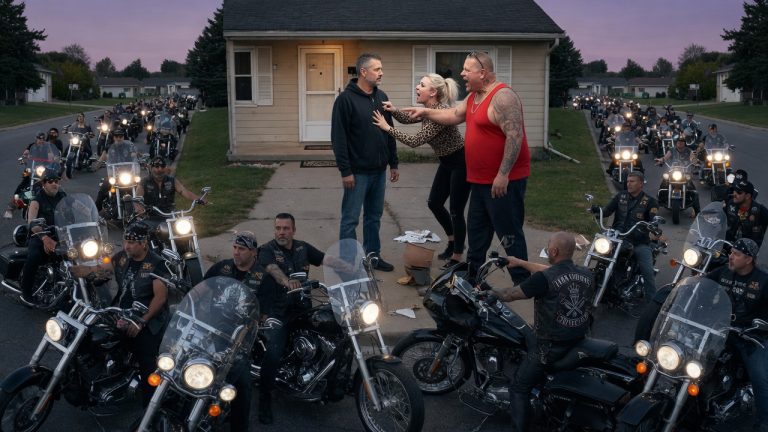
They started the engines. Five hundred motorcycles. The sound was biblical. It wasn’t a noise; it was a vibration that shook the very foundation of the town. They rode in a tight, disciplined formation, two by two, a river of black leather and chrome flowing through the quiet, Sunday-morning streets.
The townspeople stood on their porches, clutching their Bibles, their mouths open in shock. They had been told these men were monsters. But the bikers weren’t shouting. They weren’t revving their engines. They were riding in a dead, somber silence, like a funeral march for a king.
At the head of the line was Bishop, his back straight, his eyes fixed on the white stone tower of the courthouse. He could feel the weight of the envelope in his vest—the “Shepherd’s Debt.” It was the money he had inherited, converted into a cashier’s check for the full amount of the funds Miller had stolen all those years ago, plus interest.
He was going to pay the debt his father couldn’t. And he was going to make Miller watch him do it.