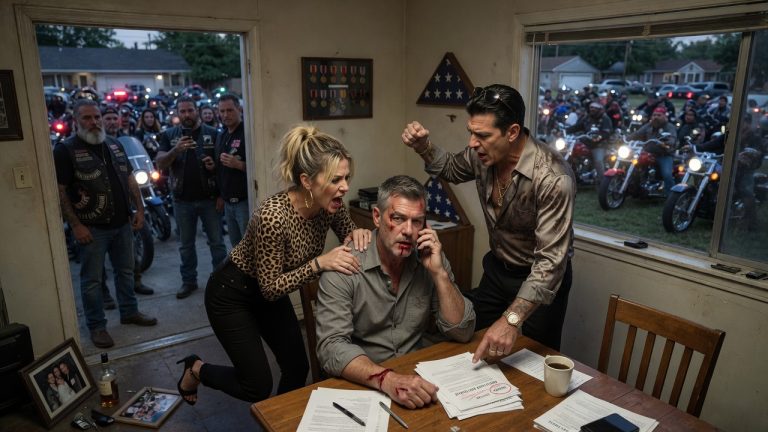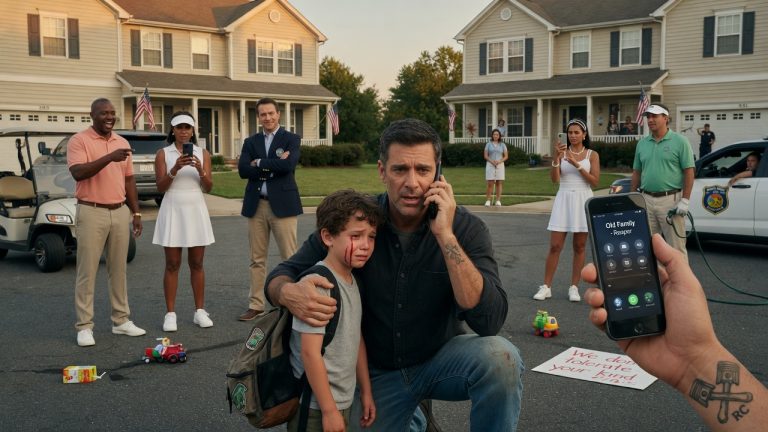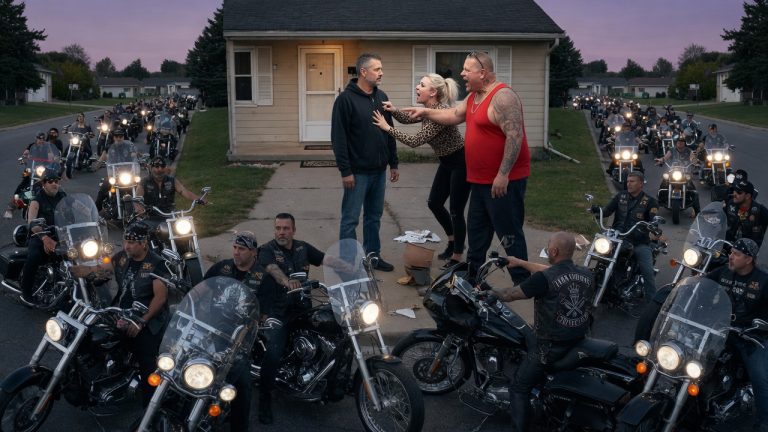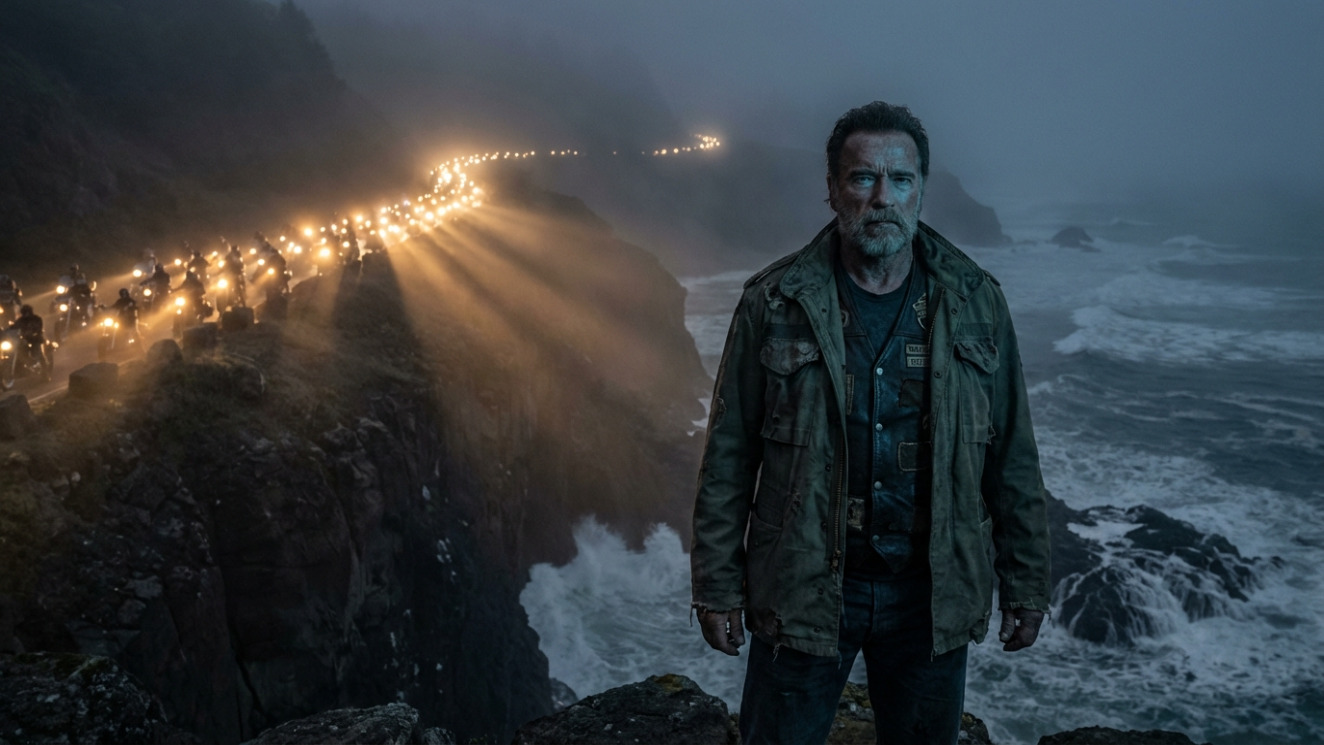
Mack Thorne spent ten years living like a ghost in a town that smelled of salt and diesel. Every month, he walked into the post office and sent an anonymous money order for $1,200 to a woman who didn’t know his name.
Elena thought it was a miracle. Mack knew it was blood money.
He was the man who called in the strike. He was the reason her husband never came home from the market in Kandahar. He thought if he stayed in the shadows, he could balance the scales.
But then Judge Miller decided he wanted Elena’s land for a new coastal resort. He thought she was alone. He thought she was easy prey.
He didn’t know about the five hundred men Mack had served with. He didn’t know that when a man has nothing left to lose but his shame, he becomes the most dangerous thing in the world.
Tonight, the fog is rolling in off the Oregon coast, and the sound of five hundred engines is about to wake up the dead.
FULL STORY
Chapter 1
The rain in Coos Bay didn’t so much fall as it did hang, a heavy, gray curtain that tasted like salt and old cedar. Mack Thorne stood in the open bay of his shop, Thorne’s Heavy Cycles, watching the mist crawl across the asphalt of Highway 101. His hands were stained with 10W-40, the grease worked so deep into his cuticles it looked like permanent ink.
He liked the grease. It gave him something to scrub at when the 3:00 a.m. shakes started.
“You’re staring again, Mack,” a voice rasped from the shadows near the tool bench.
Mack didn’t turn. He knew the rhythm of the footsteps. Sarge walked with a hitch in his left hip, a souvenir from a roadside IED outside Fallujah. Sarge was seventy, a Vietnam vet who had seen Mack through the worst of his transition back to the “real world,” which mostly consisted of Mack drinking himself into a stupor in a VA parking lot.
“Just checking the weather,” Mack said.
“Weather’s the same as yesterday. Gray and wet. You’re looking at that diner across the road.”
Mack finally turned, wiping his hands on a rag that was more dirt than fabric. “I’m looking at the traffic.”
“Elena’s in there,” Sarge said, leaning against a jacked-up Dyna. “And Miller’s boys are in there too. Third time this week. They aren’t there for the clam chowder.”
Mack’s chest tightened, a familiar pressure that felt like a physical weight behind his ribs. He walked to the sink in the back, pumping the orange goop from the industrial soap dispenser. He scrubbed hard.
Every month for ten years, Mack had sent half of everything he earned to Elena Vance. He did it through a series of offshore money orders, routed through a lawyer in Portland who didn’t ask questions as long as the cash cleared. To Elena, it was an anonymous trust from her late husband’s “life insurance policy” that had mysteriously reactivated. To Mack, it was the only thing keeping him from putting a .45 in his mouth.
He remembered the thermal feed. The white-hot bloom of the Hellfire missile hitting the courtyard. The report that came in twenty minutes later: One insurgent neutralized. One civilian casualty. Male. Mid-30s.
He hadn’t known the man’s name until he tracked down the widow three years later. Elena had moved back to her family’s plot in Oregon, opening The Foghorn Diner. She was a woman who moved with a quiet, exhausted grace, her hair tied back in a messy bun, always smelling of fried onions and coffee.
“What does Miller want with her?” Mack asked, his voice low.
“The land,” Sarge said. “The Judge is backing that new pier development. He wants the whole block leveled for a boutique hotel. Elena’s the only one who hasn’t signed the buyout. She’s stubborn. Reminds me of you.”
Mack threw the rag onto the counter. He grabbed his denim vest—the one with the Vets for Vets patch on the back. It wasn’t a “1%er” club. They didn’t move weight or run girls. They were just men who couldn’t find a way to talk to anyone who hadn’t carried a rifle.
He crossed the highway, the cold rain hitting his face. The bell above the diner door jingled, a bright, cheerful sound that felt out of place.
Inside, the air was warm and smelled of bacon grease. Elena was behind the counter, her face pale. Standing across from her were two men Mack recognized. They were “contractors” for Judge Miller—local thugs who wore suits that didn’t fit right across their shoulders.
“It’s a generous offer, Mrs. Vance,” the taller one was saying. His name was Roy. He had a neck like a bull and a smile that didn’t reach his eyes. “But the Judge’s patience isn’t infinite. The county’s already looking at the plumbing codes for this building. It’d be a shame if you had to close down before you even got your check.”
Elena’s knuckles were white as she gripped the edge of the counter. “My husband’s family built this place. My daughter grew up in that booth. I’m not selling.”
Roy laughed, a dry, rattling sound. He reached out to pat her hand, a gesture that was meant to be condescending, a show of power.
Mack didn’t think. He didn’t plan. He was just there.
He caught Roy’s wrist mid-air. The man was big, but Mack was dense, built from years of lifting engine blocks and carrying gear.
“She said she’s not selling, Roy,” Mack said. His voice was conversational, which made it worse.
Roy tried to yank his hand back, but Mack’s grip was a vice. The other man, a smaller guy with a ratty mustache, stepped forward, his hand going toward his waistband.
“Don’t,” Mack said, looking the small guy in the eye. “I’ve had a very long morning, and I haven’t had my coffee yet. You don’t want to be the reason I stay cranky.”
“Thorne,” Roy spat, his face flushing red. “This is city business. Legal business. You’re a grease monkey with a hobby club. Walk away.”
“I’m a customer,” Mack said. He let go of Roy’s wrist with a flick that sent the man stumbling back. “And right now, I’d like a Denver omelet. Which means you’re blocking my service. Get out.”
The diner went silent. The three old men in the corner booth—regulars who had lived in Coos Bay since the timber mills were still open—watched with wide eyes.
Roy straightened his jacket, his chest heaving. “The Judge is going to hear about this. You think that patch on your back makes you untouchable? This isn’t the sandbox, Mack. You’re in Miller’s town now.”
“Tell the Judge I said hi,” Mack said.
The two men glared at him before turning and walking out, the door slamming hard enough to rattle the salt shakers.
Mack stood there for a moment, the adrenaline fading into a dull ache in his joints. He turned to Elena. She was looking at him, her eyes searching his face. It was the closest he had been to her in months. Up close, he could see the fine lines of worry around her eyes and the way her apron was frayed at the edges.
“You shouldn’t have done that,” she whispered.
“They were bothering you.”
“They’ve been bothering me for a month. Now they’re going to bother you too. Miller… he doesn’t forget a slight, Mack. He owns the cops. He owns the bank. He’s going to come for your shop next.”
“Let him come,” Mack said.
“Why do you care?” she asked, her voice cracking slightly. “You barely say two words when you come in here. You sit in the back, you eat, you leave. Why jump into this for me?”
Mack looked down at his boots. He could feel the ghost of that thermal image flickering in his mind. One civilian casualty. Male. Mid-30s.
“I don’t like bullies,” he said. It was a lie, or at least, only a fraction of the truth.
“I can’t pay you for protection, Mack. I’m barely making the taxes as it is.”
“I don’t want your money, Elena,” Mack said. The irony tasted like copper in his mouth. “Just the omelet. And maybe a refill on the coffee.”
He sat in the back booth, the one where he could see the door and the highway. He watched the rain turn into a downpour. Across the street, Sarge was standing in the garage door, watching the diner.
Mack knew he had just started a fire. He knew the Judge would react. Miller was a man who built his empire on the small humiliations of others. He would see Mack’s interference as a challenge to his sovereignty.
But as Elena set a steaming mug of black coffee in front of him, her hand trembling just a little less than before, Mack felt a strange, cold clarity. For ten years, he had been sending money into the void, hoping it would buy him a night of sleep without the smell of burning ozone.
Maybe money wasn’t the currency he needed to pay with. Maybe it was something else.
“Thanks, Elena,” he said.
She nodded, a small, tentative smile touching her lips. “Be careful going home, Mack. The roads get slick near the cliffs.”
“I’ve survived worse than a slippery road,” he said.
As he drank his coffee, he pulled his phone out. He scrolled through his contacts until he found a number he hadn’t dialed in three years. It was a number for a man in California who ran a different kind of club. A man who owed Mack his life ten times over.
He didn’t call yet. He just stared at the name on the screen: JAX.
Jax was the mirror Mack didn’t want to look into—young, aggressive, and in love with the violence Mack was trying to forget. Jax represented the version of the MC that Mack had spent years trying to steer his own chapter away from. But Jax also had reach. He had five hundred men who followed his lead, and all of them were looking for a reason to ride north.
Mack put the phone away. Not yet.
He finished his meal, left a twenty-dollar bill on a six-dollar check, and walked back out into the rain. The water soaked through his shirt, cold and unforgiving, but for the first time in a decade, the weight in his chest felt like it might actually be movable.
Chapter 2
The VA clinic in Eugene was a two-hour ride from Coos Bay, a winding trek through the Douglas firs and the logging trucks that owned the mountain passes. Mack did the ride every Thursday. It was part of the “reintegration program” he had been on for years, though he mostly went so that Doc would keep signing his prescription for the sleep aids that didn’t work.
Doc was a man named Miller—no relation to the Judge—who had lost an arm in ‘Nam and spent the rest of his life trying to talk younger men off the ledge. His office smelled of stale peppermint and old paper.
“You’re twitchy today, Mack,” Doc said, leaning back in his chair. The prosthetic arm rested on his desk, looking like a piece of industrial equipment.
“I’m fine.”
“You haven’t looked at me once since you sat down. You’re looking at the exit. You’re looking at the shadows in the corner. You’re scanning for threats in a government building in middle-of-nowhere Oregon. Tell me what happened.”
Mack rubbed his face. “I got into a thing at a diner. Local politics.”
“Local politics usually don’t make a man like you look like he’s waiting for an incoming mortar strike.”
Mack sighed, the sound heavy and jagged. “The Judge back home is trying to squeeze the woman who owns the diner. Elena Vance.”
Doc went still. He knew the name. He was the only one who knew the whole story—the drone strike, the anonymous payments, the crushing guilt that Mack wore like a shroud.
“You’re getting involved,” Doc said. It wasn’t a question.
“I didn’t have a choice.”
“You always have a choice, Mack. You could have stayed in your shop. You could have sent the money and kept your head down. Why now?”
“Because the money doesn’t matter if she loses her home,” Mack said, his voice rising. “I spent ten years trying to fix what I broke with a checkbook. It’s not working, Doc. The Judge is sending guys to lean on her. He’s going to take her land and she’s going to end up in some apartment in the city, and everything her husband worked for will be gone. I can’t let that be the ending.”
Doc looked at him for a long time, his expression unreadable. “You’re looking for a fight, Mack. Be honest with yourself. You’ve been sitting in that garage for a decade waiting for a war to come to you so you can feel like a soldier again instead of a murderer.”
The word murderer hit Mack like a physical blow. He flinched, his hands curling into fists. “I was doing my job.”
“I know you were. And I know the brass cleared you. But your soul didn’t clear you, did it?” Doc leaned forward. “If you do this—if you step out of the shadows and take on this Judge—you aren’t just protecting a diner. You’re exposing yourself. You’re inviting the world to look at you. Are you ready for Elena to know who you really are?”
“She won’t find out,” Mack said, though his voice lacked conviction.
“People talk, Mack. Secrets in small towns are just lies with a slow fuse. You go to war for her, she’s going to ask why. And you aren’t a good enough liar to give her an answer that satisfies.”
Mack stood up, the chair scraping loudly against the linoleum. “I don’t need a therapy session, Doc. I just need the pills.”
“The pills won’t stop the Judge,” Doc said, sliding the script across the desk. “And they won’t stop the ghosts. Be careful, Mack. You’re leading a lot of men. Don’t lead them into a hole you can’t climb out of.”
Mack took the paper and walked out without saying goodbye.
He rode back to Coos Bay as the sun was dipping below the horizon, turning the Pacific into a sheet of hammered gold. When he pulled into his shop, he found Jax sitting on his porch.
Jax was twenty-six, with a shaved head and a tattoo of a reaper on his forearm. He was leaning against the railing, tossing a folding knife into the air and catching it. He looked like trouble looking for a place to happen.
“Long ride, Mack,” Jax said, grinning. His bike, a blacked-out Street Glide with loud pipes, was parked in the center of the driveway like a middle finger to the neighborhood.
“What are you doing here, Jax? I told you Coos Bay was off-limits for the main chapter.”
“I heard you were having some fun,” Jax said, closing the knife with a snap. “Roy—the guy you handled at the diner? He’s my cousin’s brother-in-law. Word travels fast when a ‘peaceful’ vet starts throwing his weight around.”
“It’s not your business,” Mack said, dismounting his bike.
“Everything the club does is my business. You’re the regional lead, Mack. But you’ve been quiet. Too quiet. The guys are restless. They think you’ve gone soft, living in this fog, fixing carburetors for old ladies.” Jax stepped closer, his voice dropping. “Then I hear you’re taking on a Judge. A guy with deep pockets and a lot of land. That sounds like club business to me.”
“It’s a personal matter,” Mack said, his voice cold.
“Nothing is personal when you wear the patch. You want to scare this Miller guy? You want to make sure he never touches that woman again? Give me the word. I can have fifty guys here by tomorrow morning. We can burn his summer house. We can make sure his ‘enforcers’ never walk right again.”
Mack looked at Jax—at the hunger in his eyes. Jax didn’t care about Elena. He didn’t care about justice. He just wanted a reason to break things. He wanted the myth of the biker outlaw—the power, the fear, the chaos.
“No,” Mack said. “We’re not doing it your way. If I need the club, I’ll call. Until then, get your bike off my property.”
Jax’s smile didn’t falter, but his eyes hardened. “You’re making a mistake, Mack. You’re trying to be a hero. Heroes get buried. Soldiers… soldiers survive because they use the tools they have.”
“I’m not a soldier anymore,” Mack said.
“Could’ve fooled me,” Jax said, hopping onto his bike. He kicked it into gear, the roar of the engine echoing off the shop walls. “I’ll stay in town a few days. Just in case you change your mind.”
He tore out of the driveway, leaving a plume of blue smoke and the smell of burnt rubber.
Mack walked into his shop and locked the door. He didn’t turn on the lights. He sat on a milk crate in the dark, surrounded by the skeletons of motorcycles and the smell of old oil.
His phone buzzed. A text from an unknown number.
The building inspector is coming tomorrow morning at 8:00 AM. Then the Sheriff. Don’t be at the diner, Mack. It’s going to get ugly.
Mack stared at the screen. He knew it was a warning—likely from one of the townspeople who worked for Miller but still felt a shred of guilt.
He looked at the burner phone he used for the payments. He looked at the photo of the drone strike he hadn’t yet burned.
He realized Doc was right. He was looking for a war. But for the first time in his life, he wasn’t looking for one he could win with a missile. He was looking for a way to stand his ground until the ground itself gave way.
He picked up his phone and dialed Sarge.
“Sarge,” Mack said when the older man picked up. “Call the list. Not just the local chapter. Call the Vets in Washington, California, and Idaho. Tell them we have a veteran’s widow being bullied by a crooked politician.”
“How many you want, Mack?” Sarge’s voice was steady, the sound of a man who had waited years for this call.
Mack looked out the window at the fog rolling in. “All of them. I want every man who ever wore a uniform and a patch to be here by Saturday. Tell them to bring their tools. We aren’t here to fight. We’re here to work.”
“And if Miller brings the heat?”
“Then we’ll be the shade,” Mack said.
He hung up and finally struck the match, lighting the drone photo. He watched the white-hot image of the courtyard shrivel into black ash. It didn’t make him feel better. But it made him feel ready.
Chapter 3
The following morning, the fog was so thick it felt like breathing wet wool. Mack was at the diner at 7:30 AM, sitting in his usual booth. He wasn’t wearing his vest. He was wearing a flannel shirt and work boots, a cup of coffee steaming in front of him.
Elena was frantic. She was trying to scrub a stain off the counter that wouldn’t come out, her movements jerky and panicked.
“Mack, you have to go,” she said, her voice a hushed whisper. “The Sheriff called. He said there was an ‘anonymous tip’ about health violations. They’re going to shut me down today.”
“Let them come, Elena,” Mack said calmly.
“You don’t understand! If they shut me down for code violations, the bank can call in the loan immediately. Miller has the bank manager in his pocket. I’ll lose the building by noon.”
“Take a breath,” Mack said, standing up. He walked around the counter and gently took the rag from her hand. His touch was hesitant, as if he was afraid he might break her. “You haven’t done anything wrong. The kitchen is clean. The plumbing works. This is a scare tactic.”
“A scare tactic that works!” she cried, her eyes filling with tears. “I’m just one person, Mack. I can’t fight the whole town.”
“You aren’t fighting the town,” Mack said. “You’re fighting one man who thinks he’s a king. Kings are just men who haven’t been told ‘no’ enough times.”
A black SUV pulled into the gravel lot, followed by a county car with a light bar on top. Two men in suits got out, along with Sheriff Whittaker. Whittaker was a man Mack had known for years—a guy who used to be decent until the Judge helped him get elected.
They walked into the diner, their boots clumping on the linoleum. The lead suit—a man with a clipboard and a narrow, pinched face—didn’t even look at Elena. He started walking toward the kitchen.
“Excuse me,” Mack said, stepping into the man’s path. “Can I help you?”
The inspector looked up, annoyed. “Health and Safety. We have a warrant for a mandatory inspection. Out of the way.”
“I’d like to see the warrant,” Mack said.
Sheriff Whittaker stepped forward, his hand resting on his belt. “Mack, don’t do this. This is a civil matter. The county has every right to inspect a public eatery.”
“I’m not saying they don’t, Bill,” Mack said, looking the Sheriff in the eye. “I’m saying I want to see the paperwork. I also want to see the specific complaint that triggered a ‘mandatory’ inspection at 8:00 on a Friday morning.”
“The complaint is confidential,” the inspector snapped.
“Funny,” Mack said. “Because under Oregon State Law, a business owner has the right to a 24-hour notice for a non-emergency inspection unless there is a clear and present danger to public health. Is there a plague in the kitchen, Elena?”
Elena looked surprised. “No.”
“Then you’re trespassing,” Mack said to the inspector.
The inspector looked at the Sheriff. Whittaker looked uncomfortable. “Mack, you’re playing lawyer. You’re going to make this worse for her.”
“It can’t get much worse, Bill. You’re here to take her livelihood away because a Judge wants to build a gift shop on her grave. How do you sleep at night?”
“I’ve got a job to do,” Whittaker muttered.
“So do I,” Mack said.
From the parking lot, the sound of a heavy engine rumbled. Then another. Then five more.
Jax and six of his guys pulled up, their bikes gleaming even in the gray light. They didn’t come inside. They just parked their bikes in a row, blocking the entrance to the lot, and stood by their machines. They weren’t doing anything illegal. They were just… there. Six large men in leather vests, watching the Sheriff.
Whittaker looked out the window. “You calling in the cavalry, Mack?”
“I’m calling in witnesses,” Mack said. “The more people see what’s happening here, the harder it is to keep it ‘confidential.'”
The inspector puffed out his chest. “I don’t care how many bikers you bring. This building is a hazard. I’m tagging the door.”
He tried to push past Mack. Mack didn’t move. He was a wall of muscle and quiet intent. The inspector bumped into him and recoiled as if he’d hit a brick pillar.
“That’s obstruction,” the inspector yelled. “Sheriff, arrest him!”
Whittaker hesitated. He looked at Mack, then at the bikers outside, then at Elena, who was watching with a mix of terror and hope. He knew Mack wasn’t a criminal. He knew Mack was a guy who spent his weekends fixing bikes for veterans for free.
“I’m not arresting him for standing in a diner,” Whittaker said. “Inspector, maybe we should come back Monday. Give them time to… prepare.”
“The Judge will hear about this, Whittaker!” the inspector hissed. He turned and stormed out, the door nearly hitting the Sheriff on his way out.
Whittaker stayed for a second. He looked at Mack. “He’s not going to stop, Mack. Miller is going to go after the bank next. He’ll have the foreclosure papers served by the end of the day. There won’t be anything I can do then. It’ll be a court order.”
“Thanks for the heads up, Bill,” Mack said.
The Sheriff nodded and left.
Elena collapsed onto a stool, her face in her hands. “It’s over. He’s going to take it. The bank… I’m three months behind on the balloon payment. I thought I could catch up, but…”
Mack sat next to her. “How much, Elena?”
“It doesn’t matter.”
“How much is the debt?”
“Thirty thousand,” she whispered. “The anonymous money… it covers the taxes and the utilities, but the bank restructured the loan after my husband died. They made it impossible to pay off.”
Mack felt a surge of cold fury. He knew how it worked. Predatory lending, local corruption, the slow strangulation of the small guy.
“I can get the money,” Mack said.
“No,” Elena said, looking up. Her eyes were hard now. “I won’t take it from you, Mack. You’ve already done too much. I won’t be another person you’re trying to ‘save.’ I see how you look at me. Like I’m a ghost.”
Mack flinched. The precision of her words cut deeper than any insult Roy could have thrown.
“I’m not trying to save you, Elena,” he lied. “I’m trying to stop a bad man from winning.”
“Why? Why do you care about this place? Why do you care about me?”
The truth was a physical weight in his throat. He wanted to tell her. He wanted to say: I killed your husband. I watched him die on a screen six thousand miles away. I sent you money for ten years because I’m a coward who couldn’t face the reality of what I did.
But he looked at her—at the strength in her jaw, the way she held herself together even when her world was crumbling—and he realized that telling her wasn’t for her. It was for him. It would be a confession to ease his own soul, and it would destroy the only peace she had left.
“Because you’re a good woman,” he said instead. “And your husband was a good man. And people like Miller shouldn’t be allowed to erase that.”
She looked at him for a long time. “How do you know my husband was a good man? You never met him.”
“I know,” Mack said, his voice cracking. “I just know.”
He walked out of the diner before she could ask anything else.
In the parking lot, Jax was leaning against his bike, a smug look on his face. “Nice show, Mack. But the Sheriff’s right. Miller’s going to use the law now. You can’t punch a foreclosure notice.”
“I know,” Mack said. He looked at the line of bikes. “Go back to the clubhouse. Get everyone ready. We’re moving the timeline up.”
“What’s the plan?” Jax asked, his eyes lighting up. “We hitting the bank?”
“No,” Mack said. “We’re going to the Judge’s house. But not for what you think.”
“Then what for?”
Mack looked toward the hills where Miller’s mansion sat overlooking the bay. “We’re going to show him what a real brotherhood looks like.”
Chapter 4
The call went out through the networks—the quiet, iron-clad threads that connected veterans across the Pacific Northwest. It wasn’t a call for violence. It was a “Code 4,” a call for community support.
By Saturday morning, the town of Coos Bay felt different. The air was thick with the low-frequency hum of V-twin engines. They came from Portland, from Boise, from Seattle, and from the small mountain towns in Northern California.
They weren’t “bikers” in the way the movies showed them. They were mechanics, teachers, plumbers, and retired cops. They were men with gray in their beards and scars that told stories of places like the Chosin Reservoir, the Mekong Delta, and the streets of Ramadi.
Mack stood in the parking lot of his shop as Sarge checked the ledger.
“We’re at four hundred and eighty-two, Mack,” Sarge said, his eyes bright. “A few more are pulling in from the coastal highway now. The Judge is going to have a heart attack when he looks out his window.”
“Is the equipment here?” Mack asked.
“Two flatbeds full of lumber, a roofing crew from the Salem chapter, and enough paint to cover the Taj Mahal. We’ve got three generators and a mess tent.”
Mack looked at the sea of leather and denim. He felt a swell of something he hadn’t felt in years. It wasn’t the adrenaline of combat. It was the solid, unshakeable feeling of belonging to something that mattered.
“Listen up!” Mack shouted, stepping onto the bed of a truck.
The hum of conversation died instantly. Five hundred pairs of eyes turned toward him.
“Most of you know why we’re here,” Mack said. “We’ve got a sister in trouble. Elena Vance. Her husband didn’t come home, and now a local parasite is trying to take what’s left of her life. He thinks he can use the law to bully a woman who’s alone.”
A low growl went through the crowd.
“But she’s not alone,” Mack continued. “We aren’t here to break windows or start a fight. We’re here to work. The Judge thinks this building is a ‘hazard’? We’re going to make it the safest, cleanest, most perfect building in this county. He thinks she’s behind on her bills? We’ve got a hat going around that’s going to take care of that bank note before the sun goes down.”
He paused, his gaze sweeping the crowd. “There will be cops. There will be lawyers. There will be threats. You stay calm. You stay professional. If anyone tries to stop us, you just stand there. Five hundred of us. They can’t arrest a wall.”
“What about the Judge?” Jax called out from the back. He looked disappointed that there wasn’t a plan for mayhem.
“I’ll handle the Judge,” Mack said.
The group moved out in a single, massive column. The sound was deafening—a tectonic shift of sound that shook the windows of the town. People came out of their shops to watch. They didn’t see a gang. They saw a parade of discipline.
They arrived at the diner and immediately went to work. It was like a military operation. One team hit the roof. Another began scraping the old, peeling paint. A third group, led by an electrician from the VFW in Medford, started ripping out the outdated wiring the inspector had complained about.
Elena stood on the porch, her hand over her mouth. She looked at Mack, her eyes wide with disbelief.
“Mack… what is this?”
“Renovations,” Mack said, handing her a thick manila envelope.
She opened it. Inside was thirty-two thousand dollars in cash—hundreds, fifties, and twenties collected from the pockets of five hundred men who knew what it meant to lose everything.
“I can’t take this,” she whispered.
“It’s not from me,” Mack said. “It’s from them. Consider it a down payment on a ten-year debt.”
While the men worked, Mack climbed back onto his bike. He didn’t take the club with him. He rode alone up the winding road to the Judge’s estate.
Judge Miller was sitting on his patio, a glass of scotch in his hand, watching the activity through binoculars. When Mack pulled up the driveway, Miller didn’t look surprised. He looked disgusted.
“You’re a dead man, Thorne,” Miller said, not looking away from the binoculars. “You think a few hundred grease monkeys can stop a multi-million dollar development? I have the Sheriff, the city council, and the circuit court in my pocket. By Monday morning, I’ll have an injunction that will seize that property and every bike in your lot.”
Mack walked up to the patio. He didn’t look at the view. He looked at the man. Miller was soft—expensive clothes, expensive skin, a life built on the labor and misery of people he considered beneath him.
“I don’t care about the development, Miller,” Mack said. “And I don’t care about your injunctions.”
“Then why are you here?”
Mack pulled a small, digital recorder from his pocket and set it on the table. He pressed play.
Roy’s voice filled the air: “…The Judge said he doesn’t care if the building is up to code. He said find a way to tag it or he’ll find a new inspector who will. He wants that widow out by Friday or we start breaking things.”
Miller’s face went from pale to a sickly, mottled red. “That’s a private conversation. It’s inadmissible.”
“Maybe in your court,” Mack said. “But I’m not taking this to your court. I’ve already sent a copy to the Oregon State Bar, the Attorney General’s office, and every news station from here to Portland. My ‘grease monkeys’ include a few guys who used to work for the DOJ. They’re very interested in how you’ve been using county inspectors to devalue property for your own investment group.”
Miller slumped in his chair, the scotch glass trembling. “You… you can’t prove anything.”
“I don’t have to,” Mack said. “The scandal alone will kill the pier project. Investors don’t like ‘corruption’ in the headlines. It’s bad for the bottom line.”
Mack leaned in, his voice dropping to a dangerous whisper. “Here is what’s going to happen. You’re going to call the bank. You’re going to tell them that the ‘anonymous donor’ has paid off the Vance mortgage in full. You’re going to drop all claims to the land. And then, you’re going to retire. Effective immediately.”
“You’re blackmailing a sitting judge,” Miller hissed.
“No,” Mack said. “I’m a soldier neutralizing a target. There’s a difference.”
Mack stood up and pocketed the recorder. “I’d stay inside if I were you, Miller. There are five hundred men down there who are very fond of that widow. If they see you, I might not be able to keep them ‘professional.'”
He walked back to his bike and rode down the hill.
As he approached the diner, the sun broke through the clouds for the first time in a week. The building was already transformed. The new blue paint was bright and clean. The roofers were hammering the last of the shingles. A group of bikers was sitting at the picnic tables, drinking coffee and laughing with the locals who had come out to help.
It looked like a community. It looked like peace.
But as Mack saw Elena standing in the doorway, her eyes searching for him, he felt the old familiar coldness return to his gut. He had beaten the Judge. He had saved the diner.
But he hadn’t told the truth.