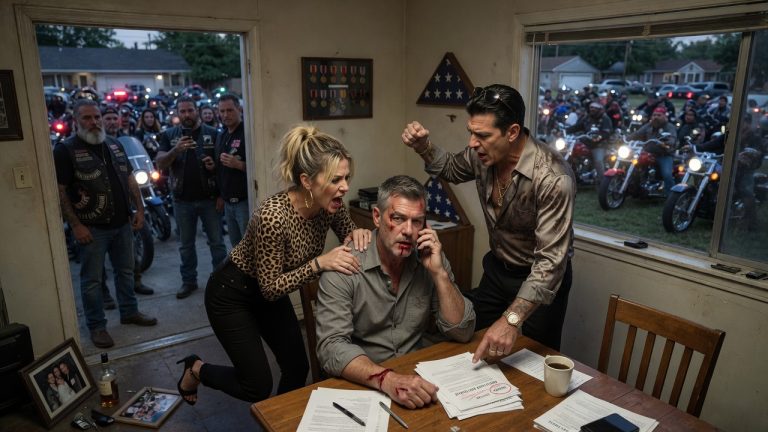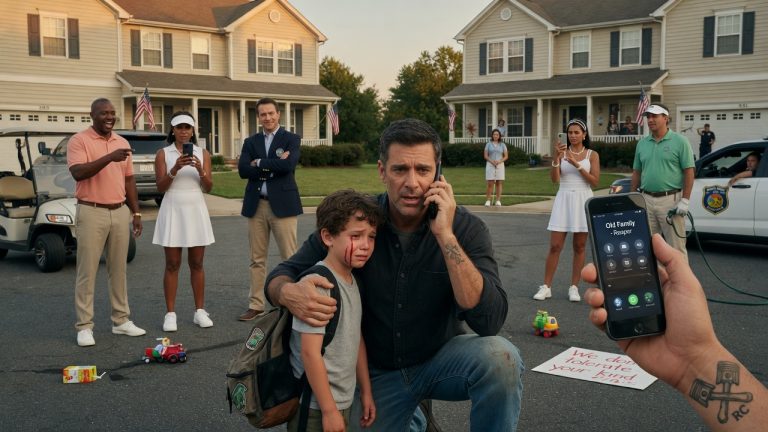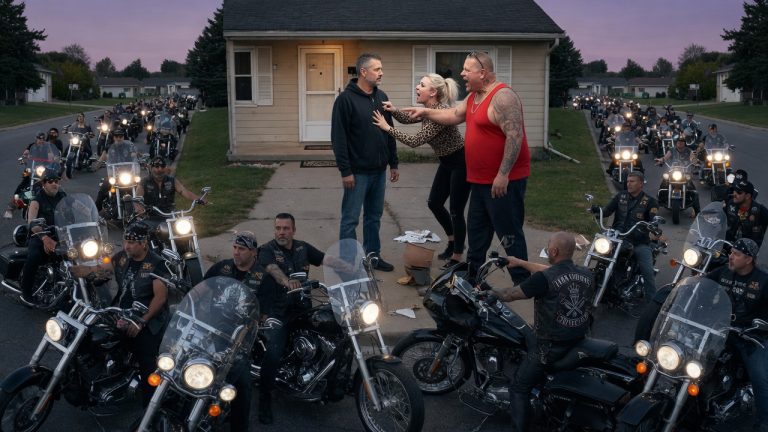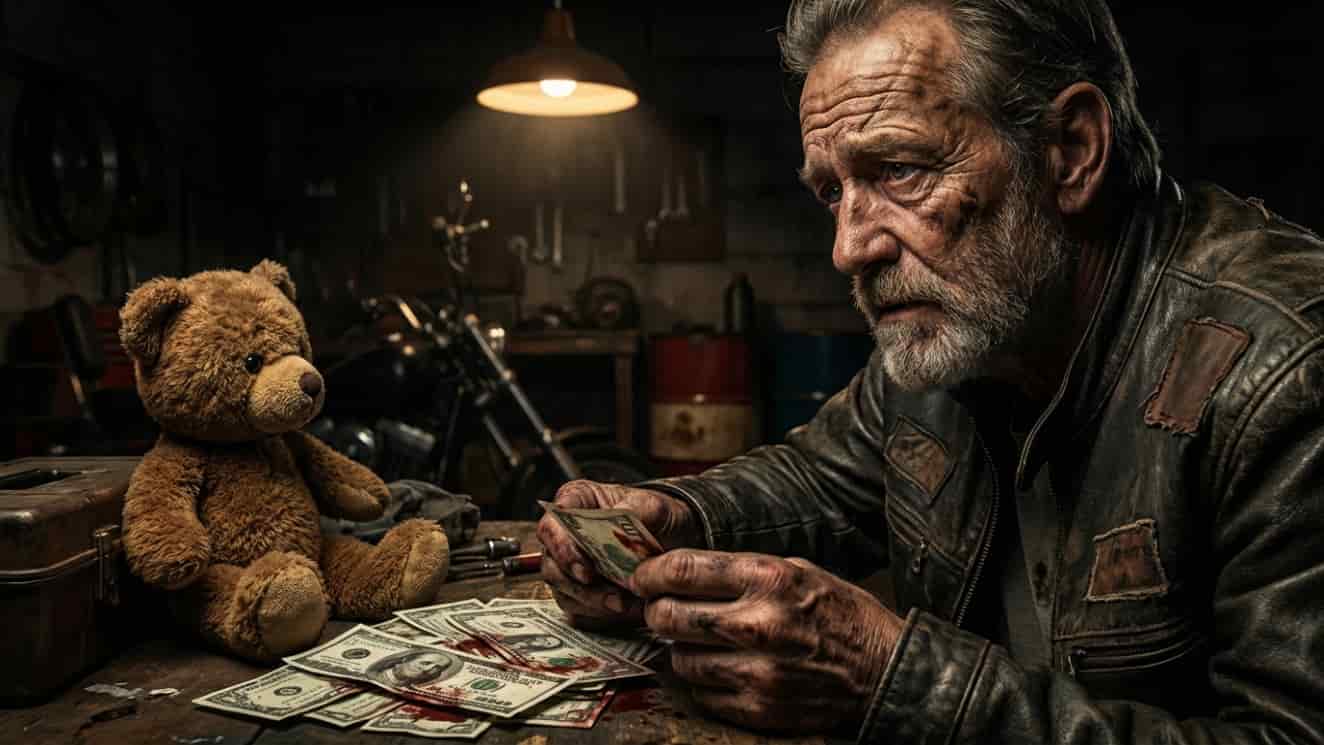
The town thinks Russell “Rusty” Thorne is a hero. They see the leather-clad “Chapter 500” bikers riding into the orphanage with teddy bears strapped to their sissy bars, and they cheer. They don’t see the ledgers. They don’t see the blood on the bills.
For years, Rusty has been the club’s best ghost. He washes the dirty money through “Ride for Hope” events, making the MC look like saints while the Treasury stays off their backs. It was a perfect system, born out of a father’s grief and a man’s need to disappear into the hum of an engine.
But Rusty has a secret that would get him buried in the Midwest dirt. He’s been stealing from the most dangerous men he knows. Not for himself, but for a building on the edge of town that smells like fresh sawdust and second chances.
When the club sends a “special auditor” to find the missing percentages, the clock starts ticking. Rusty is an old man on a fast bike, running out of road.
FULL STORY
Chapter 1: The Weight of the Ledger
The air in the garage smelled of primary colors: stale gasoline, burnt oil, and the sweet, cloying scent of cheap candy. It was the aftermath of the “Toys for Tots” run, an annual spectacle where sixty members of the Chapter 500 Motorcycle Club rode through the streets of Oakhaven, Nebraska, looking like a benevolent rolling thunderstorm.
Russell “Rusty” Thorne sat at a scarred wooden desk in the back office, his fingers stained black. Not from grease—though there was plenty of that under his nails—but from the ink of a faulty printer. On the desk lay three separate ledgers. One was for the public, showing every penny of the $42,000 raised that day going to the local orphanage. The second was for the “Big Five” of the MC, showing the $18,000 “administrative fee” they’d skimmed off the top.
The third ledger was a small, spiral-bound notebook tucked inside a hollowed-out manual for a 1978 Shovelhead. That one was for Rusty. That one showed the $9,000 he’d redirected from the Big Five’s cut into a private account held by an anonymous LLC.
“You look tired, Pop,” a voice said from the doorway.
Rusty didn’t jump. He’d lost the ability to be startled somewhere around his forty-fifth birthday. He closed the public ledger and looked up at Jax. Jax was twenty-four, wore a vest that was too clean, and had a smile that reminded Rusty of a switchblade—shiny, but only useful for cutting things.
“Numbers don’t get younger, Jax. Neither do I,” Rusty said. He leaned back, his spine popping like dry kindling. “What do you want? The party’s out front.”
Jax stepped into the office, his boots clicking on the concrete. He picked up a stuffed bear that had fallen off a crate, tossing it back and forth between his hands. “The President is asking about the ‘logistics’ fee. Says the take from the Omaha route seemed a little light this year. Especially since the weather was so good.”
Rusty felt a familiar coldness settle in his gut. It wasn’t fear, exactly. It was more like the feeling of a bike sliding on a patch of black ice—a calm realization that things were about to get messy. “Gas is up. Insurance on the sweep trucks is up. If the President wants to do the math himself, tell him to come sit in this chair. It’s got a broken spring that pokes you in the kidney. He’ll love it.”
Jax laughed, but his eyes stayed on the ledgers. “You’ve been doing this a long time, Rusty. Maybe too long. People get comfortable. They start thinking the money belongs to the hand that counts it.”
“I count the money because nobody else in this club can add past ten without taking their boots off,” Rusty snapped. He stood up, towering over Jax despite the twenty-year age gap. Rusty wasn’t a bodybuilder; he was built like an old oak tree that had survived a dozen droughts. He was dense, heavy, and hard to move. “Go get a beer, kid. Leave the paperwork to the grown-ups.”
Jax dropped the bear. The smile didn’t reach his eyes. “The club is sending someone down from the Regional Chapter. A guy named Miller. He’s an ‘efficiency expert.’ He’ll be here Tuesday to help you get the books ‘streamlined.'”
Rusty watched Jax walk out. He waited until the sound of the party outside—the roar of engines, the loud, forced laughter of men trying to prove they were still outlaws—drowned out the silence of the office.
He reached into the Shovelhead manual and pulled out the small notebook. He looked at a number circled in red: $142,000. It was almost enough. The youth center on 4th Street had a roof that didn’t leak anymore, and the plumbing was done. But the electrical was a mess, and the city inspectors were sniffing around for bribes he couldn’t afford to pay through the official LLC.
He tucked the notebook into his inner vest pocket, right against his ribs.
He walked out of the garage and into the cooling Nebraska evening. The sun was a bruised orange on the horizon. Across the street, the Oakhaven Children’s Home sat like a grey stone fortress. He saw a small figure at one of the upper windows—a boy named Leo. Leo was eight, quiet, and had a habit of taking things apart to see how they worked. Rusty had given him a set of wrenches three months ago.
Rusty raised a hand. The boy didn’t wave back, but he didn’t move away from the glass.
For twenty years, Rusty had been the ghost of Chapter 500. He’d helped them launder drug money, protection money, and racketeering profits through these “charity” events. He’d done it because, after his son Caleb died on a stretch of Highway 20, he didn’t care about the world anymore. Caleb had been eighteen, riding a bike Rusty had built for him, racing for a pot of money Rusty had put up to “test the boys’ grit.”
The grit had held. The tires hadn’t.
Now, Rusty looked at the stone building across the street. He wasn’t a good man. He knew that. He’d seen the faces of the people the MC had crushed to get those bills. But he figured if he could just get those kids out of that stone fortress and into a place where they could learn a trade—something real, something that didn’t involve a leather patch—maybe the scale would tip just an inch back toward the light.
He climbed onto his bike, a weathered Road King with more miles than sense. He kicked it over, the vibration rattling his teeth. As he pulled out of the lot, he saw a black SUV parked under a dead streetlamp. The windows were tinted dark.
Miller was early.
Rusty didn’t slow down. He shifted into second gear, the mechanical “clack” echoing in the quiet street. He had three days to hide the truth, or one day to die for it. He wondered, as the wind bit into his face, which one would be easier.
Chapter 2: Ghost Tracks
The “efficiency expert” didn’t look like a biker. Miller wore a charcoal grey polo shirt, khaki slacks, and a pair of spectacles that looked like they cost more than Rusty’s first three bikes combined. He sat in Rusty’s office on Tuesday morning, tapping a stylus against a tablet screen.
“You have a very… tactile system, Russell,” Miller said. His voice was flat, like a dial tone. “Physical ledgers. Handwritten receipts. It’s charmingly archaic.”
Rusty sat across from him, sipping lukewarm coffee from a mug that said World’s Okayest Mechanic. “Harder to hack a piece of paper.”
“True,” Miller conceded, not looking up. “But easier to lose a page. Or to add one that shouldn’t be there. I’ve been looking at the ‘Ride for Hope’ filings from the last five years. There’s a consistent three-percent variance in the overhead. Every year, like clockwork. Usually, when things are this consistent, it’s not an accident. It’s a habit.”
Rusty felt the pressure behind his eyes. “Small towns have habits, Miller. The sheriff expects a ‘donation’ to the PAL league. The local baker ‘forgets’ to charge us for the rolls, but then his nephew needs a summer job at the garage. It’s called grease. It makes the wheels turn.”
Miller finally looked up. His eyes were the color of a winter sky over a frozen lake. “I’m not here to talk about grease, Russell. I’m here to talk about the engine. The club is expanding. We’re moving into logistics—real logistics. Shipping, warehousing. We can’t have ‘variances’ in the new world. We need every cent to be accounted for.”
Miller stood up and walked to the window, looking out at the garage floor where Jax and a few other prospects were tearing down a bike. “Jax tells me you spend a lot of time at the old community center on 4th. The one that’s being renovated.”
Rusty’s heart did a slow, heavy roll. “It’s a hobby. I’m a carpenter’s son. Sometimes I like to hit a nail instead of a wrench.”
“It’s a big project for a hobby,” Miller said softly. “The permit office says it’s being funded by ‘Heritage Foundations LLC.’ I tried to look them up. They don’t seem to exist outside of a P.O. Box in Lincoln. You wouldn’t happen to know who’s behind it, would you?”
“No clue,” Rusty said. He didn’t blink. He’d practiced this lie in the mirror for six months. “Probably some out-of-state outfit looking for a tax write-off.”
Miller hummed a low, discordant note. “I’ll be staying at the Motel 6. I’ll need all the bank statements from the charity accounts by tomorrow morning. Not the summaries. The raw statements.”
When Miller left, the office felt ten degrees colder. Rusty waited five minutes, then stood up and grabbed his keys.
He didn’t go to the youth center. He went to the cemetery.
The Oakhaven cemetery was a flat, wind-swept place where the grass was always yellow. Rusty stood over Caleb’s grave. The headstone was simple: Caleb Thorne. 1988-2006. Too Fast for This World.
“I’m in trouble, kid,” Rusty whispered. The wind whipped the words away. “I thought I could outrun them. I thought if I just did enough good, they wouldn’t notice the bad. But they’re counting. They’re always counting.”
He remembered the night Caleb died. The sound of the crash hadn’t been a bang; it had been a sickening crunch, like a foot stepping on a dry branch. Rusty had been the first one there. He’d held his son’s head in his lap while the boy’s life leaked out onto the asphalt. Caleb had looked at him, his eyes wide and terrified, and said, “Dad, did I win?”
Rusty had lied then, too. “Yeah, son. You won.”
He’d been lying ever since.
He left the cemetery and drove to 4th Street. The youth center was a brick building that used to be a grocery store. It wasn’t much to look at, but inside, the walls were being painted a bright, clean white. There was a library area, a small computer lab with donated machines, and a large workshop in the back where Rusty planned to teach kids how to weld.
Sister Claire was there, wearing a splattered apron over her habit. She was the head of the orphanage, a woman who had the backbone of a drill sergeant and the patience of a saint.
“Russell,” she said, wiping her hands. “You look like you’ve been riding through a storm.”
“Just the wind, Claire,” he said. He looked around the room. “The electrical guy come by?”
“He did. He said the bill was paid in full. He even stayed an extra hour to fix the exterior lights.” She looked at him closely. “Where is this money coming from, Russell? I’m a nun, not a fool. Foundations don’t just drop fifty thousand dollars on a whim.”
Rusty walked over to a stack of plywood. He ran his hand over the rough grain. “It’s money that was being wasted, Claire. I’m just putting it where it can do some work. Don’t worry about the source. It’s clean now.”
“Nothing is ever truly clean, Russell,” she said, her voice dropping an octave. “I see the men who come to your garage. I see the patches on their backs. They aren’t the kind of men who give without taking.”
“They won’t take this,” Rusty said. It was a promise he wasn’t sure he could keep. “This place stays outside the club. You understand? If anyone asks—anyone—you don’t know me. I’m just a guy who volunteered some time.”
“You’re a bad liar for a man with so many secrets,” she said. She reached out and touched his arm. Her hand was small but incredibly strong. “Leo asks about you. He thinks you’re his grandfather.”
Rusty looked away. “I’m not anyone’s grandfather. I’m just a mechanic.”
He left the building as the sun went down. As he walked to his bike, he saw a black SUV parked a block away. It didn’t move. It just sat there, a dark shape in the twilight, watching the house that blood had built.
Chapter 3: The Price of Brotherhood
The clubhouse of Chapter 500 was a converted warehouse on the industrial edge of town. It smelled of stale beer, old sweat, and the electric hum of a neon Budweiser sign that flickered over the bar.
Rusty walked in on Wednesday night to find the atmosphere thick with more than just smoke. The “Big Five” were sitting at the long oak table in the center of the room. In the middle of them, looking entirely out of place in his grey polo shirt, was Miller.
Jax was standing behind the President, a man named ‘Grizzly’ who had more gray hair than skin.
“Rusty! Come sit,” Grizzly boomed, though his voice lacked its usual warmth. “Our friend Miller here has been telling us some very interesting things about the books.”
Rusty took a seat at the far end of the table. He felt like a man walking into a trap, but he kept his hands steady on the table. “I’m sure he has. He’s a very interesting guy.”
Miller tapped his tablet. “I’ve been tracing the ‘logistics’ fees, Grizzly. It seems our friend Russell has been using a very clever system of double-invoicing. He pays the vendors the full amount, then receives a ‘rebate’ in cash, which he then deposits into an account that doesn’t belong to the club.”
The room went silent. In the world of MCs, there was no sin greater than skimming. It was worse than being a snitch. It was a betrayal of the “brotherhood” that was supposedly the club’s foundation.
“Is that true, Rusty?” Grizzly asked. He leaned forward, his massive chest pressing against the table. “You’ve been eating off our plates?”
“I haven’t taken a dime for myself, Grizz,” Rusty said, his voice calm. “I live in the same two-room apartment above the garage. I drive the same bike. I haven’t bought a new pair of boots in three years.”
“Then where’s the money?” Jax asked, stepping forward. “We know about the building on 4th Street, Pop. We know you’ve been funneling club cash into a playground for orphans.”
“It’s not a playground,” Rusty said, finally letting a spark of anger show. “It’s a future. Those kids across the street—they’ve got nothing. When they turn eighteen, the state kicks them out with a hundred bucks and a garbage bag full of clothes. Half of them end up in lockup. The other half end up working for guys like us until they get shot or OD.”
Grizzly laughed, a dry, hacking sound. “Since when did you become a social worker? You’re a laundryman. You wash the dirt off the money so we can spend it. You don’t get to decide who gets a ‘future’.”
“I decided when I saw what our ‘future’ looks like,” Rusty said. He looked at Jax. “Guys like this. Kids who think a patch makes them a king. Kids who don’t know the difference between loyalty and a paycheck.”
Jax lunged, but Grizzly held up a hand. The young man subsided, but his face was flushed with rage.
Miller cleared his throat. “The total amount missing over the last three years is approximately one hundred and forty thousand dollars. That’s a significant investment, Russell. The club wants it back. With interest.”
“The money’s gone,” Rusty said. “It’s in the walls. It’s in the roof. You want it? Go tear the building down.”
Grizzly leaned back. “Oh, we won’t tear it down. Miller says we can use it. A youth center is a great front. Better than the charity runs. We can move product through there, use the basement for storage. It’s perfect. It’s close to the highway, quiet, and nobody suspects a nun.”
Rusty felt a cold horror dawning on him. He’d tried to build a sanctuary, and all he’d done was provide a new warehouse for the poison he’d been helping to distribute for decades.
“No,” Rusty said.
“No?” Grizzly grinned. “You don’t have a ‘no’ left, Rusty. You’re sixty-two years old. You’ve got a bad hip and a heart that skips beats when you climb stairs. You’re going to give us the keys to that building, and you’re going to give us the access codes to the LLC account. And then, maybe, we’ll let you retire.”
“And if I don’t?”
Grizzly leaned in close. “Then we’ll go talk to that Sister. What’s her name? Claire? And that kid you like so much. The one with the wrenches. Leo. Accidents happen in those old buildings, Rusty. Fires. Gas leaks.”
Rusty looked around the room. He saw the men he’d called brothers for twenty years. He saw the greed in their eyes, the boredom, the casual cruelty. He looked at Miller, who was already back to tapping on his tablet, disinterested in the human cost as long as the numbers eventually balanced.
“I need to get the paperwork,” Rusty said, his voice sounding old and defeated. “It’s in the floor safe at the garage. I’ll bring it tomorrow.”
“Jax will go with you,” Grizzly said. “Just to make sure you don’t get lost.”
Rusty stood up. He felt every year of his life. He felt the weight of the ink on his fingers and the blood on his soul.
As he walked out with Jax following him, he saw Leo through the warehouse window, standing by the gate, looking for the man he thought was his grandfather. Rusty didn’t look back. He had one night to find a way to burn his life down without catching the kids in the flames.
Chapter 4: The Cracked Pavement
The garage was silent, except for the rhythmic tink-tink of a cooling engine. Jax sat on a stool by the door, a Glock 19 resting casually on his thigh. He was playing a game on his phone, the tinny music sounding ridiculous in the heavy atmosphere.
Rusty was on his hands and knees in the back office, supposedly clearing out the safe. But his mind was elsewhere.
“You know, Pop,” Jax said, not looking up from his screen. “I actually liked you. I thought you were the only one in this club who actually knew how anything worked. But you’re just another old man with a soft spot. It’s pathetic.”
“Life is pathetic, Jax,” Rusty said. He pulled a stack of folders out of the safe. “Wait until you’re my age. You’ll find out that the only things that stay with you are the things you didn’t do. The people you didn’t save.”
“I don’t plan on being your age,” Jax said. He finally looked up, his eyes hard. “I plan on being the President. And I’m not going to be washing money for nickels. I’m going to own this town.”
Rusty stood up, clutching the folders. “You already own it. Look at it. It’s a dying town full of people who can’t afford their mortgages. You’re king of a graveyard.”
“At least I’m the king,” Jax snapped. “Now shut up and get the codes.”
Rusty walked to the desk. He felt a strange sense of clarity. He knew what he had to do. It wasn’t a good plan—it was a desperate one—but it was the only one that didn’t end with a “gas leak” at the orphanage.
“I need to go to the hardware store,” Rusty said.
Jax laughed. “Are you kidding? You’re staying right here.”
“The safe has a secondary lock. A mechanical one. I lost the key years ago, so I’ve been using a bypass. The bypass snapped tonight. I need a specific type of drill bit to get into the inner compartment where the LLC documents are kept. Unless you want to tell Grizzly we can’t get the money because you wouldn’t let me buy a five-dollar tool.”
Jax narrowed his eyes. He stood up, tucking the gun into his waistband. “Fine. But I’m driving. And if you even look at a cop, I’ll put a hole in you before they can unholster.”
They drove in Rusty’s old Ford pickup. The town of Oakhaven was quiet. Most people were already in bed, the blue light of televisions flickering through window curtains.
Rusty looked at the familiar streets. He saw the diner where he’d taken Caleb for breakfast every Sunday. He saw the spot where the old movie theater used to be. It was a town of ghosts.
“Turn left here,” Rusty said.
“The hardware store is straight,” Jax said.
“Shortcut. Avoids the light on Main. It’s always red this time of night.”
Jax turned. They were on 4th Street now. The youth center loomed ahead, its fresh white paint glowing under the new streetlights.
“Wait,” Jax said, slowing down. “What are you doing?”
“Just looking,” Rusty said. “One last time.”
Suddenly, a figure stepped out from the shadows of the building. It was Leo. He was holding a flashlight, pointing it at the truck.
“Is that the kid?” Jax sneered. “He looks like a rat.”
“Stop the truck, Jax,” Rusty said, his voice low and dangerous.
“No way. We’re going to the store.”
Rusty didn’t wait. He grabbed the steering wheel and jerked it hard to the right. The truck swerved, tires screaming, and slammed into a parked car. The airbag deployed with a deafening pop, filling the cabin with white dust.
Rusty, expecting the impact, had braced himself. Jax, caught off guard, slammed his head against the side window.
Rusty didn’t hesitate. He reached over, grabbed the Glock from Jax’s waistband, and kicked the door open. He tumbled out onto the pavement, his breath coming in ragged gasps.
“Leo! Run!” he shouted.
The boy didn’t move at first, paralyzed by the sight of the crashed truck.
“Run to Sister Claire! Tell her to call the police! Now!”
Leo finally turned and bolted toward the orphanage.
Rusty stood up, his hip screaming in pain. Jax was groaning in the truck, blood streaming down his face. Rusty knew he didn’t have much time. He didn’t kill Jax—not because he was a saint, but because the sound of gunfire would bring the club down on them even faster.
He limped to the youth center door, unlocked it, and went inside. He didn’t go to the safe. He went to the electrical closet. He pulled a heavy, duct-taped envelope from behind the breaker box.
Inside was the last of the cash—$20,000—and a flash drive.
He walked back out to the street just as Jax was stumbling out of the truck, a dazed, murderous look in his eyes.
“You’re dead, Rusty,” Jax wheezed. “Grizzly… he’s gonna skin you alive.”
“Maybe,” Rusty said. He leveled the Glock at Jax’s chest. “But not tonight. Tonight, you’re going to sit there and wait for the cops. I called them from the truck’s OnStar system right before we hit.”
He heard the first faint sound of sirens in the distance.
Rusty didn’t wait. He got into the car he’d parked in the youth center’s alley weeks ago for just such an occasion—a nondescript Chevy Malibu. He started the engine and drove away, leaving Jax standing in the middle of the street, bleeding and broken, as the blue and red lights began to dance on the horizon.