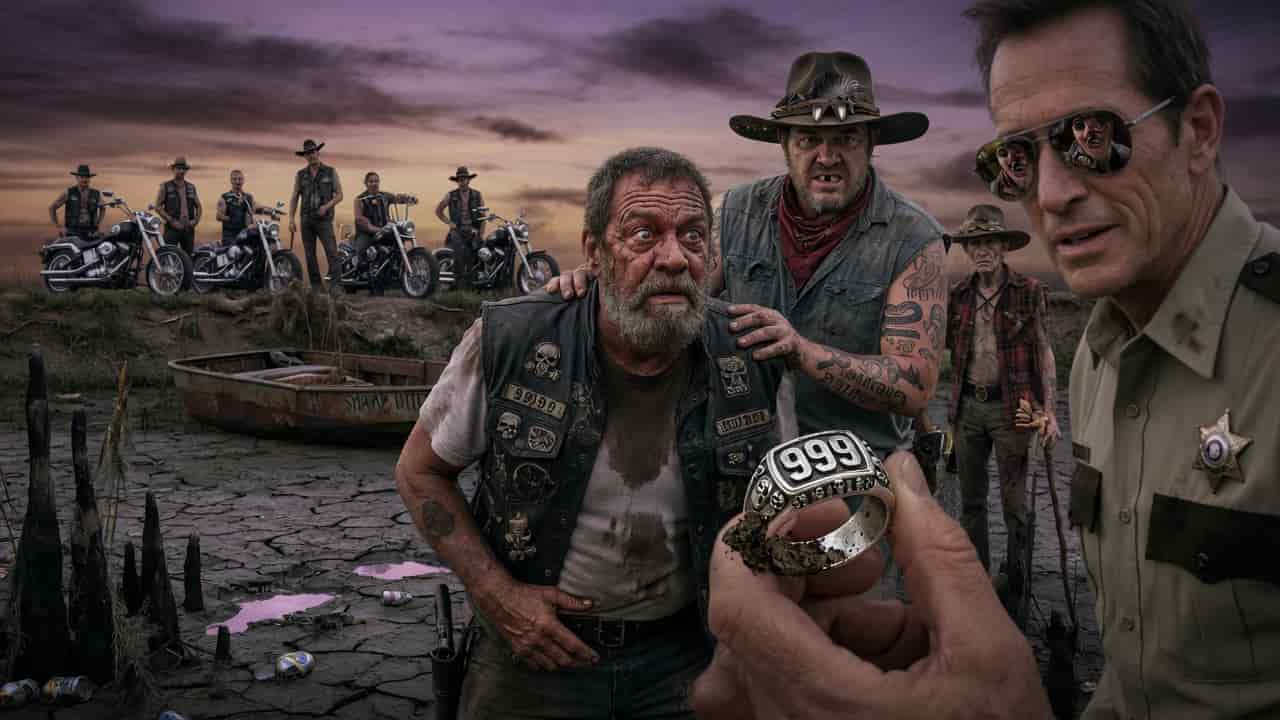
“Found this in the muck today, Gator. You want to tell the boys why your brother’s ring was sitting under ten feet of swamp water?”
The Sheriff didn’t say it quietly. He said it right in front of the whole 999 crew, the sun beating down on the cracked mud of the Louisiana basin. For fifteen years, Gator told everyone his brother ran off to start a new life. He told their mother—who still sits on the porch every evening waiting for a ghost—that Danny was coming home any day now.
But the water is gone. The bayou is dry. And the secrets are starting to surface.
Gator felt the eyes of his club members on his back. Men who live and breathe by a code of blood and loyalty. If they find out what really happened that night in the trees, there won’t be enough of Gator left to bury.
“I don’t know what that is, Miller,” Gator rasped, but his hands were shaking.
“That’s funny,” the Sheriff sneered, turning the ring so the silver caught the light. “Because the inscription says ‘Danny.’ And you’re the only one who was with him the night he ‘disappeared.’ Maybe we should start digging a little deeper?”
The silence that followed was worse than any threat. Gator looked at his men, then at the dried-out swamp, and realized the truth was finally coming for him.
Chapter 1: The Weight of Dry Earth
The heat in Iberia Parish didn’t just sit on you; it owned you. It was a thick, wet wool blanket that smelled of rotting algae and diesel exhaust. But this year, the wet was gone. The Atchafalaya was receding, drawing back like a dying man’s gums, revealing things the bayou had promised to keep forever.
Gator Henderson sat on the sagging porch of his mother’s house, watching the dust motes dance in the stagnant air. He was a big man, built like a cypress stump, his skin mapped with the scars of thirty years in the 999 Biker Alliance. His leather vest, heavy with the weight of the “President” patch, felt like a lead yoke today.
“He’s late, Gator,” a voice drifted from the screen door.
Gator didn’t turn. He didn’t have to. “He ain’t late, Ma. He’s just… out.”
His mother, Lorraine, shuffled out onto the porch. She was a ghost in a floral housecoat, her eyes cloudy with the fog of dementia. She carried a glass of sweet tea that had long since gone lukewarm. She set it on the small wicker table next to Gator’s empty chair—the chair that had belonged to his younger brother, Danny, fifteen years ago.
“The sun’s going down,” she whispered, her voice a thin reed. “Danny don’t like being in the woods after dark. You go find him? You go bring him in for supper?”
Gator felt a sharp, familiar knot tighten in his gut. It was a physical pain, a hook buried deep in his diaphragm. “I’ll go look for him in a bit, Ma. You go on inside. The mosquitoes are gonna get bad.”
“He’s a good boy,” she said, looking out at the wall of grey trees at the edge of the property. “He just gets lost sometimes.”
Gator waited until the screen door clicked shut. He reached into his pocket and pulled out a small, tarnished silver ring. He’d found it two days ago, walking the receding shoreline of the coulee behind the house. It was a club ring—the 999 emblem worn smooth by years of silt and salt. He knew exactly what it was. He knew whose finger it had been on when it went into the water.
He also knew that a mile down the road, the parish was dredging the main canal. The drought had forced the state’s hand, and they were digging out the silt to keep the water flowing to the rice farmers. Every scoop of the crane was a gamble. Every foot of mud they moved was a threat to the life Gator had built.
His phone buzzed against his thigh. It was Mud, his Sergeant-at-Arms.
“Boss,” Mud’s voice was low, vibrating with the rumble of a heavy engine in the background. “You need to get down to the levee. Near the old pumping station.”
“What’s going on?” Gator asked, his voice steady despite the roar in his ears.
“The Sheriff’s there. And some of the boys. They found something in the dredge bucket. Miller’s asking for you specifically. He’s got that look on his face, Gator. The one he gets when he thinks he’s finally caught a big cat in a small cage.”
Gator closed his eyes. He could feel the ring in his palm, the cold metal biting into his skin. “I’m on my way.”
He stood up, his joints popping like dry kindling. He looked at the screen door, seeing the faint shadow of his mother through the mesh. She was still standing there, waiting for the boy who was never coming back. Gator had spent fifteen years building a lie to protect her, and himself. He’d told the club that Danny had flipped, taken some money, and vanished into the night. He’d branded his own brother a traitor to keep the secret of what happened in the clearing when the whiskey was high and the tempers were short.
He walked down the porch steps and swung his leg over his custom Shovelhead. The engine roared to life, a violent, mechanical scream that shattered the afternoon silence. As he kicked the bike into gear and headed toward the levee, the dust rose up behind him like a funeral shroud.
He rode hard, the wind doing nothing to cool the sweat on his neck. Iberia Parish was a small world. Everyone knew Gator. Everyone feared him, or respected him, or waited for him to fall. And Sheriff Miller had been waiting longer than most.
The levee was crowded when he arrived. Three cruisers, their lights pulsing blue and red against the dusty green of the cypress, were parked near the dredging crane. A group of 999 members stood in a semi-circle, their arms crossed, their faces grim. They looked like a wall of leather and ink.
In the center of it all was Sheriff Miller. He was holding a plastic evidence bag.
Gator killed the engine and let the bike coast to a stop. He dismounted, his boots crunching on the dry clay. He didn’t rush. A leader never rushed, even when his world was on fire.
“Sheriff,” Gator said, nodding. “You’re a long way from the AC.”
Miller stepped forward, his mirrored shades hiding his eyes. He held up the bag. Inside was a piece of white bone, jagged and stained brown by the swamp.
“Found this in the last scoop, Gator,” Miller said, his voice smooth as river stone. “Looks like a femur. Human. From the size of it, belonged to a young man. Not too tall. Maybe twenty, twenty-one.”
Gator felt the world tilt. Danny had been twenty when he died.
“The bayou is full of bones, Miller,” Gator said, his voice a low growl. “Old hunters, runaways from the sixties. You find a bone and you call a press conference?”
“It ain’t just the bone,” Miller said. He reached into his pocket and pulled out another ring—the twin to the one in Gator’s pocket. “We found this stuck in the joint. Club ring. 999. Now, I remember back in ’11, you told me your brother Danny headed for the coast with a pocket full of club cash. You said he was a thief and a coward.”
The bikers behind Gator shifted. Mud stepped forward, his face unreadable. The air between them felt like it was charged with static.
“I said what I said,” Gator replied.
“Funny thing is,” Miller continued, stepping closer until Gator could smell the peppermint on his breath. “Danny never struck me as the type to leave his ring behind. Especially not at the bottom of a hole he didn’t dig himself. What do you think, boys? Does this look like a runner’s ring to you?”
Miller turned the bag toward the bikers. The silence was absolute. Gator could feel the residue of the lie sticking to him, thick and oily. He looked at the bone, then at the ring, and then at the hard, questioning eyes of the men he led. The drought had ended the peace. The reckoning had begun.
Chapter 2: The Ghost in the Garage
The clubhouse of the 999 was an old converted warehouse on the edge of the marshes, a place that smelled of stale beer, old oil, and the lingering scent of unwashed denim. Normally, the place was a riot of noise—pool balls clacking, music blaring, the constant banter of men who lived outside the law.
Tonight, it was quiet. Too quiet.
Gator sat in his office, a cramped room with a view of the main floor. He watched his men through the glass. They were huddled in small groups, speaking in low tones that died out whenever he looked their way. The trust was fraying. He could see it in the way they stood, the way they avoided his eyes.
Mud knocked on the door and entered without waiting for an answer. He sat down across from Gator, his massive frame dwarfing the chair.
“The boys are talking, Gator,” Mud said bluntly.
“They always talk,” Gator replied, leaning back and lighting a cigarette. He kept his hands below the desk so Mud wouldn’t see the slight tremor in his fingers.
“Not like this. Miller put a seed in the ground today. He’s been out there all afternoon with a forensic team. They’re pulling more than just bones out of that mud. They found a watch today. A Timex with a leather band.”
Gator’s heart hit his ribs like a hammer. He remembered that watch. He’d given it to Danny for his eighteenth birthday.
“So?” Gator said, blowing a cloud of smoke. “Danny was a member. He spent time at the pumping station. Maybe he lost it.”
“In the middle of a dredge site ten feet down?” Mud shook his head. “Come on, Boss. We aren’t stupid. If Danny didn’t run, if he ended up in that swamp… then someone put him there. And if someone put a 999 member in the ground, and we didn’t go to war over it… it means the club was lied to.”
Mud leaned forward, his eyes boring into Gator’s. “You were the last one to see him. You said you had a meeting with him about the money he stole. You said he walked away. If he didn’t walk away, Gator… where did he go?”
The psychological weight of fifteen years of deception pressed down on Gator’s chest. He looked at Mud—his most loyal soldier, the man who had taken a bullet for him in Shreveport. He wanted to tell him. He wanted to scream the truth: that it was an accident, a shove that went wrong, a head hitting a rock, and a panicked brother who couldn’t face the shame of what he’d done.
But Gator Henderson was the President. And in this world, an accident was just a weakness you couldn’t afford.
“You questioning me, Mud?” Gator asked, his voice dropping to a dangerous whisper.
Mud didn’t flinch. “I’m telling you what the room feels like. The boys are starting to wonder if the man leading them is a brother or a butcher. You need to make a move, Gator. Before the Sheriff makes it for you.”
“I’ll handle Miller,” Gator said. “Go tell the boys to gear up. We’re going to Voodoo’s place.”
“Voodoo? Why?”
“Because if anyone knows what the bayou is hiding, it’s him. He’s lived on that water since before the pumps were built. If Miller is finding things, I need to know what else is down there.”
Mud hesitated, then nodded and left the office.
Gator stood up and walked to the small safe in the corner of the room. He dialed the combination and pulled out an old, mud-stained ring he’d hidden years ago. He looked at it, then at the ring he’d found on the shore. He had both now. The evidence was piling up, and the wall he’d built around his life was cracking.
He left the clubhouse and rode out toward the deep swamp. Voodoo lived in a shack on stilts, accessible only by a narrow wooden walkway that wound through the tupelo trees. The air out here was even heavier, thick with the smell of sulfur and decay.
Voodoo was waiting for him on the porch, sitting in a rocking chair made of driftwood. He was a man of indeterminate age, his skin the color of old coffee, his eyes bright and sharp as a hawk’s.
“I knew you’d come, Gator,” Voodoo said, his voice a gravelly rasp. “The water’s low. The secrets are coming up for air.”
“What have you seen, Voodoo?” Gator asked, stepping onto the porch.
“I see the Sheriff digging in the wrong place,” Voodoo cackled. “He’s looking for bones. But the bayou don’t just hold bones. It holds the spirit of the thing. I remember that night, fifteen years back. I remember the sound of your bike racing away from the pumping station. I remember the silence that followed.”
Gator felt a cold sweat break out on his skin. “You saw me?”
“I saw a man who was carrying a heavy load,” Voodoo said, his eyes narrowing. “A man who didn’t want to be seen. You think the mud is a grave, Gator. But the mud is a womb. It keeps things until they’re ready to be born. And your brother… he’s ready.”
“Shut up,” Gator snapped. “I didn’t come here for riddles. I came to find out if there’s anything else. Anything that can link me to that site.”
Voodoo stood up, his movements slow and deliberate. He walked to the edge of the porch and pointed toward the dark expanse of the swamp. “The Sheriff found the ring. He found the bone. But he ain’t found the jacket yet. The one with the patches. The one you tried to burn, but the water took instead.”
Gator felt the world dissolve around him. He’d forgotten the jacket. In his panic, he’d tried to burn Danny’s kutte, but the dampness of the swamp had fought the flames. He’d shoved it into a hollow log near the water’s edge. If the water was low enough…
“Where is it?” Gator whispered.
“It’s where you left it,” Voodoo said. “But the Sheriff is moving that way. He’s got the dogs out tonight, Gator. He’s got the light of justice in his eyes. You better get there first.”
Gator didn’t wait for another word. He turned and ran back to his bike. He could hear the distant baying of hounds in the night air—a sound that felt like it was coming from inside his own head. He kicked the Shovelhead into life and roared back toward the pumping station, the darkness of the bayou closing in around him like a trap.
Chapter 3: The Reckoning in the Mud
The pumping station was a rusted skeleton of iron and concrete, standing guard over a dry canal that looked like a scar across the earth. The moon was a sliver of bone in the sky, providing just enough light to see the silhouettes of the dredging equipment.
Gator parked his bike a quarter-mile away and approached on foot. He moved with the stealth of a predator, his heart hammering against his ribs. He had to find the log. He had to find the jacket before the sun came up and the Sheriff’s crew returned.
But as he reached the edge of the canal, he realized he wasn’t alone.
Flashlights cut through the darkness, their beams sweeping over the cracked mud. He heard voices—harsh, authoritative.
“Spread out!” Sheriff Miller’s voice echoed off the concrete walls. “The dogs picked up a scent near the old cypress grove. Keep your eyes on the ground.”
Gator ducked behind a stack of rusted pipes. He could see Miller about fifty yards away, walking with two deputies and a bloodhound. The dog was pulling at the leash, its nose glued to the mud. It was heading straight for the hollow log.
The psychological pressure was unbearable. If they found the jacket, it was over. The blood on the leather, the bullet hole—it would all be there, preserved by the silt. He had to do something. He had to create a distraction.
He reached into his pocket and pulled out a heavy brass lighter. He looked around, eyes landing on a patch of dry sawgrass near the dredging crane. It was a risk, but it was his only chance.
He crawled through the mud, ignoring the filth that smeared his vest. He reached the grass and struck the lighter. The flame caught instantly, the dry stalks tinder-quick. Within seconds, a wall of fire began to climb toward the sky, illuminating the pumping station in a hellish orange glow.
“Fire!” one of the deputies shouted. “The crane’s gonna go up!”
Miller and his men turned, their attention diverted by the roaring flames. Gator didn’t waste a second. He ran toward the cypress grove, his eyes searching for the landmark he’d tried to forget for fifteen years.
There. The hollow log, half-buried in the silt.
He reached it and began to dig with his bare hands. The mud was cold and thick, clinging to his skin like a memory. He felt something soft—not wood, but leather. He gripped it and pulled.
The jacket came free with a wet, sucking sound. It was heavy, encrusted with mud, but the “999” patches were still visible. He felt a wave of nausea. This was his brother’s skin. This was the proof of his sin.
“Gator?”
The voice was low, but it hit him like a physical blow. He turned, the jacket clutched to his chest.
Mud was standing ten feet away. He was alone, his face cast in shadow by the distant fire. He was looking at the jacket in Gator’s arms.
“I followed you,” Mud said, his voice trembling with a mix of anger and grief. “I didn’t want to believe it. I told the boys you were just stressed. I told them you were my brother.”
Gator stood up, his legs shaking. “Mud, listen to me. It wasn’t… it wasn’t what it looks like.”
“What does it look like, Gator?” Mud stepped forward, his fists clenched. “It looks like you killed a member. It looks like you killed your own blood and then lied to us for fifteen years. You let us think he was a rat. You let us hate him.”
“I did it to protect the club!” Gator shouted, the lie finally collapsing under its own weight. “Danny was going to talk to the feds! He was scared, Mud. He was gonna flip on all of us. I tried to stop him, and we fought… and he fell. It was an accident.”
“An accident you buried,” Mud said, his voice cold. “An accident you used to solidify your power. You made yourself a martyr, Gator. The man who lost his brother to the law. But you’re just a liar.”
The fire was spreading, the smoke thick and choking. In the distance, Gator could hear the sirens of the fire trucks. The Sheriff would be back any minute.
“What are you gonna do, Mud?” Gator asked, his voice hollow.
Mud looked at the jacket, then at Gator. The silence between them was a chasm. “I should kill you right here. I should put you in that hole with him.”
“Then do it,” Gator said, dropping the jacket. “Do it and tell the boys. But remember—if I go down, the club goes with me. Miller won’t stop at Danny. He’ll use this to take down every man in the 999. Is that what you want?”
Mud’s expression shifted. The loyalty to the club—the very thing Gator had manipulated—was now the only thing keeping him alive.
“Give me the jacket,” Mud said.
“What?”
“Give it to me. I’ll take it to the deep water. I’ll make sure it stays gone. But you’re done, Gator. Tomorrow morning, you’re gonna stand in front of the club and you’re gonna step down. You’re gonna tell them you’re retiring. And if you ever show your face in this parish again, I’ll tell them everything.”
Gator looked at the man he’d trained, the man he’d treated like a second brother. He felt a flicker of hope, but it was quickly extinguished by the cold reality of his loss. He’d kept his life, but he’d lost his soul.
He handed the mud-slicked leather to Mud. “Thank you.”
“Don’t thank me,” Mud said, his voice full of disgust. “I’m doing this for the patches. Not for you.”
Mud turned and disappeared into the smoke, the jacket draped over his arm like a shroud. Gator stood alone in the mud, the fire reflecting in his eyes, as the sirens drew closer.
Chapter 4: The House of Broken Mirrors
Gator rode back to his mother’s house in a daze. The fire at the pumping station was a distant glow in his rearview mirror, but the fire inside him was just beginning to burn.
He parked the bike and walked up the porch steps, his boots leaving muddy prints on the wood. He felt ancient. Every step was a struggle against the gravity of his own guilt.
He entered the house and found his mother sitting at the kitchen table. She was staring at a bowl of cold soup, her hands folded in her lap.
“He’s still not home, Gator,” she said, her voice devoid of emotion.
“I know, Ma,” Gator said, sitting down across from her. He looked at her weathered face, the lines of worry that had been etched there by years of waiting. He realized then that his lie hadn’t protected her at all. It had only kept her trapped in a state of perpetual grief, a living ghost waiting for a dead one.
“Why is it so hot?” she asked, looking toward the window. “I can smell smoke.”
“Just a brush fire, Ma. Nothing to worry about.”
“Danny likes the fire,” she whispered. “He used to sit by the hearth and tell me stories about the big bikes. He wanted to be just like you, Gator. He looked up to you so much.”
Gator felt a sob rise in his throat, a violent, jagged thing. He choked it back, his jaw aching from the effort. “He was a good kid, Ma. Better than me.”
“He was different,” she said, her eyes suddenly clearing for a brief, terrifying moment. “He had a light in him. You… you have the shadows. I always worried the shadows would swallow him up.”
She looked at him then, really looked at him, and for a second, Gator saw a flicker of recognition in her eyes. Not of the man he was, but of the thing he’d done.
“Where is he, Gator?” she asked, her voice steady and sharp. “Tell me the truth. Just once.”
Gator opened his mouth to lie, to tell her the same old story about the coast and the money. But the words wouldn’t come. The weight of the jacket, the ring, and Mud’s betrayal had broken the mechanism of his deception.
“He’s in the bayou, Ma,” Gator whispered, the truth finally spilling out like blood from a fresh wound. “He’s been there the whole time.”
His mother didn’t scream. She didn’t cry. She just leaned back in her chair, the light in her eyes fading back into the fog. “I know,” she said quietly. “I’ve always known. I was just waiting for you to say it.”
Gator sat in silence as the clock on the wall ticked away the seconds of his life. He felt a strange sense of relief, a cold peace that came with the total destruction of his world.
But the peace didn’t last long.
A heavy knock sounded at the front door. Not the polite knock of a neighbor, but the rhythmic, aggressive pounding of the law.
Gator stood up and walked to the door. He knew who it was.
He opened it to find Sheriff Miller standing on the porch. He wasn’t wearing his sunglasses now. His eyes were red-rimmed and tired, but they held a grim satisfaction.
“Gator,” Miller said. “We found something else tonight. Not in the mud. In a truck we pulled over near the deep-water bridge.”
Gator looked past Miller to the driveway. Mud was sitting in the back of a squad car, his head bowed, his hands cuffed. The mud-caked jacket was sitting on the hood of the cruiser, illuminated by the flashing lights.
“Your boy Mud tried to play hero,” Miller said, stepping into the house. “But he didn’t count on us having a checkpoint at the bridge. He told us everything, Gator. He didn’t even put up a fight. I think he wanted to be caught.”
Gator looked at Mud, then at the jacket. He felt a strange sense of pride in his Sergeant-at-Arms. Mud hadn’t betrayed the club. He’d saved it by giving the law the one thing they needed to end the cycle.
“Lorraine?” Miller said, looking past Gator to the kitchen. “I’m sorry it had to be like this.”
Gator’s mother didn’t look up. She was back in her own world, whispering to the empty chair.
“Come on, Gator,” Miller said, reaching for his handcuffs. “Let’s go for a ride. It’s been a long time coming.”
Gator didn’t resist. He held out his wrists, the metal cold and final against his skin. As he was led out to the car, he looked back at the house one last time. He saw his mother standing at the window, her hand raised in a slow, phantom wave.
He realized then that the bayou hadn’t just taken Danny. It had taken all of them. And as the cruiser pulled away, the dust rising up to swallow the house, Gator Henderson finally felt the weight of the dry earth lift from his chest.
But the silence that followed was the loudest thing he’d ever heard.
Chapter 5: The Glass Box of Truth
The Iberia Parish interrogation room smelled of industrial lemon cleaner and the stale, sour sweat of a thousand desperate men. It was a windowless box, illuminated by flickering fluorescent tubes that made everyone’s skin look like curdled milk. Gator sat at the bolted-down metal table, his hands cuffed to a steel ring in the center. The “999” patches had been stripped from his vest—Miller’s deputies had taken the leather as evidence—leaving him in a plain grey t-shirt that felt like a flimsy second skin. Without the leather, he felt smaller, as if the air in the room was slowly crushing his ribs.
Sheriff Miller sat across from him, looking refreshed despite the hour. He had a file folder in front of him and a lidded cup of coffee that smelled like heaven. He didn’t offer Gator any.
“You know, Gator, I’ve spent twenty years wondering why a man like you—a man who clearly loves his mother and treats his club like a religion—would just let his baby brother walk away into the night,” Miller said, peeling back the plastic lid of his coffee. “It never sat right. In this parish, blood doesn’t just evaporate. It soaks into the dirt. It stays.”
Gator stared at the cinderblock wall behind Miller’s head. He didn’t speak. He’d lived his life by a code of silence, and jail didn’t change that. But the silence today didn’t feel like strength. It felt like a vacuum.
“We got Mud in the other room,” Miller continued, his voice conversational, almost friendly. “He’s a mess. Crying like a kid. He thinks he failed you, Gator. He thinks that by trying to save you, he destroyed the only thing he ever believed in. He told us about the pumping station. He told us about the jacket. But more importantly, he told us what you said to him in the mud.”
Gator’s jaw tightened. “Mud’s a good man. He was confused. The smoke, the fire… people say things when they’re scared.”
“He wasn’t scared, Gator. He was heartbroken,” Miller leaned forward, the steam from his coffee rising between them. “He said you told him it was an accident. A shove. A fall. He said you did it to protect the club because Danny was going to talk to the feds. Is that the story we’re sticking to? Because I checked the federal logs from fifteen years ago. There wasn’t a single whisper about a Danny Henderson being a CI. Not a phone call, not a meeting, not a ghost of an inquiry.”
The air in the room suddenly felt very thin. Gator looked down at his cuffed hands. The “accident” lie was the only thing that had kept his mind from fracturing over the last decade and a half. If he admitted it wasn’t about the feds, it was just… a fight. A stupid, drunken fight between two brothers who loved each other too much and understood each other too little.
“He wasn’t gonna flip,” Gator whispered, the words barely audible over the hum of the lights.
“Say again?”
Gator looked up, his eyes bloodshot. “He wasn’t gonna flip. He was just twenty. He was a kid, Miller. He wanted out. He wanted to take that girl from Lafayette and move to Texas. He told me that night at the pumping station that he was done with the 999. He said the club was a cult for men who were too afraid to grow up.”
Gator’s mind drifted back, the memory hitting him with the force of a physical blow. He could see the night clearly now—not the blurred version he’d told himself for years, but the raw, jagged reality.
Fifteen years ago.
The mosquitoes were thick, a humming cloud around the dim yellow light of Gator’s truck. Danny was standing by the edge of the canal, his face flushed with anger. He’d already taken his vest off—his “kutte”—and thrown it into the dirt. To a man like Gator, that was the ultimate insult.
“You don’t just walk away, Danny!” Gator had roared, the whiskey in his blood making his voice boom through the cypress. “I spent three years getting you patched in! I put my reputation on the line for you!”
“I didn’t ask you to!” Danny screamed back. “I want a life, Gator! A real one! I don’t want to spend my Saturdays guarding a warehouse and my Sundays hungover in a ditch! I’m leaving. With or without your blessing.”
“You leave now, you’re a rat,” Gator sneered, stepping into Danny’s space. “The club will come for you. I won’t be able to stop them.”
“Then don’t stop them!” Danny shoved Gator, a hard, two-handed strike to the chest. “Stop being their puppet! You’re my brother, not my warden!”
Gator had reacted without thinking. It was the training, the years of bar fights and enforcer work. He’d swung a heavy, open-palmed hand—not a punch, but a shove aimed at the head. Danny had been off-balance, his boots slick with the rising mud of the canal bank. He’d stumbled back, his eyes wide with surprise, and then his heel caught on a rusted piece of rebar sticking out of the old pumping station foundation.
There had been a sound—a sickening, dull thud—as Danny’s temple hit the corner of a concrete piling.
Gator had frozen. The world went silent, the crickets stopping their song as if they were holding their breath. He’d scrambled down the bank, his heart screaming in his throat.
“Danny? Danny, hey… get up. Stop playing, man.”
But Danny wasn’t playing. His eyes were open, staring at the stars, but the light was gone. A thin trickle of blood ran from his ear, disappearing into the dark Louisiana silt.
Gator had sat there for an hour, cradling his brother’s cooling body. He’d looked at the “999” on Danny’s discarded vest and realized that if he told the truth, the club would see it as a murder of a brother—a fratricide that would lead to his own execution. And his mother… she would lose both her sons in one night.
So he’d dug. He’d dug until his fingernails bled and his back felt like it was breaking. He’d wrapped Danny in a tarp from the truck and pushed him into the soft, yielding mud beneath the pumping station. Then he’d picked up the vest, the ring, and the watch, and started the long, slow process of building a lie that would last fifteen years.
“Gator? You still with me?” Miller’s voice snapped him back to the present.
Gator blinked, the fluorescent lights stinging his eyes. “He was just a kid,” he repeated. “He didn’t deserve a mud grave.”
“No, he didn’t,” Miller said, his voice softening slightly. “But you’re the one who put him there. And now the club knows. We had to move Mud to a different facility for his own safety. Word got out to the jail house telegraph. The 999 are outside the gates, Gator. About forty of them. They aren’t here to bail you out.”
Gator felt a cold shiver. The social pressure of the club was a tangible thing, even through the thick walls of the jail. He’d built that club on the myth of Danny’s betrayal. He’d used Danny’s “theft” of club money—money Gator had actually burned in a barrel—to justify his own rise to power, to show the men that even blood didn’t come before the alliance.
He had become a god to them by desecrating his brother’s memory.
“Who’s leading them?” Gator asked.
“A guy named ‘Rex.’ Big fella, lots of facial tattoos,” Miller said. “He’s calling for your head, Gator. Says the code of the 999 is ‘Blood for Blood.’ He thinks you murdered a brother in cold blood to keep him from leaving. He doesn’t believe the accident story any more than I do.”
Gator leaned back, the metal chair creaking. He was a man without a country. The law wanted him for manslaughter and tampering with evidence. His club wanted him for treason and murder. And his mother… his mother was finally free of the lie, which meant she had nothing left to live for.
“I want to see my mother,” Gator said.
“That’s not gonna happen today,” Miller said, closing the file. “She’s being looked after by the state. She’s… she’s not doing well, Gator. The doctors say the shock of the news has accelerated things. She’s drifted off into a place where nobody can reach her.”
Gator felt a sharp, stabbing pain in his chest. Residue. That was what this was. The residue of every choice he’d made, every lie he’d told, finally coalescing into a weight he couldn’t carry. He’d tried to save her from the truth, and in doing so, he’d robbed her of fifteen years of mourning. He’d forced her to live in a state of suspended animation, waiting for a ghost that he had buried with his own hands.
“I’ll tell you where the rest of him is,” Gator said, his voice cracking. “The dredging… they’re missing the main site. He’s deeper than they think. Under the third piling of the old station. I’ll give you the exact spot. Just… tell Rex and the boys to go home. This is between me and the bayou. It ain’t got nothing to do with them anymore.”
Miller looked at him for a long moment, then nodded. “I’ll relay the message. But I don’t think they’re going anywhere, Gator. You taught them too well. You taught them that loyalty is everything. And you’re the one who broke it.”
As Miller left the room, the heavy steel door clicking shut, Gator was left alone with the humming lights and the ghosts of his past. He closed his eyes and saw the bayou—the dark, swirling water, the cypress knees like tombstones, and the face of his brother, forever twenty, forever waiting for the truth to come out of the mud.
Chapter 6: The Residue of the Bayou
The transport van was a windowless metal box that bounced violently over the rutted dirt roads leading back to the pumping station. Gator sat on the narrow bench, his ankles shackled, his wrists chained to a belt around his waist. He was flanked by two deputies in riot gear—a clear indication that Sheriff Miller didn’t trust the 999 to stay away.
When the van finally stopped and the doors swung open, the heat of the bayou hit Gator like a physical assault. It was midday now, the sun a white-hot eye in a cloudless sky. The air was thick with the scent of turned earth and stagnant water.
The site had changed since the night before. The fire had been extinguished, leaving a blackened scar across the sawgrass. A new, larger crane had been brought in, and a team of men in white forensic suits were carefully sifting through a pile of wet, grey silt.
But it was the perimeter that caught Gator’s attention.
Beyond the police tape, a line of motorcycles stretched as far as the eye could see. The 999 were there in force. Rex stood at the front, his arms crossed over his heavily tattooed chest, his face a mask of cold fury. Mud was nowhere to be seen—likely already processed and moved to a state facility.
The bikers were silent. There was no shouting, no revving of engines. Just a heavy, suffocating wall of men watching their fallen leader be led toward the scene of his crime.
“Watch your step,” a deputy muttered, gripping Gator’s arm as they navigated the slippery mud.
Miller was standing near the third concrete piling. He looked at Gator, then pointed to a spot where the mud seemed darker, more compressed. “This it?”
Gator nodded. “You have to go down another four feet. The silt settled over the years. He’s wrapped in a blue tarp. Or what’s left of it.”
He watched as the forensic team began to dig by hand. It was slow, agonizing work. Every shovel-full of mud felt like it was being taken from Gator’s own lungs. He stood there, exposed to the sun and the judgmental gaze of his club, and realized that this was his real sentencing. Not a courtroom, not a jail cell, but this—the public excavation of his soul.
An hour passed. Then two. The heat became unbearable, making the air shimmer over the dry canal.
“We got something!” a technician shouted.
Gator felt his knees buckle. The deputy gripped his arm tighter, keeping him upright.
A corner of blue plastic emerged from the grey mud. Then a shape—the unmistakable outline of a human form, curled into a fetal position. The technician began to clear away the silt with a soft brush, revealing a shock of dark hair, a fragment of a checked shirt, and the glint of a metal buckle.
The silence on the levee broke. A low, collective groan went up from the bikers—a sound of mourning mixed with absolute betrayal. Rex took a step forward, his hand resting on the hilt of a knife at his belt, but the deputies moved to intercept him.
“Stay back!” Miller barked.
Gator didn’t look at Rex. He couldn’t. He was staring at the tarp. As the forensic team carefully lifted the remains onto a stretcher, a small object fell from the folds of the plastic. It tumbled into the mud, rolling toward Gator’s boots.
It was a small, plastic toy—a miniature motorcycle, its wheels encrusted with dirt.
Gator felt a sob rip through him, a raw, primal sound that echoed across the water. He remembered that toy. Danny had carried it in his pocket for luck since he was ten years old. He’d forgotten it was there.
“Take him back to the van,” Miller ordered, his voice uncharacteristically quiet. “We’re done here.”
As Gator was led away, he passed within five feet of Rex. The new leader of the 999 didn’t move. He didn’t speak. He simply reached up and spat on the ground at Gator’s feet. It was a formal excommunication, a social death that was far more permanent than any legal one.
Gator was loaded back into the van. As the doors closed, he caught one last glimpse of the bayou. The sun was starting to set, casting long, twisted shadows across the mud. The remains of his brother were being loaded into a black SUV, heading toward a city morgue where he would finally be given a name and a proper grave.
The ride back to the station was quieter. The deputies didn’t speak. Even the rattling of the van felt subdued.
When they arrived at the jail, Miller was waiting for him in the processing area. He looked older, the events of the last forty-eight hours having etched new lines into his face.
“Your mother passed away an hour ago, Gator,” Miller said, his voice level. “The nurse said she just… stopped. Like she’d finally finished what she was waiting for.”
Gator didn’t react. He couldn’t. He felt hollow, as if the dredging crane had scooped out everything inside him and left only a shell. He’d lost his brother, his club, his reputation, and now his mother. The lie had been the only thing holding the world together, and without it, there was nothing but the cold, hard reality of his own failure.
“She’s being taken to the same funeral home as Danny,” Miller continued. “The state will handle the costs if you can’t, but I imagine you’ve got some money tucked away somewhere that Rex hasn’t found yet.”
“I have money,” Gator whispered. “I want them buried together. Under the oaks in the parish cemetery. Away from the water.”
“I’ll see what I can do,” Miller said. He signaled to the deputies. “Take him down to the high-security wing. I don’t want him anywhere near the general population tonight.”
Gator was led down a long, white hallway, the sound of his shackles echoing against the linoleum. He was placed in a single cell at the very end of the block. It was small, cold, and smelled of lye.
He sat down on the narrow cot and leaned his head against the concrete wall. For the first time in fifteen years, he didn’t have a secret to keep. He didn’t have a club to lead. He didn’t have a mother to protect.
He was just a man. A man who had killed his brother and spent a lifetime trying to bury the truth in a place that didn’t know how to keep it.
The night came on, and with it, the familiar sounds of the bayou—the crickets, the frogs, the distant rumble of a boat engine. But for Gator, the sounds were different now. They weren’t threats. They weren’t ghosts. They were just the world moving on, indifferent to the tragedy of the Henderson boys.
He closed his eyes and saw Danny. Not the skeletal remains in the blue tarp, and not the angry kid at the pumping station. He saw the boy who had sat on the porch and talked about the big bikes, the boy who had looked up at his older brother with eyes full of hero-worship.
“I’m sorry, kid,” Gator whispered to the empty cell.
The silence that followed wasn’t deafening. It was just final.
The residue of the bayou would stay with him forever—the smell of the mud, the weight of the secret, the cold touch of the silver ring. But as he drifted off into a fitful sleep, Gator Henderson finally understood that the truth hadn’t set him free. It had simply left him with nothing left to lose.
Outside, the Louisiana drought continued, the sun parching the earth and revealing the bones of a thousand other stories. But for Gator, the water had finally stopped receding. The secrets were all out in the light, and there was nowhere left to hide.