“Chapter 5: The Aftermath of the Flame
The weeks following Vane’s arrest were a whirlwind. The “”2,000 Engines”” protest, as the media called it, became a national symbol of grassroots justice. People from across the country sent donations to the Blackwood Home. They didn’t just send money; they sent clothes, books, and toys.
I went back to my shop, but things were different. I wasn’t just “”Dutch the mechanic”” anymore. I was the guy who stood in the dark.
One afternoon, a few weeks later, I was under the hood of a ’67 Mustang when a familiar car pulled up. It was Deputy Miller. He looked older, more haggard. He’d survived the purge of the department, but only barely.
“”Vane is talking,”” Miller said, leaning against the doorframe. “”He’s trying to implicate everyone. He thinks if he takes enough people down with him, he can negotiate a lighter sentence.””
“”Will it work?”” I asked, not looking up from the engine.
“”Not for him. The DA has enough on the arson charge alone to put him away for twenty years. But he’s naming names on the development board. It’s going to be a long winter for the ‘city fathers.'””
Miller stayed for a while, talking about nothing in particular. I think he wanted a sense of normalcy, a reminder of what the town used to be before Vane twisted it into something unrecognizable. Before he left, he handed me a small envelope.
“”From Sister Mary,”” he said. “”She wanted you to have it.””
Inside was a drawing by Leo. It was a picture of a giant man with grease on his hands, standing in front of a house. Behind the man were thousands of tiny circles representing the headlights. At the bottom, in shaky six-year-old handwriting, it said: The man who stopped the fire.
I felt a lump in my throat that no amount of coffee could wash down. I’d spent my whole life thinking I was just a guy who fixed things that were broken. I realized then that sometimes, the things that need fixing aren’t made of steel and oil.
Chapter 6: The Long Road Home
Six months later, the Blackwood Home for Children had a new roof, a new playground, and a kitchen that was always full of the smell of baking bread instead of damp rot.
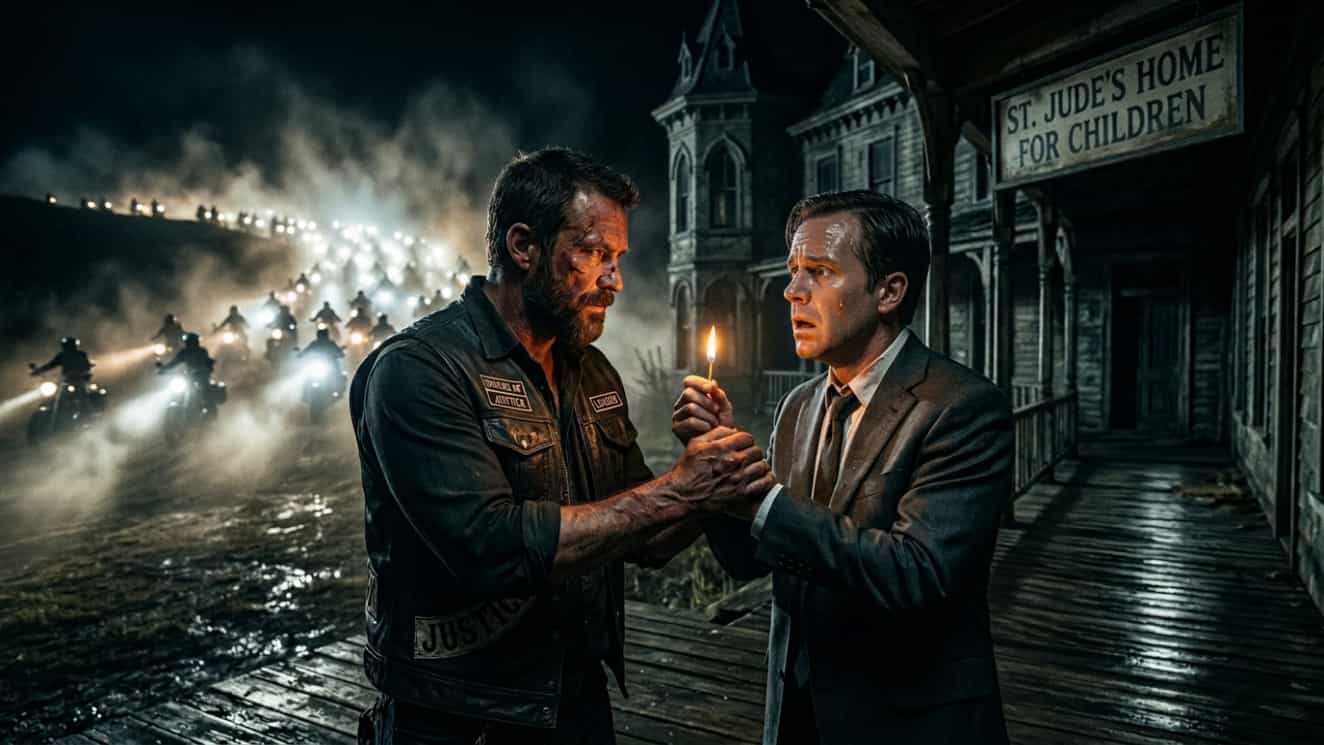
I rode my bike up to the ridge one evening, the same spot where I’d watched Silas Vane with his gas can. The valley was quiet now, the lights of the town twinkling like fallen stars.
I thought about the 2,000 people who had stood there with me. They were gone back to their lives—driving trucks, teaching schools, working the lines at the new factory that had opened up in the wake of the corruption scandal. But there was a bond now, an invisible thread that tied us all together. We knew what we were capable of when the lights were on.
I saw a light flick on in the upstairs window of the orphanage. That was Leo’s room. He was probably reading one of the new books Sarah had brought him. He was safe. They were all safe.
I realized then that Silas Vane was right about one thing: the world is a dark place. But he was wrong about the rest. He thought the darkness was a place to hide. He didn’t understand that for people like us—the ones with grease under our nails and fire in our hearts—the darkness is just the canvas where we show our light.
I kicked my engine over, the familiar roar echoing through the trees. It was a good sound. A solid sound.
I looked at the house one last time before heading down the mountain. The gasoline smell was finally gone, replaced by the scent of pine and the promise of a morning that didn’t belong to a tyrant.
The fire he lit didn’t burn the house down. It just lit the way for us to find our way home.
Justice doesn’t always come with a gavel; sometimes, it comes with 2,000 engines idling in the dark.”